

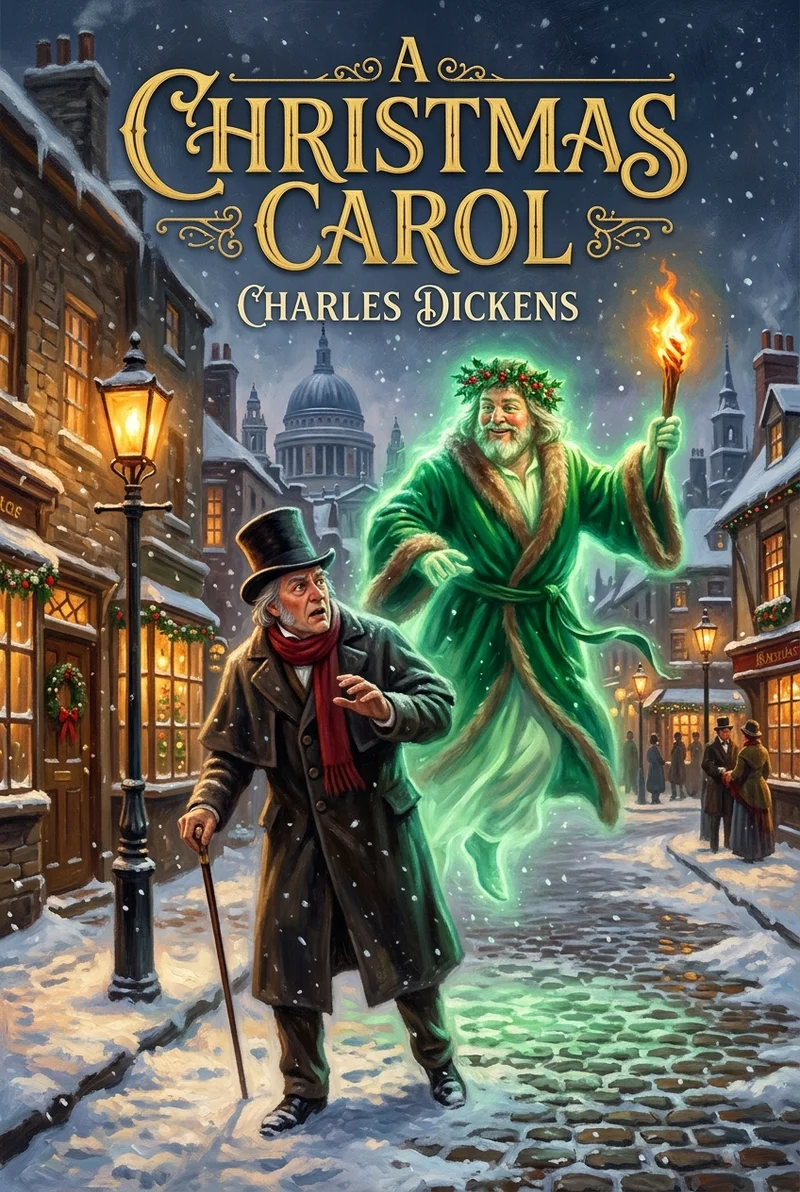
About This Book
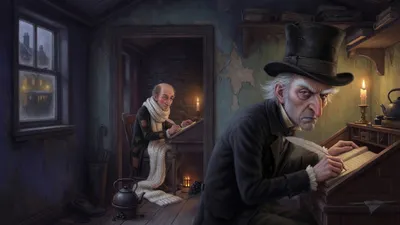
London, Christmas Eve, in the 1840s. Fog sits so thick in the courtyards that the houses opposite look like ghosts, and in a cramped counting-house an elderly moneylender named Ebenezer Scrooge is trying to finish his work while the holiday keeps interrupting him. His nephew stops by. Two gentlemen collecting for the poor stop by. His clerk asks, very carefully, about tomorrow. Scrooge wants none of it, and he will go home alone to rooms that once belonged to his dead partner, Jacob Marley — whose name is still painted over the warehouse door.
Almost every student already knows a version of this story from a film, a cartoon, or a school play, which makes the original an unusually good book to read closely: Dickens is stranger, funnier, and angrier than the adaptations usually let on. The novella is short enough to study scene by scene rather than rush, and it is a nearly perfect text for watching how a writer argues through character, weather, food, and talk instead of through speeches. Its central civic question — what do people actually owe one another — is one middle-school readers are already meeting in their own lives.
Meet the Characters

More about Ebenezer Scrooge
Ebenezer Scrooge runs a small counting-house in the City of London, where he lends money and watches every penny. He is famous in his neighborhood for being cold, impatient, and unwilling to spend anything on comfort — his own or anyone else's. As the story opens on Christmas Eve, he wants nothing more than to be left alone with his ledgers.

More about Bob Cratchit
Bob Cratchit copies letters all day in a tiny, freezing back room of Scrooge's counting-house for fifteen shillings a week. He is patient and hard to discourage, even though his wages barely stretch to feed a large family in Camden Town. On Christmas Eve he is still at his desk, trying to keep his fingers warm enough to write.

More about Jacob Marley
Jacob Marley was Scrooge's partner for many years in the firm of Scrooge and Marley, and the two men thought about business in exactly the same way. He died on Christmas Eve seven years before the story begins, and Scrooge — his sole executor and sole mourner — never painted Marley's name off the warehouse door. People new to the office still sometimes call Scrooge by his old partner's name.

More about Fred
Fred is Scrooge's only living relative, a good-natured young man who has recently married and set up a comfortable, noisy household of his own. He genuinely enjoys Christmas and refuses to be discouraged by his uncle's sour temper. Every year he shows up at the counting-house to invite Scrooge to dinner anyway.

More about Tiny Tim
Tiny Tim is the smallest of the Cratchit children and often rides on his father's shoulder. He is quiet and thoughtful for his age. His family plainly cares for him a great deal.

More about The Ghost of Christmas Past
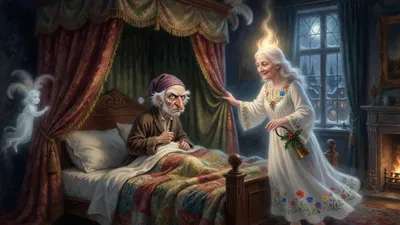
This spirit looks like a child and an old man at the same time, and it is hard to keep its outline fixed in your mind. It speaks gently but will not be put off. A jet of light shines from its head, and it carries a great extinguisher-shaped cap under its arm.

More about The Ghost of Christmas Present
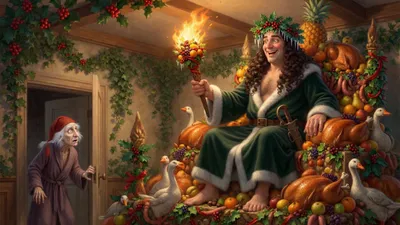
This spirit is a giant who appears surrounded by greenery and a heap of holiday food. He is generous and quick to laugh, but he says exactly what he thinks. He is interested in how ordinary people actually spend Christmas Day.

More about The Ghost of Christmas Yet to Come
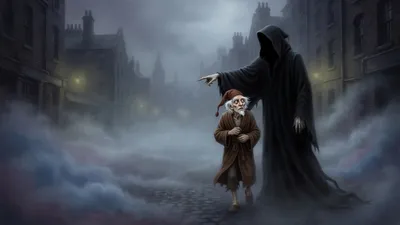
This spirit does not speak. It is draped from head to foot in a black garment that hides its face and form, and it communicates only by pointing. Standing still, it is more unsettling than a ghost that explains itself.

More about Belle
Belle is a thoughtful young woman who was engaged to Scrooge after his apprenticeship, when he was already in the prime of life and growing hard. She has little money of her own. She speaks plainly and does not pretend that a change in someone is smaller than it is.

More about Fan
Fan is Scrooge's little sister, much younger than he is, and she is the one member of his childhood household who treats him with open affection. She is slight, quick, and talkative. When she appears she has come a long way on a winter road to see him.

More about Mr. Fezziwig
Mr. Fezziwig runs a warehouse in the City and employs apprentices, including a younger Scrooge. He is plump, oily, and impossible to keep solemn. When the clock strikes the end of the working day, he is the first to call for the floor to be cleared.

More about Mrs. Cratchit
Mrs. Cratchit runs the Cratchit house in Camden Town and makes a feast out of almost nothing. She is proud, sharp-tongued when she needs to be, and fiercely protective of her children. She dresses the holiday up with ribbons because that is what she can afford.
Pre-Reading Discussion Questions
- What do you already think you know about this story, and where did that version come from — a film, a cartoon, a play, a song? Write it down now so you can compare it with the book later.
- Dickens calls the book a ghost story and divides it into 'staves,' meaning verses of a song. What would you expect from a story that is trying to be both a ghost story and a carol?
- Who is responsible for taking care of the poorest people in a society — families, charities, employers, the government, or everyone? Defend your answer.
- What does the word 'business' mean besides making money? List as many meanings as you can.
- Some narrators stay invisible; others chat with you, crack jokes, and interrupt themselves. Which do you prefer, and what can a talkative narrator give a reader that a quiet one cannot?
- Think of a holiday your family or community keeps. Which parts of it feel genuinely old, and which parts do you suspect are newer than people assume? How could you find out?
Themes & Big Ideas to Track
- Money as a measurement: notice when characters evaluate people and events by cost and profit, and when they use some other measure.
- Chains, locks, and closed doors: watch for images of things that bind, shut, or weigh people down, and notice who made them.
- Warmth and cold: fire, fog, frost, and food appear constantly, and their distribution is never accidental.
- The word 'business': several characters use it, and they do not all mean the same thing by it.
- Sight and blindness: notice how often characters are described as seeing, refusing to see, or being shown something.
- The narrator's voice: mark the places where Dickens talks straight to you instead of disappearing into the story.
Chapter-by-Chapter Study Guide
Chapter 1: Stave One: Marley's Ghost
Before you read — think about:
- A counting-house is a small office where money is lent, counted, and written down in ledgers. Picture one on a freezing December evening — what would it smell like, sound like, and feel like to sit in for ten hours?
- Dickens calls this book a ghost story and also a carol. What would you expect from a story that is trying to be both?
- Fog, cold, and dark at three in the afternoon — why might a writer spend this long on weather before anyone important walks through the door?
- A ghost story has to make you believe someone is really gone, or the ghost is no surprise. How would you prove a death in the opening of a book, using only ordinary facts?
- Some narrators stay invisible; others chat with you, crack jokes, and interrupt themselves. Which do you prefer, and what can a talkative narrator give a reader that a quiet one cannot?
Watch for these while reading:
- The narrator speaks straight to you in the opening pages — joking, arguing, doubling back. Mark two or three places where you can hear him rather than the story.
- Scrooge is described in weather words: frost, wind, ice, sleet. Notice how far Dickens pushes that comparison, and how closely the real London weather outside the window matches it.
- Dickens measures warmth in coal. Count the fires in the counting-house and note the size of each.
- Notice who comes into the counting-house on this particular afternoon, and how Scrooge speaks to each of them.
- Listen for the word 'business.' More than one character uses it in this stave, and they do not all mean the same thing by it.
Vocabulary to know:
humbug (noun) — nonsense; a cheat or a fraud — Scrooge's favorite word for anything he thinks is fake sentiment; counting-house (noun) — the office where a business keeps its accounts and handles its money; situation (noun) — a paid job or position of employment (the meaning Scrooge threatens to take away); comforter (noun) — a long knitted scarf wound around the neck for warmth; executor (noun) — the person legally responsible for carrying out a dead person's will; legatee (noun) — someone who is left money or property in a will; residuary (adjective) — receiving whatever is left of an estate after all debts and specific gifts are paid; undertaker (noun) — a person whose trade is preparing bodies and arranging funerals; solemnised (verb) — marked an occasion with a formal ceremony (used sarcastically here); unhallowed (adjective) — not holy; not treated as sacred; ironmongery (noun) — hardware made of iron, such as nails, hinges, and tools; ramparts (noun) — the defensive walls around a castle, wide enough to walk along the top; emphatically (adverb) — with strong, unmistakable force; leaving no room for doubt; covetous (adjective) — greedily wanting more, especially money or possessions; flint (noun) — a very hard grey stone that throws sparks when struck with steel; shrivelled (verb) — dried up and wrinkled from cold or age; rime (noun) — a coating of white frost; entreaty (noun) — an earnest, pleading request; gladsome (adjective) — cheerful; full of gladness; implored (verb) — begged desperately; trifle (noun) — a very small amount; something of little value; palpable (adjective) — so thick you could almost touch it; dismal (adjective) — gloomy and depressing; intimation (noun) — a hint or first sign that something is coming; ruddy (adjective) — healthily red in the face; morose (adjective) — gloomy and bad-tempered; indignantly (adverb) — in an angry way, as though insulted; veneration (noun) — deep respect, especially for something holy; impropriety (noun) — behavior that breaks the rules of what is proper; portly (adjective) — pleasantly stout or heavyset; credentials (noun) — papers proving who someone is or what they are authorized to do; liberality (noun) — generosity in giving; ominous (adjective) — threatening; suggesting that something bad is about to happen; destitute (adjective) — having no money, food, or shelter at all; workhouse (noun) — a grim public institution where the very poor were housed and made to work; treadmill (noun) — a large wheel that prisoners were forced to walk on as punishment; vigour (noun) — strength and full force of operation; surplus (noun) — an amount left over beyond what is needed; facetious (adjective) — joking, especially at a moment when joking is out of place; brazier (noun) — an open metal container for burning coals outdoors; misanthropic (adjective) — hating people; unfriendly toward everyone; pageant (noun) — a bright, showy public display; garret (noun) — a small, cheap room in the attic of a house; congenial (adjective) — agreeable; well suited to someone's nature; melancholy (adjective) — sad and gloomy; beguiled (verb) — passed the time pleasantly; chambers (noun) — a set of rented rooms used as a private residence; fain (adverb) — gladly, or of necessity willing; spectre (noun) — a ghost; a visible spirit of someone who has died; dirge (noun) — a slow, mournful song for the dead; ponderous (adjective) — extremely heavy and slow to move; irresolution (noun) — hesitation; the state of not being able to decide; waggish (adjective) — playfully joking; in the mood to make jokes; lamentation (noun) — loud crying or mourning; incoherent (adjective) — jumbled and hard to understand; worldly (adjective) — concerned with money and everyday life rather than spiritual things.
Chapter 2: Stave Two: The First of the Three Spirits
Before you read — think about:
- You have been told that something is coming at exactly one o'clock. Does knowing the precise time make waiting easier or worse? Why?
- In Dickens's time many boys left home to board at school or to sleep above a warehouse as apprentices. What would that do to a child's idea of home?
- Some faces in stories will not stay one age or one size. What would a writer have to do, in words, to make a figure feel like a child and an old man at the same moment?
- A promised hour can feel longer than an unpromised one. Besides watching a clock, what else do people do with themselves when they are waiting for something they cannot stop?
- Dickens often writes rooms by their sounds before he finishes their looks. What can you already know about a place from hearing it through a wall?
Watch for these while reading:
- This spirit's face, size, and clothing. Note every detail Dickens gives, especially at the points where the outline is hardest to hold still.
- Light is treated as a physical object in this stave — a jet of it, and a great cap carried under an arm. Notice how often Dickens returns to it.
- Keep a list of the places the spirit takes Scrooge, in the order they arrive, and note roughly how much time has passed between them.
- Track Scrooge's own speech, and what he does with his face and his hands, as the stave goes on.
- Dickens fills the past with sound — voices, music, laughter coming through a wall. Mark the sounds, not only the pictures.
Vocabulary to know:
opaque (adjective) — impossible to see through; ferret (adjective) — sharp, narrow, and peering, like the small hunting animal of that name; repeater (noun) — a pocket watch that chimes the hour when a spring is pressed; preposterous (adjective) — utterly ridiculous; contrary to all sense; tunic (noun) — a loose garment worn over the body, reaching to the knees; lustrous (adjective) — shining softly; full of light; sheen (noun) — a soft shining brightness on a surface; emblem (noun) — an object that stands for an idea or season; extinguisher (noun) — a cone-shaped cap used to snuff out a candle flame; fluctuated (verb) — kept changing back and forth; dwarfish (adjective) — unusually small in size; stature (noun) — a person's or figure's height; reverently (adverb) — with deep respect; disclaimed (verb) — denied having any part in something; wilfully (adverb) — on purpose; deliberately; reclamation (noun) — the act of rescuing or reforming someone; remonstrated (verb) — protested or argued against something; supplication (noun) — humble begging; vestige (noun) — the smallest remaining trace of something; jocund (adjective) — cheerful and light-hearted; cupola (noun) — a small dome-shaped structure on top of a roof; weather-cock (noun) — a rooster-shaped vane on a roof that shows wind direction; retentive (adjective) — holding on to something; keeping it; savour (noun) — a distinct smell or taste; deal (noun) — cheap softwood timber, usually pine or fir; forms (noun) — long backless benches used for seating in schoolrooms; latent (adjective) — present but hidden or not yet active; panelling (noun) — wooden boards covering the walls of a room; despondent (adjective) — hopeless and downcast; bridle (noun) — the straps on a horse's head used to guide it; ecstasy (noun) — overwhelming delight; laths (noun) — thin strips of wood behind a plaster wall or ceiling; veriest (adjective) — the most extreme example of something; decanter (noun) — a glass bottle for serving wine; dainties (noun) — small choice treats to eat; instalments (noun) — portions handed out a little at a time; meagre (adjective) — thin and undernourished; scanty; postboy (noun) — the driver or rider who managed a hired carriage; chaise (noun) — a light open carriage pulled by horses; hoar-frost (noun) — a white feathery frost that forms on cold surfaces; gainsay (verb) — to deny or contradict; thoroughfare (noun) — a busy main street; apprenticed (verb) — placed with an employer to learn a trade for a fixed number of years; capacious (adjective) — roomy; able to hold a lot; jovial (adjective) — warmly cheerful and full of good humor; agility (noun) — quickness and ease of movement; negus (noun) — a hot drink of sweetened, spiced wine and water; forfeits (noun) — a party game in which losing players must pay a penalty; artful (adjective) — clever and sly; porter (noun) — a dark, strong beer; comely (adjective) — pleasant and attractive in appearance; matron (noun) — a married woman, especially one with a settled household; recumbent (adjective) — lying back; half sitting up; avarice (noun) — extreme greed for money; idol (noun) — a thing worshipped as if it were a god; here, money treated as the thing that matters most; corroborated (verb) — confirmed that something was true by matching it; agitation (noun) — a state of being shaken up with strong feeling; tumultuous (adjective) — loud, chaotic, and full of noise.
Chapter 3: Stave Three: The Second of the Three Spirits
Before you read — think about:
- The first spirit dealt in memory. What could a spirit of the present possibly show a man who is already living in the present?
- What do people actually mean when they call a season or a holiday 'magic'? Is it the decorations, the food, the days off, the company — or something you cannot point at?
- A writer can make an argument by describing something instead of stating it. Why might showing work better than telling?
- Dickens read this book aloud to paying audiences more often than anything else he wrote. Take a page you have already read and try a paragraph out loud. What changes?
- Holiday meals are ordinary to the people eating them and strange to anyone standing outside the room. What details of a meal would tell you what a household can afford?
Watch for these while reading:
- Every physical detail Dickens gives this spirit, from the first appearance to the last — age, clothing, size, and the things it carries.
- The torch the spirit carries. Watch when and how it is used, not only what it looks like.
- Keep a list of every place the spirit takes Scrooge, in order, and mark which stops you did not expect.
- How Dickens writes about food, shops, and meals in this stave — the order things appear, the size of everything, who speaks while it is being carried.
- The rusted, empty scabbard at the spirit's waist is mentioned once and never explained. Decide for yourself what Dickens means by it.
Vocabulary to know:
prodigiously (adverb) — enormously; to a remarkable degree; intervention (noun) — the act of stepping in to arrange or change something; predicament (noun) — a difficult situation with no easy way out; spontaneous (adjective) — happening by itself, without an outside cause; combustion (noun) — the process of burning; petrification (noun) — something turned to stone; here, a cold and lifeless thing; brawn (noun) — a cold meat dish made from boiled and pressed pork; seething (adjective) — boiling; giving off hot steam; mantle (noun) — a loose sleeveless cloak; disdaining (verb) — refusing something as beneath one's dignity; artifice (noun) — clever trickery or artificial disguise; ample (adjective) — generously large; genial (adjective) — warm, friendly, and cheerful; unconstrained (adjective) — free and unrestricted; not held back; demeanour (noun) — the way a person carries and conducts themselves; scabbard (noun) — the sheath that holds a sword; sheath (noun) — a close-fitting cover for a blade; submissively (adverb) — in an obedient, yielding way; aught (noun) — anything at all; furrows (noun) — long narrow grooves cut into a surface; waggons (noun) — large four-wheeled vehicles for carrying goods; intricate (adjective) — complicated and hard to follow; sooty (adjective) — covered with or made of black smoke residue; parapets (noun) — low walls along the edge of a roof; poulterer (noun) — a shopkeeper who sells poultry — chickens, geese, and turkeys; fruiterer (noun) — a shopkeeper who sells fruit; apoplectic (adjective) — swollen and red, as if about to burst; opulence (noun) — rich abundance; luxurious plenty; friars (noun) — members of a religious order who traditionally wore plain brown robes; wanton (adjective) — playfully mischievous; slyness (noun) — playful craftiness; demurely (adverb) — in a modest, shy way; filberts (noun) — hazelnuts; squab (adjective) — short, plump, and squat; swarthy (adjective) — dark-colored; passionless (adjective) — without strong feeling; canisters (noun) — metal containers for tea, coffee, or spices; candied (adjective) — preserved and coated in sugar; bilious (adjective) — queasy; sick to the stomach; revellers (noun) — people celebrating and making merry; incense (noun) — a substance burned to give off a sweet-smelling smoke; threshold (noun) — the strip of floor beneath a doorway; the entrance to a house; sprinklings (noun) — small scattered drops shaken over something; twice-turned (adjective) — describing cloth that has been unpicked and resewn twice to hide the worn side; brave (adjective) — finely dressed; showy (an older meaning of the word); officious (adjective) — eagerly busy and fussing over someone; zeal (noun) — great energy and enthusiasm; declension (noun) — a sudden drop or decline; rampant (adjective) — in high, unrestrained spirits; prematurely (adverb) — earlier than intended; credulity (noun) — a readiness to believe things too easily; compounded (verb) — mixed together to make a preparation.
Chapter 4: Stave Four: The Last of the Spirits
Before you read — think about:
- Why is a character who says nothing often more unsettling than one who explains themselves? Think of an example from a film or a story you already know.
- Fear in stories comes in different kinds — a sudden jump, a slow dread, a thing you cannot look away from. Which kind stays with you longest, and why?
- In the 1840s, a British family with nothing could ask for help mainly by entering a workhouse — an institution deliberately made grim so that few would choose it. Why might a society design help to be unpleasant to accept?
- This stave is shorter than the ones before it. What can a writer do with brevity that a long scene cannot do?
- A figure that will not speak still has to be understood. Besides dialogue, what tools does a writer have for making a silent character feel dangerous?
Watch for these while reading:
- This spirit never speaks. Track how Dickens gets meaning across without dialogue — a hand, a fold of cloth, stillness, the direction it points.
- The London of this stave is a different part of the city from stave one's: narrower, dirtier, further from the shops. Note the streets, the trades, and how people stand when they talk.
- Mark each conversation's tone, and whether the speakers know they are being heard.
- Track light and warmth across this stave — candles, firelight, weather — and set it beside the stave you have just finished.
- The word 'shadows' has been in the book since stave two. Mark every time it appears in this stave, and what it is attached to — a person, a place, or a thing.
Vocabulary to know:
phantom (noun) — a ghost; a shape with no solid body; shrouded (verb) — wrapped and hidden in cloth, like a body prepared for burial; stately (adjective) — impressively tall and dignified; solemn (adjective) — serious and grave; contracted (verb) — drew together; shrank inward; thrilled (verb) — sent a sudden shiver through someone; spectral (adjective) — ghostly; waning (verb) — growing shorter or weaker; running out; encompass (verb) — to surround completely; chinked (verb) — made a light clinking sound; seals (noun) — small engraved stamps worn on a chain and used to press a mark into wax; esteem (noun) — the good opinion others hold of someone; snuff (noun) — powdered tobacco taken by sniffing; pendulous (adjective) — hanging down loosely; excrescence (noun) — an ugly growth or lump on the body; pleasantry (noun) — a joking remark; disinterested (adjective) — having nothing personally to gain; obscure (adjective) — hidden away and little known; repute (noun) — the reputation a place or person has; slipshod (adjective) — shabby and careless in appearance; cesspools (noun) — pits for collecting waste and filthy water; disgorged (verb) — poured out in a rush; reeked (verb) — gave off a strong, unpleasant smell; infamous (adjective) — famous for being wicked; beetling (adjective) — jutting out overhead; penthouse (noun) — a sloping roof built out from a wall like a lean-to; refuse (noun) — waste material; rubbish; scrutinise (verb) — to examine very closely; sepulchres (noun) — tombs or burial vaults; frouzy (adjective) — musty, stale-smelling, and untidy; tatters (noun) — torn scraps of cloth; charwoman (noun) — a woman hired by the day to clean houses; laundress (noun) — a woman paid to wash other people's clothes; flaunting (adjective) — showy and deliberately bold; defiance (noun) — open refusal to be ashamed or to obey; screw (noun) — an old slang word for a miser; judgment (noun) — a punishment believed to come from heaven; gallantry (noun) — polite attentiveness, especially toward women; plunder (noun) — goods taken by theft; appraised (verb) — judged the value of something; sixpence (noun) — a small silver coin worth half a shilling; calico (noun) — cheap plain cotton cloth; detestation (noun) — intense hatred; spoil (noun) — stolen property shared out among thieves; recoiled (verb) — jerked backward in shock or horror; uncurtained (adjective) — having no curtains or hangings; bereft (adjective) — stripped of everything; left with nothing; unwept (adjective) — not cried over by anyone; dominion (noun) — the territory over which something rules; hearthstone (noun) — the flat stone in front of a fireplace; beseech (verb) — to beg urgently; agonised (adjective) — showing intense mental pain; careworn (adjective) — showing the marks of long worry; repress (verb) — to hold a feeling down and keep it hidden.
Chapter 5: Stave Five: The End of It
Before you read — think about:
- Think of a story, a film, or a piece of music you go back to every year at the same season. What does repeating it give you that a first encounter cannot?
- Dickens wrote this book in about six weeks so that it would reach the shops before Christmas 1843. What do you think a deadline like that costs a piece of writing — and what might it give it?
- Comedy and moral seriousness are usually treated as opposites. Can a story be genuinely funny and genuinely serious about right and wrong at the same time? Name one that manages it.
- This book helped popularize a warmer, more family-centred idea of Christmas. Which of your own family's or community's traditions do you think are genuinely old, and which do you suspect are newer than people assume?
- Dickens has to bring a ghost story to a close in five short staves. What makes an ending feel earned rather than convenient?
Watch for these while reading:
- Dickens uses a great many exclamation marks and very short sentences here. Read a paragraph out loud and notice what the punctuation does to the pace.
- Compare this stave's London with stave one's — the same streets, the same church bells, the same weather vocabulary. Mark what Dickens repeats on purpose.
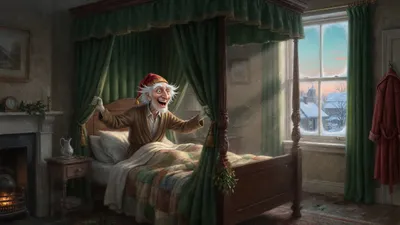
- Objects from earlier staves come back: a knocker, a bed-curtain, a corner of a room. Note each one, and note what Scrooge says to it.
- Keep count of the separate people Scrooge speaks to in this stave, and of who starts each conversation.
- The narrator, mostly quiet since the opening pages, steps forward at the very end and addresses you directly. Mark where he takes over, and consider why Dickens put it there.
Vocabulary to know:
amends (noun) — actions taken to make up for a wrong; fluttered (adjective) — flustered and trembling with excitement; dispelled (verb) — driven away and scattered; extravagance (noun) — wild, excessive behavior; giddy (adjective) — dizzy with excitement; winded (adjective) — out of breath; illustrious (adjective) — splendid and distinguished; transports (noun) — overwhelming bursts of joy; peals (noun) — loud ringing sounds from bells; loitered (verb) — hung about with nothing particular to do; shilling (noun) — a British coin worth twelve old pence; half-a-crown (noun) — a coin worth two shillings and sixpence; sealing-wax (noun) — hard wax melted to seal letters shut; recompensed (verb) — paid someone for a service; sticking-plaster (noun) — an adhesive strip used to cover a cut; pang (noun) — a sudden sharp feeling of guilt or pain; farthing (noun) — a coin worth a quarter of a penny; the smallest British coin; back-payments (noun) — amounts owed from earlier and paid late; array (noun) — an impressive arrangement or display; unanimity (noun) — complete agreement among everyone present; feign (verb) — to pretend; coal-scuttle (noun) — a metal bucket for carrying coal to a fire; bishop (noun) — a hot punch made of spiced wine and roasted oranges; malady (noun) — an illness or disease; abstinence (noun) — the practice of going entirely without something; alteration (noun) — a change in something.
About the Author
Charles Dickens (1812–1870) was the most popular English novelist of his century, and he wrote about poverty from the inside. When he was twelve his father was imprisoned for debt, and Dickens was sent to work long days pasting labels onto bottles in a shoe-polish factory — an experience he kept secret for most of his life. He began as a court and parliamentary reporter, then published fiction in monthly installments that readers followed the way people now follow a series. He was also a spectacular live performer who toured Britain and America giving dramatic readings of his own work, and A Christmas Carol was the piece he read most often.
Dickens wrote A Christmas Carol in about six weeks in the autumn of 1843, and it went on sale a few days before Christmas that year. Britain was in the middle of the Industrial Revolution: cities were growing faster than housing, sanitation, or schools could keep up, and enormous numbers of children worked instead of studying. A law passed in 1834 had reorganized poor relief around the workhouse, a deliberately grim institution meant to make asking for help a last resort — which is why talk of prisons and workhouses in the opening would have landed on Victorian readers as a specific political position, not just general grumpiness. Dickens had recently read a government report on child labor and had visited a school for destitute children in London. He originally planned to answer with a pamphlet, then decided a story would strike harder. The book sold out its first printing almost immediately and helped popularize a warmer, more family-centered idea of Christmas that much of the English-speaking world still keeps.