

About This Book
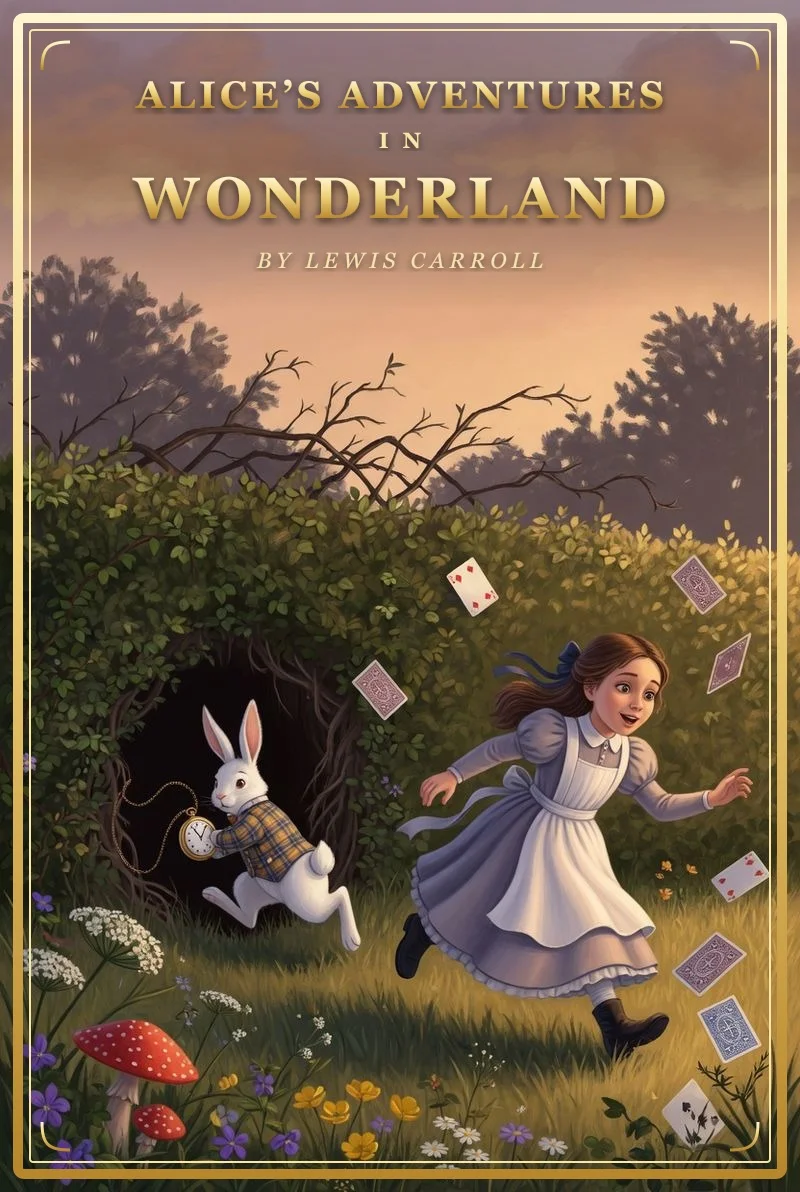
On a sleepy riverbank, a curious girl named Alice sees a white rabbit in a waistcoat checking a pocket-watch — and, because she has never seen such a thing, she gets up and follows. Lewis Carroll's story begins with that chase, and with the ordinary afternoon that suddenly is not ordinary at all.
This is a book that treats curiosity as a kind of courage. Alice is close to a fifth-grader's age, she talks to herself when she is nervous, and she keeps trying to be polite in a world that will not explain its rules. Reading her is practice in paying attention, in noticing when language is playing a trick, and in staying yourself when everything around you has gone strange — which is also why the book is still funny more than 150 years later.
Meet the Characters

More about Alice
Alice is a sensible, talkative English girl sitting beside her sister on a riverbank when the story begins. She is fond of lessons, of being right, and of asking questions. Wonderland is not a place she was looking for.

More about The White Rabbit
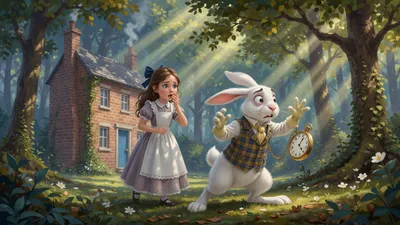
The White Rabbit is the first wonder Alice meets: a fussing, well-dressed rabbit who is late for something important. He is nervous, official, and not at all interested in explaining himself.

More about The Mouse
The Mouse is a small, easily offended creature Alice meets while she is swimming. He is formal, a little proud, and very ready to take offence if cats or dogs are mentioned.

More about The Dodo
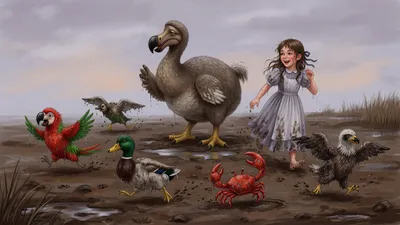
The Dodo is a large, grave bird among the creatures who gather on the bank after the swim. He speaks in long words and likes to be the one who organises things.

More about Bill the Lizard
Bill is a small lizard used as a handy-man by the White Rabbit's household. He is nervous, obedient, and not at all eager to go first.

More about The Cheshire Cat
The Cheshire Cat is a talking tabby with an enormous grin. He is calm, philosophical, and not quite as solid as other cats. Alice first meets him in a chaotic kitchen.

More about The Mad Hatter
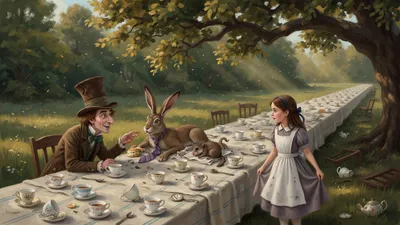
The Hatter is one of three guests at a tea-table set out under a tree. He is rude, fond of riddles, and very sure that his own remarks are the clever ones. Alice sits down uninvited.

More about The March Hare
The March Hare shares the tea-table with the Hatter and the Dormouse. He is argumentative, a little wild, and not a careful host.

More about The Dormouse
The Dormouse is the third guest at the tea-table, perpetually dropping off and being pinched awake. He is the mildest of the three.

More about The Caterpillar
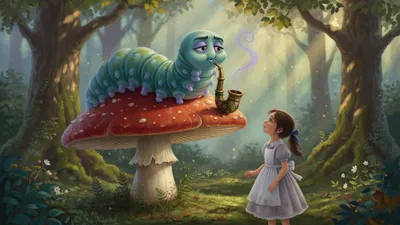
The Caterpillar sits on a mushroom and asks Alice questions in a languid, superior voice. He is not unkind, only sure that he knows more than she does.

More about The Duchess
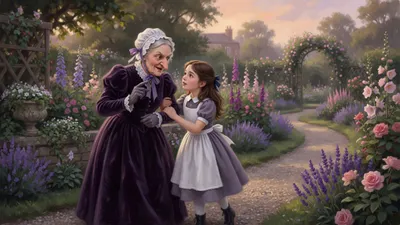
The Duchess lives in a chaotic house with a cook who loves pepper and a baby who howls. She is rude at first, then suddenly affectionate. Alice is sent to her house with an invitation.

More about The Queen of Hearts
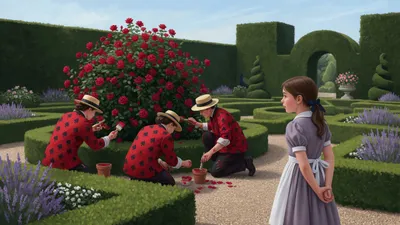
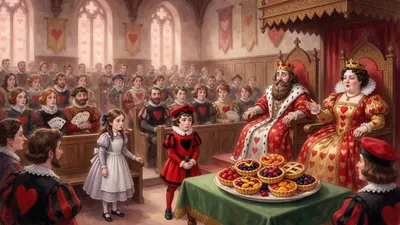
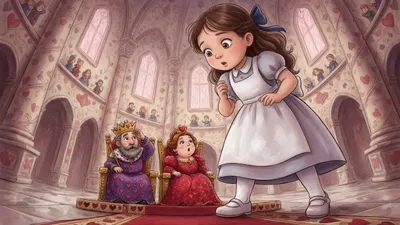
The Queen of Hearts rules a court of living playing-cards. She is loud, impatient, and used to being obeyed. Alice meets her in a garden.

More about The King of Hearts
The King of Hearts is the Queen's husband: smaller, fussier, and always trying to soften her orders. He is not the one anyone is afraid of.

More about The Knave of Hearts
The Knave of Hearts is one of the Queen's card-servants, often walking just behind her and carrying whatever she has just taken off. He is young, stiff, and trying not to be noticed.

More about The Mock Turtle
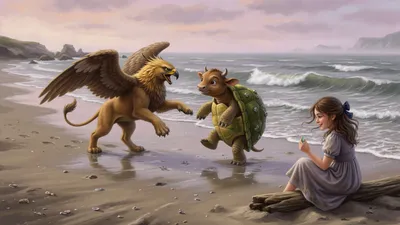
The Mock Turtle is a gloomy Wonderland creature who sits on a rock by the sea and tells Alice about his schooldays. He is fond of sad stories and of soup.

More about The Gryphon
The Gryphon is a Wonderland beast, half eagle and half lion, less tragic than the Mock Turtle and more impatient. He likes a dance as much as a sob story.
Pre-Reading Discussion Questions
- Have you ever been so bored on a quiet afternoon that you wished something — anything — would happen? What did you do with that feeling?
- What would you do if you saw an animal wearing clothes and talking, the way people do?
- How do you act when you meet someone new whose manners are nothing like yours?
- When you do not understand the rules of a game or a place, how do you figure them out?
- What does it mean to be curious, and when might curiosity be a good idea or a risky one?
- Have you ever had a dream that felt completely real while you were inside it? How did you know, later, that it was a dream?
Themes & Big Ideas to Track
- Curiosity: notice what Alice chooses to follow, and what she wants explained.
- Manners: watch how Alice tries to stay polite, and how the creatures she meets answer her.
- Language: pay attention to jokes that come from a word having two meanings at once.
- Rules: think about who makes the rules in a new place, and whether they have to make sense.
- Identity: notice the times Alice asks herself who she is, and why the question comes up.
- Nonsense: enjoy how the story mixes ordinary feelings with events that could never happen at home.
Chapter-by-Chapter Study Guide
Chapter 1: Down the Rabbit-Hole

Before you read — think about:
- Why might a person keep talking even when nobody else is there to hear?
- What makes you decide to follow a mystery instead of staying where you are comfortable?
- Why do some books spend time inside a character's thoughts, not only on what the character does?
- How can a character seem both careful and not-careful at the same time?
- What makes a long, empty afternoon feel even longer than it is?
Watch for these while reading:
- The narrator stepping in now and then to chat with the reader as if you were both looking at Alice together.
- Alice's habit of holding whole conversations with herself, including the advice she hands out.
- The schoolroom facts and grand-sounding words Alice recites to keep herself company.
- How Alice treats ordinary objects — jars, doors, and printed labels — with everyday manners.
- The White Rabbit's clothes, and the way he talks to himself as he hurries past.
Vocabulary to know:
remarkable (adjective) — unusual enough to be worth noticing; waistcoat (noun) — a short, sleeveless buttoned vest worn over a shirt; marmalade (noun) — a bitter-sweet jam made from oranges; latitude (noun) — a measurement of how far north or south a place is on the earth; longitude (noun) — a measurement of how far east or west a place is on the earth; Antipathies (noun) — Alice's mistaken word for the Antipodes, the lands on the opposite side of the earth; ignorant (adjective) — not knowing something you might be expected to know; curtsey (verb) — to bend the knees and dip politely as a greeting; earnestly (adverb) — in a serious, sincere way; alas (interjection) — a word said to show sorrow or disappointment; telescope (noun) — a tube that slides shorter or longer; Alice uses it as a picture of folding herself smaller; ventured (verb) — dared to try something that might be risky; presently (adverb) — after a short while; soon; fancy (verb) — to picture something in your mind; to imagine; croquet (noun) — an outdoor lawn game in which balls are knocked through hoops with a mallet; respectable (adjective) — proper enough to be taken seriously; currants (noun) — tiny dried grapes used to decorate cakes; anxiously (adverb) — in a worried, uneasy way; seldom (adverb) — almost never; not often; disagree (verb) — to make a person unwell, as a bad drink might; flavour (noun) — the taste of a food or drink; severely (adverb) — in a harsh, strict way; out-of-the-way (adjective) — strange and not like ordinary life; opportunity (noun) — a chance to do something; poker (noun) — a metal rod used to stir a fire; considering (verb) — thinking carefully about something before acting; practice (noun) — doing something again so you get better at it.
Chapter 2: The Pool of Tears

Before you read — think about:
- The title names a pool of tears. How might a feeling become a place in a story?
- What is hard about being in a place where the usual rules of home may not apply?
- The White Rabbit is still somewhere ahead. What do we already know about him from the way he hurries?
- Why do people look around for someone — anyone — who might be able to help?
- What can a person's voice tell you about how they feel, even before you understand the words?
Watch for these while reading:
- The way Alice scolds herself the way a grown-up would scold a child.
- Alice's memory of lessons, poems, and maps, and the tone she uses when she recites them.
- The White Rabbit's hurry, the things he is carrying, and how he answers when Alice speaks.
- The manners Alice brings with her from above ground, and the first words she offers a new listener.
- The narrator's asides about Alice's guesses, and how sure she sounds when she makes them.
Vocabulary to know:
curiouser (adjective) — Alice's made-up comparative of curious, meaning stranger and stranger; stockings (noun) — close-fitting coverings for the legs and feet; nonsense (noun) — silly talk that does not make sense; ashamed (adjective) — feeling sorry and embarrassed about something you have done; splendidly (adverb) — in a grand, richly dressed way; muttering (verb) — speaking in a low, unclear voice, often to yourself; Duchess (noun) — a noblewoman of high rank, just below a queen; savage (adjective) — fierce and likely to be very angry; timid (adjective) — shy and easily frightened; violently (adverb) — with sudden, strong force; queer (adjective) — odd or strange (Victorian sense: unusual, not a slur); ringlets (noun) — long curls of hair that hang in coils; hoarse (adjective) — rough and strained in sound, as a tired voice; poky (adjective) — small, cramped, and unimpressive; existence (noun) — the state of being alive and still here; railway (noun) — a train line; here, Alice's idea of a way home from the coast; lodging (noun) — a rented room or house to stay in, as at the seaside; inquisitively (adverb) — in a curious way, as if wanting to know more; quiver (verb) — to tremble or shake slightly; Conqueror (noun) — someone who takes a country by force; here, William the Conqueror of 1066; notion (noun) — an idea, often a vague or unsure one; soothing (adjective) — meant to calm someone down; bristling (verb) — stiffening with anger, as fur standing on end; vulgar (adjective) — low and rude; not polite or well-bred; commotion (noun) — a noisy disturbance; sorrowful (adjective) — full of sadness; passion (noun) — a burst of strong feeling, here angry feeling; signify (verb) — to matter or be important; carrier (noun) — a person or service that delivers parcels; scurried (verb) — ran with short, quick, frightened steps.
Chapter 3: A Caucus-Race and a Long Tale
Before you read — think about:
- A caucus is a political meeting; a race is a contest. What kind of event do you expect when those two words are joined?
- The title promises a long tale. What does a teller owe a listener, and what does a listener owe a teller?
- What does a person need from a gathering besides a solution to the problem that brought them together?
- What would make a race fair, and who should get to decide?
- When a group cannot agree on what to do next, who usually takes charge, and why?
Watch for these while reading:
- The Mouse's history lesson — the long names, the important tone, and who seems to be in charge of the circle.
- The Dodo's way of speaking, and how the other birds reply to it.
- How Carroll prints the Mouse's story on the page, not only what the story says.
- Alice's fondness for talking about her cat Dinah.
- The tone the animals take when they talk about races, prizes, and good manners.
Vocabulary to know:
assembled (verb) — gathered together in a group; draggled (adjective) — wet and hanging limp, as feathers after a swim; consultation (noun) — a talk held to decide what to do; familiarly (adverb) — in a friendly, informal way, as if you already know someone well; sulky (adjective) — silently bad-tempered; refusing to take part; positively (adverb) — firmly and with no doubt; authority (noun) — the right to be in charge and to be listened to; usurpation (noun) — taking power that belongs to someone else; insolence (noun) — rude, insulting boldness; patriotic (adjective) — showing love of one's country; advisable (adjective) — sensible; a wise thing to do; adjourn (verb) — to stop a meeting for now, to be continued later; energetic (adjective) — full of force and activity; remedies (noun) — cures or solutions for a problem; tittered (verb) — gave a quiet, nervous little laugh; audibly (adverb) — loudly enough to be heard; Caucus-race (noun) — the Dodo's circular race with no start or finish, used here as a silly way to get dry; comfits (noun) — small sugar-coated candies; thimble (noun) — a small hard cap worn on a finger to push a needle; gravely (adverb) — in a serious, solemn way; absurd (adjective) — so silly that it is hard to take seriously; elegant (adjective) — graceful and finely made; insult (verb) — to offend someone by what you say; despair (noun) — the feeling that there is no way out of a problem; humbly (adverb) — in a modest, apologizing way; pretexts (noun) — made-up reasons used to hide the real one; snappishly (adverb) — in a short, irritated way; melancholy (adjective) — sad in a quiet, lingering way; solemnly (adverb) — in a formal, very serious way; low-spirited (adjective) — feeling down and discouraged.
Chapter 4: The Rabbit Sends in a Little Bill
Before you read — think about:
- Why do people sometimes argue both sides of a question out loud, as if they were two people?
- Alice is alone again. What is hard about deciding what to do next when there is no one left to ask?
- The chapter's title names someone called Bill. What do you already expect a "little Bill" sent by the Rabbit might be like?
- How do stories you have already read change what you expect from a new adventure?
- Alice has wanted the garden since the hall of doors. Why do people keep a goal in mind even when they cannot yet reach it?
Watch for these while reading:
- What the White Rabbit is hunting for, and how he speaks when he notices Alice.
- How the White Rabbit speaks to Alice this time, compared with how he has spoken around her before.
- Any house, door-plate, or room Alice comes to, and how its size compares with hers.
- The different voices that talk about Bill, and what each voice seems to want.
- How large or small other creatures seem from wherever Alice is standing.
Vocabulary to know:
executed (verb) — put to death as a punishment; ferrets (noun) — small, fierce hunting animals; the Rabbit uses them in a saying that means 'as sure as sure'; good-naturedly (adverb) — in a kind, willing way; housemaid (noun) — a servant whose job is housework in someone else's home; engraved (verb) — cut as letters or a design into metal; looking-glass (noun) — a mirror; nevertheless (adverb) — even so; in spite of that; uncorked (verb) — pulled the cork out of a bottle; stoop (verb) — to bend the body forward and down; resource (noun) — a last trick or method you can try; fairy-tales (noun) — old stories of magic, which Alice used to think never happened to real people; inwards (adverb) — toward the inside; snatch (noun) — a quick grab at something; shriek (noun) — a short, high cry of fear or surprise; cucumber-frame (noun) — a low glass case used to grow cucumbers; coward (noun) — a person who will not face something frightening; rumbling (noun) — a low, rolling sound; particular (adjective) — fussy; hard to please about small details; slate (noun) — a thin sheet of rock used as a roof tile; scrambling (verb) — climbing or crawling in a hurried, awkward way; flustered (adjective) — so shaken and confused that you cannot think straight; Jack-in-the-box (noun) — a toy that springs out of a box when the lid opens; sky-rocket (noun) — a firework that shoots straight up into the air; barrowful (noun) — as much as a wheelbarrow can hold; pebbles (noun) — small, smooth stones; enormous (adjective) — extremely large; feebly (adverb) — weakly; without much strength; coaxing (adjective) — gently persuading, as you might soothe an animal; thistle (noun) — a prickly wild plant; cart-horse (noun) — a large horse used to pull carts; here, a picture of how huge the puppy seems; trampled (verb) — stepped on heavily and crushed; circumstances (noun) — the facts of the situation you are in; hookah (noun) — a long-stemmed pipe in which smoke is drawn through water; lest (conjunction) — for fear that; to avoid the chance that; messages (noun) — errands; small jobs of fetching and carrying; guinea-pigs (noun) — small household rodents; here, two of them hold Bill up after his fall.
Chapter 5: Advice from a Caterpillar
Before you read — think about:
- What do you expect advice from a caterpillar to sound like, and why?
- The Caterpillar has been sitting still, smoking, taking no notice of Alice. What does that manner already tell you before it speaks?
- How do you listen to someone who is not in a hurry when you yourself are?
- Alice has already wondered whether she might be Ada or Mabel. What would it take to convince you that you were still yourself?
- What is the difference between a rule, a hint, and a piece of advice?
Watch for these while reading:
- The Caterpillar's short answers, and the long pauses between them.
- The words Alice uses for change, size, and self, and whether the Caterpillar seems to share them.
- Alice's schoolroom recitations, if they appear again, and the voice she uses for them.
- What the Caterpillar says as it leaves the mushroom.
- The wood around the mushroom, and any other creature who shares it with Alice and the Caterpillar.
Vocabulary to know:
languid (adjective) — slow, droopy, and without energy; sternly (adverb) — in a strict, unsmiling way; chrysalis (noun) — the hard case a caterpillar makes before it becomes a butterfly; contemptuously (adverb) — in a scornful way, as if the other person is not worth much; irritated (adjective) — annoyed and on edge; incessantly (adverb) — without stopping; injure (verb) — to harm or damage; uncommonly (adverb) — unusually; more than is ordinary; back-somersault (noun) — a backward flip through the air; sage (noun) — a wise old person; supple (adjective) — bending easily; not stiff; ointment (noun) — a thick medicine you rub on the skin; shilling (noun) — an old British coin, worth twelve pence; suet (noun) — hard fat used in cooking, here as a picture of very soft food; muscular (adjective) — having strong muscles; airs (noun) — a show-off manner; acting as if you are more important than you are; contradicted (verb) — said the opposite of what someone else just said; wretched (adjective) — very poor or miserable; here, a pitiful height to be; rearing (verb) — rising up on the hind part of the body; piteous (adjective) — sounding so sad that it asks for pity; morsel (noun) — a tiny bite of food; serpent (noun) — a snake; the name the Pigeon gives Alice; zigzag (noun) — a line that turns sharply left and right again and again; indignantly (adverb) — in an angry way because you feel you have been treated unfairly; subdued (adjective) — quieter and less fierce than before; hatching (verb) — keeping eggs warm until the young birds come out; wriggling (verb) — twisting and turning the body like a worm or snake; crouched (verb) — bent down close to the ground; entangled (verb) — caught and twisted up in something; wits (noun) — your mind and good sense; to frighten someone 'out of their wits' is to terrify them.
Chapter 6: Pig and Pepper
Before you read — think about:
- The last chapter ended at a little house about four feet high. What do you expect from a house that small?
- The title names pepper. What can a strong smell in a closed room do to the people inside?
- Why do some households have so many servants, and what are those servants actually for?
- What does a grin usually mean, and can it mean more than one thing?
- The title is "Pig and Pepper." What two kinds of scene could those words belong to — a kitchen, a farmyard, or something else?
Watch for these while reading:
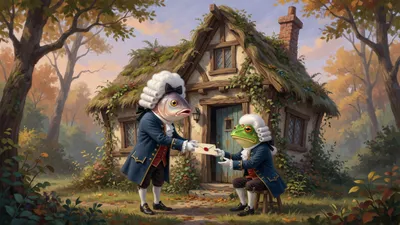
- The two footmen's livery, their powdered hair, and the way they handle the Queen's invitation.
- The pepper in the air, the sneezing, and who in the kitchen is not affected.
- The Duchess's tone when she talks to Alice and when she talks to the baby.
- The Cheshire Cat's grin, and how Alice tries to talk with it.
- The Cat's talk of other residents of Wonderland, and the look of any house Alice comes in sight of.
Vocabulary to know:
footman (noun) — a male servant in uniform who opens doors and carries messages; livery (noun) — a servant's official uniform; knuckles (noun) — the joints of the fingers, used here to rap on a door; powdered (adjective) — dusted with white powder, as fashionable servants' hair once was; invitation (noun) — a written request to come to an event; extraordinary (adjective) — very unusual; beyond what is ordinary; uncivil (adjective) — rude; not polite; skimming (verb) — flying fast and low, barely touching; grazed (verb) — brushed against lightly; variations (noun) — slightly different versions of the same remark; cauldron (noun) — a large, deep cooking pot; alternately (adverb) — first one, then the other, taking turns; hearth (noun) — the floor of a fireplace; grinning (verb) — smiling widely, often showing teeth; fire-irons (noun) — the metal tools kept by a fireplace, such as a poker and tongs; saucepans (noun) — deep cooking pans with handles; agony (noun) — extreme pain or distress; axis (noun) — the imaginary line the earth turns around; abide (verb) — to put up with; to stand; lullaby (noun) — a song meant to soothe a baby to sleep; thoroughly (adverb) — completely; all the way through; flinging (verb) — throwing with force; star-fish (noun) — a sea animal with five arms; Alice's picture of the baby's shape; snorting (verb) — forcing breath out through the nose in loud puffs; steam-engine (noun) — a machine driven by steam; here, a picture of the baby's loud puffing; snout (noun) — the long nose and mouth of a pig; relieved (adjective) — feeling glad that a worry has lifted; handsome (adjective) — good-looking, in a pleasing way; bough (noun) — a large branch of a tree; vanished (verb) — disappeared from sight; giddy (adjective) — dizzy, as if the world is spinning; thatched (verb) — covered with a roof of straw — or, here, of fur; raving (adjective) — wildly out of control; wildly mad; grant (verb) — to admit that a statement is true; therefore (adverb) — for that reason; as a result.
Chapter 7: A Mad Tea-Party
Before you read — think about:
- The title is A Mad Tea-Party. What do you already picture when you hear the word tea-party, and what might "mad" change about that picture?
- What rules of taking turns in a conversation do you use at home or at school?
- The Cheshire Cat told Alice that everybody here is mad. What does that word mean to you, and is it always unkind?
- Carroll has already twisted poems and phrases you know. Why do writers play with words that have more than one meaning?
- Alice has been looking for the garden since the hall of doors. Why do people keep a goal in mind even on a day that keeps going sideways?
Watch for these while reading:
- How Alice tries to keep ordinary manners at a table she did not set.
- Carroll's habit of taking a familiar English phrase and treating it as a strict rule.
- Who is listened to at the table, who is interrupted, and who is talked over.
- Songs and verses that sound almost like ones you already know.
- The Hatter's watch, and what it does and does not tell.
Vocabulary to know:
dormouse (noun) — a small, sleepy rodent, here treated as a guest at the table; writing-desk (noun) — a small desk made for writing; riddles (noun) — puzzling questions asked for fun, sometimes with no real answer; uneasily (adverb) — in a worried, restless way; meekly (adverb) — in a quiet, gentle, slightly timid way; gloomily (adverb) — in a sad, heavy, hopeless way; readily (adverb) — quickly and willingly; cautiously (adverb) — carefully, so as to avoid trouble; quarrelled (verb) — argued angrily and broke off friendly terms; concert (noun) — a public performance of music; tea-tray (noun) — a flat board used for carrying teacups and a teapot; bawled (verb) — shouted in a loud, harsh voice; mournful (adjective) — full of sadness; proposal (noun) — a suggested plan; treacle (noun) — a thick, sticky, sweet syrup; triumphantly (adverb) — in a proud, winning way, as if scoring a point; unwillingly (adverb) — not wanting to; reluctantly; consented (verb) — agreed to do something after first resisting; muchness (noun) — Carroll's playful word for a great amount, or for things being much the same; rudeness (noun) — impolite, unkind behavior; disgust (noun) — a strong feeling of dislike and offense; wearily (adverb) — in a tired, worn-out way; grumbled (verb) — complained in a low, unhappy voice; personal (adjective) — aimed at someone's private looks or habits in a pointed way; daresay (verb) — suppose or guess; an old-fashioned way of saying "I would guess"; twinkling (noun) — a tiny instant; the time a star takes to flash; tea-things (noun) — cups, plates, and other dishes used for tea; slightest (adjective) — the very smallest amount; puzzled (adjective) — confused and unable to work something out; manner (noun) — a kind or sort; here, every kind of thing.
Chapter 8: The Queen's Croquet-Ground
Before you read — think about:
- The title names a Queen and a croquet-ground. What do you already know about how people are supposed to behave around a queen?
- What do you already know about croquet — balls, mallets, hoops — and who usually makes the rules?
- Alice has finally reached the garden. What do people hope a garden will feel like after a long time of not being allowed in?
- The last chapter ended among bright flower-beds and cool fountains. What do you expect to find in a garden that belongs to a queen?
- When you join a game you have never played before, what do you watch first — the equipment, the other players, or the person in charge?
Watch for these while reading:
- How Carroll stages a royal procession — the order of the people, and the details on their clothes.
- The Queen's favorite command — you heard it in the Hatter's story — and how often it is spoken here.
- How Alice answers when someone royal speaks to her, compared with how the gardeners answer.
- How a game is supposed to work, versus how this one is actually played.
- The Cheshire Cat's way of arriving a piece at a time, a habit you have already seen in reverse.
Vocabulary to know:
beheaded (verb) — having one's head cut off as a punishment; unjust (adjective) — unfair; not right or deserved; oblong (adjective) — longer than it is wide, with roughly rectangular sides; courtiers (noun) — people who attend a king or queen at court; ornamented (adjective) — decorated; covered with fancy designs; recognised (verb) — knew again; spotted someone familiar; knave (noun) — the jack in a pack of cards; a court-card servant; crimson (adjective) — a deep, rich red; velvet (noun) — a soft, thick, luxurious cloth; procession (noun) — a line of people moving forward in a formal parade; majesty (noun) — a title of respect for a king or queen; fury (noun) — wild, raging anger; glaring (verb) — staring in an angry, fierce way; decidedly (adverb) — in a firm, definite way; shrill (adjective) — high, sharp, and piercing in sound; unfortunate (adjective) — unlucky; about to suffer something bad; evidently (adverb) — clearly; as the facts show; ridges (noun) — raised strips of ground; furrows (noun) — narrow grooves or trenches in the ground; hedgehogs (noun) — small spiny animals, here used as croquet balls; mallets (noun) — long-handled hammers used to hit croquet balls; flamingoes (noun) — long-necked pink wading birds, here used as croquet mallets; arches (noun) — the hoop-shaped goals in croquet, here made of doubled-up soldiers; provoking (adjective) — annoying; enough to make a person lose patience; dispute (noun) — an argument or quarrel; impertinent (adjective) — rude in a bold, cheeky way toward someone in authority; executioner (noun) — the official whose job is to carry out a death sentence; appealed (verb) — asked someone to settle an argument; deserved (verb) — had earned a punishment or reward by what one did; chanced (verb) — happened by luck or accident; protection (noun) — safety provided by someone who stands between you and danger; flower-pot (noun) — a pot that holds a plant.
Chapter 9: The Mock Turtle's Story
Before you read — think about:
- The title names a Mock Turtle. What do you already picture when you hear turtle, and what does the extra word mock make you wonder?
- Alice has already met the Duchess in a peppery kitchen. What do you already know about her temper, and what don't you know yet?
- How can you tell whether a speaker is proud, sad, or only pretending, from the way they tell a story?
- When someone says they will tell you their history, what kind of facts do you expect to hear first?
- What is the difference between a story that explains how someone got their name and a story that explains how they feel?
Watch for these while reading:
- How a character who frightened Alice in an earlier kitchen scene speaks to her now.
- Carroll's taste for explanations that sound like lessons.
- The Duchess's voice and her favorite word, compared with how she spoke in the kitchen.
- Alice's manners when a speaker goes on and on.
- How two creatures share a story, interrupting and backing each other up.
Vocabulary to know:
affectionately (adverb) — in a warm, loving, friendly way; camomile (noun) — a bitter herb often brewed as tea; barley-sugar (noun) — a hard, sweet candy made from barley; stingy (adjective) — unwilling to share or give; moral (noun) — the lesson a person claims a story or remark is supposed to teach; mustard (noun) — a hot, sharp yellow paste used as a condiment; mineral (noun) — a natural non-living substance from the earth, such as a rock or salt; experiment (noun) — a trial done to find out what will happen; doubtful (adjective) — not sure; uncertain; thunderstorm (noun) — a storm with thunder and lightning; here, a comparison for an angry face; custody (noun) — being held under guard as a prisoner; pardoned (verb) — officially forgiven and set free from a punishment; gryphon (noun) — a mythical creature with an eagle's head and wings and a lion's body; chuckled (verb) — laughed quietly to oneself; mock (adjective) — imitation or pretend; here, a turtle named after a soup made without real turtle; favourite (adjective) — liked more than the others; preferred; absence (noun) — the state of being away; vinegar (noun) — a sour liquid used in cooking and pickling; bore (verb) — put up with something unpleasant; ledge (noun) — a narrow shelf of rock; hollow (adjective) — deep and empty-sounding; simpleton (noun) — a person treated as foolish or slow to understand; Uglification (noun) — Carroll's made-up school subject, a joke opposite of making things prettier; Seaography (noun) — Carroll's sea-school version of geography; Drawling (noun) — Carroll's sea-school version of drawing, taught by a conger-eel; Reeling (noun) — Carroll's sea-school version of reading; Writhing (noun) — Carroll's sea-school version of writing; Derision (noun) — mockery; here, a joke name for a branch of arithmetic; Distraction (noun) — something that pulls your mind away; here, a joke name for a branch of arithmetic; Ambition (noun) — a strong wish to succeed; here, a joke name for a branch of arithmetic; Tortoise (noun) — a land turtle; here, a nickname given because the teacher "taught us"; conger-eel (noun) — a large sea eel; flappers (noun) — flipper-like limbs, used here like fingers for counting; coils (noun) — loops or spirals; here, part of a joke art lesson called Fainting in Coils.
Chapter 10: The Lobster Quadrille
Before you read — think about:
- The title names a quadrille. What do you already know about dances that have figures, partners, and steps you have to remember?
- The last chapter ended with a request for games. What do you expect a sea-creature's game to look like?
- Carroll has already made Alice recite poems that came out wrong. Why do writers put well-known verses into a story and then change them?
- Why do similar-sounding words make people laugh — or groan?
- Who usually sings during a dance, and what kind of voice would fit a dance with the word lobster in its name?
Watch for these while reading:
- How the Gryphon and the Mock Turtle share the job of explaining.
- Sea creatures spoken of as if they paid visits and wore shoes.
- Carroll's puns built on words that sound almost alike.
- Schoolroom verses you may already know, and the rhythm underneath them.
- The Mock Turtle's voice when he sings, compared with his speaking voice.
Vocabulary to know:
lobster (noun) — a sea creature with a hard shell and claws, here used as a dance partner; quadrille (noun) — a lively dance for several couples, performed in figures or sets; jelly-fish (noun) — a soft sea animal, here treated as something to clear off a dance floor; advance (verb) — to step forward, especially as a figure in a dance; retire (verb) — to step back to your place, especially as a figure in a dance; capering (verb) — leaping and dancing about in a lively way; treading (verb) — stepping on something, often by accident; forepaws (noun) — the front feet of an animal; whiting (noun) — a small sea fish; also, in a pun, a white powder used to clean shoes; porpoise (noun) — a small sea mammal related to the dolphin; here also a pun on "purpose"; purpose (noun) — a reason for doing something; an aim; shingle (noun) — a beach covered with small worn stones; askance (adverb) — sideways, with doubt or distrust; scaly (adjective) — covered with scales, like a fish; beloved (adjective) — dearly loved; blacking (noun) — a black paste used to shine shoes; soles (noun) — the bottoms of shoes, and also a kind of flatfish — Carroll uses both meanings at once; eels (noun) — long, snake-shaped fish; here also a pun on "heels"; shrimp (noun) — a small sea creature; here, even a shrimp is said to know the joke; obliged (adjective) — forced by duty or necessity to do something; sluggard (noun) — a lazy person; the title character of an old moral poem Alice is told to recite; tureen (noun) — a deep, covered dish for serving soup; dainties (noun) — choice, delicious foods; pennyworth (noun) — as much as one penny will buy; faintly (adverb) — weakly; in a way that is hard to hear; uncommon (adjective) — unusual; not of the ordinary kind; persisted (verb) — kept on asking or doing something instead of giving up; disobey (verb) — to refuse to do what you are told; tremulous (adjective) — shaking slightly from fear or weakness; boon (noun) — a favor or gift, often granted as a kindness; banquet (noun) — a large, formal feast; explanations (noun) — statements that try to make something clear.
Chapter 11: Who Stole the Tarts?
Before you read — think about:
- What do you already know about how a court works — judge, jury, witnesses, evidence?
- Why does a court need rules, and who makes sure they are followed?
- How would you feel if you had to speak in front of a room full of people?
- What is the difference between knowing something and being able to prove it?
- The title asks who stole the tarts. What do you already know about that nursery rhyme, and what does a rhyme not tell you?
Watch for these while reading:
- How Alice uses words she has only met in books.
- What the creatures in the jury write down, and why.
- The King's idea of how quickly a trial should move.
- How earlier characters look and behave when they appear in this formal room.
- Where Alice is standing or sitting, and how much of the court she can see.
Vocabulary to know:
parchment (noun) — a stiff sheet made from animal skin, used for important writing; tarts (noun) — small open pastry pies, often filled with fruit or jam; refreshments (noun) — food and drink served to guests; justice (noun) — fair treatment under the law; a court of justice is a courtroom; wig (noun) — false hair worn by a judge as part of the official costume; becoming (adjective) — attractive or suitable in appearance; spectacles (noun) — eyeglasses; muddle (noun) — a confused mess; herald (noun) — an official who makes announcements at court; accusation (noun) — a formal statement that someone has committed a crime; verdict (noun) — the jury's decision about whether someone is guilty; witness (noun) — a person called to tell a court what they know; memorandum (noun) — a short written note made to remember a fact; fidgeted (verb) — moved restlessly from nervousness; evidence (noun) — information given in court to support a claim; reasonable (adjective) — fair and sensible; not extreme; ridiculous (adjective) — so silly that it is hard to take seriously; suppressed (verb) — stopped or put down by force; here, stuffed into a bag; canvas (noun) — a strong, rough cloth; applause (noun) — clapping to show approval; cross-examine (verb) — to question a witness closely, often to test their story; undertone (noun) — a voice kept low so that not everyone will hear; fumbled (verb) — handled something in a clumsy, uncertain way; dunce (noun) — a person treated as slow or foolish; chains (noun) — metal links used to hold a prisoner; trumpet (noun) — a brass horn used here to call the court to attention; scroll (noun) — a roll of writing, often official.
Chapter 12: Alice's Evidence
Before you read — think about:
- The title is Alice's Evidence. What do you already know about what a witness is supposed to do in a court?
- What does a person owe a court that has just called their name — the truth, politeness, or something else?
- What makes a piece of writing count as evidence?
- The Knave of Hearts is the prisoner. What do you already know about him from the procession and the accusation, and what do you still not know?
- Fairness, courage, and good manners have all been tested underground. Which of those matters most in a courtroom, and why?
Watch for these while reading:
- How Alice speaks now compared with her first timid answers underground.
- The King's notebook, and when he chooses to read from it.
- Any paper brought in as evidence, and how people in the court talk about it.
- How the King and Queen each think a trial should be run.
- How the courtroom sounds — the voices, the silences, and who is allowed to break them.
Vocabulary to know:
flurry (noun) — a sudden rush of confused activity; sprawling (verb) — lying spread out in an ungainly way; dismay (noun) — a feeling of shock and distress; vague (adjective) — not clear or definite; emphasis (noun) — special force put on a word to make it stand out; signifies (verb) — matters; means something important; diligently (adverb) — with careful, steady effort; gazing (verb) — looking steadily for a long time; respectful (adjective) — showing polite regard for someone in authority; invented (verb) — made up; created on the spot; prisoner (noun) — a person held and accused of a crime; verses (noun) — lines of poetry; handwriting (noun) — the way a particular person forms letters on a page; imitated (verb) — copied someone else's way of doing something; mischief (noun) — trouble or harm done on purpose; guilt (noun) — the state of having done something wrong; sixpence (noun) — an old British coin worth six pennies; atom (noun) — the tiniest bit; here, not even a speck of meaning; cardboard (noun) — stiff paper board; here, what the Knave is actually made of; inkstand (noun) — a desk container that holds ink; trickling (verb) — flowing in a thin, slow stream; pun (noun) — a joke that plays on two meanings of the same word; fluttered (verb) — moved with light, quick, irregular motions; rustled (verb) — made a soft, dry, whispering sound; clasped (verb) — held tightly together; reality (noun) — the ordinary waking world, as opposed to a dream; rippling (verb) — moving in small, shifting waves; reeds (noun) — tall, hollow-stemmed water plants; tinkling (verb) — making light, ringing sounds; clamour (noun) — a loud, confused mixture of voices and noises; lowing (noun) — the deep calling sound made by cattle; after-time (noun) — the years still to come; the future of a person's life; riper (adjective) — more mature; further on in life; gold-fish (noun) — small orange aquarium fish.
About the Author
Lewis Carroll was the pen name of Charles Lutwidge Dodgson, an English mathematician and photographer who taught at Oxford. He loved word games, puzzles, and telling stories to children. He first invented Alice's adventure one summer afternoon while rowing on the Thames with the three Liddell sisters; Alice Liddell asked him to write it down, and the book that followed became one of the most lasting children's stories in English.
The story was published in England in 1865, in the Victorian era, when many books for children were written mainly to teach manners and morals. Alice's Adventures in Wonderland was different: it was written to be playful, full of nonsense, riddles, and jokes about schoolroom learning. It helped open the door to children's books that were allowed to be fun first.