


About This Book
Matthew and Marilla Cuthbert keep a quiet farm called Green Gables on Prince Edward Island, and they send for a child to help with the work. The child who arrives is not the helper they pictured: a talkative, red-haired orphan named Anne Shirley. The first pages leave one question hanging — will Green Gables take her in?
Anne of Green Gables still matters because it takes a child's inner life seriously. Anne notices more than the grown-ups think is practical, and Montgomery writes that noticing in a voice that is funny and exact. It remains one of the great portraits of a mind that will not stay quiet.
Meet the Characters

More about Mrs. Barry
Mrs. Barry lives with her family at Orchard Slope, the farm nearest Green Gables. She is a tall, black-haired woman with a very resolute mouth, known in Avonlea for being strict with her children. As the story opens she is simply a neighbor in the same small community as the Cuthberts.

More about Anne Shirley
Anne Shirley is a talkative, big-hearted orphan with a runaway imagination and a gift for turning ordinary things into wonders. She feels everything deeply, talks in floods, and has never had a place she could call her own. As the story opens she is still being moved from household to household, hoping the next door might be home.

More about Marilla Cuthbert
Marilla Cuthbert keeps house at Green Gables with her brother and believes in hard work, tidy rooms, and keeping one's feelings to oneself. She can seem stern and unsmiling, but she has a fair mind and a quietly good heart. As the story opens she is a settled woman who has never planned on sharing her kitchen with a child.

More about Matthew Cuthbert
Matthew Cuthbert is a bashful, kindhearted farmer who dreads talking to strangers and would rather work quietly in his fields than say a word in company. He is loyal, patient, and tender in a way he finds hard to put into words. As the story opens he lives a slow, orderly life with his sister at Green Gables.

More about Diana Barry
Diana Barry is a friendly, good-natured girl who lives with her family on a nearby farm. She is cheerful, fond of play, and easy company. She belongs to the settled neighbor-world around Green Gables.

More about Gilbert Blythe
Gilbert Blythe is a clever, self-assured boy from the Avonlea neighborhood, used to being liked and fond of a joke. He is a little older than Anne, easy in company, and sure of himself. He lives in the same small community as the Cuthberts.

More about Mrs. Rachel Lynde
Mrs. Rachel Lynde lives just where the Avonlea road dips into the hollow, and from her kitchen window she can see nearly everyone who comes or goes. She is a notable housewife who finishes her own work and still has time to keep a sharp eye on her neighbors. She speaks her mind plainly, knits cotton-warp quilts as she watches the road, and believes other people's business is worth knowing well.

More about Mrs. Allan
Mrs. Allan is the young wife of Avonlea's new minister, recently arrived in the parish. She is naturally kind, interested in people, and easy to talk to. Anne meets her as a welcome new face in the neighborhood.

More about Miss Stacy
Miss Stacy is a bright, sympathetic young woman who has just come to teach at the Avonlea school. She has a ladylike manner and a sweet voice, and she has the gift of winning her pupils' trust. She is new to the community when Anne first meets her.

More about Mr. Phillips
Mr. Phillips is the current master of the Avonlea school when Anne first takes her seat there. He spends a good deal of time curling his mustache and sitting with the older scholars at the back of the room, and he is given to sudden fits of sternness between long stretches of neglect. Anne meets him as the teacher of her new classroom, not yet a judge of whether he is a good one.

More about Josie Pye
Josie Pye is an Avonlea schoolgirl already settled in Anne's class when Anne first arrives. She likes to come out first, peeps in her book if she thinks no one is looking, and has a malicious little smile ready when someone else is in trouble.
Pre-Reading Discussion Questions
- What does the word "home" mean to you, and what would make a place feel like home?
- Have you ever been judged by a first impression before people got to know you? How did it feel?
- What is it like to arrive somewhere new where everyone else already belongs?
- How do grown-ups and children sometimes disagree about what a household is for?
- When you look at a new landscape, what do you notice first — the land, the houses, or the people?
- How do you decide whether to speak up or stay silent when you are among people you have just met?
Themes & Big Ideas to Track
- How the narrator treats ordinary island places as if they were worth naming and looking at twice.
- The difference between what people in Avonlea say out loud and what they leave unsaid.
- How a talkative person and a quiet person share a room — who fills the silence, and who does not.
- The way a small community notices, and comments on, its neighbors.
- What "practical" and "fanciful" sound like in everyday talk about chores, clothes, and meals.
- How names, labels, and first looks attach to a person before anyone has heard their story.
Chapter-by-Chapter Study Guide
Chapter 1: Mrs. Rachel Lynde Is Surprised

Before you read — think about:
- What are the advantages and the drawbacks of living somewhere everyone knows everyone else's business?
- How can a narrator make you smile at a character without asking you to dislike them?
- How do you form an opinion about a person you have never met?
- What can the way a house sits in a landscape suggest about the people who live in it?
- How did news travel in a country village a hundred years ago, with no telephones and no internet?
Watch for these while reading:
- The narrator's amused tone whenever Mrs. Rachel Lynde's curiosity is described.
- How the brook behaves back in the woods compared with how it behaves once it passes Mrs. Rachel's door.
- The way Green Gables sits apart from the other Avonlea houses.
- Matthew Cuthbert's manner around people, and how few words he uses.
- Marilla's way of answering a question she would rather not be asked.
Vocabulary to know:
intricate (adjective) — Very complicated, detailed, or winding.; decorum (noun) — Proper, polite, and respectable behavior.; ferreted (verb) — Searched out and discovered through persistence.; notable (adjective) — Remarkably capable and efficient, especially at running a household.; wont (adjective) — Accustomed or inclined to do something.; gauntlet (noun) — A difficult or hostile passage where one is exposed to scrutiny or danger.; myriad (noun) — An extremely large, nearly endless number of things.; placidly (adverb) — Calmly, quietly, and without showing worry or excitement.; betokened (verb) — Gave a sign, warning, or indication of something.; deftly (adverb) — In a quick, skillful, and clever manner.; scant (adjective) — Barely enough, or just short of a full amount.; patriarchal (adjective) — Grand, ancient, or imposing, resembling a dignified family leader.; prim (adjective) — Stiffly neat, proper, and formal.; proverbial (adjective) — Well-known because of a familiar saying or idiom.; bidden (verb) — Invited, requested, or ordered to enter or act.; dissimilarity (noun) — A difference or lack of resemblance between people or things.; aggressively (adverb) — In a bold, forceful, or sharp manner.; rigid (adjective) — Strict, firm, or unwilling to bend or change.; indicative (adjective) — Serving as a sign or suggestion of a particular quality or condition.; unaccountably (adverb) — In a way that cannot be explained or understood; mysteriously.; innovation (noun) — A new idea, method, or change introduced into a routine.; perforce (adverb) — Unavoidably or out of necessity.; spry (adjective) — Active, lively, and nimble, especially when referring to an older person.; irresponsible (adjective) — Too light or careless for a serious situation.; disposition (noun) — A person's natural mood, attitude, or general character.; qualms (noun) — Uneasy feelings of doubt, worry, or hesitation.; pessimism (noun) — A tendency to expect the worst possible outcome in any situation.; uncanny (adjective) — Strange, mysterious, or unsettlingly unnatural.; profound (adjective) — Very deep, intense, or significant..
Chapter 2: Matthew Cuthbert Is Surprised

Before you read — think about:
- What do you notice first about a place you are seeing for the very first time?
- What do you already know about Prince Edward Island, if anything, and where did you learn it?
- What is the longest journey you have made, and how did you pass the time?
- How do you get to know a quiet person?
- What season of the year do you like best, and what does it look like where you live?
Watch for these while reading:
- How much Matthew says out loud compared with how much he thinks.
- The child's way of talking — how long the sentences run and how quickly the subject changes.
- The names given to places along the road, and what kind of names they are.
- The apple trees, the shore road, and the other Avonlea scenery Montgomery lingers over.
- Matthew's manner as the drive goes on.
Vocabulary to know:
sorrel (adjective) — Having a reddish-brown color, especially describing a horse's coat.; farmsteads (noun) — Farms along with their houses, barns, and surrounding buildings.; balsamy (adjective) — Having a sweet, pine-like fragrance characteristic of balsam fir trees.; filmy (adjective) — Thin, delicate, and light enough to see through partially.; sundry (adjective) — Various or miscellaneous; made up of several different kinds.; personage (noun) — An individual or character, especially one with a notable appearance.; ungainly (adjective) — Awkward, clumsy, or lacking grace.; sidled (verb) — Walked or moved sideways in a cautious, shy, or subtle manner.; main (noun) — Full physical strength, power, or exertion.; preparatory (adjective) — Serving to prepare or get ready for an upcoming event.; scope (noun) — Opportunity, freedom, or room for thought, action, or imagination.; gravely (adverb) — In a serious, quiet, and solemn manner.; asylum (noun) — An old-fashioned term for a residential institution providing care to vulnerable people, such as orphans.; jauntily (adverb) — In an easy, lively, confident, and cheerful manner.; bearding (verb) — Boldly confronting or standing up to an intimidating person or situation.; garbed (verb) — Dressed or clothed in a particular kind of clothing.; wincey (noun) — A strong, coarse fabric woven from a mixture of wool and cotton.; vivacity (noun) — High spirits, liveliness, and energetic charm.; expressive (adjective) — Effectively showing feelings, thoughts, or meaning.; discerning (adjective) — Showing good judgment and the ability to notice subtle details.; commonplace (adjective) — Ordinary, unremarkable, or dull.; ludicrously (adverb) — In an absurd, foolish, or laughably unreasonable way.; ordeal (noun) — A very difficult, painful, or severe experience.; shabby (adjective) — Worn out, faded, or in poor condition from long use.; carpet-bag (noun) — A heavy traveling bag constructed from thick rug material.; scrawny (adjective) — Uncomfortably thin, small, and bony.; deferred (verb) — Put off or delayed until a later time.; knack (noun) — A special skill, trick, or natural talent for doing something easily.; missionary (noun) — A person sent to a distant place to do charitable, educational, or religious work.; bliss (noun) — Supreme happiness, great joy, or perfect contentment.; prowling (verb) — Moving around restlessly, curiously, or secretively.; detested (verb) — Disliked or hated intensely.; tresses (noun) — Long locks, strands, or braids of a person's hair.; resignedly (adverb) — In a manner showing quiet acceptance of an unwanted outcome.; alabaster (adjective) — Smooth, pale white, and clear, like the fine stone alabaster.; ingenuously (adverb) — In an innocent, open, and candidly honest way.; eccentric (adjective) — Unconventional, unusual, or slightly strange in behavior or style.; canopy (noun) — A high, roof-like covering formed overhead by trees, cloth, or arches.; rapturously (adverb) — With intense delight, enthusiasm, or joy.; bustling (adjective) — Full of energetic, lively, and noisy activity.; reverie (noun) — A state of being pleasantly lost in deep thoughts or daydreams.; ethereal (adjective) — Extremely delicate, light, and heavenly in appearance.; elusive (adjective) — Difficult to catch, define, find, or keep in mind.; translucent (adjective) — Allowing light to pass through, but not completely clear.; ruminated (verb) — Thought deeply and repeatedly about a subject.; heathenish (adjective) — Strange, uncivilized, or contrary to traditional manners and customs.; afterlight (noun) — The soft glow left in the sky after the sun has set.; waif (noun) — A homeless, neglected, or helpless child.; quenched (verb) — Extinguished, put out, or completely satisfied..
Chapter 3: Marilla Cuthbert Is Surprised
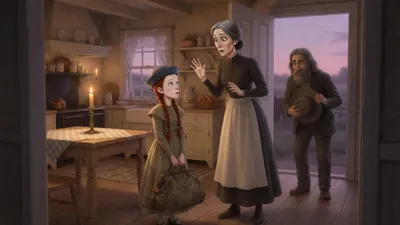
Before you read — think about:
- How do you tell that someone in a room is uncomfortable, even if they do not say so?
- What is the difference between being strict and being unkind?
- Who in your family is hardest to read, and how do you work out what they are thinking?
- What object in your bedroom would you show a visitor first?
- Who talks the most at meals in your house, and who talks the least?
Watch for these while reading:
- Marilla's manner when something takes her by surprise, and how quickly she gathers herself again.
- The child's insistence on names — what she asks to be called and how she wants it spelled.
- Matthew's method of making his opinion known in a room where he says almost nothing.
- The bare east gable room, and how much attention Montgomery gives to describing it.
- The gap between what Marilla says and what her face is doing while she says it.
Vocabulary to know:
luminous (adjective) — shining bright, glowing, or full of light; wretchedly (adverb) — in a deeply miserable, unhappy, or distressed manner; animation (noun) — liveliness, energy, or spirited emotion visible in a person's expression or behavior; deprecatingly (adverb) — in a way that expresses regret, disapproval, or a desire to lessen bad feelings; tragical (adjective) — dramatically sad, sorrowful, or distressing; mellowed (verb) — softened, relaxed, or became less stern and severe; distinguished (adjective) — having a grand, noble, or impressive appearance or quality; reconcile (verb) — to accept or adjust to a situation that is disappointing or difficult to change; abundance (noun) — a large quantity or overflowing supply of something; reproachfully (adverb) — in a way that shows blame, disappointment, or mild disapproval; shortcoming (noun) — a flaw, fault, or weakness in character or behavior; despair (noun) — the complete feeling of having no hope left; consolation (noun) — a comfort or encouraging thought received after a loss or disappointment; wistfully (adverb) — with a sad, gentle longing or yearning for something out of reach; aforesaid (adjective) — mentioned or spoken of earlier in the text; raiment (noun) — clothing or garments; tempestuous (adjective) — wild, stormy, or violent in appearance or motion; perturbation (noun) — a state of mental distress, worry, or anxiety; predilection (noun) — a special preference or strong liking for something; despatched (verb) — sent off promptly to a specific place or destination; resolutely (adverb) — in a firm, determined, and purposeful manner.
Chapter 4: Morning at Green Gables

Before you read — think about:
- What can you see from your own window, and how often do you actually look at it?
- What does a good morning look like in your house before anyone has to rush?
- What do you like to do in the first half-hour after you wake up?
- How do adults who are not used to children sometimes come across to them?
- What is the earliest morning you can remember clearly, and what made it stick?
Watch for these while reading:
- The view from the east gable window, and how much space Montgomery gives to it.
- The names the child gives to a cherry tree and to a geranium on the windowsill.
- Marilla's crispness, and whether it always matches what she appears to feel.
- Matthew's way of slipping a suggestion into a conversation.
- The orchard, the brook, and the rest of the Avonlea landscape described this morning.
Vocabulary to know:
sash (noun) — a sliding frame that holds the glass panes of a window; boughs (noun) — large main branches of a tree; lush (adjective) — growing thickly, healthily, and abundantly; undergrowth (noun) — bushes, shrubs, and small plants growing beneath taller trees in a forest; lingered (verb) — stayed or remained in a place longer than necessary out of enjoyment or hesitation; curtly (adverb) — spoken or done in a abrupt, brief, or rudely sharp manner; comprehensively (adverb) — in a way that covers or includes everything broadly and thoroughly; radiantly (adverb) — in a bright, glowing way; edgewise (adverb) — with the edge leading; used in idioms like 'get a word in edgewise' meaning finding a brief opening to speak; pervading (verb) — spreading or flowing through every part of something; wilderness (noun) — a wild, lonely, or confusing place; here used metaphorically to describe feeling isolated; affliction (noun) — something that causes pain, distress, or hardship; unswervingly (adverb) — steadily and without turning aside or wavering; persistency (noun) — the quality of continuing firmly in a course of action despite obstacles; potent (adjective) — having great power, influence, or effect; effectual (adjective) — producing the intended result; effective; kindred (adjective) — sharing similar values, feelings, or qualities; closely aligned in spirit; threshold (noun) — the entrance or doorway of a building or room; extinguisher (noun) — a device or object used to put out a fire or snuff out light and brightness; martyr (noun) — Someone who suffers or gives something up, or who talks as if they were doing so.; relinquishing (verb) — giving up, letting go, or surrendering control of something; handles (noun) — personal names or titles given to objects or plants to make them feel familiar and human; intercepted (verb) — caught or noticed a look before it passed; indignantly (adverb) — in a manner expressing anger or annoyance at unfair treatment.
Chapter 5: Anne's History

Before you read — think about:
- When you tell a stranger about your life, what do you start with?
- How do people in your family tell stories about when they were young?
- What jobs do you think a child living in someone else's house might have been given a hundred years ago?
- What work were children expected to do a hundred years ago that they are not asked to do now?
- What is the longest you have spent talking with just one other person?
Watch for these while reading:
- The plain facts of Anne's early life, and the matter-of-fact way she hands them over.
- The way Anne chooses her words when she talks about the people she has lived with.
- Marilla's listening — what she says aloud, and what she keeps behind her teeth.
- The road to White Sands and the scenery along it.
- Anne's vocabulary, and the grown-up words she enjoys using.
Vocabulary to know:
confidentially (adverb) — spoken or done in a private, trusting manner; bewitching (adjective) — enchanting, charming, or captivating; mercilessly (adverb) — in a harsh, unfeeling manner without showing pity; heroine (noun) — a principal female character in a story, known for noble qualities or courage; inculcate (verb) — to teach or instill an idea or habit through repeated instruction; moderation (noun) — the quality of avoiding extremes and staying within reasonable limits; succession (noun) — a series of people or things following one after another in order; faltered (verb) — hesitated or stumbled while speaking or acting; embarrassment (noun) — a feeling of self-consciousness, shame, or awkwardness; abstractedly (adverb) — in a preoccupied, distracted, or absent-minded manner; drudgery (noun) — hard, boring, or repetitive work; divine (verb) — to figure out or discover something through intuition or subtle clues; indulge (verb) — to yield to or satisfy a desire or wish; whim (noun) — a sudden, unexpected desire or impulse; tussle (noun) — a vigorous struggle, fight, or scuffle; coves (noun) — small, sheltered bays along a coastline; inlaid (adjective) — set flat into a surface to form a decorative pattern or design; shimmering (adjective) — shining with a soft, flickering, or wavering light; pinions (noun) — the outer parts of a bird's wings, or wings in general; mournfully (adverb) — in a sad, sorrowful, or tragic manner.
Chapter 6: Marilla Makes Up Her Mind
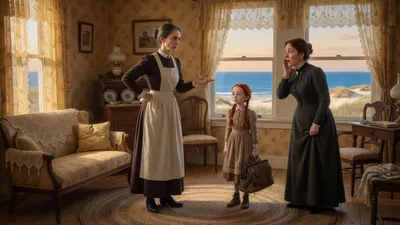
Before you read — think about:
- What does 'making up your mind' feel like for you — fast, slow, or something in between?
- Who makes the big decisions in your home, and how can you tell?
- What do you notice first about a community you are only visiting, compared with the one you live in?
- What makes a first meeting with a new adult easy, or hard?
- How do people in your family share news they heard from someone else?
Watch for these while reading:
- Mrs. Spencer, and how she talks when she is explaining herself.
- The people Marilla speaks with on this errand, and the details Montgomery picks out to describe them.
- Marilla's questions, and what they suggest she is weighing up.
- Anne's face and voice while the adults talk over her head.
- The conditions and cautions Marilla attaches to anything she says.
Vocabulary to know:
benevolent (adjective) — Having a kind, generous, and caring nature.; blight (noun) — A depressing influence or something that ruins hope and joy.; corroborated (verb) — Confirmed or backed up a statement with additional evidence.; heedlessness (noun) — A careless lack of attention to danger or consequences.; providential (adjective) — Happening at an unusually lucky or convenient time, as if guided by good fortune.; shrewish (adjective) — Ill-tempered, nagging, and harsh in speech or personality.; superfluous (adjective) — Extra, unnecessary, or beyond what is needed.; ottoman (noun) — A low, padded seat or footstool without a back or arms.; stipulations (noun) — Specific rules, requirements, or conditions that must be met in an agreement.; wiry (adjective) — Lean, slender, but surprisingly strong and tough.; fractious (adjective) — Irritable, easily upset, or difficult to control.; conviction (noun) — A firm, unwavering belief or strong feeling of certainty.; ungraciously (adverb) — Done in a rude, unwelcoming, or unpleasant manner.; transfigured (verb) — Transformed completely in appearance, usually into something brighter or more joyful.; gimlet (noun) — A small hand tool used for boring holes, used figuratively to describe someone with a sharp, piercing look.; reproved (verb) — Scolded, criticized, or corrected someone for bad behavior.; meekly (adverb) — In a quiet, gentle, and submissive manner.; vim (noun) — Lively energy, spirit, and vigor.; contempt (noun) — A feeling of deep disrespect or scorn toward someone or something..
Chapter 7: Anne Says Her Prayers
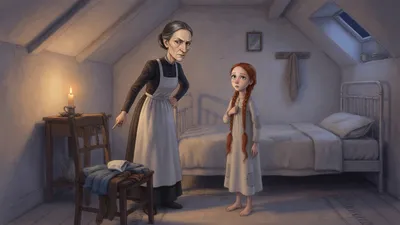
Before you read — think about:
- What words do you know by heart — a song, a poem, a speech — and when did you learn them?
- What is a custom in your house that a visitor would have to be told about?
- What time of day do you find it easiest to be serious, if you ever are?
- Why do people sometimes show the most of themselves in small, ordinary moments?
- What did a Sunday look like in a country village a hundred years ago?
Watch for these while reading:
- What Anne already knows about religion, and where she picked it up.
- Anne's ideas about where and how she would most like to say her prayers.
- Marilla's tone when she is instructing rather than scolding.
- The kind of language Anne reaches for when she is trying to be solemn.
- Montgomery's habit of letting something comic sit inside something serious.
Vocabulary to know:
harrowed (adjective) — deeply distressed, troubled, or upset; admonished (verb) — warned or scolded someone gently but firmly; glibly (adverb) — speaking smoothly and quickly without deep thought or genuine feeling; catechism (noun) — a summary of religious principles taught through a series of questions and answers; assented (verb) — agreed to a request, opinion, or suggestion; oblige (verb) — to do a favor for someone or help them out of kindness; interjected (verb) — interrupted a conversation to add a quick remark or comment; flowery (adjective) — using overly fancy, elaborate, or decorative language; irreverence (noun) — a lack of proper respect or seriousness toward something sacred or honored; petition (noun) — an earnest, formal request or prayer; luxuriously (adverb) — in a deeply comfortable, cozy, or delightful manner; manse (noun) — a house provided by a church community for its minister or pastor to live in.
Chapter 8: Anne's Bringing-up Is Begun
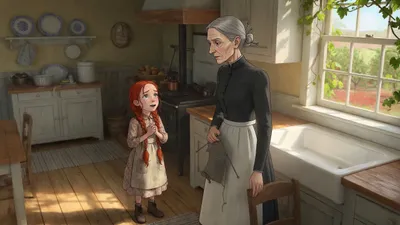
Before you read — think about:
- What does it mean to truly belong to a family, beyond simply living in the same house?
- If you could keep one ordinary object from your house forever, what would it be?
- How do you like to spend a rainy afternoon indoors?
- What makes a Saturday at home feel like a good one?
- What jobs would a child have been given around a farmhouse in Anne's day?
Watch for these while reading:
- How Marilla words things when she has something important to say.
- The imaginary companions Anne describes from her earlier life.
- What Anne notices about the pictures and furnishings around the house.
- Marilla's rules about work, and Anne's manner of complying with them.
- Anne's ideas about what a true friend would be like.
Vocabulary to know:
bosom (adjective) — intimate, deeply cherished, and exceptionally close (as in a companion); forenoon (noun) — the morning hours before midday; reprimand (noun) — a severe, formal scolding or sharp warning; catastrophe (noun) — a sudden disaster or complete failure; dilated (verb) — became wider or larger; imploring (adjective) — begging or pleading earnestly; immovably (adverb) — firmly and stubbornly, without changing stance or opinion; bewilderment (noun) — a state of total confusion or puzzlement; fortnight (noun) — a period of two weeks; mantelpiece (noun) — a shelf above a fireplace; apologetically (adverb) — in a way that shows regret or asks for forgiveness; discourse (verb) — to speak or converse at length about a subject; astar (adjective) — shining bright or sparkling like stars; vivid (adjective) — brightly colored; strikingly intense in color; chromo (noun) — a color print made using lithography (popular in the 19th century); askance (adverb) — with suspicion, distrust, or disapproval; intently (adverb) — with eager, fixed, and concentrated attention; hallowed (adjective) — holy, sacred, or deeply respected; diligently (adverb) — with steady, energetic, and careful effort; endure (verb) — to bear, tolerate, or put up with something unpleasant; inconsequently (adverb) — casually or without logical connection to the topic; intoxicated (adjective) — drunk or impaired by alcohol; preserves (noun) — fruit cooked with sugar and sealed in jars for keeping; fickle (adjective) — frequently changing one's interests, feelings, or loyalties; irresistible (adjective) — too attractive or enticing to be resisted; brocade (noun) — a rich fabric woven with raised, decorative patterns; tapestry (noun) — a heavy piece of textile fabric with woven pictures, hung on walls; mahogany (noun) — a high-quality, reddish-brown tropical wood; regal (adjective) — royal, magnificent, and fit for a queen or king; clad (adjective) — dressed or covered in a specific type of clothing; pallor (noun) — an unnatural paleness of the skin.
Chapter 9: Mrs. Rachel Lynde Is Properly Horrified
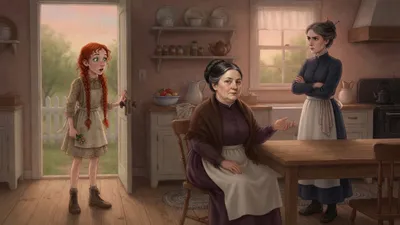
Before you read — think about:
- What does a typical visit from someone outside your family look like, from knock to goodbye?
- Who in your family is the most blunt, and who is the most careful with words?
- What rules apply when guests are in your house that do not apply the rest of the time?
- What do you know about your own parents' or grandparents' childhoods?
- How were visitors received in a house in the days before anyone telephoned ahead?
Watch for these while reading:
- Exactly how Mrs. Rachel Lynde talks about other people to their faces.
- Anne's way of speaking when she is feeling something very strongly.
- Marilla's tone as a hostess — what she says to a caller, and what she holds back.
- The east gable room, and the use Anne makes of it.
- What Montgomery lets us glimpse of Marilla's own girlhood.
Vocabulary to know:
grippe (noun) — an old-fashioned term for the flu or influenza; unseasonable (adjective) — occurring at an unusual or unexpected time of year; suppositions (noun) — ideas or beliefs formed without solid evidence; guesses; vagaries (noun) — unexpected, erratic, or unpredictable changes and twists; coppice (noun) — a dense thicket or small grove of small trees; gossamers (noun) — fine, delicate cobwebs often seen floating in the air or on plants; tremulous (adjective) — shaking or quivering slightly; abashed (adjective) — embarrassed, ashamed, or self-conscious; obtrusive (adjective) — unpleasantly noticeable or intrusive; consternation (noun) — feelings of sudden anxiety, dismay, or shock caused by something unexpected; undauntedly (adverb) — courageously and fearlessly, refusing to be discouraged by danger or difficulty; vehemently (adverb) — with intense, forceful, or passionate feeling; solemnity (noun) — a state or quality of deep seriousness and dignity; vexed (verb) — annoyed or distressed someone; enormity (noun) — the extreme seriousness, scale, or outrageously bad nature of an offense; oblivious (adjective) — totally unaware of or paying no attention to what is happening around oneself; counterpane (noun) — a decorative bedspread or top quilt covering a bed; evasive (adjective) — avoiding a direct answer or confrontation; indirect and slippery; rankle (verb) — to cause persistent resentment, annoyance, or emotional pain over time; reprehensible (adjective) — deserving severe blame, criticism, or strong moral disapproval; dumbfounded (adjective) — speechlessly amazed, shocked, or astonished; visitations (noun) — severe trials or hardships viewed as punishments or tests sent by a higher power; retorted (verb) — replied quickly in a sharp, angry, or witty manner; exhaling (verb) — breathing out or giving off a strong feeling or atmosphere.
Chapter 10: Anne's Apology

Before you read — think about:
- What is the hardest part of apologising, in your experience?
- Who taught you how to apologise, and what did they say it should sound like?
- How is apologising to someone older than you different from apologising to a friend?
- What did people in a small village expect of one another as neighbours?
- Is there a form of words your family uses to patch things up after a row?
Watch for these while reading:
- Matthew's few words in the kitchen, and how at ease he seems compared with out of doors.
- The language Anne chooses when she sets out to do a thing thoroughly.
- Mrs. Rachel Lynde's manner on her own ground rather than someone else's.
- The walk home, and what passes between Anne and Marilla along it.
- How Montgomery keeps comedy and real feeling in the same scene.
Vocabulary to know:
refractory (adjective) — Stubborn, unmanageable, or resisting control.; rejoinder (noun) — A quick, sharp, or clever reply.; obdurate (adjective) — Completely stubborn and unwilling to change one's mind or course of action.; depleted (adjective) — Significantly reduced, drained, or emptied out.; gravitated (verb) — Moved naturally toward or was drawn to a particular person, place, or thing.; wanly (adverb) — In a weak, pale, or weary manner.; prematurely (adverb) — Occurring or done before the proper or expected time.; humiliating (adjective) — Causing a painful loss of pride, dignity, or self-respect.; plaintive (adjective) — Sounding sad, mournful, or sorrowful.; banisters (noun) — The handrail and supporting posts along a staircase.; dejected (adjective) — Sad, dispirited, and feeling defeated.; exhilaration (noun) — A strong feeling of excitement, joy, and high energy.; behooved (verb) — Was necessary, proper, or appropriate for someone to do.; penitent (noun) — A person who feels or expresses genuine regret and sorrow for doing wrong.; askew (adverb) — going wrong; not working as planned; beseechingly (adverb) — In a begging, desperate, or pleading manner.; abasement (noun) — The act of lowering or humbling oneself completely.; plumed (verb) — Prided or congratulated oneself on an achievement or trait.; officious (adjective) — Overly eager to offer unwanted advice, interference, or authority.; auburn (adjective) — Having a rich, reddish-brown color.; benefactor (noun) — A person who gives money, help, or other valuable support to a person or cause.; forcible (adjective) — Strong, powerful, and emphatic in expression or style.; sheaf (noun) — A bundle of cut plants, flowers, or papers tied or held together.; twit (verb) — To tease, taunt, or poke fun at someone about something.; gyrations (noun) — twisting turns of thought; maternity (noun) — The quality, feeling, or state of being a mother..
Chapter 11: Anne's Impressions of Sunday-school

Before you read — think about:
- What do you like to wear when you want to feel like yourself?
- How does it feel to be the newcomer in a group where everyone already knows one another?
- What do you remember about sitting still in a long grown-up gathering?
- What would your ideal Sunday include, from morning to evening?
- How do you decide what is 'proper' to wear, and who taught you that?
Watch for these while reading:
- What Marilla values in a dress, and what Anne longs for instead.
- The clothes Anne wears to Sunday-school, and how she feels about them.
- The Avonlea girls' manner toward a newcomer.
- Anne's ideas about hats, sleeves, and what makes a dress worth wearing.
- How honestly Anne reports her real opinions to Marilla.
Vocabulary to know:
serviceable (adjective) — practical, durable, and suitable for regular use rather than decorative.; pampering (verb) — treating someone with extreme care, attention, or indulgence.; furbelows (noun) — showy, unnecessary trimmings or flounces on clothing.; dudgeon (noun) — a state of intense anger, offense, or resentment.; frenzy (noun) — a wild, energetic, or uncontrolled burst of activity.; garlanded (verb) — decorated or crowned with a wreath of flowers or leaves.; attired (adjective) — dressed or clothed in a particular kind of clothing.; adornment (noun) — a decoration or ornament added to improve appearance.; advances (noun) — friendly gestures or initial steps taken to make contact or start a relationship.; rebukingly (adverb) — in a manner that expresses stern disapproval or criticism.; paraphrase (noun) — in religious contexts, a passage of scripture rewritten as a poem or song for church recitation.; melancholy (adjective) — sad, gloomy, or tending to cause quiet sorrow.; slaughtered (adjective) — killed violently or in large numbers during a battle.; squadrons (noun) — large organized military units or groups operating together.; hampered (verb) — hindered, restricted, or held back from moving or acting freely.; undeniable (adjective) — unquestionably true and impossible to deny or dispute.; unuttered (adjective) — not spoken aloud; kept silent or private in one's mind..
Chapter 12: A Solemn Vow and Promise
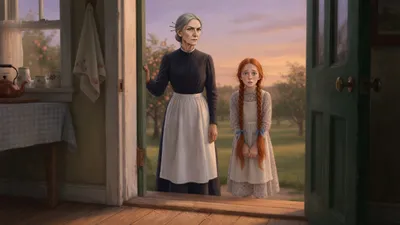
Before you read — think about:
- What games do you remember playing outdoors when you were younger?
- What would you want a new friend to know about you that is not obvious?
- What makes a promise between friends feel serious rather than casual?
- Do you and your friends have private words, signals or rituals? Where did they come from?
- Why might a strict adult hide their fondness for someone behind gruff words?
Watch for these while reading:
- Anne's nervousness about the Barrys, and how she prepares herself.
- Diana's manner, and how it compares with Anne's.
- The kind of ceremony Anne invents where an ordinary form would do.
- Matthew's habit of noticing what Anne would like.
- The words Marilla uses when she is pleased and does not wish to show it.
Vocabulary to know:
swear (verb) — To make a sacred, solemn vow or promise of devotion and friendship.; caper (noun) — A silly, foolish, or playful trick or stunt.; aggravating (adjective) — Exasperating or highly annoying.; dubious (adjective) — Uncertain, questionable, or unsafe.; consumption (noun) — A historical medical term for a severe wasting disease, such as tuberculosis.; unheeded (adjective) — Noticed or paid attention to by no one; completely ignored.; fluster (noun) — A state of nervous excitement, confusion, or worry.; audible (adjective) — Loud enough to be heard clearly.; abets (verb) — Encourages, assists, or supports someone in doing an activity.; poring (verb) — Studying, reading, or examining something with intense concentration.; prospect (noun) — The possibility or expectation of something happening in the future.; fraught (adjective) — Filled or loaded with specific emotions, tension, or meaning.; bowery (adjective) — Shaded and leafy, like an arbor or sheltered garden pathway.; intersected (verb) — Crossed through or divided by passing across one another.; beguiled (verb) — Charmed, distracted, or persuaded into doing something.; loitering (verb) — Lingering or hanging around an area without a clear purpose.; coincidence (noun) — A remarkable situation in which events happen at the same time by chance.; dryad (noun) — A nature spirit or tree nymph from ancient mythology.; dismal (adjective) — Gloomy, sad, or cheerless in mood or appearance..
Chapter 13: The Delights of Anticipation

Before you read — think about:
- Why can looking forward to something be almost as good as the thing itself?
- How do you and a friend usually decide what to do with a free afternoon?
- How does having a close friend change the way ordinary days feel?
- What did children do for entertainment before screens, and what would you have made of it?
- What is a small tradition you have with a friend that nobody else would understand?
Watch for these while reading:
- The Sunday-school picnic, and how large it looms in Anne's talk.
- Idlewild, the playhouse, and the world the two girls build there.
- Marilla's amethyst brooch, and the place it holds in the household.
- Anne's way of showing affection, and Marilla's way of receiving it.
- Marilla's way of answering when Anne is full of talk about a coming pleasure.
Vocabulary to know:
ninny (noun) — A foolish or silly person.; infatuated (adjective) — Completely swept up in strong admiration, affection, or foolish fascination with someone or something.; staccato (adjective) — Made up of short, sharp, quick, and disconnected sounds.; featherbrained (adjective) — Silly, scatterbrained, or unable to stay focused.; sallow (adjective) — Having an unhealthy, pale, or yellowish color on one's skin.; brusquely (adverb) — In a sudden, blunt, or sharp manner that may seem impatient or rude.; dolefully (adverb) — In a sad, mournful, or gloomy way.; inspiration (noun) — A sudden brilliant idea or a creative spark that leads to a new thought.; tribulations (noun) — Great troubles, severe struggles, or difficult hardships.; frantic (adjective) — Wildly excited, anxious, or worried to the point of losing control.; pulpit (noun) — A raised platform or lectern in a church where a minister stands to deliver a sermon.; sacrilegious (adjective) — Showing extreme disrespect toward something considered holy, special, or deeply respected.; bequeathed (verb) — Handed down or left property to another person, usually through a will.; amethyst (noun) — A clear, purple variety of quartz prized as a precious gemstone.; smitten (adjective) — Deeply captivated, charmed, or taken with strong affection.; drowsed (verb) — Slept lightly or rested in a half-awake state.; torrent (noun) — A fast-moving, violent stream, or a sudden overwhelming rush of something.; impulsive (adjective) — Acting suddenly on a sudden feeling or idea without thinking about the results..
Chapter 14: Anne's Confession
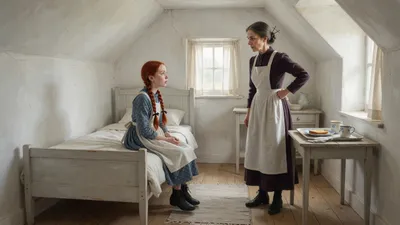
Before you read — think about:
- How can a writer show two people talking past each other?
- What does a quiet house sound like in the middle of the day?
- If you had to stay useful around the house all day, what job would you pick?
- How were children disciplined in Anne's day compared with now?
- How do authors make you take a character's side in an argument?
Watch for these while reading:
- Anne's account of the brooch, and the way Marilla hears it.
- The picnic, and how much weight it carries in Anne's mind.
- Marilla's reasoning, and the steps she takes through it.
- The east gable room, and how it feels to Anne this time.
- Montgomery's eye for ordinary household detail even in a tense scene.
Vocabulary to know:
meddle (verb) — to interfere in or tamper with something that is not one's concern; pertly (adverb) — in a bold, lively, or impudent manner; assertion (noun) — a confident and forceful statement of fact or belief; defiance (noun) — open resistance or bold disobedience toward authority; falsehood (noun) — an untrue statement or lie; pincushion (noun) — A small stuffed cushion used to hold pins.; slyness (noun) — sneaky, cunning, or secretive behavior intended to deceive; circumstances (noun) — The facts and conditions around a situation.; confounded (adjective) — utterly confused, perplexed, or amazed; cranny (noun) — a small, narrow opening, crack, or crevice; forlornly (adverb) — in a sad, hopeless, or lonely manner; grimly (adverb) — in a stern, harsh, or unyielding way; steadfastly (adverb) — in a firm, unwavering, and resolute manner; repressed (verb) — suppressed, restrained, or held back by force; viewless (adjective) — invisible or unseen to the eye; benediction (noun) — a blessing or expression of good wishes; compunction (noun) — a feeling of guilt, regret, or moral uneasiness about an action; repentance (noun) — sincere regret or remorse for past wrongdoings or bad behavior; tranquilly (adverb) — in a calm, peaceful, and unbothered manner; stonily (adverb) — in an unfeeling, cold, or unforgiving manner; disengaged (verb) — released or detached from a connection or grasp; writhing (verb) — twisting and squirming the body in pain or intense distress; abandonment (noun) — a state of complete surrender to emotion or impulse without restraint; remorse (noun) — deep, painful regret for having done something wrong; exasperated (adjective) — intensely irritated, annoyed, or frustrated; reiterated (verb) — repeated a statement or idea several times for clarity or emphasis; rent (noun) — a tear, rip, or split in fabric or material; facets (noun) — the flat, polished surfaces cut onto a gem or stone; rigmarole (noun) — a lengthy, overly complicated, or confusing story or routine; beatification (noun) — a state of supreme, radiant happiness or heavenly joy; scrumptious (adjective) — delightful, splendid, or extremely enjoyable; sublime (adjective) — of magnificent, grand, or inspiring beauty and excellence; candidly (adverb) — in an honest, direct, and straightforward manner.
Chapter 15: A Tempest in the School Teapot

Before you read — think about:
- What is your walk or journey to school like, and what do you notice on the way?
- What is your favourite part of a school day, and what is the least?
- What makes a school day feel long or short for you?
- What was a one-room country school like, where every age sat together?
- What do you like most about walking to school with someone, if you do?
Watch for these while reading:
- The route Anne and Diana take to school, and the names they have given it.
- Mr. Phillips as a schoolmaster, and how an Avonlea school day is run.
- The Avonlea pupils as a group — who is noticed, and who does the noticing.
- Gilbert Blythe's manner with the girls in the class.
- The slates, the long seats, and the other furnishings of the Avonlea schoolroom.
Vocabulary to know:
take-notice (noun) — A public message or scribbling written on a wall or board teasingly pairing two classmates together.; toothsome (adjective) — Delicious, tasty, or appealing to eat.; reposing (verb) — Lying, resting, or remaining placed in a specific spot.; tantalize (verb) — To tease or torment someone by showing them something desirable that remains out of reach.; rustic (adjective) — Simple, rough, or characteristic of the countryside.; lissom (adjective) — Supple, limber, and moving with graceful ease.; pigeonberries (noun) — Low woodland berries with scarlet fruit.; emerald (adjective) — Having a bright, rich green color like that of a precious stone.; hieroglyphics (noun) — Symbols, scribbles, or marks that are difficult or impossible to read.; eaves (noun) — The lower edges of a roof that overhang the outside walls of a building.; substantial (adjective) — Solidly built, sturdy, and strong.; misgivings (noun) — Feelings of doubt, hesitation, or fear about an outcome.; industriously (adverb) — In a busy, steady, hard-working way.; mortified (adjective) — Extremely embarrassed, ashamed, or humiliated.; blithely (adverb) — In a lighthearted, cheerful, and carefree manner.; torments (verb) — To tease, annoy, or bother someone persistently.; stealthily (adverb) — Quietly and secretively to avoid being seen or heard.; roguish (adjective) — Playfully mischievous or sly in a charming way.; inexpressible (adjective) — Too strong or strange to put into words.; drollery (noun) — Whimsical, sly, or playful humor.; cureless (adjective) — Incurable; impossible to fix or undo.; excruciatingly (adverb) — In a way that hurts extremely, in body or feeling.; vindictive (adjective) — Having or showing a strong desire for revenge; spiteful.; sustained (verb) — Supported, held up, or kept going during a difficult moment.; malicious (adjective) — Spiteful; intended to cause harm, embarrassment, or pain.; contritely (adverb) — In a way that shows deep regret or remorse for a bad action.; disdainfully (adverb) — With feelings of contempt, scorn, or prideful superiority.; seductive (adjective) — Strongly tempting, attractive, or hard to resist.; bracken (noun) — Coarse, large ferns that grow densely in wild woodland patches.; scapegoat (noun) — A person forced to take the blame or punishment for others.; disheveled (adjective) — Untidy, rumpled, or messy in appearance.; rakish (adjective) — Jaunty, slightly unconventional, or wildly tilted in style.; inflection (noun) — A change in pitch, tone, or emphasis in a person's speaking voice.; haughtily (adverb) — In an arrogant, overly proud, or snobbish manner.; seethed (verb) — Churned or boiled with quiet, intense anger.; obstinate (adjective) — Stubbornly adhering to an opinion or purpose despite reason.; ostentatiously (adverb) — In a showy, dramatic manner intended to attract attention.; amiably (adverb) — In a pleasant, friendly, and agreeable way.; scandalous (adjective) — Disgraceful, shocking, or offensive to accepted moral standards.; appease (verb) — To calm, satisfy, or make peace with someone by yielding to demands.; avail (noun) — Help, benefit, or useful result.; gingerly (adverb) — With extreme care, delicacy, or caution.; unyielding (adjective) — Firm, stubborn, and completely unwilling to bend or surrender.; spasmodic (adjective) — Occurring in sudden, brief, irregular bursts.; tableau (noun) — A striking, dramatic scene formed by motionless people or objects.; whiplash (noun) — A sudden, sharp snapping strike or sting.; legend (noun) — A written inscription, caption, or statement displayed on a surface..
Chapter 16: Diana Is Invited to Tea with Tragic Results

Before you read — think about:
- Why might a formal, grown-up tea party feel exciting to two young friends?
- What makes hospitality — feeding and welcoming a guest — feel so grown-up?
- What food do you associate with having company in?
- How do you behave differently when you are the host rather than the guest?
- Who taught you how to treat a guest, and what did they say?
Watch for these while reading:
- How Anne and Diana behave when they are trying to be proper and grown-up.
- The sitting room at Green Gables, and how it is got ready when there is company.
- The talk between Anne and Diana once they are left to play hostess.
- Mrs. Barry's manner and what she seems to value.
- The difference between how Marilla speaks to Anne and how other Avonlea adults do.
Vocabulary to know:
aftermaths (noun) — second-growth crops or grass produced in fields later in the autumn season; reveled (verb) — took intense pleasure or delight in something; aesthetic (adjective) — relating to beauty or the appreciation of artistic taste; addlepated (adjective) — confused, muddled, or foolish; grown-uppish (adjective) — acting or feeling like a mature adult; ecstatically (adverb) — with intense, overwhelming happiness and joy; crock (noun) — an earthenware pot or jar used for storing food; cordial (noun) — a sweet, fruit-flavored drink; dignified (adjective) — showing a serious, calm, and respectful manner; crossover (noun) — a short wrap or shawl that crosses over the chest; tassels (noun) — ornamental bunches of hanging threads bound at one end; tumbler (noun) — a flat-bottomed drinking glass without a stem or handle; entreated (verb) — begged or pleaded with someone earnestly; determinedly (adverb) — In a firm, unshakable way.; cloistered (adjective) — secluded or isolated from the outside world; seclusion (noun) — the state of being hidden away or private from others; daintily (adverb) — In a delicate, careful, refined way.; dizzily (adverb) — in a lightheaded, unsteady, or spinning manner; zest (noun) — great enthusiasm, energy, or enjoyment; abroad (adverb) — out of one's house or out in the open; fiddlesticks (interjection) — an expression used to dismiss something as nonsense or foolishness; currant (noun) — a small, sour berry used in jams, baking, or beverages; recollected (verb) — remembered or brought something back to mind; hospitable (adjective) — friendly, generous, and welcoming toward guests; unsteadily (adverb) — In a shaky, unbalanced way.; whisked (verb) — moved or swept away quickly and suddenly; distracted (adjective) — unable to concentrate because one's mind is occupied with worries or other thoughts; sere (adjective) — dry, withered, or faded; suppliant (noun) — a humble person making an earnest request or plea; prejudices (noun) — preconceived opinions or unreasonable dislikes formed without fair knowledge; prepense (adjective) — considered or planned beforehand; contamination (noun) — the process of making something dirty, impure, or harmful; intimacy (noun) — close friendship, familiarity, or affection; insultingly (adverb) — in a rude, disrespectful, or offensive manner; well-bred (adjective) — having good manners and proper social training; unholy (adjective) — unseemly, improper, or outrageous; personified (verb) — Made into a living picture of some quality.; unaccustomed (adjective) — not used to or familiar with something; snaps (noun) — thin, crisp cookies.
Chapter 17: A New Interest in Life

Before you read — think about:
- What is the hardest homework you have had this year, and what made it hard?
- What does a schoolyard or hallway sound like before the bell?
- How do you decide whether to join in a classroom joke or stay out of it?
- What is a skill you wish you were faster at?
- How does having a friend in the same class change a day, if it does?
Watch for these while reading:
- The old-fashioned, dramatic language Anne reaches for at solemn moments.
- What school offers Anne that Green Gables cannot.
- How Anne and Gilbert each go at their schoolwork.
- Anne's habits of study — at her desk, and in the evenings at home.
- Which lessons Anne takes to easily, and which she works at.
Vocabulary to know:
relented (verb) — Gave in or softened one's harsh attitude; agreed after refusing.; severed (verb) — Cut off or broke apart completely.; stanchly (adverb) — In a firm, loyal, and unwavering manner.; ruthlessly (adverb) — In a harsh way that shows no pity or mercy.; muse (verb) — To think deeply, ponder, or reflect in quiet thought.; perusal (noun) — The act of reading or inspecting something carefully and thoroughly.; effusion (noun) — An outpouring of strong feeling or poetic expression.; annexed (verb) — Took control of or grabbed something, often without permission.; perquisites (noun) — Special privileges, perks, or benefits accompanying a position.; bedizened (verb) — Decorated or dressed up in a flashy or gaudy style.; exalted (verb) — Raised to a high level of joy, pride, or noble feeling.; commune (verb) — To connect closely or share deep thoughts spiritually with someone or something.; tenacity (noun) — The quality of being determined, persistent, and stubborn.; fluctuated (verb) — Changed continually or shifted back and forth.; inflexibly (adverb) — In a rigid way that refuses to yield or change.; branches (noun) — Higher-level school academic subjects beyond elementary studies, such as algebra and Latin.; dunce (noun) — A slow or foolish learner.; pageant (noun) — An elaborate public show, procession, or spectacle.; unpraiseworthy (adjective) — Not deserving of praise or approval; blameable.; inextinguishable (adjective) — Impossible to put out or bring to an end..
Chapter 18: Anne to the Rescue

Before you read — think about:
- What does this chapter's title make you picture, before you start?
- What is a winter chore or job you have actually done, if any?
- What do you like about being indoors when the weather is bad?
- What stories have you heard about winter in your family?
- What is the coldest night you can remember, and how did your house feel?
Watch for these while reading:
- The Green Gables kitchen on a winter evening, and how Montgomery describes it.
- Matthew's way of being in the house when Marilla is not in the room.
- The Barry household as Anne has known it so far.
- The winter roads and how people get about on them.
- How news travels along the winter roads of Avonlea.
Vocabulary to know:
Premier (noun) — The chief minister or head of government in certain countries or provinces.; nonsupporters (noun) — People who do not back a cause or party.; sneaking (adjective) — Secretive, unacknowledged, or hidden beneath the surface.; warranted (adjective) — Guaranteed or promised to produce a specific outcome.; proposition (noun) — A formal statement or theorem in mathematics that must be demonstrated or proved.; electors (noun) — Voters who are eligible to cast ballots in an election.; Conservative (noun) — A member or supporter of a political party that favors traditional values and cautious change.; Grits (noun) — An informal term used in Canada for members or supporters of the Liberal political party.; courting (noun) — The act of dating or seeking to win someone's romantic affection.; beaus (noun) — Male suitors or boyfriends.; russets (noun) — A specific variety of crisp apples with rough, reddish-brown skin.; embedded (adjective) — Fixed firmly and deeply into a surrounding substance.; croup (noun) — A respiratory condition in young children marked by severe coughing and difficult breathing.; ipecac (noun) — A plant-derived medicinal syrup formerly used to induce vomiting or help clear mucus from the throat.; insensible (adjective) — Unaware of or indifferent to something.; ebony (adjective) — Deep, dark black in color.; estranged (adjective) — No longer close or friendly; alienated from a companion.; buxom (adjective) — Plump, healthy-looking, and full-figured.; pressing (adjective) — Urgent; requiring immediate action or attention.; triumphantly (adverb) — In a proud, victorious way.; vain (adjective) — Useless or having no chance of success.; phlegm (noun) — Thick mucus secreted in the throat and air passages during an illness.; unweariedly (adverb) — Tirelessly; without losing energy or growing tired.; white-frosted (adjective) — Covered in white frost.; uplifted (adjective) — Raised in spirit; carried high with feeling.; consequent (adjective) — Following as a natural result or effect.; irradiated (verb) — Illuminated, brightened, or filled with light or feeling.; aerial (adjective) — Light, delicate, and ethereal, as if belonging to the air or sky.; elfin (adjective) — Small, delicate, and charmingly magical.; mantle (noun) — A cloak or figurative covering that conceals or surrounds something.; crochet (noun) — A handicraft in which yarn is looped into textured fabric using a hooked needle..
Chapter 19: A Concert, a Catastrophe, and a Confession
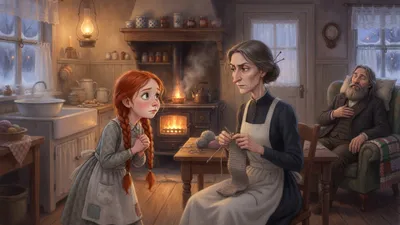
Before you read — think about:
- Why does a first big social occasion feel so enormous when you are young?
- What is the most dressed-up you have ever had to be, and for what?
- How do you get ready for an evening that starts after dark?
- What did a village put on for entertainment before radio, cinema or television?
- How late are you allowed to be out on a special night, and who decides?
Watch for these while reading:
- How Matthew puts his view to Marilla, and how little he raises his voice doing it.
- The Debating Club concert, and how Avonlea prepares for an event.
- Matthew's way of taking Anne's side without making a speech.
- Anne's account of the concert when she gets back to Green Gables.
- The Barry house after dark, and how it feels to a visitor staying the night.
Vocabulary to know:
traipsing (verb) — Walking or wandering around casually or aimlessly.; emphatically (adverb) — In a forceful, definite, or strongly emphasized manner.; sarcastically (adverb) — In a mocking or ironic tone used to express annoyance or humor.; pung (noun) — A low, horse-drawn sleigh with a box-like wooden body.; gadding (verb) — Wandering about restlessly in search of fun or social activity.; pathetic (adjective) — Arousing feelings of pity, sadness, or tender sympathy.; clickety-clack (noun) — A quick, rattling sound of talk or machinery.; spare-room (noun) — An extra bedroom kept in a house for visitors or guests.; heart-stirring (adjective) — Moving the feelings deeply.; refuge (noun) — A place of shelter, safety, or comfort from trouble or noise.; inevitable (noun) — A situation or outcome that is impossible to avoid or prevent.; tartly (adverb) — In a sharp, crisp, or slightly harsh tone.; pneumonia (noun) — A serious lung infection causing fever, coughing, and difficulty breathing.; crescendo (noun) — A gradual increase in volume, sound, or emotional intensity.; pompadour (noun) — A hairstyle created by brushing the hair high up off the forehead.; sapphire (noun) — A bright blue gemstone highly valued for its intense color.; mirth (noun) — Joyful amusement, laughter, or lighthearted fun.; frescoed (adjective) — Decorated or painted with artwork on plaster surfaces.; threadbare (adjective) — Worn down, shabby, or overused to the point of losing interest or freshness.; oration (noun) — A formal, dramatic, or grand public speech.; mutiny (verb) — To rebel or rise up against an authority figure or leader.; sated (adjective) — Fully satisfied or filled to capacity, especially with food or enjoyment.; dissipation (noun) — Overindulgence in foolish entertainment, late nights, or wasteful living.; embers (noun) — Small, glowing pieces of coal or wood remaining in a dying fire.; discreet (adjective) — Careful, tactful, and cautious to avoid causing embarrassment or trouble.; furtive (adjective) — Secretive, sly, or done quietly to avoid being noticed.; exultation (noun) — A feeling of intense, triumphant joy or celebration.; pensive (adjective) — Deeply engaged in quiet, serious, or dreamy thought.; stifling (verb) — Suppressing, holding back, or smothering a sound or reaction.; arduous (adjective) — Requiring great physical or mental effort; tiring and difficult.; rarity (noun) — Something unusual, uncommon, or hard to come across.; waist (noun) — A dressy blouse or top worn on the upper body.; telltale (noun) — A person who informs on others' misdeeds; a snitch.; valise (noun) — A small traveling bag or suitcase carried by hand.; apprehensive (adjective) — Nervous or worried that something may go wrong.; crusted (adjective) — Covered with a hardened outer layer or crust.; tight-sleeved (adjective) — Having sleeves that fit close to the arm.; satin-smooth (adjective) — As smooth and even as satin.; ceremony (noun) — Formal manners, stiff politeness, or rigid adherence to social rules..
Chapter 20: A Good Imagination Gone Wrong

Before you read — think about:
- When does imagination help you, and when does it get in the way?
- What kinds of stories did you like when you were younger than you are now?
- Who tells stories in your family, and are they funny, frightening, or something else?
- What time does your household usually finish the day's work?
- How can an author make a familiar place feel unfamiliar?
Watch for these while reading:
- How Montgomery writes the Avonlea landscape in spring.
- Marilla's ideas about what imagination is good for.
- Diana and Anne's way of talking about ordinary places they both know.
- How a household sounds when the day's work is not yet finished.
- The difference between what Anne says aloud and what she keeps to herself.
Vocabulary to know:
capricious (adjective) — Given to sudden and unpredictable changes in mood, behavior, or weather.; reluctant (adjective) — slow or unwilling; hanging back; resurrection (noun) — A revival, rebirth, or coming back to life after a period of stillness or darkness.; spoil (noun) — Gathered treasure, prizes, or pleasant items collected on an outing.; empurpled (verb) — Colored or covered in purple shades.; reverent (adjective) — Feeling or showing deep and solemn respect.; savor (noun) — A distinctive odor, smell, or pleasing scent.; vital (adjective) — Full of life, energy, and lively spirit.; limpid (adjective) — Clear, transparent, and completely unclouded.; ravishing (adjective) — Delightful, enchanting, or extremely beautiful.; glower (verb) — To stare with sullen anger, annoyance, or hostility.; countenance (verb) — To tolerate, approve of, or permit an action or behavior.; inexorable (adjective) — Impossible to stop, alter, or persuade; firm and unyielding.; specters (noun) — Ghosts, phantoms, or spooky spirits.; lurked (verb) — Remained hidden or waited secretly in a place.; mayflowers (noun) — Trailing spring wildflowers with a sweet scent; trailing arbutus.; unearthly (adjective) — Strange, unnatural, or ghostly.; tuckered (adjective) — Exhausted or completely worn out.; steed (noun) — A spirited, noble, or energetic horse.; stalks (verb) — Walks with stiff, measured, or threatening strides.; retreats (noun) — Secluded, quiet, or sheltered places used for privacy or safety.; spruce (noun) — A type of evergreen tree with sharp needles and pinecones..
Chapter 21: A New Departure in Flavorings

Before you read — think about:
- What makes a new arrival such large news in a small community?
- How do people in a small place share an opinion about someone new?
- Who is the adult outside your family you would most like to be like, and why?
- What was the minister's household expected to be in a village like Avonlea?
- This chapter's title is 'A New Departure in Flavorings.' What does that title make you expect?
Watch for these while reading:
- Mr. Phillips as the schoolmaster, and how the pupils talk about him.
- Mrs. Allan, the new minister's wife, and why Anne is drawn to her.
- The preparations Anne and Marilla make for an important guest.
- The talk at Green Gables about the new minister and his wife.
- Mrs. Allan's manner, and what it shows about her character.
Vocabulary to know:
presentiment (noun) — An intuitive feeling that something, especially something bad, is about to happen.; heartrending (adjective) — Causing deep distress, grief, or sorrow; heartbreaking.; affecting (adjective) — Touching or moving to the emotions.; wholeheartedly (adverb) — With complete feeling and no holding back.; fashionably (adverb) — In a stylish manner that conforms to current popular trends.; uncharitable (adjective) — Unkind, harsh, or quick to judge others unfavorably.; allowances (noun) — Tolerances or concessions made for someone's circumstances or limitations.; actuated (verb) — Motivated, driven, or impelled to take a specific action.; avowed (adjective) — Stated openly, publicly declared, or acknowledged.; sojourn (noun) — A temporary stay or visit in a place away from home.; unimpassioned (adjective) — Calm and without strong feeling.; theology (noun) — The study of religious beliefs, doctrines, and divine matters.; farseeing (adjective) — Having foresight; wise and thoughtful about planning for the future.; doctrine (noun) — A set of fundamental beliefs, principles, or teachings held by an organization or faith.; enthusiasms (noun) — Intense excitement, passions, or interests in particular subjects or activities.; exquisite (adjective) — extremely delicate or beautiful; mistress-ship (noun) — The position of being mistress of a house.; superintendent (noun) — An official responsible for directing, overseeing, or managing an organization or district.; undertaking (noun) — A task, project, or venture that is assumed, especially one that is large or difficult.; eclipsed (verb) — Outshone, surpassed, or overshadowed in importance, skill, or beauty.; abstained (verb) — Refrained voluntarily from doing or participating in something.; prudent (adjective) — Showing care, caution, and good judgment in practical matters.; cultivate (verb) — To foster, nurture, or develop a skill, quality, or belief thoughtfully over time.; dabbling (verb) — Splashing or paddling lightly in water.; culinary (adjective) — Related to cooking or the kitchen arts.; adulterated (adjective) — Made inferior or impure by adding cheaper, improper, or foreign substances.; flummery (noun) — Insignificant or superficial decoration, fuss, or nonsense.; palate (noun) — A person's sense of taste or appreciation of flavors.; inveigled (verb) — Persuaded, lured, or enticed someone into doing something through cleverness or charm.; liniment (noun) — A liquid or semi-liquid lotion applied to the skin to soothe pain or soreness.; dyspeptic (adjective) — Suffering from indigestion or stomach discomfort; easily upset or irritable.; anodyne (adjective) — Serving to soothe pain or relieve physical suffering..
Chapter 22: Anne Is Invited Out to Tea

Before you read — think about:
- Why can being invited somewhere feel as exciting as the occasion itself?
- What do you talk about at a meal that is not at your own house?
- What is the best conversation you have had recently with someone older than you?
- What manners are expected at your table that would not be expected at a picnic?
- What would you take as a small gift if you were invited out to tea?
Watch for these while reading:
- How Anne responds to being treated as a young lady rather than a child.
- Marilla's worry about how intensely Anne feels everything.
- The advice Marilla gives Anne about thinking of other people.
- The way Anne and Mrs. Allan talk to one another.
- Talk in Avonlea about the school and who will teach there.
Vocabulary to know:
sprite (noun) — an elf, fairy, or whimsical spirit; trebled (verb) — increased three times in size, amount, or intensity; compensate (verb) — to make up for a loss, drawback, or disadvantage; alien (adjective) — unfamiliar, strange, or completely contrary to someone's nature; demure (adjective) — modest, quiet, and reserved in behavior; deportment (noun) — a person's manner of standing, walking, and behaving; sonorous (adjective) — having a deep, rich, and full sound; prophecy (noun) — a prediction or sign of what will happen in the future; etiquette (noun) — the customary rules of polite and acceptable social behavior; pithy (adjective) — short, direct, and full of meaningful wisdom; breach (noun) — a violation or breaking of a rule, duty, or custom; saffron (adjective) — having a bright golden-yellow color; seraph (noun) — an angel of high rank, symbolizing beauty and purity; aspire (verb) — to hope, aim, or strive toward achieving a high goal; trustees (noun) — people appointed to manage and make official decisions for an organization or school.
Chapter 23: Anne Comes to Grief in an Affair of Honor

Before you read — think about:
- What does an 'affair of honor' suggest to you, before you read?
- What older English phrases for 'things went badly' do you know?
- What is a word your friends use for 'brave' that adults do not?
- How do you usually spend a Saturday with friends?
- What does honour mean to you in ordinary life, not in a history book?
Watch for these while reading:
- Josie Pye's manner, and the way the other girls respond to her.
- The Avonlea girls as a group this afternoon, and the different manners they bring.
- The Barry house and garden, and how the afternoon is laid out.
- Marilla's bearing when something serious is going on.
- Anne's habit of looking for something to be glad about.
Vocabulary to know:
elapsed (verb) — passed or slipped by, referring to time; untoward (adjective) — unexpected and inconvenient or unpleasant; enticing (adjective) — attractive, tempting, or inviting; mortal (adjective) — extreme, as if from fear of death; infested (adjective) — overrun or inhabited by large numbers of unwelcome pests; discomfiture (noun) — a feeling of unease, embarrassment, or awkwardness; gamely (adverb) — in a brave, spirited, or determined manner; deficient (adjective) — lacking a necessary quality, element, or skill; exploit (noun) — a daring, bold, or impressive deed or act; ridgepole (noun) — the horizontal timber along the peak of a roof where rafters meet; rashly (adverb) — hastily and without careful thought or regard for consequences; precarious (adjective) — dangerously unstable, unsteady, or uncertain; absentmindedly (adverb) — Without paying attention; lost in thought.; hysterics (noun) — a state of uncontrollable emotion, panic, or crying; revelation (noun) — a sudden, surprising realization or insight; absurdity (noun) — the quality of being completely unreasonable, foolish, or ridiculous; tedious (adjective) — long, slow, dull, or tiresome; juvenile (adjective) — relating to or suitable for young people or children; recitations (noun) — formal performances of poems, stories, or speeches from memory before an audience; inborn (adjective) — existing from birth; natural rather than learned; unconcern (noun) — a lack of worry, interest, or anxiety; calm indifference; staggered (verb) — walked, moved, or stumbled unsteadily as if losing balance; heir (noun) — a person who inherits or is legally entitled to receive money, property, or a title.
Chapter 24: Miss Stacy and Her Pupils Get Up a Concert

Before you read — think about:
- What makes a teacher someone students genuinely want to work hard for?
- What would you put on a programme if your class had to give a concert?
- Why do people get so excited about putting on a concert?
- How can a person be nervous and thrilled about the very same event?
- What is the most old-fashioned rule in your house, and what is the most modern?
Watch for these while reading:
- Miss Stacy's methods, and how they differ from Mr. Phillips's.
- Marilla's opinion of new-fangled ideas about teaching.
- The programme the pupils are preparing, and how it is put together.
- The different ways Marilla and Matthew meet Anne's enthusiasm.
- Matthew's manner whenever Anne wants something.
Vocabulary to know:
tang (noun) — a sharp, crisp, or distinctive quality, smell, or flavor in the air; tripping (verb) — stepping or walking lightly and quickly; instinctively (adverb) — without thinking; by natural feeling; meditatively (adverb) — in a deeply thoughtful, calm, or reflective manner; contortions (noun) — twisted, strained, or unnatural shapes or physical movements; laudable (adjective) — deserving praise, recognition, or admiration; rank (adjective) — complete, total, or absolute (used to emphasize something foolish or bad); patriotism (noun) — love, pride, and devotion toward one's country; suppression (noun) — the act of stopping, holding back, or putting an end to an activity or habit; mottoes (noun) — short phrases or sentences expressing the guiding principles or values of a group; poplar (noun) — a tall, fast-growing tree with light-colored bark and thin branches; appreciative (adjective) — feeling or showing gratitude, enjoyment, or understanding; exclusive (adjective) — belonging solely to one person or group; not shared with others; inclination (noun) — a natural preference, desire, or tendency to act in a certain way.
Chapter 25: Matthew Insists on Puffed Sleeves

Before you read — think about:
- What does a piece of clothing you love make you feel that others might not understand?
- How do you decide what to wear for a special evening?
- What is a winter holiday morning like in your house?
- How did people buy clothes before ready-made sizes and shops full of them?
- What is a tradition around the end of the year that you actually like?
Watch for these while reading:
- What Matthew notices when he looks at Anne among the other Avonlea girls.
- Matthew when he has an errand among other people.
- Marilla's ideas about what a girl Anne's age needs to wear.
- Marilla's words about the dress, and her face while she says them.
- The Green Gables kitchen at Christmas.
Vocabulary to know:
bevy (noun) — a large group or collection of people or things; bootjack (noun) — a wooden or metal tool used to pull off boots without bending over; recourse (noun) — a source of help or assistance in a difficult situation; unvarying (adjective) — not changing or altering; remaining always the same; soberly (adverb) — in a quiet, plain, or serious manner without flashiness; inscrutable (adjective) — impossible to understand or interpret; mysterious; oar (noun) — a paddle used for rowing; in common expressions, an unwanted opinion or interference; trifling (adjective) — unimportant, minor, or easy to deal with; bargainer (noun) — a person who negotiates prices, deals, or terms; cogitation (noun) — deep, careful thought or quiet deliberation; contrive (verb) — to manage or succeed in doing something through effort or cleverness; dashing (adjective) — stylish, attractive, and full of confidence; ingratiatingly (adverb) — in a polite or charming manner intended to gain favor or approval; lumber (noun) — disused household items, old furniture, or odds and ends stored away; loftily (adverb) — in a proud, grand, or condescending manner; rallied (verb) — gathered together inner strength, focus, or courage for a renewed effort; gruesome (adjective) — causing horror, disgust, or intense distress; heresy (noun) — an action or opinion that goes strongly against accepted traditional rules or customs; hayseed (noun) — Grass seed sold for planting hay.; harassed (adjective) — feeling stressed, exhausted, or troubled by continuous demands or problems; gloria (noun) — a smooth, durable fabric with a slight gloss, often made of silk mixed with wool or cotton; unobservant (adjective) — Not noticing what is going on.; diplomatic (adjective) — tactful and skilled in handling sensitive situations smoothly without causing offense; extravagance (noun) — wasteful, excessive, or unnecessary spending; hankering (verb) — wanting something persistently; swathings (noun) — outer wrappings, bandagings, or protective coverings of paper or fabric; feigned (verb) — pretended or gave a false appearance of an emotion or action; pintucked (adjective) — decorated with small, narrow parallel folds stitched into the fabric; ulster (noun) — a long, loose overcoat made of heavy fabric; encored (verb) — called back for an additional performance due to enthusiastic audience applause; garret (noun) — a small attic room located on the top floor under a sloping roof; gowned (adjective) — dressed or clothed in a gown or formal dress; shirrings (noun) — decorative gathers created by drawing up parallel rows of stitching in fabric; unwarranted (adjective) — Without good reason; not justified.; elaborately (adverb) — With a great deal of careful, fancy detail..
Chapter 26: The Story Club Is Formed

Before you read — think about:
- If you and your friends started a club, what would it be for?
- What are the benefits of practising a skill alongside friends?
- How can imagination be trained, or 'cultivated', over time?
- What kinds of stories do you like to make up, if you like to at all?
- Who is the most practical person in your house, and what do they think of made-up stories?
Watch for these while reading:
- How Anne feels about turning thirteen.
- The style of the stories Anne likes to write.
- Anne's efforts to model herself on Mrs. Allan.
- Marilla's opinion of story-writing, and the way she expresses it.
- Anne's rules about what a story ought to contain.
Vocabulary to know:
humdrum (adjective) — lacking excitement or variety; dull and routine.; goblet (noun) — a drinking glass with a base and stem, often used for special occasions.; unprofitable (adjective) — yielding no useful result, benefit, or value.; precedence (noun) — the state of being considered more important or given priority over others.; frictions (noun) — disagreements or conflicts between people with differing views.; novelty (noun) — the quality of being new, original, or unusual.; besetting (adjective) — constantly troubling, harassing, or tempting someone.; virtuously (adverb) — behaving in a morally good, upright, or honorable manner.; complacent (adjective) — feeling overly satisfied with oneself without recognizing potential flaws or problems.; devotedly (adverb) — with deep love, loyalty, or dedication.; coronet (noun) — a small crown or circular ornament worn around the head.; authority (noun) — a person with extensive knowledge or expertise in a specific subject.; descendants (noun) — People born later in the same family line.; turbulent (adjective) — moving violently or disturbance-filled; wild and unstable.; brink (noun) — the extreme edge of a steep place or cliff.; peerless (adjective) — having no equal; matchless or unrivaled.; imposing (adjective) — grand, impressive, or dignified in size or appearance.; retribution (noun) — punishment inflicted on someone as vengeance for a wrong or crime.; opined (verb) — expressed or stated an opinion.; admission (noun) — the act or process of allowing someone to enter or join a group.; sentimental (adjective) — excessively prone to feelings of tenderness, sadness, or romance.; nom-de-plume (noun) — a pen name used by an author instead of their real name.; scoffed (verb) — spoke about someone or something in a mocking or doubtful way.; wholesome (adjective) — promoting health, well-being, or moral goodness..
Chapter 27: Vanity and Vexation of Spirit

Before you read — think about:
- What does vanity mean to you, and is it always a bad thing?
- What is a fashion you like that the adults in your house do not?
- How do you cheer yourself up after an ordinary disappointing day?
- How far would you travel to buy something you could not get nearby?
- What would you find hardest about living a long way from any shop?
Watch for these while reading:
- Marilla's manner when she is angry, and when she is something else.
- Anne's ideas about what beauty is worth.
- How Anne talks when she is trying to be extra good.
- The east gable as a place Anne goes to be alone.
- What the narrator notices about Marilla that Marilla would not say aloud.
Vocabulary to know:
subjective (adjective) — Based on personal feelings, moods, or opinions rather than on external facts.; vestry (noun) — A room in or attached to a church used for meetings, official business, or holding vestments.; coruscations (noun) — Bright flashes, sparkles, or gleams of light.; kindlings (noun) — Small pieces of dry wood or twigs used to start a fire.; tomfoolery (noun) — Foolish, silly, or playful behavior.; riled (adjective) — Irritated, angry, or worked up into annoyance.; deemed (verb) — Judged, considered, or believed something to be a certain way.; cowered (verb) — Crouched down or shrank back in fear, guilt, or embarrassment.; scrutinizingly (adverb) — In a manner that involves careful, detailed, and critical examination.; ghastly (adjective) — Shocking, dreadful, or terribly unpleasant in appearance.; grotesque (adjective) — Unnatural, distorted, or weirdly ugly in style or appearance.; fix (noun) — A difficult, awkward, or embarrassing situation; a predicament.; raven (adjective) — Shiny and deep black in color.; implicitly (adverb) — without any doubt or hesitation; peddler (noun) — A traveling merchant who goes from place to place selling small goods.; feelingly (adverb) — With deep emotion, warmth, or heartfelt sincerity.; trice (noun) — A very short moment; an instant.; veracity (noun) — Truthfulness, accuracy, or honesty.; impeached (verb) — Challenged, questioned, or called into doubt regarding honesty or accuracy.; unromantic (adjective) — Lacking charm, drama, or poetic beauty; plain and practical.; quivered (verb) — Trembled or shook slightly from emotion, nervousness, or cold.; shingle (verb) — To cut hair very short all the way around the head.; penance (noun) — An act done to show regret for doing something wrong.; snood (noun) — A decorative net or fabric band worn to hold hair back off the face..
Chapter 28: An Unfortunate Lily Maid

Before you read — think about:
- What is the most ambitious game of make-believe you have ever been part of?
- Have you ever acted out a scene from a story or a film with friends? How did you cast it?
- Why were Tennyson and other poets read aloud in ordinary homes in the 1800s?
- How do you and your friends assign parts when you act something out?
- What poems or stories have you had to read that stayed in your head afterwards?
Watch for these while reading:
- The Tennyson poem the girls choose, and how they cast it between them.
- Anne's bearing when she is playing a part, and when she is not.
- How the girls talk about making the poem feel real — costumes, setting, and mood.
- Matthew's few words at the end of the day.
- How Anne describes a day afterwards — the words she picks for it.
Vocabulary to know:
conceded (verb) — admitted or acknowledged something as true, often reluctantly; headland (noun) — a high, narrow piece of land that projects into a body of water; dramatize (verb) — to adapt a story or poem into a play for performance; prescribed (verb) — officially required or set down as a rule or curriculum; parsed (verb) — analyzed the grammatical parts and structure of a sentence; servitor (noun) — a formal term for a servant or loyal attendant; pall (verb) — to cover or drape with a dark cloth; samite (noun) — a rich, heavy silk fabric woven with gold or silver threads; procured (verb) — obtained or brought about through special effort; abominably (adverb) — in a terribly bad, offensive, or hateful manner; coverlet (noun) — a decorative bedspread or light top blanket; crepe (noun) — a light, thin fabric with a puckered or crinkled surface; strand (verb) — to drift or run aground on a shore or bank; batting (noun) — layers of felted cotton or fiber used for padding or sealing gaps; plight (noun) — a dangerous, difficult, or unfortunate situation; self-possession (noun) — calm composure and control over one's emotions during a crisis; dory (noun) — a small, shallow rowboat with a flat bottom and high sides; drabbled (adjective) — wet, messy, and splattered with water or mud; frigidly (adverb) — in an extremely cold, stiff, and unfriendly manner; obligingly (adverb) — in a helpful, accommodating, and agreeable way; nimbly (adverb) — moving quickly, lightly, and with agile grace; detaining (adjective) — holding someone back or stopping them from leaving; grievance (noun) — a cause for complaint or resentment based on a perceived wrong; allayed (verb) — calmed, lessened, or quieted (such as fears or doubts); skiff (noun) — a small, light open boat propelled by oars or a motor; unstrung (adjective) — upset, nervous, and emotionally shaken; succumbed (verb) — gave in or yielded to pressure, panic, or illness; optimistically (adverb) — in a hopeful manner that expects positive outcomes; skeptically (adverb) — with doubt or disbelief; mutely (adverb) — silently, without speaking any words.
Chapter 29: An Epoch in Anne's Life

Before you read — think about:
- Have you met the word 'epoch' before? Where, and what did it seem to mean?
- What is something you have only ever seen in a picture, never in real life?
- How do people in your family talk about 'the city' if you do not live in one?
- What does it mean to call an event a turning point, or an 'epoch', in a life?
- What is the difference between a treat and an ordinary pleasure, in your house?
Watch for these while reading:
- The invitation, and how it comes about.
- Anne's response to crowds, music, and city streets.
- The way Anne measures new pleasures against the ones she knows at home.
- Aunt Josephine Barry's household, and how it is run.
- What Anne chooses to tell Marilla about it all afterwards.
Vocabulary to know:
epoch (noun) — an important period or turning point in a life; consciousness (noun) — Aware feeling; the sense of knowing something.; canto (noun) — one of the main sections or divisions of a long poem; imagery (noun) — descriptive language that creates vivid picture ideas in a reader's mind; impenetrable (adjective) — impossible to pass through, enter, or see through; behold (verb) — to look at or observe someone or something remarkable; betray (verb) — to reveal or show something unintentionally; exhibition (noun) — a public show or fair where crafts, animals, art, or farm products are displayed; broadcloth (noun) — a smooth, dense, high-quality fabric often used to make coats and suits; weather-gray (adjective) — Faded to gray by weather.; rage (noun) — a widespread, temporary fashion craze or popular style; donned (verb) — put on a piece of clothing or an accessory; shorn (adjective) — cut down or trimmed short, such as harvested crops or sheared wool; cringe (verb) — to shrink back in discomfort, fear, or embarrassment; whence (adverb) — from what place, origin, or source; upland (noun) — an elevated or hilly area of land; splendor (noun) — magnificent beauty, grandeur, or impressive detail; fancywork (noun) — decorative handcrafts, such as embroidery, lace, or needlework; magnificence (noun) — Great splendor or richness.; represented (verb) — stood for or acted on behalf of a place, group, or organization; insignificant (adjective) — small, unimportant, or meaningless by comparison; bounden (adjective) — required by moral obligation, duty, or honor; virtue (noun) — high moral goodness, excellence, or right behavior; prosaic (adjective) — dull, ordinary, or lacking poetry and excitement; aghast (adjective) — filled with shock, amazement, or surprise; veranda (noun) — a large open porch attached to the side or front of a house; transparent (adjective) — open, honest, and easy to read or understand; winning (adjective) — charming, attractive, and endearing to others; athwart (preposition) — across from one side to the other; dark-complected (adjective) — Having a dark skin tone..
Chapter 30: The Queen's Class Is Organized

Before you read — think about:
- How can having a clear goal change the way you approach schoolwork?
- How do the adults in your life react when you talk about your plans?
- What would you like to study after the school you are in now?
- How did a young person in the 1880s train to become a teacher?
- What do you want to be doing in five years, and who have you told?
Watch for these while reading:
- What Miss Stacy proposes for her older pupils.
- Marilla's way of showing love without words.
- The Queen's class, and which of the Avonlea pupils join it.
- Anne's private thoughts about Gilbert.
- The winter evenings at Green Gables, and how the household spends them.
Vocabulary to know:
vaguely (adverb) — In an unclear, faint, or indefinite way.; cordwood (noun) — Wood cut into standard lengths for fuel or building.; distilled (verb) — Extracted the essential spirit or concentrated meaning of something.; enthralling (adjective) — Captivating or holding someone's complete attention; fascinating.; cloudland (noun) — An imaginary, ideal, or dreamy realm created in one's imagination.; hearthrug (noun) — A small rug placed on the floor directly in front of a fireplace.; undemonstrativeness (noun) — The quality of being reserved and not showing affection or feelings openly.; abruptly (adverb) — Suddenly and unexpectedly, without preparation or warning.; crackerberries (noun) — Small, red, edible wild forest berries that grow on low bunchberry plants.; becoming (adjective) — Appropriate, suitable, or fitting for a person's behavior or age.; acquired (verb) — Learned, gained, or developed over time through effort or experience.; appalling (adjective) — Causing shock, dismay, or deep concern.; chariot (noun) — An ancient two-wheeled vehicle pulled by horses, often used in races or battle.; poetical (adjective) — Fitting, symbolic, or beautifully appropriate in an ideal way.; deceitful (adjective) — Dishonest or intended to trick someone into believing something false.; curdled (verb) — Caused a chilling feeling of sudden terror or horror.; agonizing (adjective) — causing very great mental pain or strain; grounded (adjective) — thoroughly taught the basics; calamity (noun) — A terrible event that causes great distress, trouble, or disaster.; ambition (noun) — A strong desire or goal to achieve something significant.; crank (noun) — An ill-tempered, easily annoyed, or stubborn person.; fireshine (noun) — The glow of a fire.; unwholesome (adjective) — Unhealthy or morally harmful.; foeman (noun) — An opponent, rival, or enemy in a contest or battle.; acknowledged (verb) — Recognized or accepted the truth, skill, or existence of something.; tacitly (adverb) — In a quiet, understood manner without needing to speak aloud.; unmercifully (adverb) — Without pity; harshly and without stopping.; evinced (verb) — Showed clearly or revealed the presence of a feeling or quality.; jested (verb) — Spoke or acted in a playful, lighthearted, or joking manner.; uncomfortably (adverb) — In an awkward, uneasy way.; dismay (noun) — Distress, disappointment, or anxiety caused by an unexpected turn of events.; resentment (noun) — A feeling of deep bitterness or anger about unfair treatment.; cherished (verb) — held onto; kept alive in the mind; overdone (adjective) — Carried too far; excessive.; shroud (verb) — To cover, conceal, or hide something from view.; retaliatory (adjective) — Done in return or payback for an insult, injury, or defeat.; snubbed (verb) — Treated someone with cold disdain by ignoring or rebuffing them.; undeservedly (adverb) — In a manner that is not earned, justified, or warranted.; lagged (verb) — Moved slowly or fell behind the pace of others.; scrupled (verb) — Hesitated to do something because of moral doubts or principles.; partial (adjective) — Favoring one thing over another; particularly fond of something.; narcissus (noun) — A spring-blooming bulbous plant with fragrant yellow or white blossoms.; rue (verb) — To feel deep regret or sorrow for a past decision or action.; ciphering (verb) — Working out, calculating, or solving something through careful thought.; unduly (adverb) — More than is reasonable or proper..
Chapter 31: Where the Brook and River Meet

Before you read — think about:
- What do people your age do with a long summer when there is no school to fill it?
- How can growing up change the way a person talks and the things they dream about?
- What is a sign, for you, that you are not as young as you were a few years ago?
- How do you get yourself to start a piece of work you have been putting off?
- How can a good teacher change the way students think about learning?
Watch for these while reading:
- How Anne speaks now compared with how she spoke at eleven.
- What Anne keeps to herself these days.
- Marilla's feelings as she watches Anne grow older.
- The Entrance examination, and how it sits over the whole class.
- Miss Stacy's teaching set against the older Avonlea ways.
Vocabulary to know:
unregenerate (adjective) — Stubbornly resisting moral improvement or spiritual reform.; scrupulously (adverb) — With extreme care to do exactly what is required.; shirks (verb) — Avoids or neglects a duty, responsibility, or assigned task.; perplex (verb) — To puzzle, confuse, or cause uncertainty for someone.; flounce (noun) — A wide, gathered strip of decorative fabric attached along the edge of a dress or skirt.; gird (verb) — To prepare oneself physically or mentally for a tough challenge.; fray (noun) — A noisy fight, intense competition, or demanding struggle.; fateful (adjective) — Having important, decisive, or life-changing consequences.; loomed (verb) — Appeared as a large, threatening, or daunting presence in the near future.; blazoned (verb) — Displayed or written prominently and conspicuously for everyone to see.; tactful (adjective) — Showing care, skill, and sensitivity when dealing with delicate matters or other people.; dictum (noun) — An authoritative statement, formal opinion, or official rule.; vetoed (verb) — Rejected or forbade a proposed action or decision.; galore (adjective) — In large quantities; present in abundant supply.; poised (adjective) — held in a balanced, steady position; creeper (noun) — A plant or vine that grows along the ground or climbs up walls and fences.; elopements (noun) — Secret runaways by couples intending to get married without public notice.; disgrace (noun) — A loss of respect or honor; a state of shame or dishonor.; rattles (verb) — Unsettles, unnerves, or makes someone feel anxious.; witcheries (noun) — Fascinating, magical, or enchanting attractions.; broadminded (adjective) — Open to new ideas and tolerant of different viewpoints..
Chapter 32: The Pass List Is Out
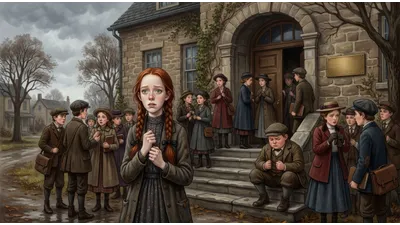
Before you read — think about:
- Why do people sometimes dread a test more than it deserves?
- How do you keep yourself occupied when you cannot do anything to hurry a result?
- What are healthy and unhealthy ways of handling pressure before something important?
- How do you usually hear school news at home?
- How can wanting to make the people who love you proud drive your hardest work?
Watch for these while reading:
- How the different pupils cope with their nerves.
- Anne's letters home, and what she chooses to put in them.
- What Anne says she is working for, when she says it at all.
- The wait for the pass list, and its effect on the household.
- Avonlea's appetite for news.
Vocabulary to know:
testimony (noun) — evidence or proof showing that something is true.; alarmingly (adverb) — in a disturbing or worrying manner that causes concern.; superstitious (adjective) — believing in luck, signs, or magical effects rather than logic.; cram (verb) — to study intensely and hurriedly right before an examination.; grind (noun) — a continuous routine of hard, exhausting, or tedious work.; headway (noun) — forward progress toward reaching a goal.; composed (adjective) — calm, peaceful, and in control of one's feelings.; boardinghouse (noun) — A house where people pay to live and eat.; chastened (adjective) — subdued or humbled in mood after realizing a mistake or facing a serious challenge.; suspense (noun) — a state of anxious uncertainty while waiting for news or an outcome.; fared (verb) — performed or turned out in a particular test or situation.; surpass (verb) — to exceed, outperform, or prove superior to someone or something.; unbearable (adjective) — too distressing, painful, or difficult to tolerate.; fervently (adverb) — with deep, passionate, and sincere feeling.; grubbing (noun) — dull, tedious, and painstaking work.; unimaginative (adjective) — lacking creativity, original ideas, or poetic inspiration.; conjugations (noun) — the organized lists of the different forms a verb takes.; sinkaway (adjective) — causing a sudden, dread-filled dropping sensation in the stomach due to intense anxiety.; languished (verb) — lost energy, vitality, or enthusiasm over time.; indifference (noun) — a total lack of interest, enthusiasm, or concern.; sibilant (adjective) — making or characterized by a soft hissing or rustling sound.; conditioned (verb) — passed an exam overall but required to clear a specific failed subject before full standing is granted.; presumptuous (adjective) — overly confident or bold, taking too much for granted without justification.; aspiration (noun) — a strong hope, desire, or ambition for high accomplishment..
Chapter 33: The Hotel Concert

Before you read — think about:
- What would you wear to perform in front of people you did not know?
- What is the difference between practising something and doing it for real?
- Have you ever performed or spoken in front of people? What did you notice about yourself?
- What did a grand seaside hotel offer visitors in the 1880s, and who could afford it?
- What kind of recitation, music, or performance do you actually enjoy, if any?
Watch for these while reading:
- Anne's east gable room, and how it has changed since her first night in it.
- The White Sands Hotel and the company gathered in it.
- Anne's thoughts about her own appearance among the guests.
- The audience, and how Anne feels it looking at her.
- Anne's ideas about what it means to be rich.
Vocabulary to know:
organdy (noun) — a lightweight, sheer cotton fabric that is slightly stiff; luster (noun) — a gentle, soft sheen or glow on a surface; burnished (adjective) — polished until smooth, bright, and shiny; freakish (adjective) — unpredictable, unusual, or strangely whimsical; conniving (verb) — quietly allowing, overlooking, or secretly agreeing to something; vagrant (adjective) — wandering, unpredictable, or drifting without a fixed direction; Cupids (noun) — artistic figures of chubby, winged cherubs or angels; amateur (adjective) — relating to an activity done for personal enjoyment rather than for professional pay; conferred (verb) — granted or bestowed as an honor, title, or privilege; debarred (verb) — excluded, prevented, or prohibited from participating in something; bestowed (verb) — given, applied, or dedicated toward a person or purpose; Madonna (noun) — a serene likeness or portrayal of Mary, symbolizing quiet grace and purity; stolid (adjective) — calm, serious, and showing little emotion or excitement; civility (noun) — polite and courteous behavior toward others; bumpkins (noun) — unsophisticated or awkward people from rural areas; belles (noun) — popular, attractive young women at a social gathering; elocutionist (noun) — a public speaker skilled in clear, expressive speech and recitation; lithe (adjective) — thin, supple, and graceful in movement; flexible (adjective) — able to adjust or change tone smoothly and easily; unpropitious (adjective) — unfavorable or unpromising; unlikely to yield success; subtle (adjective) — delicate, understated, or cleverly indirect; paralyzed (verb) — rendered helpless or unable to act due to sudden fear or shock; taunting (adjective) — mocking, teasing, or intended to provoke someone; captivated (verb) — charmed, delighted, and held the complete attention of others; decamped (verb) — departed or ran away suddenly or secretively; darkling (adjective) — growing dark, shadowy, or obscure; Titian (adjective) — a bright, rich reddish-brown or auburn color; tremor (noun) — a slight shaking or quivering in a voice or movement; partake (verb) — to join in or share, especially in eating food or refreshments.
Chapter 34: A Queen's Girl
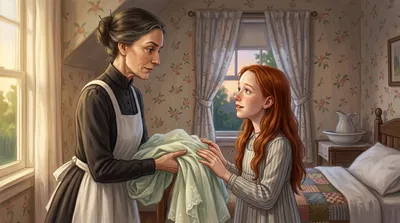
Before you read — think about:
- What is the hardest class you think the next school will have?
- Who would you want as a roommate, and what would make them easy to live with?
- How do you learn your way around a building you have never been in?
- What is a small object you like to have with you in a new place?
- How do you say hello to a room full of people you do not know yet?
Watch for these while reading:
- Marilla's way of marking the occasion.
- What Anne says to reassure Marilla.
- Matthew's private thoughts about Anne.
- The boarding house in town, and Anne's first days in it.
- The talk at Queen's about scholarships and prizes.
Vocabulary to know:
ample (adjective) — more than enough; plentiful and generous in amount.; preposterous (adjective) — completely absurd, ridiculous, or contrary to reason.; pruned (verb) — trimmed back or simplified to encourage healthy development.; agitatedly (adverb) — in an upset, restless, or nervously excited manner.; reckon (verb) — to suppose, think, or believe something to be true.; tolerably (adverb) — fairly well; to an acceptable or passable degree.; plunged (verb) — threw oneself eagerly or forcefully into an activity or task.; acutely (adverb) — with sharp intensity or deep sensitivity.; untenanted (adjective) — unoccupied or not lived in by anyone; empty.; assorted (verb) — grouped or classified together into organized categories.; license (noun) — an official permit or document granting authorization to perform a specific career or duty.; speculation (noun) — the act of forming ideas or guesses about something without complete facts.; reduced (adjective) — having fallen into lower or poorer financial circumstances than one was accustomed to.; objectionable (adjective) — unpleasant, offensive, or open to disagreement.; materially (adverb) — to a significant or noticeable extent.; agony (noun) — extreme physical pain or intense mental distress.; network (noun) — an interconnected system of lines, wires, or connections.; tramp (noun) — the heavy, rhythmic sound of marching or walking footsteps.; subside (verb) — to settle down, lessen in intensity, or become quiet.; pinnacle (noun) — the highest peak or climax of achievement.; endow (verb) — to provide a permanent gift of money or funds to support a student or school.; respective (adjective) — belonging or relating individually to each person or item mentioned.; allotted (verb) — assigned or set aside for a particular purpose or recipient.; attain (verb) — to achieve, reach, or accomplish a goal through effort.; heath (noun) — a familiar territory or native environment where one feels completely at home..
Chapter 35: The Winter at Queen's

Before you read — think about:
- What does winter look like where you live, and how do you spend it?
- What is the difference between a friend and a classmate, for you?
- What subject would you study all winter if you had to pick one?
- How do reputations form within a large group over time?
- How do you divide your time between work you must do and things you enjoy?
Watch for these while reading:
- Anne's manner toward Gilbert when their paths cross.
- The friends Anne makes at Queen's, and what draws her to them.
- How Anne balances her work against her eye for beauty.
- Miss Barry's opinion of Anne.
- The medal and the Avery scholarship as talk among the students.
Vocabulary to know:
autumnal (adjective) — Relating to, characteristic of, or occurring in the season of autumn.; satchel (noun) — A small bag, often with a shoulder strap, used for carrying books, papers, or small belongings.; conceptions (noun) — Ideas, understandings, or mental impressions formed about something.; plodding (adjective) — Working or moving slowly, steadily, and deliberately, often without flash or inspiration.; modes (noun) — Fashions, styles, or prevailing ways of doing something.; preeminence (noun) — The quality of being superior, distinguished, or dominant over others in a particular field.; academical (adjective) — Relating to school, education, study, or scholarship.; insupportable (adjective) — Impossible to endure, tolerate, or bear; unbearable.; abated (verb) — Decreased in intensity, strength, or force; lessened.; provoking (adjective) — Causing annoyance, frustration, or irritation.; belittling (verb) — Making something or someone seem smaller, less important, or less valuable than they really are.; philosophically (adverb) — In a calm, reasonable, and thoughtful manner when facing difficulty or disappointment.; eddy (noun) — A small side movement or circular drift away from a main current or topic.; chaplet (noun) — A garland or wreath of flowers or leaves worn on the head as an ornament or symbol of honor.; arena (noun) — A sphere of activity, interest, or competition..
Chapter 36: The Glory and the Dream

Before you read — think about:
- How do you usually spend the last day of a school year?
- When you have worked a whole year at something, how do you want that year to end?
- What line of poetry does the title make you think of, if any, before you start?
- How do people mark the end of a long piece of work?
- What kind of glory is worth wanting, and what kind fades as soon as it is named?
Watch for these while reading:
- The last days of term at Queen's, and how the students pass them.
- The public rooms at Queen's, and how they feel on a busy day.
- Matthew's and Marilla's habits of speech when they talk about Anne.
- Anne's manner toward the other Queen's students as the year closes.
- What Matthew says to Anne, and how much of it he says.
Vocabulary to know:
attendant (adjective) — Accompanying or naturally associated with a particular situation or event.; self-denial (noun) — The practice of giving up one's own desires, comforts, or interests for the benefit of others or a higher goal.; sympathize (verb) — To feel or express sorrow, compassion, or understanding for someone facing a difficulty.; medalist (noun) — A person who wins or is awarded a medal in a competition or contest.; vigorously (adverb) — Done with great force, strength, energy, or enthusiasm.; parasol (noun) — A small, lightweight umbrella used to protect oneself from sunlight.; pelted (verb) — Threw a series of items repeatedly at someone or something.; studious (adjective) — Devoted to reading, learning, and academic work.; coeducational (adjective) — Educating both male and female students together in the same institution.; hesitatingly (adverb) — Done with pause, doubt, or uncertainty.; oculist (noun) — An eye doctor or specialist who treats vision problems.; unfits (verb) — Makes someone or something unsuitable, incapable, or unqualified for a specific purpose or role.; sphere (noun) — An area of activity, responsibility, interest, or influence.; nominal (adjective) — Existing in name or title only, rather than holding actual power or function.; institution (noun) — An established organization or company created for a specific social, educational, or financial purpose.; lavish (adjective) — Giving, producing, or spent in generous, plentiful, or abundant amounts.; harness (noun) — Routine daily labor or work; in the story's context, remaining active in one's ongoing duties.; sanctifying (adjective) — Purifying, elevating, or making something spiritually pure or sacred.; dues (noun) — Sacrifices, obligations, or effort required in exchange for achieving success..
Chapter 37: The Reaper Whose Name Is Death
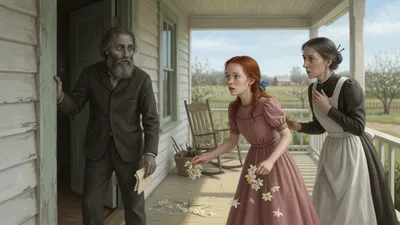
Before you read — think about:
- What do you know about the word 'reaper' from other books, songs, or sayings?
- How do you want a narrator to handle a subject this title names — plainly, gently, or at a distance?
- What is a summer smell, sound, or sight you would know anywhere?
- How do families talk — or not talk — about a life ending?
- How do you comfort someone when you do not know what to say?
Watch for these while reading:
- The talk at the Green Gables table, and who does most of it.
- The different ways people in one household show what they feel.
- How little, or how much, each person at Green Gables says in this chapter.
- Montgomery's descriptions of the summer landscape in this chapter.
- The ordinary domestic routines that carry on regardless.
Vocabulary to know:
instantaneous (adjective) — happening immediately or without any delay.; likelihood (noun) — the chance or probability that something will happen.; thronged (verb) — gathered together in large numbers to fill a place.; majesty (noun) — impressive beauty, dignity, or grandeur.; homestead (noun) — a family's farmhouse along with its surrounding land and buildings.; anguished (adjective) — experiencing or showing severe emotional pain or distress.; vigil (noun) — a period of staying awake through the night to keep watch, pray, or reflect.; solitude (noun) — the state of being alone; tilled (verb) — prepared and plowed land for growing crops.; regularity (noun) — the state or quality of occurring at fixed, predictable intervals.; inrush (noun) — a sudden, powerful inward surge or flow.; insistent (adjective) — demanding attention or refusing to give up.; disloyalty (noun) — unfaithfulness or a failure to stay loyal to someone.; unfaithful (adjective) — failing to remain loyal or true to a feeling, belief, or commitment.; slip (noun) — a small stem or shoot cut from a plant for growing a new one.; conch (noun) — a large ocean shell with a smooth, spiral shape.; convolutions (noun) — intricate coils, twists, or curved folds.; scrapes (noun) — awkward or troublesome situations caused by foolishness or carelessness.; possessed (adjective) — acting wild, irrational, or driven as if controlled by an outside force.; shapely (adjective) — having an attractive, well-proportioned form.; sulky (adjective) — silent, bad-tempered, and resentful out of disappointment..
Chapter 38: The Bend in the Road
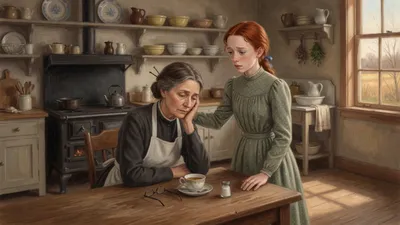
Before you read — think about:
- Why do people compare a life to a road with bends you cannot see around?
- When you finish a long book, what do you want to do immediately afterwards?
- What is a small daily thing that makes a house feel like home to you?
- What landscape do you know so well you could describe it with your eyes closed?
- If you could ask the author one question that is not 'what happens next', what would you ask?
Watch for these while reading:
- Small shifts in Marilla's tone when she speaks to Anne.
- The east gable room, and how Anne is using it these days.
- The orchard, the lane, and the view Anne has looked at since her first morning.
- Gilbert Blythe's manner toward Anne.
- The image of the bend in the road, and the language used about it.
Vocabulary to know:
inert (adjective) — lacking the power or energy to move or act; completely still; prohibition (noun) — an order or rule that forbids something from being done; fascination (noun) — the state of feeling deeply interested, captivated, or charmed by something; checkered (adjective) — Marked with patches of light and shadow.; vocation (noun) — a strong feeling of suitability for a particular career, occupation, or activity; unceasing (adjective) — continuing forever without stopping or pausing; constant; jubilantly (adverb) — with great joy, triumph, and celebration; thwarted (verb) — prevented someone from accomplishing a plan, purpose, or goal; destiny (noun) — the events or path that are predetermined to happen to a person in the future; fate; congenial (adjective) — pleasant, agreeable, and easy to get along with because of shared interests; birthright (noun) — a particular right, privilege, or freedom to which a person is entitled by birth; characteristic (noun) — a distinguishing feature, quality, or trait belonging to a person or thing; hues (noun) — shades, tints, or varieties of color; companioned (verb) — accompanied, escorted, or kept company by someone or something; scholarship (noun) — A grant of money that pays for schooling.; self-sacrificing (adjective) — willing to give up one's own desires, comfort, or advantages for the sake of others; application (noun) — a formal request submitted to secure a position, job, or opportunity; shadings (noun) — slight differences or gradual variations in color, tone, or meaning; stone-blind (adjective) — Completely blind.; bend (noun) — a sudden turn or change in life's direction, opening up unknown future opportunities; crispness (noun) — a sharp, brisk, and firm quality in tone, speech, or demeanor; horizons (noun) — the limits or range of a person's knowledge, experiences, or future possibilities.
About the Author
Lucy Maud Montgomery (1874–1942) grew up on Prince Edward Island, the landscape she gave this novel. Raised largely by her grandparents after her mother died, she drew on a childhood of reading, daydreaming, and close attention to woods and shore. The book was published in 1908 and made her famous almost at once.
The story is set on rural Prince Edward Island around 1900, when farm families did their own labor, children walked to one-room schools, and an orphan might be taken in as much for help as for charity. Neighbors knew one another's business. Montgomery used that small community as a complete world.