

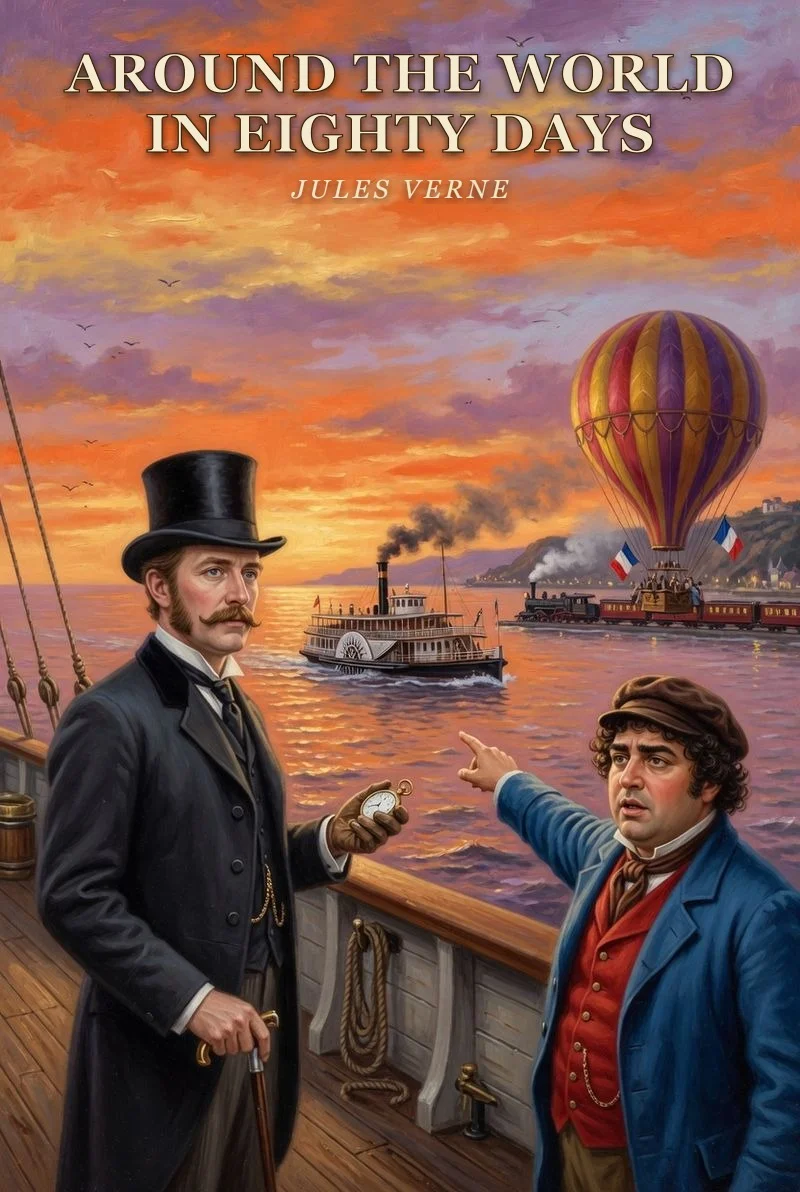
About This Book
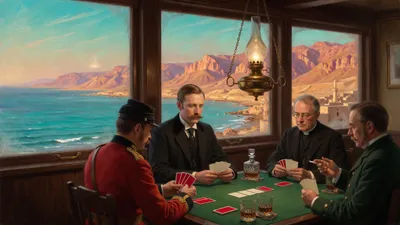
London, 1872. In a quiet corner of the Reform Club sits Phileas Fogg, a gentleman so precise that his servants can set their watches by him — same meal, same walk, same evening cards, and almost no one knows where his fortune came from. On the day he hires a new French manservant named Passepartout, a newspaper claim reaches the card table: new railways and steamships could circle the globe in eighty days. Fogg says he believes it. His friends say timetables lie. So he does something no one expects from such a calm man: he stakes half of everything he owns that he can do it himself, and he leaves that same night.
This is one of the great adventure novels, and it moves. Verne wrote it as a race, and readers feel the pressure of the deadline on nearly every page, which makes it a rewarding book for students who think they do not like older novels. It is also a book worth arguing with. Written at the height of the British Empire, it shows nineteenth-century Europeans travelling through countries they only half understand, and it gives readers a chance to notice both the wonder and the blind spots in how the travellers see the world. Underneath the chases and the printed timetable is a quieter question middle-school readers already know how to argue: what is a person actually worth — the money they have, the schedule they keep, or something the schedule cannot measure?
Meet the Characters

More about Phileas Fogg
Phileas Fogg is a rich, silent London gentleman who lives his life by the clock, doing everything at exactly the same hour every day. He belongs to the Reform Club, where he plays cards each evening, and almost nobody knows where his money came from. He is polite, generous, and so unshakably calm that he seems almost like a machine made of habits.

More about Jean Passepartout
Passepartout is a good-humoured Frenchman who has tried half a dozen jobs — including circus acrobat and firefighter — before coming to London to look for a quiet position. He takes service with Phileas Fogg hoping for a peaceful, orderly life at last. He is loyal, talkative, and sure he has at last found a household with no surprises in it.

More about Detective Fix
Fix is a determined detective from Scotland Yard who is stationed abroad watching for a criminal on the run. He is clever, patient, and stubborn, and once he fixes on an idea he refuses to let it go. He believes completely in his own instincts.

More about Aouda
Aouda is a well-educated young woman from a respected Parsee family in Bombay, raised to speak fluent English and at ease in both Indian and European company. She is gentle and soft-spoken, with a quiet dignity that does not look like helplessness. When the travellers first see her, she is not travelling with them.

More about Andrew Stuart
Andrew Stuart is an engineer and one of the regular whist players at the Reform Club in London. He enjoys a lively argument and is quick to say plainly when he thinks an idea is nonsense. He is not unkind, only blunt, and he trusts facts and figures more than grand claims.

More about Sir Francis Cromarty
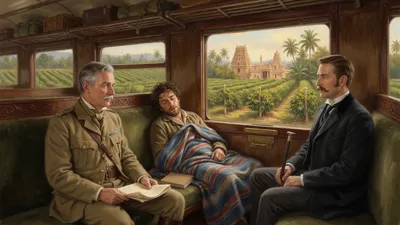
Sir Francis Cromarty is a brigadier-general in the British army in India, now on his way inland to rejoin his corps at Benares. He has spent years in the country and notices what a newcomer does not. He is courteous, plain-spoken, and more interested in people than in timetables.

More about John Bunsby
John Bunsby is the master of a small, beautifully kept pilot-boat working out of Hong Kong, with a crew who know the Chinese seas. He takes an obvious pride in his vessel. He is practical, blunt, and not easily impressed by gentlemen who want the sea to keep a schedule.

More about Colonel Stamp Proctor
Colonel Stamp Proctor is a San Francisco political man, used to crowds, arguments, and getting his own way in public. He speaks at volume and treats disagreement as an insult. When the travellers first see him, he is simply one more raised voice in a packed street.

More about Captain Andrew Speedy
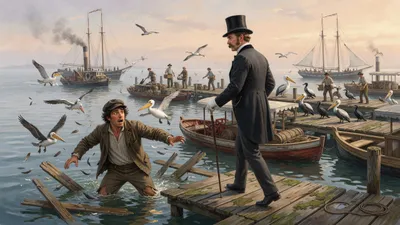
Andrew Speedy of Cardiff is the owner and captain of a small iron trading steamer lying in New York harbour. He is stubborn, short-spoken, and not for sale at any passenger's price. He introduces himself as a man going about his own business, not as a ferry.
Pre-Reading Discussion Questions
- The title tells you the goal and the deadline before you read a single page. Why might an author give away that much, and what does it make you curious about instead?
- Phileas Fogg does exactly the same things at exactly the same times every single day. Would you enjoy living on a schedule that strict? What might someone gain from it, and what might they lose?
- Fogg risks half his fortune on a bet he did not need to make. What makes people accept a challenge when they have nothing to gain and a great deal to lose?
- In 1872 a trip around the world took eighty days; today it takes about two days by air. How do you think faster travel changes the way people think about distance and about other countries?
- In 1872 a traveller with enough money could buy a ticket around the world from a printed timetable. What would such a timetable be able to promise, and what would it be unable to promise?
- Think of a story you know where someone is racing a clock. What does a deadline do to characters that a calmer situation would not?
Themes & Big Ideas to Track
- Time as both a tool and an opponent: notice how often the story measures progress in hours and minutes gained or lost.
- The difference between what people appear to be and what they actually are, especially when someone judges another person too quickly.
- Technology and progress: watch how railways, steamships, and telegraphs make the journey possible while also creating new ways for it to fail.
- Empire and the outsider's eye: pay attention to how the travellers describe the countries they pass through, and where their descriptions seem incomplete or unfair.
- The language of master and servant: notice who gives orders, who is allowed to be surprised, and who the narrator calls by name.
- What a printed timetable cannot hold: keep a running sense of what Fogg spends — money, hours, comfort — without deciding yet what the spending is for.
Chapter-by-Chapter Study Guide
Chapter 1: Fogg Hires a New Servant

Before you read — think about:
- Think of someone you know only by sight. What do you assume about them, and how much of that is guesswork?
- What can a person's daily routine tell you about who they are, before they say a single word to you?
- Is it possible to be admired by everyone and close to no one? What would a life like that look like from the outside?
- In 1872 London, wealthy men spent their days in private clubs, reading newspapers and playing cards. What do you imagine such a club offered its members besides meals?
- If you were hiring someone to work in your home, which would matter more to you: their skills or their temperament?
Watch for these while reading:
- Exact numbers. Count how often the narrator measures Fogg's life in minutes, degrees, or paces.
- The house at No. 7 Saville Row, and how little of it Fogg actually uses.
- The list of jobs Passepartout has held, and the way he tells it.
- The narrator's comparisons for Fogg: instruments, clockwork, and machinery.
- Fogg's habits at the whist table, and where his winnings go.
Vocabulary to know:
enigmatical (adjective) — mysterious and hard to figure out; taciturn (adjective) — saying very little; naturally silent; avaricious (adjective) — greedy, especially for money; benevolent (adjective) — kind and generous toward others; secluded (adjective) — hidden away and far from other people; conjectures (noun) — guesses made without proof; congenial (adjective) — pleasantly suited to a person's nature or taste; porphyry (noun) — a hard, polished purple-red stone used in grand buildings; succulent (adjective) — juicy, tender, and delicious; proffered (verb) — held out or offered something to someone; viands (noun) — items of food, especially fine dishes; decanters (noun) — glass bottles used for serving wine or other drinks at the table; eccentric (adjective) — behaving in a way most people find odd or unusual; sumptuous (adjective) — expensive, grand, and luxurious; grenadier (noun) — a tall soldier of a special infantry regiment, known for standing rigidly at attention; itinerant (adjective) — travelling from place to place instead of settling in one spot; valet (noun) — a manservant who takes care of a gentleman's clothes and personal needs; tranquil (adjective) — calm, quiet, and untroubled; pernicious (adjective) — causing harm, often in a slow or hidden way; predecessor (noun) — the person who held a job or position before someone else; luckless (adjective) — unlucky; having bad fortune.
Chapter 2: Passepartout Settles Into a Perfect Household

Before you read — think about:
- What is the first thing you would do if you were left alone in a stranger's house that you were about to work in?
- How can a room, a schedule, or a piece of furniture tell you about the person who owns it?
- Passepartout has served in several households and left every one of them. What makes an employer difficult to work for?
- When you start a new job, what do you look at first to decide whether you will like it?
- What does the word 'perfect' mean when applied to a job? Would your idea of a perfect job match your parents' idea?
Watch for these while reading:
- The printed card of duties hanging in Passepartout's room, and how finely the day is divided on it.
- Fogg described a second time, now through Passepartout's eyes rather than the narrator's.
- Objects the house does not contain, as much as the ones it does.
- The clock, and the amount of attention the narrator gives it.
- How Passepartout feels about the household after he has looked through every room.
Vocabulary to know:
flurried (adjective) — flustered and slightly confused; phlegmatic (adjective) — calm and hard to excite or upset; composure (noun) — calm control over one's feelings and behaviour; chronometer (noun) — an extremely accurate timekeeping instrument; exactitude (noun) — the quality of being exact and precise in every detail; superfluous (adjective) — more than is needed; unnecessary; deliberate (adjective) — unhurried, careful, and fully intended; rubicund (adjective) — having a healthy reddish colour, said of a face; portly (adjective) — somewhat heavy and solidly built; tresses (noun) — long locks of hair; vagrant (noun) — a person who wanders from place to place without a settled home; repose (noun) — rest, calm, and freedom from disturbance; chagrin (noun) — a feeling of annoyance mixed with disappointment; whimsical (adjective) — acting on sudden fancies; unpredictable; remonstrance (noun) — a protest or firm objection; garret (noun) — a small room just under the roof of a house; an attic; methodical (adjective) — done according to an orderly, fixed system; illustrious (adjective) — famous and greatly admired; scrutinised (verb) — examined something very closely and carefully; toilet (noun) — the process of washing, shaving, and dressing oneself — not a bathroom.
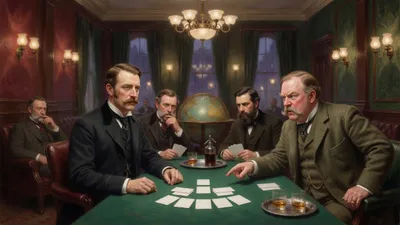
Chapter 3: A Card Game and a Reckless Wager
Before you read — think about:
- How do you tell the difference between confidence and arrogance in someone who claims they can do something difficult?
- What is the difference between betting for money and betting to prove a point?
- Why do people argue more fiercely about something that has not happened yet than about something that has?
- In 1872 new railways and canals had suddenly made long journeys much faster. How do you think people reacted to news that the world had 'shrunk'?
- What makes someone accept a challenge in public that they might quietly refuse in private?
Watch for these while reading:
- Whist itself, and the way Verne uses a card game to keep a conversation moving.
- The newspaper story the club members are chewing over before travel comes up.
- Each objection the doubters raise — weather, breakdowns, unreliable timetables — and the manner of the replies.
- The published itinerary, leg by leg, and the arithmetic that produces the number eighty.
- The five club members by name, and how differently each of them speaks.
Vocabulary to know:
edifice (noun) — a large, impressive building; imposing (adjective) — grand and impressive in appearance; habitual (adjective) — usual; done regularly out of habit; gilded (adjective) — covered with a thin layer of gold, or gold in colour; morsel (noun) — a small piece of food; flunkey (noun) — a uniformed male servant who waits on people; perusal (noun) — the act of reading something carefully; ponderous (adjective) — heavy, large, and slow-moving; functionary (noun) — an official who performs a particular duty; ingot (noun) — a block of metal, such as gold, cast into a shape for storage; gratings (noun) — frameworks of metal bars placed over an opening as a barrier; apprehension (noun) — in this chapter, the capture or arrest of a person by the authorities; concede (verb) — to admit that something is true, often reluctantly; zeal (noun) — great energy and eagerness in pursuing something; incredulous (adjective) — unwilling or unable to believe something; shrewd (adjective) — clever and quick to judge a situation to one's own advantage; wager (verb) — to bet money on an uncertain outcome; stoical (adjective) — showing no emotion even under pressure or hardship; antagonists (noun) — opponents in a contest or argument; scruples (noun) — uneasy feelings about whether something is right or fair; unattainable (adjective) — impossible to achieve or reach; almanac (noun) — a book of calendars, dates, and useful yearly information; memorandum (noun) — a short written record of an agreement; pillage (verb) — to rob a place violently, especially during unrest or war; rubber (noun) — in the card game whist, a set of games played to decide a winner; trumps (noun) — in a card game, the suit chosen to outrank all the others for that hand; judicial (adjective) — relating to courts of law and legal judgment; persistency (noun) — the quality of stubbornly continuing despite opposition.
Chapter 4: Fogg Announces the Journey

Before you read — think about:
- What does an employee owe an employer, and what does an employer owe an employee? Where would you draw the line on each side?
- What is the difference between being decisive and being impulsive, and can you tell which is which at the time?
- How should a person react when they are given surprising news at work — ask questions, stay quiet, or argue?
- Some travellers plan every detail in advance and others prefer to decide as they go. Which are you, and what does each approach cost?
- Some people explain their plans at length and some people barely explain at all. Which kind of person is easier to work for?
Watch for these while reading:
- Fogg's tone as he gives the order, measured against his tone on an ordinary morning.
- Exactly what goes into the carpet-bag, and what is deliberately left out.
- Bradshaw's railway guide, and the use Fogg intends to make of it.
- The woman waiting outside the station door.
- The send-off at Charing Cross, and which of the club members appear there.
Vocabulary to know:
conscientiously (adverb) — carefully and thoroughly, out of a sense of duty; inexactness (noun) — the fault of not being precise or exact; unaccustomed (adjective) — not usual or familiar; comprehended (verb) — understood the meaning of something; stupefaction (noun) — a state of being stunned and unable to think clearly; mackintosh (noun) — a waterproof raincoat; chary (adjective) — cautious and sparing about giving or spending something; hitherto (adverb) — up until now; alms (noun) — money or goods given to poor people as charity; tattered (adjective) — torn and worn into rags; wretched (adjective) — in a miserable, poor, or worn-out condition; susceptible (adjective) — easily moved or affected by feelings; guineas (noun) — old British gold coins, each worth slightly more than a pound; ensconced (verb) — settled comfortably and securely in a place; mechanically (adverb) — automatically, without thinking about it; stout (adjective) — strong and sturdily made; goodly (adjective) — fairly large in amount or size.
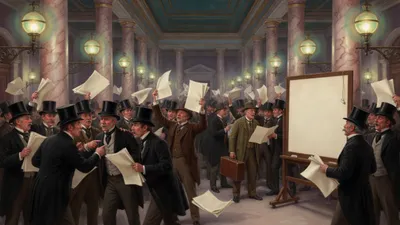
Chapter 5: London Bets on the Traveler
Before you read — think about:
- Where do you go when you want to know whether a surprising claim is true? How do you decide a source is reliable?
- Why might two newspapers take opposite sides on the same question, and how should a reader decide whom to trust?
- What is the difference between an expert's judgment and popular opinion? Is either one always more reliable?
- Would you put your own money on a stranger's success? What would you need to know first?
- Would knowing that money was riding on the answer change the way you argued about it?
Watch for these while reading:
- The scientific and geographical objections printed against the journey, and how reasonable each one sounds.
- The one elderly gentleman who holds a minority opinion, and his reasoning.
- The language of the Stock Exchange applied to a human being: shares, premiums, quotations.
- The unsolved robbery at the Bank of England, and the description circulated of the man wanted for it.
- How Verne moves the camera away from his travellers to show London talking about them.
Vocabulary to know:
scouted (verb) — in this chapter, rejected an idea scornfully as ridiculous; aberration (noun) — a departure from normal, sensible behaviour or thinking; espoused (verb) — took up and publicly supported a cause; folly (noun) — foolishness; a foolish plan or action; miraculous (adjective) — so unlikely that it seems like a miracle; misgiving (noun) — a feeling of doubt or worry about something; liability (noun) — the likelihood that something unwanted will happen; irrevocably (adverb) — in a way that cannot be undone or reversed; advocates (noun) — people who publicly support a person or cause; temperament (noun) — a person's or a people's usual nature and way of behaving; par (noun) — the normal or face value of something bought and sold, especially a bond; premium (noun) — an amount paid above the usual or face value; subside (verb) — to become less intense; to die down; paralytic (adjective) — unable to move part or all of the body; feasible (adjective) — possible to do; dwindled (verb) — grew steadily smaller in number or size; instantaneous (adjective) — happening at once, with no delay; pretext (noun) — a false reason given to hide the real one; elude (verb) — to escape from or avoid being caught; warrant (noun) — an official legal document giving police the power to arrest someone.
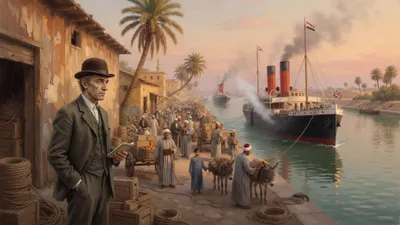
Chapter 6: Detective Fix Waits at Suez
Before you read — think about:
- What does a detective actually have to work with when hunting someone they have never laid eyes on?
- The Suez Canal opened in 1869, only three years before this story. How would a new shortcut between Europe and Asia change world travel?
- Can you tell anything true about a stranger from their face? What are the risks of believing that you can?
- If you were trying to avoid capture, would you run to a distant country or stay exactly where you were? Why?
- How might the promise of a large reward affect the way an investigator reads the evidence in front of him?
Watch for these while reading:
- The way Fix describes his own method of recognising criminals, and how much of it is evidence rather than instinct.
- The consul's objections, and the reasoning Fix offers against each of them.
- The port itself: the ships, the crowd, the mixture of nations at a place where the world crosses.
- The difference between what Fix is certain of and what he can prove.
- The first passenger off the Mongolia that Fix chooses to speak to.
Vocabulary to know:
promenading (verb) — walking slowly back and forth in a public place; wharves (noun) — landing platforms built along the water where ships are loaded and unloaded; sojourning (verb) — staying somewhere for a short time; straggling (adjective) — spread out in an untidy, scattered way; abridged (verb) — shortened; incessantly (adverb) — without stopping; manifesting (verb) — showing something clearly through behaviour; feverish (adjective) — restless and overexcited, as though ill with a fever; dogmatically (adverb) — in a way that states opinions as though they were certain facts; countenances (noun) — faces, or the expressions on them; contemptible (adjective) — deserving scorn; not worth respect; windfalls (noun) — unexpected pieces of good fortune, especially large sums of money; quay (noun) — a solid landing place built beside water for ships; minarets (noun) — tall, slender towers attached to a mosque; roadstead (noun) — a sheltered stretch of water near the shore where ships can safely anchor; discernible (adjective) — able to be seen or recognised; presentiment (noun) — a feeling that something is about to happen; importunate (adjective) — persistently demanding and hard to shake off; involuntary (adjective) — done without meaning to; not under one's control; indispensable (adjective) — absolutely necessary; consul (noun) — an official who represents their country's interests in a foreign city; plied (verb) — travelled a route regularly, as a ship or coach does.
Chapter 7: A Passport Proves Useless

Before you read — think about:
- What is a passport actually for, and what can it prove about the person carrying it?
- How do you stay polite when someone in authority is taking longer than you think they should?
- What kinds of records do people keep to prove where they have been? Which of them would convince a doubter?
- How do you keep track of whether you are ahead or behind on a long journey?
- Is it possible to pass through a whole country and see nothing of it? What would that require of a traveller?
Watch for these while reading:
- What Fix asks the consul for, and the reason he is given for the answer.
- Fogg's stated reason for wanting a visa he is not legally required to have.
- The notebook Fogg keeps, and the columns it is ruled into.
- The narrator's dry remarks about the way certain Englishmen travel.
- How long Fogg spends ashore at Suez, and how he spends it.
Vocabulary to know:
preamble (noun) — an introduction that comes before the main statement; narrated (verb) — told the story of what had happened; rascal (noun) — a dishonest or mischievous person; countersigned (verb) — signed by a second person to confirm that a document is valid; visa (noun) — an official stamp or signature on a passport permitting or recording travel; rogues (noun) — dishonest people; scoundrels; genuine (adjective) — real and authentic, not forged; devoured (verb) — in this chapter, stared at someone hungrily and intensely; customary (adjective) — usual; done according to custom; itinerary (noun) — a detailed plan or record of a journey; stipulated (verb) — stated as a required condition of an agreement; locality (noun) — a particular place or district; inscribed (verb) — written or recorded carefully; wont (adjective) — in the habit of doing something; domestics (noun) — household servants.
Chapter 8: Passepartout Says Too Much

Before you read — think about:
- Have you ever come away from a conversation and understood that you had told a stranger more than you meant to? How does that happen?
- What makes someone seem trustworthy within a few minutes of meeting them?
- Why do people talk more freely when they are far from home than they do in their own city?
- Ports mix people who will never meet again. How does that change the way they speak to each other?
- What sorts of details about your family or your employer would you treat as private, even if they sounded harmless?
Watch for these while reading:
- Each fact Passepartout hands over, and how ordinary every one of them seems by itself.
- The argument about the watch, and what Passepartout's stubbornness says about him.
- The questions Fix chooses to ask, and the ones he is careful not to ask.
- Passepartout's own private worry about the journey, and how Fix answers it.
- The quay at Suez: the heat, the crowd, and how long the two of them stand talking.
Vocabulary to know:
lounging (verb) — standing or sitting about in a lazy, relaxed way; volubly (adverb) — talking a great deal and very readily; regulate (verb) — to adjust a device so that it is set correctly; defiant (adjective) — boldly refusing to obey or give in; fob (noun) — a small pocket in a waistcoat or trousers for holding a watch; foolhardy (adjective) — recklessly bold without thinking of the danger; impenetrable (adjective) — impossible to see into or understand; solitary (adjective) — alone; without company; whence (adverb) — from where; cogitating (verb) — thinking something over carefully; equanimity (noun) — calmness and evenness of mind; pump (verb) — in this chapter, to question someone steadily in order to draw out information; dispatch (noun) — an official message sent quickly, especially by telegraph; hastily (adverb) — in a great hurry; uttered (verb) — spoke or said aloud; ere (preposition) — an old-fashioned word meaning 'before'; shillings (noun) — old British coins, twenty of which made one pound; sixpence (noun) — an old British coin worth six pennies.
Chapter 9: Smooth Sailing Toward Bombay
Before you read — think about:
- What was long-distance sea travel like before airplanes — who was aboard, and how did passengers fill the days?
- Is it possible to cross half the world and stay completely uninterested in it? What would that say about a traveller?
- What is the difference between being calm and being indifferent?
- How does someone draw information out of a person who trusts them, and is that always dishonest?
- What makes a long journey feel long? Is it the distance, the company, or something else?
Watch for these while reading:
- How Fogg passes the voyage, and how often he appears on deck at all.
- The same sea described twice: once as Fogg experiences it and once as Passepartout does.
- The cover story Fix gives for himself, and the company he keeps aboard.
- The running column of hours gained, and where the gains are coming from.
- The Red Sea, Aden and the Indian Ocean — the geography Verne pauses to describe.
Vocabulary to know:
traverse (verb) — to travel across a distance or area; exertions (noun) — great physical or mental efforts; purser (noun) — the ship's officer who handles accounts and looks after passengers; scrupulously (adverb) — very carefully and exactly, leaving nothing out; caprice (noun) — sudden and unpredictable changes of behaviour; boisterous (adjective) — rough, noisy, and wild; billows (noun) — large, rolling waves; slacken (verb) — to become slower or less forceful; impassible (adjective) — showing no feeling or reaction whatever; indifference (noun) — a complete lack of interest or concern; picturesque (adjective) — pretty or striking enough to be worth painting; propitiating (verb) — winning the favour of a god or person, often with a gift or offering; indefatigably (adverb) — tirelessly; without ever seeming to grow weary; delusion (noun) — a belief that is comforting but false; whim (noun) — a sudden wish or idea, especially one that seems unreasonable; obliging (adjective) — eager to be helpful; amiable (adjective) — friendly and good-natured; alacrity (noun) — cheerful eagerness and speed in doing something; ravished (verb) — filled with intense delight (Victorian sense of being overjoyed, not a word for violence); espied (verb) — caught sight of something at a distance; sauntered (verb) — walked in a slow, relaxed way; cisterns (noun) — large tanks built to store water; fortifications (noun) — walls, towers, and other defences built to protect a place; famished (adjective) — extremely hungry; pagodas (noun) — tiered towers used as temples in parts of Asia; thither (adverb) — an old-fashioned word meaning 'to that place'.
Chapter 10: Trouble in a Bombay Temple

Before you read — think about:
- When you have only a few hours in a new city, how do you decide what is worth seeing?
- What is the difference between being curious about a place and being careless in it?
- How do rules about jurisdiction — who holds authority where — shape the way police work across borders?
- How do you behave differently as a guest in someone else's home than in your own?
- Why do people so often assume that their own customs are the normal ones?
Watch for these while reading:
- How Fogg uses his few hours in Bombay compared with how his servant uses them.
- A short exchange about dinner that shows Fogg is sharper than his blank manner suggests.
- What the Bombay police have to tell Fix.
- The pagoda on Malabar Hill, and the details Passepartout stops to admire.
- The Bombay railway station at night, and the picture Verne draws of the departure.
Vocabulary to know:
apex (noun) — the highest point or pointed tip of something; despotic (adjective) — ruling with total power and without regard for others' wishes; dominion (noun) — control or authority over a territory; insurrection (noun) — an organised uprising against those in power; annexed (verb) — took over a territory and added it to one's own; subordinates (noun) — people of lower rank who work under someone's authority; cumbrous (adjective) — clumsy and difficult to manage because of size or weight; palanquins (noun) — covered seats carried on poles by several bearers; unwieldy (adjective) — awkward to move or handle because of size or shape; terminus (noun) — the end point of a railway or bus line; bazaars (noun) — markets made up of many small shops and stalls; deign (verb) — to lower oneself enough to do something; grottoes (noun) — caves, especially ones that have been carved or decorated; palatable (adjective) — pleasant to taste; sorely (adverb) — very greatly; painfully; fain (adjective) — willing, or forced by circumstances, to do something; austere (adjective) — strict and plain in the way one lives; thrifty (adjective) — careful and wise about spending money; gauze (noun) — a very thin, light, see-through fabric; agile (adjective) — able to move quickly and easily; adversaries (noun) — opponents in a fight or contest; squabble (noun) — a noisy, untidy quarrel or scuffle; crestfallen (adjective) — disappointed and ashamed; obscure (adjective) — dim and hard to see; hidden away; forthwith (adverb) — immediately; without delay; ferocious (adjective) — fierce and dangerous.
Chapter 11: An Elephant at a Fabulous Price
Before you read — think about:
- How much would you pay for something you absolutely had to have, if the seller knew that you had to have it?
- Passepartout keeps his watch on London time wherever he goes. Why might a person cling to a habit like that?
- If you were crossing an unfamiliar country by train, what would you most want to see out of the window?
- What is the difference between an animal that works for people and an animal that belongs to them? Should there be limits on what a working animal is asked to do?
- Sir Francis Cromarty has spent years in India and Fogg has never set foot there. How does long experience change what a person notices about a place?
Watch for these while reading:
- Sir Francis Cromarty, and the private questions he asks himself about his travelling companion.
- Fogg's standard reply whenever he is told that something has gone wrong.
- The change that comes over Passepartout as India rolls past the window.
- How a bargain is conducted when one side plainly cannot walk away.
- The Parsee guide, and the elephant Kiouni.
Vocabulary to know:
indigo (noun) — a deep blue dye made from a plant, and an important Indian export; corps (noun) — a large organised unit of an army; circumference (noun) — the distance all the way around a circle; terrestrial (adjective) — belonging to the planet Earth; oddity (noun) — the quality of being strange or unusual; comparable (adjective) — similar enough to be compared with something else; viaducts (noun) — long bridges, usually with arches, that carry a road or railway across a valley; defiles (noun) — narrow passes between mountains or cliffs; verdant (adjective) — green with growing plants; deranged (verb) — in this chapter, thrown into disorder; disrupted; tributaries (noun) — smaller rivers or streams that flow into a larger river; limpid (adjective) — perfectly clear and transparent; pensive (adjective) — thoughtful in a quiet, serious way; ruffians (noun) — violent, lawless people; reverie (noun) — a daydream; a state of pleasant thinking; vagabond (adjective) — wandering from place to place without a settled home; maledictions (noun) — curses; angry words wishing harm; sluggishness (noun) — slowness and lack of energy; meridian (noun) — an imaginary north-south line used to measure longitude and set local time; obstinately (adverb) — stubbornly refusing to change; glade (noun) — an open, grassy space within a forest; hamlet (noun) — a very small village; retorted (verb) — replied quickly and sharply; premature (adjective) — happening or announced too early; perambulating (adjective) — walking or moving about; grimace (noun) — a twisted expression showing pain or dislike; palings (noun) — a fence made of upright pointed stakes; domesticated (adjective) — tamed and trained to live or work with people; impart (verb) — to give a quality to someone or something; point-blank (adverb) — flatly and directly, with no explanation offered; alluring (adjective) — strongly tempting or attractive; sterling (noun) — British money; the pound as a currency; outright (adverb) — completely and all at once; rashly (adverb) — without thinking about the consequences; howdahs (noun) — seats, often with canopies, fastened on an elephant's back for riders; astride (preposition) — with one leg on each side of something; conveyance (noun) — a vehicle or other means of carrying people from place to place.
Chapter 12: Across the Indian Forest

Before you read — think about:
- What does it take to trust a guide — someone who knows a place that you do not know at all?
- Fogg has spent an enormous sum to buy back time. What else might a person be willing to spend on the same thing?
- Verne describes India for readers who had never seen it. What are the dangers of learning about a country only from someone else's description?
- Long journeys throw strangers together for days at a time. What do you learn about people from travelling with them?
- How does an author build suspense when the characters are only travelling?
Watch for these while reading:
- How each of the four travellers copes with a rough and jolting ride.
- The small kindnesses Passepartout shows the elephant.
- Verne's account of the forest country: the trees, the wildlife, the villages left behind.
- What Sir Francis Cromarty says about British authority in India, and where he admits it does not reach.
- The Parsee guide's manner on the march, and how he handles Kiouni.
Vocabulary to know:
jostled (verb) — shaken and knocked about roughly; spurred (verb) — urged forward to move faster; concussion (noun) — a violent shaking or jolt caused by an impact; vaulted (verb) — leapt or was thrown upward; quenching (verb) — satisfying a thirst; copses (noun) — small groups of trees or bushes; frequented (verb) — visited often; inaccessible (adjective) — impossible or very difficult to reach; fastnesses (noun) — strongholds in places that are hard to reach; contortions (noun) — twisted, exaggerated movements of the body; convulsed (verb) — shook uncontrollably, especially with laughter; gaiety (noun) — cheerfulness and high spirits; estimable (adjective) — deserving respect and admiration; ruinously (adverb) — in a way that costs so much it causes financial ruin; bolstering (verb) — propping something up for support; slumberers (noun) — people who are asleep; formidable (adjective) — large or powerful enough to inspire fear or respect; serene (adjective) — calm, peaceful, and untroubled; murmur (noun) — a low, continuous sound that is hard to identify; thicket (noun) — a dense growth of bushes and small trees; bestride (verb) — to climb onto and sit with a leg on either side; foliage (noun) — the leaves of trees and plants; discordant (adjective) — harsh and clashing in sound; lugubrious (adjective) — sad and mournful; cymbals (noun) — round brass plates struck together to make a ringing crash; entwined (adjective) — twisted together; caparisoned (adjective) — dressed in ornamental coverings, as an animal in a ceremony; haggard (adjective) — looking wild, worn, and hollow; dishevelled (adjective) — untidy and disordered, especially of hair or clothing; prostrate (adjective) — lying stretched out flat, face down; capering (verb) — leaping and dancing about wildly; ochre (noun) — a yellow-brown earth colour used as paint or dye; apparel (noun) — clothing, especially fine or formal clothing; faltered (verb) — moved unsteadily, as if about to stop or fall; muslin (noun) — a fine, lightweight cotton cloth; ravenously (adverb) — very hungrily; suttee (noun) — a historical practice in parts of India in which a widow died on her husband's funeral fire, sometimes by choice and sometimes under pressure from others; voluntary (adjective) — done by a person's own free choice; indignation (noun) — anger at something felt to be deeply unfair; repress (verb) — to hold back a feeling or reaction; intoxicated (verb) — made unable to think or act clearly, as by a drug; scanty (adjective) — barely enough; very small in amount.
Chapter 13: A Daring Rescue

Before you read — think about:
- Before a risky plan, what do you need to know about the people helping you?
- What is the difference between courage and recklessness? Where would you draw the line?
- How do you stay useful during a long wait, when there is nothing you can do?
- When you cannot see what is happening, how do you keep from imagining the worst?
- How does a person decide that a stranger's life is worth more than their own plans?
Watch for these while reading:
- What the travellers learn about the young woman's name, her upbringing, and how she came to be where she is.
- The guide's answers about the danger, and the limits he sets on his own part in it.
- The plans the party considers, and how each one is argued through.
- Passepartout's mood as the hours pass, measured against the others'.
- Fogg's manner across a long night of waiting, measured against everyone else's.
Vocabulary to know:
impracticable (adjective) — impossible to carry out in practice; ally (noun) — someone who joins with you to help in a struggle; neutrality (noun) — the state of refusing to take either side; resuscitated (verb) — brought back to life, or made to seem alive again; abduction (noun) — the act of carrying a person away without permission; pyre (noun) — a pile of wood built for a funeral fire; intervention (noun) — the act of stepping in to change what is about to happen; reconnaissance (noun) — a careful look around to gather information before acting; noiselessly (adverb) — without making any sound; rosin (noun) — a hard, sticky substance from pine trees, used to make torches burn; embalmed (verb) — treated a dead body with substances to preserve it; dusk (noun) — the dim light at the end of the day; strewn (verb) — scattered untidily over a surface; sabres (noun) — swords with curved blades; colloquy (noun) — a conversation, especially a serious or private one; anon (adverb) — an old-fashioned word meaning soon, or now and then; assiduously (adverb) — with constant and careful attention; ascertain (verb) — to find something out for certain; wane (noun) — the period when the visible moon is growing smaller; aperture (noun) — an opening or gap; prudence (noun) — careful good sense about avoiding danger; gnashed (verb) — ground the teeth together, usually in anger or frustration; suppleness (noun) — the ability to bend and move easily; multitude (noun) — a very large crowd of people; stupor (noun) — a dazed condition in which a person can barely think or move; spectre (noun) — a ghost; prodigy (noun) — an amazing event that seems beyond nature; audacity (noun) — bold daring, especially of a risky kind; apprised (verb) — informed; made aware of something; volley (noun) — a number of shots fired at the same moment; fugitives (noun) — people running away to escape capture.
Chapter 14: Down the Valley of the Ganges

Before you read — think about:
- What does a person who has just come through terrible danger need in the first hours afterward?
- How do you properly thank someone who risked their life for you, when money would be an insult?
- Famous rivers attract travellers and pilgrims. What do people come to a river like the Ganges to find?
- Is it possible to travel through a famous and beautiful region and remember nothing of it?
- Aouda has lost her home and her family's protection. What does a person need in order to start again somewhere new?
Watch for these while reading:
- The praise Fogg gives Passepartout, and how few words he spends on it.
- The elephant Kiouni, and the Parsee who has guided them this far.
- Aouda's own account of her family, her education and her marriage.
- The valley of the Ganges as Verne describes it: Benares, the pilgrims, the river itself.
- The state of the timetable by the time the party reaches Calcutta.
Vocabulary to know:
exploit (noun) — a bold and daring deed; commendation (noun) — praise or approval; spouse (noun) — a husband or wife; venerable (adjective) — deserving respect because of great age or dignity; drowsiness (noun) — a heavy, sleepy feeling; inevitably (adverb) — in a way that cannot be prevented; pilgrims (noun) — people who travel to a sacred place for religious reasons; mantle (noun) — a loose cloak worn over other clothing; pelisse (noun) — a long cloak lined or trimmed with fur; triumphantly (adverb) — in a way that shows pride in a success; rhapsody (noun) — a piece of writing or speech full of extravagant praise; exaggerated (verb) — described something as greater than it really was; farthing (noun) — an old British coin of very small value; devotion (noun) — loyal, self-sacrificing dedication to a person or cause; vengeance (noun) — punishment carried out in return for a wrong; serviceable (adjective) — useful and willing to help; debtor (noun) — someone who owes something to another person; habiliments (noun) — clothing, especially of a particular style or purpose; abashed (adjective) — embarrassed and shy about being noticed; sequel (noun) — what happens afterward as a result; deliverers (noun) — people who rescue someone from danger; menaced (verb) — threatened with harm; shuddered (verb) — shook suddenly from fear or cold; adieu (noun) — a farewell; goodbye; gallant (adjective) — brave and courteous; diversified (adjective) — varied; made up of many different kinds; ablutions (noun) — ceremonial washings performed as a religious act; pious (adjective) — deeply devoted to religious duties; fervent (adjective) — showing very strong feeling; deities (noun) — gods and goddesses; anglicised (adjective) — made English in customs, language, or appearance; packet (noun) — a boat that carries mail and passengers on a regular scheduled route.
Chapter 15: A Fine Paid in Banknotes

Before you read — think about:
- What is the purpose of a fine, as opposed to a prison sentence? When is each one appropriate?
- Calcutta in 1872 was governed by the British. What problems arise when one country's courts rule over another country's people?
- Why do courts use written charges and spoken questions instead of simply taking a policeman's word?
- How do you keep your head when you are accused of something you were not expecting?
- How would you defend yourself in a courtroom where you did not understand the charge?
Watch for these while reading:
- How Fogg behaves when a policeman gives him an order, and what the narrator says about the English and the law.
- The two Calcuttas the carriage drives through: the European quarter and the Indian one.
- Judge Obadiah's courtroom, and the comedy Verne makes out of its procedure.
- The item of evidence the clerk lays on the table.
- The public benches in the courtroom, and the kind of crowd Verne puts there.
Vocabulary to know:
squalid (adjective) — dirty and miserable, usually because of poverty or neglect; equipages (noun) — horse-drawn carriages together with their horses and attendants; bristling (verb) — covered thickly with things standing up; elapsed (verb) — passed, said of time; placidly (adverb) — calmly and without any sign of worry; magistrate (noun) — an official who judges less serious cases in a court of law; sacrilege (noun) — the act of treating something holy with disrespect; consecrated (adjective) — declared sacred and set apart for religious use; desecrator (noun) — a person who treats a sacred place with disrespect; misdemeanour (noun) — an offence against the law that is less serious than a major crime; escapade (noun) — a reckless adventure that causes trouble; damages (noun) — money paid to make up for harm or loss; connivance (noun) — secret agreement or cooperation in doing something wrong; inasmuch (conjunction) — a formal way of saying 'because' or 'to the extent that'; sternly (adverb) — in a severe and strict manner; condemn (verb) — to sentence someone to a punishment; bail (noun) — money paid to a court so an accused person can stay free until the case ends; liberated (verb) — set free; prodigal (adjective) — spending money recklessly and on a huge scale; diminishing (verb) — becoming smaller; imprudent (adjective) — unwise; not thinking about the consequences; preoccupied (adjective) — absorbed in one's own thoughts and not noticing other things; proceedings (noun) — the events and actions that make up a legal case; complainants (noun) — the people who bring a complaint before a court; constable (noun) — a police officer; moored (verb) — tied up in place, said of a boat; hoisted (verb) — raised up, especially by rope; detained (verb) — kept in official custody.
Chapter 16: Fix Plays Innocent

Before you read — think about:
- How do two people who owe each other a great deal, but hardly know one another, begin a friendship?
- How do people who are not friends, but are stuck on the same ship, settle into a daily pattern?
- What makes a sea voyage a good setting for a story? What can happen there that could not happen on land?
- Aouda has left everything behind. What is it like to depend entirely on the kindness of people you have only just met?
- Is politeness the same as kindness? Can a person be one without being the other?
Watch for these while reading:
- How Fogg conducts himself toward Aouda: what he does rather than what he says.
- Fix's habits on deck, and the company he chooses.
- A theory Fix builds about Aouda, and how little he has to build it on.
- Fix's hours on the Rangoon when he is not speaking to anyone.
- The explanation Fix offers for happening to be aboard the same steamer.
Vocabulary to know:
comprised (verb) — consisted of; was made up of; protector (noun) — a person who guards and defends another; automaton (noun) — a machine that moves on its own; a person who acts mechanically; exalting (adjective) — lifting something up so that it seems greater or nobler; baronet (noun) — a British title of honour, ranking just below a baron; essayed (verb) — attempted; tried; intractable (adjective) — stubborn and impossible to influence or manage; reserved (adjective) — keeping one's thoughts and feelings private; prosperously (adverb) — successfully and favourably; superb (adjective) — magnificent; of the highest quality; swarmed (verb) — gathered or moved in huge numbers; afforded (verb) — provided or gave; impelled (verb) — forced or driven to act; refuge (noun) — a place of safety from pursuit or danger; extradition (noun) — the legal handing over of an accused person from one country to another; avail (noun) — use or benefit; confidant (noun) — a person trusted with someone's private business; accomplice (noun) — a person who helps another commit a crime; disclosure (noun) — the act of revealing something that was secret; implicated (verb) — shown to be involved in something wrong; damsel (noun) — an old-fashioned word for a young woman; elopement (noun) — the act of running away secretly with someone, usually to marry; intrigue (noun) — a secret plot or scheme; abominable (adjective) — extremely unpleasant or objectionable; perplexed (adjective) — puzzled and unable to understand; berth (noun) — a bed or sleeping place on a ship or train; crony (noun) — a close, familiar companion; restoration (noun) — the act of giving something back or returning a person to a former state.
Chapter 17: From Singapore to Hong Kong

Before you read — think about:
- Singapore, Penang, Hong Kong — Verne names real ports his readers had never seen. Why do writers use real places instead of invented ones?
- What is the difference between a good guess and a correct one?
- What does the phrase 'reading too much into it' mean? Have you ever built a theory the facts did not support?
- What would you want to see during a single day's stop in a tropical port?
- Why do writers describe the weather at sea so carefully? What can weather do to a story that dialogue cannot?
Watch for these while reading:
- The explanation Passepartout invents for Fix's constant company, and how logical it actually is.
- How Passepartout treats Fix from day to day, now that he thinks he understands him.
- Singapore as Verne paints it: the roads, the fruit, the light.
- Verne's aside about the opium trade between British India and China, and the tone he takes toward it.
- The narrator's long comparison of Fogg to a body travelling through space.
Vocabulary to know:
divulge (verb) — to make private information known; inveterate (adjective) — long-established and unlikely ever to change; complacent (adjective) — comfortably pleased and agreeable, without worry; disembarked (verb) — went ashore from a ship; cudgelled (verb) — beat; used in the phrase 'cudgelled his brain', meaning struggled hard to think; mistrust (noun) — a lack of confidence in someone's honesty; chaff (verb) — to tease someone in a good-humoured way; allusions (noun) — indirect references to something without naming it; craggy (adjective) — steep and rocky; islets (noun) — very small islands; intercepted (verb) — blocked or cut off something on its way; prescribed (adjective) — officially set or laid down in advance; manoeuvres (noun) — clever or crafty movements made to achieve something; checkered (adjective) — marked out in a pattern of squares or patches; sleek (adjective) — smooth, glossy, and well cared for; clime (noun) — a region thought of in terms of its climate; gourmands (noun) — people who greatly enjoy good food; quota (noun) — a fixed share or number; defective (adjective) — faulty; not properly made; consigned (verb) — sent off or handed over to some place or fate; remorselessly (adverb) — without stopping or showing any pity; bantering (adjective) — teasing in a playful, joking way; intently (adverb) — with close and steady attention; foothold (noun) — a secure position from which further progress can be made; majestic (adjective) — grand, dignified, and impressive; gravitated (verb) — was drawn toward something as if pulled by gravity; perpetual (adjective) — never ending; going on continuously; indignant (adjective) — angry at something that seems unfair or wrong.
Chapter 18: Three Travelers, Three Errands

Before you read — think about:
- How can three people caught in the same storm come away with three completely different feelings about it?
- Steamships in 1872 ran on coal and could not simply go faster at will. What limits does a machine put on human plans?
- Three people want three different things from the same day in port. How do competing goals create tension in a story?
- What is the difference between a passenger and a guest? How should travellers treat someone who is travelling under their protection?
- If you had one day in a strange port and one important errand, how would you spend it?
Watch for these while reading:
- The three reactions to the gale, and what each one reveals about the man having it.
- The engineer, the coal, and the argument about pressure in the boilers.
- The captain's calculations about coal, speed and arrival, and Fogg's manner as he listens to them.
- The pilot who comes aboard off Hong Kong, and the shipping news he carries.
- The errand each of the three men sets out on once ashore.
Vocabulary to know:
monstrous (adjective) — enormous and frightening in size; tempest (noun) — a violent storm with strong winds; squall (noun) — a sudden violent burst of wind, often with rain; reefed (verb) — reduced the area of a sail by rolling or folding part of it away; rigging (noun) — the ropes and chains that support a ship's masts and work its sails; tempestuous (adjective) — stormy and violently disturbed; writhing (verb) — twisting the body about in discomfort; exultation (noun) — a feeling of triumphant joy; adversity (noun) — a time of serious difficulty or misfortune; exasperated (verb) — irritated and frustrated intensely; restrained (verb) — held back from acting; overwhelmed (verb) — flooded or overpowered with a large quantity of something; barometer (noun) — an instrument that measures air pressure and helps predict the weather; perceptible (adjective) — able to be noticed or detected; prevail (verb) — to succeed in persuading or overcoming; veered (verb) — changed direction, especially of the wind; unfurled (verb) — unrolled and spread out, as a sail or flag; imperil (verb) — to put in danger; flotilla (noun) — a fleet of small boats; junks (noun) — flat-bottomed Chinese sailing ships with square sails; postponed (verb) — delayed until a later time; broker (noun) — a person who buys and sells on behalf of others; residence (noun) — the place where a person lives; ado (noun) — fuss, trouble, or delay; gait (noun) — a manner or speed of walking.
Chapter 19: Passepartout Is Led Astray

Before you read — think about:
- When you are sent on an errand in a city you do not know, what do you do first to keep from getting lost?
- Loyalty can be a virtue or a blind spot. How would you tell which one yours is?
- How well do you need to know a person before you can vouch for their character?
- Hong Kong in 1872 was a British port on the Chinese coast. What does it mean for a city to be run by a country on the other side of the world?
- Verne keeps putting his characters in ports and harbours. What kinds of people pass through a busy port, and why might a writer find that useful?
Watch for these while reading:
- The shipping office Passepartout is sent to, and the clerk behind the counter.
- Two men holding entirely different conversations while each believes they agree.
- How sure of himself Fix looks while he talks, and how Passepartout answers him.
- The reason Passepartout gives for his answer to the offer.
- The Hong Kong waterfront after dark: the lights, the noise, and the crowd along the quay.
Vocabulary to know:
antipodes (noun) — places on the exact opposite side of the world from one another; supremacy (noun) — the state of being more powerful than all others; macadamised (adjective) — surfaced with layers of crushed stone, as a road; parterres (noun) — flower beds laid out in an ornamental pattern; imperial (adjective) — belonging to an emperor or an empire; accosted (verb) — approached and spoke to someone boldly; inveigh (verb) — to protest or complain bitterly against something; unconscious (adjective) — not awake or aware, as after a drug or a blow; tavern (noun) — a public house where drinks are served; narcotic (noun) — a drug that dulls the senses and causes drowsiness; cadaverous (adjective) — extremely pale and thin, like a corpse; despicable (adjective) — deserving contempt and disgust; afflict (verb) — to cause suffering or distress to someone; stringent (adjective) — strict and severe; ravages (noun) — the severely destructive effects of something; dispense (verb) — to manage without something; obligation (noun) — a debt of gratitude; something one feels bound to repay; raillery (noun) — good-humoured teasing; commission (noun) — an official document giving a person authority to act; dupes (noun) — people who have been tricked or fooled; complicity (noun) — involvement with others in doing something wrong; presumptions (noun) — things assumed to be true without full proof; assert (verb) — to state something firmly and confidently; conspiracy (noun) — a secret plan by several people to do something wrong; trickery (noun) — the use of deception to cheat someone; waylay (verb) — to lie in wait and stop someone on their way; stammered (verb) — spoke with hesitation, repeating sounds; exclusively (adverb) — only; limited to one group or purpose.
Chapter 20: Fix Faces Fogg at Last

Before you read — think about:
- What did it take to run a global shipping timetable before radio? How would ports and ships have kept each other informed?
- What can a traveller with unlimited money do that other travellers cannot? What can money not fix?
- What is the difference between being generous and being extravagant? Does the reason behind the spending change your answer?
- What makes a person good to work for? Would you rather have an employer who is fair or one who is kind?
- How do you keep your temper when you are depending on other people's timetables and none of them is yours?
Watch for these while reading:
- How Fogg spends his last hours in Hong Kong, and the way he accounts for his own generosity.
- Fogg's choice of words when he is handed bad news, here as everywhere else in the book.
- The performance Fix puts on the first time he speaks to Fogg face to face.
- The bargaining on the quay: the tonnage, the distance, and the sums named aloud.
- The hours spent asking after Passepartout, and who is asked.
Vocabulary to know:
acquitted (verb) — carried out or performed a task or duty; serenity (noun) — calmness and freedom from worry; vexation (noun) — annoyance or irritation; feigning (verb) — pretending to have a feeling one does not really have; excessively (adverb) — extremely; to a very great degree; presentable (adjective) — looking neat and fit to be seen; craft (noun) — a boat or ship, especially a small one; charter (verb) — to hire a vehicle or vessel for one's own private use; resort (verb) — to turn to something as a last option; excursion (noun) — a short trip taken for pleasure; earnest (adjective) — serious and sincere; formalities (noun) — official procedures that have to be completed; consulate (noun) — the office where a consul represents their country abroad; sheathing (noun) — a protective outer covering; galvanised (adjective) — coated with zinc so that it will not rust; brigantine (noun) — a type of sail, or a two-masted vessel carrying it; mariners (noun) — sailors; sprightly (adjective) — lively and full of energy; self-reliant (adjective) — able to depend on one's own abilities; timid (adjective) — easily frightened; lacking courage; cots (noun) — narrow beds, often ones that can be folded or hung; divan (noun) — a long low couch without a back or arms; confined (adjective) — small and cramped; akin (adjective) — similar to; of the same kind as; humiliation (noun) — a painful loss of pride or dignity; ensued (verb) — followed as a result; briskly (adverb) — quickly and energetically.
Chapter 21: The Tankadere in the Storm

Before you read — think about:
- What are the risks of crossing open sea in a very small boat during the stormy season?
- How does a captain weigh speed against safety?
- What makes someone trust a stranger with their life? Is it evidence, or something else?
- Sailing ships depended on skills that steam was making obsolete. What is lost when an old craft is replaced by a machine?
- How do people behave differently when they are frightened and cannot let it show?
Watch for these while reading:
- John Bunsby and his crew, and Fogg's one instruction about whose trade it is.
- Fix alone in the bow, arguing with himself.
- The attempt Fix makes to pay his own way, and the answer he is given.
- The rigging, the reefs and the seamanship: Verne's obvious pleasure in technical detail.
- The choice the skipper puts to his passengers as the weather worsens.
Vocabulary to know:
perilous (adjective) — full of danger; equinoxes (noun) — the two times each year when day and night are of equal length, often marked by storms at sea; admirably (adverb) — extremely well; in a way that deserves praise; confide (verb) — to place trust in someone; staggering (verb) — walking or standing unsteadily; profoundly (adverb) — very deeply and intensely; twilight (noun) — the dim light between sunset and darkness; frail (adjective) — weak and easily damaged; rustled (verb) — made a soft, dry crackling sound; overcast (verb) — covered over with cloud; collisions (noun) — crashes between two moving objects; meditation (noun) — long, quiet thinking; impunity (noun) — freedom from punishment or consequences; villain (noun) — a wicked person or criminal; fulfil (verb) — to carry something out completely; scintillations (noun) — tiny flashes or sparkles of light; capricious (adjective) — changing suddenly and without a reliable pattern; profile (noun) — the outline of something seen from the side; tonnage (noun) — the size or carrying capacity of a ship; surge (noun) — a powerful rolling swell of water; subsided (verb) — became less strong or died down; repast (noun) — a meal; scorched (verb) — burned the surface of something; stifled (adjective) — smothered or held back; helm (noun) — the wheel or tiller by which a ship is steered; regatta (noun) — a series of boat races; eddies (noun) — small circling currents or whirlpools of water; mercury (noun) — the silvery liquid metal used inside barometers and thermometers; phosphorescent (adjective) — giving off a faint glow without heat; typhoon (noun) — a violent tropical storm of the western Pacific; meteorologist (noun) — a scientist who studies the weather; luminous (adjective) — giving off light; glowing; adroit (adjective) — skilful and quick in handling something; philosophically (adverb) — calmly accepting what cannot be changed; trough (noun) — the low hollow between two waves; tenacity (noun) — determination that refuses to let go; founder (verb) — of a ship, to fill with water and sink; undiminished (adjective) — not reduced in force or strength; fickle (adjective) — changing often and unreliably; zephyrs (noun) — soft, gentle breezes; rudder (noun) — the flat blade at the back of a boat used for steering; muzzle (noun) — the open front end of a gun barrel; distress (noun) — a signal showing that a ship urgently needs help; succour (verb) — to give help to someone in trouble; resounded (verb) — echoed loudly.
Chapter 22: Stranded in Yokohama

Before you read — think about:
- What would you miss most about home if you were suddenly living in a country whose language you did not speak?
- How do people cope with not knowing what has become of someone they care about?
- Is it worse to be stranded somewhere yourself, or to have caused trouble for someone who depends on you?
- Yokohama in 1872 sat between Japan and the Western shipping world. What would you expect that mix to look like on the streets?
- How much can you honestly understand about a place by walking through it for a single day?
Watch for these while reading:
- The order in which Passepartout puts his own story together, and where he lays the blame.
- His thinking about whether the business of Fix should ever reach his master's ears.
- The European quarter of Yokohama set beside the Japanese quarter, and which details Verne lingers over.
- The practical problem that grows steadily worse as the chapter goes on.
- Passepartout's clothes, and how much attention he pays to them.
Vocabulary to know:
torpor (noun) — a state of heavy sluggishness in which one can barely move or think; abode (noun) — a place where someone lives or stays; totter (verb) — to move unsteadily, as though about to fall; exhilarating (adjective) — refreshing and full of energy; thunderstruck (adjective) — completely astonished, as if struck by lightning; inveigled (verb) — tricked or coaxed someone into doing something; enviable (adjective) — good enough that others would want it; verandas (noun) — roofed porches running along the outside of a house; peristyles (noun) — rows of columns surrounding a courtyard or building; promontory (noun) — a high point of land jutting out into the sea; groves (noun) — small groups or woods of trees; interminable (adjective) — seeming to go on forever; sectaries (noun) — members of a particular religious group; encrusted (verb) — covered with a hard decorative coating; enveloped (verb) — completely wrapped or surrounded; friars (noun) — members of a religious order who live on charity; stature (noun) — a person's natural height; motley (adjective) — made up of many different sorts; quaint (adjective) — attractively unusual or old-fashioned; streamers (noun) — long narrow flags or ribbons used as decoration; odorous (adjective) — having a strong smell; concocted (verb) — made by mixing ingredients together; fermentation (noun) — the chemical process that turns sugars into alcohol; camellias (noun) — flowering shrubs or small trees with large showy blossoms; voracious (adjective) — extremely greedy for food; herons (noun) — tall wading birds with long legs and necks; symbolise (verb) — to stand for or represent something; astrologers (noun) — people who claim to read the future in the stars; suites (noun) — groups of attendants accompanying an important person.
Chapter 23: A Circus Act in Japan

Before you read — think about:
- What is the difference between what something is worth and what somebody will pay for it?
- How do people find work in a place where they cannot speak the language and have no references?
- Have you ever had to do something undignified for a good reason? How did it feel afterward?
- What does an audience actually pay for at a circus or a theatre — skill, surprise, or spectacle?
- Verne wrote about Japan for readers who would never go there. What responsibility does a writer have when describing a country to people who cannot check?
Watch for these while reading:
- The first plan Passepartout considers, and the objections he raises against it himself.
- What he trades, and what he receives for it.
- The Honourable William Batulcar, his poster, and his manner of doing business.
- The parts of Passepartout's history that suddenly become useful again.
- The Long Noses: the costume, the pyramid, and how the whole act is built.
Vocabulary to know:
jaded (adjective) — worn out and exhausted; melodious (adjective) — pleasant and musical to listen to; bestowed (verb) — given as a gift; battledores (noun) — light wooden paddles once used to hit a shuttlecock; slumbers (noun) — periods of sleep; garments (noun) — items of clothing; cravings (noun) — powerful desires, especially for food; accoutred (verb) — dressed or equipped in a particular outfit; turban (noun) — a head covering made by winding a length of cloth; jingled (verb) — made a light ringing sound, as coins do; references (noun) — statements about a person's character or work from someone who knows them; placard (noun) — a large printed notice or poster; troupe (noun) — a company of performers who travel and work together; proprietor (noun) — the owner of a business; patronage (noun) — the support or protection given by a powerful patron; perspective (noun) — the technique of showing depth and distance in a picture; jugglers (noun) — performers who keep several objects moving through the air; mountebanks (noun) — travelling entertainers or showmen, sometimes tricksters; equilibrists (noun) — performers highly skilled at balancing; straightway (adverb) — immediately; robust (adjective) — strong and sturdily built; furrowed (verb) — marked with deep lines or grooves; vexed (adjective) — annoyed or irritated; designated (verb) — appointed or chosen for a particular role; rehearse (verb) — to practise a performance before presenting it; spectators (noun) — people watching an event; precipitated (verb) — flung or rushed headlong; extinguished (verb) — put out, as a flame; successively (adverb) — one after another in order; appendages (noun) — things attached to something larger; attired (verb) — dressed in a particular way; somersaults (noun) — complete forward or backward rolls of the body in the air; donned (verb) — put on an item of clothing; reminiscence (noun) — a memory of a past experience; melancholy (adjective) — sad and thoughtful; cornices (noun) — decorative mouldings running along the top of a wall; elicited (verb) — drew out a response or reaction; clambering (verb) — climbing awkwardly using hands and feet; appeased (verb) — calmed someone's anger, often by giving them something.
Chapter 24: Crossing the Pacific

Before you read — think about:
- What do you say to someone after you have accidentally caused them serious trouble?
- Three weeks at sea with very little happening — how does an author keep that interesting?
- Why might two people who have been at odds still eat at the same table for weeks?
- Long sea voyages gave passengers weeks with nothing to do. How do people fill time when there is nothing they can do to hurry things along?
- What would you miss most on a three-week Pacific crossing in 1872 — news from land, private space, or work to do?
Watch for these while reading:
- Passepartout back at his ordinary duties aboard ship.
- Aouda on deck, and how she passes the long Pacific days.
- The tallies Verne gives at the halfway point: days spent, miles covered, oceans crossed.
- How Fix and Passepartout treat one another now that three weeks on the same ship leave them nowhere to go.
- The General Grant herself, and the crowd of passengers Verne assembles aboard her.
Vocabulary to know:
procure (verb) — to obtain something with effort; complement (noun) — the full number of people needed or allowed; moment (noun) — in this chapter, importance — as in the phrase 'nothing of moment'; sustained (verb) — held up and supported; paddle-wheel (noun) — a large wheel with boards around it that drives a ship through the water; rectilinear (adjective) — moving in or forming a straight line; massive (adjective) — very large and heavy; keenest (adjective) — sharpest or most intense; attached (adjective) — fond of someone; emotionally bound to them; eulogies (noun) — speeches or writings full of praise; termination (noun) — the end or conclusion of something; deviation (noun) — a departure from a set course; parallel (noun) — an imaginary line circling the globe at a fixed distance from the equator; locomotion (noun) — movement from one place to another; circuits (noun) — roundabout routes; hilarious (adjective) — extremely funny; full of merriment; moonshine (noun) — foolish or empty talk; nonsense; theatrical (adjective) — relating to the stage; exaggerated and showy; unperceived (adjective) — unnoticed; administered (verb) — delivered or applied something to someone; pugilistic (adjective) — relating to boxing or fist-fighting; rumpled (adjective) — crumpled and untidy; vanquished (verb) — defeated or overcome; thrashing (noun) — a severe beating; budge (verb) — to move even slightly; treason (noun) — a betrayal of trust or of one's own side; faith (noun) — sincerity and honesty of intention, as in the phrase 'good faith'.
Chapter 25: A Glimpse of San Francisco
Before you read — think about:
- What do you picture when you imagine the American West of 1872? Where do those pictures come from?
- How much can a city change in twenty years, and why do people's older ideas of it stick?
- What is the difference between a stereotype and a fair generalisation? How can you tell which one you are using?
- America had just come through a civil war and chose its officials very differently from Britain. How does the way a country picks its leaders shape ordinary life?
- Fogg has crossed half the world and looked at almost none of it. Does travel change a person, or only the people who want to be changed?
Watch for these while reading:
- The San Francisco of legend measured against the city Verne actually describes.
- The election meeting: the banners, the speakers, and how little of it anyone can hear.
- Fix's clothes and his face in the San Francisco street, as Verne describes them.
- Colonel Stamp Proctor, and the impression he makes in very few lines.
- The exchange with the hotel porter at the end of the chapter, and the joke Verne is making with it.
Vocabulary to know:
facilitate (verb) — to make something easier to do; clippers (noun) — fast sailing ships built for speed; cormorants (noun) — large dark seabirds that dive for fish; innumerable (adjective) — too many to be counted; palatial (adjective) — grand and spacious, like a palace; omnibuses (noun) — large horse-drawn vehicles carrying many passengers; banditti (noun) — bandits; organised robbers; incendiaries (noun) — people who deliberately set fires; plunder (noun) — goods taken by force; emporium (noun) — a large centre of trade; lofty (adjective) — very tall and imposing; spacious (adjective) — having plenty of room; partake (verb) — to take a share of something, especially food; diminutive (adjective) — very small; precaution (noun) — an action taken in advance to prevent trouble; assemblage (noun) — a gathering of people; nominate (verb) — to put someone forward for an office or position; undulations (noun) — smooth wave-like movements; floundered (verb) — moved clumsily and helplessly; tumultuous (adjective) — loud, confused, and disorderly; din (noun) — a loud, continuous, confused noise; rout (noun) — a crowd of people driven back in disorder; repulsed (verb) — driven back by force; hubbub (noun) — a loud confused noise of many voices; frantic (adjective) — wildly excited or agitated; flank (noun) — the side of a body of people, especially in a fight; hustled (verb) — pushed and shoved roughly; brawny (adjective) — physically strong and muscular; contemptuous (adjective) — showing scorn or disdain; fray (noun) — a noisy fight or scuffle; opportune (adjective) — happening at a very suitable time; retaliating (verb) — striking back after being attacked; duelling (noun) — the practice of fighting an arranged fight over a point of honour.
Chapter 26: Aboard the Pacific Railroad

Before you read — think about:
- What would it take to lay a railway across an entire continent in the 1860s?
- How is a long train journey different from a long sea voyage?
- What changes for the people already living in a place when a railway is driven through it?
- Sleeping, eating and washing in a moving carriage for a week — what would you find hardest about that?
- Two people who have wronged each other are now sitting side by side for a week. How do people manage that?
Watch for these while reading:
- The scale of the line: its length, its cost, and how quickly it was built.
- How a passenger carriage is converted for the night, and how fast the crew do it.
- The country outside the windows — the Sierra Nevada, the desert, the long plain.
- The buffalo, and the engineer's reasoning about them.
- How Fogg occupies himself while the train stands still.
Vocabulary to know:
designation (noun) — an official name or title for something; uninterrupted (adjective) — continuous, with no break; infested (verb) — overrun by something considered unwelcome or dangerous; colonise (verb) — to settle in a territory and establish control over it; injuriously (adverb) — in a way that causes harm or damage; prairies (noun) — wide, treeless grasslands; morrow (noun) — the following day; grade (noun) — the steepness of a slope on a road or railway; perpendicular (adjective) — at a right angle to something; aisle (noun) — a passage between rows of seats; edibles (noun) — things that can be eaten; cheerless (adjective) — gloomy and without comfort; mutual (adjective) — shared by two or more people; intimacy (noun) — close friendship and familiarity; provocation (noun) — something that stirs up anger; obstruct (verb) — to block or get in the way of; steward (noun) — an attendant who looks after passengers; dormitory (noun) — a room in which many people sleep; bedsteads (noun) — the frames that support beds; ingenious (adjective) — cleverly designed or invented; improvised (verb) — made or arranged quickly from what is available; precipices (noun) — very steep rock faces or cliffs; cow-catcher (noun) — a metal frame on the front of a locomotive for pushing obstacles off the rails; cascades (noun) — small waterfalls; creeks (noun) — small streams; ruminating (adjective) — chewing the cud, as cattle and similar animals do; insurmountable (adjective) — impossible to get over or past; encumbered (verb) — blocked or burdened; spectacle (noun) — a striking or impressive sight; arsenal (noun) — a collection of weapons; impeding (verb) — getting in the way of; slowing down; mishap (noun) — an unlucky accident.
Chapter 27: A Lecture on the Way to Utah
Before you read — think about:
- What do you do when somebody tries to persuade you of something you know nothing about?
- How can you tell the difference between learning about a religion and being recruited into one?
- Why might a group of people cross an entire continent to build a community of their own?
- What is the difference between describing a place and passing judgment on the people who live there?
- Verne's narrator often mocks what he describes. How should a reader handle a narrator like that?
Watch for these while reading:
- The notice pinned to the carriage doors, and who takes it up.
- Elder William Hitch, his manner, and what the narrator suggests lies behind it.
- The size of the audience as the lecture goes on.
- The history and geography of the Great Salt Lake that Verne stops to set down.
- The last passenger to climb aboard at Ogden, and the single line he is given.
Vocabulary to know:
missionary (noun) — a person sent to spread their religion to others; manuscript (noun) — something written by hand rather than printed; affixed (verb) — attached or fastened to something; polygamy (noun) — the practice of having more than one husband or wife at the same time; martyr (noun) — a person who suffers or dies for their beliefs; persecutions (noun) — cruel and sustained mistreatment because of belief or identity; gainsay (verb) — to deny or contradict; visage (noun) — a person's face or expression; rebellion (noun) — armed or organised resistance against a government; disciples (noun) — committed followers of a leader or teacher; proselytes (noun) — people newly converted to a religion; annals (noun) — a written record of events set down year by year; bequeathed (verb) — left to someone after one's death; mystical (adjective) — relating to spiritual mystery beyond ordinary understanding; celestial (adjective) — belonging to the heavens or the sky; artisans (noun) — skilled workers who make things by hand; enterprising (adjective) — full of energy and initiative, especially in business; papyrus (noun) — an early form of paper made from a reed that grows in Egypt; wearisome (adjective) — tiring and dull; disconcert (verb) — to unsettle someone or throw them off balance; bankruptcy (noun) — the state of being legally unable to pay one's debts; creditors (noun) — people to whom money is owed; flourishing (adjective) — growing and succeeding well; ambuscade (noun) — an ambush; a surprise attack from hiding; successor (noun) — the person who takes over a position from another; fertile (adjective) — producing good crops; rich for growing; emigrants (noun) — people leaving their own country to settle elsewhere; auditor (noun) — a person who listens to a speech; vacancy (noun) — emptiness; empty space; strata (noun) — layers, especially of rock; encroached (verb) — gradually advanced into an area; breadth (noun) — width; distilled (verb) — purified by boiling a liquid and condensing the vapour; cereals (noun) — grain crops such as wheat and corn; luxuriant (adjective) — growing thickly and richly; symmetry (noun) — balanced, matching arrangement of parts; vicinity (noun) — the area near or surrounding a place; palisades (noun) — fences made of tall pointed stakes; vicissitudes (noun) — the changes of fortune, good and bad, in a life; vocation (noun) — a calling or occupation one is suited to; belated (adjective) — arriving late; decamped (verb) — left suddenly and hurriedly.
Chapter 28: Warnings Nobody Heeds
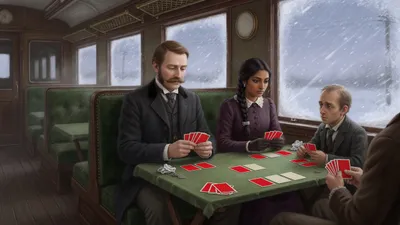
Before you read — think about:
- What makes a person hold on to a grudge? Is there ever a good reason to?
- What makes a group of people ignore the one person raising a sensible objection?
- How do you judge whether a risk is worth taking when you cannot work out the odds yourself?
- How were decisions made among a group of strangers travelling together in the 1870s?
- Mountain railways in the 1870s were new and often unfinished. What would you want to know before you rode one?
Watch for these while reading:
- The whist table in the carriage, and who sits down to play.
- The signal-man at Medicine Bow, the state of the bridge, and the choices he lays out.
- Passepartout listening, and how his manner differs from the louder men in the car.
- The vote: who argues loudest, and which arguments carry the carriage.
- The engineer's calculations about speed, weight and distance.
Vocabulary to know:
jagged (adjective) — having rough, sharp, uneven edges; subsidy (noun) — money granted by a government to support a project; pierced (verb) — made a hole or passage through something; elevation (noun) — height above sea level; ridge (noun) — a long narrow stretch of high ground; culverts (noun) — channels or small bridges that carry water beneath a road or railway; abundantly (adverb) — in large amounts; accumulation (noun) — a gradual gathering or build-up; grossly (adverb) — extremely and offensively; avenge (verb) — to take revenge on someone else's behalf; confounded (adjective) — an old-fashioned word used to express annoyance; wretched; sedentary (adjective) — inclined to sit still rather than move about; pretensions (noun) — claims to have a particular skill or quality; dummy (noun) — in whist, the fourth hand played openly when only three players are available; adept (noun) — a person highly skilled at something; counters (noun) — small discs used for keeping score in a game; declivity (noun) — a downward slope; irrigated (adjective) — supplied with water for growing crops; spurs (noun) — ridges projecting outward from a mountain range; conspicuous (adjective) — easily noticed; standing out; insolent (adjective) — rudely disrespectful; suspension-bridge (noun) — a bridge whose deck hangs from cables; penetrating (verb) — cutting or forcing a way through; immovable (adjective) — unable or unwilling to be moved; ford (noun) — a shallow place where a river can be crossed on foot; oaths (noun) — angry swear words; denouncing (verb) — publicly condemning; disinclined (adjective) — unwilling; trudge (verb) — to walk slowly and heavily; avowed (verb) — declared openly; astounded (adjective) — greatly shocked or amazed; prodigiously (adverb) — enormously; to a very great degree; sage (adjective) — wise and sensible; rapidity (noun) — great speed.
Chapter 29: Adventures on an American Railroad
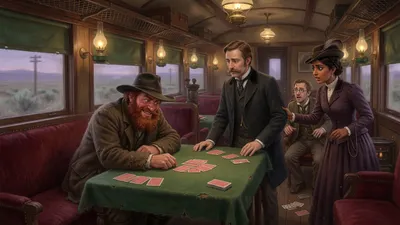
Before you read — think about:
- What makes a long train journey comfortable, and what makes it unbearable?
- Railways in the American West were built across land where other people already lived. How does that history sit alongside the story Verne is telling?
- Verne has used ships, elephants, and now a train. What does each kind of transport give a writer that the others do not?
- How do writers use a moving vehicle — a train, a ship, a coach — to shut characters in together? What does a setting like that do to a story?
- What does it mean to be responsible for someone else's safety? Have you ever been?
Watch for these while reading:
- The remark that breaks up the card game, and who makes it.
- The compromise Fogg proposes about time and place.
- The conductor's solution to a problem of scheduling, and what it says about this railway.
- Aouda's manner in the carriage, and how she watches the men around her.
- The stations and landmarks Verne names as the train runs east, and the country outside the windows.
Vocabulary to know:
inaugurated (verb) — formally opened or begun with a ceremony; artery (noun) — a main channel of movement, such as a large river or road; destined (adjective) — intended or certain to happen in the future; limitless (adjective) — having no end or boundary; honours (noun) — in whist, the highest-ranking cards of the trump suit; satisfaction (noun) — in this chapter, the redress a person demands after being insulted, often through a duel; evasion (noun) — an attempt to avoid something one ought to face; blusterers (noun) — people who threaten loudly but are not really dangerous; second (noun) — in a duel, the person who assists and stands by one of the fighters; combatants (noun) — people taking part in a fight; jeering (adjective) — mocking and taunting; vacant (adjective) — empty and unoccupied; duellists (noun) — people fighting a duel; clamorous (adjective) — loud and full of confused noise; waylaid (verb) — ambushed while travelling; gallop (noun) — the fastest running pace of a horse; muskets (noun) — long-barrelled guns of an older design; stoker (noun) — the crew member who feeds fuel into a steam engine's fire; regulator (noun) — the control that governs how much steam reaches a locomotive's engine; velocity (noun) — speed of motion; pillaged (verb) — robbed a place violently; barricaded (verb) — blocked off as a defence; siege (noun) — a sustained attack on a defended position; heroine (noun) — a woman admired for her courage; garrison (noun) — a body of troops stationed to defend a place; traction (noun) — the pulling force exerted by an engine; stunned (verb) — knocked senseless by a blow.
Chapter 30: Fogg Does His Duty

Before you read — think about:
- What do you think you owe a colleague or a friend beyond what is written into an agreement?
- What does 'a few hours' mean in winter, in open country, and why is that different from a few hours in a city?
- What does the word 'duty' mean, and who decides what yours is?
- How does waiting for news feel different from acting?
- Snow, cold and great distances shaped travel in the American West. How does harsh weather change what people are able to do?
Watch for these while reading:
- The words Fogg uses when he states his decision, and how long he takes over it.
- The captain's objections, and the argument that answers them.
- Fort Kearney itself — how many soldiers hold it, and how far away the nearest help lies.
- How Fix passes the hours of waiting, and the names he calls himself.
- The snow, the cold, and the empty plain as Verne describes them.
Vocabulary to know:
coursed (verb) — flowed or ran quickly; spokes (noun) — the bars joining the centre of a wheel to its rim; motionless (adjective) — completely still; doom (noun) — a terrible fate; pronounced (verb) — declared formally; detachment (noun) — a small group of soldiers sent on a particular task; perish (verb) — to die; volunteers (noun) — people who offer to do something without being ordered to; sergeant (noun) — a soldier ranking above a corporal who leads a small unit; squad (noun) — a small group of soldiers; pallor (noun) — an unusual paleness of the face; persistently (adverb) — continuing steadily despite difficulty; conceal (verb) — to hide something from others; agitation (noun) — a state of anxious excitement; greenness (noun) — inexperience; lack of judgment; fascinated (verb) — held someone's interest and attention completely; confidences (noun) — private matters told to someone in trust; effaced (verb) — rubbed out or erased completely; imprint (noun) — a mark left by pressure; discouraged (adjective) — having lost hope or confidence; swoon (noun) — a faint; a temporary loss of consciousness; furnace (noun) — the enclosed fire chamber of a steam engine; dismal (adjective) — gloomy and depressing; peering (verb) — looking hard and with difficulty; lapse (noun) — the passing of an interval of time; forebodings (noun) — feelings that something bad is about to happen; anguish (noun) — severe mental suffering; verge (noun) — the edge or border of something; stationary (adjective) — not moving from one place; apprehensions (noun) — fears about what may happen; densely (adverb) — thickly; closely packed; analyse (verb) — to examine something in detail to understand it; felled (verb) — knocked down.
Chapter 31: Fix Lends a Hand at Last

Before you read — think about:
- When you are badly behind on something, how do you work out whether it can still be saved?
- Winters on the Great Plains could shut down whole regions. How did people live and move in places like that before modern machinery?
- Would you accept help from somebody who had spent months trying to obstruct you?
- What does it feel like to owe a debt you can never repay?
- What keeps a person going through repeated setbacks, when each one costs more than the last?
Watch for these while reading:
- The arithmetic Fix works through, and where he finds a thread of hope in it.
- Mudge's sledge: how it is built, how it is rigged, and what makes it fast.
- Aouda at Fort Kearney in the daylight, and how she carries herself among the others.
- The prairie under snow, and the noise of the crossing.
- The single remark Fogg makes in the course of the whole journey.
Vocabulary to know:
sledge (noun) — a vehicle on runners for travelling over snow or ice; runners (noun) — the long narrow strips on which a sledge slides; lashings (noun) — ropes or wires used to tie something firmly in place; sloop (noun) — a small sailing boat with a single mast; cutter (noun) — a small, fast sailing vessel; induce (verb) — to persuade someone to do something; modified (verb) — changed somewhat; hasten (verb) — to make something happen sooner; huddled (verb) — crowded closely together, usually for warmth; intensified (verb) — made stronger or more extreme; skimming (verb) — moving lightly and rapidly just above a surface; lurches (noun) — sudden unsteady movements to one side; chord (noun) — a straight line joining two points on a curve; arc (noun) — a curved section of a circle; plaintively (adverb) — in a sad, mournful way; buoyancy (noun) — cheerfulness that keeps rising back up after being pushed down; laboriously (adverb) — with great effort; uniform (adjective) — the same all over, without variation; uninhabited (adjective) — with nobody living there; gaunt (adjective) — thin and bony, especially from hunger; impetus (noun) — the force that keeps something moving; furled (verb) — rolled up and secured, as a sail; stiffened (adjective) — made rigid, especially by cold; seaboard (noun) — a region along a sea coast; antique (adjective) — very old; belonging to an earlier age.
Chapter 32: A Struggle Against Bad Fortune

Before you read — think about:
- What is it like to arrive at a famous city and have no time to look at it?
- New York in 1872 was the busiest port in America. What do you imagine a harbour like that looked and sounded like?
- What is the difference between a setback and a failure? Who decides which one something is?
- When you are running out of time, is it better to keep pushing or to stop and rethink? How do you tell which the situation needs?
- Passepartout blames himself for everything that has gone wrong. Is he being fair to himself?
Watch for these while reading:
- The list of vessels Fogg goes down, and the reason each one is set aside.
- The single sentence Fogg says to Passepartout about the whole business.
- Captain Andrew Speedy: how he talks, and what he will not do.
- Fogg's manner of speaking to Captain Speedy, and Speedy's manner of answering.
- The Henrietta herself — her tonnage, her cargo and her engines.
Vocabulary to know:
render (verb) — to cause something to become a certain way; crushed (adjective) — completely defeated in spirit; expended (verb) — spent or used up; reproach (verb) — to express disapproval or blame to someone; anchored (verb) — held in place in the water by an anchor; hailed (verb) — called out to in order to attract attention; funnel (noun) — a ship's chimney; sea-wolf (noun) — an old, tough, weather-beaten sailor; oxidised (adjective) — changed in colour or surface by exposure to air, as metal does; growling (adjective) — making a low, rough, threatening sound; freight (verb) — to hire a ship to carry goods or people; ballast (noun) — heavy material carried by a ship with no cargo, to keep it steady; swift (adjective) — moving very fast; knots (noun) — units of speed used at sea, equal to one nautical mile per hour; repugnance (noun) — a strong feeling of dislike; merchandise (noun) — goods bought and sold; hack (noun) — a carriage available for hire; gamut (noun) — the complete range of something; indemnified (verb) — compensated for a loss; venturesome (adjective) — willing to take risks; daring; grave (adjective) — serious and worrying.
Chapter 33: Fogg Rises to the Occasion
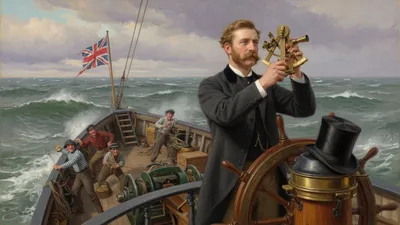
Before you read — think about:
- What is the difference between spending money and wasting it? Who gets to decide which is which?
- Crossing the Atlantic by steam in 1872 took about ten days. What would you do with ten days at sea and no way to reach anyone on land?
- What is it like to be a passenger on a working ship, among a crew who have a job to do?
- How might a person who has been wrong for a very long time come round to seeing it?
- Does a long task get easier or harder as the end of it comes into sight? Why?
Watch for these while reading:
- The crew of the Henrietta — who they are, and how they regard the passengers put among them.
- Anything the chapter lets slip about Fogg’s life before the wager.
- Fix's newest theory, and why it is very nearly reasonable.
- The Henrietta's engine-room, and the kind of work that keeps a steamer moving.
- The look of the sea as the steamer heads toward Europe, and the weather Verne gives it.
Vocabulary to know:
esquire (noun) — a courtesy title placed after an English gentleman's name; pardonable (adjective) — able to be forgiven or excused; glorious (adjective) — magnificent; deserving great admiration; dexterous (adjective) — skilful, especially with the hands; feats (noun) — impressive acts requiring skill or strength; loquacious (adjective) — very talkative; vexations (noun) — annoyances and troubles; distrustful (adjective) — full of suspicion; conquest (noun) — the act of taking control of something by force; bribery (noun) — the giving of money or gifts to persuade someone to act improperly; seaman (noun) — a sailor, especially a skilled one; pirate (noun) — someone who robs or seizes ships at sea; plausible (adjective) — seeming reasonable or believable; embarked (verb) — began an undertaking; boarded a ship; poop (noun) — the raised deck at the stern of a ship; deviate (verb) — to turn aside from a set course; unpropitious (adjective) — unfavourable; not offering a good chance of success; stern (noun) — the rear part of a ship; pitched (verb) — plunged up and down, as a ship in rough water; headway (noun) — forward progress; swamping (verb) — flooding with water; protruding (adjective) — sticking out; well-nigh (adverb) — very nearly; cherished (verb) — held on to something dear and protected it; earnestly (adverb) — seriously and sincerely; mortal (adjective) — extreme; as intense as if life were at stake; epithet (noun) — a descriptive word applied to someone, often an insulting one; self-esteem (noun) — a person's sense of their own worth; scent (noun) — a trail of clues followed during a pursuit; refrained (verb) — held back from doing something; apoplectic (adjective) — so furious as to seem about to burst; paroxysm (noun) — a sudden violent outburst of emotion; wrath (noun) — extreme anger; imperturbable (adjective) — impossible to upset or fluster; ascertained (verb) — found out with certainty; grudges (noun) — long-held feelings of resentment; keel (noun) — the central beam running along the bottom of a ship; spars (noun) — poles used to support a ship's sails; lustily (adverb) — with great energy and enthusiasm; hewed (verb) — chopped or cut with an axe; demolition (noun) — the act of tearing something down; hulk (noun) — the bare body of an old or stripped ship; commiserate (verb) — to express sympathy for someone's misfortune; supreme (adjective) — greatest possible; disdaining (verb) — treating something as beneath one's notice.
Chapter 34: Back in London
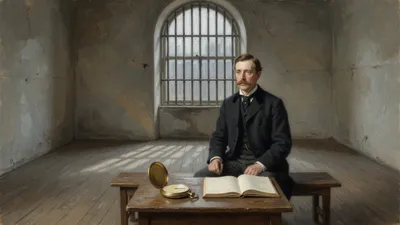
Before you read — think about:
- How do you sit with fear when you cannot do anything to shorten it?
- What would you want to see first on returning to your own city after a journey around the world?
- Passepartout has been keeping a secret for weeks. What does carrying a secret cost a person?
- Is somebody who does the wrong thing for honest reasons still answerable for the harm they cause?
- How much of a person's character can a stranger judge from the way they behave under pressure?
Watch for these while reading:
- How Fogg conducts himself in the Custom House, and what he does with his watch.
- The narrator's one-sentence summary of Fogg's position.
- Aouda and Passepartout on the far side of the cell door, and how differently each of them bears the waiting.
- Fix's face and posture in Fogg's presence.
- The streets of London as the party re-enters them, and how they feel after so many weeks away.
Vocabulary to know:
heinous (adjective) — utterly wicked and shocking; revolted (verb) — reacted with disgust and rejection; portico (noun) — a roofed porch with columns at a building's entrance; resigned (adjective) — accepting something unwelcome without protest; betrayal (noun) — an act of revealing something meant to stay hidden; knave (noun) — a dishonest, untrustworthy man; practicable (adjective) — able to be done in practice; outlet (noun) — a way out of an enclosed place; rods (noun) — thin straight bars; irresistible (adjective) — too strong to be held back or refused; attain (verb) — to reach or achieve something aimed at; singular (adjective) — unusual and striking; not ordinary; resemblance (noun) — a likeness that makes one person or thing look like another; audible (adjective) — able to be heard; singularly (adverb) — unusually; in a remarkable way; deserts (noun) — in this chapter, what a person deserves; stimulated (verb) — encouraged into greater effort.
Chapter 35: An Errand for Passepartout

Before you read — think about:
- How do people behave in the first day after losing something they worked very hard for?
- How do you talk to someone who has just lost a great deal, if you have not lost it yourself?
- What do people need on an ordinary evening at home after a public failure — company, silence, or work?
- What makes a house feel like a home — the building, or the people in it?
- Losing money changes some friendships and leaves others untouched. What do you think makes the difference?
Watch for these while reading:
- How Fogg spends his first day at home, and the one thing he does not do at half-past eleven.
- Passepartout and the gas-jet in his room.
- The exact financial position: what is left, and to whom it is owed.
- The sitting-room that evening: who is in it, and how the furniture is arranged.
- The weather and the light in Saville Row, and the use Verne makes of them.
Vocabulary to know:
domicile (noun) — the place where a person lives; blundering (noun) — the making of clumsy, stupid mistakes; braved (verb) — faced danger with courage; enriched (verb) — made someone rich or richer; meditating (verb) — thinking deeply about a plan; expedient (noun) — a means adopted to achieve an end, often a desperate one; remorse (noun) — deep regret for a wrong one has done; irretrievable (adjective) — impossible to recover or put right; saloon (noun) — in this book, a large public room in a club or hotel; keyhole (noun) — the opening into which a key is put; haunted (verb) — kept returning to trouble someone's mind; ruefully (adverb) — with sorrow and regret; pulsations (noun) — regular beats, as of the heart; disposal (noun) — the freedom to use something as one wishes; persecutors (noun) — people who cruelly pursue and mistreat someone; solitude (noun) — the state of being entirely alone; griefs (noun) — sorrows; sympathetic (adjective) — sharing and understanding another's feelings; kinswoman (noun) — a woman related to someone by family; unwonted (adjective) — unusual; not customary for that person; rectitude (noun) — moral uprightness and honesty; sincerity (noun) — genuineness of feeling; freedom from pretence; radiant (adjective) — glowing with joy; zenith (noun) — the highest point reached in the sky, or in anything; genial (adjective) — cheerful and friendly; parish (noun) — a district with its own church and clergyman.
Chapter 36: Fogg's Name Rises Again

Before you read — think about:
- How quickly does public opinion turn when new facts appear?
- Why do clubs and saloons matter so much to the men in this story? What do they offer besides cards?
- If someone had been silent for weeks, would you assume the worst or keep hoping?
- How does a rumour of good news travel differently from a rumour of bad news?
- If your reputation had been publicly damaged and then publicly repaired, what would still feel unfinished?
Watch for these while reading:
- The news out of Scotland Yard about the Bank of England, and the date attached to it.
- How the betting moves over the three days.
- The arguments the five club members give one another in the saloon.
- The whist table, and the point at which the cards are put down.
- The Reform Club saloon that evening: the fire, the chairs, and the ordinary business of the members.
Vocabulary to know:
transpired (verb) — became known; came to light; negotiable (adjective) — able to be traded or exchanged for money; threshold (noun) — the entrance or doorway of a building or room; telegrams (noun) — messages sent by telegraph; mathematically (adverb) — with the exactness of numbers and calculation; transactions (noun) — deals in which money or goods change hands; pitch (noun) — in this chapter, the highest level of intensity reached; expired (verb) — come to an end; hasty (adjective) — acting or done too quickly, without enough thought; punctuality (noun) — the habit of doing things exactly on time; absurdly (adverb) — in a ridiculous way; intelligence (noun) — in this chapter, news or information; assented (verb) — agreed to something; pendulum (noun) — the swinging weight that keeps a clock in time; shrill (adjective) — high-pitched and piercing; suspended (verb) — stopped for a time; revived (verb) — brought back into activity; quoted (verb) — given a stated price for buying or selling.
Chapter 37: What the Journey Truly Won

Before you read — think about:
- When a contest is over, what is worth talking about besides who won?
- What does a person who has been around the world owe the people who stayed at home?
- When you finish a long task, what do you notice first — how tired you are, or how the work changed you?
- The title of this book promises a journey. What else do you think the story has been about?
- What would you say makes a journey worth taking, apart from arriving?
Watch for these while reading:
- Fogg at home the next morning, and the ordinary calm of the house.
- The talk around the table that morning, and who is present for it.
- The household at Saville Row, and how it compares with the house in the opening chapters.
- The tone of the last pages, and how it sits beside the opening of the book.
- Passepartout's manner at breakfast, after the night at the club.
Vocabulary to know:
unconsciously (adverb) — without being aware of it; clergyman (noun) — a minister of a Christian church; waterspout (noun) — a rushing column of water; here, an image for something moving with great force; diminished (verb) — became smaller or fewer; victorious (adjective) — having won a contest; kidnapped (verb) — carried off by force; overturning (verb) — knocking over; fastidious (adjective) — extremely attentive to accuracy and detail; pecuniary (adjective) — relating to money; deducted (verb) — subtracted from a total; glowing (adjective) — radiating warmth and happiness; dazzling (adjective) — brilliantly bright; entitled (adjective) — having a rightful claim to something; regularity (noun) — the quality of being exact, orderly, and consistent; vigorously (adverb) — with force and energy; marvellous (adjective) — extraordinary; causing wonder; weary (adjective) — very tired.
About the Author
Jules Verne (1828-1905) was a French writer who grew up in the port city of Nantes, watching ships come and go, and who was sent to Paris to study law before deciding he would rather write. He became one of the most popular authors in the world by inventing a new kind of story: carefully researched adventure built on real science, real geography, and real technology. Working from newspapers, atlases, and travel reports, he sent his characters to the center of the Earth, to the bottom of the sea, and to the Moon, decades before such journeys were possible. Around the World in Eighty Days belongs to his long series of Voyages Extraordinaires, and it was so exciting to its first readers that newspaper subscribers reportedly placed bets on whether Fogg would make it home in time.
The novel appeared in 1872, at a moment when the world had genuinely just shrunk. The Suez Canal opened in 1869, cutting weeks off the voyage from Europe to Asia. The American transcontinental railroad was finished the same year, and a railway line had been pushed across India. For the first time in history, a traveller with enough money could reasonably plan a trip around the planet on printed timetables, and travel companies actually published schedules claiming it could be done in about eighty days. Verne built his story out of these real headlines. That world also had a darker side that shows plainly in the book: nearly every place Fogg passes through is under European control or influence, and the ease of his journey depends on the ships, railways, and authority of empire.