

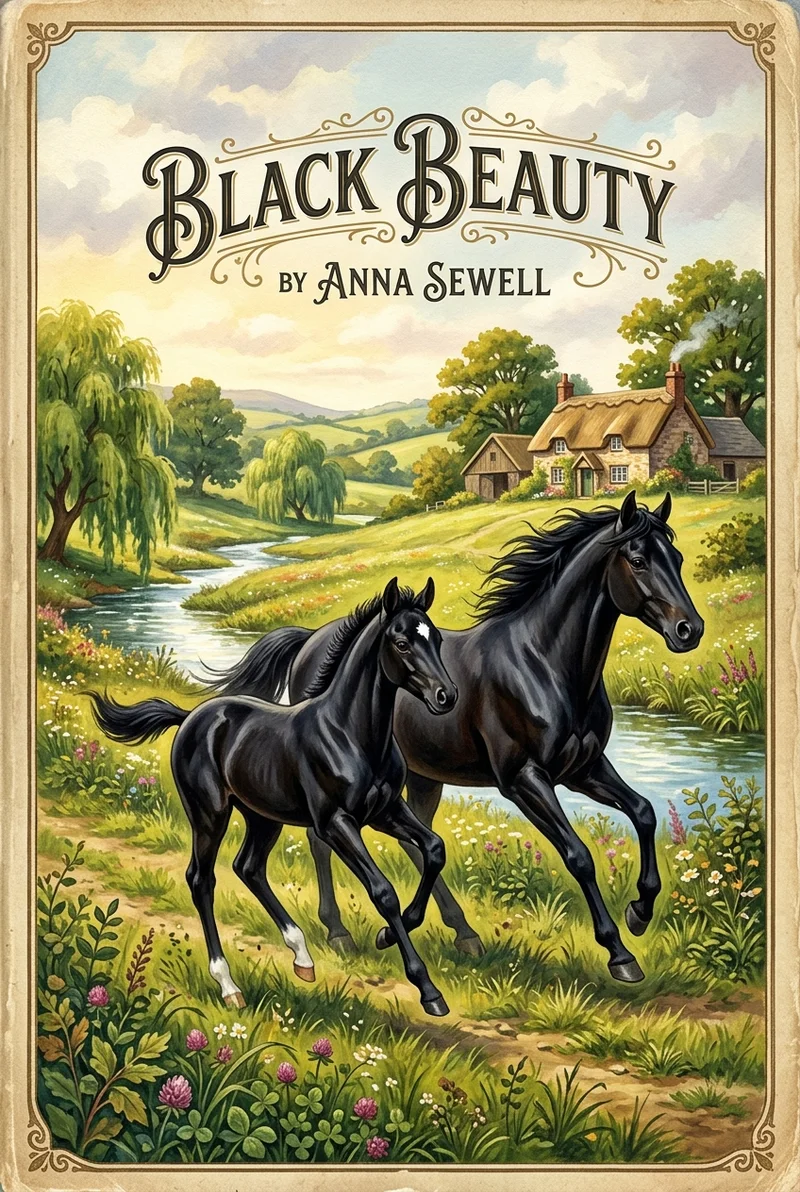
About This Book
Black Beauty is the life story of a horse, told by the horse himself. It begins in a wide green meadow in the English countryside, where a handsome black colt grazes beside his mother and learns his first lessons about the world. His mother is a wise old mare who tells him that he comes from good stock and that the best thing a horse can do is work willingly, keep his temper, and never bite or kick. Those lessons matter more than the colt can guess, because a horse in Victorian England does not choose where he lives or who owns him. When the colt is old enough, he is trained to wear a saddle, a bridle, and a harness, and he is sold to a country estate called Birtwick Park. There he is given the name Black Beauty. He meets the other horses in the stable, learns the routines of the grooms and coachmen, and discovers that some people handle horses with patience while others do not. Every new home in his life brings new work, new stablemates, and new masters, and the difference between a kind hand and a careless one is something he feels in his own body. Anna Sewell wrote the book so that readers would understand what the animals working all around them actually experienced. There are no talking humans-turned-animals and no magic here; the horses simply describe their days to one another the way people describe theirs. Because Beauty tells the story in his own steady, thoughtful voice, readers see the Victorian world from an unusual height, looking out between a pair of blinkers at a society that depended on horses for almost everything.
Black Beauty asks a question that fifth graders are exactly the right age to wrestle with: what do we owe to a creature who cannot speak up for itself? The book gives readers a narrator who is patient, honest, and easy to care about, and it never lectures — it simply lets you watch what happens when someone is kind and what happens when someone is careless or cruel. Along the way it opens a window onto a vanished world where horses pulled every cab, cart, and carriage, which makes it a natural bridge into history as well as literature. It is also a wonderful book for practicing point of view, because every event arrives filtered through a narrator who understands some things about people and completely misunderstands others.
Meet the Characters

More about Black Beauty
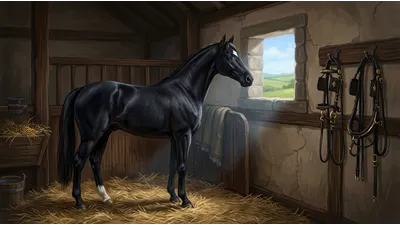
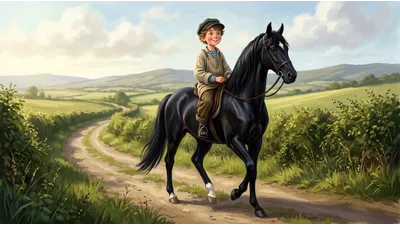
Black Beauty is a well-bred colt raised in a pleasant meadow, who tells his own story. He is willing, sensitive, and proud of doing his work well. His life depends entirely on the people who hold his reins.

More about Duchess
Duchess is Beauty’s mother, a favorite of the farmer who raised them. She is calm, proud of good manners, and full of advice about how a horse should behave. She is the first voice Beauty remembers.

More about Ginger
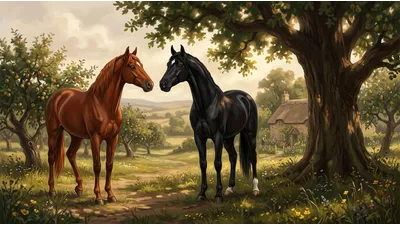
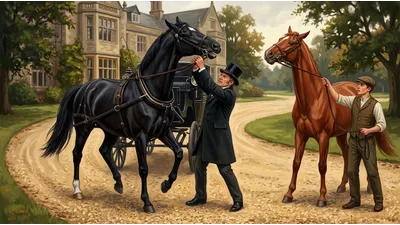
Ginger is a chestnut mare who has not always been kindly treated and therefore does not always trust people. She is spirited, honest, and capable of friendship. She and Beauty share a stable at Birtwick Park.

More about Merrylegs
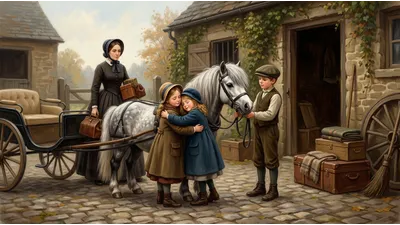
Merrylegs is the children’s pony at Birtwick, patient, cheerful, and a little proud of his own good character. He has taught many children to ride. He is one of Beauty’s first friends in the stable.

More about John Manly
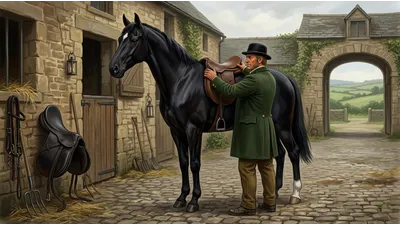
John Manly is Squire Gordon’s coachman, famous in the neighborhood for his skill and his kindness to horses. He is quiet, firm, and not afraid to speak his mind to a master. Beauty is lucky to come into his care.

More about James Howard
James is the young helper in John Manly’s stable, learning the work and hoping to be a coachman himself. He is careful, ambitious, and fond of the horses. He is one of the kindest human faces Beauty knows.

More about Joe Green
Joe Green is a younger boy who comes to the stable when James is promoted. He is willing, inexperienced, and not yet sure of a horse’s needs. John Manly has to teach him everything.

More about Squire Gordon
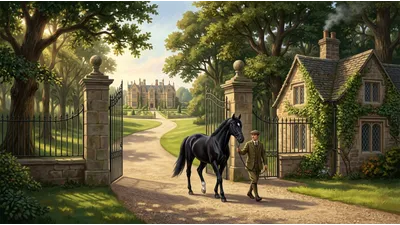
Squire Gordon is the master of Birtwick Park, a humane man who believes horses should be treated as he would wish to be treated. He is the first good master Beauty serves after leaving the meadow. His household sets the standard of the book.

More about Jerry Barker
Jerry Barker drives a cab in London and is known for being fair to his horses and to his customers. He is religious in a quiet way, fond of his family, and unwilling to work on Sunday if he can help it. Beauty comes to him after harder places.

More about York
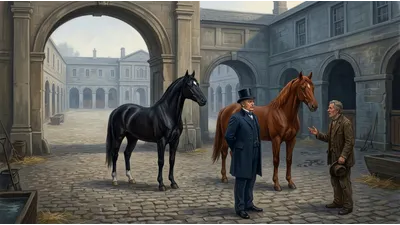
York is the coachman at Earlshall, a great house with fashionable ways. He is a good horseman who does not always dare to contradict the lady of the house. Beauty and Ginger come under his care after Birtwick.
Pre-Reading Discussion Questions
- What do you already know about how people used horses for travel and work before cars were invented?
- If an animal could describe its day to you, what do you think it would notice that a person might miss?
- What does it mean to treat an animal well? Is feeding it and housing it enough, or does kindness require something more?
- Beauty's mother tells him that being good and gentle will serve him better than being fast or handsome. Do you agree that character matters more than talent?
- Why might an author choose to tell a story through the eyes of a narrator who cannot speak to the humans around him?
- What responsibilities do you think a person takes on when they own an animal that depends on them completely?
Themes & Big Ideas to Track
- Kindness and cruelty are usually shown through small, everyday choices rather than dramatic ones.
- A narrator who cannot speak the language of the people around him sees clearly but is powerless to explain himself.
- Ignorance can do as much harm as deliberate cruelty, and the book keeps asking whether that difference matters.
- A horse's life in this era is shaped entirely by who owns him, which links the animals' fortunes to the social class of their masters.
- Fashion and appearance are repeatedly set against comfort, health, and common sense.
- Good work, patiently done, is presented as something worth respecting in both animals and people.
Chapter-by-Chapter Study Guide
Chapter 1: My Early Home
Before you read — think about:
- What do you think a young animal would notice first about the place where it was born?
- What is the best piece of advice anyone in your family has ever given you?
- Why might a writer begin a life story in a calm, safe place rather than an exciting one?
- What can you tell about a person from the way they speak to an animal that cannot answer back?
- This whole book is narrated by a horse. What might a horse understand better than a person, and what might he misunderstand completely?
Watch for these while reading:
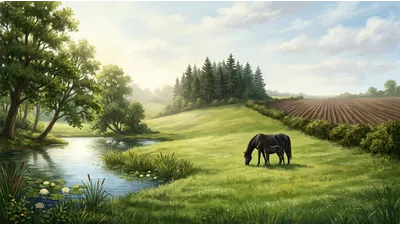
- The meadow Beauty grows up in - the pond, the fir plantation, the ploughed field beyond - and how much detail he gives to each.
- Duchess, Beauty's mother, and the standards of behaviour she holds herself to.
- What is said about Beauty's family line, and the words used for good manners in a horse.
- Farmer Grey's habits with his horses: how often he comes to the field, and what he calls Beauty's mother.
- Dick the ploughboy, and what Beauty notices about him.
Vocabulary to know:
meadow (noun) — a large field covered in grass where animals graze; grove (noun) — a small group of trees growing close together; brook (noun) — a small stream of running water; hedge (noun) — a thick row of bushes planted as a fence between fields; colt (noun) — a young male horse that is not yet grown; whinny (verb) — to make the soft, high call that a horse makes; gallop (verb) — to run at a horse's fastest pace; trot (verb) — to move at a steady, bouncing pace between a walk and a gallop; temper (noun) — the usual mood a person or animal has, especially how easily they become angry; well-bred (adjective) — born into a family of fine, respected animals; manners (noun) — polite, well-behaved ways of acting toward others; lodging (noun) — a place to stay and sleep; gig (noun) — a small, light carriage on two wheels that one horse pulls; pluck (verb) — to pick something off a plant with your fingers.
Chapter 2: The Hunt
Before you read — think about:
- What do you already know about hunting with hounds as a sport in old England?
- How might a young animal that has never seen a crowd behave when dozens of dogs and riders pour across its field?
- What sports or pastimes do people argue about today, and what are the arguments on each side?
- Can a custom be respectable, popular, and still worth questioning? How would you decide?
- What might somebody standing at the edge of a field notice that the people in the middle of it never do?
Watch for these while reading:
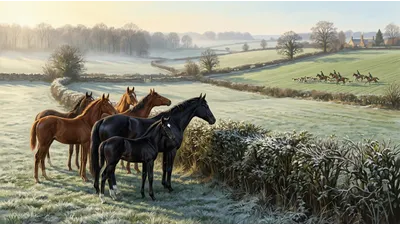
- The sounds Beauty singles out - the cry of the dogs, the horn, the drumming of hooves - and how he uses them to follow things he cannot see.
- The way the young colts in the field behave through all of this, and the way Duchess behaves.
- The hare, and how much attention Beauty gives it compared with the attention the riders give it.
- The questions Duchess raises about the sport, and how carefully she chooses her words.
- How Beauty separates what he saw with his own eyes from what he only heard about later.
Vocabulary to know:
circumstance (noun) — an event or something that happens; frost (noun) — a thin white covering of ice that forms on cold nights; hound (noun) — a dog bred and trained to hunt by following a scent; canter (verb) — to run at a smooth, easy pace slower than a gallop; hare (noun) — a wild animal like a large rabbit, with long ears and long back legs; scent (noun) — the smell an animal leaves behind that dogs follow when hunting; huntsman (noun) — a man who rides with the hounds and manages them during a hunt; shriek (noun) — a loud, sharp cry; astonished (adjective) — so surprised that you can hardly take in what you are seeing; groan (verb) — to make a low, deep sound because of pain; farrier (noun) — a person whose job is to shoe horses and treat their injuries; squire (noun) — a country gentleman who owns most of the land around a village; vice (noun) — a bad habit or fault in a person or animal's character; toll (verb) — to ring slowly, one deep note at a time, especially after a death; stag (noun) — a fully grown male deer; churchyard (noun) — the ground around a church where people are buried.
Chapter 3: My Breaking In
Before you read — think about:
- What do you think it takes to teach a young animal to carry a rider for the first time?
- How would it feel to have a piece of cold metal placed in your mouth and strapped there all day?
- Why might it matter whether a young worker is trained slowly and patiently or hurried through?
- Which everyday machines do you think would have terrified animals when they were brand-new inventions?
- What is the difference between making somebody obey you and making them willing?
Watch for these while reading:
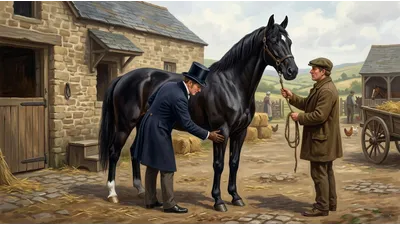
- Each separate piece of equipment Beauty has to accept, and the words he uses for how each one feels.
- The order in which Farmer Grey introduces things, and how much time he allows for each stage.
- The blacksmith's shop, and Beauty's account of what shoeing is actually like.
- The fortnight Beauty spends in a neighbouring farmer's meadow, and what that meadow happens to border.
- The three sorts of men Beauty's mother describes at parting, and what she says about the ones who mean no harm.
Vocabulary to know:
bridle (noun) — the set of straps that fits over a horse's head and holds the bit in place; bit (noun) — the bar of metal placed in a horse's mouth so the driver can guide him; saddle (noun) — the leather seat strapped onto a horse's back for a rider to sit in; harness (noun) — the whole set of straps that fastens a horse to a cart or carriage; collar (noun) — the thick padded ring around a horse's neck that lets him pull a load; crupper (noun) — a strap that passes under a horse's tail to keep the saddle from sliding forward; breeching (noun) — the strap around a horse's hindquarters that lets him hold a cart back on a hill; blinkers (noun) — the flat side-pieces on a bridle that stop a horse from seeing anything but what is straight ahead; halter (noun) — a simple rope or strap headpiece used for leading a horse about; headstall (noun) — the part of a halter or bridle that fits over the top of a horse's head; girth (noun) — the wide band that passes under a horse's belly to hold the saddle on; chaise (noun) — a light open carriage pulled by a horse; coax (verb) — to gently and patiently persuade someone to do something; oats (noun) — a grain that horses are fed and usually enjoy; forge (noun) — a workshop where iron is heated and hammered into shape; blacksmith (noun) — a worker who makes things out of iron, including horseshoes; hoof (noun) — the hard covering on the bottom of a horse's foot; fortnight (noun) — a period of two weeks; accustomed (adjective) — used to something, so that it no longer feels strange; restive (adjective) — restless, nervous, and hard to control; disregard (verb) — to pay no attention to something; weariness (noun) — the feeling of being extremely tired; pales (noun) — the upright wooden stakes that make up a fence.
Chapter 4: Birtwick Park
Before you read — think about:
- What would you most want to know first if you arrived somewhere new where you knew nobody?
- How does a group that already gets along change when one new member joins it?
- What makes a place start to feel familiar rather than strange?
- What details about a stable, a classroom or a kitchen tell you whether the people in it are well looked after?
- Who would you want to be introduced to first at a new school, and why?
Watch for these while reading:
- The loose box Beauty is given, and the one feature of it he calls the greatest thing of all.
- Merrylegs, and the way he introduces himself.
- Ginger, and the way she introduces herself.
- John Manly and James Howard, and how each of them handles a horse.
- What Merrylegs says about Ginger's temper, and where he puts the blame for it.
Vocabulary to know:
stall (noun) — a separate space in a stable where one horse stands; manger (noun) — an open box in a stable that a horse's grain is put into; rack (noun) — a frame fixed to a stable wall that holds hay for a horse to pull down; box (noun) — a large stable space where a horse is left untied and free to move about; paddock (noun) — a small fenced field close to a stable; orchard (noun) — a piece of ground planted with fruit trees; lodge (noun) — a small house standing at the entrance gate of a large estate; groom (noun) — a person whose job is to feed, clean, and care for horses; mare (noun) — a fully grown female horse; mane (noun) — the long hair that grows along the top of a horse's neck; chestnut (adjective) — reddish-brown, used to describe the color of a horse's coat; pert (adjective) — bold and cheeky in a lively, confident way; airy (adjective) — open to plenty of fresh moving air; corn (noun) — grain such as oats, used as feed for horses; rook (noun) — a large black bird with smooth, glossy feathers; ill-used (adjective) — treated badly or cruelly.
Chapter 5: A Fair Start
Before you read — think about:
- What would a careful horseman check before taking an unfamiliar animal out for the first time?
- How can the way somebody tests you tell you as much about them as it tells them about you?
- Why might the name you are given matter more than it first seems to?
- What makes two workers - or two animals - into a team rather than two individuals doing the same job?
- How do people earn a reputation, and how long does it take?
Watch for these while reading:
- Everything John does with the saddle and bridle before he ever puts a foot in the stirrup.
- The paces Beauty is asked for one after another, and what John is testing with each.
- What John reports to the squire, and the exact words the squire and his wife use back.
- The names that are put forward and set aside before one is agreed on.
- The scrap of family history Beauty overhears in the stable, and how calmly he passes it on.
Vocabulary to know:
coachman (noun) — a man employed to drive a family's carriage; cottage (noun) — a small, simple house; common (noun) — an open stretch of land that everyone in a village is allowed to use; paces (noun) — the different speeds and styles of movement a horse can be asked for; rein (noun) — a long strap fastened to the bit that a rider uses to guide a horse; fleet (adjective) — able to move very fast; counsel (noun) — careful advice given to someone; mount (verb) — to climb up onto a horse's back; ebony (noun) — a very hard, deep black wood; sensible (adjective) — showing good, practical judgment; estate (noun) — a large piece of land owned by one family, with a house and farms on it; watermill (noun) — a mill whose machinery is turned by flowing water; slacken (verb) — to slow down or become less tight; urge (verb) — to press or encourage someone to move faster; sociable (adjective) — friendly and glad of company; plucky (adjective) — brave and full of cheerful spirit; roan (adjective) — having a coat in which white hairs are mixed evenly through another color; cob (noun) — a short, strong, thickset horse; hunter (noun) — a horse bred and trained to be ridden after hounds; intimate (adjective) — very close and familiar with someone.
Chapter 6: Liberty
Before you read — think about:
- Can somebody be safe, fed and comfortable and still be missing something they need?
- What does the word 'liberty' mean to you, and what would it feel like to lose it?
- What do you do with yourself when you have to sit still for a long time?
- What does a good day off look like for you?
- How can a person be firm with you without ever using force?
Watch for these while reading:
- The one thing Beauty says he misses, and how carefully he avoids sounding ungrateful.
- The list of restraints he gives - bit, blinkers, crupper, straps - and what each one prevents.
- The word some grooms use for a lively horse, and the different name John gives the same thing.
- How John answers when Beauty is too full of spirits to stand still, and the tone of voice Beauty reports.
- What John uses instead of the whip to make himself understood.
Vocabulary to know:
liberty (noun) — freedom to move and act as you choose; discontented (adjective) — unhappy with what you have; prance (verb) — to move with high, springy, showy steps; fidgets (noun) — restless little movements caused by having too much stored-up energy; skittish (adjective) — jumpy and easily startled; spirited (adjective) — lively and full of energy; snort (noun) — a loud sound made by blowing air sharply out through the nose; fling (verb) — to throw or toss something suddenly and forcefully; nibble (verb) — to eat by taking small, gentle bites; companion (noun) — someone you spend time with and enjoy being near; determined (adjective) — having firmly made up your mind about something; treat (noun) — something special that gives unusual pleasure.
Chapter 7: Ginger
Before you read — think about:
- Before you judge somebody's bad habit, what would you want to know about their past?
- How much do you think a person's earliest experiences shape the way they behave years later?
- Why might a quiet voice have more power over a frightened creature than a shout does?
- Can two people be equally skilled at the same job and get opposite results? How?
- What is the difference between breaking somebody's will and winning their trust?
Watch for these while reading:
- What Ginger says was missing from her earliest days, and how far back she traces it.
- Her step-by-step account of being broken in, and how it compares with the account Beauty gave of his own.
- Samson, and the word he uses for horses.
- The one quality in a person Ginger says she would know among a thousand.
- The old master, and the judgment he delivers in the yard.
Vocabulary to know:
weaned (verb) — taken off the mother's milk and made to eat other food; forelock (noun) — the lock of hair that falls forward between a horse's ears; wrench (verb) — to twist or pull something violently; flog (verb) — to beat someone repeatedly with a whip or stick; fret (verb) — to worry and grow restless; pine (verb) — to grow sad and weak from wanting something you cannot have; oversee (verb) — to watch over work and make sure it is done properly; boast (verb) — to talk with too much pride about what you can do; obedient (adjective) — willing to do whatever you are told; humble (adjective) — meek and not proud; horseflesh (noun) — horses thought of only as meat and property rather than as living creatures; rear (verb) — to rise up suddenly on the hind legs; plunge (verb) — to throw yourself violently forward or downward; spurs (noun) — sharp metal points fixed to a rider's heels and used to urge a horse forward; turf (noun) — the top layer of grass and the soil it grows in; persecutor (noun) — someone who keeps on treating another creature cruelly; swarm (verb) — to gather and move about in a large crowd; flank (noun) — the side of an animal between the ribs and the hip; sieve (noun) — a shallow container with a mesh bottom, used here for carrying and shaking oats; filly (noun) — a young female horse; vexed (adjective) — annoyed and troubled by something; brute (noun) — an animal, spoken of as rough and unfeeling; high-mettled (adjective) — full of courage, fire, and spirit; bran (noun) — the crushed outer husks of grain, often mixed with water for horses; mash (noun) — a warm, soft feed made by mixing grain with hot water; scar (noun) — the mark left behind after a wound has healed.
Chapter 8: Ginger's Story Continued
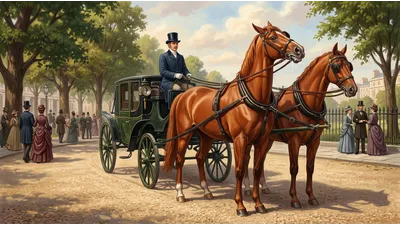
Before you read — think about:
- Have you ever seen somebody made uncomfortable purely so that they would look impressive to other people?
- How much do you think an owner really knows about the animals kept in their own stable?
- When somebody is treated unfairly and reacts badly, who usually gets blamed - and is that fair?
- Who is the calmest person you know, and what do they do that makes them seem calm?
- Why does a joke sometimes carry a serious idea better than a lecture does?
Watch for these while reading:
- The bearing rein, and Ginger's description of what it does to a horse's head, mouth and breathing.
- The reason her fashionable owners give for using it.
- How many owners Ginger passes through, and the reason given at each change.
- The advice John gives James about handling her, and what James makes of it.
- The recipe John recites at the end, and the ingredients he lists in it.
Vocabulary to know:
check-rein (noun) — a strap that forces a carriage horse to hold its head unnaturally high; dealer (noun) — a person whose business is buying and selling horses; fashionable (adjective) — following what is popular among wealthy people at the time; stylish (adjective) — looking smart and impressive to other people; turnout (noun) — a carriage and its horses seen as a showy display; froth (noun) — a mass of tiny bubbles; foam; chafe (verb) — to be rubbed sore, or to grow irritated and restless; impatience (noun) — the feeling of not being able to wait calmly; irritable (adjective) — easily annoyed or upset; surly (adjective) — gruff, unfriendly, and rude; civil (adjective) — reasonably polite in an ordinary, decent way; torment (verb) — to cause someone lasting pain or misery; windpipe (noun) — the tube that carries air from the throat down to the lungs; warranted (verb) — officially promised to be free of faults when sold; hocks (noun) — the sharply bent joints partway up a horse's hind legs; aggravate (verb) — to annoy someone until they lose their patience; rage (noun) — violent, uncontrolled anger; defiant (adjective) — boldly refusing to give in or obey; physic (noun) — medicine given to cure an illness; firmness (noun) — being steady and not giving way; jerk (noun) — a sudden, sharp pull.
Chapter 9: Merrylegs
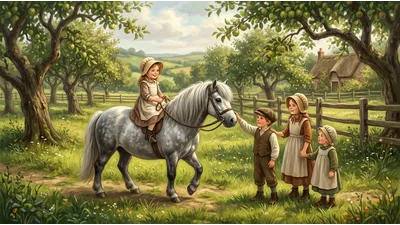
Before you read — think about:
- Have you ever had to teach a younger child something? What was hardest about it?
- Is there a difference between punishing somebody and teaching them something?
- What makes somebody easy to be around, and what makes somebody tiring?
- What could a well-liked worker lose by suddenly becoming difficult?
- Why do people so easily forget that a machine - or a living creature - has limits?
Watch for these while reading:
- The precise words Merrylegs chooses for what he did, and how much care he takes over them.
- The difference he draws between the vicar's boys and Miss Jessie and Miss Flora.
- The comparison he makes between a pony and a machine, and how far he takes it.
- The advice Ginger offers him, and the reason he gives for refusing it.
- The list of places Merrylegs imagines himself sent to if his good name were gone.
Vocabulary to know:
vicar (noun) — a priest in charge of a parish church in England; rogue (noun) — a mischievous troublemaker, often said in an affectionate way; pitch (verb) — to throw someone off suddenly; offended (adjective) — hurt or insulted by what someone has said; unsteady (adjective) — wobbly and not well balanced; hazel (noun) — a small tree with thin, whippy branches; drover (noun) — a person who drives farm animals along the roads to market; trustworthy (adjective) — able to be relied on completely; ungrateful (adjective) — not thankful for the kindness you have been shown; anxious (adjective) — worried and uneasy about what might happen; assure (verb) — to tell someone confidently so that they stop worrying; jiffy (noun) — a very short moment of time; character (noun) — the good reputation an animal or servant carries with them to a new place; spree (noun) — a lively outing taken purely for fun; agreeable (adjective) — willing and happy to go along with something; preach (verb) — to lecture someone about how they ought to behave.
Chapter 10: A Talk in the Orchard
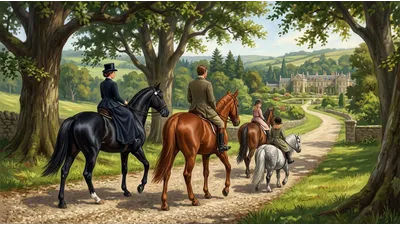
Before you read — think about:
- Why might people alter an animal's body just to make it look a certain way?
- How can a light touch give somebody more control than a hard one?
- What have you been told is 'for your own good' that you were not sure about?
- Is it fair to blame a whole group for what some of its members do?
- What arguments would you use to change a custom that everybody around you accepts without thinking?
Watch for these while reading:
- What Beauty says a light hand does for a horse's mouth and temper.
- Sir Oliver, and the two things he says have been taken from him.
- Skye the terrier and her puppies, and the question Sir Oliver asks about children.
- The arguments for and against blinkers, and which horse supplies each one.
- How Merrylegs cools the conversation down, and what he says about being fair to people.
Vocabulary to know:
breed (noun) — a particular kind of animal with shared qualities passed down in a family line; hands (noun) — the unit used to measure how tall a horse stands at the shoulder; envy (verb) — to want something that belongs to someone else; gag (noun) — a severe kind of bit that presses painfully in a horse's mouth; sprightly (adjective) — lively, springy, and full of energy; tassel (noun) — a small bunch of hanging threads or hairs; indignity (noun) — treatment that shames someone and takes away their dignity; ornament (noun) — something that makes a thing more beautiful; whisk (verb) — to sweep something away with a quick, light movement; lash (verb) — to sweep or strike sharply at something; dock (verb) — to cut an animal's tail short; shear (verb) — to cut off with sharp blades; terrier (noun) — a small, lively, sharp-eared breed of dog; litter (noun) — a group of baby animals born to one mother at the same time; pitifully (adverb) — in a way that makes you feel sorrow for someone; disfigure (verb) — to spoil the natural appearance of a living thing; fiery (adjective) — quick to blaze up with strong feeling; distended (adjective) — stretched wide or swollen out; nostril (noun) — one of the two openings at the end of the nose; blockhead (noun) — a stupid, thick-headed person; shy (verb) — to jump suddenly sideways out of fright; hearse (noun) — a carriage used to carry a coffin to a burial; overturn (verb) — to tip right over onto its side; foal (noun) — a horse in its first year of life; munch (verb) — to chew steadily and noisily; slug (noun) — a small soft creature like a snail without a shell; delicate (adjective) — easily hurt and needing gentle handling; valuable (adjective) — worth a great deal of money.
Chapter 11: Plain Speaking
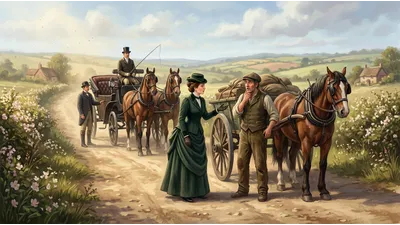
Before you read — think about:
- What is the difference between privately disagreeing with something and saying so out loud?
- Is it harder to correct a stranger or somebody from your own circle? Why?
- How might you persuade somebody by comparing their situation to something they already care about?
- When an adult loses their temper with an animal, what does that show about the adult?
- What makes an argument convincing to you: evidence, feeling, or the person making it?
Watch for these while reading:
- The mistress's habit when she meets a badly driven horse on the road, and the words she uses.
- The questions Squire Gordon puts to Mr. Sawyer, and what Sawyer's replies show about how he thinks.
- The argument the squire makes about a man's own good name, not only about the pony's comfort.
- The comparison the squire draws between carriage horses and soldiers.
- Captain Langley's exact reply, and how much it does and does not promise.
Vocabulary to know:
oppressed (adjective) — treated cruelly or unjustly by someone with power; laden (adjective) — loaded down with a heavy weight; withstand (verb) — to resist something and not give way to it; bay (adjective) — reddish-brown, with a black mane and tail; slender (adjective) — thin and gracefully built; haunches (noun) — the hindquarters of an animal, where the back legs join the body; stern (adjective) — serious and severe in manner; passion (noun) — a burst of violent feeling, especially anger; unmanly (adjective) — not worthy of a decent, honorable man; witness (verb) — to see something happen with your own eyes; grieved (adjective) — made deeply sad; rank (noun) — a person's position or level in society; hobby (noun) — a pet idea that a person keeps returning to and arguing for; uncommonly (adverb) — unusually; more than most; regiment (noun) — a large organized group of soldiers; drill (noun) — the practice of marching and movements that soldiers are trained in; fatigue (verb) — to tire someone out; decrease (verb) — to make something smaller or weaker; theory (noun) — an idea that explains something but has not been put into practice.
Chapter 12: A Stormy Day
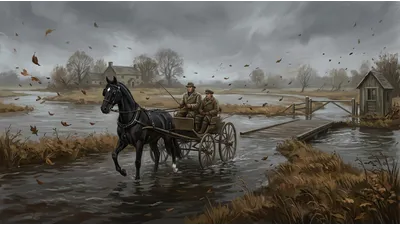
Before you read — think about:
- What is the worst weather you have ever been out in?
- How does trust build up between two workers who have no way of talking to each other?
- How do people decide whether to trust their own judgment or somebody else's warning?
- What dangers would a long journey hold in a time before cars, telephones or weather forecasts?
- What is the difference between reasoning something out and simply sensing it?
Watch for these while reading:
- The weather on the outward journey, and every detail of it Beauty records.
- The wooden bridge over the river, the toll-keeper's house beside it, and the man who lives there.
- How John speaks to Beauty on a bad road, and how the master speaks to John.
- The master's remarks about reason and instinct, and the difference he draws between them.
- The way Beauty's evening in the stable is described, and what it shows about John.
Vocabulary to know:
dog-cart (noun) — a light two-wheeled carriage set high on large wheels; plank (noun) — a long, flat, heavy board; substantial (adjective) — strong and solidly made; bait (noun) — a feed and rest given to a horse in the middle of a journey; skirts (noun) — the outer edges of an area; sway (verb) — to swing slowly from side to side; twig (noun) — a very small, thin branch; crossways (noun) — a place where roads meet and cross; flood (noun) — water that has overflowed onto land that is usually dry; torch (noun) — a burning stick carried to give light; lull (verb) — to die down and grow calm; furious (adjective) — extremely violent and forceful; current (noun) — the steady movement of water flowing in one direction; prompt (adjective) — quick and immediate, without delay; reason (noun) — the power to think a problem through and work it out; inquiry (noun) — an act of asking for information about something; tremble (verb) — to shake slightly from fear or cold; straw (noun) — dried stalks of grain used for animal bedding.
Chapter 13: The Devil's Trade Mark
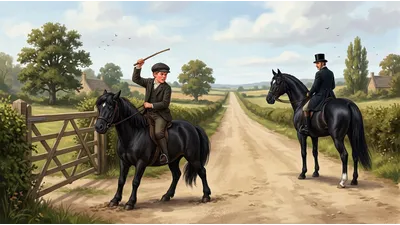
Before you read — think about:
- If you saw somebody treating an animal badly, what would you do at the time - and what would you say afterwards?
- Who taught you the strongest lesson about right and wrong, and how?
- Why might a person who bullies animals also bully people?
- What is the difference between a punishment and a lesson that actually changes somebody?
- Can you tell what a person believes from the way they treat creatures who cannot answer back?
Watch for these while reading:
- The pony at the field gate, and how many times it does the same thing before doing anything else.
- What John says to the boy, and the reason John gives himself for saying it.
- Why John deliberately rides on to Farmer Bushby's house.
- The story James tells about the same boy at school, and what the schoolmaster said to the class.
- The saying about cruelty that stayed in James's memory, and how John extends it to cover more than cruelty.
Vocabulary to know:
leap (verb) — to jump over something in one bound; thrashing (noun) — a severe beating; quickset (adjective) — grown from living cuttings planted close together to form a thick hedge; dangling (adjective) — hanging loosely and swinging about; thorn (noun) — a sharp point growing out of a plant's stem; stack-yard (noun) — the part of a farm where hay and grain are piled in stacks; inclined (adjective) — feeling willing to do something; rile (verb) — to make someone angry and impatient; obliged (adjective) — grateful to someone for what they have done; chuckle (verb) — to laugh quietly to yourself; airs (noun) — a proud, superior manner put on to impress people; swagger (verb) — to walk or behave in a boastful, showy way; bully (verb) — to frighten or hurt someone smaller or weaker; laborer (noun) — a person who is paid to do hard physical work; sprawling (adjective) — spread out awkwardly on the ground; bellow (verb) — to shout in a deep, loud voice; coward (noun) — a person who is afraid to face danger or take responsibility; hard-hearted (adjective) — showing no pity or feeling for others; trade-mark (noun) — a sign or mark that shows who something belongs to; sham (noun) — something false that only pretends to be real.
Chapter 14: James Howard
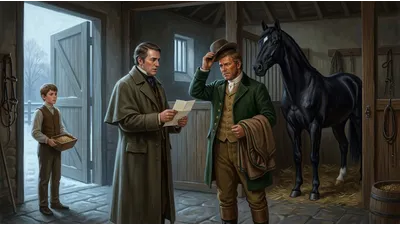
Before you read — think about:
- Who would you ask for an honest opinion about yourself, and why that person?
- What qualities would you look for in a person you were recommending for a job?
- What makes a job a good job: the pay, the people, or the chance to learn?
- What is a reference, and why did one matter so much before telephones existed?
- What sort of practice would prepare somebody to drive a carriage through a crowded city?
Watch for these while reading:
- The questions the master puts to John, and the order he puts them in.
- How strongly John answers before he understands what is being asked.
- The master's explanation of why he asked in that particular way.
- Everything the position at Clifford Hall offers, and what it might lead to later on.
- The kinds of driving James is set to practise, and the places chosen for the hardest of it.
Vocabulary to know:
industrious (adjective) — hard-working and steady; respectful (adjective) — showing proper regard for someone; slight (verb) — to do a job carelessly or leave part of it undone; suspect (verb) — to think something might be true without having proof; acquaintance (noun) — a person you know slightly rather than a close friend; livery (noun) — the special uniform worn by the servants of a household; grave (adjective) — serious and solemn in manner; attentive (adjective) — listening or watching carefully; droll (adjective) — amusing in a dry, quiet way; cautious (adjective) — careful, and slow to commit yourself; feeble (adjective) — weak, especially from old age; pensioned (verb) — retired from work with regular payments for past service; shillings (noun) — old British silver coins, twenty of which made one pound; coachhouse (noun) — a building where carriages are kept; postscript (noun) — a short note added at the end of a letter after it is signed; errand (noun) — a short trip made to deliver a message or fetch something; omnibus (noun) — a large horse-drawn vehicle that carried many paying passengers; chamber (noun) — a room set aside for a particular purpose.
Chapter 15: The Old Hostler
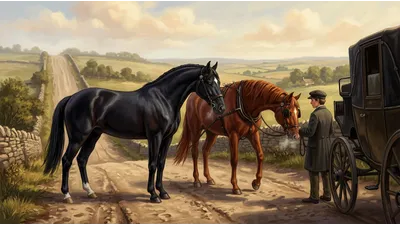
Before you read — think about:
- What small habits would make a long journey easier or harder for the animals doing the work?
- How can you tell that somebody is genuinely expert at a job rather than merely quick at it?
- What could a stranger work out about your home just by watching how you behave away from it?
- Why might somebody who can no longer do the work they loved find a way to stay near it?
- What is the longest journey you have ever made, and what do you remember about stopping along the way?
Watch for these while reading:
- What James does at the top and at the bottom of each hill, and the reason each thing helps.
- The old hostler at the inn, and the way he works: quick, but never hurried.
- The claim he makes about being able to read a horse's whole history from its coat.
- The comparison he draws between horses and children.
- His account of the men he has worked under, and what he says he would look for first in a stable.
Vocabulary to know:
harassed (adjective) — worn out by constant strain and trouble; brake (noun) — a device that slows or holds back a vehicle; breathing (noun) — a short pause to rest and catch your breath; principal (adjective) — main, or most important; market-place (noun) — the open square of a town where goods are bought and sold; archway (noun) — a curved opening built to pass through; hostler (noun) — a man employed at an inn to look after travelers' horses; unbuckle (verb) — to undo the buckles that fasten straps; crooked (adjective) — bent out of its proper shape; waistcoat (noun) — a sleeveless garment buttoned over a shirt; thorough (adjective) — complete and careful, leaving nothing undone; jockey (noun) — a person who rides horses in races; slippery (adjective) — smooth or wet, so that it is hard to keep your footing; timid (adjective) — easily frightened and lacking confidence; depart (verb) — to turn away from a path you were taught; bold (adjective) — daring and confident.
Chapter 16: The Fire
Before you read — think about:
- Why do you think animals often refuse to leave a building they are frightened of?
- What would make you follow a stranger in an emergency - and what would make you refuse?
- How does panic in one person spread to everybody around them?
- What have you been taught to do in an emergency, and who taught you?
- What is the difference between being fearless and being calm?
Watch for these while reading:
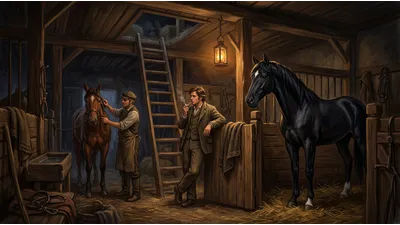
- The very first thing Beauty notices about the air in the stable, and the order in which the other details reach him.
- How each person entering the stable behaves, and how the horses answer them.
- James's voice, and what he does with the scarf he is wearing.
- The yard outside, and what Beauty can make out of it in the dark and the noise.
- The stable rule Beauty states at the end of the chapter, and how firmly he puts it.
Vocabulary to know:
lounge (verb) — to move or stand about in a lazy, careless way; gossip (verb) — to chat idly about other people; loft (noun) — the space under the roof above a stable, used for storing hay; trapdoor (noun) — a small door set into a floor or ceiling; crackling (noun) — the sharp snapping sound made by something burning; lantern (noun) — a case with glass sides that holds a light; flicker (verb) — to shine unsteadily, going bright and dim; smother (noun) — thick, choking smoke; shrill (adjective) — high, sharp, and piercing in sound; neigh (noun) — the long, loud call a horse makes; din (noun) — a loud, confused noise; rumbling (noun) — a deep, rolling sound; blaze (noun) — a bright, fierce fire; hasten (verb) — to hurry; mortal (adjective) — human; being a person who must one day die; rafters (noun) — the sloping beams that hold up a roof; tiles (noun) — flat pieces of baked clay used to cover a roof; deny (verb) — to say that something is not true; entry (noun) — a passage leading in or out of a place.
Chapter 17: John Manly's Talk
Before you read — think about:
- Who was the first person to teach you something you were bad at?
- What do you think 'take care of number one' means, and do people really live that way?
- How can one act of kindness change the whole direction of somebody's life?
- What would be the hardest part of leaving home for the first time?
- What do you think makes somebody good at looking after animals?
Watch for these while reading:
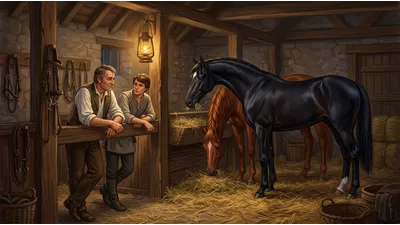
- The remark the visiting coachman makes about horses and fires, and how John answers it.
- How John receives the news of who is to take James's place, and the reasons he gives.
- The story John tells about his own childhood, and every person in it who helped him.
- The saying John argues against, and the examples he lines up against it.
- How much of this chapter is John talking, and what that tells you about him.
Vocabulary to know:
snug (adjective) — warm, cozy, and well sheltered; kind-hearted (adjective) — naturally generous and caring toward others; fever (noun) — an illness that makes the body dangerously hot; relation (noun) — a member of your family; workhouse (noun) — a harsh public institution where the very poor were housed in exchange for hard labor; widow (noun) — a woman whose husband has died; knitting (noun) — the making of cloth by looping yarn with long needles; needlework (noun) — sewing done by hand; hire (verb) — to pay money for the use of something; wages (noun) — money paid regularly in return for work; selfish (adjective) — caring only about yourself; confidentially (adverb) — privately, as something said only between two; maul (verb) — to handle something roughly and clumsily; down-hearted (adjective) — sad and discouraged; pinch (noun) — a hard, painful moment of difficulty; shift (verb) — to manage on your own without anyone's help; appetite (noun) — the desire to eat; encouraged (adjective) — given fresh hope and confidence; turnip (noun) — a round root vegetable grown as a farm crop; hoe (verb) — to break up soil around plants with a long-handled tool.
Chapter 18: Going for the Doctor
Before you read — think about:
- What would it feel like to be handed the most important job of your life with no warning?
- What jobs do people do at night while everybody else is asleep?
- What is the fastest you have ever had to move to get something done?
- Who would you want beside you in an emergency, and what would you want them to be like?
- How would you have fetched a doctor at three in the morning before telephones existed?
Watch for these while reading:
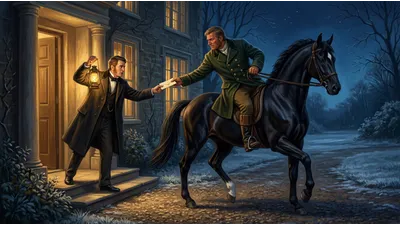
- How quickly the chapter moves in its opening paragraphs, and who is ready before anyone else is.
- What John says to Beauty during the ride, and what he says about him to the doctor.
- Beauty's remark about not needing a whip, and the person he compares himself to.
- Everything Joe does for Beauty in the stable, and the length of that list.
- What the master says to Beauty later, and how Beauty answers it inside his own head.
Vocabulary to know:
roused (verb) — woken up suddenly; thump (verb) — to strike with heavy, dull blows; flung (verb) — threw open quickly and forcefully; clatter (noun) — a rattling noise made by hard things striking together; nightcap (noun) — a soft cap worn in bed; spent (adjective) — completely worn out; pant (verb) — to breathe in quick, heavy gasps; steam (verb) — to give off visible clouds of vapor; pail (noun) — a bucket; loins (noun) — the lower part of the back; moan (noun) — a low sound made because of pain; stoop (verb) — to bend down low; gruel (noun) — a thin, warm porridge given to the sick; inflammation (noun) — painful swelling and heat in a part of the body; lungs (noun) — the two organs in the chest used for breathing; nurse (verb) — to look after someone who is ill; ache (verb) — to hurt with a steady, dull pain.
Chapter 19: Only Ignorance
Before you read — think about:
- If somebody harms you by mistake, does that make the harm any smaller?
- Is 'I didn't know' a good enough excuse? When is it, and when is it not?
- How should we treat a person who is genuinely sorry for something they got wrong?
- When you are angry with somebody, what helps you stop being angry?
- Can you name a job where simply not knowing enough could badly hurt somebody?
Watch for these while reading:
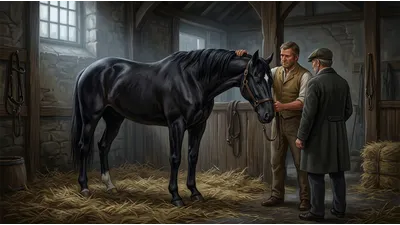
- Tom Green, and what he says his boy has been going through.
- John's first answer, and the honest reason he gives for his own hardness.
- John’s way of speaking when he is angry, compared with his usual manner.
- The three examples John gives, and the single thing all three have in common.
- How the last of those examples lands on the man John is speaking to.
Vocabulary to know:
bleed (verb) — to draw blood from a sick patient, once believed to be a cure; faint (adjective) — weak, dizzy, and close to losing consciousness; draught (noun) — a measured dose of liquid medicine; broken-hearted (adjective) — overwhelmed with grief and sorrow; ignorance (noun) — not knowing something that you needed to know; wickedness (noun) — the doing of evil on purpose; mischief (noun) — harm or damage that has been done; dose (verb) — to give someone medicine; undertake (verb) — to take on a task or responsibility; hothouse (noun) — a heated glass building for growing delicate plants; cuttings (noun) — small pieces cut from plants and rooted to grow new ones; nipped (verb) — pinched off and killed by frost; tender (adjective) — delicate and easily harmed; startled (adjective) — suddenly surprised.
Chapter 20: Joe Green
Before you read — think about:
- Who do you think of as brave, and what did they actually do?
- Is it ever right to interfere in something that is not your business?
- How do people change between the ages of fourteen and twenty?
- What makes somebody's word believable when they report what they saw?
- What does it mean to say somebody has 'grown up'?
Watch for these while reading:
- The brick cart at the bottom of the hill, and the reason it cannot move.
- The two things Joe offers the carter before riding on.
- Joe's manner from the point at which he makes up his mind: his colour, his voice, his pace.
- The rule John states about interfering, and how flatly he puts it.
- The change everyone in the household remarks on in Joe by the end of the chapter.
Vocabulary to know:
brick-field (noun) — an open yard where clay is dug and bricks are made; ruts (noun) — deep grooves worn into a soft road by wheels; carter (noun) — a man whose job is driving a cart; unmercifully (adverb) — without any pity at all; heave (verb) — to rise and fall heavily; brutally (adverb) — in a cruel and violent way; impudent (adjective) — rudely bold and disrespectful; rascal (noun) — a troublesome or dishonest person; towering (adjective) — extremely great or violent; evidence (noun) — information given to show what really happened; magistrate (noun) — a local official who hears and decides smaller court cases; summons (noun) — an official order requiring someone to appear in court; interfere (verb) — to step into a situation that is not your own affair; footman (noun) — a household servant who answers the door and waits at table; flush (verb) — to turn red in the face from strong feeling; twitch (noun) — a quick, small pull; exhausted (adjective) — completely worn out; sentenced (verb) — given an official punishment by a court.
Chapter 21: The Parting
Before you read — think about:
- What happens to the people who work in a large household when the family has to leave it?
- How do animals seem to know that something is wrong before anybody tells them?
- If you could choose any work in the world, would you pick the easiest or the most useful?
- Why do people say goodbye even when they cannot manage to speak?
- What has to change before a place stops being your home?
Watch for these while reading:
- The doctor's orders, and the way the news travels through the household.
- The arrangement made for each horse, and the condition attached to one of them.
- The work John says he would rather do, and the reason he gives for it.
- What people manage to say at the railway station, and what they do not.
- The last sentence of the chapter, and the single word it rests on.
Vocabulary to know:
deathbell (noun) — a bell rung slowly to announce that someone has died; household (noun) — all the people who live and work in one house; establishment (noun) — a great house together with all its servants, horses, and carriages; governess (noun) — a woman employed to teach children in their own home; earl (noun) — a British nobleman of high rank; engaged (adjective) — hired to do a particular job; low-spirited (adjective) — sad and without energy; situation (noun) — a paid position of employment; colt-breaker (noun) — a person whose trade is training young horses to be ridden and driven; suitable (adjective) — well fitted to a particular purpose; agent (noun) — a person who handles business matters on someone else's behalf; faithful (adjective) — loyal and reliable over a long time; repay (verb) — to give something back in return for kindness received; maid (noun) — a woman servant; platform (noun) — the raised walkway beside a railway line where passengers wait; glide (verb) — to move away smoothly and quietly.
Chapter 22: Earlshall
Before you read — think about:
- If you were starting somewhere new, what would you want passed on about you beforehand?
- How much power does an employee really have when they disagree with their employer?
- What do you already know about how servants lived and worked in a great English house?
- Who has the final say in the place where you live, and how do you know?
- What do people mean when they say something is done for 'style'?
Watch for these while reading:
- Everything John tells York about each horse, and the one thing he asks of him.
- York's answer about who actually decides matters in this house.
- How Beauty and John part, and what a horse can and cannot do at such a time.
- The very first difference Beauty feels when the new harness goes on.
- My lady's manner and her exact words, and the way York carries out what she asks.
Vocabulary to know:
vicarage (noun) — the house where a vicar lives; stabling (noun) — the buildings and stalls provided for housing horses; gateway (noun) — a grand opening with a gate in it; refreshment (noun) — food and drink offered to a visitor; adjoining (adjective) — next to each other and joined together; peculiarity (noun) — a particular quality that belongs to one individual and not to others; snappish (adjective) — quick to bite or answer sharply; suspicious (adjective) — expecting to be treated badly, and therefore not trusting; degrees (noun) — small stages, one following another; constitution (noun) — the general health and natural make-up of a body; tease (verb) — to bother or irritate again and again; foaled (verb) — born, when speaking of a horse; lordship (noun) — the title used when speaking of or to a lord; ladyship (noun) — the title used when speaking of or to a lady; drab (adjective) — dull brownish-grey in color; scarlet (adjective) — bright red; breeches (noun) — short trousers fastened just below the knee; rustling (noun) — the soft, whispering sound made by moving cloth; imperious (adjective) — commanding, in a proud manner that expects to be obeyed; respectfully (adverb) — in a polite way that shows proper regard; nuisance (noun) — something annoying that you have to put up with; dread (verb) — to feel fear about something that is coming.
Chapter 23: A Strike for Liberty
Before you read — think about:
- What usually happens just before somebody refuses to take any more?
- If a servant knows an order is wrong, what choices do they actually have?
- Why might a practice carry on even when everybody involved knows it does harm?
- Is it fair to call somebody dangerous when they are reacting to pain?
- Who should be held responsible when a warning is given and ignored?
Watch for these while reading:
- The order my lady gives, and the word she uses about humouring a horse.
- How well prepared Ginger is for what she has decided, and the way she has been talking beforehand.
- What Beauty is thinking while he stands in the yard, and what he fears for himself.
- What York says once nobody but the horses can hear him, and what he decides to do.
- The story Max tells about the dealer, and the reason the dealer gave.
Vocabulary to know:
duchess (noun) — a noblewoman of very high rank; intolerable (adjective) — too painful or unpleasant to be put up with; terret (noun) — a metal ring on a harness that a rein is passed through; desperate (adjective) — wild and reckless from distress; winch (noun) — a device with a crank, used for pulling or lifting; trace (noun) — one of the strong straps by which a horse pulls a carriage; unhitch (verb) — to unfasten something from what it is attached to; bruised (adjective) — marked and sore from being struck; confound (verb) — to express strong annoyance at something; sorely (adverb) — very greatly and painfully; sponge (verb) — to wash gently with a soft pad soaked in water; lotion (noun) — a liquid rubbed onto the skin to soothe or heal it; constrained (adjective) — forced into an unnatural position; foam (verb) — to produce a mass of bubbly spit at the mouth; unnatural (adjective) — not the way a living thing normally is; depressed (adjective) — low in spirits and worn down; diseased (adjective) — made ill by disease; relieve (verb) — to ease someone's pain or difficulty.
Chapter 24: The Lady Anne, or a Runaway Horse
Before you read — think about:
- When an expert warns you that something is unsafe, how do you decide whether to listen?
- What is the fastest you have ever travelled on something with no engine?
- How would people get help quickly in an emergency before telephones existed?
- What qualities would you want in a horse if you had to cross rough country in a hurry?
- Why might a stranger take a risk for a person they have never met?
Watch for these while reading:
- Blantyre's advice about the mare, the reasons Lady Anne gives for setting it aside, and how each of them argues.
- Lizzie, and the two very different descriptions Beauty gives of her.
- What Beauty can and cannot see from the gate where he is tied.
- The country between the hall and the common: the road, the hedges, the ditch, and how closely Beauty measures it.
- The people met along the way, and how quickly a stranger will answer a question.
Vocabulary to know:
invalid (noun) — a person who is ill for a long time and cannot go about; horsewoman (noun) — a woman who is skilled at riding; thoroughbred (adjective) — bred from a long line of pure racing stock; side-saddle (noun) — a saddle on which the rider sits with both legs on one side; amiable (adjective) — friendly and good-natured; confess (verb) — to admit that something is true; curb (noun) — a chain or strap under a horse's jaw that gives the rider extra control; evergreens (noun) — trees and shrubs that keep their leaves all year round; alight (verb) — to get down from a horse or carriage; spikes (noun) — sharp pointed pieces of metal; disorderly (adjective) — messy, unruly, and out of control; frolicsome (adjective) — playful and full of high spirits; bolt (verb) — to run off suddenly and uncontrollably; blunder (verb) — to move clumsily and crash into things; headlong (adjective) — rushing forward wildly and without control; unseated (adjective) — thrown out of the saddle; paw (verb) — to scrape at the ground with a hoof; glimpse (noun) — a very brief sight of something; road-mender (noun) — a workman whose job is repairing roads; heath (noun) — an open stretch of rough, uncultivated land; heather (noun) — a low, purple-flowered shrub that covers open moorland; furze (noun) — a prickly, yellow-flowered bush that grows on open ground; scrubby (adjective) — small, stunted, and poorly grown; habit (noun) — the long skirted coat a lady wears for riding; dike (noun) — a long ditch cut into the ground; clods (noun) — heavy lumps of earth; motionless (adjective) — completely still; ghastly (adjective) — deathly pale and frightening to see; circuit (noun) — a way taken around something; manfully (adverb) — bravely and with determination.
Chapter 25: Reuben Smith
Before you read — think about:
- Can a person be genuinely skilled and genuinely trustworthy and still be unreliable?
- What makes you decide that somebody is reliable?
- How do you decide whether to set off on a journey or wait?
- How do the consequences of one person's choices fall on people who had no say in them?
- What might a horse notice about a rider that the rider cannot notice about himself?
Watch for these while reading:
- Everything Beauty lists in Reuben Smith's favour before he mentions the one fault.
- The instruction Colonel Blantyre gives at the station, and the plan made for the next morning.
- The small problem the hostler points out, and the answer he is given.
- The company at the inn, and how Beauty keeps track of the hours from the stable.
- The road home: its surface, its stones, its pace, and every detail Beauty records of it.
Vocabulary to know:
veterinary (adjective) — having to do with the medical treatment of animals; surgeon (noun) — a doctor trained to treat injuries and perform operations; four-in-hand (noun) — a carriage pulled by four horses driven by one person; tandem (noun) — a carriage pulled by two horses harnessed one in front of the other; scholar (noun) — a well-educated person; bout (noun) — a spell of heavy drinking; disgrace (noun) — a cause of shame; hushed (verb) — kept quiet so that others would not find out; dismissed (verb) — sent away from a job; interceded (verb) — spoke up on someone else's behalf; brougham (noun) — a small closed carriage; colonel (noun) — a senior officer in the army; offhand (adjective) — careless and casual in manner; abused (verb) — spoke to someone harshly and insultingly; landlord (noun) — the keeper of an inn; oath (noun) — an angry swear word; turnpike (noun) — a gate across a road where travelers had to pay before passing; quick (noun) — the tender living flesh underneath a hoof or a nail; limp (verb) — to walk unevenly because of an injured leg; intense (adjective) — very strong and severe; frequented (adjective) — often used or travelled; nightingale (noun) — a small brown bird famous for singing at night; flit (verb) — to fly lightly and quickly from place to place.
Chapter 26: How It Ended
Before you read — think about:
- How would people work out what had happened at a roadside where nobody had seen it?
- What does it mean to say a case has been 'settled'?
- Why do people want to know exactly whose fault something was?
- What makes a rule or a law feel fair to the people it is applied to?
- How would you decide whether something was truly nobody's fault?
Watch for these while reading:
- How Beauty knows that people are coming long before he can see them.
- What the men say to each other as they look the ground over.
- Everything that is done for Beauty's knees, and how long each stage of it takes.
- The two men who come out from Earlshall, and the difference in the way each behaves.
- How much of this chapter Beauty can only report at second hand, and how he marks that difference.
Vocabulary to know:
distinguish (verb) — to tell one thing apart from another; soaked (adjective) — thoroughly wet through; attempt (verb) — to try to do something; hobble (verb) — to walk awkwardly and with difficulty; poultice (noun) — a soft, moist mass laid on a wound to draw out heat; cleanse (verb) — to clean something thoroughly; joint (noun) — the place where two bones meet and bend; blemish (noun) — a permanent mark that spoils something's appearance; caustic (noun) — a burning substance used to remove unhealthy flesh from a wound; blistering (adjective) — causing the skin to blister and the hair to fall out; inquest (noun) — an official inquiry held to find out how someone died suddenly; intoxicated (adjective) — drunk; gloomy (adjective) — dark, cheerless, and depressing.
Chapter 27: Ruined and Going Downhill
Before you read — think about:
- How would it feel to be judged on how you look rather than on what you can do?
- Why might two friends who have both been badly used find comfort in each other?
- What does an owner owe an animal that has been ruined while in their care?
- What is the difference between selling something for the best price and selling it to the best home?
- How do small differences in a workplace add up over weeks and months?
Watch for these while reading:
- Why Ginger has been put out into the meadow, and who is named as the cause.
- The sentence Ginger uses to sum up what has become of the two of them.
- What the earl says he minds most, and what he decides must be done.
- The instruction the earl gives York about where Beauty should go.
- How Beauty judges a stable — what he notices first about any place he is put.
Vocabulary to know:
sufficiently (adverb) — enough for the purpose; society (noun) — the company of other living creatures; steeplechase (noun) — a horse race run across country over jumps; wind (noun) — a horse's power of breathing freely; prime (noun) — the strongest and best time of life; drunkard (noun) — a person who habitually drinks too much; lime-trees (noun) — tall shade trees with heart-shaped leaves; annoyed (adjective) — irritated and displeased; consequence (noun) — importance; figure (noun) — a price; recommendation (noun) — a statement given in someone's favor; tolerably (adverb) — fairly; reasonably well; horse-box (noun) — a closed railway wagon built for carrying a horse; slope (noun) — a surface that is higher at one end than the other; fatiguing (adjective) — very tiring.
Chapter 28: A Job Horse and His Drivers
Before you read — think about:
- Does renting something change how you treat it, compared with owning it?
- Can you be bad at a job simply by not paying attention?
- Why might the best-behaved animal be handed to the worst handlers?
- How were horses and carriages hired out before taxis and rental cars existed?
- Why does a stranger sometimes spot what the person in charge has missed?
Watch for these while reading:
- The two opposite kinds of poor driver Beauty describes, and what is wrong with each.
- What Squire Gordon used to say about spoiling a horse, and the thing he compared it to.
- How long the driver goes without noticing anything, and who he blames when he does.
- The farmer's behaviour from the second he pulls up, and what he carries in his pocket.
- The driver's manner once the farmer has gone.
Vocabulary to know:
hitherto (adverb) — up until now; subjected (verb) — made to undergo something unpleasant; relaxing (verb) — loosening a hold or a pull; insensible (adjective) — no longer able to feel anything; slovenly (adjective) — careless, sloppy, and untidy; phaeton (noun) — a light open four-wheeled carriage; unmeaning (adjective) — done for no reason at all; lame (adjective) — unable to walk properly because of an injured leg or foot; wedged (adjective) — forced tightly into a narrow space; frog (noun) — the soft, V-shaped pad on the underside of a horse's hoof; liable (adjective) — likely to do or suffer something; stumble (verb) — to trip and nearly fall; dislodge (verb) — to force something out of the place where it is stuck; stone-pick (noun) — a small hooked tool for prying stones out of a horse's hoof; dismount (verb) — to get down off a horse; contemptuously (adverb) — in a scornful way that shows no respect; guidance (noun) — direction and help given to someone.
Chapter 29: Cockneys
Before you read — think about:
- Why might somebody who has only ever travelled by train misjudge what a horse can do?
- Is it fair to blame an animal for something its body cannot help?
- How does somebody who has grown up in a city see the countryside, and the other way round?
- If a creature is frightened, does punishing it make it braver?
- How quickly can you tell that somebody knows what they are doing?
Watch for these while reading:
- The comparison Beauty makes in the opening paragraphs, and every way these drivers act it out.
- Rory, and where in the road he is placed when the two horses go out together.
- Peggy's explanation of her odd pace, and where she says the fault lies.
- The shying horse's account of why he shies, and the old gentleman's correction of it.
- The gentleman in Pulteney Street, and everything he does before he ever gets in.
Vocabulary to know:
cockney (noun) — a Londoner; used here for a town-bred driver who knows nothing about horses; consideration (noun) — thoughtful care for what others need; plied (verb) — used steadily and repeatedly; scolding (adjective) — angrily telling someone off; uncomplaining (adjective) — bearing hardship without protest; relief (noun) — a break or easing from strain; jagged (verb) — cut and torn roughly; twilight (noun) — the dim light just after sunset; pole (noun) — the long wooden bar that runs between a pair of carriage horses; shaft (noun) — one of the two long bars between which a single horse is harnessed; stagger (verb) — to reel and almost fall; disabled (adjective) — permanently injured and no longer able to do the work; coal-carting (noun) — the work of hauling heavy loads of coal by cart; dun (adjective) — a dull greyish-brown color; dappled (adjective) — marked with rounded patches of a slightly different shade; remarkably (adverb) — unusually; strikingly; awkward (adjective) — clumsy and uncomfortable; shuffling (adjective) — dragging and uneven in step; desponding (adjective) — hopeless and low in spirits; clergyman (noun) — a minister of a church; capital (adjective) — excellent; ribs (noun) — the curved bones that form the chest; stead (noun) — the place that another has left; shindy (noun) — a noisy fuss; deer (noun) — a swift wild animal with hoofs, the males carrying antlers; considerate (adjective) — thoughtful about what others need; arched (verb) — curved into a bow shape; prevailed (verb) — successfully persuaded someone.
Chapter 30: A Thief
Before you read — think about:
- How would you check whether an animal in somebody else's care was really being fed what it should be?
- How much of what happens in a workplace does the person in charge actually see?
- Why is a victim who cannot speak especially easy to cheat?
- Before supermarkets, how did people buy and store feed for animals?
- What does the word 'honest' mean to you beyond simply not lying?
Watch for these while reading:
- Exactly what Mr. Barry orders for Beauty, and what Beauty says arrives in the manger.
- How much of the stable Beauty can watch from his own stall, and how much he can only guess at.
- The farmer's questions to Mr. Barry, and the test he performs with his own hand.
- The phrase Beauty repeats back to the reader with some bitterness in it.
- Filcher the groom, and the details of his life at home that come out along the way.
Vocabulary to know:
unmarried (adjective) — not married; condition (noun) — an animal's state of health and fitness; vetches (noun) — climbing plants grown as green food for animals; rye (noun) — a grain crop, also cut green as fodder; cultivated (verb) — grew crops on a piece of land; poultry (noun) — chickens and other birds kept for food; fiddlesticks (noun) — nonsense; scoundrel (noun) — a dishonest person with no principles; dumb (adjective) — unable to speak; stint (verb) — to give someone less than they need; bin (noun) — a large storage box; ajar (adjective) — slightly open; harness-room (noun) — the room where harness and feed are kept; bluster (verb) — to talk loudly and angrily to cover up guilt; lock-up (noun) — a small local jail; guilty (adjective) — responsible for having done something wrong.
Chapter 31: A Humbug
Before you read — think about:
- How can you tell the difference between somebody polite and somebody trustworthy?
- Why might a lazy person work hardest at looking busy?
- How do you tell whether somebody has done a job properly or only made it look that way?
- Why do people so often look for a complicated explanation before checking the simple one?
- What does it actually cost to keep a large animal?
Watch for these while reading:
- The parts of the work Alfred Smirk does carefully, and the parts he does not do at all.
- How he answers his master's suggestion about the stall.
- What gets blamed for the smell, and how much money is spent chasing that idea.
- What Mr. Barry notices about Beauty's walk, and how the groom explains it away.
- The farrier, and the way he goes about examining a horse.
Vocabulary to know:
humbug (noun) — a person who pretends to be something they are not; conceited (adjective) — far too pleased with yourself; indolent (adjective) — lazy and unwilling to make any effort; whiskers (noun) — the hair a man grows on his cheeks; looking-glass (noun) — a mirror; vapors (noun) — clouds of gas or steam rising off something; inflame (verb) — to make sore, red, and swollen; drains (noun) — pipes or channels that carry away waste water; bricklayer (noun) — a workman who builds and repairs brickwork; amiss (adjective) — wrong or out of order; lime (noun) — a white powder used to clean and sweeten drains; fumble-footed (adjective) — clumsy and unsure on the feet; disordered (verb) — upset the normal working of something; feverish (adjective) — hot and restless as though with a fever; thrush (noun) — a disease that makes a horse's hoof soft, sore, and foul-smelling; foul (adjective) — dirty and bad-smelling; liniment (noun) — a liquid rubbed on to soothe soreness; tow (noun) — coarse flax fibers used for packing and dressing wounds; deceived (verb) — tricked into believing something untrue; disgusted (adjective) — filled with strong distaste.
Chapter 32: A Horse Fair
Before you read — think about:
- What would you look for if you had to choose an animal you would depend on every day?
- How much can you learn about a person from the way they touch an animal?
- Why might a place that is entertaining for buyers be frightening for whatever is being sold?
- What becomes of workers, human or animal, once they are past their best?
- How do you decide what something is really worth?
Watch for these while reading:
- The different classes of horses at the fair, and where the worn-out ones are stood.
- What buyers do first when they come up to Beauty, and how differently each one does it.
- The three things about one particular man that make Beauty want him for a master.
- The bargaining itself, and the way the price moves.
- The journey out of the fair, and the street Beauty is taken to at the end of it.
Vocabulary to know:
marshes (noun) — low, wet, boggy ground; droves (noun) — large groups of animals driven along together; shaggy (adjective) — covered with long, rough, untidy hair; braided (adjective) — plaited into a thick strand; cord (noun) — thin rope; unsoundness (noun) — a lasting fault or weakness in a horse's health; dejected (adjective) — sad and without hope; knuckling (verb) — bending forward weakly at the knee; bargaining (noun) — arguing back and forth over a price; trickery (noun) — the use of dishonest tricks; salesman (noun) — a person whose business is selling; flashy (adjective) — showy in a cheap, boastful way; hayloft (noun) — the loft above a stable where hay is stored; governor (noun) — a friendly title of respect used among working men; sixpence (noun) — an old British coin worth six pennies; monstrous (adjective) — enormously great; thoroughfare (noun) — a main road running right through a place.
Chapter 33: A London Cab Horse
Before you read — think about:
- What would an animal have to get used to in order to work in a busy city?
- How can an employer be strict about the work and still be kind?
- Picture a London street in the 1800s: what is on it, and what is the noise like?
- What difference does it make to be able to turn round and lie down comfortably?
- Why would one regular day off matter so much to somebody who works very hard?
Watch for these while reading:
- Jerry Barker's family, and how each of the four is introduced.
- What Jerry decides about the marks on Beauty's knees, and the name he settles on.
- The piece of harness Beauty is not given, and the word he uses for going without it.
- The men at the cab stand, and the way a new horse's standing among them is settled.
- The alterations Jerry has made in his little stable, and Beauty's opinion about water.
Vocabulary to know:
plump (adjective) — pleasantly round and full; trim (adjective) — neat and well kept; merry (adjective) — cheerful and full of fun; frank (adjective) — open and honest in manner; brick (noun) — old-fashioned slang for a thoroughly good and reliable person; olden (adjective) — of long ago; large-boned (adjective) — heavily built with a big frame; cavalry (noun) — soldiers who fight on horseback; snaffle (noun) — a simple, mild jointed bit with no curb attached; palisades (noun) — a fence made of upright iron or wooden stakes; remarks (noun) — comments or observations made out loud; comforter (noun) — a long woollen scarf; grunt (noun) — a short, low sound made in the throat; disputes (noun) — quarrels or arguments; good-humored (adjective) — cheerful and easy-going; fist (noun) — a tightly closed hand; movable (adjective) — able to be shifted from one place to another; moisten (verb) — to make slightly wet; gulp (verb) — to swallow quickly in large amounts; bucketful (noun) — as much as a bucket will hold.
Chapter 34: An Old War Horse
Before you read — think about:
- What do you already know about how horses were used in wars before machines took over?
- How might a trained animal behave in a situation it cannot possibly understand?
- Why might somebody who has been through something terrible describe it very calmly?
- What is the difference between how an army looks on parade and how it looks in a battle?
- Can loyalty to one person carry you through something you would never face otherwise?
Watch for these while reading:
- How the horses were got aboard ship, and what Captain says about the voyage out.
- Captain's account of his master: the man's hand, his voice, his habits.
- What Captain says kept him from being afraid, and how long that lasts.
- The details Captain gives of the ground during a charge, and what he says about the noise.
- The last question Beauty puts to him, and the answer Captain gives.
Vocabulary to know:
halt (verb) — to stop, especially at a command; trumpet (noun) — a brass instrument used to signal soldiers; iron-gray (adjective) — dark grey, the color of iron; abroad (adverb) — to or in another country; vessel (noun) — a ship; deck (noun) — the floor of a ship; hauled (verb) — pulled or lifted with great force; endure (verb) — to put up with something difficult; hardships (noun) — conditions that are hard to bear; cannon (noun) — a large, heavy gun mounted on wheels; bullets (noun) — the small metal missiles fired from guns; musket (noun) — an old long-barrelled gun carried by foot soldiers; lances (noun) — long spears carried by soldiers on horseback; pierced (verb) — driven through; agony (noun) — extreme pain or suffering; mortally (adverb) — in a way that causes death; trampling (verb) — treading heavily on something underfoot; terror (noun) — overwhelming fear; caparisoned (adjective) — dressed in full harness and trappings; daybreak (noun) — the first light of morning; animated (adjective) — lively and full of eagerness; champing (verb) — biting restlessly on the bit; crest (noun) — the ridge along the top of a horse's neck; ranks (noun) — the lines in which soldiers are drawn up; comrades (noun) — fellow soldiers; gallant (adjective) — brave and fine; overpowered (verb) — defeated by greater force; shattered (verb) — broken into pieces; engagements (noun) — battles; parade (noun) — a formal march or display by soldiers.
Chapter 35: Jerry Barker
Before you read — think about:
- Is it fair to expect somebody else to hurry because you set out too late?
- What is the difference between refusing to work hard and refusing to work badly?
- Would you rather be paid extra or thanked properly? Does it depend?
- Who is the most straightforward person you know, and how do they behave?
- Can you judge how good a driver is by how often the whip comes out?
Watch for these while reading:
- The two little songs Jerry sings, and what each one is actually about.
- The one thing Beauty says comes nearest to putting Jerry out of temper.
- What Jerry says to the two young men at the stand, and what the driver next to him does instead.
- The young man with the luggage at the station, and the way he puts his request to Jerry.
- What Jerry takes at the station, and how he answers the other drivers' teasing.
Vocabulary to know:
quarrel (noun) — an angry disagreement; scurry (verb) — to hurry along with short, quick steps; flurry (verb) — to rush about in a flustered, confused way; loitering (noun) — hanging about and wasting time; idleness (noun) — the habit of doing nothing; tavern (noun) — an inn where drink is sold; conscience (noun) — the inner sense of right and wrong that guides a person; jog-trot (noun) — a slow, steady trot; jaded (adjective) — worn out and dulled by overwork; portmanteau (noun) — a large travelling case; stunned (adjective) — dazed by a blow or a shock; earnestly (adverb) — in a serious, urgent way; chirrup (noun) — a short, cheerful clicking sound made to encourage a horse; vans (noun) — covered vehicles for carrying goods; trucks (noun) — open carts for carrying heavy loads; wagons (noun) — large four-wheeled carts for heavy goods; vehicle (noun) — anything used for carrying people or goods along a road; chaffing (noun) — good-natured teasing; gammon (noun) — nonsense; slyly (adverb) — in a knowing, half-secret way; half-crown (noun) — an old British coin worth two shillings and sixpence; porter (noun) — a railway worker who carries passengers' luggage; principles (noun) — the rules a person chooses to live by; commandments (noun) — the religious rules given as laws to live by; whipcord (noun) — the strong cord used for the lash of a whip; wealth (noun) — a great deal of money and property.
Chapter 36: The Sunday Cab
Before you read — think about:
- Should a worker be allowed to refuse a job that would cost them their only day off?
- Why do you think Sunday was treated so differently in Victorian Britain?
- Is it fair to judge a belief by how the people who hold it behave?
- How much power does one worker have compared with a group of workers together?
- What would you give up a day of rest for, and what would you not?
Watch for these while reading:
- The reasons Jerry gives for holding a six-days' licence, and how many of them are practical rather than religious.
- The arguments Mrs. Briggs's servant brings, and the way the conversation is ended.
- Polly's answer, and what she admits about how the family's money stands.
- How the household's takings run over the three weeks that follow.
- The argument among the men at the cab stand, and the proposal Jerry puts to them.
Vocabulary to know:
arrangements (noun) — plans made in advance; license (noun) — an official permit allowing someone to do something; legal (adjective) — allowed by law; abolished (verb) — done away with completely; annual (adjective) — happening once a year; oblige (verb) — to do a favor for someone; worship (noun) — religious prayer and praise; customers (noun) — people who regularly pay for a service; favors (noun) — kind acts done for someone; sovereign (noun) — an old British gold coin worth one pound; honorable (adjective) — honest and fair in dealing with others; rent (noun) — money paid regularly for the use of a house or stable; chaps (noun) — fellows; men; privileges (noun) — special advantages that only some people enjoy; applauded (verb) — showed approval of something said or done; foundling (noun) — an abandoned baby found and taken in by strangers; strike (verb) — to stop work together in order to win a right; mackintoshes (noun) — waterproof raincoats; chapel (noun) — a small place of worship; preachers (noun) — people who deliver religious talks; debts (noun) — money that a person owes; convenient (adjective) — easy and suiting one's own comfort.
Chapter 37: The Golden Rule
Before you read — think about:
- What does 'do to others as you would have them do to you' mean in practice?
- Can a rule you hold firmly still have exceptions? How would you decide which?
- Where have you heard the saying this chapter is named after, and what do people use it for?
- Who in your life keeps their word no matter what, and how do you know?
- What is the best day out you have ever had, and what made it good?
Watch for these while reading:
- Why Mrs. Briggs sends to Jerry again, and the reasons her servant gives for it.
- The request Polly brings to Jerry, and the way she argues it.
- The state Jerry keeps his cab and harness in, and what that says about him.
- Beauty's behaviour in the meadow with his harness off, and the detail he lingers on.
- What Jerry says when he gets home, and what he has brought back with him.
Vocabulary to know:
dangerously (adverb) — in a way that puts life at risk; faithfully (adverb) — reliably, exactly as promised; Sabbath (noun) — the weekly day set apart for rest and worship; pit (noun) — a deep hole in the ground; minister (noun) — a member of the clergy who leads worship; sermon (noun) — a religious talk giving moral instruction; compliments (noun) — polite good wishes sent to another person; trap (noun) — a light two-wheeled carriage; preparations (noun) — things done to get ready for something; lane (noun) — a narrow country road; farmhouse (noun) — the main dwelling house on a farm; cowshed (noun) — a simple shelter where cows are kept; sheer (adjective) — pure and complete; hawthorn (noun) — a thorny shrub with clusters of white blossom; sprays (noun) — slender branching stems with leaves or flowers on them; ivy (noun) — a climbing evergreen plant with dark glossy leaves; hymns (noun) — religious songs of praise.
Chapter 38: Dolly and a Real Gentleman
Before you read — think about:
- Why is bad weather harder on a working animal than on the person driving it?
- How can somebody show respect for a worker without giving them any money?
- Is it your business if you see a stranger treating an animal badly?
- What is the difference between disapproving of something and doing something about it?
- How often do you think people notice the animal that did the work?
Watch for these while reading:
- Why Beauty says frost and snow are the worst conditions of all for a horse.
- What Jerry does instead of going into the tavern, and the reasons he gives for it.
- Dolly's errands to the cab stand, and what Harry adds to them.
- The small thing one passenger does that makes Jerry call him a real gentleman.
- The two statements that same passenger makes about minding one's own business.
Vocabulary to know:
sleet (noun) — rain mixed with snow or ice; keen (adjective) — sharp and biting; rugs (noun) — thick cloths laid over a horse for warmth; waterproof (adjective) — made so that water cannot soak through; nerve (noun) — a fibre in the body that carries feeling; exhausting (adjective) — extremely tiring; roughed (adjective) — given rough edges so as to grip icy ground; pavement (noun) — the paved footway at the side of a street; thronged (adjective) — crowded with people or traffic; basin (noun) — a wide bowl; umbrella (noun) — a folding cover held over the head against rain; hastening (verb) — hurrying; bounding (verb) — leaping along energetically; vaults (noun) — underground storage cellars; arrested (verb) — taken into custody by the police; abusive (adjective) — full of insulting language; note-book (noun) — a small book for writing notes in; growled (verb) — spoke in a low, angry voice; grim (adjective) — stern and forbidding; doctrine (noun) — a belief or principle that someone holds and teaches; wrongdoer (noun) — a person who does wrong; sharers (noun) — those who take part in something along with others; guilt (noun) — responsibility for having done something wrong.
Chapter 39: Seedy Sam
Before you read — think about:
- If a worker is treated unfairly, does that excuse how they treat somebody below them?
- What is the difference between renting your tools and owning them?
- Can a person be cruel without wanting to be?
- Who is responsible when a whole system pushes people into bad choices?
- What would it take to change something that everybody agrees is wrong?
Watch for these while reading:
- The difference Beauty draws between his own position and that of most cab horses.
- The figures Sam gives - rent, fares, hours - and what they add up to.
- The way Sam builds his case: what he opens with, and what he saves until last.
- How the governor of the stand answers, and the one thing he still asks of Sam.
- Sam's last words in the argument, and what the governor makes of them for the rest of the men.
Vocabulary to know:
shabby (adjective) — worn out and poor-looking; tattered (adjective) — torn and ragged; fares (noun) — the charges made for a journey, or the passengers who pay them; season (noun) — the busiest time of the year in a city; starve (verb) — to suffer or die from lack of food; radius (noun) — the distance measured outward from a central point; twopences (noun) — sums of two pennies each; overcharging (noun) — charging more than the proper price; gentry (noun) — well-off people of good social position; purses (noun) — small bags for carrying money; pickpockets (noun) — thieves who steal from people's pockets; handsome (adjective) — generous in amount; pledge (verb) — to leave something with a lender in return for money; mockery (noun) — something that makes a serious idea look absurd; dram (noun) — a small drink of strong liquor; approved (verb) — agreed with and supported; raving (verb) — talking wildly and without sense, as in a high fever.
Chapter 40: Poor Ginger
Before you read — think about:
- How much can a body change over a few years of hard work?
- What would you say to a friend you had not seen since things went badly for them?
- Is there a point at which resisting stops being worth it?
- How do you greet somebody you have not seen for a long time?
- What does an owner owe an animal that can no longer work?
Watch for these while reading:
- The details of the worn chestnut horse that Beauty notices before he places her.
- The chain of owners she describes, and the reason given at each change.
- Her answer when Beauty reminds her how she used to stand up for herself.
- The one thing she says she wishes for.
- What Beauty sees passing in the street a short time afterwards, and how few words he uses for it.
Vocabulary to know:
ill-kept (adjective) — badly looked after; hopeless (adjective) — without any hope left; glossy (adjective) — smooth and shining; lank (adjective) — thin, limp, and without firmness; fetlocks (noun) — the joints just above a horse's hoofs; swelled (adjective) — grown larger through injury or illness; sidled (verb) — moved sideways quietly; twelvemonth (noun) — a full year; doctored (verb) — treated for illness or injury; weakness (noun) — a lasting fault or failing in health; knackers (noun) — the men who bought worn-out horses to be killed; merciful (adjective) — showing pity and kindness; lifeless (adjective) — dead; sunken (adjective) — hollow and fallen inward; streak (noun) — a long thin mark of a different color.
Chapter 41: The Butcher
Before you read — think about:
- Who is really responsible when a delivery has to be made faster than is safe?
- How might a customer's convenience cost an animal its health?
- Can somebody be pushed into cruelty by the way their job is organised?
- What does a genuinely contented working animal look like?
- Before vans and refrigeration, how do you think meat reached people's kitchens?
Watch for these while reading:
- The butcher's horse, and the details of harness and load that Beauty picks out.
- The butcher's complaint to his son, and the answer the boy gives him.
- The single change the two of them agree would put the trouble right.
- The costermonger and his family, and the way they speak to their pony.
- The comparison Beauty draws between the grandest stable he has known and a poor man's yard.
Vocabulary to know:
countess (noun) — the wife of an earl; silver-mounted (adjective) — decorated with fittings made of silver; straining (verb) — pulling with all one's strength; mutton (noun) — the meat of a full-grown sheep; chops (noun) — small cuts of meat left on the bone; housekeeper (noun) — the woman in charge of running a large household; unexpectedly (adverb) — without any warning; crescent (noun) — a curved row of houses; sullen (adjective) — silently resentful; dogged (adjective) — stubbornly refusing to give way; bail (noun) — money paid so that an arrested person can go free until their trial; coster-boy (noun) — a boy who sells fruit and vegetables from a cart in the street; greens (noun) — leafy vegetables; coal-heaver (noun) — a laborer who carries and unloads sacks of coal; plod (verb) — to walk slowly and steadily with heavy steps; accord (noun) — one's own free choice, without being told; rattle (verb) — to move along noisily.
Chapter 42: The Election
Before you read — think about:
- How were elections run before secret ballots and opinion polls?
- How do people in your life show which side they are on in an argument?
- What happens to an argument once people start wearing colours to show their side?
- Is defending somebody the same thing as joining a fight?
- What does the word 'liberty' actually mean to you?
Watch for these while reading:
- What Jerry is offered for his cab during the election, and how the offer is put to him.
- How Jerry talks about the candidates, and the difference he draws between a man's politics and his conduct.
- The state of the streets on polling day, and the traffic Beauty describes in them.
- The distinction Jerry draws for Harry between two kinds of fighting.
- Jerry's definition of the liberty that an election colour actually buys you.
Vocabulary to know:
vote (noun) — the choice a citizen makes in an election; election (noun) — the process of choosing representatives by voting; bills (noun) — printed posters stuck up in public places; public-houses (noun) — inns where drink is sold; insult (noun) — a remark or act meant to hurt or offend; politics (noun) — the beliefs a person holds about how a country should be run; frock (noun) — a girl's dress; pinafore (noun) — an apron-like garment worn over a dress to keep it clean; spattered (adjective) — splashed with something wet or dirty; ragamuffin (noun) — a dirty, ragged child; blackguards (noun) — rough, dishonorable people; premises (noun) — a person's building and the ground it stands on; party (noun) — an organized political group; poll (noun) — the place where votes are cast; hoarse (adjective) — rough and croaking from shouting; gravely (adverb) — seriously and solemnly.
Chapter 43: A Friend in Need
Before you read — think about:
- What is the most useful thing a stranger has ever done for you?
- Is it fair for somebody to take a service that another person needed more?
- What is the busiest place you have ever been, and how did people behave in it?
- How do people behave toward each other on a day when everybody is in a hurry?
- How can a busy working day still leave room for kindness?
Watch for these while reading:
- The sorts of fares Jerry takes in the first part of the day.
- The young woman with the child at the cab stand, and the way Jerry speaks to her.
- The two men who climb into Jerry's cab, and the way they speak to him.
- The words Jerry says quietly to himself outside the hospital.
- The lady Jerry meets at the station, and what he admits to her about his own health.
Vocabulary to know:
stout (adjective) — heavily built; puffy (adjective) — swollen-looking and short of breath; nose-bag (noun) — a bag of feed hung over a horse's nose; candidates (noun) — the people standing for election; limb (noun) — an arm or a leg; hurrahing (verb) — shouting cheers; mouthfuls (noun) — amounts that fill the mouth at once; bewildered (adjective) — completely confused; order (noun) — an official letter granting admission to a hospital; missis (noun) — a plain, everyday way of addressing a woman; risk (verb) — to put in danger; buttonholes (noun) — the slits in a coat where a flower or badge is worn; dodge (noun) — a clever trick used to get round a difficulty; stoppage (noun) — a delay or interruption; by-streets (noun) — small side streets away from the main roads; veil (noun) — a piece of thin fabric worn over a woman's face; shelter (noun) — cover from the weather.
Chapter 44: Old Captain and His Successor
Before you read — think about:
- What rules would you want for sharing a crowded street?
- Is money ever enough to make up for a loss?
- How hard is it to break a habit that has taken hold of somebody?
- What do you think makes somebody a good employer?
- How do you decide whether to blame a person or the situation they were in?
Watch for these while reading:
- The law about drunken drivers as the men at the stand describe it, and what they say it is worth in practice.
- Jerry's argument about compensation, and what he says money cannot replace.
- The conversation between Jerry and the governor, and how Jerry describes his own struggle with drink.
- The choice Jerry is faced with over Captain, and what he has to weigh on each side of it.
- Hotspur, and the explanation given for how he came to be in the market at all.
Vocabulary to know:
dray (noun) — a low, strong cart used for carrying heavy loads; drayman (noun) — the driver of a dray; brewer (noun) — a person or firm that makes beer; fly (noun) — a light carriage let out for hire; splintered (verb) — broke into long sharp pieces; miracle (noun) — an escape or event so unlikely it seems impossible; fined (verb) — made to pay money as a punishment; damages (noun) — money paid to make up for harm that has been caused; compensation (noun) — something given to make up for a loss; vexation (noun) — irritation and distress; sober (adjective) — not drunk; craving (noun) — a powerful longing for something; peppermint (noun) — a strong mint flavor, used in sweets and drinks; slave (noun) — someone completely under the control of something; repent (verb) — to be sorry afterward for what you have done; canker (verb) — to spoil something slowly from the inside; under-groom (noun) — an assistant in a stable, junior to the head groom; nobleman (noun) — a man of high birth and rank; martingale (noun) — a strap that stops a horse from throwing its head up; clipped (adjective) — with the thick winter coat cut short; hard-mouthed (adjective) — having a mouth so deadened that it barely feels the rein; guinea (noun) — an old British coin worth twenty-one shillings; come-down (noun) — a fall to a lower position than before; degrading (adjective) — lowering someone's dignity.
Chapter 45: Jerry's New Year
Before you read — think about:
- Who is still working while everybody else is celebrating?
- What does it cost somebody to keep a promise to be somewhere on time?
- What would you be willing to wait outside in the cold for?
- How did people keep warm and light their homes in winter before electricity?
- What does your family do to mark the new year?
Watch for these while reading:
- How long Jerry waits outside the house, and everything he does to keep himself warm.
- What the two gentlemen say when they come out at last, and what they do not say.
- What Jerry does for Beauty before he goes indoors that night.
- How much of this chapter Beauty witnesses himself, and how much reaches him only as voices in the stable.
- Governor Grant, and the manner he has with the other men at the stand.
Vocabulary to know:
harvest (noun) — a time of gathering in plenty; amusement (noun) — entertainment and enjoyment; shivering (verb) — shaking with cold; punctual (adjective) — always exactly on time; chimed (verb) — rang out in musical notes; squalls (noun) — sudden violent gusts of wind and rain; numb (adjective) — so cold that all feeling is lost; whisper (noun) — a very quiet voice made without full sound; bundle (noun) — a bound-up armful of something; bronchitis (noun) — a serious illness that inflames the airways to the lungs; puzzled (adjective) — unsure what to think or say; steadily (adverb) — at a regular, unbroken rate; club (noun) — a society that working men paid into for help in times of sickness; arranged (verb) — settled or organized in advance; spell (noun) — a stretch of time spent doing something; consultations (noun) — discussions held in order to decide something; slush (noun) — half-melted snow mixed with mud; scrubbed (verb) — rubbed hard in order to clean; henhouse (noun) — a small building where hens are kept; page-boy (noun) — a boy servant in uniform who runs errands in a large house; remove (verb) — to move house to another place; improvement (noun) — a change for the better; uncommon (adverb) — unusually; jolly (adjective) — cheerfully splendid; stiff (adjective) — hard to bend or move.
Chapter 46: Jakes and the Lady
Before you read — think about:
- What happens when the person giving the orders never has to do the work?
- How would you persuade a stranger to change the way they treat an animal?
- Is it harder to start a good habit or to stop following a bad one?
- Why might somebody keep doing something they know is wrong just because everybody else does it?
- How do you think bread reached people's tables in a Victorian town?
Watch for these while reading:
- Who decides how much Beauty is loaded with, and who has to deal with the result.
- The lady who stops in the street: what she says and does, in order, and what she never does.
- The exact reason Jakes gives for keeping the bearing rein on.
- The lady's answer about fashion, and her argument about creatures that cannot speak.
- Jakes's manner toward the lady compared with his manner toward the horse in front of him.
Vocabulary to know:
foreman (noun) — the worker put in charge of other workers; overloaded (adjective) — given more to carry than is safe; overruled (verb) — decided against someone else's opinion; hundredweight (noun) — an old unit of weight of about a hundred pounds; footpath (noun) — a path at the side of a road for people to walk on; persuasively (adverb) — in a way that gently convinces someone; laughing-stock (noun) — a person everyone laughs at; detain (verb) — to keep someone longer than they wish to stay; threshold (noun) — the strip of floor across a doorway; glare (noun) — a harsh, dazzling light; depressing (adjective) — making someone low in spirits; purblind (adjective) — having very poor, partly blind sight; stone-blind (adjective) — completely blind; imperfect (adjective) — faulty; not sound or complete; permanent (adjective) — lasting for ever; misfortune (noun) — a piece of bad luck.
Chapter 47: Hard Times
Before you read — think about:
- What happens to workers when the person above them is under pressure too?
- Can a passenger be responsible for how the horse pulling them is treated?
- Picture a railway station where everybody arrives by horse. What is happening outside it?
- Is an animal worth keeping only for as long as it can work?
- What does the phrase 'hard times' bring to mind for you?
Watch for these while reading:
- What Beauty says about the difference between seeing a thing and feeling it.
- The Saturday-night habit he remembers from Jerry's stable, and what he has in place of it now.
- The young girl at the station, everything she says to her father, and the way he answers her.
- The talk Beauty hears going on above him in the street.
- The farrier's opinion when he is called in, and the question of money Skinner weighs it against.
Vocabulary to know:
hooked (adjective) — curved like a hook; harsh (adjective) — rough and unpleasant to hear; graveled (adjective) — covered with small loose stones; utter (adjective) — complete and total; unbroken (adjective) — not interrupted at any point; niter (noun) — a cooling powder once mixed into a horse's mash in hot weather; fevered (adjective) — hot and unwell; indignities (noun) — treatments that shame and insult; wretched (adjective) — thoroughly miserable; blustering (adjective) — loud, boastful, and overbearing; beseeching (adjective) — pleading and begging; injustice (noun) — unfair treatment; goaded (verb) — driven on by repeated prodding or urging; gasping (adjective) — struggling to draw breath; cordial (noun) — a strengthening drink given to someone who is ill; well-littered (adjective) — thickly bedded with straw; ounce (noun) — a very small unit of weight; broken-winded (adjective) — having permanently damaged breathing; fetch (verb) — to sell for a certain price; linseed (noun) — the seed of the flax plant, boiled and fed to horses.
Chapter 48: Farmer Thoroughgood and His Grandson Willie
Before you read — think about:
- How can you tell what an animal used to be, once it has been worn down?
- Why do children sometimes notice what the adults beside them overlook?
- How do you think animals were bought and sold at a country market?
- What job would you trust a ten-year-old with, and what would you not?
- What does it mean to give somebody a second chance rather than a reward?
Watch for these while reading:
- The kind of sale this is, and the buyers and sellers Beauty describes standing about it.
- What the old farmer notices about Beauty, and what his grandson notices.
- The seller's speech about Beauty, and how much of it Beauty himself confirms.
- The way the old farmer handles Beauty, and how it differs from the way the other buyers do.
- Willie’s way of talking to his grandfather, and how much notice the old man takes.
Vocabulary to know:
tottering (adjective) — unsteady and about to fall over; poverty (noun) — the state of being very poor; hardened (adjective) — made unfeeling by long difficulty; ruddy (adjective) — healthily red in the face; broad-brimmed (adjective) — having a wide edge all the way round, said of a hat; pitiful (adjective) — full of pity for others; horsey (adjective) — keenly interested in horses and knowledgeable about them; strained (adjective) — injured by being stretched or worked too hard; speculation (noun) — a risky purchase made in the hope of a later profit; benefactor (noun) — a person who generously helps another; oversight (noun) — the duty of watching over and caring for something; seriousness (noun) — the state of taking something earnestly; undertook (verb) — took on a task or duty; caresses (noun) — gentle, affectionate touches; crony (noun) — an old and familiar friend; delight (noun) — great pleasure; genteel (adjective) — quiet, respectable, and well-mannered.
Chapter 49: My Last Home
Before you read — think about:
- How much should something in your past count against you when you are looking for a fresh start?
- What would make you take a chance on somebody that others had passed over?
- What do you think a working life should look like at its end?
- What has to happen before a workplace becomes a home?
- What makes you trust a promise somebody makes to you?
Watch for these while reading:
- The trouble taken over Beauty's appearance beforehand, and what that signals to him.
- The objection one of the three ladies raises, and how Mr. Thoroughgood answers it.
- The marks and scars Beauty still carries, and how much attention is paid to them.
- The groom at the new place, and Beauty's description of him.
- The promise made at the very end, and the picture the book closes on.
Vocabulary to know:
extraordinary (adjective) — far beyond what is usual; trimmed (verb) — neatly cut and tidied; tarbrush (noun) — a brush used to put a protective coating on a horse's hoofs; lawn (noun) — an area of closely cut grass; shrubbery (noun) — an area planted with bushes; shawl (noun) — a large piece of cloth worn round the shoulders; stately (adjective) — dignified and impressive in manner; nervous (adjective) — easily frightened or made anxious; incline (verb) — to feel willing to do something; adviser (noun) — a person whose guidance is trusted; objection (noun) — a reason given for being against something; knot (noun) — a small hard lump; three-penny (adjective) — worth three pennies; overjoyed (adjective) — extremely happy; ventured (verb) — dared to do something that felt risky; fancy (verb) — to imagine.
About the Author
Anna Sewell was born in Norfolk, England, in 1820 into a Quaker family that believed strongly in kindness and social reform. As a teenager she injured both ankles in a fall, and for the rest of her life she had trouble walking, which meant she depended on horses and carriages to get anywhere at all. Those years of driving gave her an unusually close knowledge of horses and a lasting anger at the way many of them were treated. She wrote Black Beauty slowly over several years while she was ill, often dictating it to her mother because she was too weak to write, and it was the only book she ever published. It appeared in 1877, and Anna Sewell died a few months later, before she could see it become one of the best-loved books in the English language.
In the England of the 1870s, almost nothing moved without a horse. Cabs, omnibuses, delivery carts, farm wagons, fire engines, and private carriages were all horse-drawn, and city streets were crowded with animals working long hours on hard stone pavement. Reformers had begun to argue that animals deserved legal protection, and Sewell aimed her book squarely at the people who handled horses every day: grooms, drivers, and owners. She attacked specific practices by name, especially the bearing rein, a strap that forced a carriage horse to hold its head unnaturally high because fashionable owners thought it looked stylish. The book was widely read on both sides of the Atlantic, was handed out to cab drivers and stable hands, and is often credited with helping to change how working animals were treated. It also helped invent a whole genre — the animal autobiography — that children's writers have been using ever since.