

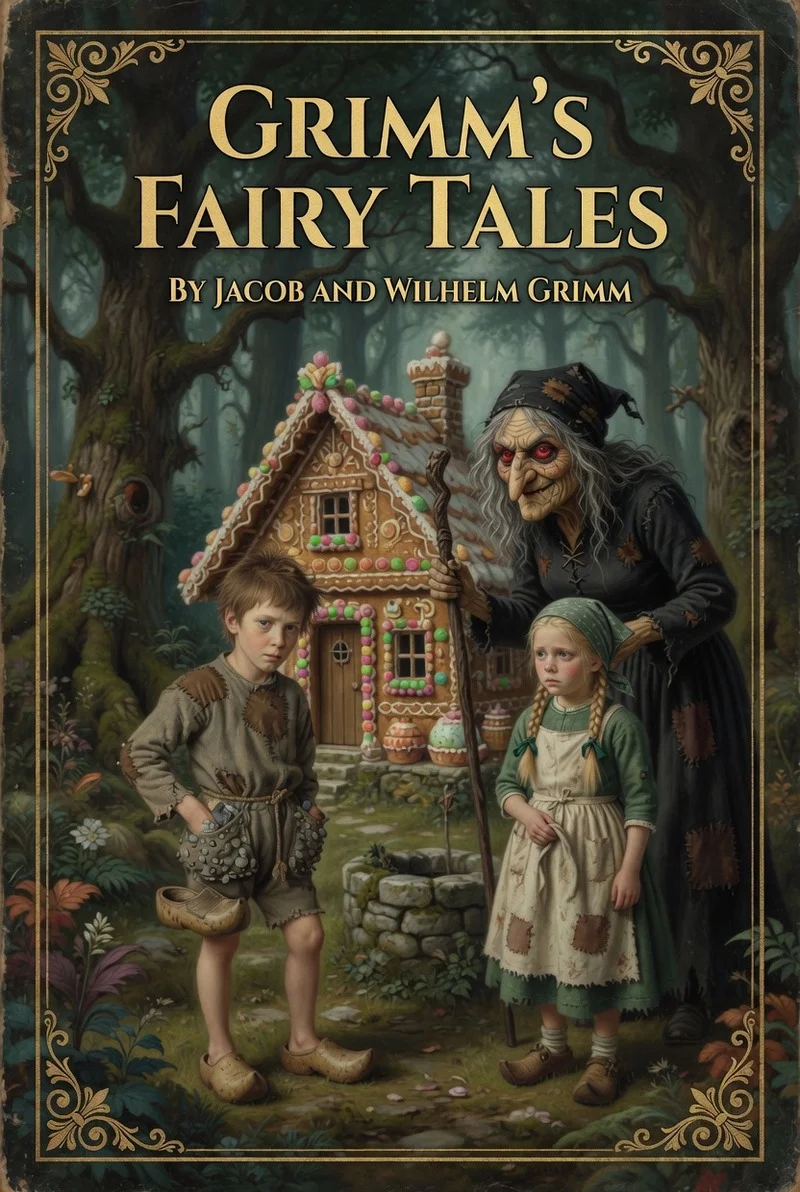
About This Book
Two German brothers wrote down the fairy tales people told around 1800. This guide collects twelve of them. Each chapter is a complete story: a princess at a forest well, two children at the edge of the woods, a girl in a red velvet cap. You do not need one tale in order to read the next.
These tales give sixth-grade and other middle-school readers practice with older English, tight plots, and arguments about fairness, promises, hunger, and cleverness. Because each story stands alone, a class can finish one, talk it through, and start another the next day without losing the thread of a novel. Many students already know a movie or picture-book version of a similar story; reading the older telling is a chance to notice what is actually on the page.
Meet the Characters

More about The Frog Prince
The Frog Prince is a talking frog who lives in a deep well in the forest. He is polite, persistent, and surprisingly sure of himself. A young princess meets him when her golden ball falls into his well.

More about The Princess with the Golden Ball
This princess is the youngest daughter of a king and loves to play alone by a cool well in the woods. She is a little proud and a little lonely. Her favorite toy is a golden ball.

More about Hansel
Hansel is a clever, calm boy who looks after his younger sister and tries hard to keep her from being afraid. He lives in a small cottage at the edge of a great forest with his family, who are very poor. As the story opens, he is doing his best to stay hopeful even when times are hard.

More about Gretel
Gretel is a gentle, caring girl who trusts her older brother and stays close to him wherever they go. She lives with her family in a poor cottage beside the woods. As the story begins, she is frightened by the family's troubles but comforted by having her brother nearby.

More about The Witch in the Gingerbread House
Deep in the forest stands a little house that looks good enough to eat, and this old woman lives there. She speaks in a sweet, creaking voice and seems glad of visitors. Hansel and Gretel find her after they have been walking a long time.

More about Little Red-Cap
Little Red-Cap is a friendly, obedient girl who is easy to spot because of the red hooded cape she loves to wear everywhere. She lives near a forest with her mother and adores her grandmother, who lives on the other side of the woods. As the story begins, she is happy to help by carrying food to her grandmother.

More about Grandmother
Grandmother lives alone in a cottage in the woods and is not well. She is fond of her granddaughter and of the little cakes and wine the child brings. She is the person Little Red-Cap is sent to visit.

More about The Wolf
The Wolf lives in the forest and is always hungry. He is clever with words and likes to walk beside people who are carrying food. Little Red-Cap meets him on the path to her grandmother's house.

More about The Donkey
The Donkey has spent his life turning a mill and is now considered too old for the work. He decides to go to Bremen and become a town musician. He is the leader of a small band of worn-out animals.

More about The Hound
The Hound is a hunting dog whose master thinks he is no longer fast enough. He is loyal, gloomy, and glad of company. He meets the donkey on the road to Bremen.

More about The Cat
The Cat is an old house cat whose teeth are no longer sharp enough for catching mice. She is clever and a little sarcastic. She is happy to travel with anyone who will treat her as a musician.

More about The Rooster
The Rooster has been told he will be cooked for Sunday dinner. He has a magnificent voice and no wish to be soup. He is the last of the four Bremen Town Musicians.

More about The Mother Goat
The Mother Goat lives in a cottage in the woods with her seven little kids. She is careful, loving, and always warning them about the wolf. She has to go to the forest to find food.

More about The Shoemaker
The Shoemaker is a poor, honest man who has only enough leather left for one pair of shoes. He is pious, hardworking, and not bitter. Mysterious help begins to arrive in his workshop overnight.

More about The Shoemaker's Wife
The Shoemaker's Wife shares her husband's poverty and his hope. She is practical, curious, and the one who suggests they stay awake to see who has been helping them. She is as honest as he is.

More about The Elves
The Elves are tiny, silent helpers who come at midnight to a poor workshop. They work with astonishing skill and then vanish before dawn. They seem to love the work itself.

More about The Fisherman
The Fisherman lives in a miserable little hovel by the sea with his wife. He is mild, easily talked into things, and not greedy himself. One day he catches a flounder that can speak.

More about The Fisherman's Wife
The Fisherman's Wife is never satisfied with what she has. She is energetic, commanding, and full of bigger wishes. When her husband brings home news of a talking fish, she knows exactly what to ask for.

More about The Enchanted Flounder
The Enchanted Flounder is a magical fish who lives in the sea and can speak. He asks to be let go, and he has the power to change a person's life. The fisherman is the one who first hears his voice.

More about Rumpelstiltskin
Rumpelstiltskin is a mysterious, quick little man who seems to appear out of nowhere when someone is in trouble. He loves gold and enjoys striking clever bargains. As his story opens, no one is quite sure where he comes from or what he truly wants.

More about The Miller's Daughter
The miller's daughter is a quiet, ordinary girl whose father has boasted about her in front of the king. She is not proud and not a magician. She finds herself alone with a roomful of straw and an impossible task.

More about Dummling
Dummling is the youngest of three brothers and is often teased and thought to be foolish, but he is truly warm-hearted and polite to everyone he meets. He lives with his family and is sent out to work in the forest. As his story begins, he sets off with a cheerful spirit and a habit of sharing what little he has.

More about The Golden Goose
The Golden Goose is a magical bird Dummling finds in the roots of a tree. She is the prize of his kindness in the forest. People who try to steal a golden feather find they cannot let go.

More about Snow-White
Snow-White is a sweet, cheerful princess who is loved by almost everyone for her kindness and her lovely looks. She lives in a grand castle and treats every person she meets with warmth. As her story opens, she is happy, trusting, and quick to help others.

More about The Queen
The Queen is Snow-White's stepmother, famous for her beauty and for a magic mirror she asks questions of. She is proud, restless, and not used to being second. The mirror hangs in her private chamber.

More about The Seven Dwarfs
The Seven Dwarfs live together in a tidy little cottage in the forest and work all day in the mountains digging for ore. They are kind, orderly, and unused to guests. Snow-White finds their empty house while they are still at work.

More about Tom Thumb
Tom Thumb is the much-longed-for son of a poor woodcutter and his wife, born no bigger than a thumb. He is clever, brave, and always getting into places a full-sized boy could never go. His parents love him dearly.

More about Rapunzel
Rapunzel has been shut in a tower in the forest since she was a child. She has a beautiful voice and hair long enough to climb. She does not know the ordinary world outside the tower window.

More about The Enchantress
The enchantress keeps a walled garden of the finest rapunzel, a leafy green that grows nowhere else so well. She is feared in the neighborhood and does not share what is hers. A husband and wife live in a house that looks over her garden wall.

More about The King's Son
The king's son rides out hunting in the forest and hears a girl singing from a tower. He is brave, a little impulsive, and unused to being shut out. He has never seen a window so high.
Pre-Reading Discussion Questions
- When is a promise easy to make and hard to keep?
- Why might a storyteller send a child into a forest instead of down a city street?
- What makes a small creature in a story worth listening to?
- How can a brother or sister help when grown-ups are worried?
- If you already know a movie of an old fairy tale, how will you notice what is actually on this page instead of filling in the film?
- How was daily life different when most stories were heard aloud, with no phones, cars, or grocery stores?
Themes & Big Ideas to Track
- Keeping one's word
- Cleverness versus force
- How hunger and fear change a household
- What kindness looks like when it is inconvenient
- How an older telling can differ from a movie you already know
Chapter-by-Chapter Study Guide
Chapter 1: The Frog-Prince

Before you read — think about:
- Many people know a movie or picture book about a frog and a princess. What people, objects, and settings do you already picture — and how will you notice what is actually on THIS page?
- Jacob and Wilhelm Grimm wrote down spoken German tales around 1800. This English is an old public-domain translation. Why did people tell stories aloud instead of only reading them?
- A palace around 1800 had stairs, servants, and strict manners, and a king's child was still expected to keep house rules. How is that different from your house?
- What does it mean to give your word?
- Why is it a mistake to judge a speaker only by looks?
Watch for these while reading:
- What the princess is playing with when the story opens
- How she first speaks to the frog
- The frog's manner of speaking, and any lines that repeat
- The king, and the way he talks to his daughter
- Which people, objects, and settings actually appear in this palace-and-spring telling, compared with any frog-and-princess story you already know
Vocabulary to know:
bewail (verb) — to cry over a loss; to complain sadly; spiteful (adjective) — mean on purpose; eager to hurt someone out of unkindness; fated (verb) — destined by fate; required to remain a certain way until a condition is met; abide (verb) — to remain or stay in a place or condition; decked (verb) — decorated or dressed up; plumes (noun) — large ornamental feathers; harness (noun) — the straps and fittings that attach horses to a coach; misfortunes (noun) — strokes of bad luck; unhappy events; well-nigh (adverb) — almost; very nearly; whilst (conjunction) — while; during the time that (a British/older form); greenwood (noun) — a leafy forest; woods in full leaf; clogs (noun) — heavy wooden-soled shoes; bonnet (noun) — a hat tied under the chin, once worn outdoors by girls and women; plash (noun) — a splashing sound in water; gay (adjective) — bright, festive, and showy (the older meaning, not about people).
Chapter 2: Hansel and Gretel
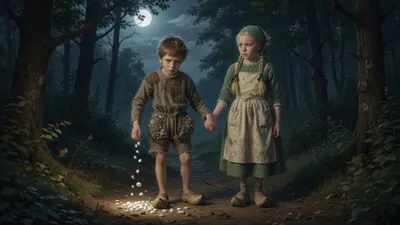
Before you read — think about:
- Many picture books and films retell a story of two children named Hansel and Gretel. What do you already picture — and how will you notice which people, objects, and settings actually appear in THIS telling?
- Why do so many old German tales send people into a forest instead of down a town street?
- Around 1800, a wood-cutter's family might go hungry after a bad harvest. There were no grocery stores and no phones. How would that change an ordinary day at home?
- How can two children in the same house have very different tempers and still help each other?
- The title is two children's names, not one. What does that make you expect about who will do the talking?
Watch for these while reading:
- The wood-cutter and his wife, and the way each talks
- How Hansel speaks to Gretel
- The path through the trees
- The bread they are given for the day
- How the forest looks and sounds as they walk
Vocabulary to know:
dearth (noun) — a time when food is scarce; procure (verb) — to get or obtain something, especially with effort; consented (verb) — agreed, especially after being pressed; sluggards (noun) — lazy people who are slow to get up or to work; brushwood (noun) — small dry twigs and branches gathered for a fire; withered (adjective) — dried up and dead; dwelt (verb) — lived in a place (an old past form of dwell); forsake (verb) — to abandon or leave someone without help; reproached (verb) — blamed or scolded someone for a fault; yielded (verb) — gave in; stopped resisting; morsel (noun) — a small piece of food; strewn (verb) — scattered loosely over a path or surface; weariness (noun) — exhaustion from long effort or travel; alighted (verb) — landed and settled, as a bird does; parlour (noun) — a sitting room in a house; entice (verb) — to lure someone in by offering something tempting; malice (noun) — a wish to harm someone; spiteful ill will; mockingly (adverb) — in a scornful, teasing way that makes fun of someone; shrivelled (adjective) — dried, wrinkled, and shrunken; lament (verb) — to cry out in grief; to mourn loudly; cauldron (noun) — a large metal pot used for boiling; kneaded (verb) — pressed and folded dough with the hands; pinafore (noun) — a sleeveless apron-like garment worn over a dress; plane (verb) — to smooth wooden boards with a carpenter’s tool; grated (adjective) — fitted with bars, like a cage door; dainty (adjective) — especially delicious or choice, as a tempting bite of food; godless (adjective) — wicked; showing no fear of God; dost (verb) — do (an old verb form used with thou); devoured (verb) — ate up completely; whosoever (pronoun) — anyone who; whatever person.
Chapter 3: Little Red-Cap [Little Red Riding Hood]
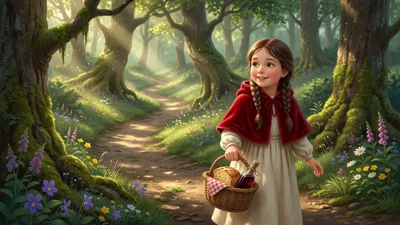
Before you read — think about:
- Cartoons often call this girl Little Red Riding Hood. This English telling calls her Little Red-Cap. What difference does that name make in your mind before you read a line?
- Why might a story told aloud give a child one famous piece of clothing as her whole name?
- In a village around 1800, an errand to a relative might mean a walk through woods, not a car ride. What would you want to know before you set out?
- What does it mean to be a good grandchild?
- How is a path through trees different from a street of houses?
Watch for these while reading:
- How Little Red-Cap got her name
- The mother's list of instructions
- The wood, and how it looks when she first enters it
- Cake, wine, and other things she carries
- The grandmother, and where she lives — and which people, objects, and settings actually appear in THIS telling, compared with any cartoon you remember
Vocabulary to know:
league (noun) — an old measure of distance, about three miles; whither (adverb) — to what place; where (going); craftily (adverb) — in a sly, cunning way; gravely (adverb) — in a serious, solemn manner; nosegay (noun) — a small bunch of flowers picked to give as a gift; fancied (verb) — imagined; supposed something to be true; appeased (verb) — satisfied, especially hunger or appetite; huntsman (noun) — a hunter; a man whose work is hunting; grey-beard (noun) — an old man (here, a mocking name for the wolf); trough (noun) — a long open container that holds water or food for animals; sought (verb) — looked for; tried to find (past tense of seek); thrice (adverb) — three times (an old-fashioned word); scarcely (adverb) — barely; only just; almost not.
Chapter 4: The Travelling Musicians
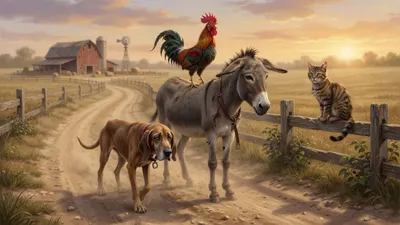
Before you read — think about:
- Some picture books call this tale the Bremen Town Musicians. This English title is The Travelling Musicians, and it never names that city. Why might two titles for a similar tale make you listen for different things?
- Why might farm animals in an old spoken tale talk and travel as if they were people?
- On a farm around 1800, animals were kept because they worked — carrying loads, hunting, catching mice, announcing morning. How is that different from keeping a pet today?
- What is the difference between a job and a friend?
- What makes a band a band, and not just people walking the same road?
Watch for these while reading:
- The donkey, and the farm he comes from
- The dog, the cat, and the cock — and how each one talks
- The word musician, and who uses it
- The road and the wood they walk through
- Which animals actually travel in THIS telling, and which settings they pass
Vocabulary to know:
livelihood (noun) — the way a person earns food and a living; rueful (adjective) — looking sorrowful or regretful; jollily (adverb) — cheerfully; in high spirits; contrive (verb) — to plan or scheme a way to make something happen; brayed (verb) — made the loud, harsh cry of a donkey; hobgoblin (noun) — a frightening goblin or sprite; dispatched (verb) — finished off quickly (here, ate up); espying (verb) — catching sight of; spotting; hearth (noun) — the floor of a fireplace; the warm place in front of the fire; quarters (noun) — a place to stay or lodge; main (noun) — strength or force (in the old phrase ‘might and main’); groped (verb) — felt about with the hands because one could not see; hideous (adjective) — horribly ugly or frightening.
Chapter 5: The Wolf and the Seven Little Kids
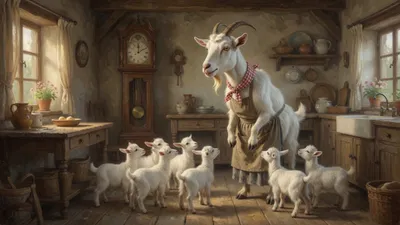
Before you read — think about:
- This tale is less famous as a movie than Little Red-Cap. It still comes from the same kind of spoken German folklore. What changes when a story meant for listening is written down in English?
- Why might a storyteller give a mother seven children instead of one?
- A goat family in an old tale lives in a cottage with a door, a window, and a meadow. How is that household different from yours?
- What is the difference between being careful and being frightened?
- How is a kid (a young goat) different from a human child — and why might a tale treat a goat family like a human one?
Watch for these while reading:
- What the mother goat tells the kids before she leaves
- The mother goat's voice
- The house-door, and the window beside it
- The seven kids, and how they talk to one another
- The green meadow outside the house
Vocabulary to know:
disguises (verb) — hides who he really is by changing how he looks or sounds; wretch (noun) — a cruel, miserable creature; bleated (verb) — cried out in a goat’s voice; meal (noun) — coarsely ground grain used as flour (not a dinner); ceremony (noun) — polite fuss or formality; gorged (adjective) — stuffed full after eating far too much; thither (adverb) — to that place; in that direction; miller (noun) — a person who owns or works a mill that grinds grain; clock-case (noun) — the tall wooden body of a clock, big enough here for a kid to hide in; greediness (noun) — wanting more and more, especially of food or riches; washing-bowl (noun) — a basin used for washing; stirred (verb) — moved even a little; shifted or woke.
Chapter 6: The Elves and the Shoemaker
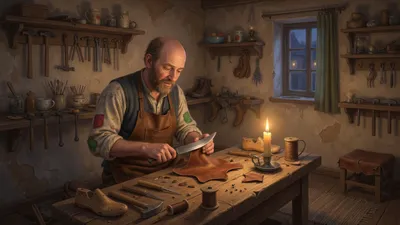
Before you read — think about:
- Some holiday specials retell a cobbler-and-elves story. This page is an old German tale in English. What will you notice about who is actually in the workshop on THIS page?
- Why do some old tales take place in a workshop instead of a palace?
- A cobbler around 1800 made shoes by hand from leather, one pair at a time. How is that different from buying shoes in a store today?
- What is honest work?
- What does 'enough' mean when a family has very little?
Watch for these while reading:
- How much leather the shoemaker has left
- The workbench, and the leather on it
- The shoemaker's wife, and how she talks
- How the couple speak to each other when the shop is closed
- Which people, and how many, actually appear in this workshop — not only in a holiday special you may know
Vocabulary to know:
peaceably (adverb) — in a calm, quiet way; workmanship (noun) — the skill and quality shown in how something is made; betimes (adverb) — early; in good time; thriving (adjective) — doing well and becoming prosperous; ply (verb) — to work steadily and skillfully with the hands; bustled (verb) — hurried away with busy, energetic movement; wights (noun) — little creatures; here, the tiny elves; waistcoat (noun) — a sleeveless jacket worn over a shirt; a vest; pantaloons (noun) — close-fitting trousers; cobbler (noun) — a person whose job is making or mending shoes; twinkling (noun) — an instant; the time it takes to blink; capered (verb) — leaped and danced about in a playful way; save (preposition) — except; apart from; amidst (preposition) — in the middle of; among; handsomely (adverb) — generously; at a high price.
Chapter 7: The Fisherman and His Wife

Before you read — think about:
- This tale is less famous than some Grimm stories. If you have never seen a movie of it, what do the title's two people make you expect?
- People who lived by the sea told stories about talking fish long before these pages were printed. Why might a fishing village invent a fish that can answer back?
- A fisherman around 1800 worked with a rod on the shore, then walked home. No phone, no weather app. How would you know it was time to come in?
- Why might a storyteller give a husband and wife different voices, instead of having them want the same thing?
- How should two people in a household talk when they want different things?
Watch for these while reading:
- Where the fisherman and his wife live at the start
- The great fish, and how it speaks
- The wife, and how she greets her husband
- The shore, and how the water looks from it
- The fisherman's voice — including any rhyme he repeats
Vocabulary to know:
pigsty (noun) — a dirty shed where pigs are kept; here, a wretched hut; hearken (verb) — to listen carefully; boon (noun) — a favor or gift that is asked for; dolefully (adverb) — in a sad, heavy-hearted way; bestir (verb) — to get moving; to rouse yourself into action; overspread (verb) — covered over the whole surface; lofty (adjective) — very high; towering; Christendom (noun) — the Christian world; the lands that share the Christian church; billows (noun) — great swelling waves; pomp (noun) — splendid display and ceremony meant to show power; rushlight (noun) — a small, cheap candle made from a dried rush dipped in fat; leave (noun) — permission; brink (noun) — the very edge, especially of water; float (noun) — a fishing bobber; a bit of cork or wood that rides on the water and dips when a fish bites; hath (verb) — has (an old verb form); trim (adjective) — neat, tidy, and well kept; dame (noun) — a title for a grown woman, like Lady or Mrs.; earls (noun) — noblemen ranking below a duke; maidens (noun) — young unmarried women; cow-houses (noun) — barns or sheds where cows are kept.
Chapter 8: Rumpelstiltskin
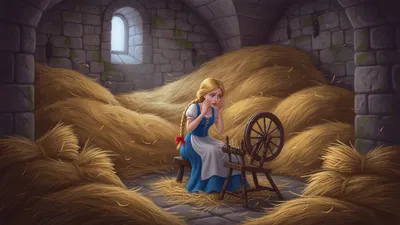
Before you read — think about:
- Some films retell a story with this strange name. This page is an old English translation of a German tale. What will you notice about who actually speaks, and in which rooms?
- What is a mill for, and why do old tales so often put one on a stream beside a wood?
- A miller around 1800 worked with grain and water-power, not a factory. How is that job different from most jobs you see now?
- How can you tell a true statement from a boast?
- Why do storytellers give some characters ordinary names and some characters long, odd ones?
Watch for these while reading:
- The miller, and how he talks about his daughter
- The mill beside the stream, and the palace rooms the girl is in
- The little man's manner of speaking
- The little man's clothes, and the way he moves
- The miller's daughter, and how she speaks when she is alone
Vocabulary to know:
shrewd (adjective) — sharp-minded; good at noticing and planning; chamber (noun) — a private room in a palace; droll-looking (adjective) — odd and amusing in appearance; hobbled (verb) — walked with an awkward, uneven limp; morrow (noun) — the morning; used in an old-fashioned greeting meaning “good morning”; lass (noun) — a girl or young woman; reel (verb) — to wind thread or yarn onto a spinning reel; sorely (adverb) — painfully; very badly; manikin (noun) — a tiny man; a diminutive fellow; grace (noun) — extra time allowed before a promise must be kept; brew (verb) — to make a drink, especially by boiling; jeered (verb) — mocked or made fun of someone in a loud, scornful way; spinning-wheel (noun) — a machine with a wheel used to twist fibre into thread; behold (verb) — see; look (an old command, often in ‘lo and behold’).
Chapter 9: The Golden Goose
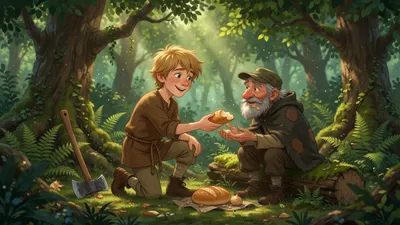
Before you read — think about:
- This tale is less famous than The Frog-Prince or Hansel and Gretel. What does a title that names a golden bird make you listen for, even if you have never seen a movie of it?
- Why do old tales so often give a family three children, and pay most attention to the youngest?
- Around 1800, cutting wood was a real job, not a hobby. How is going into a forest to work different from going into a park today?
- How should the youngest person in a room be treated?
- How can a writer show that one child is treated unlike the others without saying so?
Watch for these while reading:
- How the two elder brothers treat Dummling
- The forest, and who walks into it
- The little grey-haired man, and how he speaks
- The goose, and the colour of its feathers
- The name Dummling, and who uses it
Vocabulary to know:
despised (verb) — looked down on and treated as worthless; hew (verb) — to chop or cut, especially wood; sneered (verb) — spoke or looked at someone with open scorn; draught (noun) — a drink of liquid taken in one swallow; cinders (noun) — the leftover ashes and burned bits of a fire; seemly (adjective) — proper, decent, or suitable in public; sexton (noun) — a church officer who looks after the building and helps at services; christening (noun) — a church ceremony in which a baby is named and welcomed; decree (noun) — an official order issued by a ruler; quench (verb) — to satisfy a thirst by drinking; vexed (adjective) — annoyed, irritated, or displeased; obliged (verb) — forced or required to do something; simpleton (noun) — a foolish or easily tricked person; the English meaning of Dummling; bade (verb) — said; offered (past tense of bid, as in ‘bade him good day’); host (noun) — the innkeeper; the person who runs an inn; parson (noun) — a parish priest or minister; thereupon (adverb) — right after that; as a result.
Chapter 10: Snowdrop

Before you read — think about:
- Many people know a movie about a girl some English books call Snow White. This telling names her Snowdrop. How will you tell the people, objects, and settings on THIS page apart from the movie you remember?
- Why do so many old tales begin with a wish for a child?
- Ebony window-frames and palace looking-glasses were luxury goods around 1800. What ordinary objects in your house would a tale like this never mention?
- Why is it a mistake to judge a person's worth only by looks?
- What does the name Snowdrop make you picture before you read a line?
Watch for these while reading:
- The first queen at her ebony window
- The looking-glass in the palace — the object, and the words spoken to it
- How Snowdrop is described as she grows — colours and name
- The servant, and how he is spoken to
- What the little cottage in the forest is like inside
Vocabulary to know:
ebony (noun) — a very dark, almost black wood; looking-glass (noun) — a mirror; art (verb) — are (an old verb form used with thou); beauteous (adjective) — beautiful (an older, more formal word); spruce (adjective) — neat, clean, and carefully kept; meddling (verb) — interfering with someone else's things without being asked; brethren (noun) — brothers; members of the same close group; pedlar (noun) — a person who travels from place to place selling small goods; wares (noun) — goods offered for sale; bobbins (noun) — small spools that hold thread or lace; laces (noun) — cords used to tighten a bodice or corset; body (noun) — a person (an old-fashioned way to speak of someone); stays (noun) — a laced bodice or corset that supports the waist; nimbly (adverb) — quickly and lightly, with skill; ailed (verb) — was wrong with; troubled (as in ‘what ailed her?’); senseless (adjective) — unconscious; without feeling or awareness; peasant (noun) — a poor country farmer or farm worker; bier (noun) — a stand on which a body is laid before burial; bemoaned (verb) — mourned aloud for someone; expressed sorrow over a loss; besought (verb) — begged someone earnestly; splendour (noun) — magnificent richness of appearance; ween (verb) — to think or believe (an old-fashioned word); reigned (verb) — ruled as king or queen.
Chapter 11: Tom Thumb
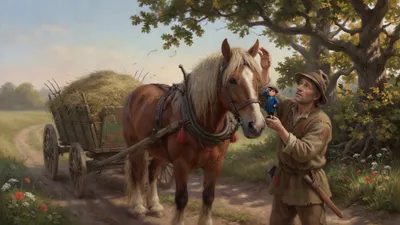
Before you read — think about:
- Some versions of Tom Thumb send him to a king's court. This telling starts in a woodman's cottage. What will you notice about which world THIS page actually uses?
- Why do old tales sometimes tell of a person no bigger than a thumb?
- A woodman around 1800 needed a cart and a horse to bring fuel home. How is that work different from chores in your house?
- What do parents worry about even on an ordinary day?
- How do you tell a tall tale — a story stretched for fun — from a true one?
Watch for these while reading:
- The woodman and his wife by the fire
- How small Tom is, and how the tale describes him
- The horse and cart
- Tom's voice, and who hears it
- Ordinary cottage jobs — spinning, fetching fuel, harnessing
Vocabulary to know:
bridle (noun) — the headgear used to steer a horse; dusky (adjective) — dim; almost dark, as at the end of day; clod (noun) — a lump of earth; furrows (noun) — long grooves cut in a field by a plow; urchin (noun) — a small, lively, often mischievous child; ploughed (adjective) — turned over by a plow, ready for planting; bawl (verb) — to shout in a loud, rough voice; roguish (adjective) — playfully dishonest; fond of tricks; woefully (adverb) — in a sadly unfortunate way; hay-loft (noun) — the upper part of a barn where hay is stored; rick (noun) — a stacked pile of hay for feeding animals; overset (verb) — knocked over; threshold (noun) — the strip at the bottom of a doorway; the entrance; disheartened (adjective) — discouraged; having lost hope or spirit; reckoned (verb) — calculated or planned on something happening; frolic (noun) — a burst of playful fun; scythe (noun) — a long-handled tool with a curved blade for cutting grass or grain; carter (noun) — a person who drives a cart; dunghill (noun) — a heap of manure; crosses (noun) — troubles and hardships; afflictions; undone (adjective) — ruined; brought to disaster; befell (verb) — happened to (said of bad luck); lack-a-day (interjection) — an old cry of surprise or dismay; wits (noun) — quick thinking; one's mind and alertness.
Chapter 12: Rapunzel
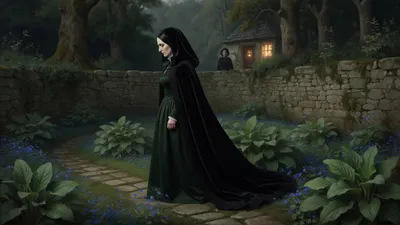
Before you read — think about:
- Many people know a movie with a similar name. How will you tell the people, objects, and settings on THIS page apart from the movie you remember — including the girl's name and how her hair is described?
- The girl's name is also a plant (rampion). Why might an old tale name a child after something that grows in a garden?
- A garden behind a high wall, grown for herbs and food, is different from a park or a grocery store. How would you get vegetables if you could not shop?
- What is the difference between a garden grown for food and a garden grown for show?
- How should a powerful person treat ordinary neighbors?
Watch for these while reading:
- What grows in the enchantress's garden
- The husband, and the high wall
- The enchantress, and how she speaks
- The tower in the forest, and how this telling describes it
- Rapunzel's hair, and how it is described
Vocabulary to know:
enchantress (noun) — a woman with magical power; rampion (noun) — a leafy garden plant, also called rapunzel, eaten as a green; pined (verb) — grew weak from longing; clambered (verb) — climbed using both hands and feet, often awkwardly; tresses (noun) — long locks of hair; ells (noun) — an old unit of length used for cloth, about as long as a person's arm; solitude (noun) — the state of being alone for a long time; resound (verb) — to ring out loudly and fill a space with sound; remarked (verb) — noticed; observed (not ‘said out loud’); skein (noun) — a coiled length of yarn or silk ready for weaving; pitiless (adjective) — showing no mercy or kindness; venomous (adjective) — full of spite, as if poisoned by hate; desert (noun) — a wild, empty wasteland (not necessarily sand); naught (noun) — nothing (an old-fashioned word).
About the Author
Jacob Grimm (1785–1863) and Wilhelm Grimm (1786–1859) were scholars as well as story-collectors. They wrote down tales they heard from friends and neighbors in the German states, then revised the collection over many years. English readers first met many of these stories in nineteenth-century translations such as the public-domain Hunt text used here.
The tales grew out of spoken folklore in German-speaking lands around 1800, when most people still heard stories aloud rather than reading them. Daily life was slower and harder than a student's life now: forests were workplaces, hunger was a household fact, trades such as milling and shoemaking were done by hand, and a spoken promise was treated as binding. Writing the tales down kept talking animals, wishes, and forest cottages for later readers. The English text in this guide is a public-domain translation from Project Gutenberg. Later films and picture books often soften, rename, or add details — this guide asks readers to see the older telling first.