


About This Book
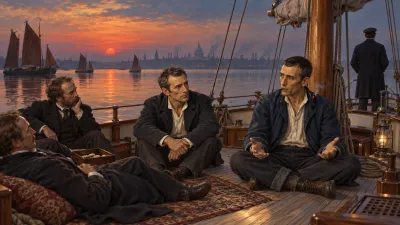
Five men sit on the deck of a small yawl anchored in the Thames below London, waiting for the tide to turn. The day dies, the lights of the city come up under a low ceiling of cloud, and one of them — a sailor named Charlie Marlow — begins to talk about a few months he once spent commanding a river steamboat for a European trading company in Africa. The company deals in ivory. Somewhere at the far end of its river there is an agent named Kurtz, and Marlow’s job is to go and find him.
Heart of Darkness is one of the books modern literature keeps arguing with, and reading it puts you inside that argument rather than outside it. It is a founding text of literary modernism — the unreliable narrator, the story-within-a-story, the refusal to explain — and it is also one of the earliest works in English to look hard at European colonialism and call its official language a lie. At the same time, the novel has been powerfully criticized, most famously by the Nigerian novelist Chinua Achebe, for the way it portrays Africans: as a silent backdrop for a European crisis of conscience rather than as people with their own inner lives. Both of those things are true of the same book, and learning to hold them at once — to admire a work's craft and moral courage while naming its blindness, and to notice that the text uses racial language that is offensive today — is exactly the kind of reading high school is for.
Meet the Characters

More about Charlie Marlow
Charlie Marlow is an experienced English merchant sailor who has spent years at sea in the Indian Ocean, the Pacific and the China Seas. Restless after months ashore in London, he sets his relations on the Continent to work on his behalf, and an aunt with useful connections gets him a post steering a river steamboat for a European trading company in Africa. He is blunt, curious, and famous among his friends for telling long, winding stories that circle a point rather than land on it.

More about Mr. Kurtz
Mr. Kurtz is the trading company's most celebrated agent, in charge of a remote post deep in the interior, and the quantity of ivory he ships downriver exceeds what every other agent produces between them. Everyone along the river has an opinion about him: some call him a genius and an emissary of progress, others resent how quickly he is rising. He is spoken of above all as an extraordinary talker, a man whose words can carry an audience anywhere.

More about The Manager
The manager runs the company's Central Station, a muddy river post crowded with idle agents waiting for a posting where ivory can be had. He has outlasted every colleague through nothing more remarkable than good health, and he keeps the routine turning without ever originating anything himself. He is neither rude nor friendly, and no one can say what he actually wants.

More about The Russian Trader
A young Russian, the son of an arch-priest, who ran away from school to go to sea and has since spent nearly two years wandering the river alone, trading a little and living mostly on nerve. He is cheerful, endlessly talkative, and almost entirely without caution. His moods swing from delight to gloom and back within a single sentence.

More about The Intended
Kurtz’s fiancée, whom he left in Europe when he went out to Africa. She is a woman of deep and steady feeling, entirely certain of the man she loves and of the greatness of the plans he described to her. She lives in a tall, quiet house in the same city as the Company’s offices.

More about The African Woman
A woman of great authority among the people who live near the trading post farthest up the river. She moves with deliberate, unhurried dignity, and when she appears the people around her go still and watch her. Her clothing and heavy brass and bead ornaments mark her out as someone of real standing in her community.

More about The Chief Accountant
The chief accountant keeps the Company's books at the Outer Station with a devotion to linen and ink that borders on the miraculous. He is vain of his appearance and of his ledgers, and he is one of the first company men Marlow meets in Africa. He speaks of Kurtz as a remarkable man who will go far.

More about The Helmsman
The helmsman is the African crewman who steers Marlow’s steamboat up the river. He belongs to a coast tribe and was trained at the wheel by the captain Marlow replaced. He steers with a great deal of swagger whenever the captain is watching him, and Marlow — who is impatient with him and never gives him a name — rates him a poor helmsman.

More about The Brickmaker
The brickmaker is supposed to be making bricks at the Central Station, but there is not a fragment of a brick anywhere and he has been waiting more than a year for materials that are never going to arrive. He is a gossip and a climber, and the other agents say he is the manager’s spy. He keeps a room in the main station building, hung with native mats and a trophy of spears and shields, and he is the only man there besides the manager with a candle of his own.

More about The Narrator
One of the four men waiting out the tide aboard the Nellie with Marlow. He has followed the sea himself, and he is the one who sets down what Marlow says that evening — every word of the story reaches the reader through him. He never gives his name and says very little.

More about The Manager’s Uncle
The manager’s uncle arrives at the Central Station at the head of the Eldorado Exploring Expedition, a party sworn to secrecy and loaded down with the contents of a great many outfitting shops. For as long as his men are at the station he speaks to nobody but his nephew, and the two of them can be seen walking about all day with their heads close together.

More about The Knitting Woman
The older of two women who sit knitting black wool in the outer room of the Company’s offices in Europe. She does not get up and does not speak; she looks at each man who comes through over the top of her spectacles, and goes back to her knitting.
Pre-Reading Discussion Questions
- When an organization describes its own work in noble language — a mission, a service, progress — what would make you trust that description, and what would make you doubt it?
- Think about a story you have heard secondhand, told aloud by someone who was there. What does that form of telling add, and what does it cost in reliability?
- Before 1900, most Europeans knew about Africa only through maps, adventure books, and company advertising. How does learning about a place only through other people's accounts shape what you expect to find there?
- The word 'darkness' in this book's title is doing several jobs at once. What different things can that word mean when applied to a place, to a person, or to a time in history?
- Chinua Achebe argued that a novel can be brilliantly written and still do damage through how it represents a whole people. How would you go about judging both of those things in the same book?
- What responsibility does a reader have toward a work written in another era, whose author's assumptions about race and empire differ from your own?
Themes & Big Ideas to Track
- The gap between the language an institution uses about itself and what actually happens on the ground.
- Restraint — where the book uses that word, whose behaviour it gets used about, and what Marlow seems to be measuring with it.
- The frame narrative: a story told aloud, inside another story, by a narrator who admits he cannot make himself understood.
- Work as an anchor — Conrad's characters cling to practical tasks as a way of staying attached to reality.
- Who is given a voice in this book and who is not, and what that silence does to the reader's sense of the people described.
- Light and darkness as unstable images that keep changing sides throughout the novel.
Chapter-by-Chapter Study Guide
Chapter 1
Before you read — think about:
- This story reaches you secondhand: one man repeats what another man said aloud one evening. What does a listener gain from a story told out loud, and what does a listener lose compared with a written first-person account?
- In the 1890s, European readers learned about the African interior mainly from company reports, missionary accounts and adventure fiction. What are the risks of forming a picture of a place entirely from sources that have never been checked against one another?
- What is the difference between a job you do for money and a job you believe in? Can the same job be both at once, and does the difference change how a person does the work?
- Conrad often establishes a place through the behaviour of light — haze, glare, gloom, a sunset going out. Why might a writer choose atmosphere over direct statement to tell you how somewhere feels?
- When you arrive somewhere new — a job, a school, a team — which small details do you notice before anyone explains anything to you, and why do those details stick?
Watch for these while reading:
- The four men listening to Marlow on the yacht: how often any of them speaks, and what their silence does to the telling.
- Marlow's habit of fixing on a single physical detail of a person — a collar, a pair of eyes, the way someone holds a stick — instead of drawing a full portrait.
- The vocabulary the company and its supporters use for the work: mission, cause, progress, the Workers. Notice who reaches for those words and who does not.
- Which people and places Conrad gives proper names to, and which he identifies only by a job title.
- Marlow's attitude toward practical work, and the way he talks about the steamboat he has been hired to command.
Vocabulary to know:
brooding (adjective) — heavy with silent, troubled thought; venerable (adjective) — old and deserving of respect; inscrutable (adjective) — impossible to read or understand; propensity (noun) — a natural tendency to behave in a particular way; ascetic (adjective) — severely plain and self-denying in appearance or habits; savagery (noun) — wildness and cruelty — in this book, the word Europeans reach for whenever they meet something in the forest they cannot understand; abomination (noun) — something viewed with horror and disgust; efficiency (noun) — doing a job well and without waste — the quality Marlow claims separates modern empire from plain robbery; philanthropic (adjective) — done for the good of others — the word the Company uses about work that is nothing of the kind; volubility (noun) — a rush of unstoppable talk; redeems (verb) — makes something bad acceptable or worthwhile; hankering (noun) — a stubborn longing for something; glamour (noun) — an exciting charm that makes a thing seem better than it is; calamity (noun) — a disaster; sepulchre (noun) — a tomb; somnambulist (noun) — a sleepwalker; calipers (noun) — an instrument with two hinged arms used to measure width; alienist (noun) — an old-fashioned word for a doctor who studies mental illness; emissary (noun) — someone sent out to represent a cause or carry a message; apostle (noun) — someone who goes out to spread a belief; humbug (noun) — impressive-sounding nonsense; imposter (noun) — someone pretending to be what they are not; enigma (noun) — a puzzle that resists explanation; sordid (adjective) — shabby and morally squalid; languid (adjective) — slow and lacking energy; lugubrious (adjective) — so mournful that it becomes faintly absurd; devastation (noun) — ruin and destruction; detonation (noun) — an explosion; objectless (adjective) — having no purpose at all; meagre (adjective) — thin and pitifully insufficient; indifference (noun) — a complete absence of interest or feeling; alacrity (noun) — brisk, cheerful readiness; rapacious (adjective) — greedy and grasping; pitiless (adjective) — refusing to be moved by suffering; moribund (adjective) — close to death; demoralization (noun) — a collapse of order, discipline and morale; muddle (noun) — a confused mess; prodigy (noun) — a person of extraordinary gifts; caravan (noun) — a company of people travelling together with goods; ostentation (noun) — a showy display meant to be noticed; salvage (noun) — the job of recovering a wrecked vessel — here, the work of raising and repairing the steamboat; trenchant (adjective) — sharp and cutting; stealthy (adjective) — quiet and secretive; uneasiness (noun) — a vague, unsettled feeling that something is wrong; insolence (noun) — open, deliberate disrespect; futile (adjective) — pointless; certain to achieve nothing; bewitched (adjective) — held as if under a spell; taint (noun) — a trace of something rotten or corrupt; imbecile (adjective) — stupid to the point of absurdity; superciliousness (noun) — an air of looking down on other people; prevaricator (noun) — someone who dodges around the plain truth; mica (noun) — a mineral that splits into thin, glittering transparent flakes; declaim (verb) — to speak in a grand, theatrical way; primeval (adjective) — belonging to the earliest ages of the earth; buccaneers (noun) — pirates; hardihood (noun) — boldness and toughness; audacity (noun) — daring; rivets (noun) — short metal pins hammered through metal plates to fasten them — the small thing Marlow needs and cannot get; temperament (noun) — a person's basic, settled nature; mortality (noun) — the condition of being subject to death.
Chapter 2

Before you read — think about:
- At the end of the last chapter Marlow warned his listeners that a dream cannot really be conveyed to anyone else. What does a storyteller gain by telling you in advance that he may fail to make you understand?
- Read one of Conrad's long sentences aloud — the kind that stacks up several images before it reaches its verb. What does that rhythm do to a reader that a series of short sentences could not?
- What makes a journey in a book feel long, and what might a writer be doing when they slow one down?
- Nineteenth-century travel writing often described unfamiliar peoples as belonging to an earlier stage of history rather than to the present day. What is wrong with that way of seeing, and why was it convenient for the people who used it?
- A steamboat captain on an uncharted river in the 1890s had no charts, no radio and no way to call for help. What kinds of judgement does a person have to build when there is nobody to ask?
Watch for these while reading:
- The word 'restraint' and every place it turns up.
- How Conrad describes the river itself — its width, its bends, and how far ahead anyone on the boat can actually see.
- The steamboat's crew and the company's agents as two distinct groups, and how Marlow's tone shifts depending on which he is describing.
- Places where one of the listeners on the yacht breaks in on Marlow, and where in the story they choose to do it.
- How often Kurtz's name comes up, compared with how much concrete information about him Marlow actually gets.
Vocabulary to know:
sagacious (adjective) — shrewd and knowing; impudence (noun) — bold disrespect toward someone in authority; scoundrel (noun) — a dishonest, unprincipled person; pestilential (adjective) — like a plague; thoroughly objectionable; beacon (noun) — a light or signal set up to guide others; flourish (noun) — a showy sweeping movement of the hand or arm; treacherous (adjective) — dangerous in a way that is hidden until too late; implacable (adjective) — impossible to soften or satisfy; vengeful (adjective) — wanting revenge; snag (noun) — a sunken tree or branch that can rip open a boat's hull; unpardonable (adjective) — impossible to forgive; cannibals (noun) — people who eat human flesh — the word the Europeans on board use for the African crew they have hired; begrimed (adjective) — covered in dirt and soot; prehistoric (adjective) — belonging to the time before written records; anguish (noun) — severe mental suffering; frenzy (noun) — wild, uncontrolled excitement; unearthly (adjective) — not belonging to this world; eerie; kinship (noun) — a family relationship, or a deep connection like one; intrepidity (noun) — fearlessness; decipher (verb) — to work out the meaning of writing that is hard to read; forbearing (adjective) — holding back from doing something you have every reason and every opportunity to do; enthralling (adjective) — completely absorbing; luminous (adjective) — glowing; here, lit up with meaning; cipher (noun) — writing in code; extravagant (adjective) — far beyond what is reasonable or expected; malevolently (adverb) — with active ill will; clammy (adjective) — damp and unpleasantly cool to the touch; opaque (adjective) — impossible to see through; clamour (noun) — a loud, continuous outcry; headman (noun) — the leader of a group of workers; pensive (adjective) — deep in thought; recondite (adjective) — obscure and hard to understand; sustenance (noun) — food that keeps a person alive; restraint (noun) — the power to hold yourself back from what you want — the quality Marlow keeps testing in everyone on the river; superstition (noun) — belief in magic, omens or spirits; perdition (noun) — utter ruin; the loss of one's soul; hyena (noun) — a scavenging animal that feeds on the dead; unfathomable (adjective) — impossible to measure or get to the bottom of; apathy (noun) — a collapse into doing nothing, after feeling too much; desperation (noun) — a state of hopeless urgency; helmsman (noun) — the person who steers a vessel; abject (adjective) — utterly wretched and cowed; fusillade (noun) — a burst of gunfire from several weapons at once; evanescent (adjective) — vanishing almost as soon as it appears; lustre (noun) — a soft, shining brightness; bartered (verb) — traded goods for other goods rather than for money; preeminently (adverb) — above all others; deceitful (adjective) — meant to mislead; fortitude (noun) — courage in bearing difficulty; inestimable (adjective) — too great to be measured; impalpable (adjective) — impossible to touch or take hold of; wraith (noun) — a thin, ghostly figure; eloquence (noun) — powerful, persuasive speaking or writing; peroration (noun) — the grand closing section of a speech; altruistic (adjective) — unselfishly concerned for the good of others; rudimentary (adjective) — undeveloped; at an early stage — a word the Europeans use to place other people below themselves; profundity (noun) — great depth of feeling or meaning; promptitude (noun) — quickness in acting; harlequin (noun) — a comic stage character whose costume is made of coloured patches; countenance (noun) — a person's face or expression.
Chapter 3

Before you read — think about:
- Across two chapters Conrad has assembled Kurtz entirely out of other people's descriptions, no two of which agree. What does a writer gain by building a character that way, and what does it demand of a reader?
- The Congo Free State was presented to European publics as a humanitarian and scientific enterprise while operating as an extraction business. When an institution's public story and its private practice come apart, who inside it is in a position to notice, and what usually stops them from saying so?
- Marlow keeps telling his listeners that words fail — that a dream, a life-sensation, a whole epoch of experience cannot be handed to anyone else. Yet the book is nothing but words. Is that a contradiction, or is it the point?
- This novel first reached readers as three magazine installments published a month apart. What does a reader do differently when a story arrives in parts, with weeks of waiting between them?
- This is the last of the three parts the book was originally published in. What do you expect an ending to do, and what makes one feel earned rather than tacked on?
Watch for these while reading:
- How the Russian talks about Kurtz, and how he talks about himself.
- How much of this chapter Marlow spends watching rather than acting.
- The word 'voice', and Conrad's habit of giving sound priority over sight.
- The manager's vocabulary whenever he discusses methods, results and the Company's interests.
- Light and darkness as images — how often each appears, and which of the two keeps attaching itself to Europe.
Vocabulary to know:
motley (noun) — the multicoloured costume of a jester or clown; inexplicable (adjective) — impossible to explain; destitution (noun) — extreme poverty; having nothing at all; privation (noun) — the lack of basic necessities; fatalism (noun) — the belief that what happens is fixed and cannot be resisted; reluctance (noun) — unwillingness to do or say something; ascendancy (noun) — dominant influence over other people; gratification (noun) — the satisfying of a desire; deficiency (noun) — something missing that ought to be there; solitude (noun) — the state of being completely alone; hollow (adjective) — empty at the centre; having nothing solid inside; wilderness (noun) — wild, uncultivated country — in this book almost a character, with intentions of its own; intolerable (adjective) — impossible to bear; subdued (adjective) — quietened; brought under control; disciple (noun) — a devoted follower of a teacher or leader; enchantment (noun) — the effect of a magic spell; apparition (noun) — a figure that appears suddenly, like a ghost; satiated (adjective) — so completely filled that no appetite is left; factitious (adjective) — artificial; produced by effort rather than genuine; gorgeous (adjective) — richly and strikingly splendid; barbarous (adjective) — foreign and uncivilised — the word Marlow reaches for when all he really means is that he cannot read what he is looking at; voracious (adjective) — ravenously hungry; wanting to devour everything; ominous (adjective) — suggesting that something bad is coming; fecund (adjective) — richly fertile; teeming with life; tenebrous (adjective) — dark and full of shadow; formidable (adjective) — inspiring awe or fear; precarious (adjective) — dangerously unstable; unsound (adjective) — not based on good judgement — the manager's polite word for anything the Company intends to disown; partisan (noun) — a committed supporter of a person or cause; corruption (noun) — decay; moral rot; impenetrable (adjective) — impossible to get through or see into; phenomenon (noun) — a remarkable thing or person, hard to account for; incantation (noun) — words chanted as a spell; narcotic (adjective) — causing drowsiness; unnerved (adjective) — robbed of nerve and steadiness; odious (adjective) — hateful and repulsive; exultation (noun) — triumphant joy; cocksure (adjective) — arrogantly certain; vapour (noun) — mist or steam; irretrievably (adverb) — beyond any hope of recovery; wistfulness (noun) — a longing sadness; beguiled (verb) — charmed or tricked into going somewhere; degradation (noun) — a fall from dignity or decency; withering (adjective) — so scathing that it destroys someone’s confidence or belief; ordeal (noun) — a severe and testing experience; transfixed (adjective) — rooted to the spot; craven (adjective) — cowardly; merciless (adjective) — pursuing something to the end without softening — Marlow’s word for the logic of life itself; riddle (noun) — a question that may have no answer at all; candour (noun) — complete frankness; conviction (noun) — firm, settled belief; extremity (noun) — the last, most extreme point of an experience; oblivion (noun) — the state of being completely forgotten; sarcophagus (noun) — a stone coffin; mourning (noun) — the state of public grief after a death, and the black dress that marks it; fidelity (noun) — faithfulness that does not waver; guileless (adjective) — completely without cunning; certitude (noun) — absolute certainty; illusion (noun) — a false belief that comforts the person who holds it; decorous (adjective) — correct and respectable in a stiff, careful way.
About the Author
Joseph Conrad was born Józef Teodor Konrad Korzeniowski in 1857, in a Polish family living under Russian rule in what is now Ukraine. His father, a poet and translator active in the Polish independence movement, was exiled by the Russian authorities; both parents died before Conrad was twelve. At sixteen he left for Marseille and went to sea, first in French ships and then in the British merchant service, rising over twelve years to master mariner and becoming a British subject in the same year, 1886, before some twenty years at sea in all. In 1890 he took a post commanding a steamer on the Congo River, a journey that left him seriously ill and permanently changed his view of the imperial enterprise. He began publishing fiction in his late thirties, writing in English — his third language, after Polish and French — and produced Lord Jim, Nostromo, The Secret Agent and Under Western Eyes before his death in 1924.
The novel appeared in three installments in Blackwood's Edinburgh Magazine in 1899 and in book form in 1902. Its immediate subject was the Congo Free State, a territory roughly the size of Western Europe that King Leopold II of Belgium held from 1885 as personal property, not as a Belgian colony. Officially the enterprise was a humanitarian and scientific mission; in practice it was an extraction operation, first in ivory and later in wild rubber, run on forced labour and hostage-taking, and the death toll ran into the millions. Conrad had seen a piece of that system firsthand in 1890, and he wrote the book at a moment when European publics still largely believed the official story. Within a few years journalists and campaigners such as E. D. Morel and Roger Casement had documented the reality and forced Leopold to surrender the territory to the Belgian state. Conrad's novel is not a documentary report — he never names the country, the river, the company or the city — but its readers at the time knew precisely which enterprise he meant.