


About This Book
High above the Swiss village of Doerfli, an old man lives alone in a hut the villagers will not approach. They call him Alm-Uncle, and they agree he is the last person who should be trusted with a child. On a hot June morning a young woman named Dete climbs the mountain path anyway, bringing a five-year-old orphan named Heidi — and she means to leave her there. The first pages leave one question hanging: will the old man take her in?
Heidi still matters because it takes a child's feelings as seriously as any adult's. Spyri writes in plain, fast-moving sentences, which makes a nineteenth-century novel easy to enter, but the book keeps asking what a child is owed when grown-ups hold all the power. Middle-school readers are the right age for those questions: what counts as a home, how rumor works in a small place, and whether kindness is a feeling or a habit.
Meet the Characters

More about Heidi
Heidi is a cheerful, blunt, endlessly curious little girl who has been passed from relative to relative since her parents died. As the story opens, her aunt Dete is marching her up an Alpine path to leave her with a grandfather she has never met. Heidi says exactly what she thinks, loves being outdoors more than anything, and is far less frightened of strangers than a child her age is expected to be.

More about Dete
Dete is Heidi's mother's sister. She has looked after the child for some years while working as a servant, and as the story opens she is climbing the mountain path from Mayenfeld with Heidi in tow. She is practical, talkative, and in a hurry: a good place of work is waiting, and she has decided the child's grandfather must take her now.

More about Alm-Uncle
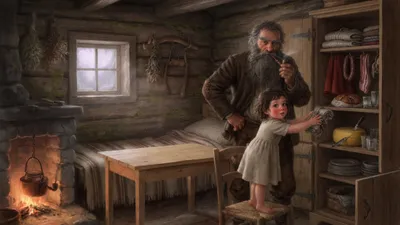
Known to the village only as Alm-Uncle, he lives by himself in a hut high above Doerfli with two goats and three old fir trees for company. Years of hard luck and old rumors have left him bitter toward his neighbors; he refuses to go to church, speaks in short gruff sentences, and everyone in the valley gives him a wide berth. Whatever the villagers whisper about him, he is remarkably capable with his hands and knows the mountain better than anyone alive.

More about Peter
Every morning Peter climbs from the village to collect the goats and drive them up to the high pasture, and every evening he whistles them back down. He is good-natured and astonishingly sure-footed on rock, but words come to him slowly. The mountain is the world he knows, and he knows every spring, ledge, and patch of good grazing on it.

More about Brigitta
Brigitta keeps the goatherd's poor cottage halfway down the mountain, spinning and mending while Peter is out with the flock. She is a hardworking village woman, curious about her neighbors and used to making do with very little. As the story opens she is simply Peter's mother — the woman of that rattling house below the Alm.

More about The Grandmother
Peter's grandmother lives in a crooked, rattling hut halfway down the mountain with Peter and his mother, Brigitta. She lost her sight years ago and can no longer leave her chair, so she passes the days spinning and listening to the wind shake the shutters. She is warm, deeply devout, and grateful for the smallest kindness, and she remembers everyone in Doerfli by voice alone.

More about Clara Sesemann
Clara lives in a large, quiet house in Frankfurt with her often-absent father, Mr. Sesemann, and a staff of servants. An illness has left her unable to walk, so she spends her days being wheeled from room to room, watching the clock and waiting for lessons or visitors. She is patient, gentle, and lonelier than she lets on, and she has been promised a companion near her own age.

More about Mr. Sesemann
Mr. Sesemann is Clara's father and the master of a large house in Frankfurt. His work takes him away for long stretches, and in his absence he leaves the household in the housekeeper's charge, with the rule that nothing is to be done against Clara's wish. He is affectionate with his daughter, used to being obeyed, and quicker to laugh than to take alarm.

More about Grandmamma Sesemann
Grandmamma Sesemann is Clara's father's mother, a keen, kind old lady who comes to stay in the Frankfurt house. She notices what other grown-ups have stopped seeing, and she speaks to children as if their thoughts were worth hearing. She is used to having her own way in a household, and she does it without fuss.

More about Miss Rottermeyer
Since the death of Clara's mother, Miss Rottermeyer has managed the Sesemann house, the servants, and Clara's daily routine, and Mr. Sesemann leaves nearly every decision to her. She values good manners, correct speech, and an unbroken schedule above almost everything else, and she has firm opinions about how a young lady ought to behave. Anything unexpected in her orderly household is, to her, a problem to be corrected at once.

More about The Doctor
The doctor is a long-standing friend of Mr. Sesemann's in Frankfurt, trusted enough to be sent for at short notice. He has a fresh, kindly manner and is more inclined to laugh than to be solemn. When he first appears he is simply the family friend who knows the house and the people in it.

More about Sebastian
Sebastian is the Sesemanns' butler: he opens the door, waits at table, and wheels Clara's couch from room to room. He has a dry sense of humor and is quicker to be kind to a child than his place strictly requires. In the household he takes orders from Miss Rottermeyer and carries them out with a straight face.

More about Tinette
Tinette is the maid who ushers visitors upstairs and attends to the rooms. She is dainty in her dress and not especially patient with people she considers beneath the house. She does as Miss Rottermeyer tells her and does not hide her opinion of a poorly dressed child.
Pre-Reading Discussion Questions
- The villagers in this story have decided what kind of person Alm-Uncle is before we ever meet him. How much of what you 'know' about a person usually comes from what other people have told you, and how reliable is that?
- What are the hardest parts of having adults make every major decision about your life, and what can a young person actually control in that situation?
- Think about a place where you feel completely like yourself. What specifically makes it that place — the people, the setting, the routine, the freedom?
- How do you form an opinion of someone you have never met, and what would it take to change that opinion?
- In the 1880s many people believed that living in nature made a person healthier, while crowded towns made them weaker. Do you think there is truth in that idea, or is it mostly a romantic fantasy?
- What does it mean to be truly educated? Is a person who can read and write automatically better prepared for life than someone who cannot?
Themes & Big Ideas to Track
- How rumor and firsthand looking sit side by side — what we are told about a person, and what we are shown.
- The way Spyri describes a place as if it had a personality of its own: weather, rooms, paths, and silence.
- Who is allowed to speak in a scene, and who is only spoken about.
- The difference between care that is said out loud and care that is done with the hands.
- How indoor rooms and outdoor weather are written differently, and what each kind of setting seems to ask of people.
- Small, ordinary acts — a meal, a mended shutter, a shared walk — and how much weight the book gives them.
Chapter-by-Chapter Study Guide
Chapter 1: Heidi's First Mountain Climb

Before you read — think about:
- In a village small enough that everyone knows everyone, a person's reputation is settled long before you meet them. What are the advantages of living somewhere like that, and what are the costs?
- Why might two people who have not seen each other in a long time start talking at once, and what kind of news do they usually trade?
- What do you already know about how people made a living high in the Alps before machines — goats, hay, cheese, and snow for half the year?
- Think of the last time you heard a strong opinion about someone you had never met. How much of that opinion was still in your head once you met them yourself?
- What do you notice first about a landscape you are walking through — the path, the view, the people, or how your own body feels?
Watch for these while reading:
- The route Spyri names: the valley town, the village, the path, and how long the climb is said to take.
- What the village women say about Alm-Uncle, and how each of them came by what she says.
- The family names in the talk on the path — Tobias, Adelaide, Dete — and how each one is said to be related to the child.
- How the two walkers are dressed, compared with the weather of the morning.
- Peter the goatherd: his age, the shape of his working day, and how he moves on the slope.
Vocabulary to know:
lofty (adjective) — Very high up; towering above everything around it.; hamlet (noun) — A very small village, usually just a cluster of houses.; wayfarers (noun) — People who are traveling somewhere on foot.; shod (verb) — Wearing shoes; having shoes put on the feet.; gruffly (adverb) — In a rough, short, unfriendly voice.; immense (adjective) — Extremely large; huge.; breeches (noun) — Short trousers that end at or just below the knee.; goatherd (noun) — A person whose job is to look after a flock of goats.; nimbly (adverb) — Quickly and lightly, with easy balance.; shunned (verb) — Deliberately avoided; kept away from on purpose.; embittered (adjective) — Made angry and resentful by being treated badly.; kinspeople (noun) — Members of a person's family; relatives.; apprenticed (verb) — Placed with a skilled worker for several years in order to learn a trade.; conscience (noun) — The inner sense that tells a person whether what they are doing is right or wrong.; unflinching (adjective) — Not turning away or showing fear.; solitary (adjective) — Alone; living or standing apart from others.; unlopped (adjective) — Never trimmed or cut back; still carrying all its branches.; wrathful (adjective) — Full of fierce anger.; lamenting (verb) — Complaining out loud in a sorrowful, dramatic way.; slacken (verb) — To slow down or become less forceful..
Chapter 2: A New Home with Grandfather
Before you read — think about:
- A home tells you a great deal about the person who lives in it. If you walked into a stranger's house tonight, which three things would tell you the most?
- Someone who has lived alone for many years keeps routines that suit nobody but themselves. Which of your own habits would be hardest to explain to a guest?
- What is the difference between an adult who says kind things and an adult who does useful ones? Which would you rather live with, and why?
- One room, no electricity, no tap, water carried in from a spring. What would count as a comfort in a house like that, and what would you miss most?
- When you stay overnight in a place that is not yours, what helps you fall asleep?
Watch for these while reading:
- The full contents of the hut. Spyri lists them, and the list is short.
- The grandfather's hands: what he builds, mends, milks and carries, all without explaining himself.
- Where each person sits, eats, and keeps their things in a room that has almost no furniture.
- The three old fir trees standing behind the hut, and the noise they make when the weather moves.
- The two goats the old man keeps — their colouring, and any difference you can see between them.
Vocabulary to know:
searchingly (adverb) — In a way that studies someone closely, trying to understand them.; murmured (verb) — Said something quietly, almost under one's breath.; anticipation (noun) — The excited feeling of looking forward to something about to happen.; cupboard (noun) — A closed set of shelves built into a wall for storing food, dishes, or clothes.; hearth (noun) — The floor of a fireplace and the area just in front of it.; hay-loft (noun) — The open upper floor of a barn or hut where hay is stored.; coverlid (noun) — A cover for the top of a bed; a bedspread. (An old-fashioned word.); flax (noun) — A plant whose tough fibers are woven into rough cloth and sacking.; rummaging (verb) — Searching through things in a hurried, untidy way.; perplexity (noun) — A puzzled, stuck feeling when you cannot work out what to do.; consoling (adjective) — Meant to comfort someone who is disappointed.; coarse (adjective) — Rough and thick in texture, not soft or fine.; handiwork (noun) — Something a person has made or arranged with their own hands.; invitingly (adverb) — In a way that makes you want to come closer or take some.; three-legged (adjective) — Standing on three legs rather than four.; brim (noun) — The very top edge of a cup, bowl, or jug.; shrill (adjective) — High-pitched and piercing.; slender (adjective) — Thin in an graceful, well-shaped way..
Chapter 3: Little Bear and Little Swan

Before you read — think about:
- A goatherd spends whole days outdoors with animals and no human company. What do you imagine fills those hours, and would you want the job?
- People who work with animals every day often treat them very differently from people who only visit them. Why is that, and is one attitude more honest than the other?
- Once an animal has a name, does it change how you treat it? Why should a name make any difference at all?
- Two people can stand in the same landscape and describe completely different things. What makes one person notice what another walks straight past?
- How do you tell animals of the same kind apart if you spend a whole day with them?
Watch for these while reading:
- The goats as individuals: which ones are named, which are described, and how Peter tells one from another.
- Peter's way of managing the herd set beside Heidi's way of talking to it.
- The lunch bag the grandfather packs for Peter, and what it quietly says about the two households.
- The high pasture itself — the flowers, the great bird circling above the rocks, the world above the tree line.
- How the light on the mountains changes as the day ends, and how each child talks about it.
Vocabulary to know:
wallet (noun) — A bag or pouch for carrying food on a journey. (In this book it is a lunch bag, not something for money.); meagre (adjective) — Very small in amount; not nearly enough.; accustomed (adjective) — Used to something because you have done it many times.; primroses (noun) — Small pale-colored flowers that bloom early in the season.; gentian (noun) — A mountain flower with a deep blue, trumpet-shaped bloom.; cistus (noun) — A low-growing shrub with wide, papery flowers; the golden kind grows on Alpine slopes.; enchanted (adjective) — So delighted by something that you forget everything else, as if under a spell.; clefts (noun) — Deep narrow splits or cracks, especially in rock.; rugged (adjective) — Rough, rocky, and uneven.; summits (noun) — The highest points of mountains.; wheeling (verb) — Flying in wide circles.; piebald (adjective) — Covered in patches of two different colors.; plaintive (adjective) — Sounding sad and unhappy.; beseeching (adjective) — Begging; pleading for help.; abyss (noun) — A drop so deep that you cannot see the bottom.; inquisitive (adjective) — Eager to investigate and find things out.; obstinately (adverb) — Stubbornly refusing to give in.; coaxingly (adverb) — In a gentle, persuading voice.; indignantly (adverb) — With anger at something you believe is unfair.; bargain (noun) — An agreement in which each side gives the other something.; crimson (adjective) — A deep, rich red.; imperceptibly (adverb) — So gradually that nobody notices it happening..
Chapter 4: Shooting Down the Mountain Side

Before you read — think about:
- What is winter like where you live, and how does it change what people can do outdoors?
- What jobs around a house can a child learn just by watching an adult work?
- Think of an old person you know well. What can they tell you that you could not get from anyone or anywhere else?
- What makes a house feel warm — the building itself, or the people inside it? Can one make up for the other?
- When you visit someone else's home, what do you notice first — the people, the rooms, or the sounds?
Watch for these while reading:
- How the weather and the work of the hut change as the days pass.
- The cottage below the pasture: who lives there, and how a visitor is received.
- The sounds inside a mountain house — wind, boards, shutters — and which people in the room still hear them.
- The nickname the grandfather has invented for Peter, and how often he uses it.
- Who in Peter's family speaks about Alm-Uncle differently from the rest of the village, and what reasons they give.
Vocabulary to know:
ailed (verb) — Made someone ill or caused them trouble.; lighthearted (adjective) — Cheerful and free from worry.; mishaps (noun) — Small accidents or unlucky events.; cauldron (noun) — A very large deep pot used for cooking or boiling over a fire.; carpentering (noun) — The work of making and repairing things out of wood.; snowdrifts (noun) — Deep banks of snow piled up by the wind.; thaw (verb) — To melt after being frozen.; assented (verb) — Agreed to something.; hand-sleigh (noun) — A small sled that a person pulls by hand and steers with their feet.; rapidity (noun) — Great speed.; herdsman (noun) — A man who keeps and looks after a herd of animals.; shabby (adjective) — Worn out and in poor condition.; spinning-wheel (noun) — A machine worked by hand or foot that twists wool or flax into thread.; scanning (verb) — Looking someone or something over carefully from top to bottom.; shutters (noun) — Wooden panels fitted outside a window to close over it.; panes (noun) — The sheets of glass set into a window.; creaks (verb) — Makes a long, low groaning noise, as old wood does.; mangers (noun) — Long open boxes that hold hay for animals to eat from.; prayer-book (noun) — A book of prayers and hymns used in worship.; strides (noun) — Long, confident steps.; trustful (adjective) — Full of confidence that someone will do the right thing.; soothingly (adverb) — In a gentle way that calms someone down..
Chapter 5: A Railroad Journey
Before you read — think about:
- What do you already know about early railways — how fast they went, who rode them, and what a first ride would have felt like?
- What is the difference between somebody who argues for what they believe and somebody who argues to win? How do you tell them apart while it is happening?
- Is there anything a person can learn from work, weather, and animals that a classroom cannot teach? Is the reverse also true?
- What do you think a person owes their family — time, obedience, money, loyalty? Does the answer change as you get older?
- Who has the right to decide where a child lives — a parent, an aunt, a grandfather, the child herself? What would you want a say in?
Watch for these while reading:
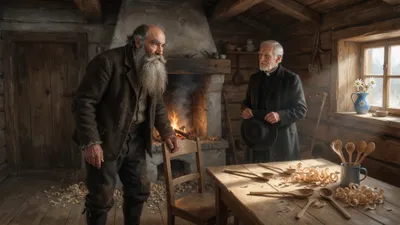
- Who comes up the path to the hut, and in what order.
- How the grandfather talks when someone from the village is in his hut, compared with how he talks when he is alone with Heidi.
- Dete's manner on this visit, set beside the Dete of Chapter 1.
- What Heidi is told, what she is not told, and who does the telling.
- The grandfather's temper: what raises it, and what he does with it once it is up.
Vocabulary to know:
schoolmaster (noun) — A man who teaches in a school.; pastor (noun) — A minister in charge of a church and its congregation.; determination (noun) — Firmness of purpose; refusing to be moved.; sleep-walker (noun) — A person who gets up and moves about while still asleep.; over-exert (verb) — To push yourself to work or move far harder than your body can stand.; lawcourts (noun) — The places where legal cases are decided by judges.; despise (verb) — To look down on someone with strong dislike.; wager (verb) — To bet; to say confidently that something will happen.; earnestness (noun) — Deep seriousness and sincerity.; reconciled (adjective) — Made peaceful again with someone after a long quarrel.; amiable (adjective) — Friendly and pleasant, sometimes on purpose to win someone over.; unspoiled (adjective) — Not made selfish or demanding by too much comfort.; thundered (verb) — Shouted in a deep, furious voice.; affirmed (verb) — Stated firmly that something is true.; agitated (adjective) — Upset and unable to keep still.; forbidding (adjective) — Looking stern and unwelcoming, so that people keep away.; ogre (noun) — A frightening giant from old stories, used to describe someone who looks terrifying.; mercy (noun) — A piece of good luck to be thankful for; a blessing.; water-trough (noun) — A long open container that holds water for animals to drink from.; trailing (adjective) — Hanging down and dragging along behind..
Chapter 6: Clara, the Patient Little Invalid

Before you read — think about:
- Every household has rules that nobody writes down. Which of the unwritten rules in your home would a visitor break inside an hour?
- A child who is ill and wealthy might have servants, a tutor, and no friends her own age at all. Which of those would be hardest to live with?
- In wealthy nineteenth-century houses the rules for addressing a servant were strict and detailed. Why would the people in charge care so much about exactly how a servant is spoken to?
- When is complete honesty a strength, and when does it make life harder for everyone in the room?
- Think about a time you were the new person somewhere. What did you want the people there to do, and what did you want them not to do?
Watch for these while reading:
- The Sesemann household as a system: who gives the orders, who carries them out, and who is never consulted.
- Miss Rottermeyer's questions, and how many of them are about Heidi rather than about the position Heidi is filling.
- Clara herself — her age, the shape of her day, her lessons, and the way she speaks to a stranger.
- The dinner table: what is served, where each person sits, and what each person does with the food in front of them.
- How the servants behave with the housekeeper in the room, compared with how they behave without her.
Vocabulary to know:
invalid (noun) — Someone who is ill or disabled and needs constant care. (A term used in the 1800s that is no longer considered polite.); embroidery (noun) — Decorative sewing done with colored thread.; dome-shaped (adjective) — Rounded on top like the roof of a dome.; solemn (adjective) — Very serious, without any hint of fun.; dignified (adjective) — Serious and formal in a way that demands respect.; superintendence (noun) — The job of overseeing and directing others' work.; entrusted (verb) — Given to someone as a responsibility to look after.; dainty (adjective) — Small, neat, and pretty.; ushered (verb) — Led someone politely into a room.; christened (verb) — Given a name at a baptism ceremony in church.; saucy (adjective) — Cheeky; disrespectful in a bold way.; fluent (adjective) — Speaking smoothly and easily, without hesitating.; truthfulness (noun) — The habit of always telling the truth.; beckoned (verb) — Signaled to someone with a hand or finger to come closer.; tutor (noun) — A private teacher who comes to a pupil's home.; short-sighted (adjective) — Unable to see things clearly unless they are close to your eyes.; butler (noun) — The chief male servant of a large household.; housekeeper (noun) — The woman in charge of running a large house and managing its servants.; insupportable (adjective) — Impossible to put up with.; lecture (noun) — A long, serious telling-off about how to behave..
Chapter 7: The Unfriendly Housekeeper

Before you read — think about:
- When you wake up in a strange place, what are the first things you look for to work out where you are?
- Is it harder for a newcomer not to know the facts, or not to know the rules that nobody has bothered to tell them?
- In a city you have never seen, what would you want to look at first, and why?
- Do you settle into a new place by exploring it, or by waiting for somebody to explain it to you? What are the risks of each?
- What is the difference between a rule that keeps someone safe and a rule that merely keeps someone quiet?
Watch for these while reading:
- How much of this house Heidi cannot manage on her own — the windows, the doors, the stairs, the streets outside.
- The conversation between Miss Rottermeyer and the tutor: who wants what from whom.
- Sebastian and Tinette: two servants, two very different ways of handling a child nobody has explained to them.
- What Heidi asks for when she is out of the house, and the words she uses.
- Any high place she is taken to, and what she can and cannot see from it.
Vocabulary to know:
washstand (noun) — A small table holding a jug and basin for washing, used before houses had bathrooms.; immovable (adjective) — Impossible to move or shift.; rudimentary (adjective) — At the most basic, beginning level.; detriment (noun) — Harm or damage done to something.; frantic (adjective) — Wild with alarm or urgency.; inkstand (noun) — A stand or holder for a bottle of ink on a writing desk.; vehicles (noun) — Things used for carrying people or goods, such as carts and carriages.; amazement (noun) — A feeling of complete wonder or bewilderment.; curtly (adverb) — In a short, abrupt way that is close to rude.; sill (noun) — The flat ledge at the bottom of a window.; hand-organ (noun) — A portable musical instrument carried on the back and played by turning a handle.; garland (noun) — A ring or chain of flowers or leaves.; tower-keeper (noun) — The person whose job is to look after a church tower and let visitors up it.; chimney-pots (noun) — Short pipes fitted on top of chimneys.; droll (adjective) — Amusing in a strange or unexpected way.; knocker (noun) — A hinged metal fitting on a front door, used for knocking.; unmannerly (adjective) — Rude; showing no good manners.; sternly (adverb) — In a strict and serious way.; stifled (adjective) — Choked back or smothered so that it can hardly come out.; elapsed (verb) — Passed, of a period of time.; rumpus (noun) — A noisy uproar or fuss.; flowered (adjective) — Decorated with a pattern of flowers..
Chapter 8: Surprises for the Children

Before you read — think about:
- In a big household, who really knows what is going on — the people in charge, or the people who do the work? Why?
- How do people behave when they have authority over someone but no real control?
- What are all the different reasons a person might struggle with something everyone around them insists is easy?
- What makes a place start to feel like home? How long does it take you, and what has to happen first?
- What is the difference between being looked after and being managed? Have you ever felt both at once?
Watch for these while reading:
- Sebastian's behaviour when nobody senior is in the room, and what he takes on himself without ever mentioning it.
- How Heidi talks about letters and lessons, and what her answers show about the way her mind works.
- Anything Heidi puts aside at the table, and who she seems to be thinking of while she does it.
- The callers at the Sesemann front door, and how each visit was arranged.
- The household's idea of what is 'suitable', and how many things fail that test in the course of one day.
Vocabulary to know:
ragged (adjective) — Wearing torn, worn-out clothes.; rascal (noun) — A mischievous, badly behaved person.; extraordinary (adjective) — Very unusual; far outside the ordinary.; energetic (adjective) — Full of vigorous activity.; tortoise (noun) — A slow-moving land reptile with a hard shell.; declensions (noun) — Grammar exercises in which the different forms of a noun are listed in order.; barbarian (noun) — A person thought to be wild and uncivilized.; cellar (noun) — An underground room beneath a house, used for storage.; equanimity (noun) — Calmness and steadiness of mind.; perpetually (adverb) — Constantly; without ever stopping.; deception (noun) — A trick that makes someone believe something untrue.; topsy-turvy (adjective) — Turned upside down; in complete confusion.; diversion (noun) — Something that takes your mind off boredom and entertains you.; exasperated (adjective) — Worn out and irritated past patience.; ungrateful (adjective) — Showing no thanks for what has been given to you.; wardrobe (noun) — A tall cupboard for hanging clothes in.; overhaul (verb) — To go right through something in order to sort and repair it.; counterpane (noun) — A bedspread; the top cover of a bed.; summons (noun) — An urgent call ordering someone to come at once.; confided (verb) — Told someone privately about a plan or secret..
Chapter 9: Mr. Sesemann Takes Heidi's Part

Before you read — think about:
- If three people gave you three different accounts of the same person, whose would you trust, and what would you use to decide?
- A parent who is away for long stretches misses a great deal. Is there anything such a parent can see more clearly than someone who is there every day?
- When a complaint is partly fair and partly about the complainer's own convenience, how do you tell the two apart?
- Why does it matter so much to some adults exactly which word a child uses to address them?
- What does it feel like to be talked about in the next room while you wait to be called in?
Watch for these while reading:
- The first question Mr. Sesemann puts to each person he speaks with, and what kind of answer each question invites.
- How the tutor talks when he is asked something simple, and how Mr. Sesemann handles it.
- Miss Rottermeyer's account of the household — which parts of it are about Heidi and which are about herself.
- How the household sounds and moves when the master of the house is at home.
- What Clara says when she is asked about Heidi, and how it sits beside the housekeeper's version.
Vocabulary to know:
commotion (noun) — A noisy, busy disturbance.; affection (noun) — Warm fondness for someone.; attached (adjective) — Fond of someone and closely bound to them.; quarrel (verb) — To argue angrily.; heartily (adverb) — With hearty enjoyment or full feeling.; gloomy (adjective) — Looking sad and grim.; imposed (verb) — To be 'imposed upon' is to be tricked or taken advantage of.; well-behaved (adjective) — Acting politely and following the rules.; disgracefully (adverb) — In a way that brings shame.; recital (noun) — An account of events told out loud from beginning to end.; inexperience (noun) — A lack of practice or familiarity with something.; uncivilized (adjective) — Lacking the manners and customs of settled, polite society.; endowed (verb) — Naturally given a quality or ability.; prejudice (verb) — To make someone form an unfair opinion against something before knowing the facts.; prospect (noun) — The expectation of something that is coming.; fortnight (noun) — A period of two weeks.; grandmamma (noun) — An affectionate, old-fashioned word for grandmother.; waylaid (verb) — Stopped and intercepted someone who was on their way somewhere..
Chapter 10: Clara's Lovable Grandmother

Before you read — think about:
- What is the difference between an adult who is kind to a child and an adult who takes a child seriously? Can you have one without the other?
- What makes you trust a grown-up you have only just met? Is it what they say, or something else?
- What is the difference between a house that is comfortable and a house that is welcoming? Can a place be one without the other?
- Who is the best listener you know? What do they actually do that other people do not?
- Think of an object somebody gave you that turned out to matter more than they knew. What made it matter?
Watch for these while reading:
- How grandmamma settles the question of what Heidi is to call her, and how little time she spends on it.
- Her method with the household: the questions she asks, and the things she notices that everybody else has stopped seeing.
- The books she brings with her, and which pages Heidi looks at longest.
- How Heidi talks about learning, and where her ideas about it seem to have come from.
- What grandmamma and Heidi say to each other when they are not talking about lessons.
Vocabulary to know:
footstools (noun) — Low stools for resting your feet on while seated.; convenient (adjective) — Placed or arranged so as to be easy and handy to use.; abruptly (adverb) — Suddenly and without any politeness.; gravely (adverb) — Seriously, without any joking.; warm-hearted (adjective) — Kind and generous in feeling toward others.; surname (noun) — A family name, used after the first name.; keen (adjective) — Sharp-minded; quick to notice and understand things.; despairing (adjective) — Showing that a person has given up all hope.; misfortune (noun) — Bad luck, or an unlucky situation.; grazing (verb) — Feeding on growing grass.; shepherd (noun) — A person whose job is to look after sheep.; vividly (adverb) — So clearly and brightly that it seems real.; beforehand (adverb) — In advance; before something happens.; affectionately (adverb) — In a loving, tender way.; earnestly (adverb) — With deep sincerity and seriousness.; dissertation (noun) — A long, detailed explanation of a subject.; marvelous (adjective) — So astonishing that it seems almost impossible.; questioningly (adverb) — With a look that asks a question without words.; blushing (verb) — Going red in the face from strong feeling.; gesture (noun) — A movement of the hands or body that expresses a feeling..
Chapter 11: Home-Sickness

Before you read — think about:
- What does a person do with a whole day when nothing in it is theirs to decide?
- Which do you miss more when you are away from home — the people, the place, or the routine? Have you ever tested that?
- Is it possible to be surrounded by people and still be lonely? What makes the difference?
- What is the longest you have been away from home? What did you find yourself thinking about most?
- What small, ordinary things from home come back to you most clearly when you have been away a long time?
Watch for these while reading:
- The length of this chapter. Spyri could have folded it into the ones on either side of it and chose not to.
- The images of the mountain that Heidi keeps returning to — the same few, over and over, and how sharp they stay.
- How much time passes here compared with the chapters before it, and how little fills that time.
- What Heidi does with her hands and her eyes when nobody in the house is looking at her.
- Who in the household notices her, and who does not.
Vocabulary to know:
oftener (adverb) — More often. (An old-fashioned way of saying 'more frequently.'); fonder (adjective) — More affectionate toward something; liking it more.; confidence (noun) — Complete trust in someone.; grieve (verb) — To cause someone deep sorrow.; repentantly (adverb) — In a way that shows you are sorry for having done wrong.; departure (noun) — The act of leaving a place.; mope (verb) — To sit about feeling gloomy and listless.; occasions (noun) — Particular times when something happens.; seldom (adverb) — Rarely; almost never.; familiar (adjective) — Well known to you from long experience.; recalled (verb) — Brought something back into a person's mind.; remembrance (noun) — The memory of something.; verge (noun) — The very edge or brink of something.; suppressed (verb) — Held something back by force so that it does not show.; glowing (adjective) — Shining with a warm, rich light.; battling (verb) — Struggling hard against something.; home-sickness (noun) — The deep unhappiness of being far from home and longing to return..
Chapter 12: "My House Is Haunted"

Before you read — think about:
- Why is a house at night frightening in a way that the same house never is by day?
- How does a rumour travel through a group of people? Have you ever watched one grow?
- What makes somebody in authority take a problem seriously? What usually has to happen before they do?
- When something unexplained happens in a house, what kinds of explanations do people reach for first?
- In a large household, who actually notices when something is wrong with one member of it — and whose job should that be?
Watch for these while reading:
- How the fear in the house grows in stages, and who passes it along to whom.
- Mr. Sesemann's first move once he is back in the house.
- The doctor: how he is introduced, how he speaks to the servants, and how he speaks to his friend.
- How the household talks about what has been happening at night, and which details they choose to put in a letter.
- How the two men who sit up through the night talk to each other, and what they bring with them for the watch.
Vocabulary to know:
twilight (noun) — The dim half-light after the sun goes down.; corridors (noun) — Long narrow passages running through a building.; mysterious (adjective) — Strange and impossible to explain.; persuasion (noun) — The work of talking someone into doing something.; cordial (noun) — A strong sweet drink, once thought to give courage or strength.; ghostly (adjective) — Like a ghost; eerie and frightening.; unaccountable (adjective) — Impossible to explain or account for.; apparitions (noun) — Ghostly figures that suddenly appear.; entail (verb) — To involve something as a necessary result.; constitution (noun) — A person's general bodily strength and health.; liable (adjective) — Likely to suffer or experience something.; ancestors (noun) — Family members from earlier generations.; penance (noun) — Suffering a person accepts in order to make up for something wrong they did.; frankly (adverb) — Openly and honestly, without holding anything back.; testimony (noun) — A statement of what a person saw or experienced.; draught (noun) — A long swallow of a drink.; precautions (noun) — Steps taken in advance to avoid possible danger.; revolver (noun) — A handgun with a rotating cylinder that holds the bullets.; punctually (adverb) — Exactly at the appointed time.; grey-haired (adjective) — Having hair that has turned grey with age.; consumed (verb) — Completely taken over and worn away by something.; skeleton (noun) — The frame of bones in a body — used here of someone grown terribly thin.; remedy (noun) — Something that cures an illness or fixes a problem.; prescription (noun) — A doctor's written instruction for treating a patient..
Chapter 13: At Home Again on the Mountain
Before you read — think about:
- What is the difference between getting good news slowly and getting all of it in a single moment?
- Why might a person want to send someone away with an armful of gifts? What is the gift doing for the giver?
- What are you most afraid has changed when you come back to a place after a long time away?
- What does 'home' actually mean — a building, a set of people, a landscape, a routine? Which of those could you do without?
- How does news travel in a small village, and what does that do to a person who has just come back?
Watch for these while reading:
- The stages of the journey, and how many different people take charge of Heidi along the way.
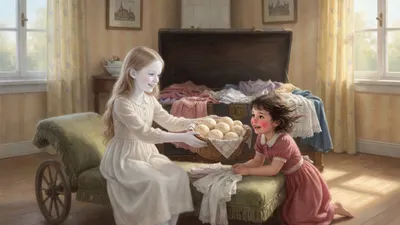
- What she is carrying, wearing, and being asked to keep.
- The one thing she keeps asking about on the road, and who she asks.
- Doerfli as she passes through it: who speaks to her, and what the village says to itself afterwards.
- The grandfather's face and his hands when she reaches the hut.
Vocabulary to know:
apparel (noun) — Clothing, especially proper or fine clothing.; trunk (noun) — A large sturdy case for carrying clothes and belongings on a journey.; visitations (noun) — Appearances by a ghost or spirit.; uneducated (adjective) — Having had no schooling.; provisions (noun) — Supplies of food, especially for a journey.; morsel (noun) — A very small piece of food.; conspicuous (adjective) — Very easy to notice; standing out.; imploring (adjective) — Begging desperately for something.; platform (noun) — The raised walkway alongside the track at a railway station.; wearisome (adjective) — Tiring and tedious.; precipice (noun) — A very steep or vertical rock face.; conveyed (verb) — Carried or transported from one place to another.; volunteered (verb) — Offered to do something without being asked.; hoisted (verb) — Lifted up with effort, often using ropes or both arms.; miller (noun) — A person whose trade is grinding grain into flour.; jagged (adjective) — Having a rough, sharply uneven edge.; underpetticoat (noun) — A plain undergarment worn beneath a skirt or dress.; unloosed (verb) — Undid or released a hold on something.; helter-skelter (adverb) — In disorderly haste, all at once.; fragrant (adjective) — Having a sweet, pleasant smell.; restlessness (noun) — An inability to stay still or settle.; gratitude (noun) — A feeling of deep thankfulness..
Chapter 14: The Coat with the Silver Buttons

Before you read — think about:
- Reading aloud to somebody is an old kind of kindness. Who has read to you, or who have you read to, and what was it like?
- Do you dress differently for different occasions? What are you saying when you do?
- Old people sometimes keep books, tools, or clothes they can no longer use. Why hold on to them?
- What is the difference between going somewhere because you want to and going because you think you ought to?
- When someone who has stayed away from a community for years walks back into it, what do you watch for first?
Watch for these while reading:
- What Heidi wants to do with the money she was given in Frankfurt, and who has an opinion about the plan.
- The old book on the shelf in Peter's cottage, and which pages Heidi turns to.
- The grandmother's face while Heidi reads to her, and the words she repeats to herself afterwards.
- The coat the grandfather takes out of the cupboard, and everything Spyri tells you about it.
- The talk outside the church in Doerfli, and how the tone of it sits beside the talk of Chapter 1.
Vocabulary to know:
devoted (verb) — Gave a period of time entirely to one purpose.; threshold (noun) — The strip of floor in a doorway; the entrance to a house.; stale (adjective) — No longer fresh; dry and hard from being kept too long.; exultation (noun) — Great triumphant joy.; hymns (noun) — Religious songs sung in worship.; prodigal (noun) — A person who leaves home, wastes what they were given, and later returns. (From the parable of the Prodigal Son.); sinned (verb) — Done something morally wrong, especially against God.; repent (verb) — To feel deep regret for something and wish undone.; festival (noun) — A great joyful celebration.; chimes (noun) — The musical ringing of bells.; congregation (noun) — The people gathered together for a church service.; nudging (verb) — Poking someone gently, usually with an elbow, to get their attention.; exaggerated (verb) — Made something sound larger, worse, or more dramatic than it really was.; quarrelsome (adjective) — Ready to argue and pick fights.; reception (noun) — The way in which someone is welcomed.; askance (adverb) — With suspicion or distrust — to 'look askance at' someone is to doubt them.; ill-will (noun) — Unfriendly feeling; a grudge.; well-meant (adjective) — Kindly intended, even if not welcomed at the time.; loitering (verb) — Hanging about a place without any real purpose.; hesitation (noun) — A pause caused by doubt or uncertainty.; consented (verb) — Agreed to something after being asked.; pillowed (adjective) — Propped up and cushioned with pillows..
Chapter 15: A Great Disappointment

Before you read — think about:
- What makes a disappointment worse — the loss itself, or having been completely sure the thing would happen?
- What is the difference between a letter and a visit? Is there anything a letter can do better?
- What does the way somebody chooses a present tell you about them?
- Is it kinder to break bad news all at once or a piece at a time? Does it depend on who is hearing it?
- When a person who is usually difficult is suddenly in a very good mood, what do you tend to assume?
Watch for these while reading:
- How the news is put to Clara, and the order in which things are said.
- The doctor's manner here, set beside the man who came up the stairs in the Frankfurt house in Chapter 12.
- What Clara offers, and who she offers it to.
- Every present in the box and who it is intended for.
- Miss Rottermeyer's mood, and which part of the arrangement she seems most pleased about.
Vocabulary to know:
postpone (verb) — To put something off until a later time.; utmost (adjective) — The greatest possible.; watchfulness (noun) — Constant careful attention to how someone is doing.; submissive (adjective) — Accepting something without arguing or resisting.; recovery (noun) — A return to health after illness.; shrugged (verb) — Raised the shoulders briefly to show doubt or that one does not know.; broken-hearted (adjective) — Overwhelmed by grief.; proposal (noun) — A plan or suggestion put forward for someone to consider.; objections (noun) — Reasons given for being against something.; solace (noun) — Comfort in a time of sadness.; pleadingly (adverb) — In a begging, imploring way.; arrangements (noun) — The preparations made so that something can happen.; reproaching (verb) — Gently blaming or scolding someone.; conciliatory (adjective) — Meant to win someone over and smooth away bad feeling.; tussle (noun) — A struggle or argument.; designed (verb) — Planned out and worked out the details of something.; tobacco (noun) — The dried leaf smoked in pipes and cigarettes.; especial (adjective) — Particular; special. (An old-fashioned form of 'special.'); picturing (verb) — Imagining something clearly in your mind.; forwarded (verb) — Sent onward to another address..
Chapter 16: The Doctor Comes with Presents

Before you read — think about:
- What is the hardest part of being the person who has to deliver bad news you did not cause?
- What makes somebody memorable to a person who has met them only a handful of times?
- If you could send presents to someone whose life you knew only from letters and stories, how would you choose them?
- What is it like to wait for visitors you have been promised, day after day, and then greet whoever actually arrives?
- What can a guest see about a household that the people living in it cannot?
Watch for these while reading:
- Peter in the opening scene, and how his tone changes depending on who he is speaking about.
- The grandfather's joking, half-military way of talking, and who he aims it at.
- What the grandfather offers the doctor, and what he says plainly that he cannot offer.
- Heidi as a hostess — the habits she has picked up since coming home.
- The presents as they come out of the box, and which one each person fixes on.
Vocabulary to know:
rustled (verb) — Made a soft, dry whispering sound.; ancient (adjective) — Extremely old.; landscape (noun) — The whole stretch of country you can see from one place.; beam (noun) — A ray of light.; vied (verb) — Competed with one another.; obstreperous (adjective) — Noisy and difficult to control.; stentorian (adjective) — Extremely loud and powerful, of a voice.; field-marshal (noun) — An army officer of the very highest rank.; snarling (adjective) — Speaking with an angry, growling tone.; duster (noun) — A cloth used for wiping dust off furniture.; irresistible (adjective) — Too strong or tempting to be resisted.; lodging (noun) — A place to stay and sleep.; excursion (noun) — A short journey made for pleasure or interest.; acknowledge (verb) — To admit or recognize that something is true.; plumper (adjective) — Rounder and better fed.; awe (noun) — A feeling of wonder mixed with respect, and a little fear.; monster (adjective) — Enormous. (Used informally, as in 'a monster sausage.'); lark (noun) — A bird that sings very early in the morning — to be 'up with the lark' is to rise at dawn.; cheery (adjective) — Bright and good-humored.; starlit (adjective) — Lit by the light of the stars.; fatherly (adjective) — Kind and protective in the way a good father is.; reassuring (adjective) — Meant to take away someone's worry or sadness..
Chapter 17: Excursions Over the Mountains

Before you read — think about:
- What makes a landscape feel healing to one person and empty to another, even when they are standing in the same place?
- What makes walking somewhere with a person different from sitting down to talk to them? Why do people say hard things more easily side by side?
- Is there an age at which people stop being able to enjoy simple things — a view, a walk, a meal outdoors? Or is that a choice a person makes?
- How do you decide whether somebody is worth telling your private thoughts to? What do they have to do first?
- What can a guest see about a household that the people living in it cannot?
Watch for these while reading:
- What goes into Peter's lunch bag, and what Peter makes of the weight of it.
- The talk between Heidi and the doctor as they walk — listen for whether they are always talking about the same thing.
- What the doctor does while Heidi recites, and how long it is before he speaks again.
- Peter's hands through this chapter, and what he does with them.
- How the mountain is described now that a stranger is walking on it. Spyri shows it through the doctor's eyes as well as Heidi's.
Vocabulary to know:
sidelong (adjective) — Sideways; from the corner of the eye.; slung (verb) — Hung something loosely over a shoulder or neck.; ascent (noun) — A climb upward.; thronging (verb) — Crowding round in a dense mass.; moss-covered (adjective) — Covered in the soft green plant that grows on damp rock.; pondering (verb) — Thinking something over slowly and carefully.; dismay (noun) — A feeling of alarm and discouragement.; defender (noun) — Someone who protects another from harm.; foeman (noun) — An enemy. (An old-fashioned word used in poetry and hymns.); tribulation (noun) — Great trouble or suffering.; forlorn (adjective) — Lonely and abandoned.; compassion (noun) — Deep sympathy for someone who is suffering.; recited (verb) — Said something aloud from memory.; pantomime (noun) — The acting out of feelings through gestures instead of words.; smote (verb) — Struck hard. (The old past tense of 'smite'; a conscience that 'smote him' stung him with guilt.); amends (noun) — Something done to make up for a wrong — to 'make amends' is to put it right.; versed (adjective) — Knowledgeable and experienced in a subject.; anecdotes (noun) — Short, entertaining true stories.; dwellers (noun) — Creatures or people who live in a particular place.; speck (noun) — A tiny spot, barely visible..
Chapter 18: A New Home for the Winter

Before you read — think about:
- What would be hardest about moving into a village you have deliberately kept away from for years?
- What would you expect a child raised outdoors to be good at in a classroom, and what might be difficult?
- What kinds of poverty are invisible until you actually go inside somebody's home?
- A long winter shuts some places off from everywhere else for months at a time. What do you think that does to the people living through it?
- How do you make a room that is not yours start to feel like yours?
Watch for these while reading:
- The description of the winter house in Doerfli. Spyri gives this building more attention than any since the hut on the Alm.
- What the grandfather has made ready in the new house before Heidi ever sets foot in it.
- The grandfather's conversation with Peter, and the way he uses Peter's own answers back at him.
- The grandmother's bed and her pillow, and the things she names when she says what she is thankful for.
- The hymn Heidi reads aloud, and how differently the grandmother and Heidi each take its last lines.
Vocabulary to know:
straggling (adjective) — Spread out in an untidy, irregular way.; half-ruined (adjective) — Partly fallen down and left that way.; ivy (noun) — A climbing evergreen plant that spreads over walls.; overgrown (adjective) — Thickly covered with plants that have grown wild.; chapel (noun) — A small building or room used for worship.; pillars (noun) — Tall upright posts that hold up a roof or arch.; partition (noun) — A wall or screen that divides a space into separate parts.; rents (noun) — Tears or splits in something — here, gaps torn in walls and roofs.; intact (adjective) — Whole and undamaged.; wainscoting (noun) — Wooden panelling covering the lower part of a wall.; huntsmen (noun) — Men who hunt, especially on horseback with dogs.; hounds (noun) — Dogs bred and kept for hunting.; receptacle (noun) — A container for holding or storing things.; mattress (noun) — The padded layer of a bed that you lie on.; lizards (noun) — Small four-legged reptiles with long tails.; oppression (noun) — A heavy, weighed-down feeling.; fathom-deep (adjective) — Extremely deep. (A fathom is about six feet.); smothered (verb) — Buried and suffocated under something.; deserter (noun) — A soldier who abandons his duty and runs away.; unruly (adjective) — Disobedient and difficult to control.; drift (noun) — The general meaning behind what someone is saying.; warlike (adjective) — Sounding as though ready for battle..
Chapter 19: Heidi Teaches Obstinate Peter

Before you read — think about:
- Where does a belief like 'I could never learn that' come from? Have you ever held one about yourself?
- When you are teaching a friend who has already decided they cannot learn, what actually helps?
- What happens to a student that nobody expects anything from?
- Is it easier to learn something from a friend or from a teacher? What does each of them have that the other does not?
- What kinds of pressure actually change a stubborn person's mind? Which kinds only make them dig in harder?
Watch for these while reading:
- How Heidi puts the work to Peter, and how accurate her description of it actually is.
- The old rhyming alphabet book, and Peter's response as each letter comes round.
- The grandfather in the background during the lessons — Spyri keeps telling you what his face is doing.
- The schoolmaster's questions, and the length of the answers he gets.
- What the grandmother says about the reading at the end of the chapter, and what she asks for.
Vocabulary to know:
hitherto (adverb) — Up until now.; hard-hearted (adjective) — Unfeeling; unwilling to be moved by kindness.; threateningly (adverb) — In a way meant to frighten someone into doing something.; scornful (adjective) — Showing open contempt for someone.; mockery (noun) — Ridicule; making fun of someone cruelly.; shudder (noun) — A sudden trembling caused by fear or cold.; mollified (adjective) — Calmed down after being angry or upset.; falter (verb) — To hesitate or stumble in the middle of doing something.; petrified (adjective) — So terrified that a person cannot move at all.; horror-stricken (adjective) — Overwhelmed with horror.; entreaties (noun) — Desperate pleadings.; diligent (adjective) — Hardworking and careful.; compensate (verb) — To make up for something lost or suffered.; anguish (noun) — Severe mental suffering.; merriment (noun) — Laughter and amusement.; twitched (verb) — Moved with a small, sudden jerk.; miracle (noun) — An event so wonderful it seems impossible.; supernatural (adjective) — Beyond what can be explained by nature.; wrought (verb) — Brought about; made happen. (An old past form of 'work.'); induce (verb) — To persuade someone to do something..
Chapter 20: A Strange Looking Procession

Before you read — think about:
- What usually happens when you see for the first time a place you had only pictured from somebody else's descriptions?
- What do you do to get a place ready when somebody important is coming to stay? What does all that preparing say about how you feel?
- What do you notice first when you meet in person someone you have only known through letters?
- Travel in the 1880s was slow, expensive and rough. What would it actually take to move a person who cannot walk from a German city to the top of a Swiss mountain?
- What would surprise a person who has lived almost entirely indoors about one full day spent outdoors on a mountain?
Watch for these while reading:
- Clara's letter, and the account it gives of how the doctor has spent his winter.
- The procession itself — count the people, the animals and the equipment it takes to bring one visitor up that path.
- Peter's face and Peter's answers whenever the visitors are mentioned.
- The grandmother in Peter's cottage: what she says, and what she does not say.
- The meals on the Alm through Clara's first day. Spyri describes food closely whenever hospitality is the real subject.
Vocabulary to know:
skilful (adjective) — Showing skill and practised ability.; four-footed (adjective) — Having four feet; used of animals.; crevasse (noun) — A deep open crack in rock or ice.; twirling (verb) — Spinning something round and round.; menacing (adjective) — Threatening; looking as if about to do harm.; confined (verb) — Kept shut in a place and unable to leave it.; apace (adverb) — Quickly; at a fast rate.; sedan (noun) — An enclosed chair carried on poles by two people. (A 'sedan chair.'); stately (adjective) — Dignified and impressive in appearance.; reclining (adjective) — Leaning back rather than sitting upright.; porter (noun) — A person employed to carry luggage.; dismounted (verb) — Got down from a horse.; constraint (noun) — Awkward stiffness between people who do not know each other.; hearsay (noun) — Information heard from other people rather than known first-hand.; magnificent (adjective) — Splendid and impressive.; envy (verb) — To wish you had what another person has.; entranced (adjective) — Filled with delighted wonder.; countenance (noun) — A person's face, or the expression on it.; lamented (verb) — Expressed sorrow or regret about something.; nosegay (noun) — A small bunch of flowers held in the hand.; centaury (noun) — A wild plant with small pink or red star-shaped flowers.; repast (noun) — A meal.; cronies (noun) — Long-standing close friends.; fortress (noun) — A strongly defended building or stronghold..
Chapter 21: Happy Days for the Little Visitor

Before you read — think about:
- What practical problems would a household face in caring day to day for a guest who cannot walk, in a house with no road leading to it?
- What does it take for a household that has lived one way for years to change its daily routine for a guest?
- Mountain weather changes fast and decides what everybody can do that day. What is it like to have your plans settled by the sky?
- What jobs around a mountain hut would be new to a guest who has lived almost entirely indoors?
- If you were writing a letter every day about the same place, what would you choose to put in, and what would you leave out?
Watch for these while reading:
- Everything the grandfather builds, fetches or rearranges for Clara without being asked to.
- What he tells Peter to do, and the reason he gives for the instruction.
- The bowls of goat's milk, and Clara's appetite from the first one onwards.
- What the grandfather asks of Clara each morning, and what he asks of her in return for an outing.
- Peter's days now: where he is, what he is doing, and how often anybody in the hut thinks about him.
Vocabulary to know:
gentleness (noun) — Mildness and care in the way one handles someone.; calling (noun) — The work a person seems born to do; a vocation.; foaming (adjective) — Covered with a froth of tiny bubbles.; snow-white (adjective) — As white as snow.; cinnamon (noun) — A sweet, warm-tasting brown spice made from tree bark.; obedience (noun) — Doing what one is told to do.; reserve (noun) — Something held back and kept private — a thought 'in reserve' is one not spoken aloud.; surlily (adverb) — In a sullen, unfriendly, bad-tempered way.; scowled (verb) — Frowned in an angry, sullen way.; echo (noun) — A sound bounced back from a surface so that it is heard again.; school-book (noun) — A book used for lessons.; lavished (verb) — Gave generously and in great quantity.; companionship (noun) — The pleasant company of another person.; charming (adjective) — Delightful and attractive.; mingled (adjective) — Mixed together.; carnations (noun) — Sweet-smelling flowers with frilled pink, red, or white petals.; thyme (noun) — A low-growing herb with small leaves and a strong scent.; brilliant (adjective) — Very bright and shining.; blossoms (noun) — Flowers, especially when open and in great numbers.; rock-roses (noun) — Low mountain plants with wide, papery, golden flowers.; irrepressible (adjective) — Impossible to hold back or control.; bell-shaped (adjective) — Shaped like a bell.; inlaid (adjective) — Set into a surface as a decoration..
Chapter 22: Wicked Peter and the Unlucky Chair

Before you read — think about:
- What is it like to want a day outdoors more than anything, and then find that the plan has changed?
- When two people have been looking forward to the same outing, how do they each handle it if the outing cannot go as planned?
- When somebody has been unfair to you, what makes you willing to be in the same room as them again?
- What is the most beautiful place you have ever been? What did being there actually feel like, hour by hour?
- What does a whole day outdoors on a mountain actually consist of, hour by hour, once the excitement of arriving is over?
Watch for these while reading:
- Peter's mood in the opening pages, and how much of the morning he spends on his own.
- The grandfather's manner when something goes against the plan — what he says aloud, and what Spyri tells you he keeps to himself.
- The high pasture through Clara's eyes: the flowers, the wind, the light, the noise of the herd.
- Snowflake, and what Clara notices about her in the time the two of them have together.
- Spyri lets you inside Peter's head further in this chapter than anywhere else in the book. Notice what he turns over.
Vocabulary to know:
timidly (adverb) — In a shy, nervous, fearful way.; glared (verb) — Stared angrily and fixedly.; blackberry (noun) — A prickly bush bearing clusters of small dark fruit.; destruction (noun) — The act of ruining something completely.; fragments (noun) — Small broken pieces of something.; padding (noun) — Soft material used to stuff and cushion something.; bolster (noun) — A long, firm pillow or cushion.; unbounded (adjective) — Without any limit.; morose (adjective) — Gloomy and unwilling to talk.; pastured (verb) — Fed on growing grass in an open field.; shimmering (adjective) — Shining with a soft, wavering light.; caressingly (adverb) — In a gentle, stroking way.; dependent (adjective) — Needing other people's help for everything.; throe (noun) — A sudden sharp pang or spasm of feeling.; acute (adjective) — Sharp and intense.; authoritative (adjective) — Speaking with the confidence of someone in charge.; encouragingly (adverb) — In a way that gives someone confidence to keep going.; lurch (noun) — To leave someone 'in the lurch' is to abandon them when they need you.; chorus (noun) — Many voices sounding at once.; meekness (noun) — Quiet, humble willingness to do as one is told.; gnawing (verb) — Biting away at something — used of a worry that keeps troubling you.; befallen (verb) — Happened to someone, especially by chance.; constable (noun) — A police officer.; sorrel (noun) — A leafy plant with a sharp, sour taste..
Chapter 23: Good-Bye to the Beautiful Mountain

Before you read — think about:
- What makes a surprise a gift rather than a shock? Where is the line between them?
- A parent who has not seen their child for a whole summer notices things that daily company misses. Why should that be?
- What is the most useful gift anybody has ever given you? Was it the most expensive one?
- This is the last chapter. What loose ends do you want a book like this to tie up, and which ones are better left alone?
- When a story is about to end, what do you listen for in the way people say goodbye?
Watch for these while reading:
- Peter's behaviour every time an adult says his name.
- Grandmamma's talk about a little watchman, and what she does immediately afterwards.
- What each person asks for when they are offered anything they like — and everything they do not ask for.
- How Mr. Sesemann looks at his daughter, and what he notices that the mountain household has grown used to.
- Peter's grandmother in the second half of the chapter, and what still troubles her.
Vocabulary to know:
slackened (verb) — Slowed down.; procession (noun) — A line of people moving forward in order.; telegram (noun) — A short message sent quickly over long distances by electric wire.; complexion (noun) — The natural color and appearance of a person's skin, especially the face.; blooming (adjective) — In full flower; looking glowing and healthy.; larch (noun) — A cone-bearing tree that loses its needles in autumn.; exhausting (adjective) — Extremely tiring.; unsophisticated (adjective) — Simple and inexperienced in the ways of the world.; injunctions (noun) — Strict orders.; limping (verb) — Walking unevenly because of pain or injury.; benefactor (noun) — Someone who gives generous help to another.; exquisite (adjective) — Extremely beautiful and finely made.; dispel (verb) — To drive away a feeling such as fear or doubt.; quaking (verb) — Trembling violently with fear.; expostulations (noun) — Strong protests against something one thinks is wrong.; brood (verb) — To dwell gloomily on a trouble for a long time.; goad (noun) — A pointed stick used to drive animals forward.; torments (verb) — Causes repeated suffering or distress.; contrite (adjective) — Feeling deep sorrow for having done wrong.; confession (noun) — An admission that one has done something wrong.; token (noun) — A sign or symbol that stands for something.; whittling (noun) — The work of cutting shapes out of wood with a knife.; toad-strikers (noun) — A local nickname for a sturdy knife with a rounded handle.; henceforth (adverb) — From this time on..
About the Author
Johanna Spyri (1827-1901) was born Johanna Louise Heusser in the village of Hirzel, in the hills above Lake Zurich, Switzerland — the countryside that would later fill her fiction. Her father was a country doctor and her mother wrote poetry, and she grew up one of six children in a house where patients and visitors came and went constantly. She married Bernhard Spyri, a lawyer and city official in Zurich, and did not begin publishing until she was in her forties, when she wrote a story to raise money for families displaced by war; it appeared anonymously. Over the next three decades she produced roughly fifty stories and novels for children and adults, but Heidi — released in two parts in 1880 and 1881 — eclipsed everything else she wrote and became one of the best-selling books in the history of Swiss literature. Spyri was private about her own life and rarely gave interviews, and she died in Zurich in 1901.
Spyri wrote during a period when Europe was emptying its countryside into its cities. Factories and railways were pulling families out of villages and into crowded industrial centers, and a great many nineteenth-century writers responded by treating mountains, farms, and open air as morally and physically healing — a Romantic idea Spyri takes completely seriously. That belief had a medical dimension too: Switzerland's Alpine air was genuinely prescribed to patients in this era, and wealthy families traveled to Swiss resorts and sanatoriums for rest cures. The novel also sits at a turning point in children's literature. Most stories written for young readers at the time existed to deliver a moral lesson; Spyri's book does include religious instruction and clear ideas about right behavior, but it also gives its heroine a real personality, real anger, and real grief, which was newer than it sounds. The book's enormous international success helped fix an image of Switzerland — alpine meadows, goat bells, wooden huts — in the imagination of readers who had never been there.