

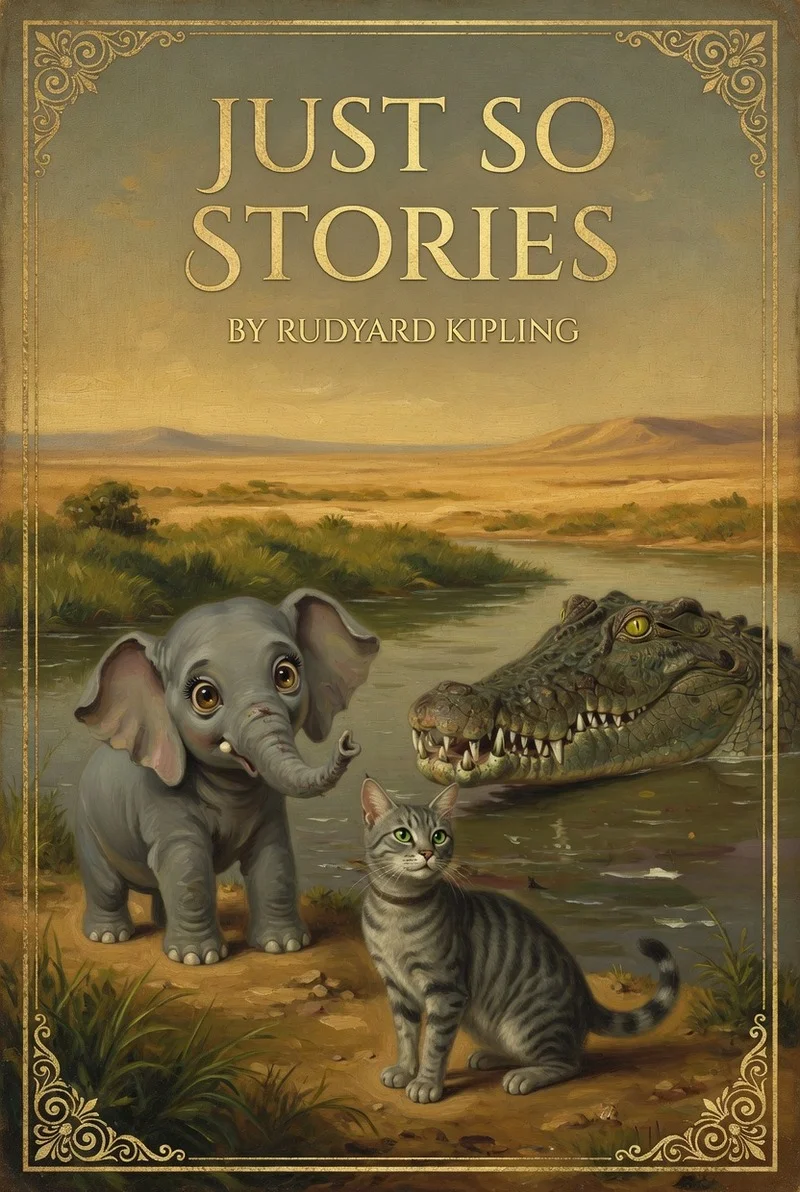
About This Book
"Just So Stories" is a collection of twelve short, funny tales that pretend to explain how things in our world first came to be. How did the camel get his hump? How did the leopard get his spots? How did the very first letter ever get written? Rudyard Kipling answers all of these questions with playful, made-up stories that were never meant to be true science, but are wonderful fun to read. Kipling first told these tales out loud to his own children at bedtime, and he told them in exactly the same words every single time. His children liked them told "just so," with nothing changed, and that is how the book got its name. Because of this, the stories are full of silly repeated phrases, funny names, and words that are fun to say out loud. Each story stands on its own, so you can read them in any order you like. Along the way you will meet clever animals, a curious little elephant, a proud wandering cat, and a cave-girl named Taffy who lived long before people knew how to read or write. Get ready for a world where anything can happen and every animal has a story to tell.
This book is perfect for young readers because each story is short, funny, and full of rhythm and repeated phrases that are a joy to read aloud. The tales spark curiosity by asking playful "how" and "why" questions about the world, which is exactly the kind of wondering that fifth graders do naturally. Reading these stories helps children enjoy rich, musical language, predict what might happen next, and think about cause and effect in a lighthearted way.
Meet the Characters

More about Taffy
Taffy is a curious, playful cave-girl who lives with her mother and father in the days when people had not yet invented reading or writing. She loves going on adventures with her dad and is quick to come up with clever ideas. She is one of the few characters you will meet in more than one story in this book.

More about Tegumai
Tegumai is Taffy's loving father, a hunter who lives near a river in the far-off cave days. He is calm, patient, and enjoys spending the whole day fishing and exploring with his daughter. Like Taffy, he appears in more than one of the stories in this collection.

More about Teshumai Tewindrow
Teshumai is Taffy's mother, brisk, loving, and much quicker to scold than Tegumai is. She is the one who has to make sense of the pictures Taffy draws. She appears with her family in the alphabet stories.

More about The Elephant's Child
The Elephant's Child is a young elephant who is famous for one thing: he is bursting with questions about absolutely everything. His endless curiosity sometimes gets him into trouble with his big relatives, but it also leads him on the boldest adventure of his life.

More about The Crocodile
The Crocodile lives in the great grey-green, greasy Limpopo River. He is patient, hungry, and very interested in the Elephant's Child's questions. He is one of the answers the young elephant goes looking for.

More about The Cat
The Cat is the wildest and most independent of all the animals, roaming the wet, wild woods entirely on his own. He is clever, proud, and values his freedom more than anything. Watch how he deals with the other animals who have chosen to live a different way.

More about The Woman
The Woman is the first person to make a real home, with a fire and a door and rules for the animals who want to come in. She is clever, firm, and not afraid of wild things. The Cat has to bargain with her.

More about The Parsee
The Parsee is a friendly, resourceful man who lives all by himself on a warm island beside the sea. He loves to cook, and the delicious things he makes have a way of drawing attention. He is a good-natured character who ends up teaching a rude neighbor an important lesson.

More about The Rhinoceros
The Rhinoceros is a short-tempered beast with very few manners and a skin that does not fit. He is greedy about other people's food. He is the Parsee's unwelcome neighbor.

More about The Camel
The Camel lives in the Howling Desert and will not do any work. His favorite word is 'Humph!' He is the animal the Djinn of All Deserts has to deal with.

More about The Djinn of All Deserts
The Djinn of All Deserts is a powerful, slightly impatient spirit who likes animals to do their share. He is the one who comes when the Horse, the Dog, and the Ox complain about the Camel. He is not a person to argue with.

More about The Whale
The Whale is so hungry he eats every fish in the sea except one. He is proud of his appetite and not at all ready for a sailor with a raft. His story explains why whales cannot swallow a man.

More about The Leopard
The Leopard lives on the High Veldt, where animals used to be the same sandy color as the grass. He is a proud hunter. His spots are the whole point of his story.

More about Old Man Kangaroo
Old Man Kangaroo goes to the gods and asks to be made different from all other animals. He is vain, energetic, and not very specific about what 'different' means. His legs are the answer he gets.

More about Stickly-Prickly Hedgehog
Stickly-Prickly is a hedgehog who lives by the Amazon with his friend Slow-Solid Tortoise. He is clever, unhurried, and good at not being eaten. Together they puzzle a jaguar.

More about Suleiman-bin-Daoud
Suleiman-bin-Daoud is a great king who understands the speech of animals and has a magic ring. He is proud, sometimes short-tempered, and very much in love with his wife Balkis. A butterfly's quarrel disturbs his garden.
Pre-Reading Discussion Questions
- Have you ever wondered why an animal looks the way it does, like why a giraffe has such a long neck?
- If you could make up a story to explain how the zebra got its stripes, what would happen in it?
- What is your favorite bedtime story, and do you like it told the same way every time?
- What do you think the world was like long, long ago, before people could read or write?
- Which animals do you think are the cleverest, and why?
- What does it mean when a story is 'make-believe' instead of 'true'?
Themes & Big Ideas to Track
- Cause and effect: watch how one small action in each story leads to a big change.
- Curiosity: notice how asking questions and wanting to learn drives many of the characters.
- Cleverness: see how animals and people use smart ideas to solve their problems.
- The power of language: pay attention to the funny, repeated phrases and playful words Kipling uses.
- Consequences: think about how a character's choices, good or bad, lead to what happens to them.
- Imagination: remember these are make-believe explanations meant for fun, not real facts about nature.
Chapter-by-Chapter Study Guide
Chapter 1: How the Whale Got His Throat
Before you read — think about:
- What do you already know about whales? Where do they live, and how big can they get?
- Kipling first told these tales out loud to his own children, using exactly the same words every time. Has a grown-up ever told you a story the same way again and again? Why did you like it that way?
- Say this out loud: 'infinite-resource-and-sagacity'. Why might a storyteller pick a long, funny-sounding word on purpose?
- What makes a story fun to LISTEN to, rather than to read quietly by yourself?
- These tales are make-believe, not science. Can an explanation still be fun even when you know it is not true? Why?
Watch for these while reading:
- The way the storyteller talks straight to you, calling you 'O Best Beloved'.
- The long list of sea creatures at the start of the tale, and how it sounds read out loud.
- The small 'Stute Fish, and the way he speaks to the Whale.
- The Mariner and the things he carries with him: blue canvas breeches, a pair of braces, and a jack-knife.
- Long chanting phrases that come back again and again, such as 'a man of infinite-resource-and-sagacity'.
Vocabulary to know:
Mariner (noun) — a sailor; a person who travels and works on the sea in a ship; sagacity (noun) — great cleverness and good sense; being very wise about how to solve problems; 'Stute (adjective) — the author's playful, short way of saying 'astute,' which means quick, sharp, and clever; grating (noun) — a criss-cross set of bars, like a little gate, that lets water through but blocks big things; suspenders (noun) — straps worn over the shoulders to hold up a person's trousers; raft (noun) — a flat floating platform, often made of pieces of wood tied together; shipwrecked (adjective) — left stranded at sea after a ship has been wrecked or destroyed; Equator (noun) — an imaginary line that runs around the middle of the Earth; in the story it is drawn like a funny mark on the map.
Chapter 2: How the Camel Got His Hump
Before you read — think about:
- What do you already know about camels? Where do they live, and what is the bump on a camel's back called?
- Which genies or magical helpers do you know from other stories? What sort of powers did they have?
- What do you think a desert is like? What would you see, hear and feel if you stood in one?
- Kipling ends every tale with a short poem. What songs or rhymes do you know by heart?
- Animals in these tales talk and argue just like people. Which talking animals do you know from other stories or films?
Watch for these while reading:
- The Camel's rude way of answering anybody who speaks to him.
- The three working animals - the Horse, the Dog and the Ox - and the job each one is given.
- The Djinn in charge of All Deserts, and the way he arrives.
- Kipling's capital-letter names for places, like the Howling Desert.
- The short poem at the end, and how it sounds when you say it out loud.
Vocabulary to know:
Djinn (noun) — a magical spirit or genie; in this story, the powerful being in charge of all the deserts; idle (adjective) — lazy; not wanting to do any work; hump (noun) — the big rounded bump on a camel's back; in the story it grows from the Camel's own rude word; trot (verb) — to run gently at a steady pace, the way a horse moves; fetch (verb) — to go and bring something back; plough (verb) — to break up and turn over the soil so seeds can be planted; harness (noun) — the straps put on a working animal so it can pull or carry loads; desert (noun) — a very dry, sandy place with little water and few plants.
Chapter 3: How the Rhinoceros Got His Skin
Before you read — think about:
- What do you already know about a rhinoceros? What does its skin look like?
- What are the table manners in your home, and who taught them to you?
- What would it be like to live all alone on a warm island by the sea?
- Kipling gives places grand silly names, like 'the Altogether Uninhabited Island'. Invent a grand silly name for the place where you live.
- Kipling drew the pictures for this book himself and wrote long, playful notes under them. If you drew a picture for a story you love, what part would you choose to draw?
Watch for these while reading:
- The Parsee man, his fire, and the hat that shines brighter than the sun.
- The cake he bakes, and every single thing he puts into it.
- What Kipling says a rhinoceros's skin was like in those far-off days.
- The made-up place names, such as the Altogether Uninhabited Island.
- The Rhinoceros's manners, and the way he speaks to somebody he has only just met.
Vocabulary to know:
Parsee (noun) — a person belonging to a group of people whose families first came from Persia and India; in this story, a kind man living on an island; uninhabited (adjective) — having nobody living there; empty of people; splendour (noun) — great brightness, beauty, and shine; currants (noun) — small dried fruits, like tiny raisins, used to flavor cakes; crumbs (noun) — tiny broken bits of cake or bread; manners (noun) — the polite way a person or animal is supposed to behave; palm (noun) — a tall tree with a straight trunk and big leaves at the very top, found in warm places; buttons (noun) — small round fasteners; long ago the rhinoceros's skin fastened with three of them.
Chapter 4: How the Leopard Got His Spots
Before you read — think about:
- What do you already know about a leopard's coat? What colour is it, and what pattern does it have?
- Which animal have you watched most closely - a pet, a bird, a bug? What did you notice about it that other people might miss?
- Kipling loves long lists of animal names. How many wild African animals can you name in one breath?
- This tale is set on the High Veldt, a wide, dry, grassy plain. What is the most open, empty place you have ever stood in?
- Some words here are fun just to say: 'Baviaan', 'Koodoo', 'Bonte-buck'. Make up a name for an animal nobody has ever seen.
Watch for these while reading:
- The High Veldt at the start of the tale, and the colours Kipling gives it.
- The Ethiopian hunter and the Leopard, and the way the two of them work together.
- Baviaan, the wise dog-headed baboon, and the odd advice he gives.
- The animal names Kipling lists over and over: Giraffe, Zebra, Eland, Koodoo, Bush-buck and Bonte-buck.
- The shady forest, and the way Kipling describes light falling through the leaves.
Vocabulary to know:
veldt (noun) — wide, open grassland in southern Africa; Baviaan (noun) — the wise baboon in the story who gives clever advice; 'sclusively (adverb) — the author's playful short way of saying 'exclusively,' which means only or entirely; blotches (noun) — large, uneven spots or patches of color; Koodoo (noun) — a kind of large African antelope with long, curling horns; Hartebeest (noun) — a kind of African antelope with a long face and curved horns; aboriginal (adjective) — original; there from the very beginning.
Chapter 5: The Elephant's Child
Before you read — think about:
- Do you like asking questions? What is something you have always wondered about?
- What do you already know about an elephant's trunk? Name three things an elephant can do with one.
- Kipling invents words on purpose, such as ''satiable curtiosity'. Make up a word of your own and say what it means.
- Read this out loud: 'the great grey-green, greasy Limpopo River'. Which sounds repeat, and why do you think Kipling chose them?
- Have you ever been to a river or a big pond? What did it look like, and what could you hear there?
Watch for these while reading:
- The made-up words Kipling uses for this young elephant, such as ''satiable curtiosity'.
- The long list of aunts and uncles the Elephant's Child asks his questions.
- The Kolokolo Bird, and the strange way he talks.
- The great grey-green, greasy Limpopo River, all set about with fever-trees - and how many times that phrase comes back.
- The Bi-Coloured-Python-Rock-Snake, and the long names Kipling builds out of little dashes.
Vocabulary to know:
curiosity (noun) — a strong wish to know or learn about things; the author playfully spells it 'curtiosity'; Limpopo (noun) — the name of a real African river, called in the story 'great, grey-green, and greasy'; Python (noun) — a very large snake that squeezes instead of using poison; Kolokolo (noun) — the name of the bird that tells the elephant where to go; trunk (noun) — the long, bendy nose of an elephant; melon (noun) — a big, round, juicy fruit; greasy (adjective) — slick and slippery, like something covered in oil or slimy mud; spanked (verb) — smacked as a punishment.
Chapter 6: The Sing-Song of Old Man Kangaroo
Before you read — think about:
- What do you already know about kangaroos? Where do they live, and how do they move?
- Kipling calls this tale a 'Sing-Song'. What songs or chants do you know that have a strong beat you can clap along to?
- Australia is on the other side of the world. What do you know about it, and what would you like to know?
- The gods in this tale are called Nqa, Nquing and Nqong. Try saying them. Why might a storyteller invent names that are tricky to say?
- Kipling repeats whole lines in these tales, like a drum beat. Why do you think somebody telling a bedtime story repeats things?
Watch for these while reading:
- What Old Man Kangaroo looks like at the very beginning - his fur, his legs, and his manner.
- The three gods he goes to see - Nqa, Nquing and Nqong - and the odd times of day he picks.
- Yellow-Dog Dingo, and the words Kipling uses for the way he runs.
- The Australian place names in the tale, like the Darling Downs and the Wollgong River.
- The sing-song beat that gives this tale its name, and the lines that keep repeating.
Vocabulary to know:
Dingo (noun) — a wild dog that lives in Australia; woolly (adjective) — covered in thick, soft wool or fuzzy fur; proud (adjective) — thinking very highly of yourself and wanting others to admire you; popular (adjective) — liked, wanted, and admired by many others; prayed (verb) — asked earnestly and seriously for something; grumbled (verb) — complained in a low, unhappy voice.
Chapter 7: The Beginning of the Armadillos
Before you read — think about:
- What do you already know about an armadillo? Where does it live, and what does its body look like?
- Have you learned a rhyme or a song that helps you remember something, like the days of the month? Say one you know.
- The Amazon is a huge muddy river in South America. What do you know about jungles, and where did you learn it?
- Kipling makes names by sticking two words together, like 'Stickly-Prickly'. Make up two-word names for a cat and a dog you know.
- What is something a grown-up in your family taught you carefully, step by step? How well did you remember it?
Watch for these while reading:
- The rhyme Mother Jaguar teaches her son, and the way it keeps coming back.
- Stickly-Prickly and Slow-Solid - names Kipling makes by sticking two words together.
- The way the Painted Jaguar talks to his mother, and the way she answers him.
- The muddy, turbid Amazon, and the banks where the whole tale takes place.
- The arguing between the hedgehog and the tortoise, which goes round and round.
Vocabulary to know:
Amazon (noun) — a huge, muddy river in South America; turbid (adjective) — cloudy and muddy, so you cannot see through it; Jaguar (noun) — a large, spotted wild cat that lives in the Americas; Hedgehog (noun) — a small animal whose back is covered in sharp prickles; Tortoise (noun) — a slow, land-living reptile that carries a hard shell on its back; prickles (noun) — sharp, stiff spines that stick out and hurt if touched; curl (verb) — to roll the body up into a tight ball; Armadillo (noun) — an animal with a hard, bony, plated shell that can roll up.
Chapter 8: How the First Letter Was Written
Before you read — think about:
- How do people send messages to somebody far away? Name as many ways as you can.
- What could people do before anybody in the world knew how to write?
- Have you ever drawn a picture to tell somebody something instead of using words? What did you draw?
- Taffy lives in a cave, long long ago. What would a whole day be like with no shops, no school and no writing?
- Why do you think somebody long ago decided that writing things down would be useful?
Watch for these while reading:
- Taffy's very long full name, and her father's, and how often Kipling says them out in full.
- A whole day in the life of a cave family: the cave, the fishing, the carp-fish and the spear.
- The Stranger-man from Tewara, who does not speak a word of Taffy's language.
- The piece of birch-bark and the shark's tooth that Taffy works with.
- The little side-remarks the storyteller drops in to you while the tale goes along.
Vocabulary to know:
Neolithic (adjective) — from the far-off Stone Age, when people lived in caves and used stone tools; spear (noun) — a long stick with a sharp point, used for hunting or fishing; carp (noun) — a kind of large freshwater fish; birch (noun) — a kind of tree with smooth, papery bark; Stranger (noun) — a person you have never met and do not know; tribe (noun) — a group of families who live and travel together; mend (verb) — to fix something that is broken.
Chapter 9: How the Alphabet Was Made
Before you read — think about:
- How many letters are in the alphabet? Can you say them all?
- Which letter do you think is the most fun to write, and why?
- Look carefully at the letters O and S. What shapes or things do they remind you of?
- What was it like for you when you were first learning to write your own name?
- Kipling made up these tales for his own daughter. Which grown-up would you most like to invent something with, and what would the two of you make?
Watch for these while reading:
- The way Taffy and her father say a sound out loud before they draw anything at all.
- The shape of a carp-fish's mouth, and the other shapes they borrow from things around them.
- How Tegumai talks to his daughter - patient, teasing, or a bit of both.
- The days going by while the two of them keep working.
- The poem at the end of this tale, and how different its mood is from the story.
Vocabulary to know:
alphabet (noun) — the whole set of letters used to spell words; hiss (noun) — the soft 'sss' sound a snake makes, used to invent the letter S; scratch (verb) — to make marks by scraping something sharp across a surface; shark (noun) — a large ocean fish with very sharp teeth; bead (noun) — a small object with a hole through it, strung with others to make jewelry; necklace (noun) — a string of beads or shells worn around the neck.
Chapter 10: The Crab That Played with the Sea
Before you read — think about:
- What do you know about tides - the way the sea creeps up a beach and then slides back again?
- Have you watched the sea, or a big lake? What did the water do while you watched it?
- Which magicians or wizards do you know from other stories? What could they do?
- This tale is set among islands far away, in places called Sarawak and Malacca. Find one on a map or a globe - how far is it from where you live?
- Crabs are strange-looking creatures. If you have seen one, what did you notice? If not, what do you imagine one looks like up close?
Watch for these while reading:
- The Eldest Magician, and the words he says to each animal in turn.
- Pau Amma the Crab, and the way Kipling describes his size and his shell.
- The Man's little daughter, and the things she has with her in the canoe.
- The real far-away place names Kipling drops in, such as Sarawak and Malacca.
- How this tale sounds more like a song about the whole wide world than the shorter tales do.
Vocabulary to know:
Magician (noun) — a person with great magic powers; here, the Eldest Magician who made the world; eldest (adjective) — the oldest of all; tide (noun) — the daily rising and falling of the sea along the shore; flood (noun) — a great overflow of water that covers the land; shell (noun) — the hard outer covering that protects an animal's body; shears (noun) — a large cutting tool with two blades, like big scissors.
Chapter 11: The Cat That Walked by Himself
Before you read — think about:
- How are dogs and cats different from each other? Think about how each one behaves.
- What does it mean to 'tame' a wild animal?
- Do you know a pet that likes to do exactly as it pleases? Describe it.
- Long ago, people lived in caves and cooked over a fire. What would you miss most from your own home?
- Which animals live on your street or near your home? Which of them are wild, and which belong to somebody?
Watch for these while reading:
- The Woman and her cave: the fire, the dry horse-skin, and the mutton bone she uses.
- The order in which the wild animals come out of the Wet Wild Woods.
- The Cat's line, 'I am the Cat who walks by himself, and all places are alike to me', and how often he says it.
- The Bat, who goes back and forth between the woods and the cave.
- The words the Woman says to the Cat, and the words the Cat says straight back to her.
Vocabulary to know:
wild (adjective) — living free in nature and not used to people; tame (verb) — to make a wild animal gentle and used to living with people; cave (noun) — a hollow space in rock, used here as the family's warm home; bargain (noun) — an agreement or deal between two sides; servant (noun) — one who works for and helps another; purr (verb) — to make the soft, rumbling sound a happy, contented cat makes; praise (noun) — kind words that say how good someone or something is.
Chapter 12: The Butterfly That Stamped
Before you read — think about:
- What do you know about kings, queens and palaces from other stories you have read?
- This is the last tale in the book. What makes a good ending to a book of stories?
- Suleiman-bin-Daoud is Kipling's name for King Solomon, famous in very old tales for being wise. What does it mean to call somebody 'wise'?
- Butterflies are tiny and easy to miss. When did you last watch a very small creature closely? What was it doing?
- If you could talk to any animal, which one would you choose, and what would you ask it?
Watch for these while reading:
- Suleiman-bin-Daoud, and the long list of things Kipling says he could do.
- Balkis the Queen of Sheba, and how she is unlike the other wives.
- The Butterfly and his wife, and the way the two of them speak to each other.
- The Djinns and Afrits, and the words Kipling picks to describe them.
- How this last tale is longer and grander than the others, and what stays exactly the same in the telling.
Vocabulary to know:
palace (noun) — the large, grand home of a king or queen; boast (verb) — to brag; to speak with too much pride about yourself; stamp (verb) — to bring your foot down hard and quickly; vanish (verb) — to disappear suddenly and completely; quarrel (verb) — to argue angrily; Afrit (noun) — a powerful magical spirit that obeys the king's command; obey (verb) — to do what you are told or commanded to do.
About the Author
Rudyard Kipling was a British writer who was born in India in 1865 and grew up loving stories from many different places. He became one of the most famous authors of his time and wrote poems, novels, and tales for both children and grown-ups, including "The Jungle Book." He first made up the "Just So Stories" to tell to his own children at bedtime before writing them down for everyone to enjoy.
"Just So Stories" was published in 1902, more than a hundred years ago, during a time when many people traveled by ship to faraway lands and were fascinated by the animals and cultures they found there. The stories belong to a very old tradition of "pourquoi tales" (a French word meaning "why"), which are folk stories from all around the world that explain how something in nature came to be. Kipling even drew his own funny pictures for the book and wrote long, playful captions to go with them.