

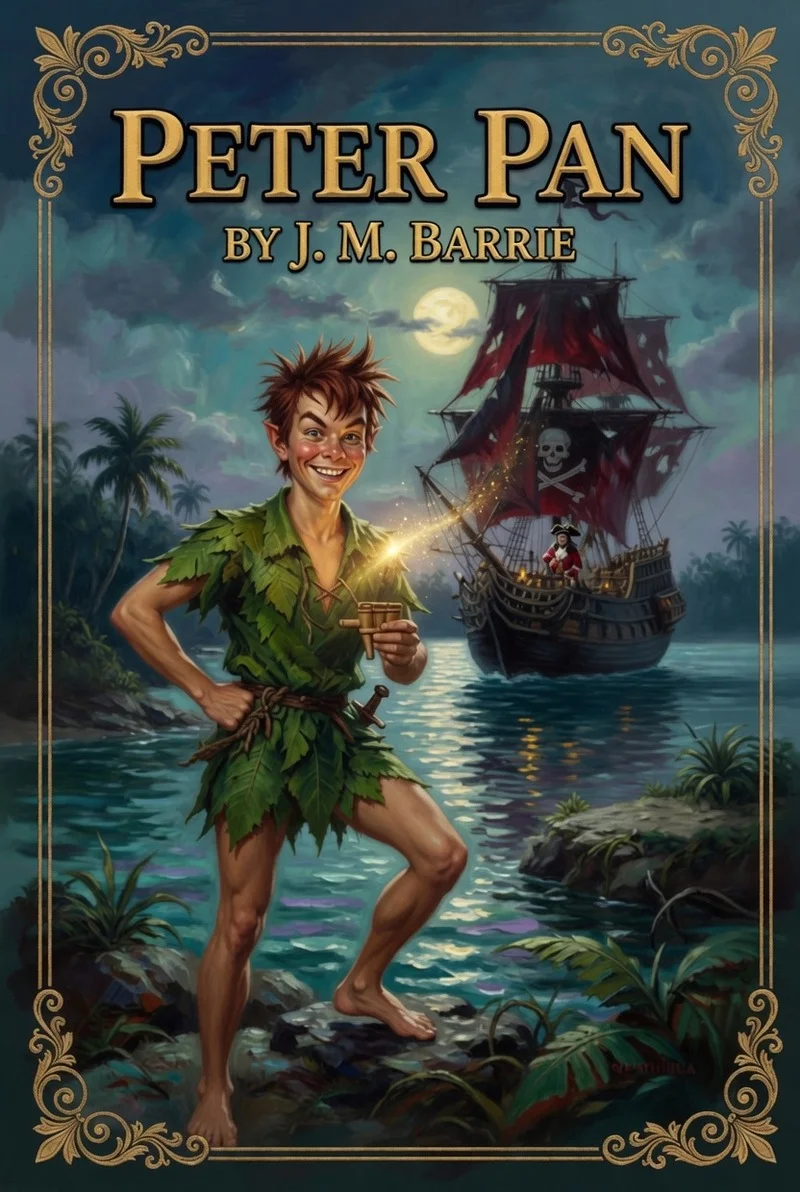
About This Book
Peter Pan, first published as the novel Peter and Wendy, is J.M. Barrie's beloved story about a boy who refuses to grow up. It opens in the comfortable London home of the Darling family, where three children—Wendy, John, and Michael—sleep each night in a warm nursery watched over by a most unusual nurse: a Newfoundland dog named Nana. Their lives seem ordinary, filled with bedtime routines and the everyday worries of a family that does not have much money. Everything changes when a mysterious boy slips through the nursery window. Peter Pan can fly, and he comes from Neverland, a wild island that exists partly in the imagination of every child. Peter invites the Darling children to fly away with him to a place where no one ever has to grow up. There they discover fairies, mermaids, a hidden home beneath the ground, and a crew of dangerous pirates led by the fearsome Captain Hook. Beneath its magic and adventure, Peter Pan asks surprisingly deep questions: What do we gain, and what do we lose, when we grow up? Why do home and family matter so much? The story is playful and thrilling, but it also has a bittersweet heart that has kept readers thinking about it for more than a hundred years.
Peter Pan is a classic that rewards fifth-grade readers on more than one level. On the surface it is a fast-moving adventure packed with pirates, fairies, and daring escapes. But Barrie also weaves in a thoughtful, sometimes wistful look at childhood itself—the freedom of imagination and the quiet cost of never growing up. Reading it invites students to enjoy an exciting story while also wrestling with real ideas about family, courage, memory, and change, and to notice how an author can make a reader feel two things—delight and sadness—at the very same time.
Meet the Characters

More about Peter Pan
Peter Pan is the cocky, fearless leader of a band of children in Neverland, and he has decided he will never grow up. He is brave and endlessly playful, but also careless and forgetful, living so completely in the present that yesterday barely exists for him. His charm and daring are matched only by his pride.

More about Wendy Darling
Wendy Darling is the oldest of the three Darling children and already loves the stories and small responsibilities of growing up. Thoughtful and caring, she is fascinated by Peter's world yet never forgets the comforts of home. She often finds herself acting as the sensible, motherly one among the children.

More about John Darling
John is Wendy's younger brother, fond of being proper and of pretending to be a grown-up. He is brave in a stiff, schoolboy way. He follows Peter because Wendy does.

More about Michael Darling
Michael is the baby of the Darling nursery, still young enough to need a night-light. He is trusting, a little plump, and ready to believe anything Wendy tells him. He wants to go wherever the others go.

More about Captain Hook
Captain Hook is the elegant, ruthless commander of the pirates who haunt the waters around Neverland. He prides himself on his fine manners and 'good form' even as he schemes, which makes him both charming and chilling. Clever and vain, he nurses a bitter grudge against Peter Pan.

More about Tinker Bell
Tinker Bell is a common fairy who mends pots and kettles, which is how she earned her name. She speaks in the tinkling of tiny bells and feels everything intensely, swinging from devotion to jealousy in an instant because a fairy is so small she can only hold one feeling at a time. Fierce and quick-tempered, she is utterly loyal to Peter.

More about Nana
Nana is the Darling family's devoted Newfoundland dog, who serves as nursemaid to the children because the family cannot afford an ordinary nurse. She takes her duties with complete seriousness, running the nursery with quiet, watchful care. Gentle and dependable, she treats the children as if they were her own pups.

More about Mrs. Darling
Mrs. Darling is the children's mother, romantic, tidy, and a little anxious. She is the one who finds Peter's shadow in a drawer. She loves her children with a completeness that Peter does not understand.

More about Mr. Darling
Mr. Darling is a respectable city man who worries about money and about what the neighbors will think. He is not unkind, but he is vain and easily flustered. The nursery is his wife's kingdom; he is only a visitor there.

More about Smee
Smee is Captain Hook's bo'sun, the gentlest of the pirates and the one the Lost Boys almost like. He is chatty, a little stupid, and good at sewing. He would be nobody's idea of a terror except that he serves on the Jolly Roger.

More about Tiger Lily
Tiger Lily is the dignified princess of the island's tribe, respected and even feared for her courage. She carries herself with pride and refuses to show fear, even in danger. Watchful over Neverland, she is a formidable presence among the island's many rival groups.

More about Tootles
Tootles is one of the Lost Boys who live with Peter in the home under the ground. He is the most modest of them and the one who most wants a mother. He is loyal, a little clumsy, and easily led.
Pre-Reading Discussion Questions
- The story is partly about a boy who never grows up. In your opinion, what are the best and hardest parts of growing older?
- What do you think an island that lives inside a child's imagination might contain, and why might it look different for each person?
- The Darlings cannot afford a human nurse, so a dog cares for the children. What does a detail like that suggest about the family?
- What makes a house truly feel like 'home' to you?
- Adventure stories often force characters to choose between excitement and safety. When is it worth taking a risk?
- Why do you think stories about pirates, fairies, and flying have stayed popular for so long?
Themes & Big Ideas to Track
- Track the tension between growing up and staying a child, and notice how different characters feel about it.
- Watch how imagination transforms ordinary things—minds, trees, a bedtime story—into something magical.
- Pay attention to what 'home' and 'mother' mean to Peter, to Wendy, and to the Lost Boys.
- Notice how the narrator's playful, teasing voice sometimes hides a note of sadness beneath the fun.
- Consider how memory and forgetting shape the characters, especially Peter.
- Look for moments where courage, loyalty, and even jealousy drive the characters' choices.
Chapter-by-Chapter Study Guide
Chapter 1: Peter Breaks Through
Before you read — think about:
- A story that begins by promising that one child never grows up — what would you expect such a story to be about?
- How might money worries change the way an ordinary household is run?
- What qualities would you want in a person trusted to look after young children?
- If someone could draw a map of the inside of your mind, what do you think would be on it?
- Why do some people remember a made-up place from childhood as clearly as a real one?
Watch for these while reading:
- The narrator's chatty, teasing voice, and his habit of breaking in to give his own opinion.
- The arithmetic Mr. Darling does over each child, and how the family's money worries colour ordinary life.
- Nana the Newfoundland, and the way the household treats her as a nurse rather than a pet.
- The idea that a child's mind is a map, with a Neverland drawn somewhere on it.
- Two things the narrator keeps returning to: the nursery window, and the kiss in the corner of Mrs. Darling's mouth.
Vocabulary to know:
Neverland (noun) — the ever-changing imaginary island that the narrator says exists in the mind of every child; perambulator (noun) — an old-fashioned word for a baby carriage or pram; conspicuous (adjective) — very easy to see or notice; standing out; propriety (noun) — correct and proper behavior; contempt (noun) — a strong feeling that someone or something is worthless or beneath you; sedately (adverb) — in a calm, dignified, unhurried way; imploringly (adverb) — in a pleading or begging manner; perplexing (adjective) — puzzling and hard to understand; cocky (adjective) — boldly and annoyingly overconfident.
Chapter 2: The Shadow
Before you read — think about:
- What are the different jobs people take on in a household you know well?
- Do children see their parents differently as they get older? How?
- What does the word 'dignity' mean to you?
- How do you tell the difference between somebody teasing you and somebody being unkind?
- Who in your life is good at calming other people down, and what do they do?
Watch for these while reading:
- Mr. Darling's pride, and how badly he wants to be admired inside his own house.
- The way the narrator handles Mr. Darling — mocking him in one line and pitying him in the next.
- Medicine, and the attitude each member of the family takes toward it.
- Nana's standing in the household, and which people in it treat her with respect.
- Mrs. Darling's mood as the evening goes on, and the way the night sky is described.
Vocabulary to know:
distress (noun) — great worry, pain, or suffering; scoundrel (noun) — a dishonest or wicked person; pamper (verb) — to treat someone with too much comfort or indulgence; vindictive (adjective) — wanting to hurt someone who has upset you; spiteful; reproachfully (adverb) — in a way that shows disappointment or blame; beseechingly (adverb) — in a begging, pleading manner; perturbed (adjective) — worried and uneasy; placid (adjective) — calm and peaceful; sarcastic (adjective) — using mocking words that mean the opposite of what they say.
Chapter 3: Come Away, Come Away!
Before you read — think about:
- What is your house like at night once everybody else has gone to sleep?
- What do you already know about fairies, and where did you learn it?
- What responsibilities does the oldest child in a family often take on?
- What jobs and responsibilities do you associate with the word 'mother'?
- If you could do one impossible thing, what would you choose, and why?
Watch for these while reading:
- How Peter talks about himself, and how much he needs to be admired.
- Tinker Bell — her size, her voice, and her temper.
- The small objects that pass between Peter and Wendy, and the names the two of them give those objects.
- The arguments Peter uses to make Neverland sound worth visiting.
- Everything Peter says about the Lost Boys, about fairies, and about how flying is done.
Vocabulary to know:
thimble (noun) — a small cap worn to protect a fingertip while sewing; in this scene Peter and Wendy comically swap the word for a kiss; courteously (adverb) — politely and with good manners; conceit (noun) — excessive pride in oneself; ignorant (adjective) — lacking knowledge about something; contemptuously (adverb) — in a scornful way that shows no respect; indignantly (adverb) — with anger at something felt to be unfair or wrong; exulting (verb) — feeling or showing great triumph and delight; imperiously (adverb) — in a proud, commanding way, as if giving orders; entreated (verb) — asked earnestly or begged.
Chapter 4: The Flight
Before you read — think about:
- What is the longest journey you have ever made? What do you remember about it?
- What do you do to pass the time on a long trip?
- What do you notice about the sky at night that you never notice in the day?
- When you travel with brothers, sisters or friends, who tends to take charge, and why them?
- What is the difference between being brave and simply not knowing any better?
Watch for these while reading:
- How Peter behaves toward the others once they are tired, hungry or frightened.
- How much Peter remembers from one hour to the next.
- The way the island looks and sounds as the children come nearer to it.
- The first things the children say about Captain Hook, and where their information comes from.
- Tinker Bell's manner toward Wendy all through the journey.
Vocabulary to know:
implicitly (adverb) — completely and without any doubt or question; engrossed (adjective) — completely absorbed and interested in something; appalling (adjective) — shocking and dreadful; laboured (adjective) — done slowly and with great effort; tremulously (adverb) — in a trembling, frightened way; mutual (adjective) — shared or felt equally by two or more sides; lure (verb) — to tempt someone toward danger or a trap; bewildered (adjective) — deeply confused; eerie (adjective) — strange, mysterious, and frightening.
Chapter 5: The Island Come True
Before you read — think about:
- What do you already know about pirates, and where did that picture come from?
- What details make a villain frightening? What different details make one memorable?
- How can an author give you a clear sense of a character in only a line or two?
- How much can you tell about a person from the way they dress and the way they speak?
- What does it mean to call a place imaginary and still treat it as completely real?
Watch for these while reading:
- The procession of groups that circles the island, and the order they travel in.
- How each Lost Boy is sketched — roughly one habit or phrase apiece.
- The narrator's long portrait of Captain Hook: his clothes, his manners, his voice.
- The pirate crew, and the odd, almost affectionate way the narrator lists them.
- The crocodile, and the sound that goes along with it.
Vocabulary to know:
lethargy (noun) — a lack of energy; sluggish, sleepy dullness; melancholy (noun) — a deep, thoughtful sadness; sinister (adjective) — giving the impression that something evil is going to happen; genial (adjective) — friendly and good-natured; motley (adjective) — made up of many different, mismatched kinds; brandished (verb) — waved or shook (a weapon) in a threatening way; exultation (noun) — a feeling of great triumph and joy; procession (noun) — a line of people or creatures moving along in an orderly way; petulantly (adverb) — in a sulky, childishly bad-tempered way.
Chapter 6: The Little House
Before you read — think about:
- What rules does a group of friends you know follow, even though nobody ever wrote them down?
- How can a group make a newcomer feel genuinely at home?
- If you could build a house exactly the way you wanted it, what would be in it?
- How do people in a group decide who does which job?
- What is the difference between a leader and a boss?
Watch for these while reading:
- Tootles, and how the narrator describes him beside the other Lost Boys.
- Tinker Bell among the Lost Boys, and how readily they believe what she tells them.
- The acorn button Wendy was given in Chapter 3, and where she wears it.
- Peter's manner as he gives orders, and how quickly the boys obey him.
- The little house the boys build, and what each of them contributes to it.
Vocabulary to know:
conqueror (noun) — someone who defeats or overcomes an enemy; reverently (adverb) — with deep respect and seriousness; relent (verb) — to soften and give in after being firm or harsh; aghast (adjective) — filled with shock and horror; amicably (adverb) — in a friendly, good-natured way; dignity (noun) — a calm, serious, self-respecting manner; carousing (verb) — celebrating in a noisy, wild way; sneering (verb) — smiling or speaking with obvious scorn and contempt.
Chapter 7: The Home Under the Ground
Before you read — think about:
- What does a normal weekday evening look like in your home?
- What games did you play when you were younger that needed a lot of pretending?
- What do you miss most when you are away from home for a few nights?
- Why do authors sometimes pause an adventure to show ordinary daily life instead?
- What makes a place feel like home: the building, the people, the routines, or something else?
Watch for these while reading:
- The hollow trees, and the rule that each boy must fit his own exactly.
- The furnishings of the home under the ground, and the joke buried in each one.
- Wendy's daily work as mother — the sewing, the cooking, the tucking in.
- How Peter treats make-believe, and whether he can tell it apart from the real thing.
- Signs that the Darling children's memories of London are wearing thin.
Vocabulary to know:
ardently (adverb) — with strong, eager feeling; fastidious (adjective) — very careful, fussy, and hard to please about details; inevitable (adjective) — certain to happen and impossible to avoid; entrancing (adjective) — so delightful that it holds your attention completely; despised (verb) — looked down on with dislike and contempt; solemn (adjective) — very serious and grave; recess (noun) — a small hollow space set back in a wall; novel (adjective) — new, unusual, and interesting.
Chapter 8: The Mermaids' Lagoon
Before you read — think about:
- What do you already know about mermaids from stories, films or songs?
- What is it like to swim somewhere you cannot see the bottom?
- Where is the best place you have ever spent a whole day outdoors?
- Do you and your friends ever argue about the rules of a game? How do those arguments get settled?
- What does 'showing off' mean to you, and is it always a bad thing?
Watch for these while reading:
- The mermaids, and how little they resemble the mermaids of picture books.
- Marooners' Rock, and everything the characters say about the tide.
- Peter's talent for imitation, and the uses he puts it to.
- Hook's idea of the rules a fight ought to follow, and Peter's idea of them.
- How Peter speaks about danger, and the tone the narrator takes while reporting it.
Vocabulary to know:
formidable (adjective) — causing fear or respect through being powerful or hard to deal with; submerged (adjective) — completely covered by water; captive (noun) — a person held as a prisoner; impassive (adjective) — showing no feeling or emotion; elated (adjective) — extremely happy and full of triumph; ingratiating (adjective) — trying hard to win someone's favor or approval; dejection (noun) — a state of low spirits and sadness; gallantly (adverb) — in a brave and bold way; intuition (noun) — a feeling of knowing something without being told or reasoning it out.
Chapter 9: The Never Bird
Before you read — think about:
- What birds do you notice where you live, and what are they like?
- What is the most patient thing you have ever had to do?
- What do you think animals understand about people?
- Which do you find funnier: a joke somebody tells on purpose, or something that goes wrong by itself?
- What would you take with you if you had to spend a night outdoors on your own?
Watch for these while reading:
- The Never bird, and the way the narrator describes her nest and her eggs.
- The comedy Barrie makes out of two characters shouting past each other.
- Peter's habit of solving a problem with whatever object happens to be nearest.
- The pirate hat left behind on the rock, and the use that is found for it.
- The narrator stepping outside the story to explain a Neverland custom.
Vocabulary to know:
desperate (adjective) — having a great, urgent need and willing to take any risk; tormented (verb) — caused someone great suffering or teased them cruelly; propelled (verb) — pushed or drove something forward; reflected (verb) — thought carefully about something; buccaneers (noun) — pirates, especially those of long ago; hoard (noun) — a hidden store of valuable things; abandoned (verb) — left behind or gave up completely; scandalised (verb) — shocked by something felt to be improper.
Chapter 10: The Happy Home
Before you read — think about:
- How do you thank somebody for something too big to repay?
- What nicknames do people you know have, and how did they get them?
- What is the difference between playing at being a family and being one?
- What instrument would you most like to be able to play, and why?
- Is it easier to talk about how you feel, or to show it? Which do you do?
Watch for these while reading:
- Tiger Lily's people above the home, and the arrangement they have with Peter.
- The title Peter enjoys being given, and how he behaves once he has it.
- The gap between what Wendy means by 'family' and what Peter means by it.
- The narrator's habit of breaking into the domestic scene to speak straight to the reader.
- Peter's pipes, the thimble, and the other small rituals of the household.
Vocabulary to know:
condescendingly (adverb) — in a way that shows you think you are better than others; sympathised (verb) — shared or understood someone else's feelings; remonstrated (verb) — protested or argued against something; gratified (adjective) — pleased and satisfied; progeny (noun) — a person's children or offspring; devoted (adjective) — loving and loyal; in this scene Peter uses it to describe himself only as a 'son,' not as a husband; uproariously (adverb) — in a very noisy, wildly cheerful way; insinuated (verb) — hinted at something in an indirect, sly way.
Chapter 11: Wendy's Story
Before you read — think about:
- What makes a bedtime story different from any other kind of story?
- What story were you told over and over as a small child? Why that one, do you think?
- What do you remember about the house you lived in when you were very small?
- Who is the best storyteller you know, and what makes them good at it?
- What is something your family does that you think no other family does?
Watch for these while reading:
- The story Wendy tells, and how closely it matches her own household back in London.
- The window in Wendy's story, and who is said to be keeping watch on it.
- Peter's face and his voice while the story is being told.
- The one thing Peter says about his own mother.
- How the Lost Boys talk about mothers, and how much they remember of having one.
Vocabulary to know:
admonished (verb) — warned or scolded someone gently but firmly; candour (noun) — openness and honesty in speaking; resolutely (adverb) — in a firm, determined way; solicitously (adverb) — in a caring, anxiously attentive way; insubordination (noun) — refusal to obey an order or authority; forlornly (adverb) — in a sad, lonely, hopeless way; cynicism (noun) — a bitter, distrustful attitude that expects the worst of people; callous (adjective) — unfeeling and unconcerned about others.
Chapter 12: The Children Are Carried Off
Before you read — think about:
- What does the word 'fair' mean to you when you are competing against somebody?
- Why do some people hate a rival far out of proportion to anything that rival has actually done?
- Have you ever had to keep a secret? What made it hard or easy?
- What habits or signals does a group you belong to share, and how would a newcomer pick them up?
- Is loyalty to your own side ever a good enough reason to do something you would otherwise think wrong?
Watch for these while reading:
- The customary rules of Neverland fighting, as the narrator sets them out.
- Hook's manner in command, and the way his crew respond to him.
- The narrator's explanation of why Hook hates Peter so bitterly.
- The tom-tom, and the signal it is supposed to give.
- How much the children below ground can actually tell about what is happening above them.
Vocabulary to know:
unscrupulous (adjective) — having no honesty or moral principles; treacherous (adjective) — betraying trust; dangerously disloyal; enigma (noun) — a person or thing that is mysterious and hard to understand; pandemonium (noun) — wild and noisy disorder; uproar; avidly (adverb) — with great eagerness or enthusiasm; malignant (adjective) — deeply harmful and full of ill will; doomed (adjective) — certain to meet a terrible fate; aloof (adjective) — distant and uninvolved; keeping apart from others.
Chapter 13: Do You Believe in Fairies?
Before you read — think about:
- What do you think cowardice actually is? Is it the same thing as being afraid?
- Can a villain hold on to a few good qualities and still be a villain?
- What does it mean to say that believing in something is enough to make it real?
- Why might an author speak straight to the reader and ask them to do something?
- What is something you believed in as a small child? What happened to that belief?
Watch for these while reading:
- The rule about hollow trees fitting their boys, first laid out back in Chapter 7.
- Hook's habits and his talk when he believes nobody is watching him.
- The medicine Wendy leaves ready for Peter, and the promise attached to it.
- Tinker Bell's behaviour toward Peter here, set beside her behaviour in Chapter 6.
- The place where Barrie stops the story altogether and addresses the reader.
Vocabulary to know:
ruthless (adjective) — showing no pity or mercy; compassion (noun) — sympathy and concern for someone's suffering; virulent (adjective) — extremely poisonous or harmful; gloating (verb) — taking cruel, selfish pleasure in one's own success or another's misfortune; brooding (verb) — thinking deeply and gloomily about something; impertinent (adjective) — not showing proper respect; boldly cheeky; obliterated (verb) — completely wiped out or destroyed; perilous (adjective) — full of danger; very risky.
Chapter 14: The Pirate Ship
Before you read — think about:
- What would daily life on a sailing ship have been like? What do you think would be hardest?
- What makes somebody frightening to be around even when they are being perfectly polite?
- Would you rather lose honestly or win by cheating? Why?
- What rules of politeness were you taught, and why do you think people care about them?
- Who do you turn to when you need cheering up, and what do they say?
Watch for these while reading:
- The Jolly Roger itself — the deck, the cabin, the way the narrator describes the ship.
- Hook alone with his own thoughts, and what it is that troubles him.
- 'Good form,' and how often Hook comes back to the phrase.
- The way each pirate is drawn, Smee above all.
- How the boys and Wendy speak to the pirates while they are frightened.
Vocabulary to know:
inscrutable (adjective) — impossible to understand or read; mysterious; degenerated (verb) — sank or declined into a worse condition; presentiment (noun) — a feeling that something, usually bad, is about to happen; disdainfully (adverb) — with scorn and contempt; prudent (adjective) — careful, sensible, and wise about the future; diffidently (adverb) — in a shy, hesitant, unconfident way; superstitious (adjective) — believing that certain events bring good or bad luck; averted (verb) — turned away (especially the eyes or face).
Chapter 15: "Hook or Me This Time"
Before you read — think about:
- Where is the line between being clever and being sneaky?
- Does how you play matter as much as whether you win? Where did you get that idea from?
- What makes a character your favourite in a story — is it always the hero?
- What superstitions do you know of, and do you take any of them seriously?
- What is the difference between courage and recklessness?
Watch for these while reading:
- The cabin door, and how willing the pirates are to walk through it.
- Hook's superstitions, and how a crew behaves once its captain is rattled.
- 'Good form' as it comes up between Peter and Hook.
- The way Peter talks about himself in the middle of a fight.
- The ticking, and how each person aboard responds to it.
Vocabulary to know:
ingenious (adjective) — clever, original, and inventive; abject (adjective) — utterly hopeless, miserable, and humbled; brazenly (adverb) — in a bold, shameless way; mutiny (noun) — an open rebellion against a leader or captain; cajole (verb) — to persuade someone by flattery or coaxing; parried (verb) — turned aside or blocked an attack, especially with a weapon; insolent (adjective) — boldly rude and disrespectful; precarious (adjective) — unstable, risky, and uncertain.
Chapter 16: The Return Home
Before you read — think about:
- What is the first thing you do when you get home after being away?
- How do neighbours find out each other's business, and why do people care?
- If you have a pet, what does it do that seems almost human? If you do not, what pet would you want?
- What is the longest you have ever been away from your own bed?
- What does the word 'forgiveness' mean to you — is it something you decide, or something you feel?
Watch for these while reading:
- Mr. Darling's new living arrangements, and how London has reacted to them.
- Mrs. Darling's chair, her window, and her habits since the children went.
- The narrator's open interference — ordering characters about, refusing to describe things.
- How much of their own house the Darling children actually remember.
- Peter at the window, and what is going through his head while he stands there.
Vocabulary to know:
desolate (adjective) — empty, lonely, and full of sadness; remorse (noun) — deep, painful regret for having done wrong; deference (noun) — humble, respectful submission to another's wishes; upbraid (verb) — to scold or criticize sharply; exultantly (adverb) — in a joyfully triumphant way; withered (adjective) — dried up, shrunken, and worn; pettishly (adverb) — in a sulky, childishly bad-tempered way; ecstasies (noun) — feelings of overwhelming joy or delight.
Chapter 17: When Wendy Grew Up
Before you read — think about:
- Do you think growing up is something to celebrate, something to regret, or both?
- What is your earliest memory? How sure are you that it is accurate?
- Which book or film have you loved enough to go back to more than once? Why that one?
- What do adults lose when they stop believing in make-believe, and what do they gain?
- What makes an ending feel satisfying to you? Does every question have to be answered?
Watch for these while reading:
- How Barrie handles the passing of years — how quickly he moves, and in what tone.
- Peter's memory, and which things from earlier chapters he still carries.
- The nursery itself, and the way it is described now.
- The narrator's voice in the closing pages — where he is joking and where he is not.
- The word 'heartless,' and who Barrie applies it to.
Vocabulary to know:
ordinary (adjective) — normal and usual; not special or magical; inquiring (adjective) — showing curiosity; eager to ask questions and learn; authority (noun) — an expert whose knowledge others trust; plaintive (adjective) — sounding sad and full of longing; repulsed (verb) — pushed or drove back and away; artful (adjective) — clever and sly, often in a charming way; receding (verb) — moving farther away or back into the distance; innocent (adjective) — pure and carefree; in the book's final phrase, part of what lets children fly.
About the Author
J.M. Barrie (James Matthew Barrie) was a Scottish novelist and playwright born in 1860. A gifted storyteller with a lifelong fascination for childhood and make-believe, he first created Peter Pan for a group of children he had befriended. The character appeared on the London stage in a hugely popular 1904 play before Barrie expanded the story into this novel, published in 1911. Barrie was celebrated for mixing whimsy and humor with a surprising undercurrent of sadness.
Peter Pan was written in England during the Edwardian era, a time just before the First World War, and the novel appeared in 1911. In well-off families of that period, children were often raised by a nanny and slept together in a nursery, exactly as the Darling children do. Barrie blends this recognizable, old-fashioned home life with a boundless fantasy world, and the story's popularity has only grown through more than a century of books, stage plays, and films.