

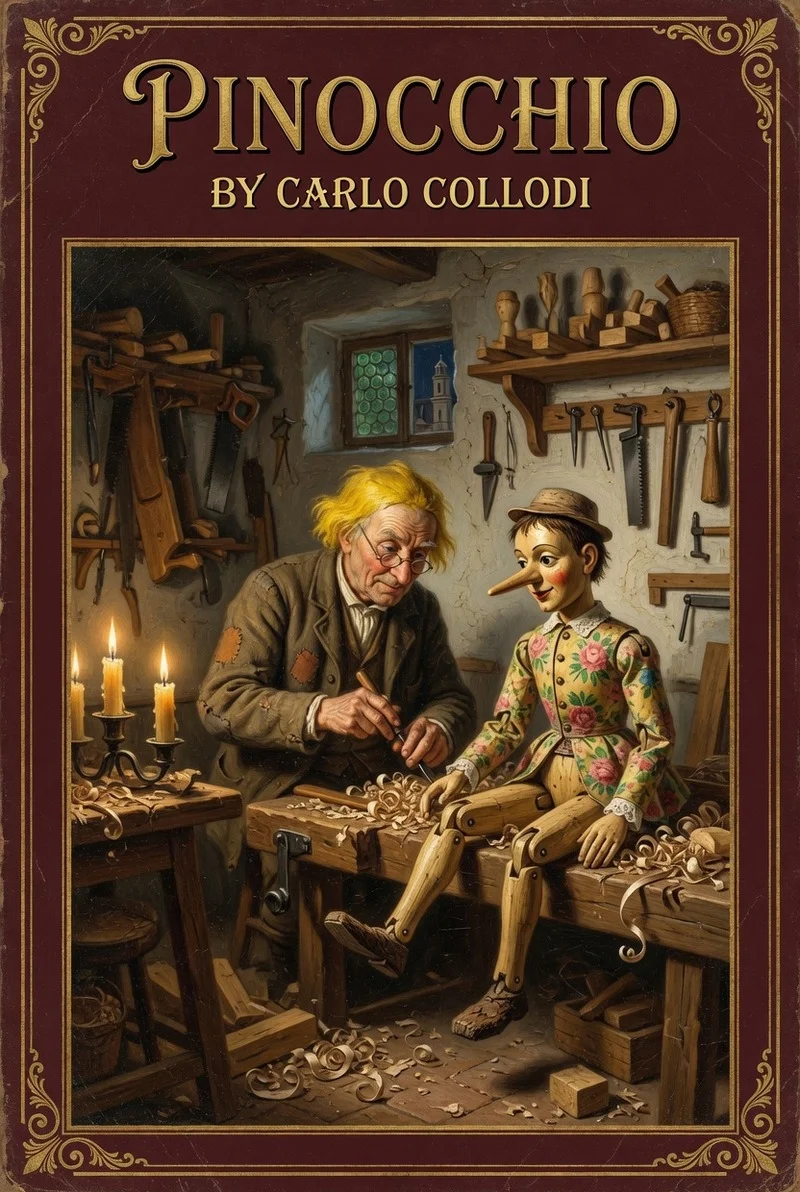
About This Book
The Adventures of Pinocchio is a famous fairy tale from Italy about a wooden puppet who wishes he could be a real boy. It all begins when a poor old woodcarver named Geppetto carves a puppet out of a special piece of wood. To his great surprise, the puppet can talk, walk, and run — and right away he is full of mischief! Geppetto names the puppet Pinocchio and loves him like a son. But Pinocchio is not always good. He would rather play than go to school, and he often forgets to listen to the people who care about him. Along the way he meets a wise cricket, a kind fairy with blue hair, and a sly fox and cat who are not to be trusted. This story follows Pinocchio as he heads out into the world and gets into all kinds of trouble. Each adventure teaches him something new about telling the truth, working hard, and being kind. Readers will want to find out whether this lively little puppet can learn to make good choices.
This book is a wonderful story for young readers because it is exciting, funny, and full of surprises, while also teaching important lessons about honesty and kindness. Pinocchio makes many mistakes, just like real children do, so readers can see how small choices lead to big results. As they follow his adventures, children learn that it is never too late to say sorry and try to do better.
Meet the Characters

More about Pinocchio
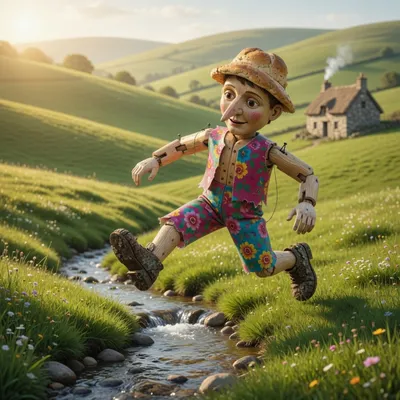
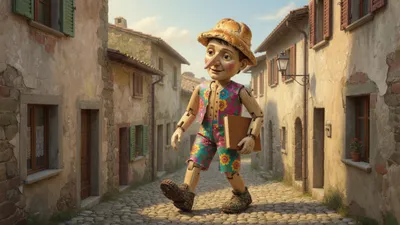
Pinocchio is a lively wooden puppet carved by a poor old woodcarver. He is curious, playful, and full of energy, but he does not always stop to listen or think before he acts. More than anything, he dreams of having adventures out in the wide world.

More about Geppetto
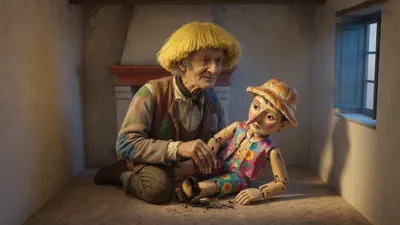
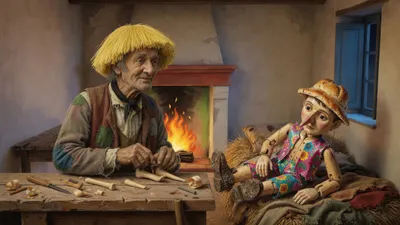
Geppetto is a kind but very poor old woodcarver who has always wished for a child of his own. He is gentle, patient, and hardworking. One day he decides to carve a wooden puppet to keep him company and to help him earn a living.

More about The Blue-Haired Fairy
The Blue-Haired Fairy is a mysterious and gentle girl who lives in a little white house at the edge of the woods. She is caring, calm, and wise beyond her years. She keeps a watchful eye on travelers who lose their way and need a friend.

More about The Talking Cricket
The Talking Cricket is a wise old insect who has lived in the woodcarver's house for many, many years. He enjoys giving good, sensible advice to anyone who will listen, even when no one wants to hear it.

More about The Fox
The Fox is a clever, smooth-talking traveler who wanders the roads looking for someone to fool. He always seems friendly and full of grand plans. He walks with a limp and is never seen without his quiet companion.

More about The Cat
The Cat is the Fox's quiet companion, who pretends not to be able to see. The Cat follows the Fox everywhere and copies whatever the Fox says and does. Together the two make a curious and sneaky pair.
Pre-Reading Discussion Questions
- What do you think it would be like if one of your toys came to life and could talk?
- Have you ever wanted to skip school or a chore to go play instead? What happened?
- What does it mean to tell the truth, and why can it sometimes be hard?
- Who are the people in your life who give you good advice, and do you always listen to them?
- What do you think makes someone a 'real' or 'good' person?
- When you make a mistake, what helps you decide to try to do better next time?
Themes & Big Ideas to Track
- Honesty: Notice when Pinocchio tells the truth and when he does not, and what happens each time.
- Listening to good advice: Watch how Pinocchio treats the people who try to help and guide him.
- Choices and consequences: See how each choice Pinocchio makes leads to something good or bad.
- Growing up: Pay attention to the ways Pinocchio slowly learns to be more responsible.
- Kindness and love: Look for the moments when characters care for one another, even when it is hard.
- Temptation: Notice how easy it is for Pinocchio to be led away from what he knows is right.
Chapter-by-Chapter Study Guide
Chapter 1: Mastro Cherry Finds a Strange Piece of Wood
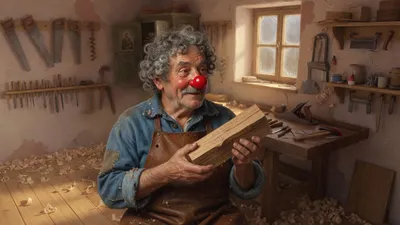
Before you read — think about:
- What do you already know about the story of Pinocchio before we begin?
- What jobs did people do in small Italian towns a hundred and fifty years ago?
- What kinds of things does a carpenter make out of wood?
- Why do people get nicknames, and how does a nickname usually start?
- What is the oldest or most unusual object in your home, and where did it come from?
Watch for these while reading:
- Mastro Cherry's workshop, and the tools a carpenter keeps close at hand
- The nickname the old carpenter goes by, and how people came to use it
- The little voice in the shop, and the different tones it uses
- The way the carpenter talks out loud to himself when no one else is there
- Collodi's comic style: how he stretches one small moment out to make it funny
Vocabulary to know:
carpenter (noun) — a person whose job is building and fixing things made of wood; firewood (noun) — wood that is cut up so it can be burned to make a fire; hatchet (noun) — a small axe with a short handle; beseeching (adjective) — begging or pleading for something; solemn (adjective) — very serious; trembling (verb) — shaking, usually from fear or cold; stuttering (verb) — repeating sounds while trying to speak, often from nervousness; unmercifully (adverb) — in a rough way, without any kindness; plane (noun) — a carpenter's tool that shaves wood to make it smooth; shavings (noun) — thin curls of wood that come off while a tool shapes it; courage (noun) — being brave even when you feel afraid; mumbled (verb) — spoke in a low, quiet voice that is hard to hear; ripe (adjective) — fully grown and ready, the way a fruit is when it can be eaten; wig (noun) — a covering of fake hair worn on the head; giggled (verb) — laughed in a light, silly way.
Chapter 2: Geppetto Takes the Talking Wood to Carve a Puppet
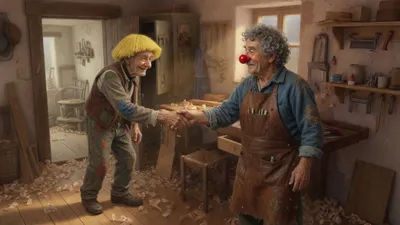
Before you read — think about:
- If someone gave you a special piece of wood, what would you want to make out of it?
- Where have you seen a puppet show, on a stage or on a screen? What was it like?
- Puppet shows have been popular in Italy for hundreds of years. Why do you think people have always liked them?
- What tools and skills would someone need in order to carve a figure out of wood?
- What is a marionette, and how does a puppeteer make one move?
Watch for these while reading:
- Geppetto's yellow wig, and the nickname that goes with it
- The plan Geppetto has for a piece of wood, and why he wants it
- How the two old men speak to each other, polite one minute and shouting the next
- The little voice, and the times it chooses to speak up
- Collodi's way of writing an argument as fast back-and-forth talk, almost like a play
Vocabulary to know:
marionette (noun) — a puppet with a wooden body that can be made to move; somersault (noun) — a roll or flip in which the body turns heels over head; dapper (adjective) — neat and tidy in the way one looks or dresses; temper (noun) — how easily a person becomes angry; soothe (verb) — to make someone feel calm and less upset; insult (verb) — to say something rude or unkind that hurts a person's feelings; flatter (verb) — to say nice things to please someone; favor (noun) — a kind or helpful thing you do for someone who asks; surly (adjective) — grumpy and unfriendly; violent (adjective) — using strong, rough force; jerk (noun) — a quick, sudden movement; lame (adjective) — not able to walk well because of a hurt leg or foot; thrashing (noun) — a rough beating or tussle; limped (verb) — walked in an uneven way because of a sore leg.
Chapter 3: Geppetto Carves Pinocchio, Who Runs Away
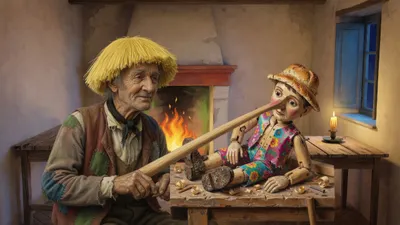
Before you read — think about:
- What is the hardest thing you have ever made with your own hands?
- Why do people think carefully about choosing a name?
- What does a room tell you about the person who lives in it? What would yours tell someone?
- Why might someone who owns very little take great care of the few things they have?
- What rules do you know about staying safe on a busy street?
Watch for these while reading:
- Geppetto's one small room, and the fire painted on its wall
- The order in which Geppetto carves each part of the puppet
- Where the name Pinocchio comes from, and what Geppetto hopes it will bring him
- The neighbours out in the street, and the way Collodi sketches a crowd in a line or two
- The policeman, called a carabineer, and the way he goes about his job
Vocabulary to know:
pranks (noun) — playful tricks meant to fool or tease someone; rickety (adjective) — weak and shaky, likely to break; tumble-down (adjective) — falling apart or almost in ruins; fixedly (adverb) — staring steadily without looking away; grieved (adjective) — feeling sad and hurt; impertinent (adjective) — rude and not showing proper respect; despair (noun) — the feeling of having no hope left; downcast (adjective) — sad and discouraged; impudent (adjective) — boldly rude and disrespectful; wicked (adjective) — naughty or badly behaved; deserve (verb) — to have earned something by what you have done; stiff (adjective) — hard to bend or move; limbered (verb) — loosened up so they could move easily; bounds (noun) — great leaping jumps; peasants (noun) — poor country people who work the land; carabineer (noun) — a soldier who works as a policeman; colt (noun) — a young horse; resolved (adjective) — firmly decided to do something; seize (verb) — to grab hold of suddenly; ungrateful (adjective) — not thankful for the kindness one is given; tyrant (noun) — a cruel person who treats others harshly; liberty (noun) — freedom to go or do as one wishes; wailed (verb) — cried out loudly with sadness.
Chapter 4: Pinocchio Meets the Talking Cricket
Before you read — think about:
- What do you know about crickets? Where do they live, and what sound do they make?
- If you could talk to any animal, which one would you pick, and what would you ask it?
- What is the oldest living thing you know of, and how long has it been there?
- In old stories, animals often talk. What other stories do you know where an animal speaks?
- What are your jobs at home, and which one is your least favourite?
Watch for these while reading:
- The Talking Cricket, and how long it says it has lived in that room
- The advice the Cricket gives about school and work
- The kind of life Pinocchio says he wants for himself
- The way Pinocchio answers anyone who tries to correct him
- Collodi's habit of giving animals a voice and a lesson to teach
Vocabulary to know:
rascal (noun) — a person who causes mischief and trouble; clutches (noun) — a tight, controlling grip or hold; meadows (noun) — open fields covered with grass; brambles (noun) — rough, prickly bushes; brooks (noun) — small streams of water; hounds (noun) — dogs used for hunting; woe (noun) — great sadness or trouble; obey (verb) — to do what you are told to do; philosopher (noun) — a wise person who thinks deeply about life; offended (adjective) — hurt or upset by something rude; trade (noun) — a job or skill you use to earn a living; patience (noun) — staying calm while dealing with something annoying; fury (noun) — very strong, wild anger; laughingstock (noun) — someone that everyone laughs at; hare (noun) — an animal much like a large, fast rabbit.
Chapter 5: The Omelet That Flew Out the Window
Before you read — think about:
- What is your favourite thing to eat for breakfast?
- How do you make an omelet, and what do you need for one?
- Who does the cooking in your home, and what is the best thing they make?
- What does a very old, bare room look like? Describe one you have seen or imagined.
- Where does the food in your home come from before it ever reaches the kitchen?
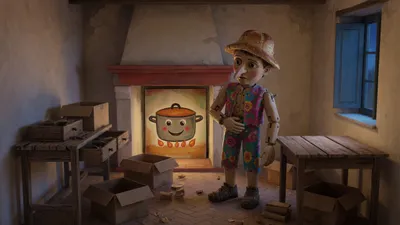
Watch for these while reading:
- The words Collodi uses to describe hunger, and how real he makes it feel
- The bare little room, and what is painted on its walls
- The steps Pinocchio takes when he tries to make himself a meal
- The thoughts about Geppetto that come to Pinocchio while he searches
- The weather outside the cottage, and how it is described
Vocabulary to know:
omelet (noun) — a food made from cooked, beaten eggs; ravenous (adjective) — extremely hungry; amazement (noun) — a feeling of great surprise; relief (noun) — the easing of something unpleasant; yawn (noun) — the wide opening of the mouth that happens when you are tired or hungry; dizzy (adjective) — feeling like everything is spinning around you; faint (adjective) — weak and about to fall down; sweepings (noun) — bits of dust and trash swept into a pile; pounced (verb) — jumped on something suddenly; yolk (noun) — the yellow center of an egg; darting (verb) — moving quickly and suddenly; charitable (adjective) — kind and giving to those in need; grumbling (verb) — making a low rumbling sound; shriek (verb) — to cry out in a high, loud voice; appetite (noun) — the wish or need to eat; jiffy (noun) — a very short moment of time.
Chapter 6: Pinocchio Burns His Feet While He Sleeps
Before you read — think about:
- Have you ever been outdoors in a bad storm? What was it like?
- What does your town look like late at night when everyone has gone indoors?
- How do people keep themselves warm on a cold, wet night when they have very little?
- Have you ever been caught outside in the rain without a coat? What did you do?
- What is a nightcap, and what did people wear to bed long ago?
Watch for these while reading:
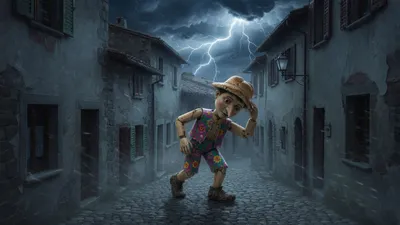
- The storm, and the words Collodi chooses to describe it
- The empty village at night, and how still it is made to seem
- The old man at the upstairs window in his nightcap, and the way he speaks
- What Pinocchio's body is made of, and how easily he forgets it
- The pan of hot coals, and the way a poor house is warmed
Vocabulary to know:
thundered (verb) — made the loud booming sound of thunder; lightning (noun) — bright flashes of electricity in a stormy sky; dense (adjective) — thick and packed closely together; weird (adjective) — strange and a little spooky; deserted (adjective) — empty, with no one around; desperation (noun) — a feeling of hopeless worry that makes you act wildly; nightcap (noun) — a soft cap worn on the head while sleeping; roam (verb) — to wander around from place to place; weariness (noun) — the feeling of being very tired; ashes (noun) — the soft gray powder left after something burns; snored (verb) — breathed with a loud, rough sound while sleeping; moaned (verb) — made a low, sad sound.
Chapter 7: Geppetto Gives Pinocchio His Own Breakfast
Before you read — think about:
- Who in your family do you go to when something has gone wrong?
- What do you think people ate for breakfast a hundred and fifty years ago?
- Why should we be thankful for the food we are given?
- What does it mean to go without something so that someone else can have it?
- How can you tell when a grown-up really cares about you?
Watch for these while reading:
- The explanation Pinocchio offers when he is asked about his feet
- How Geppetto's voice changes as the chapter goes on
- The three pears, and the parts of a pear Pinocchio calls unfit to eat
- How little food there is in Geppetto's house, and how he shares it
- Collodi's use of repetition, with the same request made over and over
Vocabulary to know:
staggered (verb) — walked or moved unsteadily, almost falling; headlong (adverb) — head-first and in a rush; sorrowful (adjective) — full of sadness; caressed (verb) — touched gently and lovingly; jumbled (adjective) — mixed up and hard to follow; pears (noun) — a sweet, soft fruit; dainty (adjective) — fussy and delicate about small things; fussy (adjective) — hard to please; accustom (verb) — to get used to something; twinkling (noun) — a very short instant of time; devoured (verb) — ate quickly and hungrily; wry (adjective) — twisted up in dislike; core (noun) — the hard middle part of a fruit; peel (verb) — to take the skin off a fruit; skins (noun) — the outer peels of the fruit; observed (verb) — said as a remark; pointed out.
Chapter 8: Geppetto Sells His Coat to Buy an ABC Book
Before you read — think about:
- What makes a promise hard to keep?
- Would you give up something of your own to help someone you love? What would it be?
- Why do children need books and supplies in order to go to school?
- How does it feel to be given a present by someone who has very little?
- What does it mean for a family to be poor, and how might that change daily life?
Watch for these while reading:
- The promises Pinocchio makes, and how quickly he makes them
- The materials Geppetto uses for the puppet's clothes, shoes and cap
- How fast Geppetto works, and what his speed says about him
- The snow outside, and the way Collodi describes the cold
- Collodi's way of showing love through small practical acts instead of speeches
Vocabulary to know:
appeased (verb) — satisfied or calmed; mischief (noun) — naughty behavior that causes trouble; stern (adjective) — serious and strict; diligently (adverb) — working hard and carefully; slender (adjective) — thin and narrow; nimble (adjective) — quick and light in movement; modeled (verb) — shaped or formed by hand; grateful (adjective) — feeling thankful; gentleman (noun) — a polite, well-mannered man; poverty (noun) — the state of being very poor; darns (noun) — places where holes in cloth have been sewn shut; patches (noun) — pieces of cloth sewn over holes; restrain (verb) — to hold back; sobbing (verb) — crying hard with short, gasping breaths.
Chapter 9: Pinocchio Sells His Book for the Puppet Show
Before you read — think about:
- Have you ever been tempted to do something fun instead of something you were supposed to do?
- Why is it hard to walk past a show or a game that looks exciting?
- What does it mean to put off a job you ought to be doing right now?
- What do you picture in your head on the morning of a first day at a new school?
- What is an ABC book, and how did children learn to read long ago?
Watch for these while reading:
- The daydreams Pinocchio has about school and about his father
- The music in the distance, and how Collodi describes the sound of it
- The other children on the road, and where they are all heading
- The Great Marionette Theatre, its painted sign and the price of a ticket
- How Pinocchio argues with himself out loud before he decides anything
Vocabulary to know:
arithmetic (noun) — the part of math that uses numbers, like adding and subtracting; nuisance (noun) — something annoying or bothersome; puzzled (adjective) — confused and unsure; brilliant (adjective) — very bright and colorful; curiosity (noun) — a strong wish to know or see something; shamelessly (adverb) — without any feeling of embarrassment; hesitated (verb) — paused because of doubt before doing something; ragpicker (noun) — a person who collects and sells old rags and scraps; shivering (verb) — shaking because of cold; square (noun) — an open public space in the middle of a town; theater (noun) — a place where plays and shows are performed; bargain (noun) — a good deal in buying or trading; shrugging (verb) — raising the shoulders to show you don't care; pipes (noun) — musical instruments that make sound when you blow into them.
Chapter 10: The Puppets Welcome Pinocchio, and Fire-Eater Appears
Before you read — think about:
- How do you behave differently when you are somewhere for the first time?
- What makes a live show more exciting to watch than a screen?
- What does a theatre look like inside, and where does the audience sit?
- How does it feel to meet people who are a lot like you?
- How does a puppet theatre work, and who makes the puppets move?
Watch for these while reading:
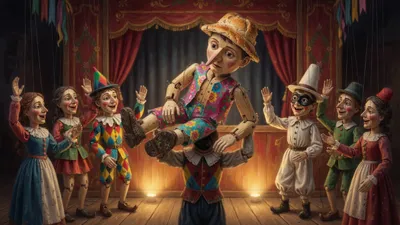
- The little play already going on when Pinocchio arrives, and the characters in it
- How the stage puppets talk to one another and to the people watching
- The audience, and the way its mood shifts during the chapter
- The theatre's Director, and every detail of how he looks
- Collodi's love of noise, with shouting, singing and crowds all at once
Vocabulary to know:
riot (noun) — wild, noisy confusion among a crowd; performance (noun) — a show put on for an audience; reciting (verb) — saying words or lines aloud; spectacle (noun) — an interesting or impressive sight; antics (noun) — silly, playful actions; audience (noun) — the people watching a show; wings (noun) — the hidden sides of a stage; orchestra (noun) — the area of a theater near the stage where the musicians sit; embraces (noun) — warm hugs; triumph (noun) — a joyful celebration of victory; fangs (noun) — long, sharp, pointed teeth; apparition (noun) — a sudden, startling appearance; ogre (noun) — a cruel giant in stories; spit (noun) — a thin rod used to hold meat over a fire for roasting; wriggling (verb) — twisting and turning the body; eel (noun) — a long, slippery fish shaped like a snake; pitifully (adverb) — in a way that makes others feel pity.
Chapter 11: Fire-Eater Spares Pinocchio and Harlequin
Before you read — think about:
- What jobs do people have to do behind the scenes to keep a theatre running?
- What does it mean to be brave for the sake of a friend?
- Have you ever had to speak to an adult you found a bit frightening? What was that like?
- What does it feel like to be very small in a room with someone very large?
- Why do stories so often give the villain a huge and frightening appearance?
Watch for these while reading:
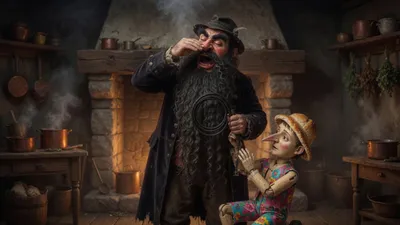
- Fire-Eater's sneezing fits, and how often they come over him
- The polite titles and careful words Pinocchio uses when he speaks to the Director
- Harlequin, and the way the other puppets behave while all this is going on
- The kitchen fire, and the mutton being cooked for the Director's supper
- Collodi's trick of giving a fearsome character one funny, very human habit
Vocabulary to know:
reigned (verb) — was widely present, like a ruler over a place; waver (verb) — to become unsure and begin to give in; weaken (verb) — to become less firm or strong; sneeze (noun) — a sudden burst of air out of the nose; here, Fire-Eater's sign that he feels sorry; willow (noun) — a tree with long, drooping branches; hoarse (adjective) — rough and harsh sounding; heartbreaking (adjective) — causing deep sadness; bitterly (adverb) — with deep sorrow; Excellency (noun) — a title of great respect for an important person; compassionate (adjective) — feeling kindness for someone who is suffering; mercy (noun) — kindness shown by choosing not to punish or harm; spared (verb) — chose not to harm someone; duty (noun) — something a person feels they ought to do; piercing (adjective) — sharp and loud; scurrying (verb) — moving quickly with short little steps; pardon (noun) — forgiveness that frees someone from punishment; granted (verb) — given or allowed.
Chapter 12: The Fox and the Cat Tempt Pinocchio with Gold
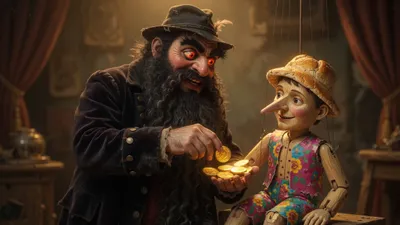
Before you read — think about:
- If somebody gave you money to take home, what would you do to keep it safe?
- Have you ever met a stranger who seemed a little too friendly? How did that feel?
- Why do some people make promises that sound too good to be true?
- What would you do with a handful of gold coins?
- Where does money come from, and how do people earn it?
Watch for these while reading:
- The gift Fire-Eater sends home for Geppetto, and the message that goes with it
- The two travellers Pinocchio meets on the road, and what each one is said to suffer from
- The way the Fox and the Cat back each other up whenever one of them speaks
- The Blackbird on the hedge, and what it has to say
- The names Collodi invents, such as the Field of Wonders and the Land of Simple Simons
Vocabulary to know:
regards (noun) — friendly good wishes sent to someone; courteously (adverb) — in a polite way; whiskers (noun) — the long stiff hairs near an animal's mouth; tinkle (noun) — a light, ringing sound; unconsciously (adverb) — without meaning to or realizing it; paw (noun) — the foot of an animal like a fox or cat; coals (noun) — glowing, burning pieces of fuel; inquired (verb) — asked about something; blackbird (noun) — a small black songbird; perched (verb) — sat or rested on an edge; companions (noun) — friends who travel or spend time together; double (verb) — to make something twice as much; miserable (adjective) — small and pitiful in amount; expense (noun) — a cost, often something you suffer or lose; fortune (noun) — great luck or riches; blessed (adjective) — lucky or holy, as if given special favor; sprouts (verb) — begins to grow, like a seed; blossoms (verb) — opens into flowers or bloom; sprinkle (verb) — to scatter small bits or drops; multiply (verb) — to add a number to itself many times; sparkling (adjective) — shining with tiny flashes of light; gain (noun) — profit or something won for oneself; enrich (verb) — to make someone rich.
Chapter 13: A Night at the Red Lobster Inn
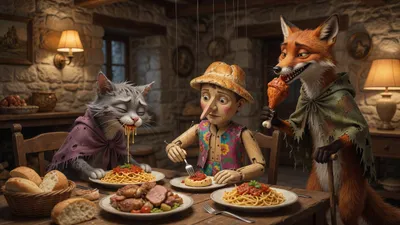
Before you read — think about:
- Have you ever been so excited about something that you could not get to sleep?
- What is an inn, and where did travellers stay before there were hotels?
- What is the biggest meal you have ever seen anyone eat?
- How did people travel from town to town before there were cars?
- Have you ever stayed somewhere away from home? What was different about it?
Watch for these while reading:
- The Red Lobster Inn, and every single thing the Cat and the Fox order to eat
- How the two travellers explain their huge appetites and their little aches
- The innkeeper, and the way he behaves toward his guests
- The country road at midnight, and how dark Collodi makes it feel
- Any advice Pinocchio is given along the way, and the way he answers it
Vocabulary to know:
inn (noun) — a place where travelers can eat and sleep; mullets (noun) — a kind of fish eaten as food; coaxing (noun) — gentle urging to get someone to do something; diet (noun) — a limited way of eating, often to stay healthy; partridges (noun) — plump birds hunted for food; pheasants (noun) — long-tailed birds hunted for food; indigestion (noun) — an uncomfortable, sick feeling in the stomach; here, from thinking too much about gold; innkeeper (noun) — the person who runs an inn; winking (verb) — closing one eye quickly as a secret signal; vines (noun) — climbing plants that grapes grow on; swayed (verb) — swung gently back and forth; telegram (noun) — a short written message sent quickly over a wire long ago; refinement (noun) — fine, polite manners; visible (adjective) — able to be seen; bats (noun) — small flying animals that come out at night; echoed (verb) — repeated a sound back from far away; glimmering (verb) — shining with a faint, soft light; ghost (noun) — the spirit of someone who has died; swindlers (noun) — cheats who trick people out of their money; assassins (noun) — dangerous robbers who attack travelers; snuffed (verb) — put out, like a candle flame; grief (noun) — deep sorrow or trouble.
Chapter 14: Pinocchio Falls into the Hands of Robbers
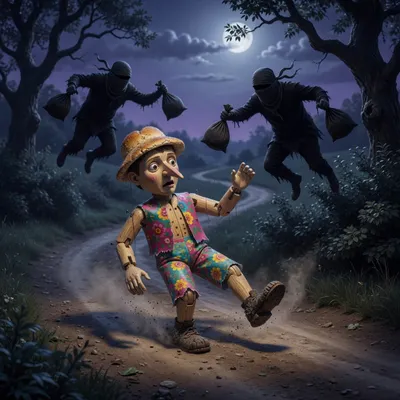
Before you read — think about:
- What do you know about how people carried their money before there were banks?
- What do people do to protect their homes from thieves?
- Who keeps people safe in your town, and what do they do?
- What does it mean to be brave in a frightening moment?
- What do robbers look like in the stories and films you have seen?
Watch for these while reading:
- What Pinocchio tells himself about Assassins as he walks along
- The two figures in charcoal sacks, and how Collodi describes them
- The way the two robbers move and the way they speak
- The lonely road and the open country at this hour of the night
- How a wooden body behaves differently from a boy's body
Vocabulary to know:
unlucky (adjective) — having bad luck; scolds (verb) — speaks angrily to correct someone; bothersome (adjective) — annoying and troublesome; misfortunes (noun) — unlucky or bad events; rustle (noun) — a soft crackling sound; shadows (noun) — dark shapes cast where light is blocked; grasped (verb) — grabbed and held tightly; thieves (noun) — people who steal; threatening (adjective) — showing a plan to hurt or harm; stubborn (adjective) — refusing to give in or change; deaf (adjective) — not able to hear; pry (verb) — to force something open; claws (noun) — the sharp nails on an animal's paws; pursuers (noun) — those who chase after someone; exhausted (adjective) — extremely tired; spurred (verb) — urged on to try harder; sputter (verb) — to make popping, spitting sounds; somber (adjective) — dark and gloomy; drenched (adjective) — completely soaked with water; terror (noun) — very great fear.
Chapter 15: The Robbers Hang Pinocchio from an Oak Tree

Before you read — think about:
- When you are very frightened, what makes you feel safer?
- What colour would you dye your hair if you could pick any colour at all?
- What kinds of trees grow near you, and what is the biggest one you have seen?
- What does a cottage in a wood look like in the fairy tales you know?
- How does a storyteller make a reader worry about a character?
Watch for these while reading:
- The little white cottage among the trees, and how Collodi describes it
- The girl at the window, and her strange, calm way of answering
- The colour of the girl's hair, which Collodi mentions more than once
- The great Oak on the road, and the weather around it
- The names Pinocchio calls out loud when there is nobody to hear him
Vocabulary to know:
cottage (noun) — a small house; gleaming (verb) — shining softly; labored (adjective) — slow, heavy, and hard; maiden (noun) — a young girl; azure (adjective) — sky-blue in color; wax (noun) — a smooth, pale substance, like the kind used to make candles; coffin (noun) — a box in which a body is placed; dismay (noun) — a feeling of shock and worry; noose (noun) — a loop of rope that tightens when pulled; limb (noun) — a large branch of a tree; gasp (noun) — a sudden, sharp breath; mockingly (adverb) — in a teasing, unkind way; seasick (adjective) — sick and dizzy from rocking motion; choked (verb) — kept from breathing by something tight around the throat; murmured (verb) — spoke in a very soft, low voice; oak (noun) — a strong, tall kind of tree.
Chapter 16: The Blue-Haired Fairy Rescues Pinocchio
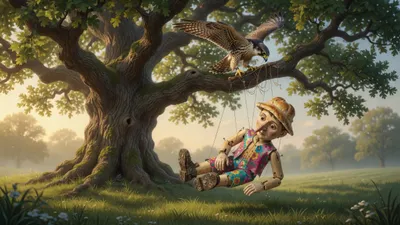
Before you read — think about:
- Have you ever been helped by someone just when you needed it most?
- Why do fairy tales so often include magical helpers, such as talking animals?
- When a person is very ill, who looks after them, and what do those helpers do?
- Have you ever felt that people were talking about you? How did that feel?
- What do you imagine a fairy looks like? Where have you seen one in a story?
Watch for these while reading:
- The girl with azure hair, and how much older she seems than she looks
- The Falcon, and the job the girl gives it to do
- The Poodle in his coachman's uniform, and the coach he drives
- The three doctors, and the very different way each one talks
- Collodi's fun with grand, important-sounding medical language
Vocabulary to know:
dangled (verb) — hung loosely and swung; pity (noun) — a feeling of sadness for someone else's trouble; whirr (noun) — a soft, buzzing, rushing sound; falcon (noun) — a swift bird that hunts; ledge (noun) — a narrow shelf sticking out from a wall; reverence (noun) — deep respect; vicinity (noun) — the area near a place; sigh (noun) — a long, deep breath that shows a feeling; magnificent (adjective) — grand and splendid; poodle (noun) — a dog with curly hair; livery (noun) — the fancy uniform of a servant; tricorn (noun) — a hat with three corners; jaunty (adjective) — cheerful and stylish; velvet (noun) — a soft, thick cloth; breeches (noun) — short trousers that stop at the knee; crimson (adjective) — deep red; coach (noun) — a fancy carriage pulled by animals; pulse (noun) — the beat of the heart felt in the body; contradict (verb) — to say the opposite of what someone else says; colleague (noun) — a fellow worker; shuddered (verb) — shook suddenly with fear; recover (verb) — to get well again.
Chapter 17: Pinocchio Tells a Lie and His Nose Grows
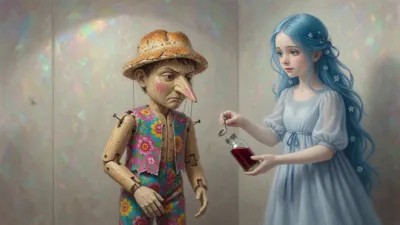
Before you read — think about:
- Why do some children make a great fuss about taking medicine?
- Have you ever bargained for a treat before doing something you did not want to do?
- Does a lie usually stay hidden forever, or does something happen to it in the end?
- Why is it easier to tell a second lie once you have told the first one?
- How might a storyteller show, in a magical way, that lying is wrong?
Watch for these while reading:
- All the excuses Pinocchio finds for putting off the glass of medicine
- The Fairy's patience, and the way her tone shifts as she talks to him
- The four black Rabbits, and what they are carrying between them
- The questions the Fairy asks about the four gold pieces
- What the Fairy has to say about lies, once the subject comes up
Vocabulary to know:
fever (noun) — a hot, sick feeling caused by illness; powder (noun) — fine, dry bits like dust; whining (adjective) — complaining in a high, unhappy voice; bitter (adjective) — having a sharp, unpleasant taste; lump (noun) — a small solid piece; smacking (verb) — making a sharp sound with the lips; medicine (noun) — something taken to help cure sickness; pillow (noun) — a soft cushion for resting on; gulp (noun) — a big swallow; muttering (verb) — speaking in a low, unclear voice; confused (adjective) — mixed up and unsure; windowpanes (noun) — the sheets of glass in a window; shame (noun) — the bad feeling that comes from doing wrong; imagine (verb) — to picture something in your mind; sickness (noun) — the state of being ill; swallowed (verb) — made food or drink go down the throat; burning (adjective) — feeling very hot, as with a fever; ink (noun) — a dark liquid used for writing; here used to mean very black; chewing (verb) — grinding food with the teeth; feather (noun) — one of the soft, light parts that cover a bird; death (noun) — the end of life; rabbits (noun) — small animals with long ears; here, coal-black messengers; forehead (noun) — the part of the face above the eyes.
Chapter 18: Back to the Field of Wonders with the Fox and Cat
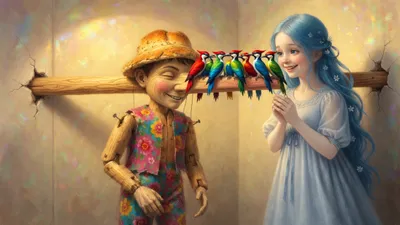
Before you read — think about:
- When you set out to do something good, what things can pull you off course?
- Why do tricksters go back to the same person again and again?
- Have you ever believed a promise that was too good to be true?
- What would a field where money grows look like? Picture it in your head.
- Why is it hard to say no to the same temptation a second time?
Watch for these while reading:
- The news the Fairy gives Pinocchio about his father
- The Fox and the Cat, and how their looks have changed since the last time
- The story the Fox tells about the Cat's paw
- The city of Catchfools, and the animals wandering its streets
- The exact instructions Pinocchio is given out in the Field of Wonders
Vocabulary to know:
mourned (verb) — felt and showed deep sadness; acquire (verb) — to get or pick up something, like a habit; habit (noun) — something a person does over and over; woodpeckers (noun) — birds that peck at wood with their beaks; pecked (verb) — struck at something with a beak; enormous (adjective) — very, very large; sling (noun) — a cloth loop that holds up a hurt arm or paw; modest (adjective) — humble; not showing off; wolf (noun) — a wild animal like a large, fierce dog; starved (adjective) — suffering badly from hunger; beast (noun) — a wild animal; overtook (verb) — caught up to someone from behind; sow (verb) — to plant something in the ground, like seeds; rogues (noun) — dishonest, sneaky people; hairless (adjective) — having no hair or fur; sheared (adjective) — with the wool cut off; peacocks (noun) — large birds known for their beautiful tail feathers; bedraggled (adjective) — messy, wet, and untidy; scuttling (verb) — moving with short, quick steps; paupers (noun) — very poor people; beggars (noun) — people who beg for money or food; hawk (noun) — a bird that hunts smaller animals; vulture (noun) — a large bird that eats dead animals; pail (noun) — a bucket; grain (noun) — a single seed of a food plant like wheat; wheat (noun) — a grassy plant whose grain is used to make bread.
Chapter 19: Pinocchio Is Robbed and Sent to Prison
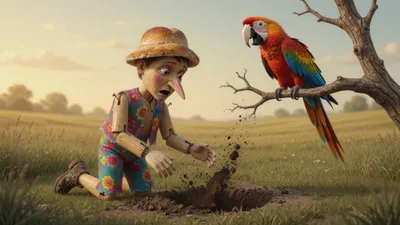
Before you read — think about:
- What are the dangers of believing that money can come without work?
- Have you ever waited eagerly for something that never arrived?
- Why does it matter that we earn things honestly?
- What would you do if you found out that someone had tricked you?
- Is the law always fair? What could make a court unfair?
Watch for these while reading:
- The daydreams Pinocchio has about all the ways he will spend his money
- The Parrot up in the tree, and its manner of speaking
- The courtroom in Catchfools, and the judge who sits in it
- Collodi's joke of a city where everything seems to work backwards
- How Pinocchio describes himself whenever he is trying to get his own way
Vocabulary to know:
impatiently (adverb) — in a restless way, not able to wait calmly; palace (noun) — a very large and grand house; stables (noun) — buildings where horses are kept; cellar (noun) — a room below a house, underground; fancies (noun) — pleasant things imagined in the mind; hearty (adjective) — loud, warm, and full of energy; parrot (noun) — a brightly colored bird that can talk; preening (verb) — cleaning and smoothing feathers with the beak; peevishly (adverb) — in a grumpy, irritated way; simpletons (noun) — foolish people who are easily fooled; conclusion (noun) — a final decision or opinion reached after thinking; furiously (adverb) — with wild, fast energy; courthouse (noun) — a building where a judge hears cases; magistrate (noun) — a judge; gorilla (noun) — a very large, powerful ape; venerable (adjective) — respected because of great age; spectacles (noun) — eyeglasses; justice (noun) — fair treatment under the law; mastiffs (noun) — large, strong dogs; stunned (adjective) — shocked and unable to move or speak; emperor (noun) — the ruler of a large land or empire; jailer (noun) — a person who guards a prison.
Chapter 20: The Long Road Back to the Fairy
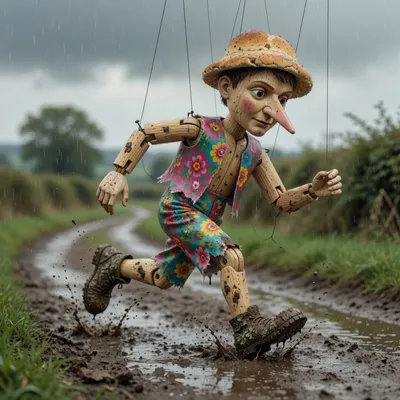
Before you read — think about:
- What do you know about snakes? Where do they live, and which ones are dangerous?
- What is the longest walk you have ever been on?
- What fruits grow near where you live, and when are they picked?
- Collodi first wrote this story in short pieces for a magazine. How might that change the way each chapter ends?
- What does it mean to be patient, and when is being patient hardest?
Watch for these while reading:
- The promises Pinocchio makes to himself as he walks along the road
- The enormous Serpent stretched across the path, and the smoke from its tail
- Collodi's timing, and how long he keeps his puppet standing and waiting
- The vineyard full of ripe grapes, and how hungry Pinocchio is by then
- The way Collodi mixes something scary and something silly into the same scene
Vocabulary to know:
serpent (noun) — a large snake; greyhound (noun) — a slim dog that can run very fast; tormented (verb) — troubled or bothered greatly; immense (adjective) — extremely large; fiery (adjective) — burning or glowing like fire; chimney (noun) — a pipe that carries smoke up from a fire; column (noun) — a tall, upright shape; awkwardly (adverb) — in a clumsy way; whirlwind (noun) — a spinning column of wind; pangs (noun) — sudden sharp pains; withstand (verb) — to hold up against or bear something; grapevine (noun) — the climbing plant that grapes grow on; trap (noun) — a device made to catch animals; weasels (noun) — small, thin, sneaky animals; heartless (adjective) — unkind and without pity; artery (noun) — a tube in the body that carries blood.
Chapter 21: Pinocchio Is Made to Guard a Chicken Coop

Before you read — think about:
- What does a glow-worm or firefly look like, and when would you see one?
- What animals live on a farm, and what work do people keep them for?
- What is a chicken coop, and why would one need protecting?
- What would a farmer's day look like, from morning to night?
- Have you ever looked after an animal? What did you have to do for it?
Watch for these while reading:
- The Glow-worm, and the gentle way it speaks to Pinocchio
- The farmer, and what he has to say about thieves
- The dog Melampo, and everything the farmer tells us about him
- The kennel, the collar and the chain, described in careful detail
- The honest things Pinocchio admits to himself when nobody is listening
Vocabulary to know:
glowworm (noun) — a small insect that gives off a soft light; flickering (verb) — shining with an unsteady, wavering light; lantern (noun) — a light in a case that can be carried; collar (noun) — a band that goes around the neck; chain (noun) — a line of connected metal loops; doghouse (noun) — a small shelter for a dog; straw (noun) — dried stalks of grain plants; henhouse (noun) — a small building where hens are kept; watchdog (noun) — a dog kept to guard a place; huddled (verb) — curled up close together for warmth or comfort; tugged (verb) — pulled hard; truant (noun) — a child who stays away from school without permission; vagabond (noun) — a person who wanders with no home; sermon (noun) — a serious talk about right and wrong.
Chapter 22: Pinocchio Catches the Thieves and Wins His Freedom
Before you read — think about:
- What does it mean to be loyal, even when nobody is watching?
- Would you keep a promise if breaking it meant getting a treat? Why?
- Has anyone ever offered you something in return for doing the wrong thing?
- How can doing a job well change the way people see you?
- What makes a good guard dog, and what is a guard dog supposed to do?
Watch for these while reading:
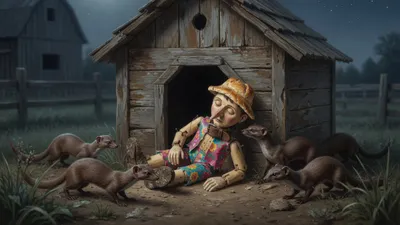
- The four Weasels, and the smooth way they make their offer
- What the Weasels say about the arrangement they used to have
- The hen house after dark, and the sounds that carry across the farmyard
- The questions the farmer asks when he comes out in the morning
- Collodi's interest in what a character does when he thinks nobody can see
Vocabulary to know:
seldom (adverb) — not often; whisperings (noun) — soft, quiet talking; stealthy (adjective) — quiet and sneaky; fond (adjective) — liking something very much; terms (noun) — the conditions of a deal; provided (conjunction) — as long as; on the condition that; coop (noun) — a small pen where chickens are kept; faithful (adjective) — loyal and true; mortal (noun) — a human being; generous (adjective) — giving freely and kindly; shameful (adjective) — deserving shame; disgraceful; contract (noun) — an agreement between two sides; accusing (verb) — saying that someone did something wrong; audacity (noun) — bold rudeness or nerve; proposition (noun) — an offer or suggestion; bribed (verb) — paid or offered a treat to make someone do something wrong; reward (noun) — something good given for a good deed; faults (noun) — weaknesses or mistakes in someone.
Chapter 23: A Pigeon Carries Pinocchio to the Sea
Before you read — think about:
- What birds do you see where you live, and how far do you think they can fly?
- What do you know about carrier pigeons and the messages they used to carry?
- What is the longest journey you have ever taken, and how did you travel?
- Would you make a frightening journey to help a member of your family?
- What does the sea look like in a storm? Have you ever seen one?
Watch for these while reading:
- What Pinocchio is hoping for as he makes his way back toward the Fairy's house
- The great Pigeon, and the conversation it strikes up
- What Collodi tells us Geppetto has been doing all these months
- The view from the air, and the countryside passing by underneath
- The crowd along the shore, and the things people in a crowd shout out
Vocabulary to know:
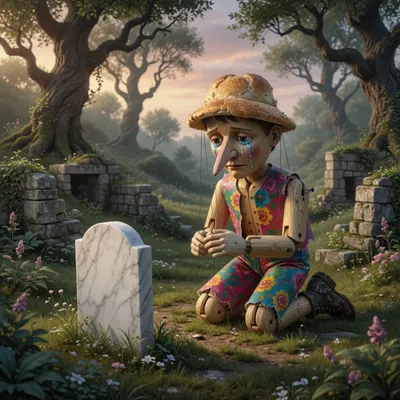
seashore (noun) — the land right along the edge of the sea; marble (noun) — a smooth, hard stone; slab (noun) — a flat, thick piece of something hard; inscription (noun) — words carved or written on something; abandoned (verb) — left behind completely; heartbroken (adjective) — filled with deep sadness; frame (noun) — the body's structure; lonely (adjective) — sad from being all alone; pigeon (noun) — a common gray bird; turkey (noun) — a large bird; ocean (noun) — a very large body of salt water; anxiously (adverb) — in a worried way; astride (adverb) — sitting with one leg on each side; steed (noun) — a horse for riding; gallop (verb) — to run fast, the way a horse does; thirsty (adjective) — needing something to drink; chick-peas (noun) — round beans eaten as food; relish (noun) — great enjoyment; sauce (noun) — a liquid served with food; here used in a saying about hunger; nutshell (noun) — the hard shell around a nut; oars (noun) — long poles with flat ends used to row a boat; prayer (noun) — words spoken to God or Heaven; dive (verb) — to plunge headfirst into water; float (verb) — to rest or move on top of water; rough (adjective) — not calm; full of choppy waves; recognized (verb) — knew someone again from before; valley (noun) — low land between hills or mountains.
Chapter 24: Pinocchio Reaches the Island of the Busy Bees
Before you read — think about:
- How far do you think a person could swim without stopping?
- Why do some people look down on begging and think so highly of hard work?
- Have you ever had to do a job you did not want to do in order to earn something?
- What do you know about how bees live and work together?
- What do you picture when you hear that a whole town is busy?
Watch for these while reading:
- The sea at night, and the words Collodi uses for the long swim
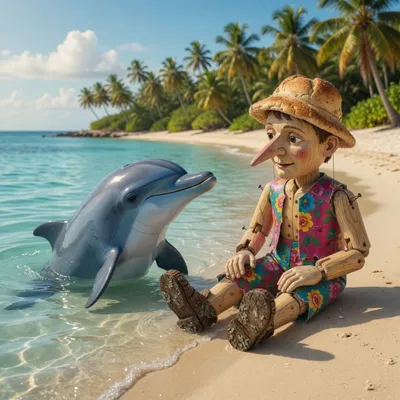
- The Dolphin, and its very polite manners
- The name and the reputation of the creature the Dolphin talks about
- The town where every single creature is busy, and the jobs Collodi lists
- The woman carrying the water jugs, and the bargain she offers
Vocabulary to know:
hailed (verb) — fell as small balls of ice from the sky; stretch (noun) — a long, continuous area; island (noun) — land with water all around it; twig (noun) — a small, thin branch; tremendous (adjective) — very great in size or force; daunted (adjective) — discouraged or frightened away; splendor (noun) — great brightness and beauty; calm (adjective) — still and peaceful; sails (noun) — large sheets of cloth that catch the wind to move a boat; lonesome (adjective) — lonely; dolphin (noun) — a smart, friendly sea animal; necessarily (adverb) — for certain; always; swamped (verb) — filled with water and sunk; shark (noun) — a large, dangerous fish; gait (noun) — a way of walking; idle (adjective) — not working; doing nothing; tramp (noun) — a person who wanders with no home or work; perspiration (noun) — sweat; carts (noun) — small open wagons for carrying loads; pride (noun) — too high an opinion of oneself; bricklayer (noun) — a worker who builds with bricks; plaster (noun) — a paste spread on walls that dries hard; jugs (noun) — containers with handles for holding liquid; cauliflower (noun) — a white vegetable; resist (verb) — to hold out against a temptation; bottomless (adjective) — seeming to have no bottom; benefactress (noun) — a woman who helps or gives to someone; stammering (verb) — speaking with nervous pauses and repeats; clasped (verb) — held onto tightly; preached (verb) — taught with strong urging.
Chapter 25: Pinocchio Promises to Study and Be Good
Before you read — think about:
- Have you ever wished you could grow up faster?
- What do you think it takes to earn a really big reward?
- Why do grown-ups say that work matters so much?
- What does it mean to truly promise that you will do better?
- If you could grow up overnight, what is the first thing you would do?
Watch for these while reading:
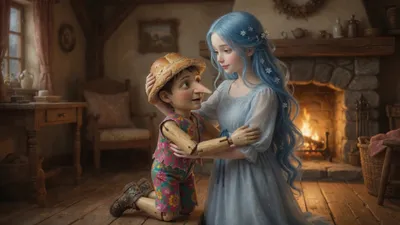
- How the Fairy explains the way she has changed since the wood
- The list of habits the Fairy asks Pinocchio to give up
- What the Fairy has to say about lazy children
- The reasons Pinocchio gives for wanting to grow
- How easily and how loudly Pinocchio makes a promise
Vocabulary to know:
melt (verb) — to soften and seem to dissolve away; disgustedly (adverb) — in a way that shows strong dislike; contrary (noun) — the opposite; profession (noun) — a job that needs special training; laziness (noun) — the habit of not wanting to work; cure (verb) — to make a sickness go away; comfort (noun) — someone or something that brings ease and happiness; depth (noun) — how deep or strong something is; forgiven (verb) — stopped being angry at someone for a wrong; admitted (verb) — agreed that something is true; suffered (verb) — felt pain or great sadness; tiresome (adjective) — boring and tiring; illness (noun) — a condition of being unwell; childhood (noun) — the time of being a child; serious (adjective) — not joking; thoughtful and grave.
Chapter 26: Off to See the Terrible Dogfish
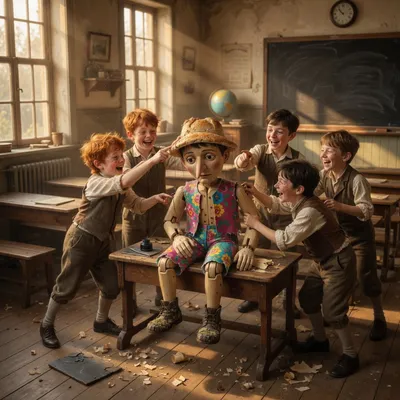
Before you read — think about:
- What was school like a hundred and fifty years ago? How was it different from yours?
- What is your favourite subject at school, and what makes it your favourite?
- What is a dogfish, and what other big fish live in the sea?
- What is the most exciting piece of news that ever went round your school?
- Why do people drop important plans to chase after something exciting?
Watch for these while reading:
- How the other pupils treat Pinocchio during his first days at school
- The sort of boys Pinocchio begins spending his time with
- The warnings he is given at home and at school about his companions
- The news the boys bring about something out at sea
- Collodi's picture of a whole class of children let loose at once
Vocabulary to know:
classroom (noun) — a room in a school where lessons are taught; mustache (noun) — hair that grows above the upper lip; respect (verb) — to treat someone with honor and politeness; howled (verb) — cried out loudly; elbows (noun) — the bending joints in the middle of the arms; admired (verb) — looked up to with respect; attentive (adjective) — paying close attention; astray (adverb) — away from the right path or good behavior; scamps (noun) — naughty, mischievous children; troop (noun) — a group moving together; dreadful (adjective) — terrible and frightening; shin (noun) — the front of the leg below the knee; praised (verb) — said good things about someone's work.
Chapter 27: A Fight on the Beach and an Arrest
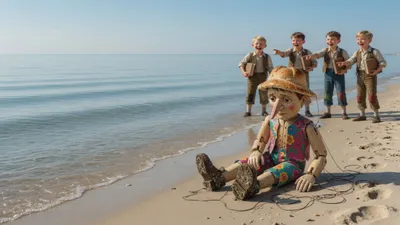
Before you read — think about:
- What can happen when a group of friends dare one another into trouble?
- Have you ever been blamed for something you did not mean to cause?
- Why is fighting wrong, even when somebody else starts it?
- What games do children play at the beach?
- How do you carry your schoolbooks about, and what is in your bag?
Watch for these while reading:
- The shore where the boys arrive, and how Collodi describes the sea that morning
- The schoolbooks the boys are carrying, and the titles Collodi gives them
- How the argument on the beach starts, and how fast it grows
- The Carabineers, and the questions they put to Pinocchio
- Alidoro the mastiff, and everything Collodi tells us about him
Vocabulary to know:
battle (noun) — a fight between two sides; playmates (noun) — friends you play with; wounded (adjective) — hurt or injured; arrested (verb) — taken away by officers of the law; smooth (adjective) — flat and even, without waves; goody-goody (noun) — a person who tries too hard to be good, in a way others tease; enemies (noun) — people who are against you; bragging (verb) — boasting; talking proudly about yourself; apologize (verb) — to say you are sorry; fray (noun) — a noisy fight; defended (verb) — protected against attack; opponents (noun) — the people you are fighting or competing against; enraged (adjective) — made very angry; geographies (noun) — books about the earth's lands and places; grammars (noun) — books about the rules of language; nibble (noun) — a small bite; horrid (adjective) — very unpleasant; crab (noun) — a sea animal with a hard shell and claws; trombone (noun) — a large brass musical instrument with a deep sound; ammunition (noun) — things thrown or fired as weapons; volume (noun) — a book; leather (noun) — a strong material made from animal skin; missile (noun) — an object thrown to hit something; senseless (adjective) — knocked out; not awake or aware; handkerchief (noun) — a small square of cloth; schoolmate (noun) — a fellow student at the same school; bathed (verb) — gently washed with water; influence (noun) — the power to change how someone acts; temple (noun) — the flat side of the head beside the eye; fishermen (noun) — people who catch fish; innocent (adjective) — not guilty of doing wrong; nightmare (noun) — a very frightening dream; gust (noun) — a sudden burst of wind; bullet (noun) — the small piece of metal shot from a gun.
Chapter 28: Pinocchio Nearly Becomes a Fried Fish
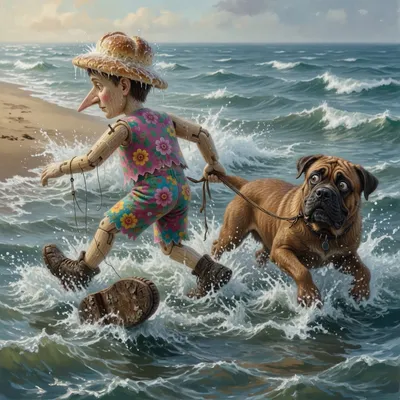
Before you read — think about:
- What kinds of work do people do by the sea, and what do fishermen catch?
- What makes swimming in the open sea different from swimming in a pool?
- How do people cook fish, and what do they do to it before it goes in the pan?
- What dangers might a swimmer meet far out in the open sea?
- What would you do if nobody believed what you told them about yourself?
Watch for these while reading:
- How the chase changes once it leaves the sand and reaches the water
- The stretch of coast Collodi describes, with its rocks and its caves
- The fisherman in the cave, and his very unusual colouring
- The net, the creatures caught in it, and how the fisherman sorts them
- How Pinocchio explains to strangers what kind of creature he is
Vocabulary to know:
frenzy (noun) — wild, uncontrolled excitement; trail (noun) — the track or scent left behind by someone; bulging (adjective) — swelling or sticking out; swollen (adjective) — puffed up and larger than normal; balloon (noun) — a bag that puffs up round when filled; spiral (noun) — a coiling, twisting shape; cave (noun) — a hollow opening in rock; net (noun) — a mesh of ropes used to catch fish; lizard (noun) — a scaly reptile with four legs and a tail; gloomy (adjective) — dark and dreary; sizzled (verb) — made a hissing, frying sound; repelling (adjective) — disgusting; driving one away; odor (noun) — a smell; spade (noun) — a tool with a flat blade for digging; bass (noun) — a kind of fish; whitefish (noun) — a pale-colored fish eaten as food; flounders (noun) — flat fish that live near the sea floor; anchovies (noun) — very small ocean fish; tub (noun) — a large, deep container; mortified (adjective) — very embarrassed; resentfully (adverb) — in a hurt, bitter, and angry way; esteem (noun) — high respect; opportunity (noun) — a good chance to do something; streaming (verb) — flowing steadily; stout (adjective) — thick and strong; cord (noun) — a thin, strong rope; flour (noun) — the fine powder made from ground wheat; cupboard (noun) — a closet or cabinet for storing food or dishes; chalk (noun) — a soft white stone used for writing.
Chapter 29: A Grand Party Is Planned for Pinocchio

Before you read — think about:
- What is the slowest animal you can think of, and how does it get about?
- What would you serve at a party if you could choose anything at all?
- Have you ever had to wait a very long time for something?
- How do people send invitations to their friends? How do you think they did it long ago?
- What does it feel like to earn a reward you have worked hard for?
Watch for these while reading:
- The village where Pinocchio comes ashore, and the people he stops to ask
- The Snail at the upstairs window, and how long she takes over everything
- The tray the Snail eventually carries down to the door
- Pinocchio's school days, and how Collodi describes a hard-working boy
- Collodi's trick of stretching time out until the reader feels impatient too
Vocabulary to know:
mindful (adjective) — keeping something in mind; attracted (verb) — drawn toward something; refusal (noun) — the act of saying no; bared (verb) — uncovered or showed openly; bundle (noun) — a wrapped-up package of things; snatched (verb) — grabbed quickly; coughing (noun) — the act of forcing air noisily from the throat; appetizing (adjective) — making you feel hungry; digested (verb) — broken down as food inside the body; hut (noun) — a small, plain house; sunning (verb) — warming oneself in the sun; feigning (verb) — pretending; ignorance (noun) — not knowing something; urchin (noun) — a poor, ragged, mischievous child; calumnies (noun) — cruel, false statements about someone; clad (adjective) — dressed; uneasy (adjective) — worried and uncomfortable; knocker (noun) — a metal piece on a door used for knocking; snail (noun) — a small, slow animal with a shell on its back; disturbed (verb) — bothered or interrupted; determined (adjective) — firmly decided; torture (noun) — great pain or suffering; tray (noun) — a flat board for carrying food or dishes; cardboard (noun) — stiff, thick paper; alabaster (noun) — a smooth, pale stone; sofa (noun) — a long, soft seat for more than one person; examinations (noun) — important school tests; remainder (noun) — the part that is left; the rest; celebrate (verb) — to do something special to mark a happy event; natural (adjective) — normal; the usual size or state; pale (adjective) — having very little color; whitish; roast (adjective) — cooked by roasting in heat; interrupted (verb) — broke in while someone was speaking; wound (noun) — an injury to the body; behave (verb) — to act in a good, proper way; report (noun) — a written account of how well someone has done; spoil (verb) — to ruin something; apt (adjective) — likely to do something.
Chapter 30: Pinocchio Runs Off to the Land of Toys
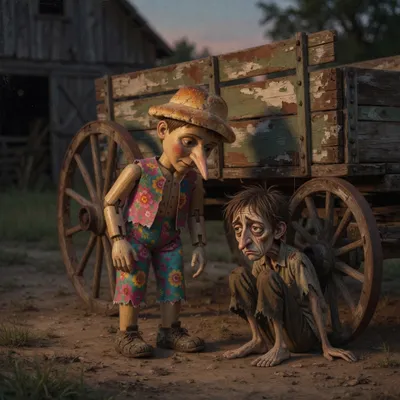
Before you read — think about:
- Why is it so hard to say no to a tempting offer?
- Have you ever been talked into something you knew you should not do?
- What would a country with no school and endless play really be like?
- Why are promises harder to keep when a good friend pulls the other way?
- If you could design a country just for children, what would you put in it?
Watch for these while reading:
- The party Pinocchio is told to arrange, and the friends he sets out to invite
- Lamp-Wick, his nickname, and where that nickname comes from
- The country Lamp-Wick describes, and the details he chooses to mention
- How many times Pinocchio says no, and how Lamp-Wick answers each time
- The hour of the night, and the sounds out on the road
Vocabulary to know:
permission (noun) — being allowed to do something; invitations (noun) — requests asking people to come to an event; accepted (verb) — agreed to something offered; woebegone (adjective) — looking very sad; vacation (noun) — time off from school or work; enjoyment (noun) — the feeling of having fun; boundaries (noun) — the outer edges of a place; marvelous (adjective) — wonderful and amazing; composed (verb) — made up of certain parts; muffled (adjective) — made softer and harder to hear; mosquito (noun) — a small insect that buzzes and bites; buzz (noun) — a low humming sound; queer (adjective) — strange or odd; tempt (verb) — to try to make someone want to do something they shouldn't; useless (adjective) — having no use; pointless; colleges (noun) — schools students attend after high school; elders (noun) — people who are older than you; wagon (noun) — a cart with wheels for carrying people or goods; hurriedly (adverb) — in a fast, rushed way; worried (adjective) — feeling anxious or troubled; morn (noun) — morning; distance (noun) — the far-off space away from you; nodding (verb) — moving the head up and down; dearly (adverb) — very much; with deep love; agree (verb) — to suit or be good for someone.
Chapter 31: Five Months of Play End in a Surprise
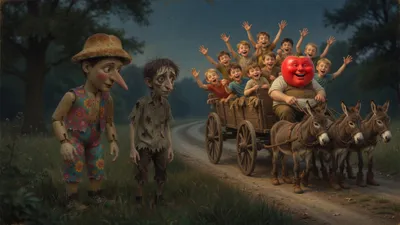
Before you read — think about:
- What do you know about how a fair or a circus travels from town to town?
- How did children get to a fair or a festival long ago?
- What might a place with no rules and no work really be like after a while?
- Why is it easy to get carried along when everybody else is doing something?
- What does it mean to give up your own good plans just to please a friend?
Watch for these while reading:
- The wagon, its wheels, and the animals harnessed in front of it
- The little driver, and his soft, sweet, buttery way of speaking
- The white leather boots the animals are wearing
- Any voice that speaks up while Pinocchio is climbing aboard
- The Land of Toys itself, and the games Collodi takes the trouble to list
Vocabulary to know:
rags (noun) — torn, worn-out pieces of cloth; burden (noun) — a heavy load that is carried; laced (adjective) — tied up with laces; beaming (verb) — shining and smiling brightly; wheedling (adjective) — coaxing with sweet, flattering words; sardines (noun) — small fish packed tightly in a can; complaint (noun) — words said to show one is unhappy; discomfort (noun) — a lack of comfort; bows (noun) — polite bends of the body to greet someone; coachman (noun) — a person who drives a coach; mount (verb) — to climb up onto something; rebellious (adjective) — refusing to obey; resisting control; uproariously (adverb) — with loud, wild laughter; applause (noun) — clapping to show approval; sprawling (verb) — lying spread out clumsily; reasonable (adjective) — sensible and calm; dormouse (noun) — a small animal that looks like a mouse; population (noun) — all the people living in a place; trumpets (noun) — brass instruments that make a loud sound; deafening (adjective) — so loud it almost hurts the ears; marbles (noun) — a game played with small glass balls; hopscotch (noun) — a hopping game played on squares drawn on the ground; tag (noun) — a chasing game; regiments (noun) — large groups of soldiers; catcalls (noun) — loud, mocking shouts; imitated (verb) — copied the sound or actions of another; den (noun) — the home of a wild animal; pandemonium (noun) — wild noise and confusion; cotton (noun) — soft, white, fluffy fibers; charcoal (noun) — a black material used for drawing or writing; investigation (noun) — a careful looking-into or exploring; nook (noun) — a small corner or hidden spot; stripes (noun) — long bands of color; rooster (noun) — a male chicken.
Chapter 32: Pinocchio Grows Donkey Ears
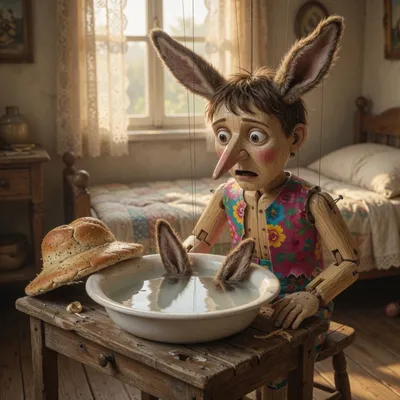
Before you read — think about:
- What do you know about donkeys? What work do they do, and what are they like?
- Have you ever woken up to a surprise you did not want?
- What is a marmot, and what other small animals live in houses and barns?
- Have you ever had an itch or an ache you could not explain? What did you do about it?
- What do people wear on their heads, and why? Think of as many kinds of hat as you can.
Watch for these while reading:
- The Marmot, and the matter-of-fact way she delivers her news
- The name Collodi invents for the illness in this chapter
- The caps and handkerchiefs the two friends keep on indoors
- How the two boys treat each other once they are both in trouble
- Collodi's habit of putting a joke and a scare into the very same scene
Vocabulary to know:
eventful (adjective) — full of important happenings; naked (adjective) — bare; without any covering or help; organs (noun) — parts of the body that each do a job; adorned (verb) — decorated; mirror (noun) — a glass that shows your reflection; basin (noun) — a wide bowl for holding water; manly (adjective) — like a grown man; neighbor (noun) — someone who lives close by; wrist (noun) — the joint between the hand and the arm; fate (noun) — what is bound to happen to someone; decreed (verb) — decided in a firm, official way; heedless (adjective) — careless; not paying attention to warnings; classmate (noun) — someone in the same class at school; false (adjective) — not true, or not loyal; shelf (noun) — a flat board fixed to a wall for holding things; bruised (adjective) — hurt with a sore mark under the skin; earache (noun) — a pain inside the ear; flute (noun) — a musical instrument that makes a soft, high sound; honey (noun) — a sweet, thick food made by bees; tottered (verb) — wobbled and nearly fell; snouts (noun) — the long noses and mouths of animals; lengthened (verb) — grew longer; humiliation (noun) — a strong feeling of shame; bemoan (verb) — to cry or complain about something sad; brays (noun) — the loud sounds a donkey makes; ached (verb) — hurt with a dull, steady pain; stumbled (verb) — tripped or almost fell while moving; helplessly (adverb) — without being able to help oneself; overnight (adverb) — during the night; figure (noun) — the shape of a person's body.
Chapter 33: Pinocchio the Donkey Joins the Circus
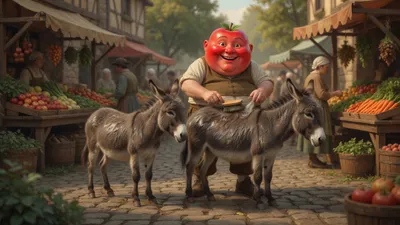
Before you read — think about:
- How were animals treated in circuses long ago, compared with today?
- What tricks can animals be taught, and how do trainers teach them?
- Have you ever been to a circus or a big show? What do you remember best?
- What music would you play to bring a performer into the ring?
- What acts and animals would you expect to see at a circus?
Watch for these while reading:
- What the Little Man does with the donkeys, and how his business actually works
- The circus Director, his whip, and the way he speaks to his animals
- The tricks the new donkey is made to learn, and how he is taught them
- The audience at the circus, described box by box
- Collodi's plain, unsparing way of writing about how animals are used
Vocabulary to know:
currycomb (noun) — a comb used to clean an animal's coat; millionaire (noun) — a person who has a huge amount of money; hardships (noun) — hard, painful conditions; stable (noun) — a building where horses or donkeys are kept; manger (noun) — a box or trough that holds food for animals; hay (noun) — dried grass used to feed animals; particular (adjective) — very fussy and hard to please; lashing (noun) — a hard whipping; headache (noun) — a pain in the head; macaroni (noun) — a kind of pasta; rice (noun) — small white grains eaten as food; waltz (noun) — a smooth, spinning dance; polka (noun) — a fast, bouncy dance; announce (verb) — to tell everyone about something publicly; extraordinary (adjective) — very unusual and special; gallery (noun) — the highest row of seats in a theater; balcony (noun) — an upper level of seats in a theater; swarmed (verb) — crowded together in great numbers; pompous (adjective) — acting too grand and self-important; humble (adjective) — modest; not proud; arrayed (verb) — dressed up in a grand way; bridle (noun) — the straps put on an animal's head to guide it; buckles (noun) — metal fasteners for straps; brass (noun) — a shiny yellow metal; camellias (noun) — large, showy flowers; tassels (noun) — hanging bunches of threads used for decoration; mane (noun) — the long hair on the neck of a horse or donkey; sash (noun) — a wide band worn around the waist or shoulder; encountered (verb) — met or faced something; tame (verb) — to make a wild animal gentle and obedient; savage (adjective) — wild and fierce; civilization (noun) — an advanced, orderly human society; subduing (verb) — bringing under control; resort (verb) — to turn to something as a last choice; bump (noun) — a small raised lump; salute (verb) — to greet with a sign of respect; quickstep (noun) — a fast marching step; pistol (noun) — a small handgun; medallion (noun) — a large medal worn on a chain; spectators (noun) — people watching an event; gracefully (adverb) — in a smooth, lovely way; veterinary (noun) — a doctor who treats animals; drumhead (noun) — the tight skin stretched over the top of a drum; cliff (noun) — a high, steep face of rock.
Chapter 34: Back to the Sea and into the Dogfish
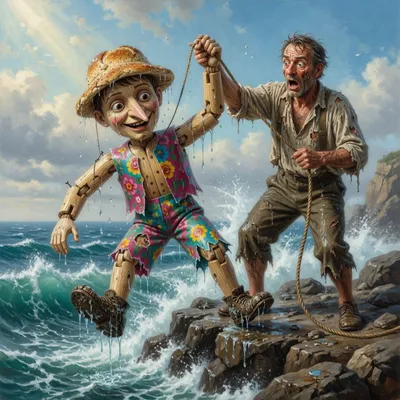
Before you read — think about:
- What is it like to be underwater, and how long can a person hold their breath?
- If you had to tell someone your life story in one minute, what would you put in?
- What would you do if a huge creature were coming toward you in the water?
- Why do sailors tell stories about monsters that live in the sea?
- What do you know about goats, and where do they like to climb?
Watch for these while reading:
- The fish under the water, and the job Collodi hands them
- The story Pinocchio tells to the man who bought him
- The little Goat on the white rock, and the colour of its coat
- The Dogfish, its size, and the nickname the sailors have given it
- How Collodi keeps switching between something horrible and something funny
Vocabulary to know:
surface (noun) — the top layer of the water; cheat (noun) — a person who tricks others dishonestly; effect (noun) — a result of something; untie (verb) — to loosen or undo a knot; hatred (noun) — a very strong feeling of hate; experience (verb) — to go through or feel something; porpoise (noun) — a small sea animal much like a dolphin; bleating (verb) — making the crying sound of a goat or sheep; beckoning (verb) — signaling to someone to come closer; redoubled (verb) — increased greatly; rows (noun) — lines of things placed side by side; hasten (verb) — to hurry; hoofs (noun) — the hard feet of animals like goats and horses; inkwell (noun) — a small pot that holds ink; lungs (noun) — the parts of the body used for breathing; asthma (noun) — an illness that makes breathing hard; convinced (adjective) — made completely sure of something; guitar (noun) — a musical instrument with strings; tunny (noun) — a large sea fish, also called a tuna; dignified (adjective) — showing calm self-respect; opinion (noun) — what a person thinks or believes; wits (noun) — a person's mind or good sense; dot (noun) — a tiny round mark; squirming (verb) — twisting and turning the body; circus (noun) — a traveling show with performers and animals; fair (noun) — a large outdoor market and show; harm (noun) — hurt or damage; swear (verb) — to promise something very strongly; horrified (adjective) — filled with shock and horror; greedy (adjective) — wanting far more than one needs; cruelty (noun) — the act of being very unkind and harsh; nicknamed (verb) — given a fun or extra name; rescue (verb) — to save from danger; swiftly (adverb) — very quickly; goat (noun) — a farm animal with horns and hoofs; monster (noun) — a huge, frightening creature; effort (noun) — a hard try; senses (noun) — a person's awareness and mind; polite (adjective) — having good manners.
Chapter 35: A Surprise Inside the Dogfish
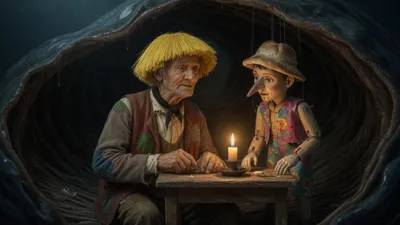
Before you read — think about:
- What is the darkest place you have ever been in?
- How can hope keep a person going in a dark, frightening place?
- What do you know about whales and other very large sea creatures?
- How do people find their way about in the dark?
- What is inside a fish? What would you expect to find if you looked?
Watch for these while reading:
- The inside of the Dogfish, and how Collodi furnishes such a strange place
- The Tunny, and what he has decided to do about his own situation
- The faint light in the distance, and how long it takes to walk toward it
- The Dogfish's breathing trouble, and the way it sleeps
- The plan that gets made, and who has to be talked into trying it
Vocabulary to know:
greasy (adjective) — covered with oil or fat; slippery (adjective) — smooth and hard to hold or walk on; proprietor (noun) — the owner of a business; whitecaps (noun) — waves with white, foamy tops; overturned (verb) — turned upside down; peppermint (noun) — a small minty candy; centuries (noun) — periods of one hundred years each; matches (noun) — small sticks used to start a fire; main-mast (noun) — the tallest pole that holds the sails on a ship; preserved (adjective) — kept from spoiling; raisins (noun) — dried grapes eaten as a snack; blessings (noun) — good things one is thankful for; crumbs (noun) — tiny bits of bread or food; obliged (verb) — forced or required to do something; glimpse (noun) — a quick look; jaws (noun) — the parts of the mouth that open and close; fugitives (noun) — people trying to escape; unceremoniously (adverb) — roughly, without any care or politeness; jolt (noun) — a sudden, hard shake; cannon (noun) — a large, heavy gun; soundly (adverb) — deeply and completely; astonishment (noun) — great surprise; ship (noun) — a large boat; sailors (noun) — people who work on a ship; throat (noun) — the passage at the back of the mouth; tiptoes (noun) — the very tips of the toes; vein (noun) — a tube in the body that carries blood back to the heart; candle (noun) — a stick of wax with a wick that burns to give light; loaded (adjective) — filled up with a load or cargo; escape (verb) — to get away from danger; storm (noun) — wild weather with strong wind and rain; spat (verb) — forced something out of the mouth.
Chapter 36: Pinocchio Becomes a Real Boy
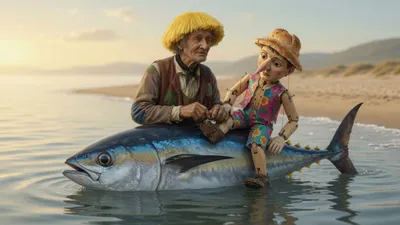
Before you read — think about:
- What does it mean to take care of somebody who needs you?
- Why is honest, hard work something to be proud of?
- How can kindness that you show to others come back to you?
- Do you think Pinocchio has earned a reward by now? Why or why not?
- What makes someone a good person on the inside?
Watch for these while reading:
- The people from earlier in the story who cross Pinocchio's path again
- The work Pinocchio takes on, and the hours he keeps
- The forty pennies Pinocchio saves up, and what he means to spend them on
- How Geppetto spends his days once the two of them are settled
- The last few sentences, and the picture Collodi chooses to leave us with
Vocabulary to know:
dawn (noun) — the first light of the morning; contented (adjective) — happy and satisfied; strokes (noun) — the arm movements made while swimming; implore (verb) — to beg earnestly; eternal (adjective) — lasting forever; gratitude (noun) — the feeling of being thankful; knelt (verb) — went down on the knees; affectionately (adverb) — in a loving way; tenderness (noun) — gentle kindness and love; plunged (verb) — jumped or dove suddenly; wayside (noun) — the edge of a road; individuals (noun) — single people; alms (noun) — money or food given to the poor; proverb (noun) — a short, wise old saying; clump (noun) — a small, tight group of things; beam (noun) — a long, heavy piece of wood that holds up a roof; courteous (adjective) — polite and respectful; reeds (noun) — tall grassy plants that grow near water; baskets (noun) — containers woven from strips of material; airing (noun) — a trip outdoors for fresh air; lamplight (noun) — the light given off by a lamp; secondhand (adjective) — already used by someone else, not new; whittled (verb) — carved wood into shape with a knife; blackberries (noun) — small, dark, sweet berries; cherries (noun) — small, round, red fruit; diligence (noun) — careful, steady hard work; purse (noun) — a small bag for carrying money; behold (verb) — to look at; to see; furnished (adjective) — filled with furniture; lark (noun) — a small bird that sings cheerfully; ridiculous (adjective) — very silly and laughable; well (noun) — a deep hole dug to reach water; bucketfuls (noun) — amounts that fill a bucket; yonder (adverb) — over there, in that direction; draw (verb) — to pull up, as water from a well; stricken (adjective) — struck down by trouble or illness; million (noun) — a very large number, a thousand thousands; hospital (noun) — a place where sick people are cared for; models (noun) — examples that others should copy; behavior (noun) — the way a person acts; strength (noun) — the power to do something hard; roof (noun) — the covering on top of a building; ceiling (noun) — the inside top surface of a room; hammer (noun) — a tool for pounding nails; kindness (noun) — the quality of being friendly and caring; spied (verb) — caught sight of; noticed; succeeded (verb) — managed to do what one was trying to do; wide-awake (adjective) — fully awake and alert; carver (noun) — a person who cuts wood into shapes; faraway (adjective) — distant; a long way off; peaceful (adjective) — calm and untroubled; amount (noun) — how much of something there is; trick (noun) — a clever act meant to fool someone; twisted (adjective) — bent or turned out of its proper shape; cows (noun) — large farm animals that give milk; market (noun) — a place where things are bought and sold; worn (adjective) — tired and used up; leaning (verb) — resting against something for support.
About the Author
Carlo Collodi was an Italian writer who was born in the city of Florence, Italy, in 1826. His real name was Carlo Lorenzini, but he chose the pen name Collodi after the small town where his mother grew up. He worked as a writer and a newspaperman, and he loved creating stories for children. His most famous creation, Pinocchio, has been read and loved all around the world for well over a hundred years.
Collodi first wrote Pinocchio's adventures as a series of short stories in an Italian children's magazine in the early 1880s. Young readers loved the puppet so much that the stories were later gathered together into one book. At that time, many fairy tales were written to entertain children while also teaching them how to behave. Pinocchio became one of the most beloved stories of its kind and has since been translated into hundreds of languages.