

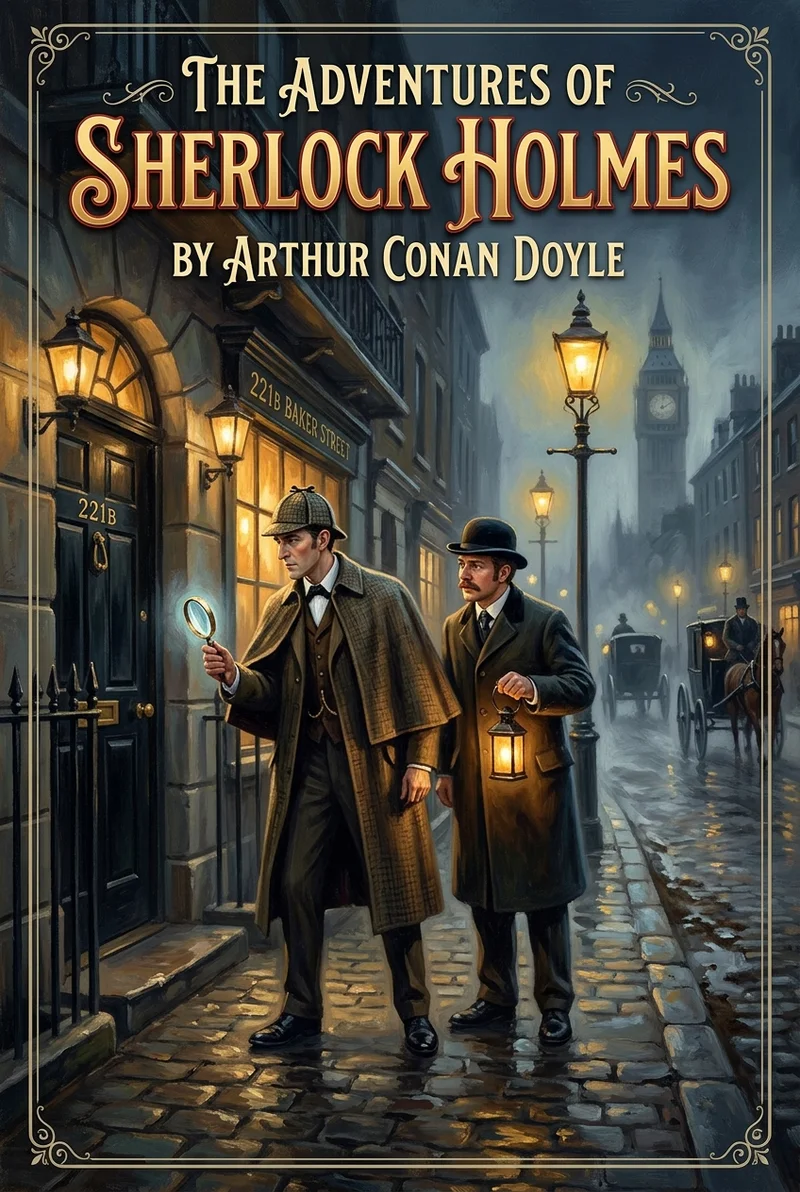
About This Book
In foggy Victorian London, a consulting detective named Sherlock Holmes shares rooms at 221B Baker Street with his friend Dr. John Watson. When a case is too strange or too delicate for the official police, visitors climb the seventeen steps and lay their troubles in front of him. Watson writes the cases down — and the first pages leave one question hanging: can you notice what Holmes notices?
These stories practically invented the detective fiction that fills bookshelves and screens today; every investigator who notices the mud on someone's shoes is a descendant of Sherlock Holmes. Each tale is a fair, self-contained puzzle that trains readers to slow down, look closely, and separate what they actually observe from what they merely assume — a useful habit far outside fiction. They are also short, fast, and often funny, which makes them an unusually painless way into nineteenth-century literature.
Meet the Characters

More about Sherlock Holmes
Sherlock Holmes is a consulting detective living at 221B Baker Street. He would rather have an interesting problem than a comfortable life, and he notices tiny details that everyone else walks past. Brilliant, restless, and often blunt, he is happiest the moment a strange visitor climbs his stairs.

More about Dr. John Watson
Dr. John Watson is an army surgeon who came home to London wounded and looking for a quieter life, and instead became Sherlock Holmes's flatmate and companion. He is steady, brave, and kind, the sort of person who notices when a frightened client needs a chair and a cup of tea. He tells these stories himself, so readers see Holmes the way an amazed friend sees him.

More about Mrs. Hudson
Mrs. Hudson owns the house at 221B Baker Street and rents its upstairs rooms to Holmes and Watson. She keeps the household running through irregular hours, sudden visitors, and a tenant whose habits would try anyone's patience. Practical and unflappable, she is usually the first person a nervous client meets at the door.

More about Inspector Lestrade
Inspector Lestrade is a professional detective with the London police at Scotland Yard. He is energetic, stubborn, and genuinely hard-working, though he tends to trust the obvious explanation. He and Holmes respect each other in a prickly sort of way, and their paths cross whenever an official case turns strange.

More about Irene Adler
Irene Adler is a celebrated contralto opera singer, born in New Jersey and now living in a quiet villa in London. She is admired for her beautiful voice, and she is as quick-witted and self-possessed offstage as she is commanding on it. When her name first reaches Baker Street, it arrives attached to a private problem a powerful visitor will not discuss in public.

More about The King of Bohemia
This visitor arrives at 221B in rich foreign clothes, speaking with a German accent and unwilling at first to give his true name. He is used to being obeyed, and he is plainly more worried about a private scandal than about any ordinary crime. Holmes and Watson first see him as a huge, masked figure who fills the sitting-room doorway.

More about Jabez Wilson
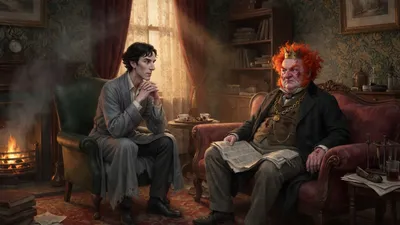
Jabez Wilson keeps a small pawnbroker's shop in a faded London square. He is elderly, rather pompous, and not as sharp as he thinks he is, but he is honest about his own limits. He comes to Baker Street because a strange job advertisement aimed at red-headed men has left him confused and out of pocket.

More about Vincent Spaulding
Vincent Spaulding works for half-wages in Wilson's shop and spends his spare time in the cellar with his photography. He is quick, obliging, and a little too eager to be useful. Wilson thinks him the smartest assistant in the trade.

More about Mary Sutherland
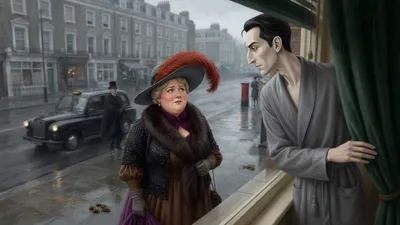
Mary Sutherland lives with her mother and stepfather and earns her own living as a typist. She is good-humoured, talkative, and not easily talked out of what she wants. She arrives at Baker Street in her best hat, hovering on the pavement before she can make herself ring the bell.

More about James McCarthy
James McCarthy is the only son of a Herefordshire tenant farmer, about eighteen, used to guns, horses, and the countryside around Hatherley Farm. He is caught in a public case before he has had much chance to speak for himself. Newspapers have already decided what they think of him.

More about John Turner
John Turner is a wealthy ex-Australian who owns the land around Boscombe Valley and lets Hatherley Farm to the McCarthys. He is old, ill, and still physically imposing. He and his tenant have a long shared past that the neighbourhood only half understands.

More about John Openshaw
John Openshaw is a well-groomed young gentleman of about twenty-two who has been living at his uncle's house in Horsham. He is refined, anxious, and careful with his words. He arrives at Baker Street on a night of violent storm, still wet from the rain, with a story he only half understands.

More about Mrs. St. Clair
Mrs. St. Clair lives in a comfortable villa at Lee, in Kent, and is used to her husband commuting into the City each day. She is small, fair, and determined: once she has seen something with her own eyes, she will not be talked out of it. Holmes and Watson first meet her on her own doorstep, lit from behind, asking for news.

More about Helen Stoner
Helen Stoner lives with her stepfather at the decaying family manor of Stoke Moran on the western border of Surrey. She is about thirty but already looks worn down by fear. She has travelled since dawn to speak to a stranger, and she is shivering from something colder than the April morning.

More about Dr. Grimesby Roylott
Dr. Grimesby Roylott is the last of an old Surrey family, a doctor who spent years in India and has come home to a crumbling manor. He is huge, short-tempered, and used to getting his own way. When he fills the Baker Street doorway, his hat brushes the cross-bar.

More about Victor Hatherley
Victor Hatherley is about twenty-five, newly qualified, and still waiting for the work that will make his name. He lives alone in lodgings and keeps his nerve even when he is badly shaken. Watson first sees him sitting in the consulting-room in a heather tweed suit, one hand wrapped in a stained handkerchief.

More about Lord St. Simon
Lord Robert St. Simon is the son of a duke, used to command and to being obeyed. He dresses with almost foppish care and speaks as if the world's opinion were a personal injury. He comes to Baker Street because a fashionable wedding has not gone the way the newspapers expected.

More about Hatty Doran
Hatty Doran is the daughter of a California millionaire, newly arrived in English society and much written about in the fashionable press. She has a graceful figure, a striking face, and a frank American manner that startles the people around her. As the story opens, she is the bride in a wedding all London is watching.

More about Alexander Holder
Alexander Holder is about fifty, a senior partner in a private bank, used to dignity and to other people's trust. He lives in a suburban house at Streatham with his son and his niece. Watson first sees him running down Baker Street in the snow, past caring how he looks.

More about Violet Hunter
Violet Hunter has been a governess for five years and is out of a place through no fault of her own. She is level-headed, well-spoken, and used to weighing a risk for herself. She comes to Baker Street with a letter of terms that she cannot quite make sense of.

More about Jephro Rucastle
Jephro Rucastle is a country gentleman of about forty-five who comes into a West End governess agency looking for a young woman to live at his house, the Copper Beeches, in Hampshire. He is prodigiously stout, endlessly smiling, and talks as if every odd request were only a family whim. Violet Hunter first sees him sitting at Miss Stoper's elbow, watching the ladies who enter.
Pre-Reading Discussion Questions
- What is the difference between observing something and simply seeing it? Try describing, from memory, the shoes of someone you sat near today.
- What can you reasonably guess about a stranger from their appearance alone — and where does a fair guess turn into an unfair assumption?
- Why do you think mystery stories are so satisfying? What does a good mystery promise the reader?
- Detective stories usually follow a set of unwritten rules, such as giving the reader every clue the detective gets. What would make you feel cheated by a mystery?
- How would investigating a puzzle in the 1890s differ from doing it today, with no cameras, computers, DNA testing, or telephones in most homes?
- Holmes is described as brilliant but difficult company. Can someone be admirable and hard to like at the same time?
Themes & Big Ideas to Track
- Observation versus deduction: Holmes gathers small facts and then reasons from them, and the two steps are worth separating as you read.
- Appearance versus reality: notice how often a person, an object, or a story is not quite what it first seems.
- What counts as justice: watch how official law, private honour, and Holmes's own judgement sit alongside one another.
- The limits of the narrator: Watson is honest but not all-knowing, so notice what he records without understanding.
- Class, money, and reputation: characters take large risks to protect fortunes, inheritances, and their standing in society.
- How a friendship works on the page: a talkative, methodical man and a steadier companion sharing rooms, work, and long silences.
Chapter-by-Chapter Study Guide
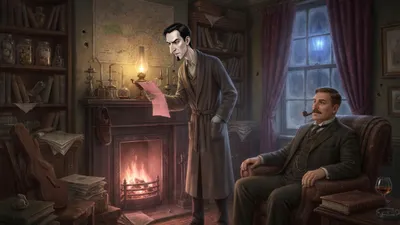
Chapter 1: A Scandal in Bohemia
Before you read — think about:
- What are the advantages and the drawbacks of sharing rooms with someone whose habits are nothing like yours?
- How do you decide whether a first impression of a stranger is fair?
- When would you take a problem to a friend rather than to an official?
- London in the 1890s had gaslamps, horse-drawn cabs, and several postal deliveries a day. What do you think would be easier about daily life then, and what would be harder?
- How does a story change when it is told by a friend who is in the room but not always a step ahead?
Watch for these while reading:
- How Watson describes Holmes's mind in the opening pages — the comparisons he chooses, and the tone he takes.
- The sitting room at Baker Street: what is lying around, and how the two men occupy the space.
- The way Holmes talks about seeing versus observing.
- Any caller who comes up the stairs — clothes, voice, and manners as Watson records them.
- Period detail the story takes for granted: gaslight, cabs, the evening post, and what a photograph meant when photographs were still uncommon.
Vocabulary to know:
abhorrent (adjective) — hateful or disgusting to someone; eclipses (verb) — completely outshines, so that everything else seems dim by comparison; gibe (noun) — a mocking or teasing remark; lodgings (noun) — rented rooms where someone lives; faculties (noun) — a person's mental powers and abilities; singular (adjective) — strange and remarkable; unlike anything usual; gasogene (noun) — a Victorian device for making fizzy soda water at home; iodoform (noun) — a strong-smelling antiseptic used by doctors in the 1800s; baffled (verb) — completely puzzled; trifling (adjective) — small and unimportant; theorise (verb) — to form an explanation, especially before the facts are known; gazetteer (noun) — a reference book listing places and facts about them; brougham (noun) — a closed four-wheeled carriage pulled by horses; guineas (noun) — old British gold coins worth a little more than a pound each; astrakhan (noun) — curly black lambskin fur used to trim expensive coats; opulence (noun) — great, obvious richness and luxury; vizard (noun) — a mask worn over the face; obstinacy (noun) — stubbornness that refuses to give way; indiscretion (noun) — an unwise action that risks damaging one's reputation; languid (adjective) — relaxed to the point of looking lazy; incisive (adjective) — sharp and cutting straight to the point; incognito (adverb) — appearing under a false name to hide one's identity; monograph (noun) — a detailed written study of one narrow subject; contralto (noun) — the lowest singing voice for a woman; compromising (adjective) — revealing something that could ruin a person's reputation; betrothal (noun) — a formal engagement to be married; chamois (noun) — a soft, flexible leather.
Chapter 2: The Red-Headed League
Before you read — think about:
- Have you ever taken a job, a favour, or a deal that sounded a little too easy? What made you say yes or no?
- Should a detective work any differently for a shopkeeper than for a powerful client?
- When you need to think something through properly, what do you do — walk, sit still, talk it out, or something else?
- What do you already know about Victorian London from films, games, or books, and how much of that picture do you actually trust?
- Why might the oddest-sounding problem be easier to untangle than a very ordinary one?
Watch for these while reading:
- Jabez Wilson's manner as he tells his story — what he stresses, what he apologises for, and what he plainly considers beneath mention.
- Holmes's swings between sitting still and sudden energy, and what an afternoon away from Baker Street seems to do for him.
- How Doyle uses real London geography — named streets, squares, and routes — to make the city feel exact.
- The wording of the newspaper advertisement, and what cheap newspapers and small ads meant to Londoners in the 1890s.
- How the official policeman and Holmes each describe the other's methods.
Vocabulary to know:
pawnbroker (noun) — a shopkeeper who lends money in exchange for items left as security; florid (adjective) — having a red, flushed complexion; embellish (verb) — to add extra details that make a story more colourful than the plain facts; pompous (adjective) — puffed up with self-importance; commonplace (adjective) — ordinary and unremarkable; bequest (noun) — money or property left to someone in a will; vacancy (noun) — an unfilled job or position; nominal (adjective) — in name only; so small or easy that it barely counts; forfeit (verb) — to lose a right or position as a penalty; obliging (adjective) — willing to help; eager to please; introspective (adjective) — turned inward; thinking hard about one's own thoughts; labyrinth (noun) — a confusing maze of paths or streets; tenacious (adjective) — holding on stubbornly and not letting go; settee (noun) — a long padded seat for two or more people; solicitor (noun) — a lawyer who handles legal business outside the courtroom; formidable (adjective) — inspiring fear or respect because of size, skill, or power; bizarre (adjective) — very strange and unusual; humdrum (adjective) — dull and boringly ordinary; shutters (noun) — wooden or metal covers that close over a shop window; trustees (noun) — people legally responsible for managing money or property for others; benefactor (noun) — someone who gives money or help to others; lantern (noun) — a portable enclosed lamp; burrowing (verb) — digging a tunnel, like an animal under the ground; comply (verb) — to obey a rule or condition; waistcoat (noun) — a sleeveless buttoned garment worn under a jacket; a vest.
Chapter 3: A Case of Identity
Before you read — think about:
- Holmes argues that real life is often stranger than anything a writer would invent. Do you agree? What is the oddest true story you know?
- What makes someone good at describing something that happened to them?
- Who would you go to with a problem you did not want to take to your family — and what makes that person the right one?
- If you could choose your work freely, what would make a job worth doing: money, interest, usefulness, or something else?
- Getting around London in the 1890s meant walking, omnibuses, hansom cabs, or the new underground railway. How would your ordinary day be different with no cars and no phones?
Watch for these while reading:
- Mary Sutherland's manner in the sitting room — what she wears, how she tells her story, and how often she has clearly told it before.
- Holmes's habit of reading a visitor before they have spoken, and the way he explains the reading afterwards.
- What the story shows about a young woman's working life in London: typing, wages, and living at home.
- Watson's part in this case — what Holmes shows him, and where he is left to guess.
- Holmes's remarks about trifles and great matters, and whether his own practice matches his theory.
Vocabulary to know:
infinitely (adverb) — to an extremely great degree; beyond measure; coincidences (noun) — events that happen together by chance in a surprising way; platitudes (noun) — dull, obvious remarks that have been said many times before; magistrate (noun) — a local judge who hears minor cases; teetotaler (noun) — a person who never drinks alcohol; amethyst (noun) — a purple precious stone; splendour (noun) — magnificent, showy richness; souvenir (noun) — an object kept as a reminder of a person or event; intricate (adjective) — complicated, with many small connected parts; panoply (noun) — an impressive full outfit or covering; oscillated (verb) — swung back and forth; discriminate (verb) — to tell the difference between things; perplexed (adjective) — confused and unable to understand; abstracted (adjective) — seeming lost in thought and not fully present; vacuous (adjective) — showing no thought or expression; blank; rambling (adjective) — wandering from point to point without clear order; axiom (noun) — a principle accepted as obviously true; conspicuous (adjective) — easily noticed; standing out; quinsy (noun) — an old term for a severe throat infection; catastrophe (noun) — a sudden terrible disaster; pledged (adjective) — bound by a solemn promise; coquettish (adjective) — flirtatious in a playful, showy way; typewriter (noun) — a machine that prints letters when you press keys; stepfather (noun) — a man who has married one's mother after one's father has died or left; confide (verb) — to tell someone a secret in trust.
Chapter 4: The Boscombe Valley Mystery
Before you read — think about:
- What is circumstantial evidence, and how is it different from an eyewitness account?
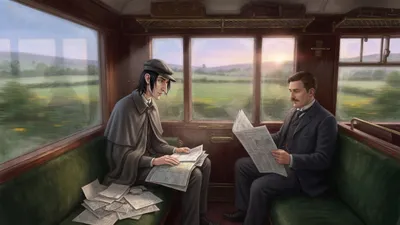
- This is the first case that takes Holmes and Watson out of London by train. What is the longest journey you have made, and what do you notice about a place in your first hour there?
- Country England in the 1890s ran on landowners, tenant farmers, and servants, in villages where everyone knew everyone. What are the advantages, and the drawbacks, of living somewhere where everyone knows your business?
- Newspapers report a case long before any court has heard it. How might that change what people believe about the people involved?
- Holmes says there is nothing so deceptive as an obvious fact. What do you think he means, and where have you seen that happen?
Watch for these while reading:
- The change of scene — farms, tenants, and the railway that carries Holmes and Watson west.
- How Watson gathers what he tells us here: newspaper reports and Holmes's summaries as much as his own eyes.
- Lestrade and Holmes working the same set of facts side by side, and the different questions each man asks.
- The relationship between a landowner and his tenant, and what that difference in rank lets each of them say to the other.
- Holmes's practical method on the ground: what he paces out, what he kneels down to look at, and what he carries in his pockets.
Vocabulary to know:
valise (noun) — a small travelling bag; gaunt (adjective) — very thin and bony; biassed (adjective) — unfairly favouring one side; rummaged (verb) — searched roughly through a pile of things; meditation (noun) — deep, quiet thinking; particulars (noun) — the detailed facts of a matter; paradoxical (adjective) — seeming to contradict itself while still being true; conjectured (verb) — guessed or supposed without proof; proprietor (noun) — the owner of a property or business; tenant (noun) — a person who rents property from an owner; equality (noun) — the state of being on the same level as someone else; colonies (noun) — territories settled and governed by a distant country; depose (verb) — to give sworn evidence; reeds (noun) — tall grassy plants growing in wet ground; inflicted (verb) — caused something painful to be suffered; verdict (noun) — the official decision reached in a legal case; inquest (noun) — an official inquiry into how someone died; circumstantial (adjective) — based on surrounding facts rather than direct proof; Assizes (noun) — court sessions once held periodically in English counties to try serious cases; coroner (noun) — the official who investigates sudden or suspicious deaths; decrepitude (noun) — the weakness and worn-down look of old age or illness; trap (noun) — here, a light two-wheeled horse-drawn carriage; cooee (noun) — a long carrying call used as a signal, especially in Australia; game-keeper (noun) — a person employed to look after game birds and animals on an estate.
Chapter 5: The Five Orange Pips
Before you read — think about:
- Watson opens by describing the notes and files he keeps of Holmes's cases. If you kept a record of your own year, what would you write down, and what would you leave out?
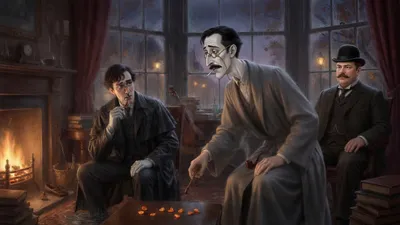
- A storm beats on the windows while this story is told. How do writers and film-makers use weather to set a mood, and does it work on you?
- Holmes keeps scrapbooks, index volumes, and commonplace books at Baker Street. Before search engines, how would you have looked something up?
- Holmes claims a perfect reasoner could describe a whole chain of events from one single fact. Is that a real possibility or a boast?
- What kinds of problems do you think people would bring to a private detective today?
Watch for these while reading:
- The storm outside the Baker Street windows, and how Doyle uses weather to set the temper of an evening.
- Watson's opening paragraph, where he describes the case notes he is choosing from and how he decides what to publish.
- The young visitor's manner — his age, his nerves, and how much of the family history he knows only second-hand.
- Period detail in how messages travel: the post, the telegram office, and how long news takes to cross an ocean.
- The reference books and commonplace files Holmes keeps at Baker Street, and how he uses them.
Vocabulary to know:
surmise (noun) — a guess based on little evidence; equinoctial (adjective) — occurring around the equinox, when day and night are equal; gales (noun) — very strong winds; inexplicable (adjective) — impossible to explain; emigrated (verb) — left one's own country to settle in another; planter (noun) — the owner of a large farming estate; colonel (noun) — a senior army officer; aversion (noun) — a strong feeling of dislike; pips (noun) — the small seeds of a fruit; in this story, a deadly warning sent by post; postmark (noun) — an official mark showing where and when a letter was posted; palpitating (verb) — trembling or throbbing with fear; cashbox (noun) — a small strong box for holding money or papers; checkmate (verb) — to defeat someone completely, as in the final move of chess; oath (noun) — here, a swear word said in anger; grate (noun) — the metal frame that holds a fire in a fireplace; pondered (verb) — thought about carefully for a long time; dread (noun) — a heavy feeling of fear about what may come; brazen (verb) — to face something out boldly, pretending not to be afraid; eccentricity (noun) — strange or odd behaviour; memoranda (noun) — written notes recording information; reconstruction (noun) — the period after the American Civil War when the Southern states were rebuilt and rejoined the Union; sundial (noun) — a garden instrument that tells the time by a shadow cast on a marked plate; telegram (noun) — a short message sent electrically along wires and printed out at the other end; franchise (noun) — the right to vote.
Chapter 6: The Man with the Twisted Lip
Before you read — think about:
- Watson begins here by doing a favour for a friend's wife in the middle of the night. What is the biggest favour you have done for someone, and what made you say yes?
- Holmes sits up through a whole night thinking. What helps you concentrate for a long stretch, and what breaks it?
- Victorian London had docks and riverside lanes at one end and quiet suburban villas at the other. What is the difference between the busiest and the quietest place you know well?
- Many great cities grew up along a river. What does a river do for a city, and what problems does it create?
- Why might an author show what a dangerous habit does to a whole household rather than to one person alone?
Watch for these while reading:
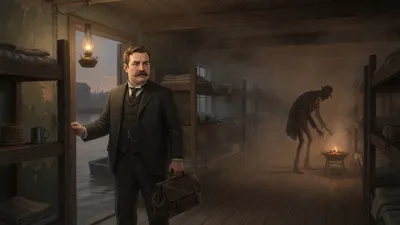
- The two Londons the story moves between — the riverside lanes near the docks and a comfortable villa out in Kent — and how differently Watson describes each.
- That the story starts with Watson on an errand of his own, and what that errand tells you about him.
- The woman waiting at the villa, and how Holmes treats a client who holds firmly to her own view of things.
- Holmes's habits through a long night of thinking, as Watson records them.
- Victorian commuting as background: the City, the trains, the suburban villa, and the man who travels in to work each day.
Vocabulary to know:
opium (noun) — an addictive drug made from poppies, smoked in dens like the one in this story; laudanum (noun) — a liquid medicine of the period containing opium; ruffians (noun) — violent, lawless men; wharves (noun) — platforms where ships tie up to load and unload; forecastle (noun) — the front part of a ship where sailors sleep; brazier (noun) — a metal pan for holding burning coals; charcoal (noun) — blackened wood burned as fuel; haggard (adjective) — looking exhausted and ill; unkempt (adjective) — untidy and uncared for; fumes (noun) — strong, harmful smoke or vapour; lassitude (noun) — extreme tiredness and lack of energy; senility (noun) — the weakness of mind that can come with old age; trap-door (noun) — a hinged door set into a floor; suburban (adjective) — belonging to the residential districts outside a city centre; linoleum (noun) — a smooth hard floor covering; dregs (noun) — the worthless remains at the bottom; the most wretched people; latch (noun) — a simple fastening for a door; stupefying (adjective) — making the mind dull and senseless; vengeance (noun) — punishment inflicted in return for a wrong; commissions (noun) — tasks someone is asked to carry out; frantically (adverb) — in a wild, desperate way; temperate (adjective) — moderate and self-controlled in habits; murky (adjective) — dark and dirty; pitiable (adjective) — deserving pity.
Chapter 7: The Adventure of the Blue Carbuncle
Before you read — think about:
- How much could a stranger work out about you from a single object you use every day — a bag, a phone case, a pair of shoes?
- Christmas and New Year fall in the middle of this story. What does your family do at the same point in the year, and what stays the same about it every time?
- Holmes spends part of this case talking to strangers who have no reason to help him. What makes you willing to help a stranger who asks you a question?
- Why do people place enormous value on rare objects — jewels, trading cards, sneakers — that have no practical use at all?
- Winter in a city before central heating meant fog, coal smoke, and frozen streets. How does really cold weather change the way people behave where you live?
Watch for these while reading:
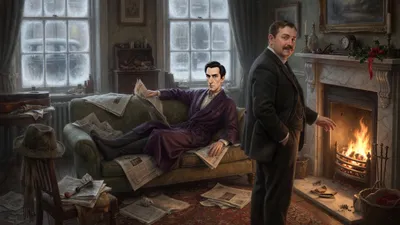
- The Christmas setting — the season, the weather, and the mood it puts Holmes and Watson in.
- Everything Holmes claims to read from a battered old hat, and how much of it he offers as certainty rather than probability.
- How Holmes talks to working Londoners — a commissionaire, a salesman, an innkeeper — and how his manner shifts with each.
- Watson as audience: what Holmes invites him to try for himself, and how he does at it.
- What Holmes says about why he takes cases at all, and what he claims to get out of them.
Vocabulary to know:
seedy (adjective) — shabby and worn out; forceps (noun) — a pincer-like instrument for gripping small objects; commissionaire (noun) — a uniformed doorman or messenger; billycock (noun) — a hard round felt hat, like a bowler; jollification (noun) — a lively celebration; unimpeachable (adjective) — beyond any possible criticism or doubt; retrogression (noun) — a going backward; a decline from a better state; sedentary (adjective) — involving much sitting and little exercise; carbuncle (noun) — a deep red gemstone; here, an unusual blue one; solder (verb) — to join metal by melting a soft alloy onto it; bureau (noun) — a writing desk with drawers; casket (noun) — a small ornamental box for jewels; rifled (verb) — searched and robbed; gem (noun) — a precious stone; tallow (noun) — hard animal fat used to make candles; scintillating (adjective) — sparkling brilliantly; spoils (noun) — goods taken by the winner of a fight; jostling (verb) — pushing and knocking against one another; swarm (noun) — a dense crowd; trophy (noun) — something kept as a prize or memento of a victory; adhesive (adjective) — sticky; sequence (noun) — the order in which events follow one another; daubing (verb) — smearing paint or ink on carelessly.
Chapter 8: The Adventure of the Speckled Band
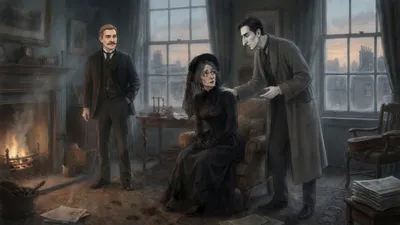
Before you read — think about:
- Watson says he is only able to write this case up now, years later. Why might someone wait years before telling a story that is true?
- This is the earliest case in the book by date, from before Watson married. What changes about a friendship when one friend's life moves on and the other's does not?
- Doyle can make you distrust a character within a few lines of their first appearance. What is the first thing that makes you distrust someone in a story?
- A client arrives at Baker Street before breakfast, having travelled since dawn. When have you had to ask an adult you did not know for help, and what made it hard?
- Large old houses are expensive to keep up. What do you imagine it is like to live in a house that is too big for the people left in it?
Watch for these while reading:
- The visitor who arrives before breakfast — how she is dressed, how she speaks, and what she is willing to say plainly.
- Any new figure who fills a doorway, and how Doyle builds a person out of size, temper, and clothes in very few lines.
- The house itself: an old building, a decayed family, and land that has been sold off piece by piece.
- The imperial background — an English family's years in India — as part of how the story accounts for a man's temper and his household.
- How Watson opens the story, explaining why he can only now write it up, and what that framing does to your expectations.
Vocabulary to know:
veiled (adjective) — covered with a thin cloth over the face; premature (adjective) — happening earlier than expected; dog-cart (noun) — a light open horse-drawn cart with two seats back to back; opal (noun) — a gemstone that shows shifting rainbow colours; tiara (noun) — a jewelled headband worn by women on formal occasions; dissolute (adjective) — wild and lacking self-control in one's way of living; mortgage (noun) — a debt secured against a house or land; squire (noun) — the chief landowner of a country district; pauper (noun) — a very poor person; morose (adjective) — gloomy and bad-tempered; ancestral (adjective) — belonging to one's ancestors; mania (noun) — a violent mental disorder; tropics (noun) — the hot regions near the equator; parapet (noun) — a low protective wall along an edge or bridge; cheetah (noun) — a large spotted wild cat; baboon (noun) — a large ground-dwelling monkey; seared (verb) — burned deeply and permanently; vagabonds (noun) — people who wander from place to place without a fixed home; butler (noun) — the chief male servant of a household; artillery (noun) — the branch of an army that uses large guns; fortnight (noun) — two weeks; hospitality (noun) — the friendly welcome and entertainment of guests; ferocious (adjective) — savagely fierce.
Chapter 9: The Adventure of the Engineer's Thumb
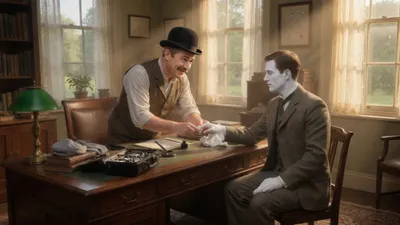
Before you read — think about:
- This is one of only two cases Watson brings to Holmes himself. What is it like to be the person who introduces two people who do not know each other?
- Victor Hatherley is young, newly qualified, and has been waiting for work that has not come. What is the hardest part of starting out at something when you have no reputation yet?
- Most of this story is one person talking, without interruption, for pages at a time. What makes a long spoken account gripping instead of dull?
- In the 1890s the railway timetable ran the country: you could plan a journey to the minute. What in your life has to run on time for everything else to work?
- Holmes and the official police often work the same case from opposite ends. When you work with someone who does things differently from you, what makes it go well or badly?
Watch for these while reading:
- That this is one of the very few cases Watson himself brings to Holmes, and what that does to his role in the telling.
- The young professional's manner — someone who has been out of work, and how that shapes what he was prepared to accept.
- How the story is built: most of it is a single long account delivered by the client, with Holmes as a listener.
- The engineering world of the 1890s — hydraulic presses, patents, and how a young man set up in business on his own.
- How Holmes and the official police divide the work once everyone is involved.
Vocabulary to know:
hydraulic (adjective) — operated by the pressure of liquid, usually water; mottled (adjective) — marked with irregular patches; spongy (adjective) — soft and absorbent like a sponge; cleaver (noun) — a heavy knife with a broad blade; genial (adjective) — cheerful and kindly; rashers (noun) — slices of bacon; stimulant (noun) — something taken to increase energy or alertness; apprenticed (verb) — bound to learn a trade from a skilled employer; chambers (noun) — rooms used as a professional office; consultations (noun) — meetings in which an expert gives advice; emaciation (noun) — extreme thinness from lack of food or illness; munificent (adjective) — extremely generous; recompense (verb) — to pay someone back for trouble or loss; eavesdroppers (noun) — people who secretly listen to others' conversations; deposit (noun) — a natural layer of a mineral in the ground; province (noun) — here, a person's own area of knowledge; shudder (noun) — a sudden trembling of horror; wadding (noun) — soft material used for padding; discreet (adjective) — careful not to reveal private matters; qualifications (noun) — the training and skills that fit someone for a job; antics (noun) — odd or extravagant behaviour; repulsion (noun) — a feeling of strong dislike; comparatively (adverb) — in comparison with something else.
Chapter 10: The Adventure of the Noble Bachelor
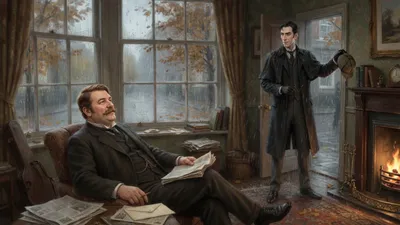
Before you read — think about:
- This story moves in a world of titles, servants, and society newspapers. What do you already know about the British aristocracy, and where did you learn it?
- In the 1890s some old families had titles and land but no money, while some new families had money but no rank. What do people gain by marrying into a different class, and what do they give up?
- How do people behave differently when they believe their reputation is being damaged in public?
- Lestrade turns up again in this story. What makes a recurring character satisfying to read, and what does an author have to do to keep them from going stale?
- Newspapers of the day printed long accounts of fashionable weddings and society gossip. Why are people so interested in the private lives of the famous — then and now?
Watch for these while reading:
- Lord St. Simon's manner — how he enters, how he sits, and how he speaks about money, rank, and the people around him.
- How Holmes treats a titled client compared with the pawnbroker, the typist, and the engineer.
- American characters and American speech as the English characters in the room hear them.
- Lestrade's way of working a case, and what he counts as evidence.
- The society press — how newspapers of the period covered a fashionable wedding, and how a family's private business became public property.
Vocabulary to know:
piquant (adjective) — pleasantly sharp and interesting; autumnal (adjective) — belonging to autumn; crest (noun) — a family emblem printed on paper or engraved on objects; affectation (noun) — false behaviour meant to impress; paramount (adjective) — more important than anything else; dowry (noun) — money or property a bride brings to a marriage; peeress (noun) — a woman holding a noble title or married to a nobleman; consternation (noun) — shocked dismay; danseuse (noun) — a female stage dancer; petulance (noun) — childish bad temper over small things; foppishness (noun) — excessive fussiness about clothes and appearance; eyeglasses (noun) — spectacles, here worn on a cord; unfettered (adjective) — not restricted by rules or ties; honeymoon (noun) — a holiday taken by a newly married couple; footman (noun) — a male household servant who attends the door and table; apparelled (verb) — dressed; implicit (adjective) — complete and unquestioning; alliance (noun) — a union formed for mutual benefit, such as a marriage between families; transition (noun) — a change from one state to another; gossips (noun) — people who enjoy spreading talk about others; episode (noun) — a single notable event in a longer story; saturated (adjective) — completely filled or soaked; listless (adjective) — lacking energy or interest.
Chapter 11: The Adventure of the Beryl Coronet

Before you read — think about:
- A bank's whole business depends on customers believing it can be trusted. What makes you trust a person, or a place, with something that matters to you?
- Watson describes a respectable man behaving so oddly in the street that a crowd follows him. What would it take to make you behave in public in a way you would normally be embarrassed by?
- If someone lent you something valuable and irreplaceable for a week, what would you do to look after it?
- Holmes now has a reputation, and clients arrive at Baker Street expecting miracles. What is it like to be the person everyone turns to when something goes wrong?
- When two people you care about seem to be on opposite sides of a quarrel, how do you decide whom to believe?
Watch for these while reading:
- Alexander Holder's state when he arrives, and how Watson describes a respectable man behaving in a way that draws a crowd behind him.
- Banking in the 1890s — private banks, security offered against a loan, and why a customer might prefer a discreet firm to a public one.
- Winter as part of the setting: a suburban house at Streatham, snow in the garden, and a household shut in together.
- How the banker describes each member of his household, and the tone he takes about each one.
- Holmes's manner with a client who is convinced he already knows what happened.
Vocabulary to know:
bow-window (noun) — a curved window projecting out from a wall; imposing (adjective) — grand and impressive in appearance; contortions (noun) — twisted, distorted movements; coronet (noun) — a small crown worn by nobility; imbedded (verb) — set firmly into a surrounding material; chasing (noun) — decorative patterns engraved into metal; incalculable (adjective) — too great to be measured; illustrious (adjective) — famous and highly distinguished; cashier (noun) — a bank employee who handles money; entailed (verb) — involved as a necessary consequence; wayward (adjective) — wilful and hard to control; squander (verb) — to waste money foolishly; turf (noun) — the world of horse racing; glamour (noun) — an alluring charm that can mislead; depositors (noun) — people who place money in a bank; lucrative (adjective) — producing a lot of money; parley (noun) — a discussion or negotiation; jewellery (noun) — ornaments made with precious stones and metals; reliability (noun) — trustworthiness; admirers (noun) — people who show romantic interest in someone; allowance (noun) — a regular sum of money given to someone; fascination (noun) — a powerful attraction; gesticulating (verb) — making dramatic gestures with the hands.
Chapter 12: The Adventure of the Copper Beeches
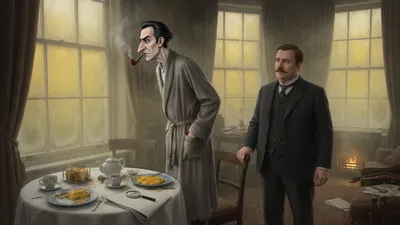
Before you read — think about:
- Holmes and Watson argue in the opening pages about the way Watson writes these cases up. Now that you have read eleven of them, what do you think the stories are actually for?
- Who is the most level-headed person you know, and how can you tell?
- A governess in the 1890s was educated, respectable, and almost powerless — an employee who lived inside the family she worked for. What difficulties would that position create?
- Empty countryside and crowded cities are both popular settings for stories. Which do you find more unsettling to read about, and why?
- This is the last story in the book. As you read, think about what you would tell a friend who had read none of the others about who Sherlock Holmes is.
Watch for these while reading:
- The argument Holmes and Watson have in the opening pages about the way Watson writes these cases up, and what each of them thinks the stories are for.
- Violet Hunter's manner — how she reasons, what she is prepared to risk, and how she differs from Holmes's other clients.
- Country against city as an idea, and the specific things Holmes says about isolated houses.
- Domestic service as a world of its own — wages, references, notice, and what an employer could ask of someone who lived in the house.
- The Copper Beeches as a house: what Violet is shown, what she is not shown, and which rooms she is told to keep away from.
Vocabulary to know:
governess (noun) — a woman employed to teach children in a private household; anteroom (noun) — a small waiting room leading into a larger one; prodigiously (adverb) — enormously; deportment (noun) — the way a person carries and conducts themselves; destitute (adjective) — extremely poor and without resources; luxuriant (adjective) — growing thickly and abundantly; faddy (adjective) — having lots of odd little preferences; fads (noun) — passing enthusiasms or odd preferences; obedience (noun) — doing what one is told; synthesis (noun) — the combining of separate parts into a whole; conceit (noun) — excessive pride in oneself; egotism (noun) — excessive concern with oneself; compositor (noun) — a worker who arranged type for printing; weaver (noun) — a person who makes cloth on a loom; rural (adjective) — belonging to the countryside; gong (noun) — a metal disc struck to make a ringing sound; manageress (noun) — a woman in charge of a business; transaction (noun) — a piece of business between two people; slits (noun) — narrow openings; cockroaches (noun) — large flat insects found in houses; freckled (adjective) — marked with small brown spots on the skin; disputatious (adjective) — inclined to argue; meditative (adjective) — thoughtful and reflective; cinder (noun) — a small piece of burning coal.
About the Author
Arthur Conan Doyle (1859-1930) was born in Edinburgh, Scotland, and trained as a doctor at the University of Edinburgh. One of his professors, a surgeon named Joseph Bell, could astonish patients by deducing their occupation and travels from small physical details — and Doyle later said he had built Sherlock Holmes on that memory. He began writing fiction while waiting for patients in a slow medical practice, introduced Holmes in 1887, and became world-famous when the short stories began appearing in The Strand Magazine in 1891. He wrote a great deal besides Holmes — historical novels, science fiction, and non-fiction — but it is the man at Baker Street the world remembers.
The stories are set in the London of the 1880s and 1890s, then the largest city on earth, and their world runs on gaslight, horse-drawn cabs, telegrams, and railway timetables. Policing was still young: Scotland Yard had only recently formed a detective branch, fingerprinting was not yet in use, and there was no forensic laboratory to send evidence to, so a detective who could actually read physical traces seemed almost magical. The stories reached readers through The Strand Magazine, a cheap illustrated monthly bought by a newly literate mass audience. Edgar Allan Poe had invented the analytical detective a generation earlier; these twelve tales fixed the shape that followed: the brilliant investigator, the loyal narrator, the baffled police, and the final explanation.