

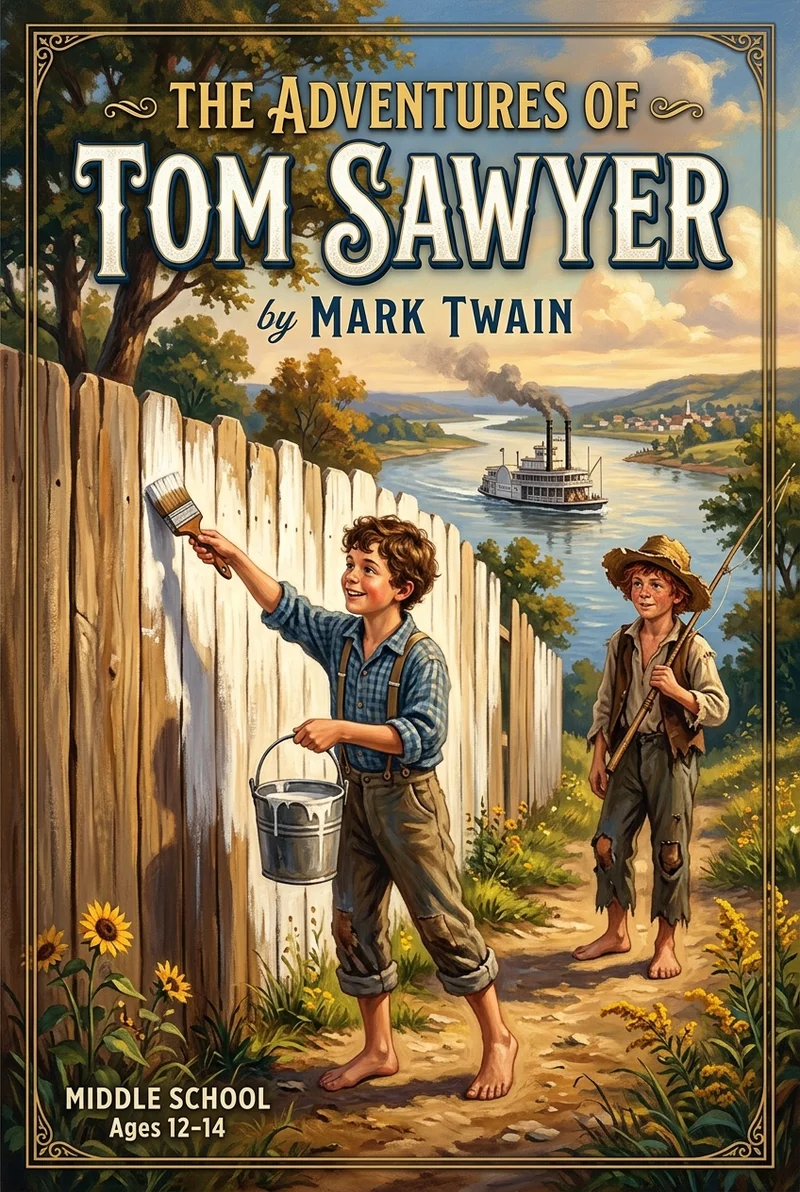
About This Book
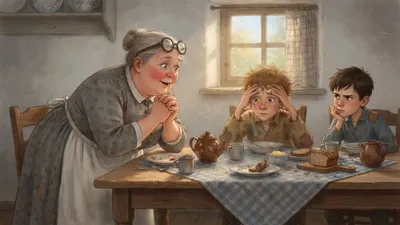
St. Petersburg, Missouri, is a drowsy Mississippi River village where everybody knows everybody else's business. Tom Sawyer, about twelve, lives there with his Aunt Polly, who is trying to raise him into a respectable boy after his mother's death. He would rather be out playing than doing chores or sitting still, and the first pages drop you into one of their long-running household battles.
The Adventures of Tom Sawyer still matters because it takes a child's inner life seriously — boredom, showing off, wanting to be watched, and the gap between the person you are and the person the grown-ups want. Twain writes that life in a voice that is funny, exact, and spoken rather than literary. Middle-school readers meet Tom at almost their own age, in a world that is both smaller and freer than theirs, and they get one of the great comic portraits of American childhood.
Meet the Characters

More about Tom Sawyer
Tom is an imaginative, restless boy living with his Aunt Polly in the sleepy Mississippi River town of St. Petersburg, Missouri. He would rather be swimming, play-acting, or trading treasures with his friends than sitting in school or church, and he has a gift for talking his way out of trouble. Underneath the mischief he is proud, loyal to the people he likes, and hungry to be noticed.

More about Huckleberry Finn
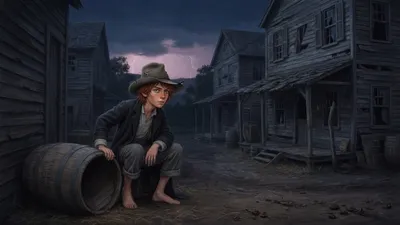
Huck is the son of the town drunkard and lives however and wherever he pleases — sleeping in empty barrels or haylofts, fishing when he is hungry, and answering to no one. The mothers of St. Petersburg forbid their children to play with him, which only makes him the most envied boy in town. He is superstitious, generous with what little he has, and completely unused to anyone's rules.

More about Becky Thatcher
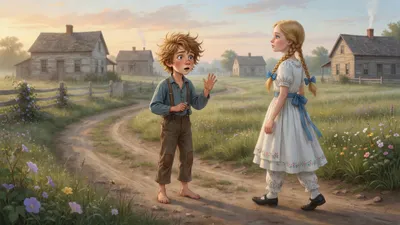
Becky has just moved to St. Petersburg from the larger town of Constantinople with her family. She is proud, well-mannered, and used to being admired, but she is also playful and quick to feel a slight. The village children notice her at once as someone new.

More about Aunt Polly
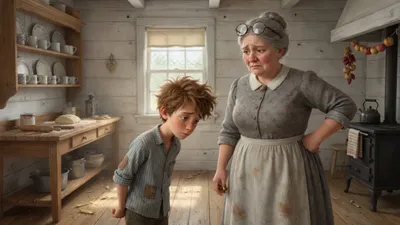
Aunt Polly has raised Tom since his mother died, and she takes the duty seriously even though he runs rings around her. She believes in hard work, church, patent medicines, and firm discipline, but her heart is far softer than her rules. She loves Tom deeply and can almost never bring herself to punish him properly.

More about Sid Sawyer
Sid lives in Aunt Polly's house with Tom and their cousin Mary. He is quiet, tidy, and careful to stay out of trouble, and he has a habit of noticing other people's mistakes. Adults find him easy to praise.

More about Mary
Mary is two years older than Tom and lives in Aunt Polly's house with the boys. She is patient, tidy, and already trusted with Sunday-school lessons and getting the children ready for church. She treats Tom firmly but without Sid's eagerness to catch him out.

More about Joe Harper
Joe Harper is one of the village boys Tom plays with whenever a game needs a second commander. He is ready for armies in the woods, Robin Hood, or whatever script Tom has been reading. He lives with his mother in St. Petersburg and knows the same streets, dares, and books Tom does.

More about Judge Thatcher
Judge Thatcher is a dignified public man from the county seat at Constantinople. When he appears in the village he is treated as an important visitor, and the Sunday-school rearranges itself around him. He is Becky's father, and the children of St. Petersburg know him first as a person to be shown off to.

More about Widow Douglas
The Widow Douglas is fair, capable, and about forty, known in St. Petersburg as generous and well-off. She lives in what the village thinks of as its only palace, up on Cardiff Hill, and she is kind to people who have fewer comforts than she does. The town speaks of her with respect even when she is not in the room.

More about Mr. Dobbins
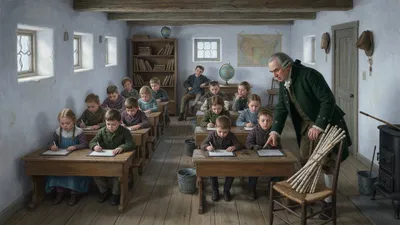
Mr. Dobbins keeps the St. Petersburg schoolroom with a switch, a desk, and a strong wish to look learned. He is middle-aged, often weary, and quick to punish a latecomer in front of the whole class. The children know him as the man who decides where they sit and how long the day feels.

More about Injun Joe
Injun Joe drifts around St. Petersburg doing occasional rough work and keeping to himself. The townspeople give him a wide berth, and the children of the village consider him the most frightening man they know. He is patient and watchful.

More about Muff Potter
Muff Potter drifts through St. Petersburg doing odd jobs, sleeping wherever he can, and rarely staying sober for long. Grown-ups shake their heads at him, but he is gentle and generous with the town's boys, mending their kites and fishing tackle and taking them fishing. Tom and Huck consider him a friend.
Pre-Reading Discussion Questions
- Think of a time you talked your way out of a chore or a punishment. What made your argument work, and what does that skill say about you?
- The children in this book roam a whole town and a river valley without adult supervision. How is that different from the freedom young people have today, and what is gained or lost either way?
- What makes someone popular among their friends but disapproved of by adults? Why do those two kinds of reputation so often point in opposite directions?
- How do you decide whether a rule is worth following when nobody is watching?
- This story was set about forty years before it was written, by an author remembering his own childhood. How reliable do you expect a grown-up's memory of being twelve to be?
- What do you think a small American river town in the 1840s looked, sounded, and smelled like on a hot summer day?
Themes & Big Ideas to Track
- Freedom versus respectability: the pull of going where you like against the pull of being thought a good, civilized child.
- Superstition as a way of explaining the world: charms, signs, and rituals used when a person cannot control what happens next.
- Performance and audience: how often a character does something because somebody might be watching.
- How a small community notices, and comments on, its neighbors.
- The difference between behaving well and actually listening — in church, in school, and at home.
- How Twain's narrator talks to the reader — when he is amused, when he is sharp, and when he steps outside the story.
Chapter-by-Chapter Study Guide
Chapter 1: Tom Dodges Aunt Polly
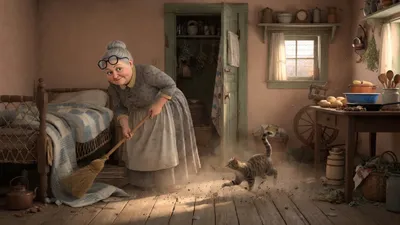
Before you read — think about:
- The book opens with an adult calling a child's name and getting no answer. What does that tell you about the household before you have read a single scene?
- What is the difference between being raised by a parent and being raised by a relative who took you in? How might the rules feel different from both sides?
- Who else lives in your household, and how are the rules different for each of you?
- In a small river town in the 1840s, a boy had chores, school, and long unsupervised hours in between. What would you do with hours like that?
- Is a restless, bored child the same thing as a badly behaved one? How would an adult around you tell the two apart?
Watch for these while reading:
- Aunt Polly's spectacles, and the narrator's joke about what she actually uses them for.
- Tom's technique for getting out of trouble — notice where he sends an adult's attention rather than what he denies.
- The threaded needles in the lapel of Tom's jacket, and how much quiet planning a small detail like that represents.
- Sid's manner toward Tom, and what being the well-behaved brother seems to be worth to him.
- How St. Petersburg treats a stranger, and what that reaction says about how small and closed this world is.
Vocabulary to know:
spectacles (noun) — eyeglasses; perplexed (adjective) — puzzled and unable to figure something out; resurrected (verb) — brought something up or out of hiding, as if bringing it back from the dead; conscience (noun) — the inner sense that tells a person whether they are doing right or wrong; guile (noun) — sly, tricky cleverness used to fool someone; diplomacy (noun) — careful, indirect handling of people to get what you want; cunning (noun) — sneaky skill at getting the better of someone; forestalled (verb) — headed something off by acting before it could happen; sagacity (noun) — sharp good judgment; shrewdness; diligence (noun) — steady, careful effort; unalloyed (adjective) — pure; not mixed with anything that would spoil it; natty (adjective) — neat, stylish, and smartly dressed; pantaloons (noun) — trousers; derision (noun) — open mockery or scorn; ambuscade (noun) — an ambush; someone waiting in hiding to catch you; adamantine (adjective) — unbreakably hard and firm; roundabout (noun) — a short, close-fitting jacket worn by boys; constituted (verb) — made up; formed the whole of something; peril (noun) — serious danger; torment (verb) — to annoy or pester someone until they lose patience; ruination (noun) — the complete spoiling or destruction of someone or something; vanity (noun) — too much pride in one's own abilities or appearance; endowed (verb) — naturally given a particular talent or quality; contemplate (verb) — to look at or think about something with satisfaction.
Chapter 2: Whitewashing the Fence
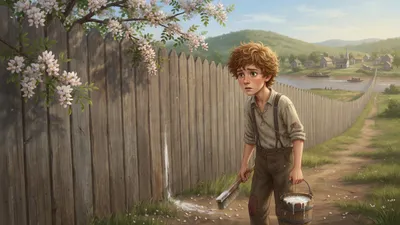
Before you read — think about:
- What chores are you expected to do at home, and how did the people around you settle on those being yours?
- In the 1840s a freshly whitewashed fence was a mark of a respectable household. What does a neighbourhood judge a house by now?
- Which jobs around a house are visible to visitors, and does that change how carefully they get done?
- Describe the difference between how a free Saturday feels and how a Saturday with a job in it feels.
- If a whole Saturday of yours were taken by a chore, what would you trade to get out of it — and what would you refuse to trade?
Watch for these while reading:
- The measurements Twain gives the fence at the start — thirty yards long, nine feet high — and how numbers set a mood.
- Tom's brush technique whenever he has an audience: the stepping back, the squinting, the small added touches.
- The inventory of odds and ends the village boys carry in their pockets; Twain lists it in full for a reason.
- How Jim is spoken to and spoken about, and where the power sits in that exchange.
- The narrator stepping out of the story to state a 'great law of human action' in his own voice.
Vocabulary to know:
whitewash (noun) — a thin white paint made from lime and water, used on fences and walls; melancholy (noun) — a heavy, gloomy sadness; skylarking (verb) — playing around and fooling about instead of working; taw (noun) — a large marble used for shooting at the others; alacrity (noun) — cheerful eagerness to do something; dilapidated (adjective) — falling apart from age or neglect; covet (verb) — to want badly something that belongs to someone else; decanter (noun) — a fancy glass bottle for serving drinks; reposeful (adjective) — calm and restful; delectable (adjective) — delightful; extremely appealing; insignificant (adjective) — so small it hardly matters; vigor (noun) — strong, lively energy; ridicule (noun) — cruel teasing meant to make someone look foolish; straitened (adjective) — very limited, especially in money; tranquilly (adverb) — calmly and peacefully; gait (noun) — a person's way of walking; melodious (adjective) — pleasant-sounding, like music; personating (verb) — acting the part of someone or something; ponderously (adverb) — in a slow, heavy way; laborious (adjective) — requiring a lot of effort; done with heavy care; pomp (noun) — grand, showy display; starboard (noun) — the right-hand side of a boat as you face forward; reluctance (noun) — unwillingness to do something; comprehended (verb) — fully understood.
Chapter 3: A Battle Won and a Heart Lost
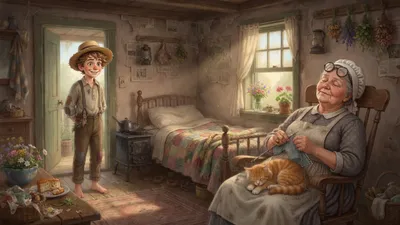
Before you read — think about:
- How does it feel to be praised for something you did not honestly earn? Does the praise still count for anything?
- What does a first crush look like from the outside, and why is it obvious to everyone except the person having it?
- What does it feel like to be near somebody who is showing off, and why is it hard to look away?
- How do brothers, sisters, or cousins compete for the same adult’s approval?
- How do you tell the difference between somebody who likes you and somebody who is only being polite?
Watch for these while reading:
- How fast Tom's attention moves from one object of affection to another, and the words he uses for each feeling at the time.
- The pansy, and where Tom carries it.
- The difference between the way Aunt Polly speaks to Tom and the way she speaks to Sid.
- How Tom spends the evening after he leaves the garden, and the mood he works himself into.
- How the boys organize their two armies, and the rank Tom gives himself.
Vocabulary to know:
intrepid (adjective) — fearless and bold; pantalettes (noun) — long frilled underpants worn by girls, showing below the dress; frock (noun) — a dress; furtive (adjective) — secret and sneaky, done so as not to be noticed; pathos (noun) — a quality that stirs up pity and sadness; felicity (noun) — great happiness; tallow (noun) — hardened animal fat used to make cheap candles; elaborately (adverb) — in a detailed, carefully worked-out way; diluted (verb) — weakened something by mixing in something else; virtuous (adjective) — morally good and honest; clods (noun) — lumps of dirt or clay; faculties (noun) — a person's mental powers; their wits; sally (verb) — to rush out suddenly; condescend (verb) — to lower oneself to do something considered beneath one's dignity; eminence (noun) — a piece of rising ground; a small hill; plaited (verb) — braided; evanescent (adjective) — lasting only a very short time before fading away; partiality (noun) — a mild liking or preference for someone; adoration (noun) — deep love and worship; grotesque (adjective) — strange and ridiculous-looking; threshold (noun) — the strip of floor at the bottom of a doorway; pliant (adjective) — bending easily; flexible.
Chapter 4: Showing Off at Sunday School
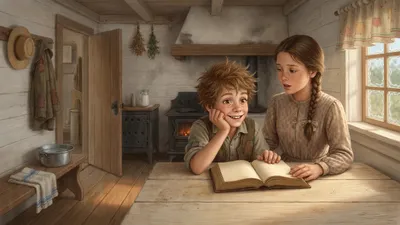
Before you read — think about:
- What is memorizing good for, and what does it fail to teach?
- Why do reward systems — points, stickers, badges, streaks — grip some people completely and leave others cold?
- Think of a time an adult was really performing for other adults while pretending to speak to you. What gave it away?
- In a village this size, a visitor from twelve miles off could count as a celebrity. What does that say about how much of the world these people ever see?
- Who was introduced to you as an important person when you were small, and what made them seem important?
Watch for these while reading:
- The Sunday-school ticket system: how it works, what the colors are worth, and what a Bible costs in tickets.
- How many different people in this chapter are showing off, and who each of them is performing for.
- Mr. Walters the superintendent, and the special voice he keeps for visitors.
- Amy Lawrence, and where she is looking while the attention of the room is on Tom.
- Judge Thatcher's arrival, and the way the whole room rearranges itself around him.
Vocabulary to know:
benediction (noun) — a blessing; eclat (noun) — dazzling public glory; pulpit (noun) — the raised platform a preacher speaks from; cravat (noun) — a wide necktie or neckcloth; portly (adjective) — heavy and dignified in build; prodigious (adjective) — enormously great or impressive; preposterous (adjective) — completely ridiculous; mortar (noun) — the paste used to hold bricks or stones together; traversing (verb) — traveling across a wide area; prospective (adjective) — expected in the future; convulsion (noun) — a sudden violent shaking; inconceivable (adjective) — impossible to imagine; grandeur (noun) — impressive greatness or splendor; counterfeited (verb) — copied dishonestly in order to fool someone; imposing (adjective) — grand enough to make an impression; contrived (verb) — managed to do something with a bit of scheming; scarify (verb) — to scratch or cut the surface of something; bureau (noun) — a chest of drawers; disconcerted (adjective) — thrown off balance; embarrassed; resolution (noun) — firm determination; groping (verb) — feeling about blindly with the hands; testimony (noun) — evidence that proves something happened.
Chapter 5: The Pinchbug in Church
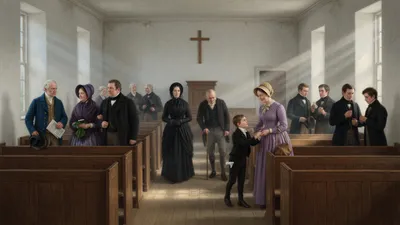
Before you read — think about:
- What do people actually do with their minds during a long ceremony they are required to attend but have no interest in?
- Why is keeping a straight face hardest exactly when laughing is forbidden?
- How does a community display its pecking order through something as ordinary as who walks into a room, and when?
- Have you ever counted things — tiles, minutes, pages — just to get through an event? What does that habit say about attention?
- What is the difference between behaving well and actually listening? Which one do adults usually check for?
Watch for these while reading:
- The order in which the townspeople come into church, and what that order tells you about St. Petersburg.
- Willie Mufferson, the Model Boy, and the detail Twain adds about his handkerchief.
- The minister's prayer — the sweep of people and causes it covers, and Twain's tone while reporting it.
- The narrator's asides about American customs; he keeps stepping outside the story to comment on them.
- The stray dog wandering the aisles, and how much of the congregation's attention the sermon still holds by then.
Vocabulary to know:
venerable (adjective) — old and deserving respect; vestibule (noun) — the small entrance hall of a building; congregation (noun) — the group of people gathered for a church service; pinchbug (noun) — Tom's name for a large biting beetle; parson (noun) — a minister of a church; simpering (verb) — smiling in a silly, self-satisfied way; gantlet (noun) — a punishing double line a person has to pass between; heedful (adjective) — careful and attentive; matrons (noun) — respectable married women; laggards (noun) — people who are slow or late; stragglers (noun) — people trailing behind the main group; ill-bred (adjective) — badly mannered; sociables (noun) — informal social gatherings held by a church; despotisms (noun) — governments run by cruel absolute rulers; tidings (noun) — news; supplication (noun) — a humble, earnest request; fertile (adjective) — able to produce a good crop; restive (adjective) — restless and unable to keep still; clergyman (noun) — a minister or priest; interlarded (verb) — mixed in among other things; scoundrelly (adjective) — behaving like a dishonest rascal; monotonously (adverb) — in a dull, unchanging tone.
Chapter 6: Huckleberry Finn and the Dead Cat
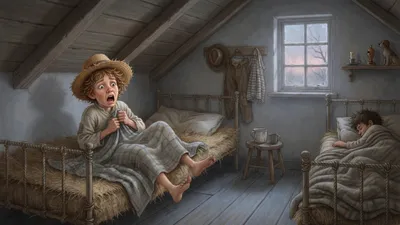
Before you read — think about:
- What were medicine and dentistry like for children before anaesthetic? What would you have dreaded most?
- Why do children so often envy the one person the adults most disapprove of?
- What is a superstition, and why do they survive even among people who admit they do not work?
- Think about how a piece of news travels through a group of friends. How much of it is still intact by the fifth retelling?
- Who is the freest person you know, and what do they give up in exchange for it?
Watch for these while reading:
- Tom's inventory of his own body for symptoms, and the order in which he checks himself over.
- The exact freedoms Twain lists while describing Huckleberry Finn — the list itself is the point.
- The boys' wart cures: the steps, the words, the timing, and how fiercely each version is defended.
- How long the two boys are willing to stand in the lane talking, and what they are willing to trade while they talk.
- Mr. Dobbins's schoolroom — the seating, the switch, and what a latecomer has to face in front of everybody.
Vocabulary to know:
expectorate (verb) — to spit; pariah (noun) — someone rejected and avoided by everyone; spunk-water (noun) — rainwater collected in a rotten tree stump, believed to cure warts; ferule (noun) — a flat ruler used to punish schoolchildren; intervening (adjective) — coming in between two things; captivity (noun) — the state of being shut in and unable to leave; fetters (noun) — chains for the feet; anything that restricts freedom; odious (adjective) — hateful and disgusting; canvassed (verb) — examined thoroughly, part by part; ailment (noun) — an illness, usually a minor one; colicky (adjective) — having sharp stomach pains; exertions (noun) — hard physical efforts; succession (noun) — a series of things following one after another; aggravated (adjective) — annoyed; mortified (adjective) — of flesh: dead and rotting; outrageousness (noun) — shockingly bad behavior; compensations (noun) — things that make up for a loss; adherent (noun) — a loyal follower; shorn (adjective) — stripped of something; disdain (noun) — scorn; a feeling that something is beneath you; dismantled (adjective) — taken apart; stripped of what made it work; juvenile (adjective) — young; of or for children.
Chapter 7: A Tick, a Kiss, and a Broken Engagement
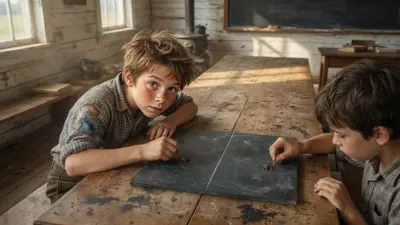
Before you read — think about:
- What is the hardest part of sitting still? Be specific about what your body and your mind do.
- What is the appeal of a secret shared between exactly two people?
- How do children work out what romance is supposed to look like when nobody ever explains it to them?
- How does the weather or the time of year change the mood of a classroom?
- What do people your age argue about most often, and how do those arguments usually end?
Watch for these while reading:
- Tom's efforts to keep his mind on his lessons, and the precise things that pull it away.
- The rules Tom lays out for being engaged, and where a boy his age could possibly have picked them up.
- The tick, the pin, and the two heads bent over one desk — the pleasure of a very small game.
- The brass andiron knob Tom offers, and what he seems to think it is worth.
- The schoolroom on a drowsy summer afternoon: the heat, the droning, and what Twain notices about a class that is not learning.
Vocabulary to know:
recess (noun) — a break between school lessons; scholars (noun) — pupils; schoolchildren; shimmering (adjective) — shining with a wavering, unsteady light; dreary (adjective) — dull and depressing; premature (adjective) — happening too soon; bosom (adjective) — closest and dearest; embattled (adjective) — set against each other in battle; momently (adverb) — from moment to moment; steadily; deftly (adverb) — with quick, skillful movement; equator (noun) — the boys' name for the dividing line drawn down the middle of the slate; abide (verb) — to stay or remain; wane (verb) — to fade or grow less; contentment (noun) — quiet happiness; engaged (adjective) — promised to marry someone — in Tom's version, a private agreement sealed with a kiss; consent (noun) — agreement or permission; timidly (adverb) — shyly and nervously; submitted (verb) — gave in; stopped resisting; blunder (noun) — a careless mistake; repulsed (verb) — pushed away; rejected; repent (verb) — to feel sorry for something you have done; nerved (verb) — gathered the courage to do something; smote (verb) — struck with a sudden strong feeling; andiron (noun) — a metal stand that holds logs in a fireplace; upbraid (verb) — to scold, sometimes yourself; intently (adverb) — with close, focused attention.
Chapter 8: The Black Avenger of the Spanish Main
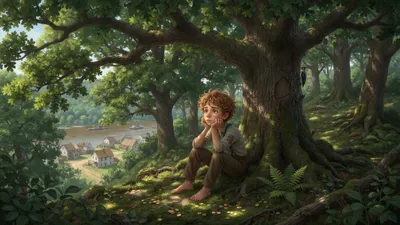
Before you read — think about:
- Where do you go when you want to feel sorry for yourself, and why does the place matter?
- What is the appeal of imagining a completely different life for yourself? What do those daydreams have in common?
- What is the difference between believing a superstition and needing to believe one?
- Why do children's games so often follow a script borrowed from a book, a film, or a show rather than being invented from scratch?
- What is the difference between a game you play by yourself and a game you play in front of somebody?
Watch for these while reading:
- The careers Tom tries on for himself in his head, in order, and the reason each one is set aside for the next.
- The rules of the marble charm: the words, the waiting, and how strictly Tom keeps to them.
- The doodle-bug Tom consults, and the kind of authority a boy is willing to grant a small insect.
- The Robin Hood game and its script — who is allowed to change the rules, and who has the last word on them.
- The title Tom awards himself, and how much rehearsal you can hear in it.
Vocabulary to know:
superstition (noun) — a belief in magic or luck rather than in evidence; insensibly (adverb) — so gradually that you do not notice; frivolity (noun) — silly, unserious behavior; illustrious (adjective) — famous and admired for great deeds; trackless (adjective) — having no paths or roads; bristling (verb) — covered thickly with things sticking out; unappeasable (adjective) — impossible to satisfy or calm; grisly (adjective) — grim and horrifying; zenith (noun) — the highest point; doublet (noun) — a close-fitting jacket worn in earlier centuries; cutlass (noun) — a short curved sword used by sailors; plumes (noun) — large decorative feathers; unfurled (adjective) — spread open, as a flag is; incantation (noun) — a set of magic words spoken as a charm; pettishly (adverb) — in a sulky, irritable way; cogitating (verb) — thinking hard about something; infallible (adjective) — never wrong; certain to work; lath (noun) — a thin narrow strip of wood; accoutrements (noun) — equipment and gear.
Chapter 9: Midnight in the Graveyard

Before you read — think about:
- What does a house sound like at night when you are lying awake waiting for something? Why do those sounds seem to mean so much?
- Why do people tell each other frightening stories in exactly the places where they are already frightened?
- What did people in the 1840s believe about graveyards at night, and where do you think those beliefs came from?
- Why do two people who are frightened together behave differently from one person frightened alone?
- In a village in the 1840s, who was expected to be indoors after dark, and who was not? What did that rule say about the town?
Watch for these while reading:
- Every small night sound Tom notices while he waits, and the meaning he attaches to each one.
- Twain's description of the graveyard itself — the crazy fence, the sunken graves, the grass, the wind.
- What the boys believe about devils, and the test they use to decide whether one is nearby.
- What the two boys whisper about while they wait, and the subjects they keep returning to.
- How Twain uses silence, whispering, and darkness to control the speed of the chapter.
Vocabulary to know:
death-watch (noun) — a beetle whose ticking in old wood was believed to foretell a death; dismally (adverb) — gloomily; caterwauling (noun) — the harsh wailing of cats; worm-eaten (adjective) — riddled with holes made by insects; ensconced (verb) — settled snugly into a sheltered place; spangles (noun) — small glittering specks of light; handbarrow (noun) — a flat frame with handles that two people carry between them; pallid (adjective) — unnaturally pale; corpse (noun) — a dead body; ruffian (noun) — a violent, lawless man; inarticulately (adverb) — without forming clear words; stolid (adjective) — showing no emotion at all; blubbering (noun) — noisy crying; impatience (noun) — restless inability to wait; despair (noun) — complete loss of hope; fidgeted (verb) — moved restlessly; muffled (adjective) — made quieter, as if covered; chamber (noun) — a bedroom.
Chapter 10: The Blood Oath
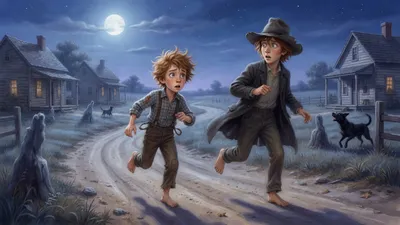
Before you read — think about:
- When two people share a frightening secret, what do they settle first — what to do about it, or that they will never speak of it?
- Why do promises sometimes get written down, signed, or sealed with a ceremony? What does the ritual add that a spoken word does not?
- How does fear change the meaning of ordinary things — a stray dog, a creaking board, a footstep in the road?
- When you cannot sleep, what do you do with the hours until morning?
- Who do you tell when something frightens you, and how do you choose that person?
Watch for these while reading:
- The reasoning the two boys use on each other, and which of them is supplying most of it.
- The wording Tom writes out, the way he writes it, and what the boys believe those words are able to do.
- The stray dog, and how many different meanings two frightened boys can pull out of one animal.
- How much of the boys' fear comes from what they saw and how much from what they believe about signs and omens.
- Aunt Polly's manner toward Tom that night, and Sid's contribution to the morning.
Vocabulary to know:
apprehensively (adverb) — nervously, expecting something bad; outlying (adjective) — lying at the edge of a town or area; tannery (noun) — a workshop where animal hides are turned into leather; exhausted (adjective) — completely worn out; mum (adjective) — silent; saying nothing; huff (noun) — a fit of offended anger; facility (noun) — the ability to do something easily and well; sublimity (noun) — grand and awe-inspiring quality; oath (noun) — a solemn, binding promise; lugubrious (adjective) — mournful in an exaggerated way; quailed (verb) — lost courage; flinched; audible (adjective) — loud enough to be heard; snuffle (verb) — to sniffle while crying; writhed (verb) — twisted the body about; weather-boarding (noun) — overlapping boards nailed to the outside of a building; whippoorwill (noun) — a night bird named for its call, thought to bring bad luck indoors; escapade (noun) — a wild or reckless adventure; bodings (noun) — feelings that something bad is about to happen; rebuke (noun) — a sharp scolding; averted (adjective) — turned away; culprit (noun) — the guilty one; flogged (verb) — beaten with a whip or switch as punishment; dismissal (noun) — being sent away; revengeful (adjective) — wanting to get even; persecuted (verb) — pestered or harassed without letup; moped (verb) — moved about gloomily; betook (verb) — took himself; went; colossal (adjective) — enormous.
Chapter 11: Muff Potter Accused
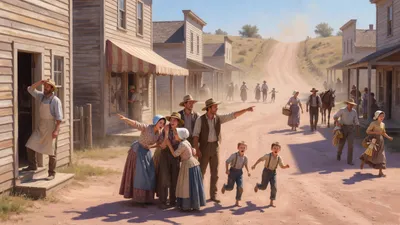
Before you read — think about:
- How fast does news travel through a school or a neighborhood, and how much of it is still accurate by the end of the day?
- What makes a crowd decide someone is guilty before any evidence has been examined?
- Why do people go to look at the scene of something terrible, even when they would rather not see it?
- How does a small town decide who its outsiders are, and what happens to them when something goes wrong?
- If you have ever changed your mind about somebody most people disliked, what changed it?
Watch for these while reading:
- How the town travels from rumor to settled opinion, and what counts as evidence along the way.
- Twain's tone while he describes the crowd at the graveyard — work out where the satire is aimed.
- What the boys believe about oaths, and where those beliefs come from.
- Sid's interest in the way Tom sleeps, and Aunt Polly's explanation for it.
- Where Tom’s conscience shows itself, given how little he says about it.
Vocabulary to know:
inquest (noun) — an official inquiry into a death; coroner (noun) — the official who investigates suspicious deaths; unaccountable (adjective) — impossible to explain; infernal (adjective) — hellish; outrageous; impudence (noun) — shameless boldness; haggard (adjective) — gaunt and worn from worry or exhaustion; palsy (noun) — uncontrollable trembling; nerveless (adjective) — limp and without strength; vanquished (adjective) — completely defeated; miscreant (noun) — a wicked person; balefully (adverb) — in a way that threatens harm; blanched (verb) — went pale; irksome (adjective) — annoying and tiresome; disjointed (adjective) — disconnected and rambling; aversion (noun) — a strong dislike that makes you avoid something; vogue (noun) — popular fashion of the moment; grated (adjective) — fitted with iron bars; electrified (verb) — shocked into sudden excitement.
Chapter 12: Tom and the Pain-Killer
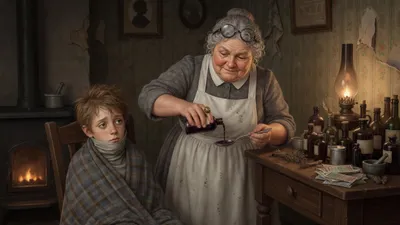
Before you read — think about:
- What did people do about illness before modern medicine? How would you tell a real cure from a useless one?
- When you are unwell, who decides what happens to you, and how much say do you get?
- How do you tell whether a person is genuinely unwell or simply unhappy? Do the adults around you always get it right?
- Have you ever kept doing something that plainly was not working because stopping felt worse? What kept you going?
- What do you know about how medicines are tested today? Who decides that one works?
Watch for these while reading:
- Aunt Polly's health periodicals, and the confidence with which she applies whatever this month's issue recommends.
- The full sequence of treatments, in order, and the way she judges whether each one is working.
- Twain's running joke about patent medicine, and who he is really aiming it at.
- Peter the cat, and how much attention Twain is willing to give an animal in a book about boys.
- The schoolyard gate before the bell, and how long Tom is prepared to loiter at it.
Vocabulary to know:
phrenological (adjective) — relating to the false science of reading character from bumps on the skull; infatuated (adjective) — unreasonably enthusiastic about something; new-fangled (adjective) — newly invented, in a way that seems suspicious to some; inveterate (adjective) — long-established in a habit; unable to stop; periodicals (noun) — magazines or journals published at regular intervals; frauds (noun) — things that are not what they claim to be; customarily (adverb) — usually; as a matter of habit; quack (adjective) — falsely claiming medical skill or benefit; metaphorically (adverb) — as a figure of speech rather than literally; balm (noun) — a soothing ointment; anything that heals; windfall (noun) — an unexpected piece of good fortune; dejected (adjective) — low in spirits; consternation (noun) — alarmed dismay; professing (verb) — claiming, often untruthfully; clandestinely (adverb) — secretly; avariciously (adverb) — greedily; petrified (adjective) — frozen stiff with shock; expiring (verb) — dying — used jokingly for being overcome; divined (verb) — guessed correctly; valance (noun) — a short cloth hanging around the frame of a bed; numskull (noun) — a fool; crestfallen (adjective) — suddenly ashamed and dejected.
Chapter 13: The Pirates Sail for Jackson's Island

Before you read — think about:
- Why is running away such an appealing idea and so rarely carried through?
- How do friends talk each other into a plan that none of them would start alone?
- How do children decide which grown-up life sounds most glamorous, and where does the information come from?
- If you were leaving tonight for good, what three things would you take, and why those three?
- Where do you think the line between borrowing and stealing sits, and who gets to draw it?
Watch for these while reading:
- Tom's reasons for going and Joe Harper's reasons, and how much the two boys actually have in common.
- Everything the boys bring with them, and where each item was obtained.
- The titles the boys give themselves, and the ceremony they build around using them.
- The password and the countersign, and how faithfully the whole performance is kept up in the dark.
- Huck's contribution to the expedition, and how differently he treats the whole business from the other two.
Vocabulary to know:
rendezvous (noun) — an agreed meeting place; forsaken (adjective) — abandoned by everyone; transpired (verb) — turned out; came to light; succumb (verb) — to give in; compact (noun) — a formal agreement between people; hermit (noun) — someone who lives alone, far from other people, often for religious reasons; conceded (verb) — admitted that someone else was right; inhabited (adjective) — lived in by people; abreast (adverb) — alongside; level with; unpeopled (adjective) — empty of people; undergrowth (noun) — low bushes growing beneath trees; bluff (noun) — a steep bank or cliff; countersign (noun) — a secret password used to prove who you are; simultaneously (adverb) — at the same time; brooding (adjective) — heavy and threatening in mood; smouldering (adjective) — burning slowly without flame; thither (adverb) — to that place; stealthily (adverb) — quietly and secretly; spree (noun) — a period of wild fun or drinking; amidships (adverb) — in the middle of a boat; dauntless (adjective) — fearless; avert (verb) — to prevent something bad from happening.
Chapter 14: Camp Life and Homesickness

Before you read — think about:
- What is the first morning in a new place actually like? What do you notice there that you would never notice at home?
- Why does food taste better outdoors? How much of that is really the food?
- What do you actually need in a day, as opposed to what you are simply used to having?
- Describe an outdoor place you know well. What does it sound like early in the morning?
- How do you behave differently when you know no adult is going to check on you?
Watch for these while reading:
- How much of the island's morning Twain describes before any boy says a word.
- The small creatures Tom watches in the grass, and the meaning he assigns to each of them.
- How the three boys fill the empty hours — swimming, fishing, exploring — and which of them needs filling most.
- The sound carrying across the water from the direction of the village, and the boys' first guesses at it.
- The island at night: the fire, the river, and how the three of them settle — or fail to settle — for sleep.
Vocabulary to know:
skiffs (noun) — small light rowboats; sycamore (noun) — a large tree with thin, peeling white bark; obtruded (verb) — pushed in where it was not wanted; manifested (verb) — showed itself clearly; musing (adjective) — thoughtful and dreamy; decisively (adverb) — in a way that settles the matter; credulous (adjective) — willing to believe almost anything; conflagrations (noun) — large destructive fires; tumblebug (noun) — a beetle that rolls a ball of dung; rioting (verb) — making a wild, joyful uproar; trilled (verb) — sang with a quivering musical sound; rapture (noun) — overwhelming joy; shrill (adjective) — high and piercing in sound; consuming (adjective) — so strong it takes over completely; limpid (adjective) — perfectly clear; ravenous (adjective) — extremely hungry; substitute (noun) — a replacement for something; underbrush (noun) — the tangle of small plants under trees; monarchs (noun) — kings — here, the greatest trees of the forest; regalia (noun) — the robes and ornaments of royalty; channel (noun) — a narrow stretch of water between two shores; sumptuously (adverb) — richly and generously.
Chapter 15: Tom's Secret Visit Home

Before you read — think about:
- How would a person cross a wide river alone at night in the 1840s? What would the risks be?
- What does your home sound like after everyone else has gone to bed?
- Why do people keep a plan to themselves even when telling somebody would make it easier?
- What is the difference between comforting someone and being seen to comfort them?
- What is the difference between a secret you keep to protect somebody and one you keep because you enjoy holding it?
Watch for these while reading:
- The Mississippi at night — the current, the ferryboat, the skiff, and what it took to get from one bank to the other in the 1840s.
- The words the two mothers use about their sons, and the difference between the two women.
- Sid's remarks in that room, and how Aunt Polly answers them.
- The bark scroll in Tom's pocket, and how often his hand goes to it.
- How Twain writes a room at night — the candle, the sewing, the long silences between remarks.
Vocabulary to know:
shoal (adjective) — shallow; quartering (verb) — moving at an angle across a current; thwarts (noun) — the crosswise seats in a small boat; swell (noun) — the rolling wave pushed out by a moving boat; unfrequented (adjective) — rarely used or visited; harum-scarum (adjective) — wild and reckless; colt (noun) — a young horse; devilment (noun) — mischief; recollecting (verb) — remembering; theatrical (adjective) — showy, like a scene on a stage; gorgeousness (noun) — splendid, dazzling quality; conjectured (verb) — guessed without proof; lodged (verb) — stuck fast in a place; perished (verb) — died; came to an end; fruitless (adjective) — producing no result; bereaved (adjective) — grieving for someone who has died; consoling (adjective) — comforting; wont (noun) — a person's usual habit; measureless (adjective) — boundless; weltering (verb) — soaking; awash; unrestfully (adverb) — restlessly; scroll (noun) — a rolled-up piece of writing material; lingered (verb) — stayed a moment longer; tenantless (adjective) — empty of occupants.
Chapter 16: A Storm on Jackson's Island

Before you read — think about:
- What is the wildest weather you have ever been outside in? What did it do to you?
- What does boredom actually feel like? Where in your day do you notice it first?
- What rules do you keep even when nobody is watching, and where did those rules come from?
- Why do people try things they have been told they will not enjoy?
- How does a group behave during a genuinely frightening event, and how do they describe it to each other afterward?
Watch for these while reading:
- The point at which the games stop working, and what each of the three boys does with himself then.
- Tom's rattlesnake rattles, and what he believes they are good for.
- The word Tom writes in the sand with his big toe, and then rubs out again.
- The boys' first experiments with tobacco, and the vocabulary they invent for talking about it.
- Twain's description of the storm — its length, its verbs, and the way the sentences pick up speed.
Vocabulary to know:
sputtering (verb) — spitting and coughing out water or air; sprawl (verb) — to lie stretched out carelessly; venture (verb) — to risk doing something; cramp (noun) — a sudden painful tightening of a muscle; longingly (adverb) — with a strong ache of wanting; downhearted (adjective) — discouraged and low; seductions (noun) — attractive offers used to win someone over; moodily (adverb) — in a sulky, gloomy way; discomforting (adjective) — unsettling; making you uneasy; ominous (adjective) — warning of trouble to come; plausible (adjective) — sounding reasonable, whether or not it is true; stupendous (adjective) — astonishingly great; novices (noun) — complete beginners; charily (adverb) — cautiously; sparingly; inundation (noun) — a flood; utterance (noun) — the act of speaking; bode (verb) — to be a sign of something coming; stifling (adjective) — so hot and airless it is hard to breathe; weird (adjective) — eerie; strange in an unearthly way; peal (noun) — a loud rolling burst of sound; rumblings (noun) — low continuous rolling sounds; broadcast (adverb) — scattered widely in every direction.
Chapter 17: The Boys Attend Their Own Funeral

Before you read — think about:
- What changes about the way a town speaks and moves when everybody in it is feeling the same thing at once?
- Why do people remember someone differently once that person is gone? Is the kinder version dishonest?
- Have you ever wished you could take back the last thing you said to somebody?
- What is the difference between being sorry and wanting to be seen being sorry?
- How does a community you belong to mark an important event? What are its rituals?
Watch for these while reading:
- Becky alone in the schoolyard, and the small object she wishes she had kept.
- The competition among the children over who spoke to the boys last.
- The way the minister describes the three of them, and how the congregation takes it.
- The church itself — the bell, the rustling, the pauses Twain sets between his sentences.
- Where Huck is standing while the other two families are occupied, and how much of the town's attention reaches him.
Vocabulary to know:
hilarity (noun) — loud cheerfulness; mourning (noun) — the black clothing and behavior of people grieving a death; ordinarily (adverb) — usually; soliloquized (verb) — spoke aloud to oneself; paling (noun) — a fence of upright pointed stakes; prophecy (noun) — a prediction of the future; tampered (verb) — interfered with in order to change something; ultimately (adverb) — in the end; distinction (noun) — an honor that sets someone apart; departed (noun) — the people who have died; loitered (verb) — hung about with nothing to do; toll (verb) — to ring a bell slowly, as for a death; Sabbath (noun) — the weekly day of rest and worship; mournful (adjective) — full of sorrow; funereal (adjective) — solemn and gloomy, like a funeral; expectant (adjective) — waiting for something to happen; dumbness (noun) — total silence; communing (adjective) — sharing a quiet moment together; graces (noun) — attractive good qualities; pang (noun) — a sudden sharp feeling; persistently (adverb) — again and again, without stopping; rascalities (noun) — acts of mischief; cowhide (noun) — a leather whip; pathetic (adjective) — causing pity and sadness.
Chapter 18: Tom's Dream and Becky's Revenge
Before you read — think about:
- What makes a story believable? List the things that make you trust one.
- What does sudden fame do to somebody's behavior in the first week of having it?
- Is it possible to hurt someone deliberately and be stung by their reaction at the same time?
- When you are angry with a friend, what do you do with the anger?
- Twain keeps showing children copying adult behaviour. What adult habits do you notice young people imitating?
Watch for these while reading:
- How Tom tells his 'dream', and how much of the story Aunt Polly supplies for him along the way.
- Sid's one remark, and the thought he decides to keep to himself.
- Amy Lawrence's afternoon, and how much of Tom's attention is actually with her.
- The picnic Becky is planning, and who is being told about it and how loudly.
- Alfred Temple, and the way a quarrel between two children makes use of a third.
Vocabulary to know:
invalided (adjective) — broken down and put out of service; attentive (adjective) — carefully looking after someone's needs; hard-hearted (adjective) — unfeeling toward others; grieved (adjective) — hurt and sorrowful; discomforted (verb) — made uneasy; repentant (adjective) — sorry for what you have done; prophesying (verb) — foretelling things by divine inspiration; audibly (adverb) — loudly enough to be heard; long-suffering (adjective) — patient through a great deal of trouble; merciful (adjective) — showing forgiveness and compassion; unworthy (adjective) — not deserving something good; realism (noun) — the habit of dealing only in hard facts; swagger (noun) — a proud, showy way of walking; tolerated (verb) — put up with; menagerie (noun) — a traveling collection of wild animals; swarthy (adjective) — darkly tanned; glittering (adjective) — brilliantly shining; insufferably (adverb) — unbearably; stuck-up (adjective) — conceited; distinguished (adjective) — famous and respected; vicious (adjective) — spiteful; meanly cruel; irresolutely (adverb) — without being able to decide.
Chapter 19: Telling Aunt Polly the Truth
Before you read — think about:
- What makes an adult decide that a child is telling the truth? What signs do they look for?
- Is there a difference between lying to someone and letting them believe something flattering?
- Why is 'I didn't think' both the commonest excuse children offer and the least satisfying one?
- Who in your family is easiest to disappoint, and why does that land harder than being told off?
- What would it take to make you believe a person who has lied to you before?
Watch for these while reading:
- How a clever joke looks different once Tom is standing on his aunt's side of the room.
- Aunt Polly's manner in this scene set against the way she spoke to Tom in chapter one.
- What Aunt Polly wants to be true, and what she is prepared to do about that wish.
- The jacket hanging in the closet, and how many times her hand goes toward it.
- How short this chapter is, and what Twain gains by setting it between two long ones.
Vocabulary to know:
unpromising (adjective) — not likely to give a good result; notion (noun) — an idea or impulse; behold (verb) — to look at; used in the phrase 'lo and behold' for a surprise; aspect (noun) — a particular side or view of something; smartness (noun) — cleverness, especially the showing-off kind; ingenious (adjective) — cleverly invented; shabby (adjective) — unworthy; not decent behavior; selfishness (noun) — caring only about yourself; uneasy (adjective) — worried and unsettled; tremor (noun) — a slight shaking; tenderness (noun) — gentle affection; dawned (verb) — began to appear, like the first light of morning; refrained (verb) — held back from doing something; fortified (verb) — strengthened; braced; garment (noun) — a piece of clothing; sought (verb) — searched for.
Chapter 20: Tom Takes Becky's Whipping
Before you read — think about:
- Why is a locked drawer in a classroom more interesting than anything else in the room?
- What makes a secret spread through a classroom, and what makes one stay put?
- What punishments existed in schools in the 1840s, and what were they meant to achieve?
- Why do people deny things out of pure habit, even when the truth would cost them nothing?
- What makes an act of courage impressive — the risk, the audience, or the reason behind it?
Watch for these while reading:
- The apology at the top of the chapter, and the way it is received.
- Mr. Dobbins's book, why a village schoolmaster owns it, and what the children have decided is inside.
- How Twain builds up the rules around that desk and that key before anyone touches either.
- Mr. Dobbins's method for questioning a whole schoolroom one pupil at a time.
- Twain's handling of time in this chapter — where he slows the telling right down, and where he skips ahead.
Vocabulary to know:
scornfully (adverb) — with open contempt; trounce (verb) — to beat thoroughly; encountered (verb) — ran into; stinging (adjective) — sharply hurtful; hurled (verb) — threw with force; breach (noun) — a break in a relationship; resentment (noun) — bitter anger at being wronged; decreed (verb) — decided officially, as if by law; engraved (adjective) — printed from a carved plate; frontispiece (noun) — an illustration facing the title page of a book; stark (adverb) — completely; utterly; flustered (adjective) — flustered means confused and rattled; onslaught (noun) — a fierce attack; thin-skinned (adjective) — easily hurt or offended; backbone (noun) — courage; the strength to hold firm; conned (verb) — studied over carefully; lethargy (noun) — a dull, drained state with no energy; denial (noun) — a statement that something is not true; principle (noun) — a rule a person sticks to on purpose; languidly (adverb) — slowly and without energy; absently (adverb) — without paying attention; levelled (adjective) — aimed straight at something; paralyzed (verb) — made completely unable to act; scanned (verb) — looked over searchingly.
Chapter 21: Examination Day
Before you read — think about:
- How do adults behave differently when they know other adults are judging them?
- What happens to a class when the teacher is under pressure to make it look good in public?
- Why do school performances reward the same style of writing and speaking year after year?
- What is the difference between learning something and being able to perform it on demand?
- What does a school choose to show off to parents, and what does it keep out of sight?
Watch for these while reading:
- How Mr. Dobbins treats the small pupils compared with the big ones as examination day comes closer.
- The master's bald head, and the amount of attention Twain gives it before the evening begins.
- The recitations — the pieces chosen, the gestures taught, and Twain's very thin patience with both.
- The pattern every young lady's composition follows, and the note each one is obliged to close on.
- The audience of parents and visiting dignitaries, and how much of the whole evening is really staged for them.
Vocabulary to know:
wig (noun) — false hair worn on the head; exacting (adjective) — demanding very high standards; lashing (noun) — a whipping; feebleness (noun) — weakness; tyranny (noun) — cruel and unfair use of power; shortcomings (noun) — small faults or failures; retribution (noun) — punishment given in return; worsted (adjective) — defeated; conspired (verb) — secretly planned together; dazzling (adjective) — brilliantly impressive; fuddled (adjective) — muddled by drink; dominie (noun) — an old-fashioned word for a schoolmaster; adorned (adjective) — decorated; wreaths (noun) — rings of woven leaves and flowers; mellow (adjective) — loosened and softened, here by drink; dignitaries (noun) — important officials; spacious (adjective) — roomy; gawky (adjective) — awkward and ungainly; muslin (noun) — a light cotton cloth; trinkets (noun) — small cheap ornaments; spasmodic (adjective) — jerky and irregular; shamefaced (adjective) — shy and embarrassed.
Chapter 22: Cadets, Measles, and a Long Summer
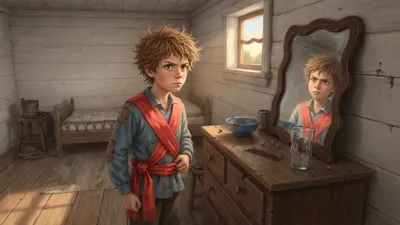
Before you read — think about:
- What did children do for entertainment in a river town before radio, film, or recorded music?
- What travelling shows, fairs, or performers come through your area? Who goes to see them?
- What was measles, and what did an outbreak mean for a town before vaccines existed?
- What organizations did young people join in the 1800s, and what did belonging to one give them?
- How does a long stretch of unstructured time change the way you think?
Watch for these while reading:
- What Tom actually wants out of the Cadets of Temperance, and how a boy's vow holds up against it.
- Tom's interest in Judge Frazer's health, and the way it rises and falls.
- The amusements that pass through St. Petersburg that summer, and the speed at which each one is used up.
- Tom's diary, and the reason he gives for how it goes.
- How Tom's mood moves from one amusement to the next, and how long each one lasts.
Vocabulary to know:
temperance (noun) — the practice of avoiding alcohol entirely; mesmerizer (noun) — a performer who claimed to hypnotize people; measles (noun) — a contagious illness with fever and a rash; abstain (verb) — to keep yourself from doing something; profanity (noun) — bad language; shackles (noun) — chains; anything that traps you; fluctuating (verb) — going up and down unpredictably; convalescent (adjective) — recovering from an illness; resignation (noun) — a formal notice that you are quitting; relapse (noun) — a return of an illness after seeming to recover; calculated (adjective) — deliberately designed to produce an effect; sensation (noun) — an event that causes great excitement; overwhelming (adjective) — so great it overpowers everything else; voids (noun) — empty stretches with nothing in them; chronic (adjective) — lasting a long time and always coming back; permanency (noun) — the quality of lasting forever; revival (noun) — a series of intense religious meetings; tracts (noun) — small religious pamphlets; refuge (noun) — shelter from trouble; depression (noun) — a heavy, sunken mood; terrific (adjective) — terrifying; causing dread; suspense (noun) — anxious waiting to find out what happens; doom (noun) — a terrible fate; hubbub (noun) — a loud confused uproar.
Chapter 23: The Trial of Muff Potter
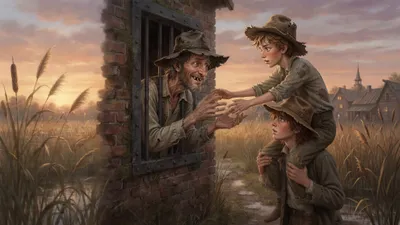
Before you read — think about:
- What is the difference between watching a public event and being part of one?
- Why might a person keep visiting somebody whose situation they are refusing to change?
- What is a trial actually for — finding out the truth, or settling a community's mind? Can it do both at once?
- How did a trial work in a frontier town in the 1840s — who sat on juries, and what counted as evidence?
- Why is a courtroom frightening even for the people who are only there to watch?
Watch for these while reading:
- The two boys' conversations about Muff Potter, and how the subject keeps finding its way back to them.
- Twain's picture of the village packing into the courthouse — the heat, the noise, the appetite for a show.
- The defense lawyer's behavior all the way through the prosecution's case.
- Huck's face in the courtroom, and how much of the trial he can bear to watch.
- Muff Potter in the dock — his clothes, his hands, and the way he talks about himself.
Vocabulary to know:
lynch (verb) — to kill an accused person by mob action, without any trial; cross-examined (verb) — questioned by the opposing lawyer to test what a witness said; feelers (noun) — remarks made to test what someone knows; unseal (verb) — to open something that was closed up; discreet (adjective) — careful not to say too much; solitary (adjective) — single; one and only; luckless (adjective) — unfortunate; cowardly (adjective) — lacking courage; befriend (verb) — to act as a friend to someone; irresistible (adjective) — impossible to hold out against; studiously (adverb) — deliberately and carefully; sauntered (verb) — strolled without hurrying; invariably (adverb) — always, without exception; distressing (adjective) — causing worry and pain; toils (noun) — nets or snares set for a hunted animal; unshaken (adjective) — not weakened or disturbed at all; jury (noun) — the group of citizens who decide a verdict at a trial; flocked (verb) — went in a crowd; proclaimed (verb) — announced officially; testified (verb) — gave evidence under oath in court; counsel (noun) — a lawyer representing someone in court; prosecution (noun) — the side in a trial that argues the accused is guilty.
Chapter 24: A Hero by Day, Afraid by Night
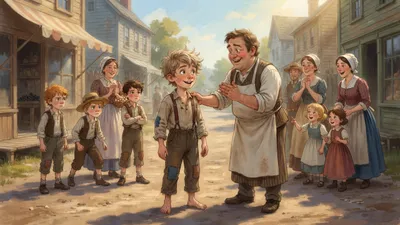
Before you read — think about:
- What happens to the person who did the right thing once everyone has finished congratulating them?
- How quickly does public opinion swing around, and what does that say about how much it is worth?
- Is there such a thing as a danger you would rather have arrive than go on waiting for?
- Why do people trust an outside expert more than the neighbours who already know the situation?
- How does fear change once the person you are afraid of is somewhere you cannot see?
Watch for these while reading:
- The difference between Tom's days and Tom's nights.
- How the town treats Muff Potter now, and the narrator's opinion of that change.
- What Huck is frightened of, and how his fear differs from Tom's.
- The detective brought down from St. Louis, and Twain's estimate of professional expertise.
- The single sentence that closes the chapter, and the way it measures time.
Vocabulary to know:
immortal (adjective) — living or lasting forever; magnified (verb) — made something seem larger or grander than it was; fickle (adjective) — changing its mind constantly; unreasoning (adjective) — acting on feeling rather than thought; conduct (noun) — the way a person or group behaves; infested (verb) — overran a place unpleasantly; wretchedness (noun) — extreme misery; notwithstanding (preposition) — in spite of; secrecy (noun) — the keeping of something hidden; wring (verb) — to force something out of someone; obliterated (verb) — wiped out completely; scoured (verb) — searched thoroughly; omniscient (adjective) — knowing everything; awe-inspiring (adjective) — filling people with wonder and respect; moused (verb) — nosed about searching, the way a cat hunts; craft (noun) — a trade or profession; clew (noun) — an old spelling of 'clue'; insecure (adjective) — unsafe; not protected.
Chapter 25: Digging for Buried Treasure

Before you read — think about:
- Where do children's ideas about pirates, robbers, and buried gold actually come from?
- What would you do with a sudden fortune at twelve? What would an adult say about that plan?
- How does a person decide that a rumor or an old story is reliable enough to act on?
- What makes a place feel haunted, quite apart from anything that has ever happened there?
- How do two friends talk each other into something neither of them really wants to do?
Watch for these while reading:
- The rules Tom lays down about where treasure is buried, and where a boy picks up rules like that.
- What Huck means to do with a share he has not got yet, and his reason for saving none of it.
- How Tom defends his method whenever Huck raises a practical objection to it.
- What the boys believe is set to guard buried treasure, and how they propose to deal with it.
- The abandoned house up the Still-House branch, and the way the two of them talk about it.
Vocabulary to know:
rightly-constructed (adjective) — properly made; the way a thing ought to be; confidentially (adverb) — privately, as a secret; enterprise (noun) — a bold undertaking; capital (noun) — money needed to start a business or scheme; superabundance (noun) — far more than enough; ciphered (verb) — worked out by figuring, as with a puzzle or code; crippled (adjective) — damaged and barely working; tramp (noun) — a long walk on foot; toiled (verb) — worked long and hard; pegged (verb) — kept working steadily; swabbed (verb) — wiped; beaded (adjective) — standing in small round drops; interfere (verb) — to meddle and spoil something; appointed (adjective) — agreed on in advance; traditions (noun) — beliefs and customs handed down over time; lurked (verb) — waited hidden; murky (adjective) — dark and gloomy; baying (noun) — the deep howling of a hound; sepulchral (adjective) — grave-like; hollow and gloomy in sound; subdued (adjective) — quieted down; commenced (verb) — began; industry (noun) — hard, steady effort; shroud (noun) — a cloth used to wrap a dead body; flickering (adjective) — burning unsteadily.
Chapter 26: Gold in the Haunted House

Before you read — think about:
- What superstitions about days, numbers, or dreams have you heard people take seriously?
- How do people behave in a place they believe is dangerous once ten minutes have passed and nothing has happened?
- What makes an abandoned building feel different from an occupied one? Be specific about the signals.
- What is the difference between good luck and bad luck while you are still inside the event and cannot yet tell which it is?
- What is the most frightened you have ever been by a place rather than by a person?
Watch for these while reading:
- The reason the boys put the expedition off by a day, and Tom's talent for reading omens into a calendar.
- Twain's description of the ruined house — the weeds, the stairs, the smell, the silence.
- The upstairs floor, and exactly how much of the room below the boys can see from it.
- The two floors of the house, the staircase between them, and what can be heard from one to the other.
- Twain's pacing — count how many paragraphs go by without anybody moving.
Vocabulary to know:
serape (noun) — a Mexican blanket worn as a cloak; sombrero (noun) — a broad-brimmed hat; bowie-knife (noun) — a large heavy hunting knife; measurably (adverb) — to a noticeable degree; prospects (noun) — chances of future success; athwart (preposition) — across; trifled (verb) — treated something carelessly; fulfilled (verb) — carried out completely; requirements (noun) — the things that must be done; desolation (noun) — bleak emptiness; weedgrown (adjective) — overgrown with weeds; unplastered (adjective) — with bare walls, never finished with plaster; ruinous (adjective) — falling to pieces; cobwebs (noun) — old dusty spider webs; quickened (adjective) — made faster; familiarity (noun) — the comfort that comes from knowing a place; modified (verb) — changed somewhat; boldness (noun) — daring; ascent (noun) — a climb upward; decay (noun) — the state of rotting away; fraud (noun) — something that is not what it promises to be; knotholes (noun) — holes in a board where a knot has fallen out.
Chapter 27: On the Trail of Number Two
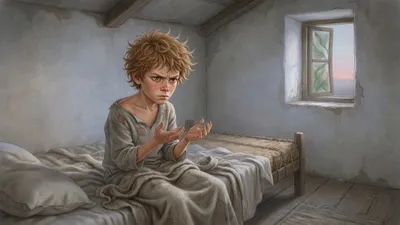
Before you read — think about:
- How do you tell a vivid memory from a dream the morning afterward?
- Why might an enormous sum of money feel unreal to somebody who has never handled much of it?
- How would you go about finding a place when your only clue is a number?
- What makes a plan sound reasonable while you are making it and reckless a day later?
- When two friends are both frightened, what does each one need the other to say?
Watch for these while reading:
- Tom's argument for believing the whole business was a dream, and how long he manages to hold on to it.
- The way Tom tests his own memory without asking anybody a direct question.
- What Huck was doing when Tom came looking for him, and what that says about the night he has had.
- The reasoning that turns two words into a place two boys can actually go and look for.
- How the boys divide the work between them, and who is given which half.
Vocabulary to know:
nothingness (noun) — complete emptiness; wakefulness (noun) — the state of being awake; incidents (noun) — the separate events that make up a happening; station (noun) — a person's position or rank in life; fanciful (adjective) — imaginary; not real; analyzed (verb) — examined part by part; bushel (noun) — a large dry measure — about eight gallons; ungraspable (adjective) — impossible to take hold of or understand; sensibly (adverb) — noticeably; attrition (noun) — wearing away by rubbing; impression (noun) — a general sense or belief; uncertainty (noun) — the state of not knowing; gunwale (noun) — the upper edge of a boat's side; flatboat (noun) — a flat-bottomed river boat; dangling (verb) — hanging loosely; pile (noun) — a large amount of money; one-horse (adjective) — small and unimportant; tavern (noun) — an inn that serves food and rents rooms; feeble (adjective) — weak; weaken (verb) — to lose nerve.
Chapter 28: Huck Stands Guard
Before you read — think about:
- What is the hardest part of waiting outside while somebody else takes the risk?
- Why do plans that sound simple in daylight feel completely different at midnight?
- What did a tavern or an inn tell you about a town in the 1840s? Who used them, and for what?
- What does it tell you about a person that they are willing to keep watch every night for weeks?
- Where do you think a boy with no home actually sleeps, and who would quietly help him?
Watch for these while reading:
- How many nights go by before the conditions suit the boys, and how they fill the waiting.
- What Tom carries with him besides the keys, and why the towel matters so much to him.
- The two taverns, and what the difference between them says about the village.
- The signal the boys agree on, and how much of the plan rests on one boy staying awake.
- Where Huck sleeps, and the people who quietly see that he is fed.
Vocabulary to know:
resembling (verb) — looking like; whereupon (adverb) — at which point; right after that; sentry (noun) — a guard on watch; anxiety (noun) — worried dread; momentarily (adverb) — at any moment now; inhale (verb) — to breathe in; thimblefuls (noun) — tiny amounts — as much as a thimble would hold; repetition (noun) — the act of saying something again; uttered (verb) — spoken aloud; deserted (adjective) — abandoned and empty; racket (noun) — a loud noise; knob (noun) — a round door handle; reflection (noun) — careful thought; gravel (noun) — small loose stones; hayloft (noun) — the upper floor of a barn where hay is stored; tote (verb) — to carry; slaughter-house (noun) — a building where animals are butchered.
Chapter 29: The Picnic and the Widow's Danger

Before you read — think about:
- What do you take with you on a day out, and who decides how long you stay?
- How do groups of children behave in a place that adults consider dangerous?
- What makes a place feel safe in a group and frightening on your own?
- Why is it hard to warn somebody when giving the warning puts you at risk?
- What does a community expect of a widow or an elderly neighbour living alone, and what does it owe them?
Watch for these while reading:
- The change of plan Tom proposes for the picnic, and the argument he uses on Becky to get it.
- How much of the village joins a children's outing, and which adults are supposedly in charge of it.
- McDougal's cave as Twain first describes it: the door, the main passage, and the candles the children carry.
- The way the picnic party keeps track of time, and the way children keep track of each other.
- The Widow Douglas, and how the village talks about her when she is not there.
Vocabulary to know:
chartered (verb) — hired for a particular trip; swarmed (verb) — moved in a crowd; craggy (adjective) — rocky and steep; rovers (noun) — wanderers; oaken (adjective) — made of oak; unbarred (adjective) — not fastened shut; limestone (noun) — a soft rock that water carves caves out of; crevices (noun) — narrow cracks or openings; labyrinth (noun) — a confusing network of passages; intricate (adjective) — complicated and detailed; rifts (noun) — splits or cracks in rock; chasms (noun) — deep splits in the earth; corridors (noun) — long narrow passages; quarry (noun) — a pit where stone is dug out; sumach (noun) — a tall shrub with red seed clusters; nimble (adjective) — quick and light on the feet; stile (noun) — a set of steps for climbing over a fence; agues (noun) — fits of shivering; ensue (verb) — to follow next; precarious (adjective) — unsteady; in danger of falling; toppling (verb) — falling over; elaboration (noun) — extreme care and detail.
Chapter 30: Missing in McDougal's Cave
Before you read — think about:
- What makes a house feel welcoming? What are the signals?
- Who looks after the children in a community who have nobody? How does that work where you live?
- Who is responsible for knowing where a child is — the child, or the adults around them?
- What makes an adult decide to take a strange child seriously?
- What do people say to each other when there is nothing useful left to say?
Watch for these while reading:
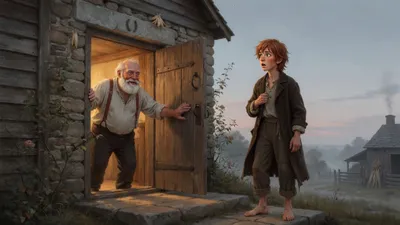
- The Welshman's first words at the door, and Huck's reaction to being spoken to like that.
- The Welshman's questions, and the care Huck takes over every answer he gives.
- The Welshman's sons, and the difference between how they and their father deal with Huck.
- The stile on the road up the hill, and the amount of attention Huck gives one ordinary landmark.
- How long it takes anybody in St. Petersburg to count the children, and why it takes that long.
Vocabulary to know:
constables (noun) — local law officers; posse (noun) — a group of citizens gathered to help the law; sheriff (noun) — the chief law officer of a county; hair-trigger (adjective) — set to go off at the slightest touch; embellishment (noun) — a detail added to make a story better; burglar (noun) — someone who breaks into buildings to steal; unutterably (adverb) — beyond words; self-possession (noun) — calm control of yourself; preservation (noun) — being kept safe from harm; beholden (adjective) — owing thanks to someone; delirious (adjective) — confused and rambling from fever; physicians (noun) — doctors; reverberations (noun) — echoes rolling back; tourists (noun) — visitors who come to see a place; inmates (noun) — the people living in a house; episode (noun) — a single incident or event; vagabond (adjective) — wandering, with no settled home; brace (noun) — a pair.
Chapter 31: Lost in the Dark

Before you read — think about:
- What is the difference between exploring and wandering? At what point does one become the other?
- Why do lost people so often keep moving instead of staying where they are?
- How would you ration a limited supply of light, food, or water without knowing how long it had to last?
- What do you say to keep another person from giving up, and what happens once those words run out?
- How much of courage is what you feel, and how much is what you let the person beside you see?
Watch for these while reading:
- The smoke marks the children make on the walls, and how much attention they give them.
- How Twain writes darkness — the vocabulary he reaches for in a place with no light at all.
- The candles, and how carefully the two children count what they have between them.
- The wedding-cake in Becky's pocket, and what she had originally been keeping it for.
- The gap between what Tom says out loud and what the narrator lets you hear him thinking.
Vocabulary to know:
stalactites (noun) — stone spikes that hang down from a cave ceiling; stalagmites (noun) — stone columns that build up from a cave floor; zeal (noun) — eager energy; sinuous (adjective) — winding; full of curves; mottoes (noun) — short sayings people adopt as their own; frescoed (verb) — decorated as if with wall paintings; incrusted (adjective) — covered with a hard coating; frostwork (noun) — a delicate pattern like frost on glass; subterranean (adjective) — underground; unavailing (adjective) — useless; doing no good; thread-bare (adjective) — worn out from overuse; sarcasms (noun) — bitter remarks that mean the opposite of what they say; moiety (noun) — a half or share; wailings (noun) — loud cries of grief; pitilessly (adverb) — without mercy; whetted (verb) — sharpened; pitfalls (noun) — hidden holes you can fall into; famished (adjective) — starving; woe-stricken (adjective) — overcome with sorrow.
Chapter 32: The Village Rejoices
Before you read — think about:
- How does a town behave when it has given up hope but cannot bring itself to say so out loud?
- What would be the first thing you wanted after three days without food or light?
- Why do people improve a story every time they retell it, even a story that is already true?
- What does a town owe the people who spend days searching for somebody else's child?
- How did news travel around a small river town in the 1840s?
Watch for these while reading:
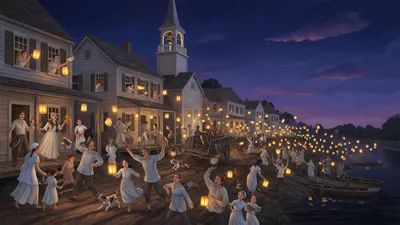
- How Twain describes the mood of the village at the opening of the chapter — the shops, the church, the streets.
- The change in Aunt Polly's appearance, and the detail Twain gives about her hair.
- The talk in the streets and the taverns, and the way a village passes information along.
- How much of McDougal's cave anybody in St. Petersburg actually understands, even now.
- The river landing and the crowded streets — who is there, and what the village has been doing with itself.
Vocabulary to know:
waned (verb) — faded gradually away; petitioner (noun) — someone making an earnest request; majority (noun) — the greater number; avocations (noun) — regular occupations or daily business; half-clad (adjective) — only partly dressed; din (noun) — a loud continuous noise; massed (verb) — gathered into a crowd; huzzah (noun) — an old-fashioned shout of celebration; dispatched (verb) — sent off quickly; auditory (noun) — an audience of listeners; withal (adverb) — besides; in addition; glimpsed (verb) — caught a brief sight of; twine (noun) — strong thin string; bedridden (adjective) — unable to get out of bed; wasting (adjective) — causing the body to weaken and shrink; ironically (adverb) — in a teasing way that means the opposite; sheathed (verb) — covered with a protective layer.
Chapter 33: The Fate of Injun Joe and the Treasure Found
Before you read — think about:
- Is it possible to pity somebody you were terrified of? Should you?
- Why do communities sometimes campaign to forgive people who have done terrible things?
- What does it mean for a place to become a tourist attraction because something awful happened there?
- What holds a secret together between two people, when the same secret told to three falls apart?
- Is there a difference between what a person deserves and what a community decides to give them?
Watch for these while reading:
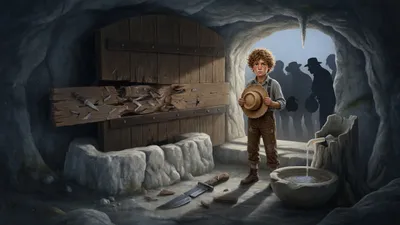
- Twain's description of the cave door and the patch of ground just inside it.
- The stone and the slow falling drop of water, and how far back in history the narrator traces that drop.
- The petition that had been going round the village, and the narrator's opinion of the people signing it.
- How Tom reasons out what 'under the cross' has to mean.
- The kite-line, the candles and the borrowed skiff — the practical details of going back into a cave on purpose.
Vocabulary to know:
powder-keg (noun) — a small barrel for gunpowder; moccasins (noun) — soft leather shoes; bloody-minded (adjective) — willing to do violence; massacre (noun) — a violent killing of many people; oblivion (noun) — the state of being completely forgotten; priceless (adjective) — too valuable to put a price on; petition (noun) — a signed request to an authority; governor (noun) — the head of a state's government; pardon (noun) — an official forgiveness that cancels a punishment; confidence (noun) — something told in trust as a secret; lucifer (adjective) — describing the new friction matches of the 1840s; landslide (noun) — a mass of earth that has slipped down a slope; ransom (noun) — money demanded for a prisoner's release; spliced (adjective) — joined end to end; precipice (noun) — a sheer drop; mystic (adjective) — mysterious and full of hidden meaning; pallet (noun) — a rough bed on the floor; rind (noun) — the tough outer skin of food; gnawed (verb) — chewed at repeatedly; fowls (noun) — birds kept for food, such as chickens.
Chapter 34: A Surprise at the Widow's Party
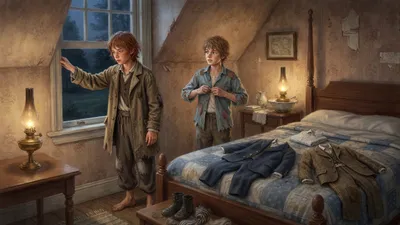
Before you read — think about:
- What is it like to be the guest of honor at an event you never agreed to attend?
- Why does spoiling somebody else's surprise feel satisfying to some people?
- How does a person who has never owned good clothes feel wearing them in a room full of strangers?
- What is the difference between being thanked and being put on display?
- Why do adults so often build a celebration around what they have decided a child ought to want?
Watch for these while reading:
- Huck's first suggestion once the bedroom door has shut behind the two of them.
- Sid's part in the evening, and the way he gets hold of his information.
- Mr. Jones the Welshman as a public speaker, and the difference between him and the room he is addressing.
- The Widow Douglas as a host, and the difference between how she speaks to the room and how she speaks to Huck.
- Tom's sense of timing — he has been building toward an audience like this since chapter one.
Vocabulary to know:
slope (verb) — to slip away quietly; blowout (noun) — a big party; fretting (verb) — worrying; overheard (verb) — heard something not meant for you; chuckled (verb) — laughed quietly to oneself; contented (adjective) — quietly pleased; propped (verb) — supported in position; modesty (noun) — unwillingness to boast about yourself; occasioned (verb) — caused; clamorous (adjective) — noisy and full of exclamation; compliments (noun) — expressions of praise; gratitude (noun) — thankfulness; laudations (noun) — loud praises; tongue-tied (adjective) — unable to speak; furnish (verb) — to supply; brimful (adjective) — filled to the very top; amounted (verb) — added up to; considerably (adverb) — by a large amount.
Chapter 35: Rich Boys and a Reluctant Huck
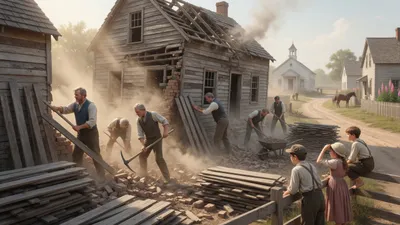
Before you read — think about:
- What changes about the way people treat you when you suddenly have money?
- Are there kinds of comfort that would feel like a punishment to you? Why those?
- Can a lie ever be the right thing to have told? How would you decide such a case?
- What does it cost a person to trade freedom for security? Is that trade ever an even one?
- What would persuade you to try something you were completely certain you would hate?
Watch for these while reading:
- What the grown men of St. Petersburg start doing to every old house in the county.
- How the boys' money is handled by the adults, and what a dollar a day was worth in the 1840s.
- Everything Huck lists as unbearable, and how ordinary every item on that list is.
- The argument Tom puts to Huck, and what it shows about the thing Huck values most.
- The 'Conclusion' — the narrator stepping forward to explain why he stops the story where he does.
Vocabulary to know:
vittles (noun) — a country word for food; whithersoever (adverb) — wherever; ornery (adjective) — disagreeable; hard to put up with; flinders (noun) — small broken fragments; tottered (verb) — wobbled as if about to fall; dissected (verb) — taken apart piece by piece; unromantic (adjective) — practical and unimaginative; courted (verb) — sought after; treated with flattering attention; commonplace (adjective) — ordinary; originality (noun) — the quality of being unlike anyone else; biographical (adjective) — describing a person's life; sketches (noun) — short written accounts; income (noun) — money received regularly; lodge (verb) — to house someone; conceived (verb) — formed in the mind; grace (noun) — mercy; forgiveness that is not earned; magnanimous (adjective) — generous and noble-spirited; lauded (adjective) — much praised.
About the Author
Mark Twain was the pen name of Samuel Langhorne Clemens (1835–1910), who grew up in the river town of Hannibal, Missouri, and drew on those boyhood years for nearly everything he wrote. Before he became an author he worked as a printer's apprentice, a steamboat pilot on the Mississippi, and a newspaper reporter in Nevada and California; the pen name he chose came from a riverboat call for safe water. He wrote in the plain, spoken American voice of ordinary people rather than the formal literary English of his day, and later writers credited him with teaching American literature how to sound like itself.
The novel was published in 1876, the year of America's centennial, but Twain set it roughly forty years earlier, in the 1830s or 1840s — a look backward at a pre-Civil War river town that no longer existed by the time he wrote. Children work as well as play, medicine is mostly guesswork and patent tonics, whipping is a normal school punishment, and religion, gossip, and superstition shape daily life in equal measure. It was also a slaveholding society, and Twain does not hide that fact; the book contains casual racial attitudes and language that were ordinary in the world he was describing and are offensive today. Reading it means reading a historical document as well as a comic adventure, and noticing where the author is gently mocking his town's assumptions and where he is simply repeating them is part of the work.