

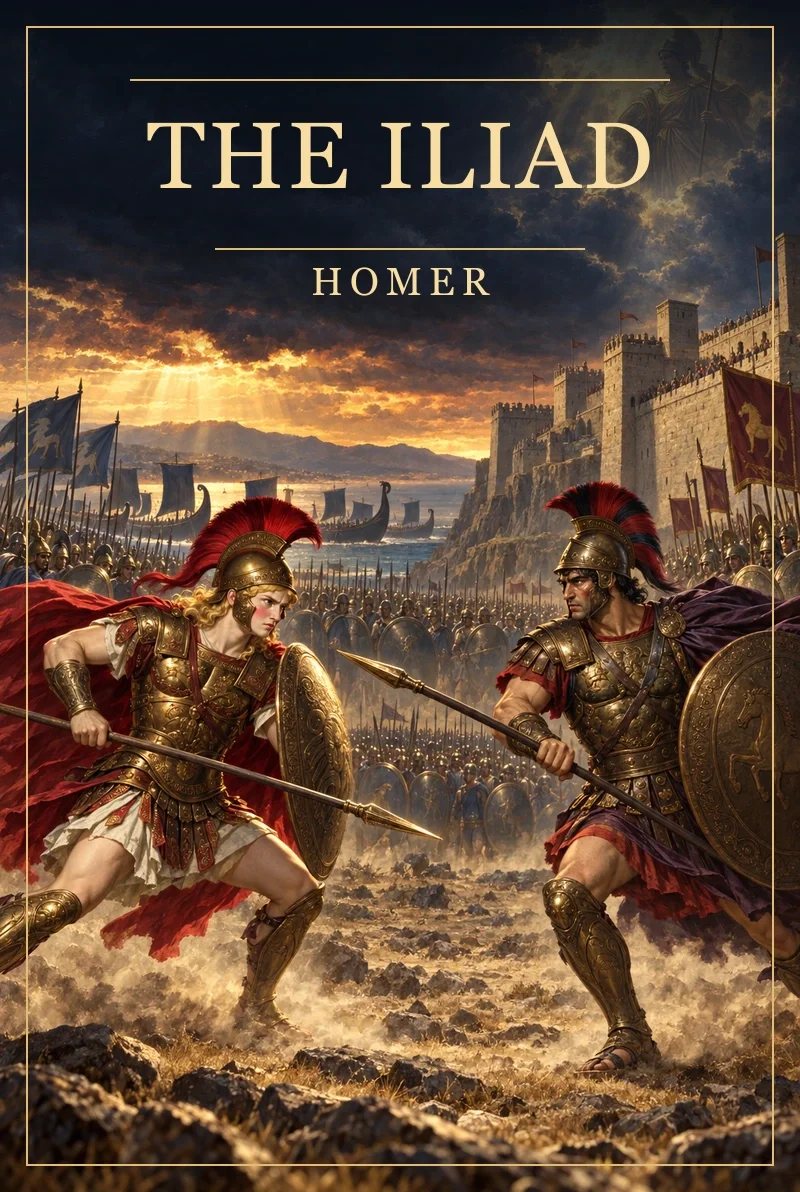
About This Book
The Iliad is an ancient Greek epic poem about a few weeks in the tenth and final year of the Trojan War. It is not the story of the whole war. It does not begin with the causes of the conflict and it does not end with the outcome everyone already knows; instead it drops the reader into an army that has been camped on a foreign beach for nine years, and it opens with a bitter argument between the Greek commander-in-chief and his best fighter over who deserves what. Everything that follows unfolds from that argument. The world of the poem is a small and crowded one. On one side is a coalition of Greek kings who have sailed to Asia Minor and dug in on the shore; on the other is the walled city of Troy, defended by its own princes and a shifting set of allies. Between the camp and the city lies a plain the armies cross and re-cross. The Greek gods are participants rather than distant observers here: they argue with each other, take sides, protect favorites, and intervene in the fighting, and the poem never lets you forget that the humans below can neither see the whole picture nor escape it. A note on the version you will be reading in this guide. The passages here come from Alexander Pope's celebrated eighteenth-century English verse translation, which renders Homer in rhymed couplets and, following the custom of its day, uses the Roman names for the gods: Jupiter or Jove for Zeus, Juno for Hera, Minerva for Athena, Venus for Aphrodite, Mars for Ares, Neptune for Poseidon, and Vulcan for Hephaestus. Odysseus appears as Ulysses. The poem's twenty-four books have been grouped into five parts for this guide, so each chapter here covers several of Homer's books at once.
The Iliad is the oldest surviving work of European literature, and reading it is the closest thing available to standing at the source of a tradition that runs through Virgil, Dante, Shakespeare, and almost every war story since. But it earns its place on a high school syllabus for a better reason than seniority: it asks questions that have not been settled. What is a person's honor actually worth, and who gets to decide? What do you owe a commander you do not respect? What do you owe the people standing beside you? The poem is unusually honest about the fact that the people doing the fighting are mostly young, that they are far from home, and that both sides believe they are in the right. It shows you the enemy's household, and his wife and child, and expects you to keep reading.
Meet the Characters

More about Achilles
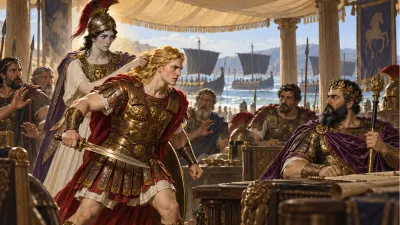
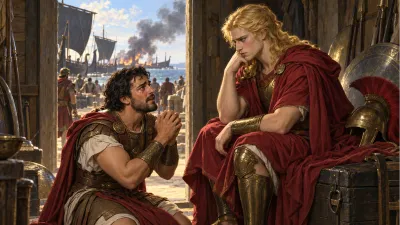
Achilles is the best fighter the Greeks have brought to Troy, the son of the sea-nymph Thetis. He is proud, quick-tempered, and not a man who takes an insult quietly. The poem opens with a quarrel between him and Agamemnon that keeps him out of the fighting.

More about Hector
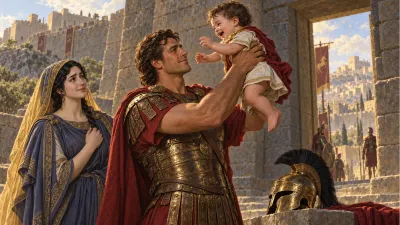
Hector is Troy's champion, Priam's son, and the brother of Paris. He is dutiful, brave, and more responsible than he is lucky. He is the man the Trojans look to when the Greeks are at the gates.

More about Agamemnon
Agamemnon is the brother of Menelaus and the leader of the Greek expedition against Troy. He is powerful, touchy about his honor, and not always wise. The quarrel that opens the poem is his as much as Achilles'.

More about Patroclus
Patroclus is Achilles' dearest friend, a warrior in his own right and the kinder of the two. He is loyal, compassionate toward the wounded, and impatient with Achilles' long anger. He lives in Achilles' hut at the edge of the Greek camp.

More about Priam
Priam is the old king of Troy, father of Hector, Paris, and many others. He is dignified, grief-worn, and still a king. The war is being fought for his city and, in part, for his son's prize.

More about Odysseus
Odysseus is the king of Ithaca, famous among the Greeks for his quick mind as much as for his fighting. He is the man Agamemnon sends when a speech or a scheme is needed. He is already the Odysseus who will later take the long way home.

More about Helen
Helen of Sparta is the woman for whom the war is being fought, now living in Paris's house in Troy. She is homesick, self-reproachful, and still the most beautiful person anyone has seen. She weaves a great cloth of the battles she has caused.

More about Paris (Alexander)
Paris is Priam's son, the man who brought Helen from Sparta. He is charming, not as brave as Hector, and very aware of his own good looks. His brother is the one who has to keep the city standing.

More about Andromache
Andromache is Hector's wife, a princess of a city Achilles has already destroyed. She is loving, clear-sighted, and afraid of the war in a way the men are not supposed to be. She meets Hector at the Scaean gates.

More about Thetis
Thetis is a sea-nymph and Achilles' mother, able to go from the depths to Olympus. She is fierce in her love and already grieving a son she knows will not live long. Achilles calls her from the beach when he is first wronged.

More about Zeus
Zeus is the king of the gods, trying (not always successfully) to keep the other gods from turning the war into their private quarrel. He is majestic, susceptible to his wife's arguments, and bound by fate. The human war is also his council's business.

More about Athena
Athena is the goddess of wise war and skilled work, a fierce partisan of the Greek side. She is the opposite of Ares' wildness. She appears among mortals when a warrior needs a sudden thought.

More about Ajax the Greater
Ajax of Salamis is the Greeks' great defensive fighter, huge, stubborn, and not a man of many words. He stands in the line when Achilles will not. He is the one the Trojans least like to see coming.
Pre-Reading Discussion Questions
- What does the word 'hero' mean to you? Does calling someone a hero require that you also find them admirable as a person?
- What is the difference between being genuinely respected and being publicly honored? If you could only have one, which would you choose, and what would it cost you?
- When someone with authority over you makes a decision you believe is unjust, what options do you actually have, and what does each one cost?
- What are people willing to trade for a reputation that outlasts them?
- In a long and exhausting group effort, what keeps people going after the original reason for starting has worn thin?
- When a story shows you both sides of a conflict from the inside, how does that change what you want to happen?
Themes & Big Ideas to Track
- Honor in this world is public and material, measured in what a person is visibly given and allowed to keep, so track what characters are actually fighting over when they say they are fighting over honor.
- The gods intervene constantly, and the poem never fully resolves how much human responsibility that leaves behind, so watch how characters explain their own choices.
- Homer's long comparisons pull in lions, weather, harvest fields, and craftsmen at work, so notice where your attention is being sent during the most violent moments.
- Both armies are shown from the inside, including their homes and families, so pay attention to how the poem distributes your sympathy and when it shifts it.
- Every human in the poem is going to die, and most of them know it, so watch how that awareness shapes what they consider worth doing.
- The poem repeatedly sets what one powerful individual wants against what the whole group needs, so track who pays for each decision.
Chapter-by-Chapter Study Guide
Chapter 1: The Quarrel (Books 1-5)
Before you read — think about:
- The Iliad was composed to be performed aloud from memory, over many hours, to a listening audience. What would listeners need from a story that readers holding a book might not?
- Before you read a line, write your own definition of 'honor.' Is honor something a person possesses on their own, or something other people have to grant them?
- What do you already know — or think you know — about the Trojan War, and where did you learn it? Keep the list; you will want to check it later.
- In stories where gods or supernatural forces reach into human affairs, what happens to your sense of whether the characters are responsible for what they do?
- Homer's original audience already knew how the Trojan War turned out before the poem started. How does knowing an outcome in advance change what you pay attention to while reading?
Watch for these while reading:
- The fixed descriptive tags — 'swift-footed,' 'cloud-gathering,' 'of the shining helmet' — that attach to particular characters and come back every time they appear.
- How the poet introduces a warrior by naming his father and his home town, even when the man has only one line to live in the poem.
- The long comparisons that break away from the battlefield entirely to describe lions, weather, harvest fields, or a craftsman at work, and how far Homer lets them run before returning.
- The way characters address each other in formal, complete speeches rather than quick back-and-forth conversation, and what that formality makes possible that ordinary dialogue would not.
- How much of the gods' attention is occupied by their own disagreements with each other rather than by the human beings below them.
Vocabulary to know:
ablutions (noun) — ritual washings performed to cleanse oneself before approaching a deity; adamantine (adjective) — unbreakably hard, like diamond or the hardest imaginable stone; ambrosial (adjective) — belonging to the gods; divinely sweet, fragrant, or immortal; aversion (noun) — a feeling of intense dislike and desire to turn away; cincture (noun) — a belt, girdle, or sash worn around the waist; circumfused (verb) — poured or spread all around; contagion (noun) — a contagious disease or pestilence that spreads rapidly; cumbrous (adjective) — heavy, unwieldy, and burdensome to carry or manage; dastards (noun) — dishonorable cowards who shrink from duty or danger; deedless (adjective) — inactive; achieving or performing no noble deeds; derision (noun) — contemptuous ridicule, mockery, or scorn; hecatomb (noun) — a large-scale public sacrifice, originally of a hundred cattle, to the gods; ichor (noun) — the ethereal, divine fluid flowing in the veins of the immortal gods; imperious (adjective) — domineering, arrogant, and commanding in an overbearing manner; imprecations (noun) — spoken curses or invocations of divine wrath and evil; inexorable (adjective) — unyielding, relentless, and impossible to persuade or pacify; insatiate (adjective) — impossible to satisfy or appease; endlessly greedy; invidious (adjective) — likely to arouse ill will, resentment, or offensive envy; inviolable (adjective) — sacred and incapable of being broken, violated, or infringed; libations (noun) — ritual offerings of wine poured out in honor of a deity; propitiate (verb) — to appease, conciliate, or regain the good will of an offended power; refulgent (adjective) — shining with radiant, dazzling brightness; suppliant (noun) — a humble petitioner making an earnest plea to someone in power; timorous (adjective) — timid, fearful, and easily frightened; venerable (adjective) — commanding profound respect because of great age, wisdom, or dignity.
Chapter 2: Between the Armies (Books 6-9)
Before you read — think about:
- The poem has kept almost entirely to one stretch of coastline and the plain in front of it. What does a story gain by staying in one place, and what does it give up?
- Homer's listeners already knew these figures from a shared body of legend before the poem started. How does an audience's prior familiarity with a character change what a poet has to explain and what he can leave out?
- Is there a difference between fighting for something you chose and fighting for something you inherited? Does the reason change what the word 'courage' means?
- What separates courage from recklessness? Can you tell the two apart while they are happening, or only afterward?
- You are reading a poem composed in Greek roughly 2,700 years ago, in rhymed English couplets written in the 1700s. Whose voice are you actually hearing, and what do you think a translator working that way adds and loses?
Watch for these while reading:
- Which fighters are given a father, a home town, and a family history before they take part, and which are given none at all.
- How much attention Homer pays to armor and equipment: how it is made, how it is worn, and what sounds it makes.
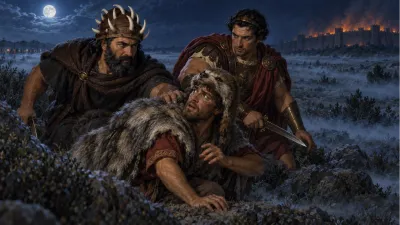
- How the poem handles nightfall — what happens to the fighting, to the councils, and to the tone of the language once the sun is down.
- Nestor's part in council: how often he speaks, how long he takes, and what kind of proposal he tends to arrive at.
- The comparisons drawn from herding, hunting, and fire, and whether Homer reaches for them more readily on one side than the other.
Vocabulary to know:
acclamations (noun) — loud and enthusiastic shouts of approval or praise; antedate (verb) — to assign to an earlier date, or cause to happen before the appointed time; atonement (noun) — reparation or amends made for an offense, injury, or crime; battlements (noun) — defensive parapets built at the top of a fortified wall; bequeath (verb) — to hand down or pass on to successors or posterity; brethren (noun) — brothers or fellow members of a family or community; bulwarks (noun) — solid defensive walls or ramparts raised for protection; consternation (noun) — a sudden feeling of dread, dismay, or paralyzing alarm; dissuade (verb) — to persuade someone not to follow a certain course of action; enchased (adjective) — ornamented with engraved or embossed metalwork; extirpate (verb) — to root out, eradicate, and completely destroy; guileful (adjective) — insidious, deceitful, and crafty; hereditary (adjective) — passed down through an ancestral line of inheritance; impudence (noun) — brazen, shameless boldness or disrespectful insolence; inflexible (adjective) — rigid, unyielding, and impossible to bend or soften; insidious (adjective) — proceeding in a gradual, subtle way, but with harmful effect; stealthily treacherous; oblivion (noun) — the state of being completely forgotten or extinguished from memory; opprobrious (adjective) — scornfully abusive, derogatory, or shameful; pernicious (adjective) — having a ruinous, destructive, or poisonous effect; prerogative (noun) — an exclusive right, privilege, or immunity given to a person or position; prodigies (noun) — marvelous omens, miraculous events, or portents of future danger; recompense (verb) — to reward, repay, or compensate someone for deeds or service; remonstrance (noun) — a reasoned objection, earnest protest, or gentle reproach; transgress (verb) — to violate an oath or overstep moral or divine boundaries; votaries (noun) — devoted worshipers or dedicated followers bound by a vow.
Chapter 3: The Long Day (Books 10-15)
Before you read — think about:
- Homer's poem was performed in episodes across more than one sitting. If you were the performer, how would you decide where to stop for the night?
- The poem names a great many fighters who appear only briefly. What does naming someone accomplish that leaving them anonymous would not?
- Think of a long contest — a season, a campaign, a project — that has run far past the point anyone expected. What changes in how the people involved treat one another?
- This poem often tells you what the gods have decided before it shows you the humans acting it out. What does a story lose by giving up suspense about outcomes, and what might it gain instead?
- In a story with this many characters, how do you personally keep track of who is who? What techniques does the poem itself hand you for doing that?
Watch for these while reading:
- How Homer manages several things happening at once across a wide field, and the signals he uses to move you from one part of it to another.
- The short life stories attached to warriors as they enter the fighting — the farms, fathers, and marriages he fits into a line or two.
- How many lines go to the gods compared with the men, and whether that balance shifts as the poem goes on.
- The sounds Homer reaches for — shouting, bronze, the sea, the noise a crowd makes — and how much of the scene he builds out of them.
- The way the poem describes tiredness: how exhausted men move, what they say, and what they stop bothering to do.
Vocabulary to know:
afflictive (adjective) — causing severe pain, suffering, distress, or grief; armipotent (adjective) — mighty in battle; powerful in arms and warfare; bestrides (verb) — stands over a fallen warrior with legs astride to defend the body; blandishments (noun) — flattering speeches or coaxing actions intended to entice or persuade; cataracts (noun) — violent downpours or overwhelming deluges of water; conflagration (noun) — a large, destructive, and sweeping fire; conspicuous (adjective) — clearly visible, prominent, or attracting notice through excellence; consistory (noun) — a solemn assembly, council, or formal gathering of leaders or judges; contiguous (adjective) — sharing a common border; touching or directly adjacent; deference (noun) — respectful submission or yielding to the judgment or will of another; emulation (noun) — ambitious rivalry or the desire to equal or surpass others in noble action; ensanguined (adjective) — stained, soaked, or covered with blood; expatiate (verb) — to wander freely and range at large over open space; fraudful (adjective) — treacherous, deceitful, and dishonest; ignominious (adjective) — deserving or causing public shame, disgrace, or dishonor; impervious (adjective) — incapable of being passed through, penetrated, or crossed; innoxious (adjective) — harmless, innocent, and causing no injury or offense; inundation (noun) — an overwhelming flood or overflowing rush of water; irrevocable (adjective) — incapable of being recalled, repealed, or changed; lethargic (adjective) — unnaturally drowsy, sluggish, or dulling to the senses; methinks (verb) — it seems to me (archaic expression of personal impression); obeisance (noun) — a deferential bow or gesture expressing deep reverence and respect; obsequies (noun) — funeral rites, ceremonies, or burial solemnities; posterity (noun) — future generations or descendants collectively; precepts (noun) — authoritative rules or moral maxims intended to guide conduct.
Chapter 4: The Turning (Books 16-19)
Before you read — think about:
- This poem moves between the wide view of a whole battlefield and a single close detail — one man's hands, one horse, one object. Where do you personally find a story most affecting, and why?
- The Greek word we translate as 'hero' did not mean 'good person.' What changes about a story when its central figures are measured by achievement rather than by goodness?
- These characters believe that being remembered is the only afterlife worth having. If you genuinely believed that, which of your decisions would change?
- You have now read three chapters. Which character do you find yourself rooting for, and has that shifted since the opening? Write your answer down before you read any further, so you can check it afterward.
- When a story has given both sides of a conflict families, homes, and reasons, how does a reader's sympathy actually work? Is it possible to want both sides to come through?
Watch for these while reading:
- Which comparisons Homer draws from the sea and which from farmland, and whether one army attracts one kind more than the other.
- The way the poem treats horses: how they are named, how they are described, and what they are worth to the people who own them.
- How Homer marks the passage of a single day — dawn, midday, evening — and what he does differently in each part of it.
- The home towns and fathers of the minor fighters, and how wide a map the poem has covered once you add them all together.
- How characters talk about fate: which of them raise it, at what moments, and whether saying it aloud changes what they do next.
Vocabulary to know:
abstemious (adjective) — sparing or moderate in eating, drinking, or indulgence; assistless (adjective) — helpless, defenseless, and entirely without aid or support; calamitous (adjective) — causing or accompanied by great disaster, misfortune, or misery; champaign (noun) — an open, flat expanse of countryside or battlefield plain; clangour (noun) — a loud, resonant, ringing metallic sound; coerulean (adjective) — deep sky-blue or azure, often describing sea deities and waters; comfortless (adjective) — devoid of solace, consolation, or cheer; cureless (adjective) — incurable; beyond remedy, relief, or healing; curriers (noun) — tanners or craftsmen who dress, stretch, and finish tanned leather; despoiled (verb) — stripped of armor, possessions, or valuables by force; disembogues (verb) — discharges or empties waters into a sea or larger body through a mouth; effulgence (noun) — a brilliant, shining radiance or dazzling splendor; fortitude (noun) — mental and moral strength in facing pain, adversity, or peril; hymeneal (adjective) — pertaining to marriage or wedding celebrations and rites; inanimated (adjective) — lifeless, without spirit or motion; dead; inextricable (adjective) — impossible to untangle, escape from, or solve; irremeable (adjective) — admitting of no return; irreversible, as the passage of death; lenitives (noun) — soothing medicines, treatments, or remedies that ease pain; melancholy (adjective) — deeply mournful, gloomy, or sorrowful; providential (adjective) — resulting from divine guardianship, foresight, or care; rebellow (verb) — to echo back a deep roar, bellow, or resonant sound; refection (noun) — nourishment, refreshment, or sustenance from food and drink; resplendent (adjective) — dazzling and shining brilliantly with great luster; rudiments (noun) — the first elementary principles, skills, or foundations of an art; subverting (verb) — overthrowing, destroying, or bringing down a city or authority.
Chapter 5: The Reckoning (Books 20-24)
Before you read — think about:
- This is the last chapter. Before you begin it, write down how you expect the poem to end and why you expect that. Homer's first audience already knew; you may not.
- Epic poetry was composed to be held in memory and performed. Which features of this poem — the repeated phrases, the fixed epithets, the formal speeches — would help a performer carry thousands of lines without a text?
- The Iliad has been read continuously for something close to three thousand years, while almost everything written alongside it has been lost. What do you think allows a story to last that long?
- Think about how other stories you know finish. What is the difference between an ending that settles a plot and an ending that settles a feeling? Can a story do only one of the two?
- This poem covers a few weeks and deliberately leaves the most famous events of the Trojan War outside its frame. Why might a poet leave the best-known part of a story out?
Watch for these while reading:
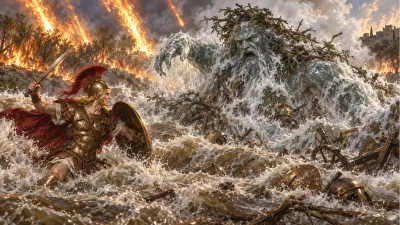
- How much presence the natural world has in this part of the poem — rivers, fire, dust, wind, the sea — and how closely Homer describes it.
- Which images come back often enough across these books to feel like a deliberate pattern rather than a one-off comparison.
- What people do with their hands: reaching, gripping, covering the face, holding something out. Homer notices hands constantly.
- Food and meals — who eats, who refuses to, and the moments when the poem stops the action to mention it at all.
- Where the poem places its silences: the moments when a character stops speaking, or the narrator declines to describe something he could have described.
Vocabulary to know:
bestrewn (adjective) — strewn or scattered thickly over a surface; capacious (adjective) — roomy, spacious, and capable of containing a vast quantity; circumvent (verb) — to deceive, outwit, or overcome through craft and underhanded strategy; coursers (noun) — swift, spirited horses trained for battle or racing chariots; fallacious (adjective) — deceptive, misleading, or calculated to ensnare and disappoint; forbearance (noun) — patient self-control, restraint, and mercy in withholding punishment; forsworn (adjective) — guilty of breaking a sacred oath; perjured and faithless; grovelling (adjective) — prostrating oneself or lying prone on the earth in extreme grief or submission; hoary (adjective) — gray or white with age, ancient and venerable; ignoble (adjective) — dishonorable, unworthy, or humiliating; not noble; ignipotent (adjective) — ruling or presiding over fire (epithet for Vulcan / Hephaestus); immolate (verb) — to kill or offer up as a sacrificial victim in ritual offering; impious (adjective) — lacking reverence for the gods; sacrilegious and wicked; implacable (adjective) — relentless and incapable of being pacified, soothed, or appeased; insatiable (adjective) — impossible to satisfy or quench in appetite or desire; insensible (adjective) — incapable of feeling, perception, or awareness; lifeless and unresponsive; languid (adjective) — weak, faint, and exhausted from exertion or suffering; pinions (noun) — the wings or wing feathers of a bird; plaintive (adjective) — expressing sorrow, mourning, or melancholy; pyre (noun) — a heap of combustible wood on which a dead body is burned in a funeral rite; sepulchre (noun) — a monumental tomb, burial vault, or grave; surcease (verb) — to bring to an end, cease, or desist from conflict or action; umbrage (noun) — dense shade or shadow cast by trees or foliage; vaunting (adjective) — boasting or bragging proudly and arrogantly; venturous (adjective) — bold, daring, and ready to undertake dangerous and hazardous exploits.
About the Author
Almost nothing about Homer can be established as fact. Ancient tradition held that he was a blind poet from somewhere on the Ionian coast of Asia Minor, but no reliable biography survives, and scholars have argued for more than two centuries over whether a single person composed the Iliad and the Odyssey, whether the two poems even share an author, and whether Homer is better understood as the name attached to a long tradition of oral performance than as an individual writer. What is clear from the poems themselves is that they were shaped for performance aloud by singers who worked from memory and technique rather than a written script, and that the result was polished by generations before it was ever written down.
The Iliad appears to have taken its written shape in the eighth century BCE, but it describes a war that Greeks of that era placed roughly four hundred years earlier, in the late Bronze Age. The poem therefore preserves an odd layered picture: bronze weapons, boar-tusk helmets, and body-shields remembered from a vanished palace civilization, mixed with details from the poet's own much later world. Nineteenth-century excavations at Hisarlik in modern Turkey uncovered a real fortified city destroyed and rebuilt many times, which most archaeologists identify with Troy, though no evidence ties any layer of it to the specific events Homer describes. For the Greeks themselves the poem functioned as something closer to a shared inheritance than a history book: it was memorized, quoted, and argued with, and it supplied the standard by which later writers measured heroism.