

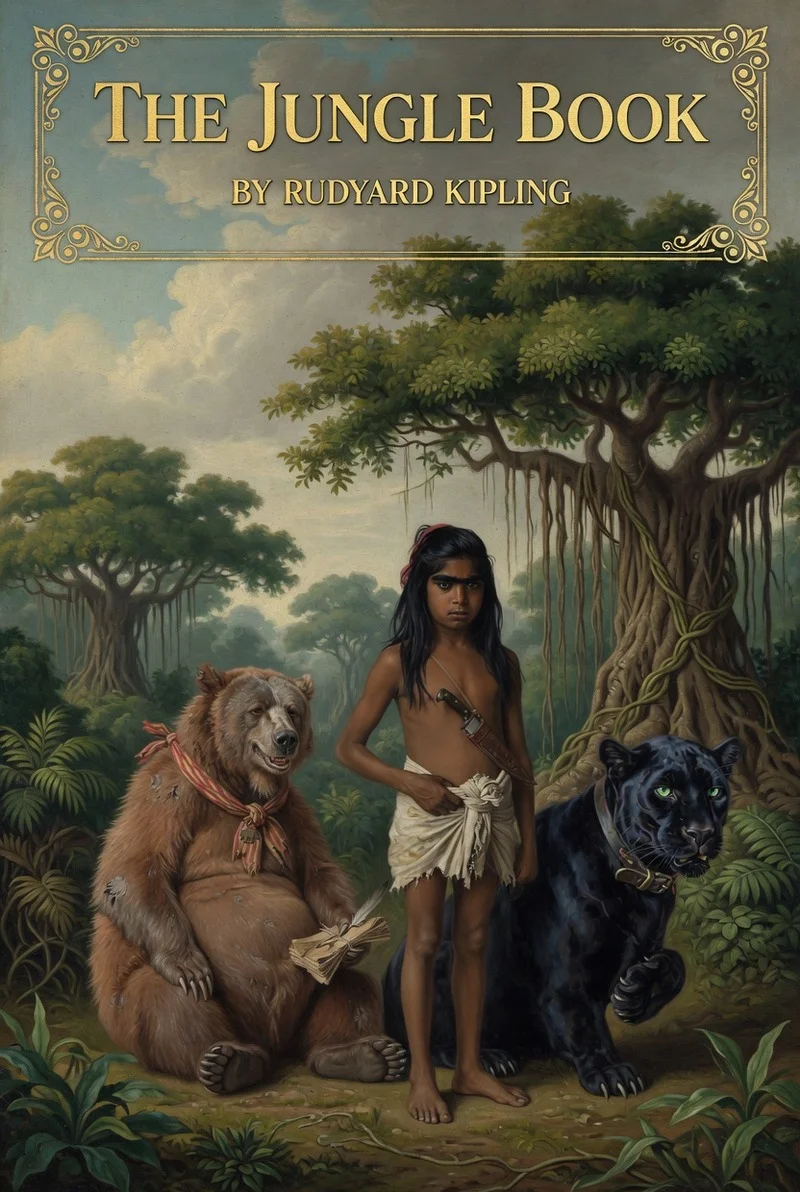
About This Book
The Jungle Book is seven separate tales, not one long novel. The first opens on a very warm evening in the Seeonee hills of central India, when Father Wolf wakes in his cave, Mother Wolf lies with four cubs, and a lame tiger is hunting too close to their ground — and then a naked human toddler crawls in over the threshold. Under the Law of the Jungle, the wolf pack will have to decide what a man-cub is doing among wolves.
Kipling gives animals voices, manners, arguments, and a code they can quote, and he expects readers to take that world as seriously as any human village. Middle-school readers get a book that is both an adventure and a study of belonging: who makes the rules, who is allowed inside them, and what it costs to live between two kinds of life. The language itself is worth the work — formal, rhythmic, and full of words a careful reader will want to keep.
Meet the Characters

More about Mowgli
Mowgli is a human toddler who crawls into a wolf den in the Seeonee hills of central India on a warm night. He is fearless and curious even before he can talk, and the wolves give him a name that means Frog. Because he is a man-cub among animals who live by the Law of the Jungle, his place in the pack is a question from the first night.

More about Bagheera
Bagheera is a black panther, the swiftest and most feared hunter in the Seeonee jungle, and every creature there steps out of his path. He speaks in a voice as soft as dripping honey and thinks carefully before he moves. When the wolf pack must decide what to do with a man-cub, he is one of the jungle people who has a voice at Council Rock.

More about Baloo
Baloo is an old brown bear whose job is to teach the Law of the Jungle to the wolf cubs of the Seeonee Pack. Because he eats only honey, nuts, and roots, he is welcome anywhere in the jungle. He is patient, long-winded, and easily wounded by rudeness, and he believes a lesson drilled in hard is a lesson that will one day save a life.

More about Shere Khan
Shere Khan is a huge tiger who hunts along the Waingunga River and has limped on one crooked foot since the day he was born. He is proud and loud, quick to announce that something belongs to him, and the other jungle animals look down on him for killing cattle and ignoring the Law. On the night the first tale opens, he has shifted his hunting grounds into the Seeonee hills without warning.

More about Father Wolf
Father Wolf is an Indian wolf of the Seeonee Pack, the father of four cubs, who lives with his family in a cave in the hills. He is stiff, law-abiding, and quick to anger when the Law is broken, and he takes his duty to hunt for the den seriously. On the warm evening the book opens, he stretches, yawns, and prepares to go out for the night's hunting.

More about Mother Wolf
Mother Wolf is a she-wolf of the Seeonee Pack, known in the jungle as Raksha — The Demon — and she is not called that for compliment's sake. She lies in the cave with her big gray nose dropped across four tumbling cubs. She is quieter than Father Wolf until something comes too close to her children, and then the whole den changes.

More about Akela
Akela is the Lone Wolf who leads the Seeonee Pack by strength and cunning. He has fallen twice into a wolf trap in his youth and once been beaten and left for dead, so he knows the manners of men. At Council Rock he lies out at full length on the highest stone while the pack sits below him, and he is the wolf who cries, 'Look well, O Wolves!'

More about Gray Brother
Gray Brother is the eldest of the four cubs born in the Seeonee cave the same season the man-cub arrives. He grows up tumbling with Mowgli as a litter-mate, and he keeps the wolf habit of speaking plainly. Among the four, he is the one who stays closest to the man-cub's side.

More about Kaa
Kaa is a huge rock python, old enough to be a little deaf, who spends his days stretched on a warm ledge changing his skin and thinking about dinner. He is not a poison snake; his strength is in his hug. He speaks with old-fashioned courtesy, and he takes a quiet pride in his length.

More about Rikki-tikki-tavi
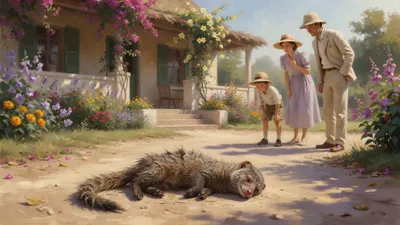
Rikki-tikki-tavi is a young mongoose whose family motto is to run and find out about everything. He is bold, tirelessly curious, and almost impossible to frighten, and nothing pleases him more than exploring a new place from top to bottom. Mongooses are born to hunt snakes, and Rikki-tikki has all the speed and nerve of his family, though he is still very young and has a great deal to learn.

More about Nag
Nag is a big black cobra, five feet from tongue to tail, who lives in the grass of an English family's garden in India. He carries the spectacle-mark on his hood that cobras say the god Brahm put there, and he expects other creatures to be afraid when he spreads it. He speaks softly, watches every movement, and thinks of the garden as his ground.

More about Nagaina
Nagaina is Nag's wife, a cobra who shares the garden grass with him. She is quicker to strike from behind than to talk, and the other small creatures of the garden are more afraid of her than of Nag. She has a clutch of eggs to think about, and she does not forget an insult.

More about Kotick
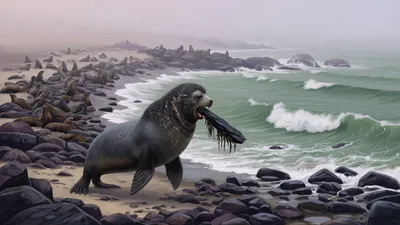
Kotick is a young fur seal born on the crowded beaches of Novastoshnah, on an island far north in the Bering Sea, where hundreds of thousands of seals haul out every summer. He arrives with a coat of pure white, something no seal there has ever seen before, and he grows into a powerful swimmer and a stubborn asker of questions. While the other young seals are happy simply to play in the surf, Kotick wants to know why things are the way they are.

More about Messua
Messua is the wife of the richest man in a village on the edge of the Seeonee jungle. She lost a son named Nathoo to a tiger, and she still looks for his face in other children. She wears heavy copper rings and speaks gently, and her hut holds a red lacquered bedstead, copper cooking pots, and a looking-glass from the country fair.

More about Little Toomai
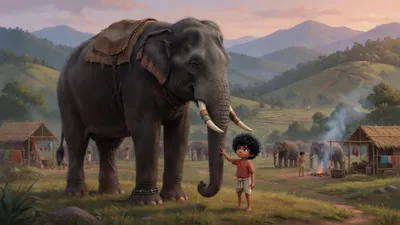
Little Toomai is ten years old, four feet tall, and the eldest son of Big Toomai, driver of the great elephant Kala Nag. He was born under the elephant's shadow and has played with the end of Kala Nag's trunk since before he could walk. According to custom he will take his father's place on the elephant's neck when he grows up, but what he likes now is the hill forests, not the brick elephant-lines his father prefers.

More about Big Toomai
Big Toomai is the mahout who drives Kala Nag, son of Black Toomai who took the elephant to Abyssinia, and grandson of Toomai of the Elephants who saw him caught. He is getting old and does not love wild elephants. He would rather have brick elephant-lines, one stall to each animal, than running up and down among the hills.

More about Kala Nag
Kala Nag — Black Snake — has served the Indian Government for forty-seven years and is nearly seventy, a ripe age for an elephant. He has hauled guns, carried tents, and worked the keddahs where wild elephants are caught. He stands ten fair feet at the shoulders, and the men of the camp say there is nothing in the way of fighting that he does not know.
Pre-Reading Discussion Questions
- What does the word 'family' mean to you — does it have to mean people you are related to?
- Every group you belong to has rules, some written down and some not. Think of one group you are part of and name a rule nobody ever says out loud.
- Authors sometimes give animals human voices and opinions. What can a writer say through a talking animal that would be harder to say through a human character?
- When you arrive somewhere new, how do you tell whether you are welcome?
- What do you already know about wolves, and where did that knowledge come from — a book, a film, a nature programme, someone you know?
- Is a rule more useful when someone can explain why it exists, or when people simply obey it? Why?
Themes & Big Ideas to Track
- The Law of the Jungle is presented as a practical code with reasons attached — notice when a character explains why a rule exists, not only what it forbids.
- Kipling gives each kind of animal a manner of speaking; listen for how rank, age, and species show up in the dialogue.
- Teachers and mentors appear in more than one tale; watch how a lesson is given, and how a pupil receives it.
- The stories are set in a world shaped by the British Empire, so pay attention to who gives orders, who obeys, and how the narrator describes people of different backgrounds.
- Between the tales Kipling places short songs and poems. Notice what a song can carry that the prose does not.
- Settings in this book are mapped as carefully as characters — caves, council rocks, beaches, gardens, elephant lines, army camps — so keep the ground of each tale straight.
Chapter-by-Chapter Study Guide
Chapter 1: Mowgli's Brothers
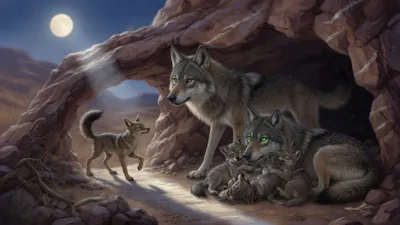
Before you read — think about:
- What is the first rule you had to learn when you joined something new — a team, a club, a new classroom? Who taught it to you, and how?
- People talk about 'an unwritten law' or 'the law of the playground'. What does the word 'law' mean when there is no judge and no courtroom?
- If you could have any animal in the world as a teacher, which would you choose, and what would you want it to teach you?
- What do you already know about wolves, and where did that knowledge come from — a book, a film, a nature programme, someone you know?
- People hand out nicknames behind each other's backs. What does a nickname usually tell you about the person who invented it?
Watch for these while reading:
- The Law of the Jungle. Kipling's characters almost always give a reason for a rule instead of just stating it, so notice the reasons.
- Father Wolf and Mother Wolf, and the way Kipling gives a wolf den the manners, arguments and small courtesies of a household.
- Shere Khan and Tabaqui, and the words Kipling puts in each of their mouths — you can hear rank in the way the jungle speaks.
- The phrase 'the Red Flower', and why the animals use a name of their own instead of the ordinary word for it.
- The 'Hunting-Song of the Seeonee Pack' printed after the story, and what a song can carry that the prose does not.
Vocabulary to know:
byre (noun) — a shed or barn where cattle are kept; talon (noun) — a sharp curved claw on a bird or beast of prey; tush (noun) — a long pointed tooth or tusk; threshold (noun) — the doorway or entrance of a home; jackal (noun) — a small wild dog of Asia and Africa that often lives on leftovers from larger hunters; despise (verb) — to look down on someone with strong dislike; hydrophobia (noun) — rabies; the disease that makes a wild animal go mad and bite; dewanee (noun) — the jungle animals' word for the madness (rabies) that makes a creature bite anything in its path; quarters (noun) — the hunting grounds or living area a creature claims as its own; mangy (adjective) — having a sick, patchy coat; looking worn-out and unclean; unsportsmanlike (adjective) — unfair or dishonorable, against the spirit of a fair hunt; lame (adjective) — unable to walk properly because of an injured or misshapen foot or leg; scour (verb) — to search a place thoroughly, moving quickly over every part of it; fostering (noun) — the act of raising a child who is not your own; haunches (noun) — the hips and hindquarters of an animal; sitting back on them means squatting on the back legs; quarry (noun) — the animal a hunter is chasing; the prey; inspection (noun) — a formal looking-over, so that others can recognize and accept someone; veterans (noun) — the oldest, most experienced members of a group; monotonous (adjective) — repeating the same sound or words over and over, without change; muffled (adjective) — made quieter or duller because something is blocking the sound; dispute (noun) — an argument over who is right or who has a claim; assembly (noun) — a formal gathering of a group to make a decision; pledge (noun) — a serious promise that someone is expected to keep; maimed (adjective) — permanently wounded or crippled.
Chapter 2: Kaa's Hunting
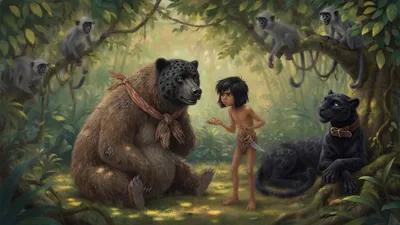
Before you read — think about:
- Stories are not always told in order. Why might a writer step backward in time to show you an earlier part of a character's life?
- Think of the hardest thing an adult ever tried to teach you. What kept you going — or what made you give up?
- Is there a song, chant or rhyme you know by heart without ever deciding to learn it? How do you think it got into your head?
- Kipling writes whole conversations between animals. What do you think makes animal-speech in a story feel like a real conversation rather than a lecture?
- What is the difference between knowing a rule and understanding why it exists? Use an example from your own life.
Watch for these while reading:
- Baloo's teaching methods and the Master Words he drills into Mowgli, and Bagheera's opinion of both — the chapter is quietly arguing about how children ought to be taught.
- The Monkey-People: how they describe themselves, and how the rest of the jungle describes them.
- The ruined city in the jungle — its tanks, terraces and summerhouses — and how much its residents understand about the place they live in.
- Kaa, and the formal, old-fashioned way he speaks. Kipling matches every animal's speech to its nature.
- How often a character in this jungle is judged by whether they keep their word, and who is described as having no memory.
Vocabulary to know:
fubsy (adjective) — short, chubby, and round (an old-fashioned word); pupil (noun) — a student; someone being taught; lounging (verb) — moving or sitting in a lazy, relaxed way; hive (noun) — a nest of wild bees, often high in a tree; cuffed (verb) — hit, especially with an open paw or hand, as a scolding; ignorance (noun) — not knowing something you need to know; Bandar-log (noun) — the Monkey-People; Kipling's name for the monkeys of the jungle, who have no law and no memory; jade (noun) — a hard green stone; here, used to describe eyes as hard and green as that stone; idleness (noun) — having nothing useful to do; doing things only because you are bored; giddy (adjective) — dizzy, as if the world is spinning; python (noun) — a huge non-poisonous snake that kills by wrapping its body around prey; mottled (adjective) — marked with patches or spots of different colors; presumptuous (adjective) — too bold; acting as if you know more than you do; drought (noun) — a long stretch of time with little or no rain; reservoirs (noun) — large tanks or pools built to store water; causeways (noun) — raised stone roads leading up to a gate or across wet ground; battlements (noun) — the notched stone walls along the top of a castle or city wall, used for defense; terrace (noun) — a flat paved platform or step, often above a pool or garden; derision (noun) — scornful laughter; making fun of someone to show you do not respect them; fascination (noun) — a hypnotic power that holds the watcher still; here, the python's ability to freeze other animals with his dance; ally (noun) — a partner in a fight; someone who takes your side; punishment (noun) — a penalty given after a rule has been broken; contempt (noun) — a feeling that someone or something is worthless and not worth respect; idols (noun) — stone or carved figures of gods, set up to be worshipped.
Chapter 3: Tiger! Tiger!
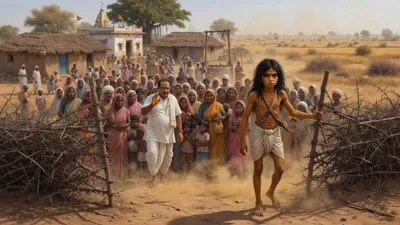
Before you read — think about:
- Have you ever had to explain something completely ordinary to someone who had never seen it before — a game, a gadget, a family custom? What made it hard?
- Have you ever been the new person somewhere — a new school, a new team, a new neighbourhood? What did the group do that made it easier or harder?
- Where do you get your ideas about a place you have never visited? How much of that do you actually trust?
- What jobs do children your age do in other parts of the world, or did in the past? How would a day of real work change your week?
- How can a writer show that two characters are looking at the same place and seeing completely different things?
Watch for these while reading:
- Messua, and the way she speaks to Mowgli from their very first meeting onward.
- Buldeo the village hunter, and the gap between what he says about the jungle and what Mowgli knows about it.
- The buffalo herd, and Kipling's vocabulary for handling one — including 'wind' used as a verb, meaning to catch a scent.
- Grey Brother, and which parts of the Pack's Law Mowgli still keeps even when he is living far away from the Pack.
- 'Mowgli's Song' printed at the end, and how different its voice is from the storyteller's.
Vocabulary to know:
ravine (noun) — a deep, narrow valley with steep sides; barricade (noun) — a barrier built to block a gate or road and keep danger out; pariah (noun) — an outcast; here, the yellow stray dogs that live on the edge of an Indian village; caste (noun) — a hereditary social class that, in this village, decides whom a person may eat with, marry, and work among; thatch (noun) — a roof made of dried grass or straw; lacquered (adjective) — coated with a hard, shiny painted finish; masonry (noun) — stone or brick work; a platform or wall built of fitted stone; musket (noun) — a long, old-fashioned gun, loaded from the muzzle; herding (noun) — the work of taking cattle or buffalo out to graze and bringing them home again; wallows (noun) — muddy pools where buffalo lie to keep cool; rupees (noun) — the main unit of money in India; anna (noun) — an old Indian coin worth a small fraction of a rupee; stampede (noun) — a sudden panicked rush of a herd; carcass (noun) — the dead body of an animal; flint (noun) — a hard stone struck against steel to make a spark for a fire; sheath (noun) — a case that holds a knife on a cord or belt; sorcerer (noun) — a person accused of using magic; a wizard; amulet (noun) — a charm worn around the neck for protection; brickbats (noun) — chunks of brick thrown as weapons; potter (noun) — a person whose work is making clay pots; scars (noun) — marks left on the skin after a wound has healed; priest (noun) — a religious official of the village; here, the fat man in white who first inspects Mowgli at the gate; conches (noun) — large shells blown like horns, used in temples as a loud signal; deposed (verb) — removed from leadership.
Chapter 4: The White Seal
Before you read — think about:
- Why might an author drop a story with a completely different setting and cast into the middle of a book?
- When a storyteller admits they heard a tale secondhand, does that make you trust it more or less? Explain your thinking.
- What do you already know about seals, walruses, or the animals of the far north, and where did you learn it?
- Maps and place-names can do work in a story. Why might an author bother to name every beach and current instead of just saying 'the sea'?
- If you were born looking different from everyone else in your family, what do you imagine would be the hardest part?
Watch for these while reading:
- Kotick's education in the sea — swimming, currents, fish, weather — and what a young seal is taught to notice.
- The beaches themselves. Kipling names and describes them the way a mapmaker would, and expects you to keep them straight.
- The grown seals Kotick puts his questions to, and the kind of answer adults give a young one who asks something awkward.
- Sea Catch and Matkah, and Kipling's language for the seals' seasons, fights and territory.
- 'Lukannon' printed after the story, which Kipling calls the great deep-sea song of the seals.
Vocabulary to know:
combers (noun) — long, high waves that roll in and break; billow (noun) — a great rolling wave; flipperling (noun) — Kipling's word for a baby seal, named for its flippers; rigging (noun) — the ropes and lines that support a ship's masts and sails; holluschickie (noun) — the bachelor seals — young males who have not yet won a place on the nursery rocks; basalt (noun) — hard, dark volcanic rock, worn smooth here by surf and seals; unaccommodating (adjective) — unwilling to make room or give way for anyone else; nursery (noun) — a stretch of beach a seal holds as home for his mate and pups; surf (noun) — the foaming water where waves break on the shore; breakers (noun) — waves that curl over and smash as they reach shallow water; scarred (adjective) — marked with old wounds; Equator (noun) — the imaginary line around the middle of the earth; here, the warm water the seals call Sticky Water; gale (noun) — a very strong wind at sea; fathoms (noun) — a measure of depth at sea; one fathom is six feet; porpoise (noun) — a small toothed sea mammal, related to the dolphin, that swims in schools; yearling (noun) — an animal in its second year of life; phosphorescent (adjective) — glowing with a cold light, as seawater sometimes does at night; albatross (noun) — a huge ocean bird with long narrow wings, famous for gliding over the southern seas; whaler (noun) — a ship that hunts whales and boils their fat down on board; blubber (noun) — the thick fat of a whale or seal, boiled down for oil; islet (noun) — a very small island; stareek (noun) — an insult meaning old man; the sea-catchers shout it at Sea Vitch the walrus; walrus (noun) — a huge Arctic sea animal with tusks and thick wrinkled hide; bachelors (noun) — the young male seals not yet holding a nursery; another name for the holluschickie.
Chapter 5: Rikki-Tikki-Tavi
Before you read — think about:
- What do you already know about mongooses, and where did that knowledge come from?
- How can a writer make a small, ordinary place — a garden, a hallway, a back porch — feel dangerous?
- What does the saying 'curiosity killed the cat' mean? Do you agree with it?
- Have you ever had a pet, or wanted one? What does an animal have to do before people will trust it inside a house?
- Think of a fear that seems perfectly reasonable to you but silly to someone else. Where do fears like that come from?
Watch for these while reading:
- Rikki-tikki's habit of stopping to think in the middle of danger, and what he says to himself while he does it.
- Darzee the tailorbird and his wife, and how differently Kipling draws the two of them.
- Nag and Nagaina talking to each other when no human is listening. Kipling gives the cobras plans and reasons of their own.
- Chuchundra the muskrat, and what a badly frightened character is and is not able to say.
- Kipling's use of eyes and colour all through the tale — whose eyes get described, and in what words.
Vocabulary to know:
mongoose (noun) — a small, fast, meat-eating animal of India, famous for hunting snakes; cantonment (noun) — a military station in British India, with houses and gardens for officers' families; bungalow (noun) — a one-story house with a veranda, common in British India; veranda (noun) — a roofed open porch along the side of a house; tailorbird (noun) — a small garden bird that stitches leaves together to make its nest; muskrat (noun) — a small, shy, water-loving rodent; here, Chuchundra, who never comes into the open floor; weasel (noun) — a slim, quick hunter with a pointed face; used here to describe a mongoose's head and habits; draggled (adjective) — wet, dirty, and limp from being soaked; cobra (noun) — a large poisonous snake that can spread a hood behind its head; hood (noun) — the spread skin behind a cobra's head, used as a warning; Brahm (noun) — Brahma, the Hindu creator god; Nag says cobras wear his mark on their hoods; spectacle-mark (noun) — the eyeglasses-shaped pattern on the back of an Indian cobra's hood; fledglings (noun) — young birds just growing their flight feathers; snakeling (noun) — a small snake; here, Karait, whose bite is as dangerous as a cobra's; kerosene (noun) — lamp oil; a fuel burned in household lamps before electric light; sluice (noun) — a drain or water-channel; here, the bath-room drain a cobra can crawl through; valiant (adjective) — brave in a showy, song-like way — Darzee's word for Rikki-tikki; consolation (noun) — something said to comfort you, often when it is already too late; matting (noun) — a floor covering woven of grass or fiber; gravel (noun) — small stones spread to make a garden path; purchase (noun) — a firm hold or grip that lets you use your strength; bantam (noun) — a small breed of chicken; used here to size Nagaina's eggs; restless (adjective) — never still; always moving; litter (noun) — a nest of loose plant stuff; here, the warm trash above the melons where the eggs are hidden.
Chapter 6: Toomai of the Elephants
Before you read — think about:
- What might it feel like to inherit a job from your parents before you were old enough to choose it?
- Would you rather have work that is safe and predictable, or work that is risky and exciting? What would you be giving up either way?
- What is the oldest living thing you have ever met — a person, a tree, an animal? What made it feel old to you?
- What do you already know about elephants, and where did that knowledge come from?
- Have you heard a chant, a work-song, or a call-and-response that people use while doing a job together? What do you think it is for?
Watch for these while reading:
- Kala Nag, and the way Kipling describes how an elephant sounds and moves depending on the ground under him.
- Petersen Sahib, and how the men of the camp speak to him and about him — Kipling is showing you how rank works here.
- Big Toomai's plans for his son, set against Little Toomai's own idea of a good life.
- The keddah: the stockade work of catching and driving wild elephants, and the specialised vocabulary Kipling uses for it.
- The songs and sayings the drivers use while they work, and what those reveal about how they think of elephants.
Vocabulary to know:
picket (noun) — a stake in the ground to which an elephant is chained when not at work; ankle-ring (noun) — the iron ring on an elephant's hind foot, used to chain him to a picket; mahouts (noun) — elephant drivers; the men who sit on an elephant's neck and give commands; ankus (noun) — an elephant-goad: a heavy iron hook used to steer and signal an elephant; goad (noun) — a pointed stick or hook used to urge an animal forward; keddah (noun) — the stockade and the whole operation of driving wild elephants into a trap; stockade (noun) — a high fence of logs used as a pen; here, the trap wild elephants are driven into; tusker (noun) — a large male elephant with tusks; pandemonium (noun) — wild uproar; a scene of shouting, trumpeting, and confusion; howdah (noun) — a seat or carriage strapped on an elephant's back for riders; rajah (noun) — an Indian prince or ruler; teak (noun) — a hard tropical timber used for ships and heavy building; sunstroke (noun) — collapse or death from extreme heat; insubordinate (adjective) — refusing to obey; not doing a fair share of the work; mortar (noun) — a short, heavy gun that throws shells in a high arc; forage (noun) — food for animals, especially grass and fodder stored for elephants; bazaar (noun) — a market of stalls and shops; fidgeting (verb) — shifting and moving restlessly because of being tied or bored; beaters (noun) — men who walk the jungle making noise to drive wild animals toward a trap; tracker (noun) — a hunter whose job is to follow animal signs and find the herd; pension (noun) — regular pay given after a person finishes government service; grievances (noun) — complaints; things a person feels are unfair; hullabaloo (noun) — a loud, confused noise of shouting and crashing; she-elephant (noun) — a female elephant; Petersen Sahib rides one named Pudmini.
Chapter 7: Her Majesty's Servants
Before you read — think about:
- How does it change a story when the narrator is a character standing inside it rather than an invisible voice?
- Have you ever been part of a huge crowd — a stadium, a parade, a festival? What did it sound like, and what did it feel like?
- Different jobs call for different kinds of courage. Name two jobs and describe how the courage each one needs is not the same.
- What can a writer show you through an argument that they could not show you through action?
- When people from very different places are camped side by side, what kinds of misunderstanding do you expect?
Watch for these while reading:
- How each animal describes its own way of working as perfectly sensible and everyone else's as ridiculous, and which of them will admit to being afraid.
- The young mule's questions. He asks the things the older animals seem to consider long settled.
- Kipling's vocabulary for army life — troop-horses, gun-bullocks, screw-guns, batteries, limbers, mules — and what each animal's job actually involves.
- The human voices that frame the animals' talk — who is listening, and what they think the camp is for.
- The 'Parade-Song of the Camp Animals' that closes the book, with its own verse for each kind of animal.
Vocabulary to know:
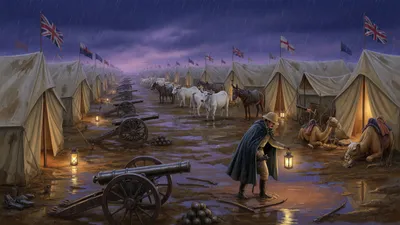
Viceroy (noun) — the British official who governed India in the name of the Queen; Amir (noun) — the ruler of Afghanistan; bodyguard (noun) — armed men whose job is to protect a ruler; slush (noun) — wet, watery mud; artillery (noun) — the big guns of an army, and the units that fire them; muzzle (noun) — the open front end of a gun barrel; harness (noun) — the straps and fittings an animal wears to pull a load; battery (noun) — a group of guns and the animals and men that serve them; screw-gun (noun) — a mountain cannon that comes apart so mules can carry the pieces; troop-horse (noun) — a cavalry horse trained to carry a soldier in formation; parade (noun) — a formal military display in which units march or stand in order; bullocks (noun) — castrated oxen used as heavy draft animals; yoke (noun) — a wooden collar that joins a pair of oxen so they pull together; also the pair itself; siege (noun) — the surrounding of a place in war; here, the huge guns used for that work; recruits (noun) — newcomers still learning the job; bridle-wise (adjective) — trained to obey the slightest signal of the bridle; farrier (noun) — the army craftsman who shoes horses and treats their hoofs; cowardice (noun) — the failure of courage; here, the troop-horse's word for a kind of fear he will not accept; regiment (noun) — a large unit of soldiers, often a thousand or more; hocks (noun) — the joints in a horse's hind legs, like human ankles; girths (noun) — the straps that hold a saddle on by going under the animal's belly; Brumby (noun) — an Australian wild horse; used here as an insult meaning untrained; Pachydermatous (adjective) — thick-skinned; the battery captain's joke-name for the elephant; Anachronism (noun) — something that belongs to an older time and seems out of place now.
About the Author
Rudyard Kipling was born in Bombay, India, in 1865, to English parents, and spent his earliest years among the sounds and languages of the city before being sent to school in England at the age of five. He returned to India as a young man and worked as a newspaper reporter, writing poems and stories in his spare time that quickly made him famous. He wrote The Jungle Book in 1894 while living in Vermont. In 1907 he became the first English-language writer to receive the Nobel Prize in Literature, still the youngest person ever to win it. He died in 1936.
The book was published in 1894, when India was governed by Britain and Kipling was one of the most widely read writers in English. That imperial world is on the page: British officers, government elephants, the northern fur trade, and a narrator who often sorts people by rank, caste, and nation. Modern readers can enjoy the storytelling and still notice, and question, the assumptions underneath it — especially where he describes Indian villagers, Aleut hunters, or Afghan visitors.