

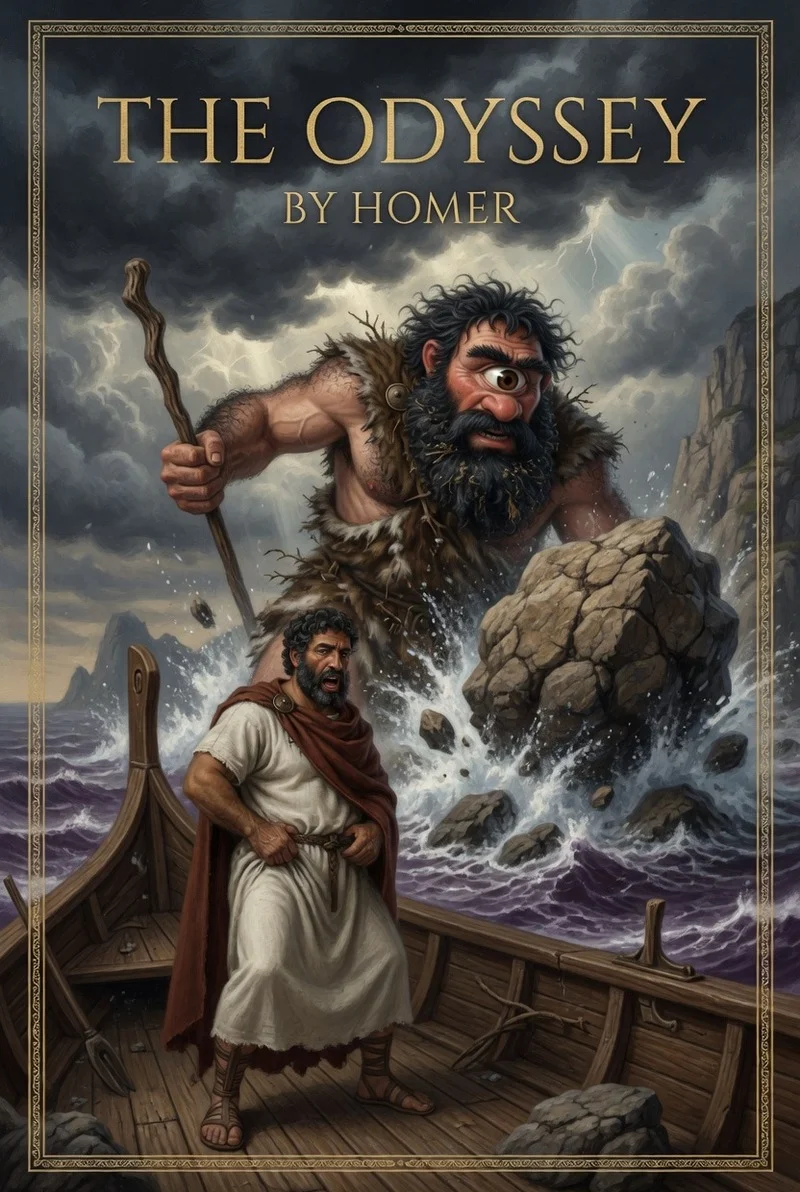
About This Book
Ten years after the fall of Troy, every Greek commander who survived the war has either reached home or died trying — except one. Odysseus, the king of the small, rocky island of Ithaca, has simply not arrived. No one knows whether he is alive, and after twenty years away his household has begun to come apart without him. His son Telemachus was a baby when his father sailed and has never met him. His wife Penelope runs the estate alone while a crowd of young noblemen camp in her hall, eating her food, drinking her wine, and demanding that she give up waiting and marry one of them. The Odyssey is the story of that man's long, interrupted journey home and of the household trying to survive until he gets there. Homer tells the two stories at once, cutting between the island where the family waits and the wider world where Odysseus is still somewhere at sea. Along the way the poem takes its hero far outside the ordinary world into places that no returning soldier is supposed to see, and it lets him tell some of that story in his own voice. What makes Odysseus unusual as a hero is that his great weapon is not his sword. The Greeks called him polytropos, the man of many turns — quick, adaptable, a talker, a planner, and a very convincing liar when he needs to be. Watching how a mind like that solves problems, and what it costs the people around him, is a large part of why this poem has been read for nearly three thousand years. A note on names: the translation included with this guide is Samuel Butler's prose version from 1900, which uses the Roman names for the gods and for the hero himself. Where this guide says Odysseus, Athena, Zeus, and Poseidon, Butler's text says Ulysses, Minerva, Jove, and Neptune. They are the same characters.
The Odyssey sits underneath an enormous amount of what you already know. Every story about a long journey home, every clever underdog who wins by outthinking something bigger, every hero who has to decide which parts of himself to hide — a great many of them trace back to this poem. Reading it directly, rather than absorbing it secondhand, gives you the original and lets you see how much later writers borrowed. It is also genuinely gripping: shipwrecks, monsters, disguises, a household under siege, and a family that has to work out whether twenty years of waiting was worth it. And because Homer's audience heard this performed rather than read it, the poem is built out of repeated phrases, vivid comparisons, and scenes designed to hold a room — which makes it an unusually good place to study how storytelling actually works on an audience.
Meet the Characters

More about Odysseus
Odysseus is the king of the small rocky island of Ithaca, famous among the Greeks less for his strength than for his quick mind and his talent for talking his way out of trouble. He left home twenty years ago to fight in the war at Troy, and long after the other surviving commanders have reached their own countries, he still has not come back. In this translation his name appears in its Roman form, Ulysses.

More about Penelope
Penelope has run her husband's household alone for twenty years, raising their son and holding the estate together with no news of whether Odysseus is alive. A crowd of young noblemen has moved into her hall insisting she choose a new husband from among them, and she has spent years finding reasons to delay. She is patient, guarded, and far shrewder than the men pressing her realize.

More about Telemachus
Telemachus was an infant when his father sailed for Troy, so he has no memory of him at all and has grown up hearing his father described by strangers. He is intelligent and proud but has never been tested, and the noblemen crowding his house treat him as a boy who can safely be ignored. The story opens with him sitting unhappily among them, wishing someone would arrive and set his household right.

More about Athena
Athena is the goddess of wisdom, skilled work, and clever strategy, and she has long admired Odysseus for having the sort of mind she values. She moves easily between the assembly of the gods and the world of people, often arriving among mortals in a borrowed shape rather than her own. In this translation she appears under her Roman name, Minerva.

More about Eumaeus
Eumaeus manages the pig farms in the hills above the harbour, living in a rough steading he built himself well away from the main house. He was brought to Ithaca as a boy and raised in the royal household, and he has never stopped speaking of his long-absent master with affection. He is generous to strangers in a way that his betters in the great hall are not.

More about Antinous
Antinous is the son of one of Ithaca's leading families and the most forceful of the young men who have installed themselves in Odysseus' hall. He eats the household's food, drinks its wine, and speaks to the family who own the house as though they were guests in it. Where the other suitors follow, he leads, and he does not bother to be polite about it.

More about Calypso
Calypso is a nymph who dwells in a cave on the island of Ogygia, far from any human city. She is powerful, lonely, and used to having her own way on her island. Odysseus has been her unwilling guest for years when the poem first turns to him.

More about Circe
Circe is a goddess-enchantress who lives alone in a stone hall in a forest on the island of Aeaea. She is famous among sailors as a hostess whose welcome is not what it seems. She sings at her loom and knows the uses of every herb that grows.

More about Polyphemus
Polyphemus is a Cyclops, a one-eyed giant who keeps sheep in a cave on a wild shore. He lives by his own law, far from the cities of men, and does not welcome guests. Odysseus and his crew come to his cave looking for hospitality.

More about Nausicaa
Nausicaa is the daughter of King Alcinous of the Phaeacians, a seafaring people who live far from Ithaca. She is brave, courteous, and more practical than her years. She is among the first friendly faces Odysseus meets after being washed ashore.

More about Eurycleia
Eurycleia is the old nurse who raised Odysseus and later Telemachus, still serving in the Ithacan household. She is loyal, sharp-tongued, and more devoted to the absent king than many of the younger servants. She knows every scar and habit of the family she has served.

More about Poseidon
Poseidon is the god of the sea, earthquakes, and horses, and he has a personal grudge against Odysseus. He is proud, implacable, and used to being feared. While Athena helps the Ithacan household, Poseidon works to keep its master from ever reaching home.

More about Argus
Argus is the dog Odysseus trained as a puppy before sailing for Troy. He has waited twenty years in the courtyard, neglected by the suitors and the servants. He is the first living creature of the household who still knows his master by sight.
Pre-Reading Discussion Questions
- In a world with no hotels, no police, and no way to check who anyone is, what should a household owe a stranger who arrives at the door with nothing? What should the stranger owe in return?
- What happens to the people who stay behind when someone leaves for a war that lasts for years? How is their experience of it different from the soldier's?
- What makes someone a leader in a community — the family they were born into, their strength, their reputation, or something else entirely?
- If a person has been gone so long that no one can say whether they are alive, how long should the people waiting keep waiting? Who has the right to decide when it is over?
- This poem was performed out loud, from memory, to a listening audience over several evenings. How might a story be built differently when it is heard rather than read silently?
- Cultures all over the world tell stories about the journey home rather than the journey out. Why might coming back make a better story than leaving?
Themes & Big Ideas to Track
- Hospitality as a test: notice how Homer uses the way a household treats visitors as a quick measure of whether the people in it are decent.
- The gods are participants, not scenery — watch who they help, who they obstruct, and what they seem to want in return.
- Reputation outlives the person: characters constantly worry about what will be said of them later, and act accordingly.
- Intelligence as a form of strength, and the question of whether being clever is the same thing as being good.
- Notice how often someone in this world asks a newcomer to tell their story, and what both sides gain from the telling.
- Home is a place, but it is also a set of relationships and duties — track what the word seems to mean to different characters.
Chapter-by-Chapter Study Guide
Chapter 1: Part One: The House Without Its Master (Books 1-4)
Before you read — think about:
- A household has been without the person who normally ran it for twenty years. What everyday decisions become difficult when no one is clearly in charge, and who usually takes them on instead?
- What might it be like to grow up hearing a parent praised constantly by people who knew them, when you have no memory of that parent yourself?
- Where is the line between a guest and someone who has simply moved in? What signals tell you a visitor has crossed it, and why is that line so awkward to enforce?
- Think of a time you had to act on information you could not confirm. How did not knowing change the way you behaved, and how long can a person reasonably keep waiting for an answer?
- In a world with no written records, what people say about you is the only thing that outlasts you. How would that change the way a person behaves in public?
Watch for these while reading:
- The care Homer takes over meals and hosting: who is offered food, who washes, who sits where, and in what order it all happens.
- Phrases that return word for word each time the same kind of moment comes around, such as the way a new morning is described.
- The set formulas people use when speaking to someone they have never met before, and how much they ask before they ask a name.
- Telemachus's manner when he speaks with adults who are older and more powerful than he is: how much he says, and how he says it.
- How different people describe Odysseus when he is not in the room, and which of his qualities each of them mentions first.
Vocabulary to know:
hecatomb (noun) — a large public sacrifice to the gods, traditionally consisting of one hundred cattle or oxen; blandishment (noun) — flattering or pleasing speech or action intended to coax or persuade someone; propitiate (verb) — to win back the favor or goodwill of an angry god or person; appease; redoubtable (adjective) — formidable and commanding respect or fear because of great strength or reputation; insolence (noun) — rude, disrespectful, and haughty behavior toward others; sovereign (adjective) — possessing supreme power, efficacy, or excellence; exceedingly potent; clamorous (adjective) — making a loud, vehement, and confused noise or outcry; staid (adjective) — serious, sedate, dignified, and respectable in conduct; perforce (adverb) — by necessity or force of circumstance; inevitably; mettle (noun) — courage, spirit, and strength of character, especially when tested by difficulty; artful (adjective) — clever in a crafty, sly, or calculating manner; imperishable (adjective) — enduring forever; incapable of rotting, decaying, or wearing out; convene (verb) — to call together or summon a formal meeting of people; avenge (verb) — to inflict punishment in return for a wrong or injury done to oneself or one's family; omen (noun) — an event or natural sign believed to portend good or evil in the future; prating (verb) — talking on and on foolishly and at tedious length about trivial or annoying matters; vying (verb) — competing eagerly or contending vigorously against others for a prize; equitably (adverb) — fairly, justly, and impartially, treating all people by the same standard; oust (verb) — to drive out, expel, or remove someone from a place or property they occupy; suppliant (noun) — a person making a humble, earnest plea or prayer to someone in authority; lamentation (noun) — a passionate expression of deep grief, weeping, and sorrow; appease (verb) — to pacify, soothe, or calm someone's wrath, often through offerings or concessions; venerable (adjective) — commanding deep respect on account of great age, wisdom, and noble dignity; renown (noun) — widespread fame, high reputation, and public glory; prowess (noun) — exceptional bravery, skill, and valor, especially in combat; stratagem (noun) — a clever trick, scheme, or ruse used to outwit or deceive an opponent.
Chapter 2: Part Two: The Sea and the Stranger's Shore (Books 5-8)

Before you read — think about:
- In Part One you watched two different households receive a visitor. What did the welcome look like in each case, and what did the host appear to expect in return?
- The gods in Part One argue among themselves about human beings. If you imagine a group with the power to help or obstruct people, what would make them favour one person over another?
- A professional singer performed at the feast in Part One, and the household could not always control what he chose to sing. What does a performer owe an audience that includes people the song is about?
- Twenty years is a long time to be away from a place. What do you think changes in a person over a span that long, and what, if anything, stays fixed?
- When someone has been through a great deal, other people often expect them either to talk about it or to keep quiet. Which is easier to be around, and why do you think that is?
Watch for these while reading:
- Homer's extended comparisons: when the poem stops to describe something from ordinary life — farming, weather, animals, a craftsman at work — notice what is being compared and how long the picture is allowed to run.
- How precisely the poem names things: tools, timbers, parts of a ship, stages of a job. Notice where it slows down to get the details right.
- The many different ways the sea is described from one passage to the next, and which of its moods the poem lingers over.
- How younger and older characters speak to one another, and who is expected to defer to whom.
- Which characters are shown running a household, and the signals Homer uses to tell you whether that household is well kept.
Vocabulary to know:
harbinger (noun) — a person, thing, or event that announces or signals the approach of another; perilous (adjective) — full of grave danger, peril, or risk; raiment (noun) — clothing, apparel, or garments; transgress (verb) — to violate or go beyond the limits of a law, rule, or divine command; matrimony (noun) — the formal state, ceremony, or union of marriage; fallow (adjective) — plowed and harrowed but left unseeded for a period; uncultivated; desolate (adjective) — deserted, barren, and joyless; devoid of inhabitants; gossamer (noun) — a fine, delicate, and filmy substance or fabric; befallen (verb) — happened to someone, especially an unfortunate event or disaster; roused (verb) — awakened from sleep, or stirred up to vigorous emotion and action; reeled (verb) — rocked, swayed violently, or lost balance under a heavy shock or blow; brine (noun) — salt water; the ocean sea; whirlwind (noun) — a violent, rapidly whirling column of air; a furious tempest; plight (noun) — a dangerous, distressing, or unfortunate condition or situation; compassion (noun) — sympathetic pity and concern for the sufferings and hardships of others; enchanted (adjective) — endowed with magical power or placed under a supernatural spell; chaff (noun) — the dry husks of corn separated during threshing; worthless or light waste matter; luxuriantly (adverb) — in a lush, rich, and abundant manner; implore (verb) — to beg someone earnestly and desperately for aid, pity, or mercy; prudent (adjective) — wise, judicious, and showing careful forethought for the future; discretion (noun) — the quality of wise judgment and careful restraint in conduct or speech; consummate (adjective) — complete, perfect, and showing supreme skill or mastery; exquisite (adjective) — characterized by intricate beauty, delicacy, and refined craft; apprehend (verb) — to understand, perceive, or grasp the meaning of something; minstrel (noun) — an ancient musician, singer, or poet who recites heroic deeds; taunt (verb) — to provoke, challenge, or mock someone with contemptuous words.
Chapter 3: Part Three: The Traveler's Own Tale (Books 9-12)
Before you read — think about:
- What makes a person decide to tell a story they have been avoiding, and what changes about a story when the one telling it is the one who lived it?
- Think of a story you have heard told by two different people who were both there. What changed between the versions, and what does a teller's stake in a story do to the way it comes out?
- In this world there is almost no way to check a traveller's claims about where they have been. If you cannot verify what someone says, what makes you decide to believe them anyway?
- The poem's opening lines told you that the crew's own recklessness cost them their homecoming. What do you think a leader owes the people who follow them into danger, and where does the followers' own responsibility begin?
- Homer's audience heard this poem performed over several evenings. If you were the performer, how would you decide where to stop for the night, and what would you want the audience thinking about until the next one?
Watch for these while reading:
- The shape of the storytelling itself: who is speaking, who is listening, and what the listeners seem to want from the teller.
- Which details the narrator dwells on at length and which he passes over in a sentence.
- How the crew is described as a group, and the rare moments when one of them is named as an individual.
- Passages where the poem stops to explain exactly how something practical is done — a job, a tool, a procedure.
- The recurring pattern of arrival: what the narrator notices first, and in what order, each time he reaches somewhere new.
Vocabulary to know:
indomitable (adjective) — impossible to defeat, break, or subdue; unconquerable; seer (noun) — a prophet or visionary gifted with divine insight into the future; unpropitious (adjective) — unfavorable, inauspicious, or not presenting a good chance of success; booty (noun) — valuable goods or plunder seized in war or a raid; gorging (verb) — feeding greedily, excessively, and voraciously; quaked (verb) — shuddered, trembled, or shook violently from a tremendous impact; weakling (noun) — a person lacking physical vigor, courage, or strength; savour (noun) — a rich, appetizing smell or flavor, especially of roasted sacrifice or food; abhorred (adjective) — regarded with extreme disgust, detestation, and loathing; reconnoitre (verb) — to make a preliminary military inspection or scouting survey of an area; valour (noun) — exceptional courage, bravery, and daring in the face of danger; wrath (noun) — fierce, vengeful anger or divine retribution; exhort (verb) — to strongly urge, encourage, or admonish someone to perform a duty; plausibly (adverb) — in a manner appearing reasonable, credible, or persuasive; gobbet (noun) — a piece, lump, or mouthful of flesh or food; faint-hearted (adjective) — lacking courage, confidence, or resolution; cowardly; besmirched (adjective) — soiled, smeared, or stained with soot, grime, or blood; frenzy (noun) — a state of wild, uncontrollable delirium, madness, or violent excitement; wont (adjective) — accustomed, used to, or in the habit of doing something; stature (noun) — a person's physical height, build, and commanding bodily presence; imposing (adjective) — grand, impressive, and commanding in appearance or size; insignificant (adjective) — too small, weak, or trifling to be of importance; intercede (verb) — to intervene or plead on behalf of someone else in trouble; beseech (verb) — to ask someone urgently, fervently, and humbly; implore; appalling (adjective) — causing shock, dismay, or terrifying dread; august (adjective) — inspiring reverence and deep respect; majestic, noble, and dignified.
Chapter 4: Part Four: The Road Back to Ithaca (Books 13-20)
Before you read — think about:
- You have now heard the same twenty years described twice: once by the people who stayed at home, and once by the man who was away. Which parts of the story does each side have no way of knowing?
- Homer keeps stopping to notice ordinary work — ploughing, weaving, cooking, carpentry, minding animals. Why might an epic poem about a king spend so much of its length on the labour of ordinary people?
- Think about returning to a place you have not seen for many years: a house, a school, a town. What would you expect to have changed, and what would you expect to feel standing there?
- This poem repeatedly says that a god put an idea into someone's head. When a story explains a choice that way, does it reduce the person's responsibility for what they then do?
- In Part Three the teller shaped a long story for a particular audience. When you tell someone about yourself, how much do you adjust the telling depending on who is listening, and is that dishonest?
Watch for these while reading:
- The everyday texture of farm and hut: tools, animals, food, fences, weather, and how much room the poem gives them beside the grand houses of earlier parts.
- How the people who work on the estate talk about the master who has been away for twenty years.
- The manners of the household — who eats where, who serves whom, who sits and who stands — and what happens to those rules when the people in the hall stop respecting them.
- Omens, dreams, and signs: who reports them, who believes them, and how everyone else responds.
- How Homer handles a single day: how many separate places the story visits, and how he moves you between them.
Vocabulary to know:
portend (verb) — to serve as an omen or warning of a future calamity or momentous event; shroud (noun) — a burial cloth or dark veil that envelops and conceals something; pestilence (noun) — a fatal epidemic disease, or a destructive and troublesome person or influence; chastise (verb) — to discipline, severely rebuke, or punish someone for wrongdoing; bewailing (verb) — expressing deep sorrow, grief, or lamentation over a misfortune; mien (noun) — a person's look, air, bearing, or outward demeanor; vassal (noun) — a subordinate dependent, subject, or servant pledged to a lord; antagonist (noun) — an adversary, opponent, or person who actively contends against another; unwearying (adjective) — tireless, relentless, and refusing to fatigue or give up; deceit (noun) — the practice of concealing or misrepresenting the truth through falsehood or trickery; wiliness (noun) — clever slyness, shrewdness, and craftiness in achieving one's purposes; reverence (noun) — deep respect, honor, and awe felt toward a sacred or noble authority; vengeance (noun) — punishment or retribution inflicted in return for an injury or insult; doughty (adjective) — brave, resolute, and fearless in combat or hardship; frugal (adjective) — sparing, economical, and avoiding unnecessary waste or luxury; scruple (noun) — a feeling of moral doubt or ethical hesitation regarding an action; insatiable (adjective) — impossible to satisfy, quench, or appease; infamy (noun) — the state of being widely and notoriously known for shameful or evil deeds; requite (verb) — to repay, reward, or retaliate for an action done (good or bad); recoup (verb) — to regain, recover, or make up for an expenditure or financial loss; curvetted (verb) — pranced, leaped, or reared gracefully like a spirited thoroughbred horse; orator (noun) — an eloquent and skilled public speaker who addresses an assembly; diplomacy (noun) — skill in managing relations, negotiations, and sensitive affairs tactfully; freebooter (noun) — a pirate, roving plunderer, or lawless raider; propitious (adjective) — giving or indicating a good chance of success; favorable and benevolent; gibe (noun) — an insulting, taunting, or mocking sneer or remark.
Chapter 5: Part Five: The Contest in the Hall (Books 21-24)

Before you read — think about:
- Homer has spent four parts building expectation toward a homecoming. What makes the climax of a long, epic journey feel earned rather than merely convenient?
- Throughout the epic, characters continually recall what happened to Agamemnon upon returning from Troy. What does a story gain by holding up a contrasting parallel again and again?
- When ancient listeners gathered to hear this epic, they already knew how the story ended. How does already knowing the outcome change what you notice and value while following the story?
- Odysseus has been described by others, portrayed by the narrator, and heard speaking in his own voice. Which version of him feels most truthful, and why?
- When a family or community has suffered years of division and grievance, can order and peace ever be restored through violence, or does retaliation create new cycles of conflict?
Watch for these while reading:
- How the poem manages a crowded room: which figures are singled out by name, which act as a collective chorus, and how tension builds between them.
- Objects, phrases, and motifs from earlier parts reappearing: the bow, the hunting scar, the roots of the olive tree, and tokens of recognition.
- The nature of divine intervention in this final movement: where the gods act openly and where mortal skill and endurance carry the action.
- The shifting pace of the narrative: moments where the verse slows to scrutinize a physical detail versus scenes of rapid, chaotic crisis.
- Voices that were previously quiet or secondary stepping forward into prominence and decisive action.
Vocabulary to know:
beguile (verb) — to charm, mislead, or influence someone through cunning or deception; respite (noun) — a temporary delay, relief, or period of rest from suffering or toil; contending (verb) — struggling, competing, or striving vigorously against rivals; indignant (adjective) — feeling or showing righteous anger at unfairness, injustice, or wickedness; illustrious (adjective) — celebrated, famous, and distinguished by nobility or outstanding achievements; weltering (verb) — lying soaked, rolling, or wallowing in blood, water, or dust; aegis (noun) — a divine, terror-striking shield or protective mantle wielded by Zeus and Athena; cower (verb) — to shrink, crouch down, or huddle in fear or helplessness; disport (noun) — amusement, pastime, recreation, or festive entertainment; reveller (noun) — a person taking part in lively, festive, and often noisy feasting and drinking; menacingly (adverb) — in a threatening, dangerous, or intimidating manner; brandishing (verb) — waving or shaking a weapon aggressively or triumphantly in display; linger (verb) — to remain slowly, drag out time, or delay departure in suffering or waiting; vaunt (verb) — to boast, brag, or speak with arrogant pride about a victory; bondage (noun) — the condition of being bound, tied up, or held in harsh captivity; lamentably (adverb) — regrettably, deplorably, or to a degree that inspires deep sorrow; brunt (noun) — the main force, chief shock, or heavy impact of an attack or conflict; unsupported (adjective) — standing alone without aid, reinforcement, or defenders; gadfly (noun) — a biting fly that torments livestock, or an agent that drives victims into wild panic; reproach (verb) — to express disapproval, censure, or fault with someone; covenant (noun) — a sacred, binding solemn agreement or treaty sworn before the gods; iniquity (noun) — gross wickedness, injustice, or moral outrage; exult (verb) — to rejoice exceedingly or display triumphant, joyful jubilation; dirge (noun) — a mournful song, chant, or hymn of grief for the dead; sacrificial (adjective) — relating to or offered in a religious sacrifice or rite to the gods; workmanlike (adjective) — characteristic of a competent, thorough, and skilled craftsman.
About the Author
Homer is the name the ancient Greeks gave to the poet they believed composed the Iliad and the Odyssey, probably somewhere along the coast of what is now western Turkey around the 8th century BCE. Almost nothing about him can be verified: ancient tradition described him as a blind travelling singer, several cities claimed him as their own, and modern scholars still argue about whether he was one poet, two, or a long line of performers whose work eventually settled into the versions we have. What is clear is that these poems grew out of an oral tradition in which singers built long narratives live from memory using stock phrases, repeated scenes, and a steady rhythm. Whether or not a single man named Homer wrote them down, the poems carry the fingerprints of that performance tradition on almost every page.
The Odyssey looks back at a world already ancient to its first audience. The Trojan War it assumes as background belongs to the Bronze Age palace culture that collapsed around 1200 BCE, while the poem itself took shape roughly four centuries later, so its picture of kings, ships, and great halls mixes genuine memory with the 8th-century present of the people listening. That audience lived in a world without police, courts, or reliable travel, where the custom of xenia — the obligation of a host to feed and protect a stranger, and of a guest not to abuse that welcome — was one of the few things standing between a traveller and disaster. Understanding how seriously that obligation was taken is essential to this poem, because Homer uses it constantly as a measure of who is civilized and who is not. The Odyssey was written in a form called dactylic hexameter and was performed aloud, most likely across several sittings, by singers accompanying themselves on a stringed instrument.