

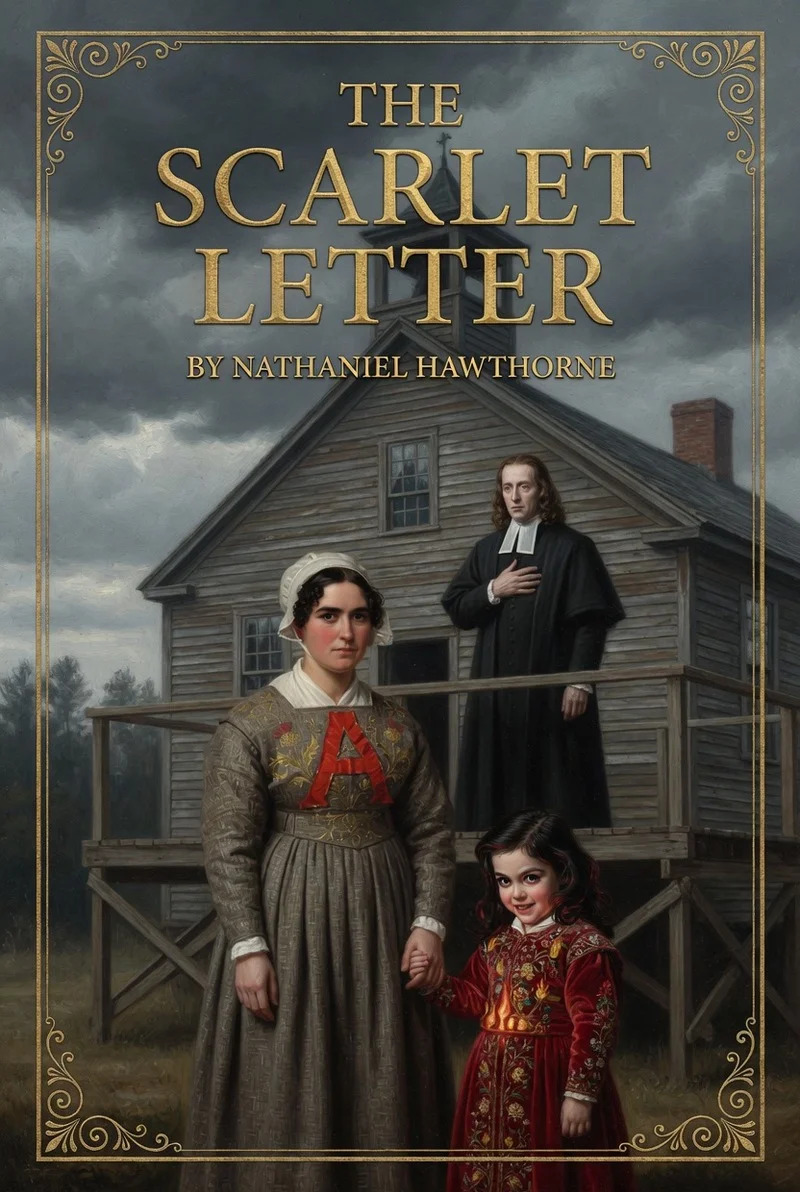
About This Book
In the Massachusetts Bay Colony of the 1640s, a young woman named Hester Prynne is brought out of the town prison to stand on a raised wooden platform in the marketplace while the whole settlement looks on. She carries an infant, and on the breast of her gown she wears a letter A, cut from scarlet cloth and worked over with gold thread so extravagantly that it seems less like a punishment than a declaration. The colony's magistrates have sentenced her to wear that letter for the rest of her life, and to answer one question in public: who else was involved. She refuses to answer. That refusal is the engine of everything that follows. The Scarlet Letter is a short novel with a small cast — Hester, her strange and brilliant daughter Pearl, the town's beloved young minister Arthur Dimmesdale, and a learned physician named Roger Chillingworth who arrives in Boston at exactly the wrong moment. Hawthorne is far less interested in what these four people do than in what they carry: what a community does to a person it has decided to make an example of, what secrecy does to the person keeping it, and what the difference is between being punished and being forgiven. The book moves slowly and deliberately, in long sentences full of shadow and firelight, and it rewards patient reading. This guide divides the novel's twenty-four chapters into five acts, the way you would map a play, so you can see its dramatic shape as you read. Act I covers chapters 1–3, Act II chapters 4–8, Act III chapters 9–12, Act IV chapters 13–20, and Act V chapters 21–24. Hawthorne opened the book with a long autobiographical sketch called "The Custom-House," which explains how he supposedly discovered Hester's story in a pile of old papers; it is worth reading, but the five acts here begin with the novel proper.
This is one of the first American novels to take seriously the idea that a society can be wrong — that a community's certainty about right and wrong says as much about the community as it does about the person it condemns. That question has not aged. Students who have watched a reputation collapse online, or seen a group decide together who deserves scorn, will recognize the marketplace scene immediately, and Hawthorne gives them a vocabulary for thinking about it: the difference between shame and guilt, between confession and exposure, between a symbol imposed on you and a symbol you make your own. It is also a masterclass in symbolism — almost nothing in the book is only itself — which makes it one of the most useful novels in the curriculum for learning to read closely.
Meet the Characters

More about Hester Prynne
Hester Prynne is a young Englishwoman living in the Massachusetts Bay Colony, known for her dignity, her self-possession, and an extraordinary skill with a needle that no one else in the settlement can match. As the story opens she is the subject of the whole town's attention, and she meets that attention without flinching.

More about Pearl
Pearl is Hester Prynne's young daughter, a restless, quick, and strangely knowing child. She is fiercely attached to her mother and not easily tamed by the grave adults of Boston. She seems to take her color from the scarlet letter itself.

More about Arthur Dimmesdale
Arthur Dimmesdale is the young, gifted minister of the Boston church, beloved by his congregation for his eloquence and his apparent holiness. He is sensitive, learned, and visibly unwell. He is among the clergymen who must speak to Hester on the scaffold.

More about Roger Chillingworth
Roger Chillingworth arrives in Boston as a physician of unusual learning, a man who has spent years among books and among people far from New England. He is quiet, watchful, and immediately interested in the woman on the scaffold. The town takes him for a useful stranger.

More about Governor Bellingham
Governor Bellingham is the civil head of the colony, a man of property and ceremony. He is concerned with public order and with the proper upbringing of children. Hester and Pearl are summoned to his mansion.

More about Mistress Hibbins
Mistress Hibbins is Governor Bellingham's sister, a well-known and slightly feared figure in Boston. She speaks in hints and smiles at people who think themselves respectable. She takes a particular interest in Hester.

More about Reverend John Wilson
Reverend Wilson is the eldest and most fatherly of Boston's ministers. He is orthodox, kind in manner, and sure of the colony's religious rules. He stands with Dimmesdale on the balcony overlooking the scaffold.
Pre-Reading Discussion Questions
- What is the difference between feeling guilty about something and feeling ashamed of it? Can a person feel one without the other?
- When a community decides publicly that someone has done wrong, what does that public judgment accomplish, and what does it fail to accomplish?
- Is a secret always a burden? What would make keeping one harder than admitting it?
- How much of who you are is decided by how other people see you? What would it take to change a label that other people have attached to you?
- Why might a society need someone to make an example of? What does the community get out of it?
- Think of a symbol you wear or carry — a uniform, a badge, a piece of jewelry, a logo. Who decided what it means: you, or the people looking at you?
Themes & Big Ideas to Track
- Symbols in this book rarely hold still — watch how the meaning of a single object shifts depending on who is looking at it and when.
- Hawthorne repeatedly contrasts the settlement with the forest that surrounds it, and gives each one its own rules about what may be said aloud.
- The novel keeps testing the gap between a person's public reputation and their private knowledge of themselves.
- Notice how often the narrator offers you two or three possible explanations for the same event and declines to choose between them.
- Light and dark, sunshine and shadow, are used with great deliberateness throughout — track who stands in which.
- The story returns more than once to the same physical place in the town, and invites you to compare those returns.
Chapter-by-Chapter Study Guide
Chapter 1: Act I — The Prison Door and the Marketplace (Chapters 1–3)

Before you read — think about:
- What can the buildings a community puts up first tell you about what that community expects from the people living in it?
- How does being part of a crowd change the way an individual behaves toward the person the crowd has gathered to look at?
- What is the difference between being looked at and being genuinely seen?
- In a settlement where the church and the government are essentially the same institution, who gets to decide what counts as a crime, and what happens to anyone who disagrees with that definition?
- Can something made beautifully still function as a punishment? What happens to a symbol when the person required to wear it makes it magnificent?
Watch for these while reading:
- The wild rose-bush growing beside the prison door, and the care the narrator takes in handing it to you before the story proper begins.
- Hester's posture on the platform, and the small physical details Hawthorne chooses to record while she is standing there.
- The women standing near the prison door — how they talk about Hester, and how the youngest of them sounds different from the oldest.
- The narrator's habit of measuring this rough New England town against the older England these settlers left behind.
- Where the light falls: the difference between the gray interior of the jail and the flat, unsparing sunshine of the marketplace.
Vocabulary to know:
edifice (noun) — a large, imposing building; sepulchre (noun) — a tomb or burial place; ponderous (adjective) — extremely heavy and slow-moving; congenial (adjective) — suited to one's nature; naturally agreeable; inauspicious (adjective) — suggesting that what follows will go badly; physiognomy (noun) — a person's face and features, treated as evidence of character; augur (verb) — to be a sign of something that is coming; culprit (noun) — the person responsible for an offense; tribunal (noun) — a court or panel assembled to pass judgment; heterodox (adjective) — holding beliefs that differ from the officially accepted ones; scourge (verb) — to whip severely as a punishment; vagrant (adjective) — wandering from place to place with no settled home; venerable (adjective) — commanding deep respect because of age, dignity, or office; transgressor (noun) — someone who breaks a law or a moral rule; infamy (noun) — the condition of being widely known for something shameful; penal (adjective) — relating to punishment under the law; infliction (noun) — something painful that is imposed on a person; impropriety (noun) — behavior that breaks accepted standards of decency; obstinacy (noun) — stubborn refusal to give way; lurid (adjective) — glowing with a harsh, unnatural light; shockingly vivid; bodice (noun) — the fitted upper part of a woman's dress; beadle (noun) — a minor town official who kept order and carried out punishments; threshold (noun) — the strip of floor beneath a doorway; the point of entering; wrought (verb) — worked, shaped, or made by hand; abashed (adjective) — embarrassed or made ashamed; haughty (adjective) — proudly superior and scornful toward others; luxuriance (noun) — rich, abundant growth or ornamentation; apparel (noun) — clothing, especially fine or formal clothing; sumptuary (adjective) — regulating what people may spend, especially on clothing; evanescent (adjective) — fading quickly; lasting only a moment; gentility (noun) — refinement of manner associated with high social rank; ignominy (noun) — public disgrace and humiliation; picturesque (adjective) — striking or charming enough to look like a painting; transfigure (verb) — to transform, especially into something more striking or exalted; brazen (adjective) — bold in a way that shows no shame; hypocrisy (noun) — pretending to hold beliefs or virtues that one does not actually have; iniquity (noun) — gross injustice or wickedness; spurn (verb) — to reject with contempt; rankle (verb) — to keep causing bitterness or pain long afterward; deportment (noun) — the way a person carries and conducts themselves; ordeal (noun) — a severe and prolonged trial or test; pillory (noun) — a wooden frame that clamped a person's head and hands for public punishment; contrivance (noun) — a device built for a particular purpose; a clever scheme; flagrant (adjective) — shockingly obvious and offensive; multitude (noun) — a very large gathering of people; mien (noun) — a person's manner, bearing, or general appearance; contumely (noun) — insulting, contemptuous treatment or language; countenance (noun) — a person's face or facial expression; disdainful (adjective) — showing scorn or contempt; conspicuous (adjective) — clearly visible; impossible to overlook; preternaturally (adverb) — to a degree beyond what is normal or natural; phantasmagoric (adjective) — like a shifting sequence of dreamlike or unreal images; eminence (noun) — a raised place; also, a position of high distinction; visage (noun) — a person's face, especially as it expresses character; cloister (noun) — a sheltered, monastery-like place; a life of study and seclusion; insensibility (noun) — the inability to feel anything; sagacity (noun) — keen practical judgment; shrewd wisdom; exhort (verb) — to urge someone strongly and earnestly; tremulous (adjective) — trembling or quivering, especially from emotion; impending (adjective) — hanging over; overhanging or about to occur.
Chapter 2: Act II — The Needle and the Child (Chapters 4–8)

Before you read — think about:
- What does a community owe to a person it has decided to punish, and what does that person owe the community afterward?
- A symbol can mean one thing to the person wearing it and something entirely different to the people looking at it. Is either reading the true one?
- Have you ever been in a room full of people and still felt entirely alone? What creates that feeling — the people around you, or something you are carrying?
- Puritan Boston had detailed laws about what people were permitted to wear. Why would a government care about clothing at all?
- What makes someone an outsider: something they did, something they are, or a decision that other people made about them?
Watch for these while reading:
- Roger Chillingworth's manner — his composure, his courtesy, and the unhurried pace at which he speaks.
- Pearl's play when she is by herself, and the kind of company a child with no playmates invents.
- The narrator's asides about what the townspeople say among themselves: notice how he reports a rumor and then declines to vouch for it.
- Governor Bellingham's house and its furnishings, and how much of old England these settlers carried across the ocean with them.
- Color in these chapters: where crimson and gold turn up, and where everything is gray, black, or brown.
Vocabulary to know:
perpetrate (verb) — to carry out something harmful or wrong; quell (verb) — to put an end to something by force or persuasion; insubordination (noun) — refusal to obey those in authority; sustenance (noun) — food and drink that keeps a living thing alive; amenable (adjective) — willing to be persuaded, controlled, or brought under a rule; peremptory (adjective) — allowing no delay, refusal, or discussion; alchemy (noun) — the old study of transforming substances, an ancestor of chemistry; efficacy (noun) — the power to produce the intended result; tempestuous (adjective) — stormy and violently agitated; quaff (verb) — to drink deeply and quickly; expostulation (noun) — an earnest protest or objection; retribution (noun) — punishment given in return for a wrong; morbid (adjective) — unhealthily preoccupied with gloom, sickness, or death; inscrutable (adjective) — impossible to interpret or understand; martyrdom (noun) — suffering endured for a cause or belief; inquisitorial (adjective) — given to harsh, prying investigation; sable (adjective) — black; of a deep, unrelieved dark color; progenitor (noun) — an ancestor; a founder of a family or line; plebeian (adjective) — belonging to the common people; lacking rank; emolument (noun) — payment or profit received for work; commiseration (noun) — sympathy or pity for another's suffering; ascetic (adjective) — severely plain; refusing comfort and pleasure; penance (noun) — an act performed to show sorrow for wrongdoing; succor (verb) — to give help or relief to someone in need; lustre (noun) — a soft glow or sheen given off by a surface; dexterity (noun) — skill and quickness, especially with the hands or body; mutability (noun) — the quality of changing constantly; perpetuate (verb) — to cause something to continue indefinitely; despondency (noun) — a state of low spirits and loss of hope; caprice (noun) — a sudden, unaccountable change of mind; perverse (adjective) — deliberately contrary; determined to go against what is wanted; placidity (noun) — calmness; freedom from disturbance; inviolable (adjective) — impossible to break into or violate; anathema (noun) — a formal curse; something denounced as detestable; enmity (noun) — deep, settled hostility; labyrinth (noun) — a maze; a confusing network of paths or ideas; ludicrous (adjective) — so absurd as to invite laughter; pristine (adjective) — in its original, unspoiled early state; imperious (adjective) — commanding in a proud, domineering way; similitude (noun) — a likeness or close resemblance; urchin (noun) — a small, mischievous or ragged child; dauntless (adjective) — fearless; not discouraged by danger; pestilence (noun) — a deadly epidemic disease; extant (adjective) — still in existence; surviving; cabalistic (adjective) — mysterious; suggesting hidden or occult meaning; burnish (verb) — to polish metal until it shines; panoply (noun) — a complete suit of armor; a splendid full array; vista (noun) — a long, narrow view, as down an avenue; antiquated (adjective) — out of date; belonging to an earlier time; behest (noun) — an authoritative command or urgent request; benevolence (noun) — kindness and goodwill toward others; apparition (noun) — a ghost, or something that appears strangely and suddenly; plumage (noun) — a bird's covering of feathers; bedizen (verb) — to dress up in a gaudy, showy way; catechism (noun) — a set of questions and answers used to teach religious doctrine; depravity (noun) — moral corruption; a wicked condition of the soul; adduce (verb) — to put forward as evidence in an argument; vehemence (noun) — great force of feeling or expression; unwonted (adjective) — unusual; not customary for that person; sunder (verb) — to split or break apart.
Chapter 3: Act III — The Physician and His Patient (Chapters 9–12)

Before you read — think about:
- What actually makes a person trustworthy — what they know, how they behave, or something you can only sense about them?
- In the 1600s, medicine, chemistry, and magic were not cleanly separated from one another. How would that change the way a town looked at its only skilled doctor?
- Communities often reach conclusions about a person with no evidence at all. When is that collective instinct sound, and when does it become a witch hunt?
- What is the difference between being respected and being known? Is it possible to have a great deal of one and none of the other?
- What is the difference between feeling sorry and being sorry? Can a person suffer a great deal over something and still never put it right?
Watch for these while reading:
- The way Roger Chillingworth talks about his own work — the words he chooses for gathering plants, for studying, and for curing.
- The burial-ground that sits at the edge of so many of this act's scenes, and how often the narrator turns your eye back toward it.
- Pearl in these chapters: where she chooses to play, and what she says to adults who were not expecting an answer.
- Sources of light after dark — lamps, lanterns, lit windows — and who is holding them.
- The gap the narrator keeps opening between what the town believes about a person and what he has shown you directly.
Vocabulary to know:
appellation (noun) — a name or title by which someone is known; vindicate (verb) — to clear of blame, or to prove a claim justified; consign (verb) — to hand over or assign, often permanently; apothecary (noun) — an old term for a person who prepared and sold medicines; exemplary (adjective) — serving as a model of correct behavior; parochial (adjective) — relating to a parish or church district; imminent (adjective) — about to happen at any moment; providential (adjective) — occurring at a favorable time as if by divine arrangement; importunate (adjective) — persistent to the point of annoyance in making requests; entreaty (noun) — an earnest or humble request; orthodox (adjective) — conforming to established or approved doctrine; emissary (noun) — an agent sent on a mission on someone's behalf; integrity (noun) — moral soundness; adherence to principle; delve (verb) — to dig, or to search deeply; intuition (noun) — knowing something immediately, without conscious reasoning; confidant (noun) — a person trusted with private matters; stealthily (adverb) — in a quiet, secretive way meant to avoid notice; inimical (adjective) — hostile; tending to obstruct or harm; askance (adverb) — with a sideways look, suggesting suspicion or unease; typify (verb) — to be a symbol or representative example of something; forebode (verb) — to have or give an inward warning of something coming; solace (noun) — comfort in sorrow or distress; remorse (noun) — deep regret for a wrong one has done; rapture (noun) — overwhelming joy or ecstasy; latent (adjective) — present but not yet active or visible; ineffectual (adjective) — producing no useful result; machination (noun) — a scheming plot, usually a harmful one; abstruse (adjective) — difficult to understand; obscure; ethereal (adjective) — delicate and light; belonging to the heavens rather than the earth; abhorrence (noun) — a feeling of intense disgust and hatred; omniscience (noun) — the state of knowing everything; abomination (noun) — something regarded as utterly detestable; defile (verb) — to make dirty or unholy; to spoil the purity of; introspection (noun) — examination of one's own thoughts and feelings; impalpable (adjective) — unable to be touched or grasped; not solid; undissembled (adjective) — not disguised or pretended; genuine; somnambulism (noun) — sleepwalking; pall (noun) — a dark covering; a cloth spread over a coffin; zenith (noun) — the point in the sky directly overhead; the highest point; expiation (noun) — the act of making amends for guilt; reverberate (verb) — to echo repeatedly; conjecture (verb) — to guess based on incomplete evidence; luminary (noun) — a source of light; also, a person of great distinction; grotesque (adjective) — distorted and strange in a way that is both comic and disturbing; torpid (adjective) — sluggish; lacking energy or feeling; firmament (noun) — the vault of the sky, imagined as a solid arch; admonish (verb) — to warn or reprove firmly but not harshly; portent (noun) — a sign or warning that something significant is coming; scrutinize (verb) — to examine closely and critically; infirmity (noun) — physical or moral weakness; egotism (noun) — excessive preoccupation with oneself; affinity (noun) — a natural closeness or attraction between two things; celibacy (noun) — the state of remaining unmarried, often for religious reasons; erudition (noun) — deep, wide learning gained from study; vilify (verb) — to speak about someone in an abusive, disparaging way; sanctity (noun) — the quality of being holy or sacred; antipathy (noun) — a deep-seated feeling of dislike; presentiment (noun) — a feeling that something is about to happen, usually something bad; cowardice (noun) — lack of the courage to face danger or difficulty; decorous (adjective) — correct and dignified in behavior or appearance.
Chapter 4: Act IV — The Forest (Chapters 13–20)

Before you read — think about:
- Is a person's character fixed, or is it something a life can grind into a different shape? Which parts of someone do you think could change the most?
- Suffering is often said to make people wiser. Does it? What might it teach, and what might it take away in exchange?
- Are there conversations that can only happen in certain places? Does where you are standing change what you are able to say out loud?
- What do children understand about the adults around them that those adults assume they do not?
- This settlement sits with a vast forest at its back and the ocean in front of it. What does a society gain by drawing a hard line around itself, and what does it give up?
Watch for these while reading:
- The scarlet letter itself across this act — how often it comes up, and whose mouth the subject comes out of.
- The brook running through the forest, and the way the narrator writes about the sound it makes.
- Sunshine: where it falls, where it will not settle, and who goes chasing after it.
- Roger Chillingworth's face, and how much attention the narrator now devotes to it.
- The long passages in which the narrator describes how Hester thinks, as distinct from anything she does.
Vocabulary to know:
abase (verb) — to lower in rank, dignity, or self-respect; infer (verb) — to work something out from evidence rather than being told it; pauper (noun) — a very poor person dependent on charity; gibe (noun) — a mocking or taunting remark; calamity (noun) — a disastrous event causing great distress; despotic (adjective) — behaving like an absolute ruler; tyrannical; propensity (noun) — a natural inclination toward a particular behavior; austerity (noun) — severe plainness; the absence of comfort or decoration; emancipate (verb) — to set free from restriction or control; stigmatize (verb) — to mark out as shameful or disgraceful; insurmountable (adjective) — too great to be overcome; precipice (noun) — a very steep cliff face; lunacy (noun) — severe mental disturbance; madness; acquiesce (verb) — to accept something reluctantly and without protest; derisively (adverb) — in a mocking, scornful manner; smoulder (verb) — to burn slowly without flame; to feel suppressed anger; gloat (verb) — to dwell on another's misfortune with malicious pleasure; extort (verb) — to obtain by force, threat, or pressure; misgiving (noun) — a feeling of doubt or unease about something one has agreed to; propinquity (noun) — nearness in place or relationship; usurp (verb) — to seize a position or right that belongs to another; bane (noun) — a cause of ruin or great distress; implore (verb) — to beg earnestly; verdure (noun) — lush green vegetation; blight (verb) — to spoil, wither, or destroy; deleterious (adjective) — causing harm or damage; malignant (adjective) — actively evil in nature; harmful; upbraid (verb) — to scold or reproach severely; reciprocate (verb) — to return something given, especially a feeling; asperity (noun) — harshness of tone or manner; primeval (adjective) — belonging to the earliest ages of the world; pensiveness (noun) — a mood of deep, slightly sad thoughtfulness; scintillate (verb) — to sparkle or flash brightly; dell (noun) — a small, secluded wooded valley; loquacity (noun) — the quality of talking a great deal; haggard (adjective) — looking exhausted and unwell; listlessness (noun) — lack of energy or interest in doing anything; spectre (noun) — a ghost; a haunting presence; colloquy (noun) — a formal conversation or dialogue; latitude (noun) — freedom from normal limits, especially of thought or behavior; trammel (verb) — to restrict or hamper; extenuation (noun) — an excuse offered to make an offense seem less serious; harrow (verb) — to distress or torment acutely; citadel (noun) — a fortress protecting a city; a stronghold; irrevocable (adjective) — impossible to undo or take back; exhilarating (adjective) — making one feel very happy and full of energy; transmute (verb) — to change completely in form or nature; denizen (noun) — an inhabitant of a particular place; tantalizing (adjective) — tormenting by offering something desirable that stays out of reach; gesticulate (verb) — to make dramatic gestures, especially while speaking; vicissitude (noun) — a sudden or dramatic change of circumstance; duplicity (noun) — deceitfulness; being double in speech or action; disquietude (noun) — a state of uneasiness or anxiety; irrefragable (adjective) — impossible to refute or dispute; uncouth (adjective) — rough and unrefined; awkward; obeisance (noun) — a gesture or attitude of deep respect; hoary (adjective) — gray or white with age; blasphemous (adjective) — showing contempt for sacred things; transitory (adjective) — lasting only a short time; ravenous (adjective) — extremely hungry.
Chapter 5: Act V — Election Day (Chapters 21–24)

Before you read — think about:
- Public ceremonies — parades, inaugurations, graduation days — put a community's values on display. What does a procession actually tell you about the people standing on the pavement watching it?
- What makes a performance great: the skill of the person performing, or something the audience brings with them and lays at the performer's feet?
- Can a person be genuinely admired for entirely the wrong reasons? What does that do to them over time?
- A holiday is often the one day a strict society lets itself relax. Why do communities seem to need days like that, and what do they permit on them that is forbidden the rest of the year?
- When a long story ends, what do you actually want from the ending — justice, an explanation, comfort, or something else? What makes an ending feel earned rather than merely final?
Watch for these while reading:
- The crowd on this holiday — where the sailors stand, where the Indians stand, where the townspeople stand, and how much empty space stays open around Hester.
- Mistress Hibbins whenever she turns up, and how much of what she says the narrator is prepared to vouch for.
- Pearl's route through the market-place: who she goes straight up to, and who she keeps her distance from.
- The pillory platform, which has been standing in the middle of the marketplace since the first pages of the book.
- The narrator's habit of laying out several versions of the same event and declining to choose between them.
Vocabulary to know:
betimes (adverb) — early; in good time; metropolis (noun) — the chief city of a region; wormwood (noun) — a bitter plant; by extension, bitter experience; languor (noun) — weariness; a lack of energy or spirit; cordial (noun) — a strong, reviving drink or medicine; effervescence (noun) — bubbling liveliness; high spirits; inarticulate (adjective) — not expressed in clear or intelligible words; jollity (noun) — cheerful merriment; festal (adjective) — relating to a festival or celebration; mirth (noun) — amusement, especially expressed in laughter; dispel (verb) — to drive away or cause to vanish; hereditary (adjective) — passed down from previous generations; pageantry (noun) — elaborate ceremonial display; impracticable (adjective) — impossible to carry out in practice; dilute (verb) — to weaken by mixing with something else; commonwealth (noun) — a state or community organized for the common good; jocularity (noun) — joking; humorous behavior; vitality (noun) — the power to live and endure; energy; interposition (noun) — the act of intervening between two parties; consecrate (verb) — to set apart as sacred; posterity (noun) — future generations; diversity (noun) — variety; a range of different kinds; inflexible (adjective) — unwilling or unable to be changed or bent; mariner (noun) — a sailor; desperado (noun) — a reckless, dangerous person, especially an outlaw; ferocity (noun) — savage fierceness; unscrupulous (adjective) — having no moral principles; not held back by conscience; arraign (verb) — to call before a court to answer a charge; depredation (noun) — an act of plundering or robbery; buccaneer (noun) — a pirate, especially one preying on Spanish shipping; relinquish (verb) — to give up or let go of; probity (noun) — complete honesty and integrity; animadversion (noun) — harsh criticism or censure; profusion (noun) — an abundant quantity; berth (noun) — a sleeping place on a ship; consternation (noun) — dismay and anxious confusion; clarion (noun) — a shrill, narrow trumpet; mercenary (adjective) — motivated only by money; hired for pay; martial (adjective) — relating to war or soldiers; sobriety (noun) — seriousness; the absence of frivolity; fortitude (noun) — courage in enduring difficulty; inducement (noun) — something that persuades or motivates; oracle (noun) — an authoritative pronouncement, or the source of one; marshal (verb) — to arrange in proper order; indefatigable (adjective) — incapable of being tired out; audacity (noun) — bold daring, often disregarding normal limits; swarthy (adjective) — dark-complexioned; smitten (adjective) — strongly and suddenly taken with someone; harass (verb) — to trouble or torment persistently; boorish (adjective) — rude and insensitive; recluse (noun) — a person who lives apart from society; surmise (verb) — to suppose without firm evidence; relapse (verb) — to fall back into a former state; pathos (noun) — a quality that evokes pity or sorrow; nerveless (adjective) — lacking strength; without energy; fathomless (adjective) — too deep to be measured; futile (adjective) — producing no useful result; pointless; nugatory (adjective) — worthless; of no real value; bequeath (verb) — to leave property to someone in a will; escutcheon (noun) — a shield bearing a coat of arms.
About the Author
Nathaniel Hawthorne (1804–1864) was born in Salem, Massachusetts, into a family whose New England roots ran back to the Puritan founders — including a great-great-grandfather who served as a judge in the Salem witch trials, an ancestry that troubled him all his life and shows up everywhere in his fiction. He spent years after college writing in near-obscurity, publishing stories in magazines and gift books before collecting them as Twice-Told Tales. To support his family he took government posts, including a job at the Salem Custom House, and it was after losing that position in a political turnover that he wrote The Scarlet Letter in a burst of a few months. Published in 1850, it made him famous almost immediately, and he followed it with The House of the Seven Gables and The Blithedale Romance. He wrote about the Puritan past not out of nostalgia but as a way of examining the moral machinery he had inherited from it.
The novel is set roughly two hundred years before it was written, in a Puritan colony where church and government were effectively the same institution, where public punishment was a normal instrument of law, and where a person's private conduct was legitimately the community's business. Hawthorne wrote it in 1849–1850, during the American Renaissance — the same decade that produced Moby-Dick, Walden, and Leaves of Grass — and at a moment when American writers were consciously trying to build a national literature out of American material. He called his books "romances" rather than novels, meaning he claimed the freedom to let the real world blur toward the symbolic and the supernatural, a mode critics now call Dark Romanticism: it shares the Romantics' distrust of institutions and their reverence for nature, but rejects the optimism of Emerson and the Transcendentalists in favor of a steady attention to guilt, secrecy, and the damage people do to one another.