

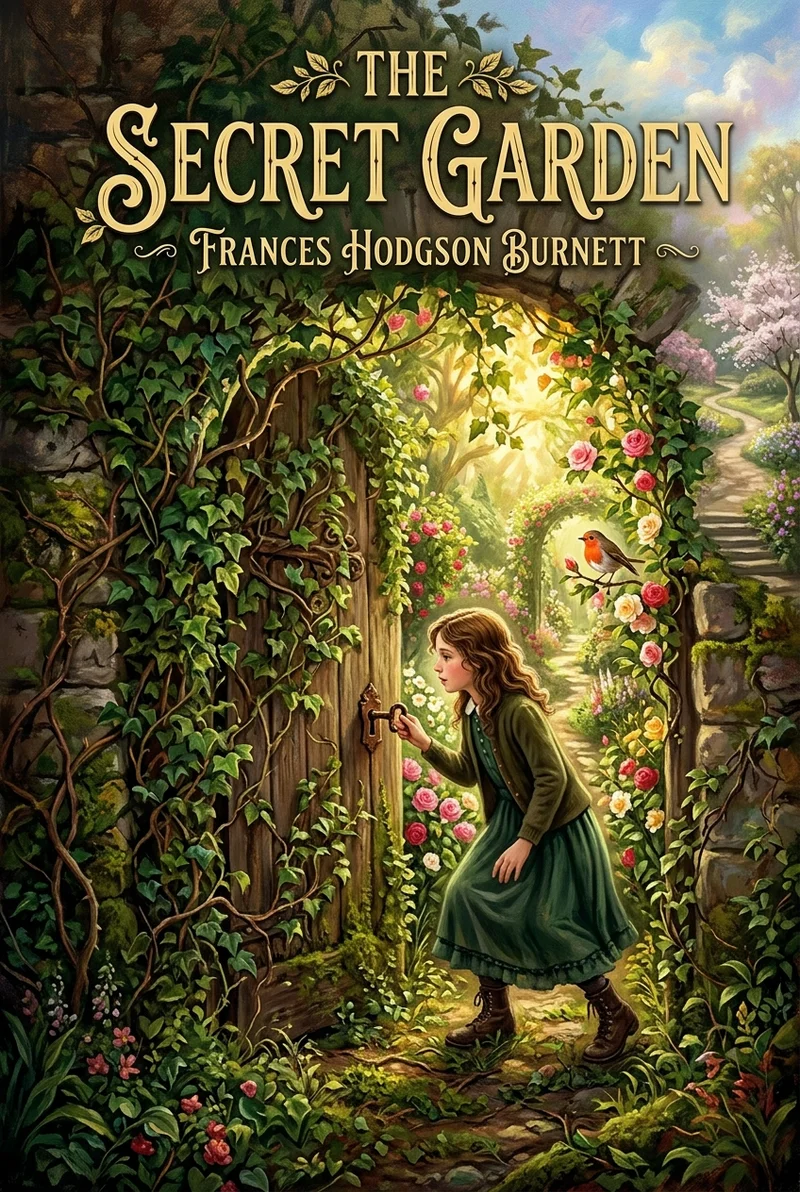
About This Book
The Secret Garden begins with a girl nobody wants. Mary Lennox is nine years old and has spent her whole life in India, in a house where servants hurried to obey her and her parents barely looked at her. She has never been taught to dress herself, to play, or to be pleasant, and she has grown into a thin, cross, disagreeable child who expects the world to move out of her way. Then, all at once, everything she knew disappears, and Mary is put on a ship and sent across the world to England. Her new home is Misselthwaite Manor, an enormous, gloomy stone house on the edge of the Yorkshire moors. It has almost a hundred rooms, and nearly all of them are locked. Its owner, Mary's uncle, is away for months at a time and has left orders that she is to keep out of the way and not go poking into rooms she has no business in. Outside there is nothing but wind, empty purple-brown moorland, and gardens shut in behind high walls. To Mary, who does not much like anything, it seems like the dullest place on earth. But a talkative housemaid mentions something she probably should not have: somewhere behind those walls there is a garden that has been locked up for ten years, with no door that anyone can find and no key that anyone will admit to having. From the moment Mary hears about it, the locked garden is all she can think about. This is a story about a bad-tempered, lonely child, a walled-up piece of ground, and what happens when the two of them find each other.
The Secret Garden is one of the rare classics that begins with a main character readers are not supposed to like — and that is exactly what makes it worth reading. Fifth graders are old enough to notice that Mary is rude, selfish, and unhappy, and old enough to be curious about why, and about whether a person like that can change. Along the way the book gives them a vivid picture of a world very unlike their own (a great English house in 1911, a wild Yorkshire moor, servants and doctors and locked wings) while asking questions they meet in their own lives every day: what do you do when you are lonely, how do you make a friend, and what happens to a person, or a plant, that has been left alone in the dark for too long. It also rewards slow, careful reading — the garden and the children grow at the same time, and noticing that connection is one of the most satisfying discoveries a young reader can make on their own.
Meet the Characters

More about Mary Lennox
Mary Lennox grew up in India in a house full of servants who gave her whatever she demanded rather than argue with her. Nobody has ever really wanted her company, and she has never had a friend, a game she loved, or a reason to be kind to anyone. As the story opens she is bored, bossy, and quite certain that nothing in the world is worth being interested in.

More about Martha Sowerby
Martha is a housemaid at Misselthwaite Manor and the eldest of a large, noisy, hard-working family who live in a tiny cottage out on the moor. She is plain-spoken, endlessly cheerful, and talks in a broad Yorkshire way that takes some getting used to. She has never waited on anyone before, and she sees no reason at all why a healthy child should not put on her own shoes.

More about Dickon Sowerby
Dickon is Martha's younger brother, one of twelve children in the Sowerby cottage on the edge of the moor. He spends nearly every hour out of doors and knows the moor the way other people know their own kitchens, so that foxes, crows, and rabbits come to him without fear. He is gentle, unhurried, and treats every living thing he meets as though it were worth talking to.

More about Colin Craven
Colin has grown up inside one shuttered room of a very large house, waited on by doctors, nurses, and servants who agree with everything he says. Because he has almost never been outside or met another child, the whole world to him is a ceiling, a fire, and the sound of the wind. He is clever, imperious, and used to being obeyed the instant he raises his voice.

More about Ben Weatherstaff
Ben Weatherstaff has worked in the gardens of Misselthwaite Manor for most of his long life and has strong opinions about everyone in them, including the birds. He is blunt to the point of rudeness, does not believe in wasting words on children, and would rather talk to a robin than to a person. Underneath the grumbling he is a careful, patient gardener who notices everything that grows.

More about Mr. Archibald Craven
Mr. Craven owns Misselthwaite Manor, a huge old house of a hundred rooms standing alone at the edge of the Yorkshire moor. He is a quiet, sorrowful man who travels abroad for months at a time because he cannot bear to stay in his own home. He has agreed to take Mary in, but he has given no sign that he wishes to see her.
Pre-Reading Discussion Questions
- The main character of this book is described as spoiled, sour, and unpleasant. Why might an author choose to start a story with a character readers do not like?
- Have you ever moved somewhere completely new, or spent time in a place where you knew no one? What was the hardest part?
- What do you think it would actually feel like to live in a house with a hundred rooms and almost no people in it?
- The title promises a secret. What kinds of secrets do you expect to find in a garden, and why would someone lock one up?
- Do you think a place can change the way a person behaves? Can you think of a place that makes you feel different than you usually do?
- What does it take to make a friend when you have never had one before?
Themes & Big Ideas to Track
- Neglect and attention: watch how the children in this book are treated by adults, and notice that being given everything is not the same as being cared for.
- Growing things: the garden and the children change at the same time and in the same way, so track what is happening in the garden whenever a character changes.
- Fresh air and the outdoors: keep an eye on what wind, walking, and digging do to a character's appetite, temper, and health.
- Secrets: notice which secrets in this book are kept out of shame and which are kept out of joy, and how differently they affect the people keeping them.
- Class and dialect: pay attention to how the wealthy characters speak compared with the Yorkshire servants, and to what the book seems to think about which group knows more about living well.
- Kindness as something learned: notice who teaches Mary how to be pleasant, and how slowly and stubbornly she learns it.
Chapter-by-Chapter Study Guide
Chapter 1: There Is No One Left
Before you read — think about:
- Some stories open by telling you plainly that the main character is unpleasant. Why might a writer take that risk on the very first page?
- If a child grew up in a house where servants obeyed every order instantly, what habits do you think that child would pick up?
- What is the difference between being looked after and being loved? Can a person have one without the other?
- Think of a time you were bored with nobody to play with. What did you do with yourself?
- In 1911 it was ordinary for British families to live in India with Indian servants running their households. What questions does an arrangement like that raise for you before you meet such a family in a story?
Watch for these while reading:
- The narrator's opening description of Mary — hair, skin, expression — and the fact that every word of it is the same shade.
- The game Mary plays by herself under a tree, and what she uses to play it with.
- How the grown-ups in the bungalow talk about Mary while she is standing in the room.
- Mary's temper: what her face and her voice do the instant something does not suit her.
- India as Burnett gives it to us — heat, verandas, servants — and how little of it Mary seems to notice.
Vocabulary to know:
disagreeable (adjective) — unpleasant to be around; grumpy and hard to like; sour (adjective) — showing a bad temper; looking displeased and unfriendly; fretful (adjective) — cranky and complaining, the way an unhappy or unwell child is; sickly (adjective) — often ill and never quite strong or healthy; tyrannical (adjective) — bossy and harsh, forcing everyone to obey you; governess (noun) — a woman hired to live with a family and teach their children at home; ayah (noun) — in India, a nursemaid hired to look after a family's children; familiarly (adverb) — in a close, everyday way, as you know people you live with; veranda (noun) — a covered, open porch running along the outside of a house; compound (noun) — the walled yard and grounds surrounding a house; hibiscus (noun) — a tropical bush with large, brightly colored flowers; scarlet (adjective) — a bright, strong red; imploringly (adverb) — in a way that begs desperately for help or mercy; disdaining (verb) — looking down on something as though it were not good enough for you; passion (noun) — a sudden burst of violent temper; stammered (verb) — spoke in a nervous, broken way, stumbling over the words; slunk (verb) — moved quietly and fearfully, trying not to be noticed; ashy (adjective) — pale gray, the color of ashes; wailing (noun) — long, loud crying of grief; cholera (noun) — a deadly disease that spreads very quickly and can kill within a day or two; fatal (adjective) — causing death; panic (noun) — sudden, uncontrollable fear that makes people act without thinking; bungalow (noun) — a low house built with only one story, common in India at that time; desolation (noun) — the state of being emptied, abandoned, and cheerless; appalling (adjective) — so shocking and dreadful that it fills you with horror; bewilderment (noun) — the feeling of being completely confused and lost; mysterious (adjective) — strange and impossible to explain; matting (noun) — a floor covering woven from straw or rushes; drowsy (adjective) — sleepy and unable to keep your eyes open; intensely (adverb) — very strongly; to a very great degree; affectionate (adjective) — showing love and warm feeling toward other people; neglected (verb) — left uncared for and ignored; disgracefully (adverb) — in a shameful way that ought to embarrass the person responsible; queer (adjective) — strange or odd.
Chapter 2: Mistress Mary Quite Contrary
Before you read — think about:
- Mary is going to live with relatives she has never met. If that happened to you, what would you want to know about them first?
- Why do unkind nicknames stick to a person more stubbornly than plain insults do?
- Mary has never had a friend her own age. What might a nine-year-old like that not know how to do?
- Do you think it is possible to miss things you never even liked? Why might that happen?
- Would you rather be told in advance what a strange new place is like, or find out for yourself once you get there?
Watch for these while reading:
- The old nursery rhyme the other children chant at Mary, and why that particular rhyme suits her name.
- How much Mary knows about England, and where the little she does know came from.
- Mrs. Medlock's clothes, her manner, and the difference between how she talks to Mary and how she talks about her.
- Every scrap of information Mrs. Medlock lets slip about Misselthwaite Manor and its master.
- Mary's face and posture while she is being discussed — Burnett keeps returning to how a sour expression gets made.
Vocabulary to know:
self-absorbed (adjective) — thinking only about yourself and your own concerns; contrary (adjective) — stubbornly determined to disagree and do the opposite of what is wanted; clergyman (noun) — a man who is a minister or priest of a church; shabby (adjective) — worn out and untidy from long use; quarreling (verb) — arguing angrily; snatching (verb) — grabbing something quickly and rudely; untidy (adjective) — messy and not neatly arranged; impudent (adjective) — cheeky and disrespectful in a bold way; rockery (noun) — a garden decoration made of piled stones with plants growing among them; scorn (noun) — a strong feeling that someone or something is worthless and beneath you; desolate (adjective) — empty, lonely, and cheerless; stony (adjective) — showing no feeling at all, like a face made of stone; stubbornly (adverb) — in a way that refuses to change or give in; pityingly (adverb) — in a way that shows sorrow for someone else's misfortune; unattractive (adjective) — not pleasing to look at or to be around; naughty (adjective) — badly behaved, especially by a child; voyage (noun) — a long journey by sea; housekeeper (noun) — the servant in charge of running a large household; stout (adjective) — thickset and heavy in build; mantle (noun) — a loose cloak worn over the shoulders; jet (noun) — a hard, glossy black stone used to make beads and trimmings; fringe (noun) — a border of hanging threads or beads used to decorate cloth; bonnet (noun) — a hat tied under the chin, worn by women at that time; sallow (adjective) — having a sickly, yellowish skin color; alter (verb) — to change; remarkable (adjective) — unusual enough to be worth noticing; evident (adjective) — easy to see or understand; obvious; marred (adjective) — a Yorkshire word meaning spoiled and sulky; pettish (adjective) — sulky and easily annoyed over small things; brisk (adjective) — quick, sharp, and businesslike; unresponsive (adjective) — not reacting or answering; indifference (noun) — a complete lack of interest or care; discomfited (adjective) — made uneasy and unsure of yourself; gloomy (adjective) — dark and dreary; low in spirits; crooked (adjective) — bent or twisted out of a straight line; guardian (noun) — an adult legally responsible for looking after a child who is not their own; involuntary (adjective) — happening without you meaning it to; positively (adverb) — in a firm, certain way that leaves no doubt; trifle (noun) — a very small amount; a little bit; dreary (adjective) — dull, gray, and depressing; curious (adjective) — eager to know more about something; nonsense (noun) — silly or unreasonable behavior; carriage (noun) — a separate section of a passenger train; straggled (verb) — hung down untidily in loose, uneven strands; limp (adjective) — drooping and without stiffness or life; slanting (adjective) — sloping at an angle instead of straight up and down; pinched (verb) — pressed tightly together.
Chapter 3: Across the Moor
Before you read — think about:
- A moor is open, treeless, windy upland. How do you build a picture of a place in your head when all anyone tells you is what is NOT there?
- Why might a writer choose to have a character arrive somewhere new at night rather than in daylight?
- What is the difference between a house being large and a house being welcoming?
- When you arrive somewhere for the first time, what do you notice first — the people, the building, the smell, the noise?
- Have you ever travelled a long way to somewhere you did not want to go? What did the journey itself feel like?
Watch for these while reading:
- The Yorkshire speech Mary starts hearing on the journey, and how much of it she can follow.
- The moor: the words Burnett chooses for its colour, its sound and its smell, and the comparison Mary keeps reaching for.
- Ordinary small things Mary does not do — carrying, helping, thanking — and what a servant would make of that.
- The number of corridors, staircases and doors between the front entrance and Mary's own room.
- Misselthwaite by night: how much of the house Mary can actually see, and how much is left dark.
Vocabulary to know:
glistening (adjective) — shining with wetness; lulled (verb) — soothed gently into sleep or calm; station-master (noun) — the official in charge of a railway station; burly (adjective) — large, strong, and heavily built; brougham (noun) — a closed carriage pulled by horses, with the driver seated outside; footman (noun) — a male servant who attends a carriage and its door; coachman (noun) — the servant who drives a horse-drawn carriage; waterproof (noun) — a long coat made to keep rain out; cushioned (adjective) — padded with soft stuffing for comfort; timid (adjective) — easily frightened; shy and lacking courage; moor (noun) — a wide stretch of wild, open, hilly land where only rough plants grow; heather (noun) — a low, tough shrub with tiny purple flowers that covers open moorland; gorse (noun) — a prickly evergreen bush with bright yellow flowers; broom (noun) — a shrub with long green stems and yellow flowers that grows on wild ground; expanse (noun) — a wide, open, uninterrupted area; bleak (adjective) — bare, cold, and cheerless; singular (adjective) — strange and unlike anything else; vicarage (noun) — the house where the minister of a village church lives; whitewashed (adjective) — painted white with a thin, chalky coating; highroad (noun) — a main road between towns; jolt (noun) — a sudden rough bump or shake; lodge (noun) — a small house at the entrance gates of a large estate; avenue (noun) — a wide road or drive lined with trees; vault (noun) — an arched roof, or a chamber covered by one; ramble (verb) — to spread out in an irregular, wandering way; massive (adjective) — very large, solid, and heavy; studded (adjective) — covered with small raised knobs or nails; armor (noun) — a metal suit worn by knights long ago to protect the body; portraits (noun) — painted pictures of people; manservant (noun) — a male household servant; husky (adjective) — rough and low in sound, as though the throat were dry; corridor (noun) — a long passage inside a building with rooms opening off it; unceremoniously (adverb) — abruptly and without politeness; dense (adjective) — thick and hard to see through.
Chapter 4: Martha
Before you read — think about:
- What everyday skills do you have that you cannot remember ever learning?
- What does a normal morning look like in your home — who gets up first, and who helps whom?
- Can a person who is paid to look after you also become your friend? What would have to change for that?
- If you were told there was one place in the world you were absolutely forbidden to go, what would you spend the day thinking about?
- Why do people who have very little sometimes seem to know more about being happy than people who have a great deal?
Watch for these while reading:
- Martha's Yorkshire: her words, her rhythm, and the fact that she says exactly what she thinks.
- Martha's family — how many of them there are, how they live, and the names she keeps mentioning.
- Everything in this chapter that is locked, shut, walled or buried.
- The gardens: which parts Mary is shown, which parts she is steered away from, and who does the steering.
- Ben Weatherstaff's face and his manners, and the one creature he speaks gently to.
Vocabulary to know:
housemaid (noun) — a female servant who cleans and tidies rooms in a house; hearth (noun) — the floor of a fireplace and the area right in front of it; cinders (noun) — the small burnt lumps left behind after a fire; raking (verb) — scraping and clearing something out with a tool; tapestry (noun) — a heavy cloth wall hanging with a picture woven or stitched into it; embroidered (verb) — decorated with pictures or patterns sewn on in colored thread; fantastically (adverb) — in a strange, fanciful way, unlike anything real; turrets (noun) — small towers on a castle or large building; grate (noun) — the metal frame that holds coal or wood in a fireplace; skylarks (noun) — small brown birds that sing while flying high above open country; grave (adjective) — serious and solemn; puzzled (adjective) — confused because you cannot understand something; obsequious (adjective) — trying too hard to please someone important, in a servant-like way; servile (adjective) — behaving like a slave; humble to the point of having no dignity; presume (verb) — to dare to do something you have no right to do; salaam (noun) — a low, respectful bow used as a greeting in parts of Asia; custom (noun) — the usual way of doing things in a particular place or family; haughtily (adverb) — in a proud way that treats others as beneath you; scullery-maid (noun) — the lowest-ranked kitchen servant, who washes dishes and pots; imperious (adjective) — commanding and expecting instant obedience; indignant (adjective) — angry because something seems unfair or insulting; sympathetically (adverb) — in a way that shows understanding of someone else's feelings; vexed (adjective) — annoyed and upset; tracts (noun) — small printed booklets, usually about religion, handed out to be read; humiliation (noun) — the painful, shamed feeling of being made to look small; helpless (adjective) — unable to do anything about a situation; unrestrainedly (adverb) — without holding anything back; sobbing (verb) — crying loudly with catching breaths; gradually (adverb) — slowly, a little at a time; ceased (verb) — stopped; relieved (adjective) — no longer worried, because a problem has passed; nursery (noun) — a room in a house set aside for the children; wardrobe (noun) — a tall cupboard for hanging clothes; approval (noun) — the feeling that something is good and acceptable; subservient (adjective) — always giving way to someone else and doing as told; untrained (adjective) — not taught the proper skills for a job; rustic (noun) — a person from the countryside, often thought of as simple or unpolished; cottage (noun) — a small, simple house in the country; swarm (noun) — a large, busy crowd all together; totter (verb) — to walk unsteadily, as a very young child does; homely (adjective) — plain, warm, and ordinary, like home; good-tempered (adjective) — cheerful and not easily made angry; porridge (noun) — a hot breakfast dish of oats boiled in water or milk; shilling (noun) — an old British coin worth twelve pennies; treacle (noun) — a thick, dark, sweet syrup made from sugar; victuals (noun) — food and supplies to eat; incredulously (adverb) — in a way that shows you cannot believe what you are hearing; abide (verb) — to put up with something; ignorance (noun) — not knowing about something; outspokenly (adverb) — in a plain, direct way that holds nothing back; pinafores (noun) — aprons worn over a dress to keep it clean; marmalade (noun) — a jam made from oranges or other citrus fruit; wintry (adjective) — cold, bare, and gray, like winter; amusement (noun) — something that entertains you and passes the time; shrubbery (noun) — an area planted thickly with bushes; clipped (adjective) — trimmed neatly with shears; borders (noun) — narrow strips of ground along a path or wall where plants are grown; evergreens (noun) — trees or bushes that keep their leaves all year; fountain (noun) — a structure that shoots water into the air for decoration; midst (noun) — the middle of something.
Chapter 5: The Cry in the Corridor
Before you read — think about:
- Mary is sent outdoors every day with nothing to do and nobody to play with. Can being bored ever be good for a person?
- What does the wind sound like where you live? Is there a word your family uses for it?
- Why might an animal be easier to talk to than a person?
- The grown-ups in this house keep certain subjects off limits. Why do adults hold things back from children, and does it usually work?
- How long does it take you to stop feeling like a visitor somewhere new? What makes the difference?
Watch for these while reading:
- Mary's appetite, her sleep and her temper — Burnett keeps a quiet tally of all three.
- The wind on the moor, and the Yorkshire word Martha uses for the noise it makes round the house.
- The garden walls: Mary walks their whole length more than once, and Burnett describes the ivy in detail.
- Ben Weatherstaff's opinions about Mary, delivered straight to her face.
- Martha's manner whenever the conversation drifts toward the shut-up parts of the house.
Vocabulary to know:
stirring (verb) — beginning to move something that has been still; whipped (verb) — drove or forced something along sharply and quickly; lungs (noun) — the two organs inside the chest that you breathe with; languid (adjective) — slow and weak, with no energy; cobwebs (noun) — the dusty webs spiders leave behind in unused corners; healthily (adverb) — in a way that shows good health; flesh (noun) — the soft parts of the body under the skin; thickly (adverb) — closely packed together; bushy (adjective) — growing thick and full, like a bush; trimmed (verb) — cut back neatly to keep something tidy; creeping (adjective) — growing by spreading slowly along a surface; spray (noun) — a slender shoot of a plant with its leaves attached; gleam (noun) — a brief flash of light or color; brilliant (adjective) — bright and sharp, easy to notice; tilting (verb) — leaning to one side; perched (verb) — sat on a narrow resting place, as a bird does; twittered (verb) — made a series of light, high bird sounds; pattering (verb) — running with light, quick steps; darting (adjective) — moving suddenly and very fast; preen (verb) — to clean and smooth feathers with the beak; chattered (verb) — talked quickly about small everyday things; objected (verb) — spoke against something; refused to agree; novelty (noun) — something new and unusual that draws your interest; persisted (verb) — kept on asking or trying, even after being put off; store (noun) — a supply of something kept ready to be used; hollow (adjective) — sounding deep and empty, as if made inside something with nothing in it; shuddering (adjective) — shaking and trembling; buffeting (verb) — striking and knocking against something again and again; distinguish (verb) — to tell one thing apart from another; draft (noun) — a current of cold air moving through a building; plainly (adverb) — clearly and unmistakably; troubled (adjective) — worried and uneasy; awkward (adjective) — uncomfortable and unsure how to behave; confused (adjective) — flustered and unable to think clearly.
Chapter 6: There Was Some One Crying--There Was!
Before you read — think about:
- Rain has shut Mary indoors. What is the difference between exploring a place and snooping in it?
- If a house had a hundred closed doors and nobody had actually told you not to open them, would you? Why or why not?
- Martha's brother tames wild animals out on the moor. What kind of person do you picture when you hear that about somebody?
- Have you ever looked at an old portrait or photograph of a child from long ago and wondered about them? What did you wonder?
- Why is it so hard to let go of a question once a grown-up has refused to answer it?
Watch for these while reading:
- What Martha's family does for amusement with no money and no toys at all.
- The portraits in the long gallery, and the one Mary keeps coming back to.
- The shut-up rooms Mary opens — covered furniture, objects left behind, and the small living things that have moved in.
- Dickon, who is talked about constantly and has still not appeared in person.
- Mrs. Medlock's manner toward Mary in this chapter, and what she seems most anxious about.
Vocabulary to know:
torrents (noun) — great rushing streams of water; mist (noun) — a thin cloud of tiny water drops close to the ground; moithered (adjective) — a Yorkshire word meaning worn out and flustered by too much fuss; cow-shed (noun) — a simple farm building where cows are kept; cub (noun) — a young fox, bear, or other wild animal; litter (noun) — all the babies born to an animal at the same time; tamed (verb) — made a wild animal gentle and used to people; resent (verb) — to feel annoyed and insulted by something; collie (noun) — a long-haired sheepdog kept on farms and moors; perplexed (adjective) — puzzled and unsure what to suggest; knit (verb) — to make cloth or clothing by looping yarn with two needles; sew (verb) — to join or mend cloth using a needle and thread; library (noun) — a room in a house where books are kept; inspired (adjective) — suddenly filled with a new idea; luxurious (adjective) — very comfortable and full of good things; brass (noun) — a shiny yellow metal used for pots, pans, and ornaments; pewter (noun) — a dull gray metal used to make plates, mugs, and dishes; abundant (adjective) — more than enough; plentiful; romping (noun) — noisy, rough play; scowl (noun) — an angry frown; authority (noun) — the power some people have to tell others what they may do; permission (noun) — being allowed to do something by someone in charge; wanderings (noun) — long, aimless walks with no particular destination; branched (verb) — divided and led off in more than one direction; mounted (verb) — climbed upward; landscapes (noun) — paintings of outdoor scenery; costumes (noun) — styles of clothing worn in a particular time or place; satin (noun) — a smooth, glossy cloth; velvet (noun) — a thick, soft cloth with a short furry surface; gallery (noun) — a long room used for hanging pictures; frocks (noun) — dresses; puffed (adjective) — gathered so as to swell out roundly; ruffs (noun) — stiff, frilled collars worn round the neck long ago; brocade (noun) — heavy cloth woven with a raised pattern, often in silk; inlaid (adjective) — decorated with pieces of other materials set into the surface; leaded (adjective) — made of small panes held together with strips of lead; panes (noun) — the separate sheets of glass in a window; mantel (noun) — the shelf above a fireplace; hangings (noun) — cloths hung on walls for decoration or warmth; ornaments (noun) — small objects kept because they are pretty; cabinet (noun) — a piece of furniture with shelves and glass doors for displaying things; ivory (noun) — the hard, creamy-white material that elephant tusks are made of; mahouts (noun) — people whose work is riding and caring for elephants; palanquins (noun) — covered seats carried on poles on people's shoulders; footstool (noun) — a low stool for resting your feet on; rustling (noun) — a soft sound of something brushing or moving; cushion (noun) — a soft padded bag used as a seat or a rest; stillness (noun) — complete quiet and lack of movement; muffled (adjective) — made quieter by passing through something; whine (noun) — a long, high, complaining cry; childish (adjective) — belonging to or sounding like a child; startled (adjective) — suddenly surprised and slightly frightened; rage (noun) — violent anger.
Chapter 7: The Key of the Garden
Before you read — think about:
- The weather changes at last. How much does weather change the way you feel about a place you already dislike?
- Have you ever watched a plant grow over several weeks? What changed first, and what took longest?
- Mary says she does not like herself. Is that a sad thing to say, a brave thing to say, or both?
- Ben Weatherstaff says you can smell spring coming. What signs of a changing season can you notice with senses other than sight?
- How does somebody learn to like other people if they have never had any practice at it?
Watch for these while reading:
- The list Mary keeps in her own head of the people she is beginning to like.
- Ben Weatherstaff on soil and roots — he talks about the earth as though it were a living thing.
- The robin: his head, his wings, his voice, and how much personality Burnett is willing to give a bird.
- The way Mary and Ben Weatherstaff insult each other, and how much they both seem to enjoy it.
- Susan Sowerby, who is quoted in nearly every conversation and has still never appeared.
Vocabulary to know:
arched (verb) — curved over in the shape of an arch; blazing (adjective) — burning very brightly and fiercely; sparkle (verb) — to shine with quick flashes of light; bottomless (adjective) — so deep that the bottom cannot be reached; fleece (noun) — the soft woolly coat of a sheep; far-reaching (adjective) — stretching a very long way; springtime (noun) — the season when plants begin to grow again; blossoms (noun) — the flowers of a plant or tree; dialects (noun) — different ways of speaking the same language in different regions; wistfully (adverb) — in a way that shows a quiet, sad longing for something; heavenly (adjective) — wonderfully beautiful, as though it belonged to the sky; reflectively (adverb) — in a thoughtful way, as if turning something over in your mind; hesitated (verb) — paused before answering or acting; recollection (noun) — a memory of something that happened; sensible (adjective) — showing good, practical judgment; thoroughly (adverb) — completely and fully; spirits (noun) — a person's mood or state of cheerfulness; accord (noun) — one's own choice, without being asked; sniffed (verb) — drew air in through the nose to smell something; damp (adjective) — slightly wet; humor (noun) — a mood or temper; crocuses (noun) — small cup-shaped flowers that push up very early in spring; snowdrops (noun) — small white flowers that bloom at the very end of winter; spikes (noun) — sharp pointed shoots pushing up out of the ground; uncurl (verb) — to open out from a curled-up position; perennial (adjective) — describing a plant that lives for years and comes back each season; shrubs (noun) — woody plants smaller than trees; bushes; pert (adjective) — lively and cheekily bold; slyly (adverb) — in a knowing, secretive way; grunted (verb) — made a short, low, unfriendly sound instead of answering properly; hunching (verb) — raising and rounding the shoulders; persuade (verb) — to make someone believe something; delight (noun) — great pleasure; trembled (verb) — shook slightly, often from excitement or emotion; flirted (verb) — flicked something quickly from side to side; waistcoat (noun) — a short sleeveless jacket worn over a shirt; mole (noun) — a small furry animal that digs tunnels underground; rusty (adjective) — covered with the reddish-brown coating that forms on old iron.
Chapter 8: The Robin Who Showed the Way
Before you read — think about:
- Have you ever kept something in your pocket for days because you were not sure what to do with it?
- What is the best present you have ever been given, and what made it good?
- What makes a thank-you feel genuine rather than automatic?
- Why do people want a place of their own that nobody else knows about, even when nothing is wrong?
- People sometimes call a lucky moment 'magic'. What do you think they mean by that?
Watch for these while reading:
- Mary's reasons for wanting into the garden — Burnett is honest that they are not especially noble ones.
- The letter Mary dictates to Martha — she has never written to anybody in her life, and it shows.
- The skipping-rope: what it does to Mary's legs, her breathing and her colour.
- The long walk beside the ivy-covered wall, and how much description Burnett spends on it.
- The robin's behaviour throughout — decide for yourself how much of it is intention and how much is a bird being a bird.
Vocabulary to know:
consult (verb) — to ask someone for advice or permission; elders (noun) — the older people who are supposed to be in charge of you; inactive (adjective) — not being used or doing anything; imagination (noun) — the ability to picture things that are not in front of you; baffling (adjective) — confusing and impossible to work out; glossy (adjective) — smooth and shiny; disappointed (adjective) — sad because something you hoped for did not happen; paced (verb) — walked back and forth with steady steps; dough-cake (noun) — a simple flat cake made from bread dough; patches (noun) — pieces of cloth sewn over holes to mend clothing; mended (verb) — repaired something that was broken or torn; stockings (noun) — close-fitting coverings for the feet and legs; camels (noun) — large desert animals with one or two humps, used for riding and carrying loads; tuppence (noun) — two pennies; wages (noun) — money paid to someone for the work they do; exhibited (verb) — showed something off for others to see; mystified (adjective) — completely puzzled; skipping-rope (noun) — a rope with handles that you swing under your feet as you jump; cottager (noun) — a person who lives in a small country cottage; practice (noun) — the state of being well trained by doing something often; urged (verb) — strongly encouraged someone to do something; clumsy (adjective) — awkward and not smooth; accustomed (adjective) — used to something because you do it often; old-womanish (adjective) — behaving stiffly and seriously, like an elderly person rather than a child; gusts (noun) — short, sudden rushes of wind; scent (noun) — a smell, usually a pleasant one; veins (noun) — the tubes that carry blood around the body; buttermilk (noun) — the sour liquid left over after butter has been churned; breathless (adjective) — out of breath; obliged (verb) — forced by circumstances to do something; swaying (verb) — swinging gently from side to side; trill (noun) — a quick, quivering run of musical notes; adorably (adverb) — in a way that is charming and easy to love; magic (noun) — in this story, a mysterious good power that makes surprising things happen; trailing (adjective) — hanging down loosely and dragging; crept (verb) — moved or spread slowly over a surface; curtain (noun) — a hanging cover that screens something from view; knob (noun) — a rounded handle for opening a door; keyhole (noun) — the hole in a lock that a key fits into; thump (verb) — to beat heavily; excitement (noun) — a strong feeling of eagerness and thrill.
Chapter 9: The Strangest House Any One Ever Lived In
Before you read — think about:
- What do you expect a garden to look like after ten years with nobody tending it?
- How can you tell whether a plant is dead or only asleep for the winter?
- Why might having a place that belongs to nobody but you matter so much to a lonely child?
- What are the risks of telling somebody your secret, and what are the risks of keeping it to yourself?
- If you had a shilling a week and nothing you wanted, what would change the day you found something you did want?
Watch for these while reading:
- The colours inside the walls, and the words Burnett chooses for the rose-stems — she is careful not to settle the question.
- The first thing Mary says out loud in there, and the way she moves and speaks once she is inside.
- The small green points in the earth, and how Mary treats them.
- How Mary manages to talk to Martha about gardening without ever mentioning the garden.
- The list of things Mary decides she needs — tools, seeds — and who she thinks could get them for her.
Vocabulary to know:
leafless (adjective) — having no leaves; stems (noun) — the main stalks of plants that hold up leaves and flowers; matted (adjective) — tangled together into a thick mass; clumps (noun) — small tight groups of plants growing together; standard (adjective) — grown on a single tall stem so the plant looks like a small tree; tendrils (noun) — thin curling shoots a climbing plant uses to hold on; hazy (adjective) — soft and blurred, as if seen through mist; tangle (noun) — a confused, twisted mass; fastenings (noun) — the ties or supports that hold something in place; flutter (verb) — to move wings quickly and lightly; fairy-like (adjective) — delicate and magical-looking; leaf-bud (noun) — the small swelling on a stem from which a leaf will open; alcoves (noun) — small recessed corners set back from the main space; urns (noun) — large decorative vases used for plants; moss-covered (adjective) — grown over with soft green moss; daffodils (noun) — tall yellow spring flowers that grow from bulbs; weeded (verb) — pulled unwanted plants out of the ground; smothering (verb) — covering something so thickly that it cannot breathe or grow; immensely (adverb) — very greatly; estate (noun) — a large piece of land belonging to one owner; midday (adjective) — happening in the middle of the day; kingdom (noun) — a place ruled by one person; root (noun) — the part of a plant that grows underground; bulbs (noun) — rounded underground plant parts that store food and grow into flowers; jonquils (noun) — a kind of small, sweet-smelling daffodil; lilies (noun) — tall flowers with large trumpet-shaped blooms; flags (noun) — another name for irises, tall flowers with sword-shaped leaves; possession (noun) — complete control over someone's thoughts; anxiously (adverb) — in a worried way; afford (verb) — to have enough money for something; pondered (verb) — thought something over carefully; fearfully (adverb) — extremely; in a way that causes fear; forevermore (adverb) — for all time to come; parsley (noun) — a leafy green herb used in cooking; radishes (noun) — small crisp red root vegetables; rake (noun) — a long-handled tool with teeth for smoothing soil; purse (noun) — a small bag for carrying money; threepence (noun) — three pennies; eye-teeth (noun) — the pointed teeth below the eyes, hard to pull out; tidy (adjective) — neat and well kept; print (verb) — to write in separate letters rather than joined-up writing; spell (verb) — to write the letters of a word in the right order; dictated (verb) — said words aloud for someone else to write down; envelope (noun) — a paper cover for sending a letter; butcher (noun) — a person who cuts and sells meat; sheer (adjective) — complete and pure, with nothing mixed in; tremendously (adverb) — extremely; restlessly (adverb) — in an uneasy way, unable to keep still; thoughtful (adjective) — quiet and full of thought.
Chapter 10: Dickon
Before you read — think about:
- What does keeping a secret cost a person, even a happy secret?
- Why might somebody keep going back to a person who is rude to them?
- How do you make friends with a wild animal? What would you have to stop doing?
- Is it usually better or worse to meet somebody after you have spent weeks imagining them?
- Can you steal something that nobody wants?
Watch for these while reading:
- How much Mary's body has changed since chapter 1, and who is the first to say so out loud.
- Ben Weatherstaff's face when the robin is near him, set against the things he says about the bird.
- What Ben says about a young lady, some roses, and ten years ago.
- Dickon's entrance: what he is doing, what he is sitting on, and what is sitting near him.
- Yorkshire again — Dickon's speech beside Mary's, and how much of it she can now follow.
Vocabulary to know:
intention (noun) — a plan to do something; astonished (adjective) — very surprised; sprouting (adjective) — beginning to grow out of the ground; bloom (noun) — the state of being in flower; determined (adjective) — firmly decided and not willing to give up; steadily (adverb) — in a regular way that does not stop or change; fascinating (adjective) — so interesting that it holds your whole attention; intimate (adjective) — close and friendly; flattered (adjective) — pleased because someone has shown they value you; elderly (adjective) — fairly old; civil (adjective) — polite in a plain, ordinary way; sturdy (adjective) — strong and solidly built; vanity (noun) — too much pride in how you look; flightiness (noun) — the habit of being silly and changeable; pride (noun) — a high opinion of yourself; hobnailed (adjective) — having heavy nails hammered into the sole for hard wear; credit (noun) — something that makes a person or place look good; plucked (adjective) — having had the feathers pulled out; disturbed (adjective) — upset or unsettled; wrinkles (noun) — small folds or creases; graces (noun) — attractive, charming movements; sarcastic (adjective) — saying the opposite of what you mean in order to tease; engagingly (adverb) — in a charming way that wins people over; currant (noun) — a garden bush that grows small sour berries; unearthly (adjective) — so strange it seems to come from beyond this world; cabbages (noun) — round leafy green vegetables; reluctantly (adverb) — unwillingly; only after hesitating; prune (verb) — to cut back parts of a plant so it grows better; twigs (noun) — the thin end branches of a tree or bush; swelling (verb) — growing larger and rounder; eager (adjective) — full of keen interest and wanting very much to know; rheumatics (noun) — an old word for painful, stiff joints; joints (noun) — the places where bones meet and bend; grumbling (adjective) — complaining in a low, muttering way; crossness (noun) — bad temper; laurel (noun) — an evergreen shrub with glossy leaves, often planted as a hedge; peculiar (adjective) — strange and unlike anything you have heard before; pipe (noun) — a simple wooden flute; squirrel (noun) — a small bushy-tailed animal that lives in trees; pheasant (noun) — a large long-tailed bird that lives in woods and fields; cock (adjective) — male, used of birds; delicately (adverb) — carefully and gently; tremulous (adjective) — trembling slightly; motionless (adjective) — completely still; scampered (verb) — ran quickly with short light steps; withdrew (verb) — pulled back out of sight; charming (verb) — putting under a gentle spell; curving (adjective) — bending in a smooth line; rust-colored (adjective) — reddish-brown, like rusted iron; stooped (verb) — bent down; hoe (noun) — a long-handled tool for chopping out weeds; trowel (noun) — a small hand tool with a scooped blade for digging; packet (noun) — a small paper envelope of something; poppies (noun) — bright papery flowers, often red, that grow easily almost anywhere; larkspur (noun) — a tall garden flower with spikes of blue or purple blooms; mignonette (noun) — a small greenish garden flower known for its strong sweet smell; holly (noun) — an evergreen bush with prickly leaves and red berries; intently (adverb) — with close, concentrated attention; flout (verb) — to treat someone with open scorn; sidled (verb) — moved sideways in a shy or sly way.
Chapter 11: The Nest of the Missel Thrush
Before you read — think about:
- How does it feel to care about something and not know whether it can be saved?
- What makes somebody a good teacher when they are exactly your own age?
- Should a garden be tidy or left wild? What is each kind good for?
- What is a job you would happily do for hours if it were outdoors? What is it about it?
- Why do people who work on something together often become friends faster than people who only talk?
Watch for these while reading:
- The Yorkshire word for 'alive' that Dickon teaches Mary — the whole book leans on it.
- How Dickon tests a rose branch, and how quickly Mary starts copying him.
- The missel thrush's nest, and the rule Dickon keeps to around wild creatures.
- Something in the garden that neither child can account for — Dickon notices it and says so.
- How Mary uses Yorkshire when she wants what she is saying to sound true.
Vocabulary to know:
creepers (noun) — plants that climb by clinging to whatever they grow over; lichen (noun) — a crusty gray-green growth that spreads over bark and stone; upholding (verb) — holding something up; blades (noun) — the flat cutting parts of a knife or tool; shoot (noun) — a new young growth on a plant; reverent (adjective) — showing deep respect, almost like worship; wick (adjective) — a Yorkshire word meaning alive and lively; panted (verb) — breathed in quick short breaths; thrived (verb) — grew strong and healthy; exultantly (adverb) — in a triumphant, delighted way; lifeless (adjective) — showing no sign of being alive; juicy (adjective) — full of moisture; sprung (verb) — grown out from something; unpromising (adjective) — looking unlikely to come to anything good; bough (noun) — a large branch of a tree; joyfully (adverb) — with great happiness; moist (adjective) — slightly damp; industriously (adverb) — in a hard-working, busy way; utter (verb) — to make a sound or say something aloud; clearings (noun) — spaces that have been cleared of growth; bean-stalk (noun) — the climbing stem of a bean plant, famous for growing fast in a fairy tale; nesh (adjective) — a Yorkshire word meaning soft, delicate, and easily chilled; knobstick (noun) — a walking stick with a thick knob at the top; quivers (verb) — trembles with small quick movements; swish (noun) — a soft rushing sound; campanulas (noun) — garden flowers shaped like little bells; spiteful (adjective) — meant to hurt out of bad feeling; crumbled (verb) — broke into small loose pieces; stifle (verb) — to hold back or smother a sound; heartily (adverb) — warmly and with full feeling; lass (noun) — a Yorkshire word for a girl; lad (noun) — a boy or young man; marigolds (noun) — bright orange or yellow garden flowers; mournfully (adverb) — in a sad, sorrowful way; bundle (noun) — a small package of things tied together; handkerchief (noun) — a square of cloth carried in a pocket; coarse (adjective) — rough in texture, not fine or smooth; bacon (noun) — salted or smoked meat from a pig; rind (noun) — the tough outer edge of bacon or cheese; distended (adjective) — swollen out; puffed up; encouragingly (adverb) — in a way that gives someone confidence; thrush (noun) — a brown songbird with a speckled breast; recovered (verb) — got back control of yourself; courtyard (noun) — an open space enclosed by the walls of a building.
Chapter 12: Might I Have a Bit of Earth?
Before you read — think about:
- How do people hide a secret in plain sight — talking about a thing without ever naming it?
- Mary's uncle has avoided her for months and now wants to see her. What would you be most nervous about in a meeting like that?
- Can somebody be a poor guardian to a child without being a bad person?
- What is the hardest kind of thing to ask somebody for out loud, and why?
- Why might a stranger see what a child needs more clearly than the people living in the same house?
Watch for these while reading:
- How Mary defends every odd thing about Dickon as soon as Martha starts teasing her.
- The questions Martha asks about where Mary has been, and how close Mary comes to answering them.
- Susan Sowerby's name coming up in a conversation she is not part of.
- Archibald Craven himself: his voice, his shoulders, the room he sits in, and how he looks at Mary.
- How Mary strikes somebody who has not laid eyes on her since the night she arrived.
Vocabulary to know:
ruffled (adjective) — pushed out of place and untidy; handsome (adjective) — good-looking; doubtful (adjective) — not certain; unconvinced; beamed (verb) — smiled very broadly with pleasure; satisfaction (noun) — the pleasure of getting what you wanted; trusty (adjective) — reliable and able to be depended on; crabbed (adjective) — bad-tempered and sour in manner; under-gardeners (noun) — the junior gardeners who work under the head gardener; brooch (noun) — an ornament pinned to clothing; collar (noun) — the band of cloth around the neck of a garment; photograph (noun) — a picture made with a camera; nervous (adjective) — uneasy and slightly afraid; stiff (adjective) — not relaxed; formal and awkward; study (noun) — a private room used for reading and writing; armchair (noun) — a comfortable chair with supports for the arms; streaked (adjective) — marked with lines of a different color; muttered (verb) — said quietly and unclearly, almost to yourself; absent-mindedly (adverb) — without paying attention to what you are doing or saying; rouse (verb) — to wake up or stir into action; lump (noun) — a tight swelling feeling in the throat when you are about to cry; scrap (noun) — a very small piece or amount; courage (noun) — the strength to do something frightening; gasped (verb) — said something while catching your breath; quavered (verb) — spoke in a trembling, unsteady voice; faltered (verb) — spoke hesitantly, losing confidence; wretched (adjective) — deeply unhappy; distracted (adjective) — unable to keep your mind on anything; respectable (adjective) — decent and worthy of respect; bold (adjective) — daring; not held back by shyness; delicate (adjective) — weak and easily made ill; liberty (noun) — freedom to do as you choose; tiresome (adjective) — annoying and tiring to deal with; charge (noun) — a person placed in someone's care; good-hearted (adjective) — kind and generous by nature; healthy-minded (adjective) — sensible and wholesome in the way one thinks; solemnly (adverb) — in a serious, weighty way; foreign (adjective) — belonging to another country; thankfully (adverb) — with relief and gratitude; thorn (noun) — a sharp point growing on a plant stem; fastened (verb) — attached firmly; service (noun) — a complete set of dishes for a meal.
Chapter 13: I Am Colin
Before you read — think about:
- At what point should you stop believing a grown-up's explanation of something you have heard with your own ears?
- What makes a person brave at night who would not be brave in daylight?
- Has a sound ever kept you awake at night? What did you imagine it was?
- Is it ever kind to keep something from a person for their own good?
- If somebody else could take your best secret away from you by telling, would you still tell them?
Watch for these while reading:
- Mary's mood as she sets out — Burnett is specific that it is not courage.
- The corridors by candlelight: the tapestry door, the turnings, the sounds.
- The way the two of them interrogate each other — who asks the questions, who gives the orders, and who is used to being obeyed.
- What is hanging over the mantelpiece, and the state it is kept in.
- How each of them talks about servants, and what that says about the households they grew up in.
Vocabulary to know:
chimneys (noun) — the tall pipes that carry smoke up from fireplaces; beating (adjective) — striking again and again; rebellious (adjective) — refusing to obey the rules; candle (noun) — a stick of wax with a wick that gives light when burned; dim (adjective) — giving only a weak light; fancied (verb) — imagined; ajar (adjective) — slightly open; faint (adjective) — very quiet and hard to hear; glimmer (noun) — a weak, unsteady light; ancient (adjective) — very old; furniture (noun) — the movable objects in a room, such as chairs and tables; faintly (adverb) — weakly; only a little; glowing (adjective) — shining with a soft warm light; firelight (noun) — the light given off by a fire; ceiling (noun) — the upper surface of a room; carved (adjective) — shaped by cutting patterns into wood or stone; four-posted (adjective) — having a tall post at each corner to hold up curtains; locks (noun) — thick strands of hair; immense (adjective) — extremely large; agate (adjective) — the cloudy gray color of a smooth banded stone; lashes (noun) — the short hairs growing along the edge of the eyelids; attracted (verb) — drew someone's attention; half-frightened (adjective) — partly scared; woolen (adjective) — made of wool; wrapper (noun) — a loose dressing gown worn over nightclothes; fold (noun) — a part of cloth doubled over on itself; pinch (verb) — to squeeze skin sharply between finger and thumb; reality (noun) — the state of being real; ached (verb) — hurt with a dull steady pain; ventured (verb) — dared to say or do something risky; generally (adverb) — usually; shadow (noun) — a dark look that passes over someone's face; seaside (noun) — the area beside the sea, often visited for health; hidden-away (adjective) — kept out of sight; invalid (noun) — a person who is ill for a long time and needs constant care; nurse (noun) — a person paid to look after someone who is ill; attend (verb) — to look after someone and see to their needs; splendid (adjective) — grand and impressive; indifferently (adverb) — in a way that shows you do not care; doze (noun) — a light sleep; elbows (noun) — the joints in the middle of the arms; nervously (adverb) — in an anxious, uneasy way; coolly (adverb) — calmly and without feeling; spoiled (adjective) — made selfish by always being given your own way; sob (noun) — a catch of breath while crying; interrupted (verb) — cut in while someone else was speaking; pleaded (verb) — begged earnestly; tramp (verb) — to walk heavily and noisily over something; clambered (verb) — climbed awkwardly, using hands and feet; dreamy (adjective) — far away in thought; silk (noun) — a fine smooth cloth; rose-colored (adjective) — pink, like a rose; cord (noun) — a thin rope used to pull something; rings (noun) — small metal loops that a curtain slides along; uncovered (verb) — revealed by taking away what was hiding something; ribbon (noun) — a narrow strip of cloth used for tying or decorating; complainingly (adverb) — in a grumbling, dissatisfied way; grumbled (verb) — muttered in a discontented way; stroke (verb) — to move your hand gently over something again and again; chanting (adjective) — sung on only a few repeated notes.
Chapter 14: A Young Rajah
Before you read — think about:
- Martha could lose her job over this. When you keep somebody else's secret, whose risk is it really?
- Colin has spent his life in one room. What would a person like that be an expert in, and what would they know nothing about?
- Is there something you know a great deal about only because it was described to you? How real does it feel?
- Which do you think does more harm to a child: never getting your own way, or always getting it?
- What would make you forget you were unhappy, if only for an afternoon?
Watch for these while reading:
- How Colin speaks to Martha and to the nurse, and what it reminds Mary of from India.
- The London doctor's words, which Colin repeats without seeming to understand them.
- Colin's face and his posture while Mary is talking about the moor.
- What the household says about Colin, out loud and half under its breath.
- Rajahs, India, and the vocabulary Mary reaches for to describe him.
Vocabulary to know:
opportunity (noun) — a chance to do something; knitting (noun) — the work of making cloth by looping yarn with needles; fright (noun) — sudden fear; agitated (adjective) — upset and unable to keep calm; souls (noun) — the innermost part of people; here, their own selves; tantrums (noun) — wild fits of temper; temper (noun) — a person's mood, especially how easily they get angry; amazement (noun) — great surprise; protested (verb) — objected strongly; den (noun) — the home of a wild animal; firmly (adverb) — in a steady, decided way; bewitched (verb) — put under a magic spell; raved (verb) — talked wildly and out of control; brace (noun) — a stiff support worn on the body to hold it straight; downright (adverb) — completely; thoroughly; typhoid (noun) — a serious infectious disease that causes high fever; fever (noun) — an illness that makes the body dangerously hot; medicine (noun) — a substance taken to treat illness; sneeze (verb) — to blow air suddenly out of the nose; fits (noun) — sudden violent outbursts; dressing-gown (noun) — a loose robe worn over nightclothes indoors; sofa (noun) — a long padded seat for more than one person; picture-books (noun) — books whose pages are mostly pictures; curtsy (noun) — a bend of the knees made by a woman or girl to show respect; duty (noun) — what a person is required to do; grandly (adverb) — in an important, lordly way; rajah (noun) — an Indian prince or ruler; rubies (noun) — deep red precious stones; emeralds (noun) — bright green precious stones; diamonds (noun) — clear, extremely hard precious stones; superb (adjective) — excellent and beautifully made; illustrations (noun) — pictures printed in a book; snake-charmer (noun) — a performer who makes snakes sway by playing a pipe; badgers (noun) — sturdy black-and-white striped animals that dig burrows; otters (noun) — sleek river animals that swim and catch fish; burrows (noun) — tunnels or holes dug by animals to live in; squeaking (verb) — making small high sounds; hideous (adjective) — extremely ugly; resentful (adjective) — bitter about something you feel is unfair; boasted (verb) — spoke proudly about something to show off; cherries (noun) — small round red fruits; remembrance (noun) — the act of remembering; sod (noun) — the top layer of earth with grass growing in it; creatures (noun) — living beings; consequence (noun) — importance; alarm (noun) — sudden fear that something is wrong; terror (noun) — very great fear; reproachfully (adverb) — in a way that blames someone; oppose (verb) — to go against someone's wishes; patient (noun) — a person being treated by a doctor; pulse (noun) — the beating of blood you can feel at the wrist; sparkling (adjective) — shining with quick flashes; warning (noun) — a statement telling someone to be careful; muffins (noun) — small round breads eaten hot with butter.
Chapter 15: Nest Building
Before you read — think about:
- Why can being pitied feel worse than being ignored?
- How do you decide whether somebody can be trusted with something that matters to you?
- What is the first sign of spring where you live, and how do you know it before you see it?
- Is a secret still a secret when three people know it? What about four?
- Do you find it easier to be outdoors or indoors? What do you do differently in each?
Watch for these while reading:
- The one person Colin says he would not mind having look at him, and the reason he gives for it.
- How much the garden has changed since Mary last saw it, and what Dickon has been doing in there.
- Dickon around the robin — the rules he keeps to while a bird is nest-building.
- The moor in spring as Dickon describes it — he talks about it as somewhere he lives, not somewhere he visits.
- Colin's manner when he does not get what he wants, and how the servants handle it.
Vocabulary to know:
colorless (adjective) — pale, with no color in the skin; blessing (noun) — something that brings unexpected good; whining (adjective) — complaining in a long, high, unhappy voice; cautious (adjective) — careful to avoid risk; glass (noun) — a mirror; scrawny (adjective) — thin and bony in an unhealthy way; admiringly (adverb) — in a way that shows approval; uncertainly (adverb) — in a hesitant, unsure way; joyous (adjective) — full of joy; blinds (noun) — screens that cover a window; waft (noun) — a gentle drifting rush of air or smell; tender (adjective) — soft and gentle; fluting (adjective) — sounding clear and high, like a flute; scores (noun) — large numbers; sets of twenty; tune (verb) — to get instruments ready to play together; concert (noun) — a performance of music; struggle (verb) — to work hard against difficulty; might (noun) — strength and power; kneeled (verb) — rested on the knees; stable (noun) — a building where horses are kept; scramble (verb) — to get up or move quickly and awkwardly; unbolt (verb) — to slide back the bar that holds a door shut; unchained (verb) — undid a chain fastening; bound (noun) — a single leap; clasped (verb) — held tightly together; pearly (adjective) — having the soft shine of a pearl; flooded (verb) — filled completely, as water fills a place; herbaceous (adjective) — made up of soft-stemmed plants rather than woody ones; glimpses (noun) — brief partial views; royal (adjective) — deep and rich, fit for a king; unfurling (verb) — opening out from being rolled up; buds (noun) — small swellings on a plant that open into leaves or flowers; caw (noun) — the harsh cry of a crow; crow (noun) — a large black bird with a harsh call; rook (noun) — a black bird of the crow family that nests in colonies; flapped (verb) — beat the wings up and down; dwarf (adjective) — of a small variety that never grows tall; tousled (adjective) — with hair rumpled and untidy; hounds (noun) — dogs bred and used for hunting; trotted (verb) — moved at a quick steady pace; mould (noun) — loose, rich, dark earth; rapture (noun) — overwhelming delight; tumbled (adjective) — in loose disorder; swiftly (adverb) — very quickly; flare (noun) — a sudden bright flash of color; mate (noun) — an animal's partner for raising young; interfering (verb) — getting involved in something that is not your business; gossiping (noun) — chatting idly about others; notion (noun) — an idea or belief; occupied (adjective) — busy with something; inquiringly (adverb) — in a questioning way; scolds (verb) — tells someone off crossly; shy (adjective) — nervous about being close to others; gauze (noun) — a very thin, see-through cloth; veil (noun) — a thin covering that softens what is behind it; black-rimmed (adjective) — edged all around with black; disobey (verb) — to refuse to do what you are told; wonders (noun) — amazing things.
Chapter 16: I Won't! Said Mary
Before you read — think about:
- How do people usually handle being pulled between two friends who both want their time? How should they?
- Is it selfish to say no to somebody who needs you?
- What do you learn from arguing with an equal that you could never learn from arguing with a grown-up?
- Can two people be angry with each other and both be right? Can they both be wrong?
- If somebody you were angry with sent you a present, would it change how you felt about them?
Watch for these while reading:
- How little sympathy Mary offers here, and whether you think she is right to hold it back.
- The accusations the two children throw at each other — listen for the one they have in common.
- How Colin talks about himself when he is angry, and the words he keeps coming back to.
- What Mr. Craven has sent home from abroad, and how Colin receives it.
- Dickon: how each of the two children talks about him, and how differently they mean it.
Vocabulary to know:
self-sacrificing (adjective) — willing to give up what you want for someone else; wilderness (noun) — a wild place left to grow as it pleases; peach (noun) — a soft round fruit with a large stone inside; plum (noun) — a small smooth-skinned fruit with a stone inside; carpet (noun) — a thick covering spread over the ground; streaks (noun) — long thin lines of something moving fast; lightning (noun) — the sudden flash of light in a storm; soared (verb) — flew high without effort; relating (verb) — telling the story of something; tweaked (verb) — gave a small sharp pull; exercise (noun) — physical activity that makes the body stronger; stringy (adjective) — thin and hanging in limp strands; doleful (adjective) — gloomy and sorrowful; pitifulness (noun) — the sad, pitiable state someone is in; condescended (verb) — agreed to do something as if it were beneath you; retorted (verb) — answered back sharply; clench (verb) — to close tightly; glared (verb) — stared angrily; agreeable (adjective) — pleasant to be with; rough-and-tumble (adjective) — involving noisy, disorderly wrestling; sneered (verb) — spoke with scornful contempt; ferociously (adverb) — in a fierce, savage way; furious (adjective) — extremely angry; pathetic (adjective) — pitiful in a self-pitying way; contradicted (verb) — said the opposite of what someone else had said; nutcracker (noun) — a hinged tool for cracking nuts; squeezed (verb) — pressed out; spine (noun) — the line of bones down the middle of the back; hysterics (noun) — a fit of uncontrollable crying and screaming caused by extreme upset; ails (verb) — makes someone ill or troubled; giggling (verb) — laughing in a silly, half-hidden way; pampered (adjective) — spoiled by being given far too much care and attention; vixen (noun) — a female fox; long ago also used to mean a fierce, sharp-tempered girl; excuses (noun) — reasons given to avoid doing something; unrelenting (adjective) — refusing to soften or give way; temporarily (adverb) — for a short time only; revealed (verb) — showed something that was hidden; packages (noun) — wrapped parcels; writing-case (noun) — a small case holding paper, pens, and ink for letters; monogram (noun) — a design made from someone's initials; inkstand (noun) — a stand holding a bottle of ink for writing; brows (noun) — the ridges of hair above the eyes.
Chapter 17: A Tantrum
Before you read — think about:
- Have you ever been so upset that you could not stop, even though you wanted to? What helped?
- The grown-ups in this house calm Colin by giving him whatever he asks for. Do you think that works?
- Is it ever right to shout at somebody who is already upset?
- Is a person responsible for what they say when they have completely lost their temper?
- Can you comfort somebody and tell them the truth at the same time?
Watch for these while reading:
- Who the grown-ups send for when they cannot manage on their own, and why that is both funny and sad.
- The words Mary chooses, and how far they are from kindness.
- The nurse and the housekeeper: how grown-ups behave when they are frightened of a child.
- Colin's manner toward the nurse and the servants, set beside the way Mary spoke to hers in India.
- Burnett's description of the sound itself, and its effect on everybody within earshot.
Vocabulary to know:
murmured (verb) — said something in a low, soft voice; instant (noun) — a single moment; dreadful (adjective) — causing shock and horror; shivering (adjective) — trembling with cold or fear; terrified (adjective) — extremely frightened; stamped (verb) — brought a foot down hard on the floor; wicked (adjective) — wilfully bad; slapped (verb) — struck with the flat of the hand; savage (adjective) — fierce and unrestrained; atom (noun) — the tiniest possible amount; swollen (adjective) — puffed up and larger than usual; choking (verb) — struggling to breathe; restrain (verb) — to hold back or control someone; writhe (verb) — to twist the body about in distress; horrid (adjective) — very unpleasant; commanded (verb) — gave a firm order; huddled (adjective) — crowded closely together; heaving (verb) — rising and falling heavily; bared (verb) — uncovered; rib (noun) — one of the curved bones around the chest; backbone (noun) — the spine; examined (verb) — looked at closely and carefully; old-fashioned (adjective) — behaving in a way that seems older than your years; twitching (noun) — a small uncontrolled movement; effect (noun) — the result something has on a person; companions (noun) — people who spend time with you; atmosphere (noun) — the general mood or feeling of a place; ignorant (adjective) — lacking knowledge; weariness (noun) — great tiredness; gulped (verb) — swallowed hard, often from emotion; storm (noun) — a violent outburst of feeling; relief (noun) — the easing of worry or pain; long-drawn (adjective) — stretched out over a long time; yawned (verb) — opened the mouth wide from tiredness; appealingly (adverb) — in a way that begs for something; relented (verb) — softened after being firm or angry; drone (noun) — a low, steady humming sound; clusters (noun) — tight groups growing close together; iris (noun) — a tall flower with sword-shaped leaves and showy blooms.
Chapter 18: Tha' Munnot Waste No Time
Before you read — think about:
- Susan Sowerby says the two worst things for a child are never getting your own way and always getting it. Which do you think does more damage?
- Why would somebody deliberately learn to talk the way their friends talk?
- Is it possible to be genuinely cheerful and genuinely worried at the same time?
- What is the longest conversation you have ever had with somebody? What kept it going?
- How do you know when you can really trust somebody — for certain?
Watch for these while reading:
- Colin's manners: count the pleases and thank-yous, and notice who is startled by them.
- Dickon and the garden news he brings in with him — what has come up, what has hatched, what has opened.
- Mary's first long speech in broad Yorkshire, and how pleased with herself she is about it.
- Mrs. Medlock and the nurse, who are used to a very different sort of morning in that room.
- Susan Sowerby's sayings, which reach Colin second-hand through Martha and third-hand through Mary.
Vocabulary to know:
fancy (noun) — a sudden liking for someone; inspiration (noun) — a sudden good idea; brightened (verb) — became happier and more lively; tame (adjective) — used to people and not wild; chap (noun) — a fellow; a friendly word for a boy or man, and here for a pony; nosing (verb) — poking about with the nose; bearable (adjective) — possible to put up with; hearken (verb) — an old-fashioned word meaning to listen; soaked (adjective) — thoroughly filled or drenched; modify (verb) — to change something slightly; broad (adjective) — strongly accented; spoken in the fullest local way; graidely (adjective) — a Yorkshire word meaning proper, splendid, or thoroughly good; shape (verb) — in Yorkshire speech, to manage or make a decent attempt at something; proceeded (verb) — went on with what you were doing; typhus (noun) — a serious disease that causes fever and rash; loveliness (noun) — beauty; wands (noun) — thin sticks used for casting spells; experienced (adjective) — skilled from having done something many times; triumphantly (adverb) — in a way that shows you are pleased with your success; echoed (verb) — sounded again off the walls; shaggy (adjective) — covered in long rough hair; muzzle (noun) — the nose and mouth of an animal; whinnied (verb) — made the gentle neighing sound of a horse; snorts (noun) — sharp sounds made by blowing air through the nose; puffs (noun) — short bursts of breath; hoof (noun) — the hard foot of a horse or pony; wiry (adjective) — thin but strong and tough; muscle (noun) — the tissue in the body that produces movement and strength; springs (noun) — coils of metal that bounce back when pressed; affectation (noun) — pretending to feel something you do not; detested (verb) — hated strongly; implored (verb) — begged earnestly; senses (noun) — a sensible, calm state of mind.
Chapter 19: It Has Come!
Before you read — think about:
- Colin's doctor is also his heir. How should a person behave when doing the right thing would cost them something?
- What do you think makes somebody good at their job when the job is looking after people?
- What is the first thing you would want to show somebody who had never been outdoors in spring?
- What does the way a person treats animals tell you about them?
- Why do people gossip about somebody they have never met?
Watch for these while reading:
- What the servants say about Colin downstairs, and how far it is from the boy in the room.
- Susan Sowerby's story about the orange — work out what she means by it before anybody explains.
- Dr. Craven's manner toward Colin, and the two things he is weighing at the same time.
- The spring weather Burnett keeps describing outside the windows while arrangements are made indoors.
- Dickon in the house: what he brings with him, and how little he bothers to say.
Vocabulary to know:
irritably (adverb) — in an annoyed, impatient way; blood-vessel (noun) — one of the tubes that carry blood around the body; insane (adjective) — not in one's right mind; self-indulgence (noun) — always giving yourself whatever you want; beheld (verb) — saw; spires (noun) — tall pointed shapes rising upward; delphiniums (noun) — tall garden flowers with spikes of blue blossoms; shrieked (verb) — screamed in a high, piercing voice; magnificently (adverb) — in a grand, impressive way; pearls (noun) — smooth white gems formed inside oysters; signet (adjective) — carrying an engraved seal used to stamp a mark; unscrupulous (adjective) — willing to do wrong to get what you want; inheriting (verb) — receiving money or property from someone who has died; steady (adjective) — reliable and not easily upset; bromide (noun) — an old-fashioned medicine given to calm the nerves; soothing (adjective) — calming and comforting; relaxed (verb) — became less tight or tense; nerves (noun) — the parts of the body that carry feelings and reactions; loosened (verb) — became less tight; limbs (noun) — arms and legs; volubly (adverb) — talking a great deal and very freely; pips (noun) — the small seeds inside a fruit; peel (noun) — the outer skin of a fruit; bitter (adjective) — having a sharp, unpleasant taste; shrewd (adjective) — sharp and clever in judging people and situations; primroses (noun) — pale yellow spring flowers that grow in woods and lanes; lanes (noun) — narrow country roads; hedges (noun) — rows of bushes planted as fences; new-born (adjective) — only just born; motherless (adjective) — having no mother; bleat (noun) — the small wavering cry of a sheep or lamb; hoarse (adjective) — rough and harsh in sound; clumping (adjective) — making a heavy thudding sound while walking; flushing (verb) — turning pink in the face with excitement; overwhelmed (adjective) — completely overcome by a strong feeling; embarrassed (adjective) — made to feel awkward and self-conscious; butt (verb) — to push with the head; tight-curled (adjective) — covered in small close curls; impatience (noun) — an unwillingness to wait; feeding-bottle (noun) — a bottle with a rubber tip used to feed a baby animal; ravenous (adjective) — extremely hungry; ecstasy (noun) — overwhelming happiness; speck (noun) — a tiny spot; excursions (noun) — short trips out and back; scenery (noun) — the natural view of a place; preference (noun) — the thing one likes best; columbine (noun) — a garden flower with drooping, spurred petals; snapdragon (noun) — a garden flower whose blossom opens like a mouth when squeezed; austerely (adverb) — in a stern, severe way; shuddered (verb) — shook with sudden horror; recluse (noun) — a person who keeps away from everyone else; unpopular (adjective) — not liked by people; butler (noun) — the chief male servant of a household; concealing (verb) — hiding; chamber (noun) — a room, especially a bedroom; stifling (verb) — struggling to breathe in stuffy air; chilly (adjective) — unpleasantly cool.
Chapter 20: I Shall Live Forever--And Ever--And Ever
Before you read — think about:
- Why is planning half the fun of a secret?
- Would a place be worth less to you if everybody knew about it?
- How do rumours about a person get started, and why do they grow?
- What do you most want to see the first time you visit somewhere you have imagined for a long time?
- Have you ever been so happy that you said something you could not possibly prove? What was it?
Watch for these while reading:
- The route the children plan, laid out like a military march, and who is posted where.
- How the servants describe Colin behind his back, set beside how he is behaving now.
- Colin's first orders as the master's son, and what he chooses to spend that authority on.
- The exact details Burnett picks out to show what air and light do to a body.
- What Colin does with his eyes at the entrance, and what Mary does to turn going in into a ceremony.
Vocabulary to know:
water-rats (noun) — small furry animals that live along riverbanks; field-mice (noun) — small mice that live in fields and hedgerows; underworld (noun) — the world hidden below the surface; thrilling (adjective) — causing a rush of excitement; scuffle (verb) — to hurry about in a scrambling way; transported (verb) — carried from one place to another; sufficient (adjective) — enough; secrecy (noun) — the state of keeping something hidden; charms (noun) — the qualities that make something delightful; route (noun) — the way taken to get somewhere; rational (adjective) — sensible and reasonable; elaborately (adverb) — in great detail and with much care; generals (noun) — the highest-ranking officers in an army; rumors (noun) — stories passed around that may not be true; filtered (verb) — passed gradually through; notwithstanding (adverb) — in spite of that; apartment (noun) — a set of private rooms in a large house; hitherto (adverb) — until now; exaggerated (adjective) — made to sound bigger or worse than it really is; uncanny (adjective) — strange in an unsettling way; numerous (adjective) — many; fanciful (adjective) — made up out of imagination rather than fact; menagerie (noun) — a collection of wild animals kept together; leniently (adverb) — in a mild, forgiving way; undignified (adjective) — not behaving with proper seriousness; servitor (noun) — an old word for a servant or attendant; fell (verb) — to cut down a tree; oaks (noun) — large hardwood trees that grow acorns; transform (verb) — to change completely; lordly (adjective) — grand and commanding, like a nobleman; trample (verb) — to walk heavily over something, crushing it; saucers (noun) — the small plates that cups stand on; morbid (adjective) — unhealthily gloomy, dwelling on illness and death; procession (noun) — a line of people moving forward together in ceremony; garlands (noun) — rings or ropes of flowers worn or carried; inspect (verb) — to examine carefully; firmness (noun) — steady determination; experiment (noun) — a test to find out what will happen; rugs (noun) — thick blankets used to keep a person warm; wheeled (adjective) — having wheels; staircase (noun) — a set of stairs with its rails and supports; outspread (adjective) — stretched out wide; crystal (adjective) — clear and shining like glass; lilac (noun) — a bush with clusters of fragrant purple flowers.
Chapter 21: Ben Weatherstaff
Before you read — think about:
- Have you ever had a day so good that you did not want it to end? What made it that way?
- If you could spend one whole day outdoors anywhere you liked, where would it be and what would you do there?
- Is there an adult outside your family you have learned things from? What sort of things?
- What is the most stubborn you have ever been about something? Were you right?
- Why is it easier to believe bad news about somebody you have never met than good news?
Watch for these while reading:
- Colin's questions — he has ten years of not having been outdoors to catch up on, and the others have to keep up.
- What Susan Sowerby is reported to believe about Mrs. Craven, and what you make of it yourself.
- How the day in the garden is organised — who fetches and carries, and where Colin's chair is put.
- Ben Weatherstaff's language, his loyalties, and how much he already knows without being told.
- The Yorkshire in this chapter — who is speaking it, and who is copying whom.
Vocabulary to know:
dawn-time (noun) — the early part of the morning when the sun rises; marvelous (adjective) — astonishing and wonderful; majesty (noun) — grand and awe-inspiring greatness; radiantly (adverb) — in a way that shines with brightness or joy; devote (verb) — to give completely to a purpose; canopy (noun) — a covering spread overhead like a roof; twig (noun) — a small thin branch; feather (noun) — one of the light growths covering a bird's body; woodpecker (noun) — a bird that hammers holes in tree trunks with its beak; hatched (verb) — broken out of an egg; state (noun) — grand ceremony fit for royalty; riches (noun) — valuable and beautiful things; flusters (verb) — makes someone confused and flurried; squawks (noun) — harsh loud bird cries; instructed (verb) — taught or told what to do; comforted (adjective) — eased in mind and made less troubled; suggestive (adjective) — putting an idea into someone's mind; rhododendron (noun) — a large evergreen shrub with showy clusters of flowers; crumpets (noun) — soft round breads full of holes, toasted and buttered; crumbs (noun) — tiny broken pieces of bread or cake; domestic (adjective) — to do with home and family life; errands (noun) — short trips made to fetch or deliver something; investigating (verb) — examining something closely to find out about it; whisked (verb) — moved quickly and lightly; mellow (adjective) — soft, warm, and golden; lances (noun) — long spears; here, the long slanting rays of the sun; film (noun) — a thin covering layer; snore (verb) — to breathe noisily while asleep; renewed (adjective) — fresh and begun again; falter (verb) — to hesitate or lose strength; ladder (noun) — a set of rungs used for climbing; fist (noun) — a tightly closed hand; threateningly (adverb) — in a way that suggests you mean to do harm; energetic (adjective) — full of forceful activity; harangued (verb) — delivered a long angry scolding; outraged (adjective) — shocked and deeply offended; overpowered (verb) — overcome by something stronger; spellbound (adjective) — held still as if under a spell; beckoned (verb) — signalled someone to come; extended (verb) — stretched out; gnarled (adjective) — twisted and knotted with age; tactless (adjective) — saying things without thinking how they will land; insulted (adjective) — offended by rude words; endure (verb) — to bear or put up with; unnatural (adjective) — beyond what is normal; disentangle (verb) — to free from something twisted around you; gabbled (verb) — said something rapidly and indistinctly; bolt (adverb) — straight and rigidly upright; lath (noun) — a thin flat strip of wood; wraith (noun) — a pale ghostly figure; weather-wrinkled (adjective) — lined and creased by years outdoors; obediently (adverb) — in a way that does as told; descended (verb) — went down.
Chapter 22: When the Sun Went Down
Before you read — think about:
- What usually happens right after a person proves themselves wrong about themselves?
- Why does it matter so much to some people to be seen doing a thing, when to others it does not matter at all?
- What is the difference between encouragement and flattery?
- What is the difference between being told you can do something and finding out for yourself that you can?
- Have you ever grown anything from a seed or a cutting? How long did you have to wait?
Watch for these while reading:
- Colin's Yorkshire, which grows broader the more excited he gets.
- Ben Weatherstaff and Colin sizing each other up: an old gardener and a boy who has never been outdoors.
- Who Colin most wants to be seen by, and who he most wants kept in the dark.
- Mrs. Craven — how often her name comes up now, and who keeps bringing it up.
- The light. Burnett times this whole chapter by the sun, starting with the title.
Vocabulary to know:
supported (verb) — held up; kept from falling; trunk (noun) — the thick main stem of a tree; testily (adverb) — in an irritable, short-tempered way; muttering (verb) — speaking under the breath so as not to be heard; uplifted (adjective) — lifted up in spirits; filled with joy; emotion (noun) — a strong feeling; shortly (adverb) — in a curt, abrupt way; decision (noun) — firmness in making up one's mind; pluck (noun) — courage and spirit; jackasses (noun) — donkeys; also used to mean foolish people; bray (verb) — to make the loud harsh cry of a donkey; mixture (noun) — a combination of different things; favor (noun) — kindness shown to someone beyond what is required; dryly (adverb) — in a matter-of-fact way that hides a joke; nigh (adverb) — an old word meaning near; grumpy (adjective) — bad-tempered and grumbling; scratch (verb) — to scrape at a surface; persevered (verb) — kept trying despite difficulty; wits (noun) — cleverness and good sense; greenhouse (noun) — a glass building where plants are grown; hobbled (verb) — walked awkwardly with stiff or painful legs; watering-can (noun) — a container with a spout for watering plants; cherry-tree (noun) — a tree that grows small red fruit and blossoms in spring; marched (verb) — walked with deliberate, steady steps.
Chapter 23: Magic
Before you read — think about:
- Colin calls what is happening to him Magic. What would you call it?
- Is there any difference between believing something will happen and making it happen?
- What is the difference between a ceremony and a habit? Does it matter which one you think you are doing?
- What does it mean to say somebody has bad manners if they have never met anybody to learn manners from?
- Have you ever repeated something to yourself to get through something hard? Did it help?
Watch for these while reading:
- The way Mary and Colin speak to each other now, compared with their first meetings.
- How carefully Burnett describes the chanting without ever saying whether it works.
- The animals settling into the circle, and whether Dickon had anything to do with that.
- Ben Weatherstaff's joke about the Fettleworths, and what Colin does with it.
- Who does the talking in this chapter, and how the others arrange themselves to listen.
Vocabulary to know:
overexert (verb) — to tire yourself out by doing too much; brute (noun) — a rough, unkind person; desert (adjective) — empty of people; communicate (verb) — to pass information to someone else; prejudice (noun) — an unfair opinion formed before you know the facts; impartially (adverb) — fairly, without taking sides; crevices (noun) — narrow cracks in a wall or rock; tint (noun) — a shade of a color; hue (noun) — a color; crimson (noun) — a deep rich red; mortar (noun) — the cement that holds bricks together; bricks (noun) — blocks of baked clay used for building; sheaves (noun) — bundles of stalks gathered together; armies (noun) — great numbers gathered together; satiny (adjective) — smooth and shining like satin; gaily (adverb) — cheerfully and brightly; defying (verb) — boldly standing up against; confessed (verb) — admitted something; sun-dial (noun) — a garden clock that tells time by a shadow; wreathing (verb) — winding around like a ring of flowers; cascades (noun) — waterfalls; here, things falling in the same way; brims (noun) — the top edges of cups or containers; unsheath (verb) — to come out of a covering, as a sword leaves its case; acquaintance (noun) — a slight knowledge of someone; insect (noun) — a small six-legged creature such as an ant or beetle; elfish (adjective) — small and strange, like an elf; ferrets (noun) — slender hunting animals related to weasels; trout (noun) — a freshwater fish with speckled skin; approved (verb) — thought something was good; scientific (adjective) — to do with studying the world by testing and observing; orator (noun) — a person making a formal speech; imposing (adjective) — grand enough to impress people; convincing (adjective) — able to make people believe you; fascination (noun) — a powerful attraction; fakirs (noun) — holy men in India and elsewhere known for great self-discipline; devotees (noun) — people deeply devoted to a religion or cause; electricity (noun) — the energy that powers lights and machines; steam (noun) — hot vapor from boiling water, once used to drive engines; drill (noun) — regular repeated practice, especially by soldiers; regularly (adverb) — at steady repeated times; succeeds (verb) — works; achieves what was intended; admiration (noun) — a feeling of respect and approval; hint (noun) — an indirect suggestion; lecture (noun) — a formal talk given to teach people something; long-eared (adjective) — having long ears; cross-legged (adjective) — sitting with the legs folded and crossed; temple (noun) — a building used for worship; majestic (adjective) — grand and dignified; prayer-meeting (noun) — a gathering held for praying together; gratified (adjective) — quietly pleased; signal (noun) — a sign given to make something happen; priest (noun) — a person who leads religious ceremonies; dervishes (noun) — members of a religious order known for spinning or swaying as they pray; sway (verb) — to move slowly from side to side; choir (noun) — a group that sings together in church; earnest (noun) — a serious and sincere state of mind; entranced (adjective) — held completely spellbound; goodly (adjective) — fairly large; mingled (verb) — mixed together; jerk (noun) — a sudden sharp movement.
Chapter 24: Let Them Laugh
Before you read — think about:
- What is strange about having to hide good news?
- Dickon's family grow food for fourteen people on a small patch of ground. What does that tell you about how they live?
- If you had to hide something you were proud of, how long do you think you could keep it up?
- Is pretending to be ill when you are not a harmless joke, or a lie?
- Susan Sowerby says laughing is better than pills. What do you think she means?
Watch for these while reading:
- Dickon talking about plants and about animals in exactly the same tone of voice.
- The children's appetites — Burnett makes a running joke of how much the two of them now want to eat.
- How much of this chapter is comedy, and whose worrying is the joke.
- The performances the two children put on for the nurse and the doctor.
- The Sowerby cottage: fourteen people, one moor, and what that family has instead of money.
Vocabulary to know:
enclosed (adjective) — shut in on all sides; twilight (noun) — the soft light after sunset; tending (verb) — looking after and caring for; potatoes (noun) — starchy root vegetables grown underground; turnips (noun) — round white root vegetables; carrots (noun) — long orange root vegetables; herbs (noun) — plants grown for flavoring and medicine; sown (verb) — scattered as seed; gooseberry (noun) — a small tart green fruit that grows on a prickly bush; pinks (noun) — small fragrant garden flowers with frilled petals; pansies (noun) — flat velvety garden flowers with face-like markings; foxglove (noun) — a tall wild plant with a spike of thimble-shaped flowers; ferns (noun) — green plants with feathery leaves and no flowers; rock-cress (noun) — a low spreading plant that grows over stones and walls; hedgerow (adjective) — growing wild in the hedges along country lanes; heartless (adjective) — unkind and without feeling; haze (noun) — a light mist that blurs what you see; deadness (noun) — the state of seeming lifeless; domain (noun) — an area belonging to someone; drama (noun) — an exciting series of events; incident (noun) — an event, especially a notable one; waxen (adjective) — pale and smooth like wax; tinge (noun) — a slight trace of a color; entertained (adjective) — amused; groaning (noun) — making low sounds of pain; suspicion (noun) — a feeling that something is being hidden; unconsciously (adverb) — without realizing it; pail (noun) — a bucket; crusty (adjective) — having a firm crisp outer layer; loaf (noun) — a whole shaped mass of baked bread; buns (noun) — small round sweet breads; currants (noun) — small dried berries used in baking; napkin (noun) — a cloth used at meals; pother (noun) — a fuss or state of anxious confusion; wolves (noun) — wild animals like large fierce dogs; disagreed (verb) — made someone feel unwell, as certain foods can; annoyance (noun) — irritation; bloated (adjective) — swollen up unhealthily; discouraging (adjective) — making others lose hope; raging (adjective) — violent and out of control; sensitive (adjective) — easily upset; abnormal (adjective) — not normal; beyond what is usual; irritate (verb) — to annoy; regretfully (adverb) — with a sense of being sorry about something; raspberry (noun) — a soft red berry; clotted (adjective) — thickened, as cream is when gently heated; sizzling (adjective) — making a hissing sound while cooking; odors (noun) — smells; tempt (verb) — to try to make someone want something; desperation (noun) — a feeling of hopeless urgency; pantry (noun) — a small room where food and dishes are kept; riot (noun) — a wild outburst; bounteous (adjective) — very generous; gratitude (noun) — thankfulness; grandeur (noun) — grand and impressive manner; copious (adjective) — very large in quantity; draughts (noun) — long swallows of a drink; oven (noun) — an enclosed space for baking or roasting; luxury (noun) — something delightful that is not a necessity; mystic (adjective) — having a mysterious spiritual quality.
Chapter 25: The Curtain
Before you read — think about:
- Part of this chapter is told from a robin's point of view. What might an animal misunderstand about people?
- Why is an old, empty building interesting to explore?
- Why might a family keep something covered up for years instead of getting rid of it altogether?
- Can you be angry with somebody for something that was not their fault?
- How would you know you had changed, if nobody ever told you?
Watch for these while reading:
- How seriously the narrator takes the robin's opinions, and how funny that is.
- What the robin makes of the exercises, and what he compares them to.
- Mary and Colin back among the portraits and shut-up rooms from earlier chapters.
- Colin's room at night: the curtain, the cord, and the way Colin talks about his mother.
- What Colin says about his father, and how much of it is bitterness.
Vocabulary to know:
miracles (noun) — wonderful events that seem impossible; feathery (adjective) — soft and covered in feathers; watchful (adjective) — keeping careful guard; conveyed (verb) — communicated something without words; innermost (adjective) — deepest and most private; whirl (verb) — to spin round very fast; accordingly (adverb) — in the way that fits the situation; distinct (adjective) — clearly separate and different; fluently (adverb) — speaking a language easily and smoothly; gibberish (noun) — speech that sounds like nonsense to the listener; intelligent (adjective) — clever; able to understand; secrete (verb) — to hide away; pounce (verb) — to spring suddenly on something to catch it; injurious (adjective) — likely to cause harm; disconcerting (adjective) — unsettling and hard to make sense of; derived (verb) — got something from a particular source; indulgently (adverb) — in a kind, forgiving, slightly superior way; atrophied (adjective) — wasted away from not being used; brooded (verb) — sat over eggs to keep them warm; also, hung over something; content (noun) — a settled feeling of being satisfied; setting (noun) — sitting on eggs to hatch them; occupation (noun) — something that fills your time; unceasingly (adverb) — without stopping; restive (adjective) — restless and impatient at being kept still; inordinately (adverb) — far more than is usual; horrified (adjective) — filled with shock and dismay; outbreak (noun) — a sudden bursting out; quarters (noun) — the rooms where someone lives or works; relations (noun) — members of your family; boudoir (noun) — a woman's private sitting room; pilgrimage (noun) — a long journey made for a special purpose; weird (adjective) — strange and unfamiliar; luncheon (noun) — the midday meal; dresser (noun) — a kitchen sideboard with shelves for dishes; injury (noun) — damage or hurt to the body; fixedly (adverb) — steadily, without looking away; patch (noun) — a small area different from what surrounds it; impress (verb) — to affect someone's mind strongly.
Chapter 26: It's Mother!
Before you read — think about:
- Colin practises giving lectures because he means to be a scientist. What is the use of practising something long before you need it?
- Susan Sowerby has been talked about for twenty-five chapters without appearing. What do you expect her to be like?
- What might a child who has never left one room know nothing about?
- Can two people mean the same thing while calling it by different names?
- What would you want to say to somebody who had helped you without ever having met you?
Watch for these while reading:
- What Ben Weatherstaff is doing during Colin's lectures, rather than listening to them.
- The hymn: how Dickon introduces it, and what he asks the others to do first.
- Susan Sowerby on names, and whether she settles the argument about Magic.
- How the children behave with a grown-up inside the walls for the first time.
- What Susan Sowerby notices about each of them within a minute of meeting them.
Vocabulary to know:
abiding (adjective) — lasting and unshakable; incantations (noun) — words chanted as a spell; aught (noun) — an old word meaning anything; devouring (adjective) — hungrily eager; taking in everything; critical (adjective) — carefully judging every detail; affection (noun) — fondness for someone; gaze (noun) — a long steady look; calves (noun) — the thick muscles at the back of the lower legs; scales (noun) — an instrument for weighing; ruddy (adjective) — having a healthy red color; moisture (noun) — a small amount of water in the air or soil; thrust (verb) — pushed forcefully; stretched (verb) — reached out to full length; realization (noun) — the moment of fully understanding something; opinion (noun) — what a person thinks about something; Doxology (noun) — a short hymn of praise sung in church; reverence (noun) — deep respect, especially for holy things; exploring (adjective) — eager to find out about new things; all-perceiving (adjective) — seeming to notice and understand everything; unaffected (adjective) — natural and not showing off; instinct (noun) — a natural feeling that tells you what to do without being taught; matter-of-fact (adjective) — plain and unfussy; appreciative (adjective) — showing that you value something; raspingly (adverb) — with a rough scraping sound; vigor (noun) — great energy and force; leathery (adjective) — tough and lined, like leather; jaws (noun) — the bones of the mouth; choke (verb) — to hold back with difficulty; dappling (verb) — marking with patches of light and shade; cloak (noun) — a loose outer garment without sleeves; greenery (noun) — green leaves and plants; intruder (noun) — someone who comes in where they are not wanted; drumsticks (noun) — thin sticks used for beating a drum; hearty (adjective) — strong, healthy, and full of appetite; motherly (adjective) — kind and caring, like a mother; confidence (noun) — belief that something is true; blush (noun) — a soft pink color, like a face turning red; rosy (adjective) — healthily pink; worrit (noun) — a Yorkshire word for worry or fuss; gloating (verb) — taking great satisfaction in watching something; feast (noun) — a large and delicious meal; difficulty (noun) — a problem or trouble; bewildered (adjective) — confused and amazed; adoration (noun) — deep love and admiration.
Chapter 27: In the Garden
Before you read — think about:
- This is the last chapter. What loose ends do you most want the book to tie up?
- Have you ever gone back to a place after a long time away? Did it seem the same?
- What would you want to say first to somebody you had not seen in a very long time?
- The book claims that thoughts are as real and as powerful as electricity. Do you agree, partly agree, or disagree?
- Who in this story do you think has changed the most, and who deserves the credit for it?
Watch for these while reading:
- The opening pages, where the narrator argues a case instead of telling a story.
- Archibald Craven's ten years abroad: the valleys and the lakes, and how much of them he has actually taken in.
- The letter from Susan Sowerby, and how plainly a woman with no schooling writes.
- Mrs. Medlock and the servants, who have been kept outside all of this from the start.
- Who Burnett hands the last scene of the book to, and why that is a good choice.
Vocabulary to know:
century (noun) — a period of one hundred years; astounding (adjective) — extremely surprising; mere (adjective) — nothing more than; batteries (noun) — devices that store and supply electric power; poison (noun) — a substance that harms or kills; germ (noun) — a tiny living thing that can cause disease; circumstances (noun) — the conditions and events surrounding someone; liver (noun) — a large organ in the body that helps digest food; digestion (noun) — the body's process of breaking down food; hypochondriac (noun) — a person who constantly believes they are ill; practical (adjective) — sensible and workable in real life; thistle (noun) — a prickly weed with a purple flower; fiords (noun) — long narrow sea inlets between steep cliffs; gentians (noun) — small deep blue mountain flowers; sorrow (noun) — deep sadness; blackness (noun) — total darkness; rift (noun) — a narrow opening or crack; pierce (verb) — to make a hole through something; forsaken (verb) — abandoned; crime (noun) — an act against the law; registers (noun) — official books where names are recorded; remotest (adjective) — furthest away from other people; moss (noun) — a soft green plant that grows in damp places; merrily (adverb) — cheerfully; luscious (adjective) — rich and delicious to the senses; bubbled (verb) — made a soft rising and popping sound; flick (verb) — to move something quickly and lightly; forget-me-nots (noun) — small bright blue wildflowers; stagnant (adjective) — still and unmoving, and therefore stale; unbound (verb) — untied; set free from what was holding it; released (verb) — set free; calmness (noun) — a quiet, untroubled state; reposeful (adjective) — restful and peaceful; burden (noun) — a heavy load; trooping (verb) — coming in a crowd; verdure (noun) — lush green plant growth; tramped (verb) — walked long and heavily; vaguely (adverb) — in an unclear, uncertain way; chiseled (adjective) — carved with sharp clear lines; rimmed (verb) — edged all around; shrank (verb) — drew back in fear or distaste; villa (noun) — a large country or seaside house; bowered (adjective) — shaded and enclosed by leaves and branches; terrace (noun) — a flat paved area beside a building; lapping (noun) — the gentle sound of small waves; alert (adjective) — wide awake and paying attention; flute (noun) — a slender musical instrument played by blowing; soundly (adverb) — deeply and without waking; salver (noun) — a small tray for carrying letters or drinks; roam (verb) — to wander with no fixed direction; lightness (noun) — a feeling of being free from weight or worry; madman (noun) — a person out of their mind; supplied (verb) — provided; adored (verb) — loved deeply; vicious (adjective) — cruel and violent; furies (noun) — fits of violent rage; plains (noun) — wide flat stretches of land; amid (preposition) — in the middle of; sovereign (noun) — an old British gold coin worth one pound; crown (noun) — an old British coin worth five shillings.
About the Author
Frances Hodgson Burnett was born in Manchester, England, in 1849. Her family lost most of its money when she was a child, and when she was sixteen they moved to the United States and settled near Knoxville, Tennessee, where the family was so poor that Frances began selling stories to magazines to help pay the bills. She went on to become one of the most popular and best-paid writers of her time, publishing more than fifty books and many plays, and dividing her life between England and America. She is remembered today chiefly for three children's novels — Little Lord Fauntleroy, A Little Princess, and The Secret Garden — all of them about children whose fortunes change suddenly and completely. Burnett loved gardening all her life and kept a walled rose garden of her own in Kent, England, which she wrote in every morning; she died in 1924.
The Secret Garden was published in 1911, at the end of the Edwardian era, when Britain still ruled India and it was ordinary for British families to live there in comfortable houses run by Indian servants — which is why Mary begins the story in a country that is not her own and arrives in England as a stranger. It was also common for wealthy English families to keep enormous country houses like Misselthwaite, staffed by dozens of servants such as Martha and Ben Weatherstaff, while working families lived in tiny cottages nearby. Medicine of the time believed that sickly children should be kept indoors, quiet, and still, an idea the book argues against energetically. Burnett wrote the novel first as a magazine serial for adults, and it was not until many years later that it became known as one of the great children's books. Modern readers should also know that some of the attitudes the characters express about India and about the Indian servants reflect the prejudices of 1911 rather than the truth, and are worth talking about as you read.