

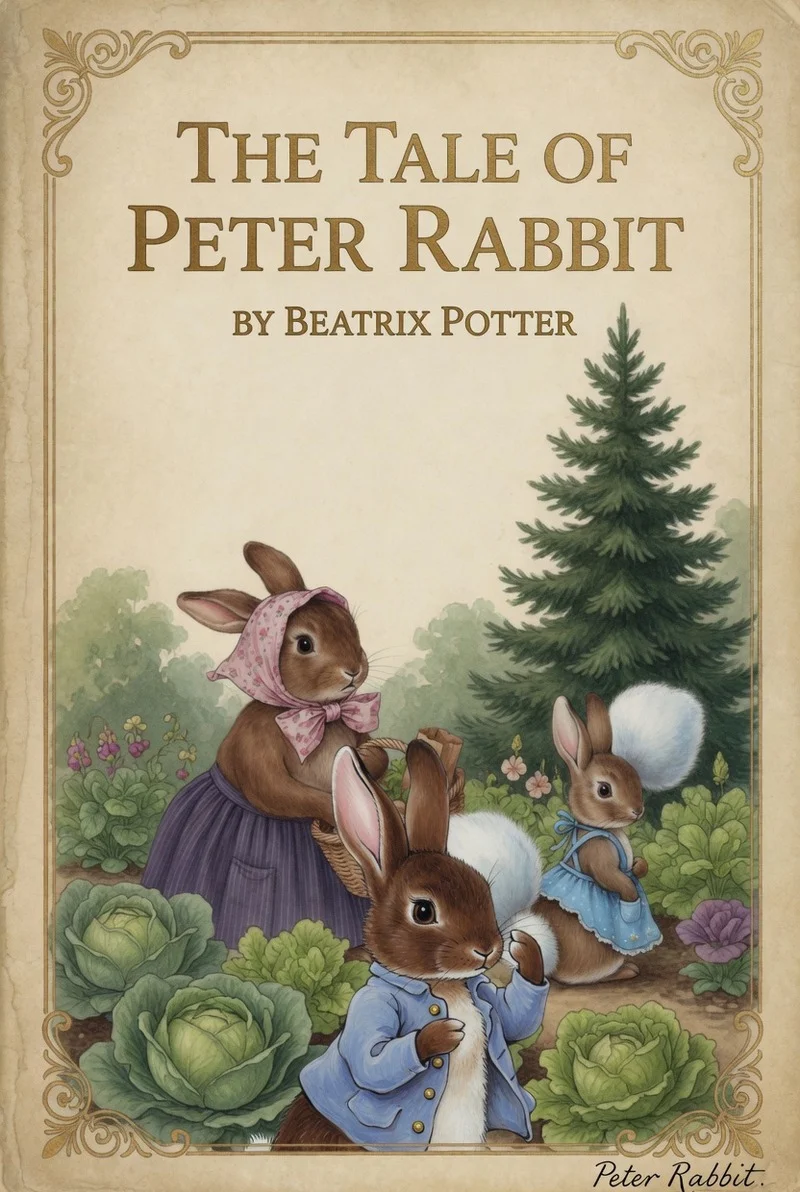
About This Book
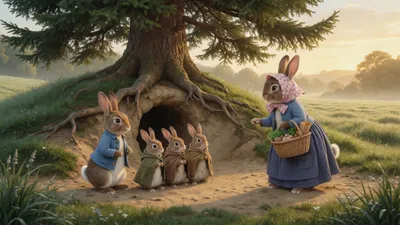
The Tale of Peter Rabbit is a short story about a little rabbit who does not listen to his mother. Peter lives in a snug home under the root of a very big fir tree with his mother and his three sisters, Flopsy, Mopsy, and Cotton-tail. Their home is warm and safe, and just beyond it lie green fields, a shady lane, and one place they must never go.
Beatrix Potter's 1902 text is short enough for a sitting and rich enough for second graders who are moving from picture books into real story language. Readers meet old-fashioned garden words, follow a chase with a clear beginning, middle, and end, and can talk about curiosity, rules, and consequences without the book preaching at them.
Meet the Characters

More about Peter Rabbit
Peter Rabbit is the most adventurous of four little rabbits who live with their mother under the root of a fir-tree. He is curious, disobedient, and very fond of garden vegetables. His mother has told him not to go into Mr. McGregor's garden.

More about Mrs. Rabbit
Mrs. Rabbit is a widow who keeps a neat burrow under a fir-tree and goes to the baker's for brown bread and five currant buns. She is sensible, loving, and used to Peter not listening. She is the one who buttons jackets and gives orders.

More about Mr. McGregor
Mr. McGregor is a gardener who keeps a well-tended vegetable garden behind a locked gate. He is not a giant and not a monster; he is a working man who wants his lettuces left alone. Peter's father had an accident in that garden.

More about Flopsy
Flopsy is one of the three good little rabbits who do what they are told. She goes with her sisters to gather blackberries. She is the opposite of Peter on this particular morning.

More about Mopsy
Mopsy is the second good sister, blackberrying with Flopsy and Cotton-tail while Peter goes the other way. She is obedient and ordinary. Mrs. Rabbit is proud of her.

More about Cotton-tail
Cotton-tail is the youngest of Mrs. Rabbit's good children. She gathers blackberries and does not go into gardens. She is named for her tail.

More about Mrs. McGregor
Mrs. McGregor keeps the gardener's cottage and is mentioned as the reason Peter's father did not come home. She is a background figure of the garden world. Peter is more afraid of her husband than of her, because he sees the husband first.

More about The White Cat
The white cat belongs to the McGregor garden and is a danger of a different kind from the gardener. Peter sees her twitching her tail. He does not go closer.
Pre-Reading Discussion Questions
- Has a grown-up ever told you not to go somewhere? Why might they say that?
- What makes a place feel safe, and what makes a place feel risky?
- Look at the cover. What kind of rabbit do you expect Peter to be?
- Why might a rabbit want to visit a vegetable garden?
- What do you do when you feel curious about something you are not supposed to touch?
- What does it mean to be a good listener at home or at school?
Themes & Big Ideas to Track
- Listening and not listening: notice what happens when a rule is followed and when it is broken.
- Choices and what comes next: watch how one small decision leads to the next thing that happens.
- Curiosity: pay attention to how wanting to know more can lead Peter into new places.
- Home and safety: think about why home feels different from the garden.
- Family: notice how Peter and his sisters act differently from one another.
- Feelings: watch for moments when Peter feels excited, scared, tired, or sorry.
Chapter-by-Chapter Study Guide
Chapter 1
Before you read — think about:
- You may know Peter Rabbit from a picture book, or from the 2018 and 2021 movies. Those movies are loud and busy. This book is a quiet watercolor morning. What people and things do you already picture? How will you notice what is on THIS page?
- In 1902, how did a mother rabbit walk to the village? How does your family go to the store now?
- What is it like when more than one child lives in the same home?
- Have you ever seen a real rabbit? Where was it, and what was it doing?
- Why might a writer use short, plain sentences?
Watch for these while reading:
- Mrs. Rabbit, and how she speaks to Flopsy, Mopsy, Cotton-tail, and Peter.
- The rabbits' home under the big fir-tree.
- Mr. McGregor's garden: the rows of vegetables, the gate, and the paths.
- Peter's blue jacket with the brass buttons.
- Count the people, the clothes, and the garden things in THIS book. Are they the same as in a picture book or movie you already know?
Vocabulary to know:
mischief (noun) — playful behavior that causes trouble; naughty (adjective) — behaving badly and not doing as you are told; sand-bank (noun) — a small hill of sandy soil, where the rabbit family dug their home; currant (noun) — a tiny dried berry baked into buns and cakes; squeezed (verb) — pushed through a very tight space; parsley (noun) — a leafy green herb that rabbits nibble to settle a sore tummy; gooseberry (noun) — a small round green berry that grows on a prickly bush; rake (noun) — a garden tool with a long handle and metal teeth; sieve (noun) — a wide bowl-shaped tool full of tiny holes, used for sifting; implored (verb) — begged someone to do something; exert (verb) — to make a strong effort and use all your strength; wriggled (verb) — twisted and squirmed the body to get free; dreadfully (adverb) — very greatly; terribly; trembling (verb) — shaking a little because of fear or cold; presently (adverb) — soon afterward; in a little while; lippity (adverb) — a made-up word the author invented for the soft, slow hopping of a tired rabbit; puzzled (adjective) — confused and unsure what to do next; wheelbarrow (noun) — a small cart with one wheel and two handles, used in a garden; hoe (noun) — a garden tool with a flat blade, used to dig up weeds; scare-crow (noun) — a figure set up in a garden to frighten birds away; fortnight (noun) — two weeks; camomile (noun) — a small daisy-like plant used to make a calming tea (also spelled chamomile).
About the Author
Beatrix Potter (1866-1943) was an English writer and artist who loved animals all her life. As a girl she kept many pets, including rabbits, and she spent hours drawing them and studying nature. She first made up Peter Rabbit in a picture letter she wrote to cheer up a sick little boy she knew, and years later she turned that letter into a book, painting all the pictures herself. When she grew older she bought farms in the English countryside and worked to protect the land she loved.
This story was first published more than one hundred years ago, in 1902, in England. Beatrix Potter had it made small on purpose, so that little hands could hold it easily, and she filled it with her own soft watercolor paintings. It belongs to a very old storytelling tradition in which animals talk, wear clothes, and act like people. Peter Rabbit became so beloved that it has stayed in print ever since and has been read to children all over the world.