

About This Book
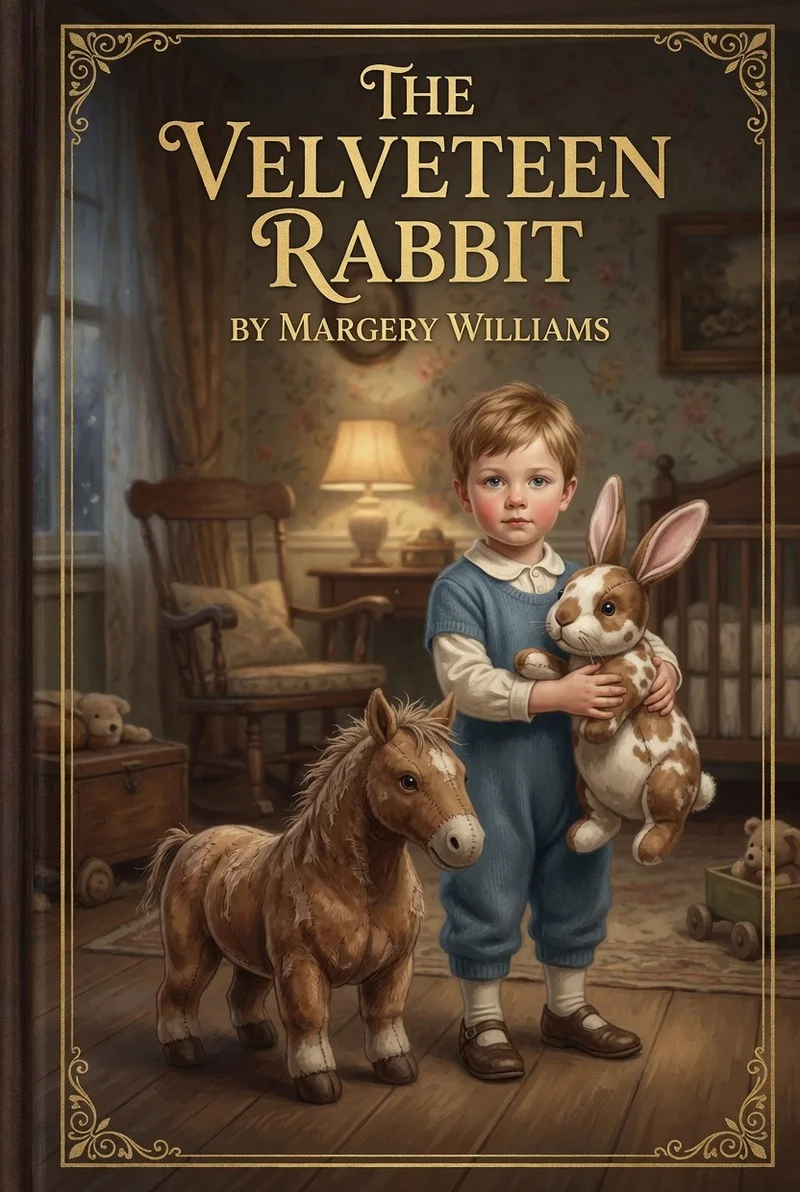
A shy stuffed rabbit arrives in a little boy's nursery one Christmas morning. He is made of velveteen, spotted brown and white, with thread whiskers and ears lined in pink sateen. Around him live other playthings — some of them shiny, modern, and sure of themselves — and an old Skin Horse who has been in the nursery longer than anyone else.
Fourth graders can read this 1922 classic as a short novel in one sitting and still find plenty to talk about. Williams writes in a literary voice with long, careful sentences, and she treats a nursery full of toys as if their feelings matter. The story asks what we mean by 'real,' what love does to the things we keep, and how it feels to be left out or chosen. It is a good book to read slowly, mark hard words, and discuss.
Meet the Characters

More about The Velveteen Rabbit
The Velveteen Rabbit is a soft, new stuffed toy who arrives in a little boy's nursery one Christmas morning. He is shy and gentle, and at first he feels small and unsure beside the fancy wind-up toys that think they are very grand. More than anything, he quietly wonders what it would feel like to be truly loved.

More about The Skin Horse
The Skin Horse has lived in the nursery longer than any other toy. He is old, patient, and very wise, and he has watched many playthings come and go over the years. The other toys look up to him because he seems to understand what truly matters in the nursery.

More about The Boy
The Boy is a cheerful little child who lives in a cozy house and loves to play in his nursery. He has many toys, but like all children he has favorites that he likes to carry with him everywhere. He is warm-hearted and full of imagination.

More about Nana
Nana is the busy, caring grown-up who looks after the nursery and the Boy. She tidies the toys, tucks the Boy into bed at night, and keeps everything in its place. She can be a little brisk and hurried, but she always means well.

More about The Nursery Magic Fairy
In the world of the nursery there is a kind of gentle magic that watches over toys who are truly loved. This magical figure cares deeply about playthings and the children who cherish them, and she brings a quiet sense of warmth and wonder to the nursery world.

More about The Doctor
The Doctor is the family physician who comes to the house when the Boy is unwell. He is practical, a little stern about germs and sickrooms, and used to giving orders in a nursery. The toys know him as a large, important grown-up who changes the rules of the room.

More about The Model Boat
The model boat is one of the grand mechanical toys that arrive at Christmas and look down on stuffed animals. It is shiny, modern, and sure of its own importance. It represents the nursery's fashionable toys who do not think much of a simple velveteen rabbit.
Pre-Reading Discussion Questions
- What is the difference between a toy that looks expensive and a toy a child actually keeps close?
- In a house from a hundred years ago, what was a nursery, and who might have worked there?
- When have you loved something that was no longer new or fancy?
- How do people decide whether something is 'real'?
- What kinds of toys were common before plastic and batteries were everywhere?
Themes & Big Ideas to Track
- How the narrator lets toys think and speak
- Fancy versus well-loved
- What grown-ups notice and what they miss
- Patience, waiting, and change over time
- The difference between looking modern and mattering to someone
Chapter-by-Chapter Study Guide
Chapter 1: The Velveteen Rabbit
Before you read — think about:
- What is a nursery in an old-fashioned house, and who might look after the children there?
- How do people sometimes treat objects that look fancy differently from objects that look plain?
- How can an author make readers care about a toy that cannot really talk or feel?
- Why might a child keep one particular toy close at bedtime?
- What does it mean to you when someone says a thing is 'real'?
Watch for these while reading:
- The Velveteen Rabbit's coat, whiskers, and pink-lined ears as they are first described.
- Which toys in the nursery act grand, and which one is kind.
- The Skin Horse's worn coat and the way he talks.
- Nana's habits when she tidies the room.
- Words the toys use when they talk about being modern, or being Real.
Vocabulary to know:
velveteen (noun) — A cotton cloth with a short, soft pile, used to make stuffed toys and clothes.; sateen (noun) — A smooth, slightly shiny cotton fabric, often used as a lining.; snubbed (verb) — Treated coldly or with scorn; ignored as if not important.; superior (adjective) — Acting as if better than others; proud and looking down on people.; insignificant (adjective) — Seeming too small or ordinary to matter.; commonplace (adjective) — Ordinary; not special or remarkable.; sawdust (noun) — Tiny bits of wood left after sawing, once used to stuff cheap toys.; mainsprings (noun) — The coiled metal springs that make clockwork toys run.; fender (noun) — A low metal guard placed in front of a fireplace.; shabby (adjective) — Worn, faded, or threadbare from long use.; burrows (noun) — Holes or tunnels that rabbits dig in the ground to live in.; bracken (noun) — Tall ferns that grow in woods and on hillsides.; brigands (noun) — Bandits or outlaws; here, a make-believe game of being robbers in the woods.; hind (adjective) — At the back; the back legs of an animal.; flushed (adjective) — Red and hot in the face, often from fever.; disinfected (verb) — Cleaned so that germs are killed, especially after illness.; threadbare (adjective) — So worn that the cloth is thin and the threads show.; wriggling (verb) — Twisting and turning the body to move through a tight space.; fronds (noun) — The large divided leaves of a fern.; plush (noun) — A thick, soft fabric with a deep pile, used for fancy stuffed toys.; rigging (noun) — The ropes and fittings that hold a boat's masts and sails.; swagger (verb) — To walk or talk in a boastful, show-off way.; swooping (verb) — Moving down or across suddenly, like a bird diving.; scarlet fever (noun) — A serious contagious illness that once spread easily among children, causing a red rash and high fever..
About the Author
Margery Williams was born in London in 1881 and later lived in the United States. She wrote stories in which toys and animals seem to have inner lives of their own. The Velveteen Rabbit, published in 1922, became the book she is best known for.
The story is set in an English house about a hundred years ago. Many children then had a nursery — a room for play and sleep — looked after by a nanny, here called Nana. Toys were often cloth, wood, or tin; some had clockwork you wound with a key.