

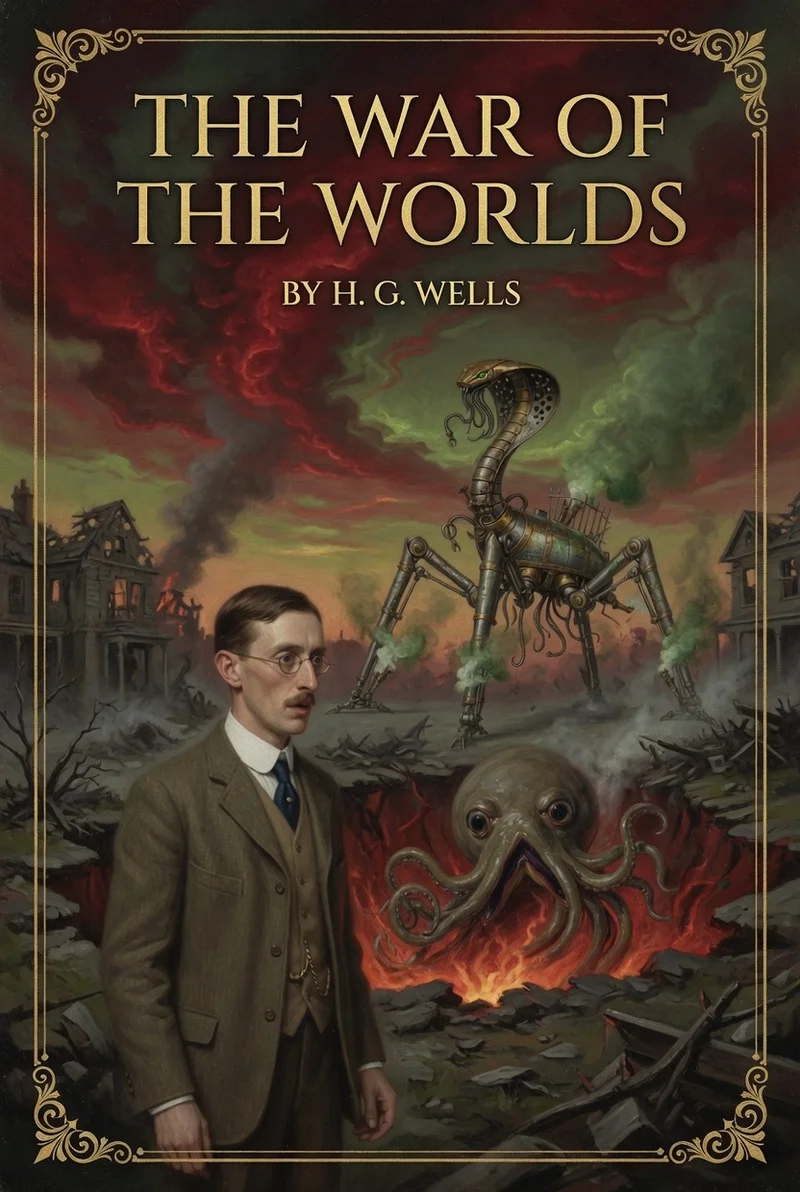
About This Book
In the last years of the nineteenth century, an essayist living in the quiet Surrey commuter town of Woking is invited by his friend Ogilvy, an astronomer, to spend a night at the telescope. Something is happening on Mars: jets of glowing gas, fired off into space on ten successive nights, like signals — or like shots. The newspapers give it a paragraph. Dinner tables give it a joke. And then, one summer night, something falls out of the sky onto the sandy heath a short walk from the narrator's front door, and by morning half the neighbourhood has strolled out to have a look at it.
This is the book that invented the alien invasion — the ancestor of nearly every story since in which something arrives from outside and humanity has to answer for itself — and reading the original is startling, because Wells is far less interested in machines than in people. He wrote it at the height of the British Empire and deliberately turned the empire's own logic around: here the technologically superior newcomers are the ones who arrive uninvited on someone else's land, and English readers are asked to imagine that from the other side. It is also an unusually honest book about fear. Wells gives you a narrator who is intelligent, decent, and not a hero, and then asks what such a person actually does when reasoning stops being enough. Very few adventure stories are willing to ask that, which is why this one still lands with real force more than a century later.
Meet the Characters

More about The Narrator
The narrator is never named. He writes essays on science and on the progress of moral ideas, keeps a comfortable house in the Surrey commuter town of Woking, and takes an amateur's pleasure in astronomy. He is curious, analytical, and used to being able to reason his way to an answer.

More about The Narrator's Wife
The narrator's wife shares his quiet suburban life in Woking. She is affectionate and practical about the household, content with evening walks and an ordinary week, and she has no appetite at all for adventure.

More about Ogilvy
Ogilvy keeps a private observatory a few miles from Woking and is a friend of the narrator. He is enthusiastic, generous with his telescope, and briskly sceptical of popular nonsense about the planets. He is the sort of man who will be out of doors before dawn to see something for himself.

More about Henderson
Henderson is a London journalist who lives in Woking and is usually to be found digging in his own garden before breakfast. He is shrewd, unexcitable, and professionally suspicious of a good story. He is the nearest thing the neighbourhood has to a newspaper.

More about Stent
Stent holds one of the most senior scientific posts in Britain and is used to being deferred to. He arrives to direct the excavation, setting workmen to dig and instructing the police to hold the crowd back, and he is plainly exasperated by onlookers who will not keep their distance. His instinct is that a difficult situation is best handled by the proper authorities, in an orderly way.

More about The Curate
The curate is a junior clergyman whose whole working life has been small services, parish visits, and a settled routine. He is devout, anxious, and accustomed to a world in which explanations are available. He has never been asked to make sense of anything he could not fit into a sermon.

More about The Artilleryman
The artilleryman is a driver in a field battery — a young regular soldier, quick-witted, talkative, and a great deal more imaginative than his rank suggests. He is a survivor by temperament, more interested in what to do next than in what has just happened.

More about The Narrator's Brother
The narrator's brother is studying medicine in London, lodging near Regent's Park with an examination close at hand. He is steady, observant, and physically confident in a way his bookish elder brother is not. A second, separate account of the same days is told through his eyes.

More about Mrs. Elphinstone
Mrs. Elphinstone is the wife of a country surgeon and is used to a sheltered, well-ordered household. She is gentle and easily overwhelmed, and she has never in her life had to make a decision without her husband. On the road she is chiefly aware of how far she is from home.

More about Miss Elphinstone
Miss Elphinstone is the sister-in-law of the woman she travels with, and the one actually holding the reins. She is level-headed, direct, and unsentimental, with a countrywoman's competence about horses. She says little and does not panic easily.

More about The Martians
For the first pages of the novel the Martians are nothing but a series of flashes seen through a telescope, arriving night after night. Wells is careful to establish them as living creatures with a motive before he lets anyone see one. Whatever they are, they are older, colder, and far better prepared than the world they are watching.

More about A Fighting-Machine
The fighting-machines are the engines the Martians assemble after they arrive — walking towers taller than the church steeples of the villages they cross. Nothing in the Victorian world is built to this scale or moves in this way, and no one who sees one has a word ready for it.
Pre-Reading Discussion Questions
- If a genuinely superior intelligence arrived on Earth and simply wanted the planet, what claim could humanity make to it? Would "we were here first" mean anything?
- Wells opens by reminding English readers what European empires had done to peoples who could not fight back. Why might a writer in 1898 choose to begin a story that way?
- How do you decide whether a piece of unusual news is worth taking seriously? What makes a distant fact feel unreal even when it is true?
- In the 1890s news travelled by telegraph, printed paper, and word of mouth. How would that shape which stories spread, how fast, and how badly distorted?
- What is the difference between courage and simply surviving? Are they ever the same thing?
- Some stories are told as though they are happening now; others are told by someone looking back on events long afterwards. What can each kind of telling give you, and what does each one cost?
Themes & Big Ideas to Track
- Scale and perspective: track every comparison the narrator makes between people and smaller creatures — insects, rabbits, ants, organisms in a drop of water — because Wells trained as a biologist and never uses those images casually.
- The empire looking in a mirror: notice where the book invites an English reader of 1898 to recognise his own country's conduct in someone else's.
- What knowledge is for: watch where scientific understanding protects people in this book, where it fails them, and where it simply makes them overconfident.
- The texture of ordinary life: Wells spends a great deal of care on timetables, suburbs, gardens and railway signals — ask what that precision is doing to the story.
- How information moves: rumour, newspapers, official statements and word of mouth all travel through this book, and they do not always travel at the same speed as the truth.
- The narrator's honesty: he is writing after the fact and chooses what to admit — notice when he qualifies a claim, confesses ignorance, or tells you what he did not understand at the time.
Chapter-by-Chapter Study Guide
Chapter 1: The Eve of the War

Before you read — think about:
- What does it mean to call a people 'primitive'? Who normally gets to apply that word, and what does using it permit the speaker to do next?
- Astronomers in the 1890s could see Mars only as a small disc of light. How much can honestly be known about a place from that, and where does careful inference shade into wishful thinking?
- Think of a piece of news that should have alarmed you and did not. What makes a distant fact feel unreal?
- Wells trained as a biologist. If you thought of humans as one animal species among many rather than as the point of creation, which everyday assumptions would stop feeling safe?
- Why might an author open a book by making readers uncomfortable about themselves rather than by starting the action?
Watch for these while reading:
- Comparisons between people and much smaller creatures — organisms in a drop of water, insects, animals in a wood. Wells starts this pattern in his first paragraph and keeps it running.
- The physical facts given about Mars: its size, its age, its cold, its air, its water. He is arguing something with them, not just describing.
- The narrator's habits as an essayist — how he weighs evidence, qualifies a claim, and admits what nobody knew at the time.
- How newspapers and dinner-table conversation handle astronomical news, and the tone the narrator takes toward each.
- Ordinary late-Victorian detail: the observatory at Ottershaw, evening walks, railway lines, gaslight. Wells is fixing a baseline on purpose.
Vocabulary to know:
secular (adjective) — happening extremely slowly, over ages — nothing to do with religion; opposition (noun) — the moment when Mars lies directly opposite the sun as seen from Earth, and so is closest and brightest; superficial (adjective) — having to do with surface area — here a measurement, not an insult; infusoria (noun) — the tiny living things found swarming in a drop of pond water; complacency (noun) — a smug, unearned sense that everything is fine and safe; scrutinise (verb) — to examine something closely and carefully, the way a scientist studies a specimen; transient (adjective) — lasting only a very short time before vanishing; disillusionment (noun) — the painful loss of a comfortable belief once you learn the truth; nebular (adjective) — relating to the theory that planets condensed out of a spinning cloud of gas and dust; attenuated (adjective) — thinned out and weakened; inundate (verb) — to flood or cover completely with water; incessant (adjective) — never stopping, going on without a pause; extermination (noun) — the complete wiping out of a group of living things; unanimity (noun) — complete agreement, everyone acting as one; incandescent (adjective) — glowing white-hot; spectroscope (noun) — an instrument that splits light into its colours to reveal what a distant object is made of; palpitating (adjective) — throbbing or trembling with excitement; colossal (adjective) — enormous, on a scale far beyond the ordinary; vigil (noun) — a long watch kept through the night; profundity (noun) — immense depth; transverse (adjective) — lying crosswise, running from side to side; unfathomable (adjective) — too deep to be measured or understood; unerring (adjective) — never missing its mark; chronometer (noun) — an exceptionally accurate clock, used for scientific timing; zenithward (adverb) — towards the zenith — the point in the sky directly overhead; jubilant (adjective) — openly delighted and triumphant; vulgar (adjective) — common or popular — the sort of idea ordinary people hold, rather than experts; apostles (noun) — devoted champions or preachers of a cause; calamity (noun) — a disaster causing widespread suffering; molten (adjective) — melted into liquid by extreme heat; eloquent (adjective) — clearly expressing or suggesting something, as if speaking it aloud; populous (adjective) — thickly filled with people; serene (adjective) — calm and untroubled, entirely without worry; vanity (noun) — excessive pride in oneself, which blinds a person to the truth; tranquil (adjective) — peaceful and undisturbed.
Chapter 2: The Falling Star

Before you read — think about:
- What is the difference between a fact and an interpretation of a fact? How would you tell which one you were being handed?
- If you saw something in the sky at night that you could not explain, who would you tell, and what would you expect them to say back?
- Think about the specialist knowledge different jobs give people — an astronomer, a journalist, a farmer, a shopkeeper. What would each notice first in an unfamiliar situation?
- In the 1890s news moved by telegraph, printed paper and word of mouth. How would that shape which stories spread, and how much they were distorted on the way?
- A narrator writing years later can tell you what he did not understand at the time. What does that hindsight give a story, and what does it cost?
Watch for these while reading:
- Exact measurements and materials — diameter, colour, crust, the coating on the object's surface. Wells wants you picturing a thing, not a symbol.
- The emptiness of the common at dawn: sand, heather, pines, silence. The setting is arranged with care.
- Ogilvy's running commentary of guesses, and the reasoning each guess rests on.
- How people in Woking treat a man in a hurry with an extraordinary story.
- Henderson the journalist, and what a newspaperman does with information he is handed.
Vocabulary to know:
cylinder (noun) — in this book, the sealed tube-shaped craft fired from Mars to Earth; shivered (verb) — smashed into splinters — not trembling with cold; insensible (adjective) — unconscious, unable to feel or respond; incrustation (noun) — a hard crust baked onto the outside of something; clinker (noun) — the grey, glassy waste left behind after something has burned fiercely; cindery (adjective) — looking like burnt cinders — blackened, ashy and rough; projectile (noun) — an object fired or hurled through the air like a shot from a gun; dun-coloured (adjective) — a dull greyish-brown; ascribed (verb) — explained something as being caused by a particular thing; circumference (noun) — the outer edge or rim of a circle — here the circular edge of the cylinder's end, not a measurement of distance; irresolute (adjective) — unable to decide what to do; hesitating; arrested (verb) — stopped something in its tracks; artificial (adjective) — made by an intelligent being rather than formed by nature; palings (noun) — a fence made of upright pointed wooden stakes; taproom (noun) — the public drinking room of an inn; potman (noun) — a man employed at an inn to serve drinks and clean up; waggoner (noun) — a man who drives a horse-drawn goods wagon; clambered (verb) — climbed awkwardly, using hands as well as feet; consolation (noun) — comfort offered to someone who is suffering; heather (noun) — a low, tough, purple-flowered shrub that covers open moorland; heath (noun) — open, uncultivated land covered in rough low shrubs; meteorite (noun) — a lump of rock or metal from space that has survived its fall to the ground; grating (adjective) — making a harsh scraping sound of metal on metal; disordered (adjective) — untidy and dishevelled, as though something has gone badly wrong.
Chapter 3: On Horsell Common
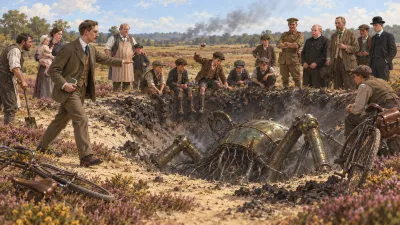
Before you read — think about:
- Why do people gather to look at things? List the different reasons that bring a crowd to the same spot.
- How does a rumour change as it passes from person to person across a small town in a single morning?
- Think about who gets treated as an authority in a strange situation, and what that authority actually rests on.
- What makes people decide that an unfamiliar thing is safe to stand near? How good is that judgement usually?
- Wells set his invasion in real, named, ordinary places a few miles from his own house. What does a writer gain by that, and what does he give up?
Watch for these while reading:
- The make-up of the crowd: boys, shopkeepers, cyclists, holidaymakers, a sweet-stuff stall. Wells is taking a census.
- Stent, the Astronomer Royal, and the way scientific and local authority are shared out at the pit.
- The narrator's own theories about what the cylinder holds, and what those theories reveal about him.
- How much of an ordinary Friday carries on undisturbed within a few hundred yards of the sand-pits.
- Everything the diggers do to the cylinder, and the trouble they have doing it.
Vocabulary to know:
extra-terrestrial (adjective) — coming from beyond the Earth; wire (noun) — a telegram — a message sent along telegraph wires; abstract (adjective) — concerned with theories and ideas rather than with physical things; jobbing (adjective) — hired by the individual job rather than permanently employed; contemplated (adjective) — planned or intended, but not yet built; afforded (verb) — provided or offered something; inanimate (adjective) — not alive; showing no sign of movement; charred (adjective) — burned black on the surface; bystanders (noun) — people standing nearby watching, without taking part; loafers (noun) — idlers who hang about with nothing in particular to do; caddies (noun) — boys or men who carry golfers' clubs for a fee; oxide (noun) — the dull coating formed when a metal combines with oxygen, such as rust; hue (noun) — a particular shade of colour; manuscript (noun) — a handwritten document or book; basket-chaise (noun) — a light open carriage with a woven wickerwork body; lordly (adjective) — grand and expensive, belonging to someone of high rank; perspiration (noun) — sweat; crimson (adjective) — deep red; impediment (noun) — something that gets in the way and slows work down; excavations (noun) — the work of digging something out of the ground; tumult (noun) — a loud, confused uproar; enclosure (noun) — an area fenced off to keep people out; waylay (verb) — to wait for someone in order to stop and speak to them; turf (noun) — the surface layer of grass and its roots; perceive (verb) — to notice or understand something, especially something not obvious; enterprising (adjective) — quick to spot an opportunity and act on it; barrow-load (noun) — as much as a wheelbarrow will hold; fancifully (adverb) — in an imaginative, playful way not governed by evidence.
Chapter 4: The Cylinder Opens
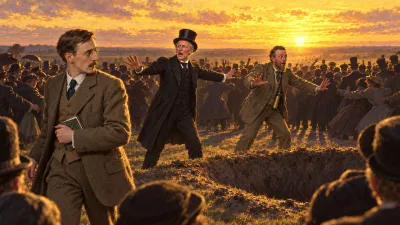
Before you read — think about:
- People at the pit assume that whatever is inside will make sense to them. Why is that assumption so hard to let go of?
- Wells was trained in biology. If a creature evolved on a colder, smaller world with weaker gravity, which parts of a human body would you expect to be different?
- What draws people toward something they have been told to keep away from? Is curiosity a virtue, a weakness, or neither?
- How does a crowd behave differently from the individuals inside it? Have you watched that happen?
- Describing something with no earthly equivalent is a real writing problem. What tools does an author have — comparison, measurement, a refusal to describe at all?
Watch for these while reading:
- The order in which the narrator's feelings arrive, and how carefully he separates one from the next.
- Which physical details Wells lingers over, and which single one he says is hardest to bear.
- How the crowd moves as one body — swaying, pressing forward, breaking apart.
- The heat, the low sun and the sunset colours; Wells lights this scene very deliberately.
- The sand-pit itself — its shape, its edges, and where people place themselves around it.
Vocabulary to know:
aperture (noun) — an opening or hole, especially a round one; concussion (noun) — a violent shock or the loud sound it makes when something strikes; cavity (noun) — a hollow space inside something; luminous (adjective) — giving off or reflecting light; glowing; writhing (adjective) — twisting and squirming continuously; inarticulate (adjective) — not formed into clear words; sounds rather than speech; ungovernable (adjective) — impossible to control or hold back; petrified (adjective) — so frightened that you cannot move, as though turned to stone; pulsated (verb) — throbbed or swelled with a regular rhythm; convulsively (adverb) — with sudden uncontrollable jerks; tentacular (adjective) — like a tentacle — long, flexible and limb-like; appendage (noun) — a limb or part that hangs from a larger body; lank (adjective) — long, thin and drooping, without stiffness; fungoid (adjective) — resembling a fungus — damp, soft and spongy-looking; deliberation (noun) — unhurried slowness, as though every movement is being weighed; tedious (adjective) — slow and drawn-out to the point of being wearying to watch; brim (noun) — the top edge or rim of something; billowy (adjective) — rolling and swelling in soft waves; steadfastly (adverb) — fixedly and without looking away; avert (verb) — to turn away, especially your eyes or face; slantingly (adverb) — at an angle rather than straight ahead; furze (noun) — a spiny yellow-flowered shrub of English heathland, also called gorse; derelict (noun) — something abandoned and left behind by its owner; nosebags (noun) — feed bags strapped over a horse's muzzle so it can eat while standing; multitude (noun) — a very large number of people; dwindling (adjective) — steadily growing smaller in number; jostling (verb) — pushing and bumping against people in a crowd; blundered (verb) — moved clumsily and heavily, colliding with things; forthwith (adverb) — immediately, without any delay; overruled (verb) — defeated or overpowered a feeling or decision.
Chapter 5: The Heat-Ray

Before you read — think about:
- When people cannot understand something, they try to fit it into a story they already know. What stories would Victorian England have had ready for something arriving out of the sky?
- Stillness makes people braver. Is that sound reasoning? What would actually make an unknown thing safe?
- How would you recognise a weapon you had never imagined? What would you be looking for?
- Why do people drift back toward something dangerous once it appears to have stopped?
- What is the difference between panic and judgement, and can you tell them apart while they are happening to you?
Watch for these while reading:
- The white flag, and the reasoning of the men who decide to carry it forward.
- Everything that rises out of the pit — a rod, a disc, a humped shape — and how little sense any of it makes to a watcher.
- Wells's use of light and colour: green flashes, the western afterglow, faces in the dusk.
- The gap between what the narrator's eyes report and what his mind can assemble from it.
- The distinction he draws between reasonable fear and something older and more physical.
Vocabulary to know:
deputation (noun) — a small group chosen to speak or act on behalf of many others; leash (noun) — a set of three — an old hunting term, not a dog's lead; appliances (noun) — machines or devices built for a particular purpose; persuasion (noun) — a strong personal conviction that something is true; unmanning (verb) — robbing someone of courage and self-control; vantage (noun) — a position that gives a better view; apex (noun) — the highest point or tip of something; accosted (verb) — went up to someone and spoke to them, often a stranger; knoll (noun) — a small rounded hill; intimation (noun) — a slight sign or hint that something is happening; intermittent (adjective) — stopping and starting rather than continuous; crescent (noun) — a curved shape like a new moon; dispersed (verb) — broke up and scattered in different directions; gride (noun) — a harsh scraping or grinding noise; trundling (verb) — pushing or rolling something heavy along on wheels; repulsive (adjective) — causing strong dislike or revulsion to look at; discreet (adjective) — careful and unobtrusive; here, cautiously far back; pallid (adjective) — unnaturally pale; droning (adjective) — making a low, continuous humming sound; impinged (verb) — struck against something; stupefied (adjective) — so shocked that you cannot think or react; dumbfounded (adjective) — struck speechless with amazement; undulating (adjective) — rising and falling in gentle waves; mustering (verb) — gathering together, as troops assemble; afterglow (noun) — the light that remains in the sky after the sun has set; void (adjective) — completely empty of something; verge (noun) — the very edge or brink of something; inevitable (adjective) — certain to happen and impossible to prevent.
Chapter 6: The Heat-Ray in the Chobham Road
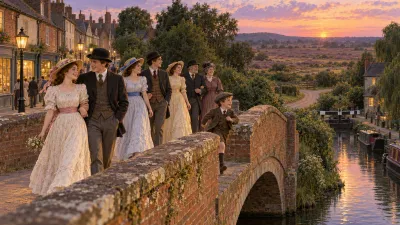
Before you read — think about:
- A single witness can only be in one place. What can a book do to widen its picture, and what does it lose by leaving one pair of eyes?
- Crowds form faster than anyone can organise them. What does a person standing in the middle of one actually know about what is happening at the front?
- How would three village constables be expected to manage several hundred people on a summer evening?
- Does explaining how something terrible works make it more frightening or less? Argue it both ways.
- Rumour outruns fact in an emergency. What makes one warning believed and another ignored?
Watch for these while reading:
- The shift out of the narrator's own eyes into a reported, assembled account, and how he flags the change.
- The technical explanation offered for the Heat-Ray, alongside a careful admission of what nobody knew.
- Ordinary evening pleasures on the Chobham and Horsell roads — a stroll, a courting couple, gossip at a gate.
- The shape of the ground itself: banks, hollows, the crest of a hill. Wells is thinking like a surveyor here.
- How much intention Wells is willing to attribute to the invaders, and the points where he refuses to guess at a motive at all.
Vocabulary to know:
incontinently (adverb) — immediately, at once; parabolic (adjective) — curved in the bowl-like shape that focuses rays into a straight beam; combustible (adjective) — able to catch fire and burn; non-conductivity (noun) — the property of not letting heat or electricity pass through; slay (verb) — to kill; massacre (noun) — the killing of many people at one time; distorted (adjective) — twisted badly out of its normal shape; ablaze (adjective) — burning fiercely; on fire; gloaming (noun) — twilight; the dim light just after sunset; novelty (noun) — something new and unusual, treated as an entertainment; trivial (adjective) — unimportant and light-hearted; deter (verb) — to discourage someone from doing something; mounted (adjective) — riding on horseback; anticipating (verb) — expecting something and preparing for it in advance; barracks (noun) — the buildings where soldiers live; collision (noun) — a violent clash between two sides; ill-fated (adjective) — doomed; certain to end badly; tallies (verb) — matches or agrees with another account; hummock (noun) — a small mound or hillock of earth or sand; intercepted (verb) — cut off or blocked something on its way; elevation (noun) — the height at which something is set or aimed; gable (noun) — the triangular upper part of a wall where two roof slopes meet; igniting (verb) — catching fire or setting alight; panic-stricken (adjective) — overwhelmed by sudden uncontrollable fear; hesitatingly (adverb) — with uncertainty; pausing before acting; bolted (verb) — ran away suddenly in fright; horse-play (noun) — rough, noisy fooling about.
Chapter 7: How I Reached Home

Before you read — think about:
- In an emergency, what do people owe the neighbours and strangers they pass? What is reasonable to expect of them?
- If you tried to tell strangers something genuinely unbelievable, what words would you choose, and how do you think they would answer?
- How does a person try to be honest and reassuring at the same time? Is it possible to be both?
- How do people decide whether to leave or to stay put when danger is a few miles off? What tips the balance?
- What does the ordinary physical business of living — a meal, a lamp, a familiar chair — do to fear?
Watch for these while reading:
- How fast the narrator's state of mind changes among houses and lamplight, and whether he notices the change himself.
- The argument he builds about the invaders' weight and helplessness, and which parts of it are genuinely sound.
- The dinner table: what is served, what is said, and what is left unsaid.
- The reactions of the people he passes and speaks to, and what they suggest about how warnings travel.
- The comparison he makes in the closing lines, and which side of it human beings are placed on.
Vocabulary to know:
sensible (adjective) — able to be noticed or felt — not 'showing good sense'; credit (verb) — to believe that something is true; cope (noun) — a heavy cloak worn over the shoulders; erethism (noun) — an abnormally heightened state of excitement and sensitivity; pitiless (adjective) — showing no mercy at all; flourishing (verb) — waving something about in a bold, sweeping way; smote (verb) — struck with great force (the old past tense of 'smite'); wayside (noun) — the edge of a road; perplexed (adjective) — confused and unable to make sense of things; garment (noun) — a piece of clothing; feebleness (noun) — weakness and helplessness; anguish (noun) — severe mental or physical suffering; incline (noun) — a slope; detachment (noun) — a feeling of being separated from yourself and everything around you; inconceivably (adverb) — to a degree impossible to imagine; incongruity (noun) — the jarring wrongness of two things that do not belong together; haggard (adjective) — looking exhausted and ill from strain; allay (verb) — to calm or reduce a fear; sluggish (adjective) — slow-moving and lacking energy; albeit (conjunction) — although; even though; invigorating (adjective) — giving strength and energy; indisputably (adverb) — in a way that cannot be argued with; counterbalance (verb) — to make up for something by having an opposite effect; dispense (verb) — to do without something; exertion (noun) — hard physical effort; timidity (noun) — a lack of courage or boldness; rashness (noun) — acting without thinking of the danger; gasworks (noun) — a factory that made gas for street lamps and homes.
Chapter 8: Friday Night
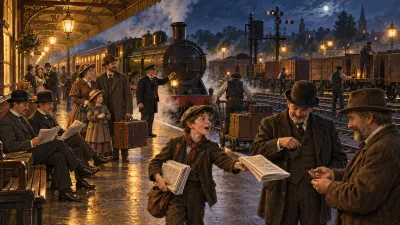
Before you read — think about:
- How far from a catastrophe do you have to be before it stops feeling like yours? Five miles? Fifty?
- Wells often writes about a society as though it were a body. What does that comparison make easy to say, and what does it hide?
- An editor receives an astonishing telegram from a reporter who then goes silent. What would a newspaper in 1898 actually do with it?
- What has to happen before soldiers are sent somewhere? Who decides, and on what information?
- Think about the last hours of normality before a change that everyone afterwards dates precisely. What is it like to be inside them?
Watch for these while reading:
- The circle Wells draws on the map around the sand-pits, and how ordinary life carries on just outside it.
- The images he uses for the invasion — a needle, a wound, an inflammation, something loose in the bloodstream.
- The sounds coming out of the pit through the night, and what the narrator makes of the hammering.
- How the military response is assembled, and how reasonable it looks given what anyone actually knows.
- Trains, telegraph wires and timetables: Wells keeps the machinery of the country visible on the page.
Vocabulary to know:
dovetailing (noun) — the way two different things fit neatly together, like joined pieces of wood; canard (noun) — a false or exaggerated story printed as news; inert (adjective) — inactive; doing nothing at all; indefatigable (adjective) — tireless; never stopping to rest; immemorial (adjective) — reaching back further than anyone can remember; commonplace (adjective) — completely ordinary and unremarkable; ultimatum (noun) — a final demand made to another country, with war as the alternative; authentication (noun) — confirmation that something is genuine and true; sensation (noun) — a widespread public stir or excitement; dominant (adjective) — most important; overshadowing everything else; trenching (verb) — intruding on someone else's territory or business; monopoly (noun) — sole control of a trade, with no competitors; alighting (verb) — getting down from a train or carriage; tidings (noun) — news; desolate (adjective) — empty, abandoned and bleak; contorted (adjective) — twisted violently out of its normal shape; smouldering (verb) — burning slowly without flames; deployed (verb) — spread out into position, as troops do; cordon (noun) — a line of soldiers or police placed to seal off an area; squadron (noun) — a cavalry unit of about a hundred and fifty horsemen; hussars (noun) — light cavalry soldiers, famous for speed and dash; regiment (noun) — a large permanent unit of an army; inflammation (noun) — the hot, swollen reaction of a body around an injury; fringe (noun) — the outer edge or border of something; artery (noun) — one of the large tubes carrying blood from the heart; searchlight (noun) — a powerful beam of light used to sweep across a wide area; adventurous (adjective) — willing to take dangerous risks.
Chapter 9: The Fighting Begins

Before you read — think about:
- What tactics were available to an army in 1898 — before tanks, before aircraft, before radio? What would its commanders reach for first?
- How do people decide it is time to leave home? What would have to happen to you?
- Why does the presence of uniformed soldiers make civilians feel safer, whether or not it should?
- Is there something in people that enjoys the idea of a battle? Where do you think that comes from?
- Wells lets ordinary Saturday routines run alongside an emergency. What does that contrast do to a reader?
Watch for these while reading:
- The milkman, the neighbour, the gardener, the strawberries — how completely normal a Saturday morning manages to be.
- The soldiers' arguments about tactics, and which of them is reasoning most carefully.
- The narrator's schoolboy daydreams of battle, and how honestly he sets them down.
- The first sixty seconds of the narrator's own emergency, and what his hands do.
- What he takes with him and what he leaves, and what those choices say about him.
Vocabulary to know:
lassitude (noun) — heavy tiredness and lack of energy; suspense (noun) — anxious uncertainty about what is going to happen; fluctuating (adjective) — rising and falling irregularly; barometer (noun) — an instrument that measures air pressure to forecast weather; chariot (noun) — used jokingly here for a humble cart; unexceptional (adjective) — perfectly ordinary; nothing out of the usual; unapproachable (adjective) — impossible to get near; sappers (noun) — soldiers trained as engineers, who dig trenches and build defences; sentinel (noun) — a soldier posted to keep watch; plied (verb) — kept supplying someone with something, here with questions; acuteness (noun) — sharpness of understanding; stereotyped (adjective) — repeated in exactly the same fixed words every time; formula (noun) — a set form of words used again and again; lowing (noun) — the deep mooing sound cattle make; armament (noun) — the weapons and military equipment gathered for a fight; belligerent (adjective) — eager for a fight; warlike; detonation (noun) — the explosion of a shell or charge; pinnacle (noun) — a slender pointed turret on top of a building; lowering (adjective) — looming darkly and threateningly, like a gathering storm; clamouring (verb) — demanding something loudly and insistently; bevy (noun) — a group, especially of people or birds moving together; lurid (adjective) — glowing with an unnatural, harsh reddish light; dismounted (verb) — got down off a horse; streamers (noun) — long narrow trailing bands, here of smoke; whirr (noun) — a continuous low buzzing or whirring sound; reins (noun) — the straps used to control a horse; plate (noun) — household articles made of silver or gold; crest (noun) — the very top of a hill or ridge; landlord (noun) — the keeper of an inn or public house; summerhouse (noun) — a small building in a garden, used for sitting out in fine weather.
Chapter 10: In the Storm
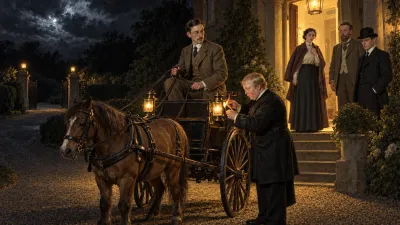
Before you read — think about:
- People on a road at night in bad weather, all moving the same way. What are the practical problems, and which of them would you not have thought of?
- How do you describe something genuinely unlike anything you have seen? What would you compare it to, and what does the comparison cost in accuracy?
- A thunderstorm gives a writer light that comes and goes. What can be done with that which steady daylight would not allow?
- How does a rumour travel along a road crowded with people in the dark? What happens to it on the way?
- Is excitement a form of courage or a form of blindness? Can a person feel fear and exhilaration at the same time?
Watch for these while reading:
- The drive itself: the silence in the cart, and what is said and not said between husband and wife.
- The comparisons Wells reaches for when the narrator meets something new — several of them deliberately domestic and absurd.
- How the lightning controls what the narrator, and therefore you, are permitted to see.
- Any sign of steering or handling — anything that suggests the machines are driven rather than automatic.
- The road between Leatherhead and Maybury, and who else is on it that night.
Vocabulary to know:
articulate (adjective) — made of jointed sections that bend, like a limb; career (noun) — a headlong rush at full speed; insensate (adjective) — without feeling or awareness; merely mechanical; brazen (adjective) — made of brass, or brass-coloured; surmounted (verb) — sat on top of something; apparition (noun) — a sudden startling appearance of something; silhouette (noun) — a dark outline seen against a lighter background; misadventure (noun) — an unlucky accident; commended (verb) — entrusted someone to another person's care; forebodings (noun) — strong feelings that something bad is going to happen; monosyllables (noun) — single-syllable words — the shortest possible answers; fusillade (noun) — a burst of gunfire from many weapons at once; contagion (noun) — the spreading of a feeling from one person to another, like an illness; reverted (verb) — returned to an earlier subject or state; precipitated (verb) — caused something to happen suddenly; harassed (adjective) — worn down by constant worry or pressure; pealing (verb) — ringing out loudly, as church bells do; reverberations (noun) — echoing rumbles that roll on after a loud noise; elusive (adjective) — hard to catch hold of or to see clearly; problematical (adjective) — puzzling; impossible to make sense of; tripod (noun) — a stand or frame supported on three legs; heeling (verb) — leaning far over to one side; brittle (adjective) — hard but easily snapped; wrenched (verb) — pulled or twisted violently; shafts (noun) — the two long poles between which a horse is harnessed to a cart; exultant (adjective) — wildly triumphant; imminent (adjective) — about to happen at any moment; peril (noun) — serious danger; desisted (verb) — stopped doing something; foliage (noun) — the leaves of trees and plants; wretchedness (noun) — a state of misery and physical distress; broadcloth (noun) — a fine, closely woven black woollen cloth used for good coats; repugnance (noun) — a strong feeling of distaste or revulsion; gingerly (adverb) — very carefully and cautiously; ruddy (adjective) — reddish; latchkey (noun) — a key for the front door of a house; conveyance (noun) — any vehicle for carrying people; hap (noun) — luck or fortune (an old word).
Chapter 11: At the Window
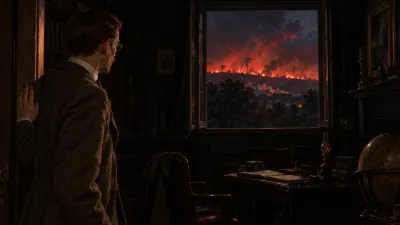
Before you read — think about:
- What do you do first when you get back into a familiar room after something terrible? Is it rational?
- How reliable is the account of a soldier describing something he barely came through? What would he emphasise, and what would he leave out?
- A man who writes essays and a man who serves a gun would tell the same story very differently. What differences in vocabulary and pace would you expect?
- What evidence would settle, for you, whether a machine is a vehicle carrying something or a creature in its own right?
- Wells keeps setting people beside animals. What happens when that comparison is turned around and pointed at our own machinery?
Watch for these while reading:
- How ordinary the narrator's first actions are, alone in his own house.
- The view from the study window, built entirely out of separate points of light in the dark.
- The two questions the narrator puts to himself about the machines, and how far he gets with each.
- The artilleryman's diction and rhythm set against the narrator's own prose.
- The posture and activity of the machines at dawn, described from a distance.
Vocabulary to know:
ironclad (noun) — an armoured warship of the period; unlimbered (verb) — detached a field gun from its horse-drawn carriage so it could be fired; torpor (noun) — a heavy, sluggish inability to move or act; lethargy (noun) — a dull, drained state in which nothing seems worth doing; impenetrably (adverb) — so completely that nothing can get through — here, that no light can; grotesque (adjective) — strangely distorted and unnatural in shape; conflagration (noun) — a large destructive fire; resinous (adjective) — smelling of pine sap; tang (noun) — a strong, sharp smell or taste; scud (noun) — low clouds driven fast across the sky by wind; oblongs (noun) — rectangles that are longer than they are wide; expanse (noun) — a wide, open, continuous area; intently (adverb) — with close, concentrated attention; disgorged (verb) — poured or emptied out; impersonal (adjective) — detached, as though the matter had nothing to do with you; astride (adverb) — with a leg on each side of something; obscurity (noun) — darkness in which little can be seen; mechanically (adverb) — automatically, without thinking about it; depression (noun) — a hollow or dip in the ground; furtively (adverb) — secretly, trying not to be noticed; skirmishing (adjective) — spread out in a loose line rather than packed together, as troops advance under fire; fugitives (noun) — people running away from danger; cowled (adjective) — wearing a hood that covers the head; scintillated (verb) — sparkled with quick flashes of light; curvature (noun) — the curve or bulge of a surface; waddle (verb) — to walk with short, rocking, side-to-side steps; impassable (adjective) — impossible to travel through; frantic (adjective) — wild with fear or distress; scalded (adjective) — burned by very hot liquid or steam; scorching (adjective) — hot enough to burn; embankment (noun) — a raised bank of earth carrying a road or railway; skulking (verb) — moving about while keeping hidden; mains (noun) — the large pipes that carry a town's water supply; pantry (noun) — a small room where food is stored; gutted (adjective) — burned out inside, leaving only the shell; gaunt (adjective) — bare, bony and grim-looking; indiscriminate (adjective) — striking everything alike, without choosing targets; surveying (verb) — looking carefully over an area; vapour (noun) — a visible cloud of gas or steam.
Chapter 12: What I Saw of the Destruction of Weybridge and Shepperton
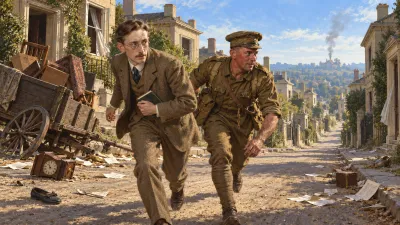
Before you read — think about:
- Two people with very different training are about to travel together. Where would you expect them to be useful to each other, and where to disagree?
- What is the best an 1898 artillery battery could realistically hope for against a weapon that sets fire to whatever it touches?
- Why do people so often refuse to believe a warning from someone who has actually seen the thing?
- What do people carry when they flee? What would you take, and what would you be embarrassed to admit you took?
- A river is a boundary, a road and an obstacle all at once. What can a writer do with one?
Watch for these while reading:
- What the artilleryman does before leaving the house — the small habits of a man who has been on active service.
- The villages between Maybury and the Thames on a Sunday morning, and how much of the news has reached them.
- Where the guns are placed, and who does and does not know they are there.
- The river itself: its depth, its temperature, its traffic, its far bank.
- Objects that people carry, drop, or refuse to put down.
Vocabulary to know:
heliograph (noun) — a signalling device that flashes messages using a mirror and sunlight; theodolite (noun) — a surveying instrument on a tripod, used for measuring angles; sabbatical (adjective) — relating to Sunday as a day of rest and church-going; patent (adjective) — obvious; plain to see; pollard (adjective) — cut back to the trunk so as to grow a thick head of new branches; portmanteau (noun) — a large stiff travelling case that opens into two halves; bore (noun) — a steep wave that surges up a river; spit (noun) — a narrow point of land running out into water; weal (noun) — a raised streak or ridge; clangorous (adjective) — filled with loud, harsh, ringing noise; din (noun) — a loud, continuous, confusing noise; reek (noun) — thick smoke or steam with a strong smell; dissuaded (verb) — persuaded someone not to do something; detour (noun) — a longer, roundabout route; ransack (verb) — to search a place thoroughly, turning everything over; flask (noun) — a flat bottle for carrying drink; debris (noun) — scattered broken remains; sodden (adjective) — soaked right through; dismal (adjective) — bleak and depressing to look at; felled (verb) — cut down; privates (noun) — soldiers of the lowest rank; detailed (verb) — assigned to a particular duty; assiduously (adverb) — with steady, determined effort; twelve-pounders (noun) — field guns named for the weight of the shell they fire; rampart (noun) — a defensive bank of earth thrown up to shelter troops; fatigue (adjective) — describing the plain uniform soldiers wear for labouring work; gravity (noun) — seriousness; shrivelled (adjective) — shrunken and wrinkled; expostulating (verb) — protesting and arguing earnestly; corporal (noun) — a junior non-commissioned officer in the army; miscellany (noun) — a jumbled mixture of different kinds of things; horseflesh (noun) — horses considered collectively; pluckily (adverb) — bravely and with spirit; vicar (noun) — the priest in charge of a parish church; grenadiers (noun) — soldiers of a senior infantry regiment; refuge (noun) — shelter or protection from danger; treble (adjective) — triple; having three parts; burdens (noun) — heavy loads being carried; jesting (verb) — joking; formidable (adjective) — frighteningly powerful; sack (verb) — to plunder and destroy a captured town; prohibited (adjective) — forbidden by law — here, the hours when inns had to close; unconcernedly (adverb) — without any sign of worry; obliquely (adverb) — at a slanting angle; hoarse (adjective) — rough and harsh-sounding; unheeded (adjective) — ignored; not listened to; suffocated (adjective) — unable to breathe; generator (noun) — the device that produces something — here, the Heat-Ray; simultaneously (adverb) — all at the same moment; riveted (adjective) — fixed so firmly that it cannot be looked away from; tattered (adjective) — torn into ragged pieces; reeled (verb) — staggered as though about to fall; intricate (adjective) — complicated, with many small parts; swerved (verb) — turned aside suddenly; submerged (adjective) — under the surface of the water; froth (noun) — a mass of small bubbles; foam; purposelessness (noun) — aimlessness; movement with no intention behind it; diverted (verb) — turned away to something else; dismay (noun) — helpless distress and alarm; intact (adjective) — undamaged and whole.
Chapter 13: How I Fell in with the Curate

Before you read — think about:
- What kinds of explanation do people reach for when something senseless happens to them? List as many as you can.
- How does a scientifically-minded person usually respond to someone offering a religious reading of a catastrophe? Is that response fair?
- What does a town look like once its people have all left it? What would you notice first, walking through?
- Is despair a failure of character, or a reasonable response to some situations? Argue it honestly.
- If you were hurt, alone and cut off from your family, what would your first three decisions be?
Watch for these while reading:
- The first description of the curate, and every physical detail Wells selects for him.
- What the invaders are doing with the later cylinders, and how the narrator pieces that together from a distance.
- The vocabulary of the curate's speech — how much is his own and how much is borrowed from the pulpit.
- What the narrator says about God and about the natural world, and whether he is being harsh, honest, or both.
- The state of the Thames valley in the hours after the fighting: heat, steam, wreckage, quiet.
Vocabulary to know:
devoted (adjective) — doomed — set apart for a fate, usually death; sally (noun) — a sudden rush out from a defended position to attack; masked (verb) — hid or screened something from view; muzzle (noun) — the open front end of a gun barrel; encumbered (adjective) — weighed down and slowed by an awkward load; negligible (adjective) — too small or unimportant to be worth noticing; advent (noun) — the arrival of something important; interplanetary (adjective) — travelling between planets; antagonists (noun) — opponents in a struggle; copse (noun) — a small group of trees; spinneys (noun) — small thickets or patches of woodland; arcades (noun) — long passages roofed by arches — here formed by burnt trees; proximity (noun) — nearness; contrived (verb) — managed to do something despite difficulty; parboiled (adjective) — partly cooked by boiling — here, badly scalded; obstructive (adjective) — getting in the way; impotent (adjective) — powerless; unable to act; mackerel (adjective) — describing a sky rippled with rows of small clouds, like fish scales; flaxen (adjective) — very pale yellow, like flax fibre; vacantly (adverb) — with a blank, unfocused expression; demented (adjective) — wild and irrational with distress; relapsed (verb) — fell back into a previous state; officiated (verb) — conducted a religious service; exempted (verb) — excused from something that applies to everyone else; invulnerable (adjective) — impossible to harm; wary (adjective) — watchful and cautious; resonance (noun) — a deep echoing sound; cockchafer (noun) — a large brown beetle that flies noisily on summer evenings; earthworks (noun) — banks of dug earth built as defences; splendour (noun) — magnificent brightness or beauty.
Chapter 14: In London

Before you read — think about:
- How does a city of six million people learn that something is badly wrong? What has to fail before anyone believes it?
- What happens to public trust when official reassurance is proved wrong? Can it be repaired?
- Wells hands the narration to a second witness. What does a book gain from a second pair of eyes, and how should it justify the switch?
- If you had to leave a huge city in a hurry along with everyone else, what would decide whether you got out?
- Newspapers, telegrams and word of mouth each carry the same event differently. What does each do to it?
Watch for these while reading:
- How the book explains whose account this is and how it reached the narrator.
- The newspaper headlines and official statements Wells quotes, and the exact wording he chooses for them.
- How reassurance and alarm sit inside the same official sentence.
- Precise London detail: churches, boating on the river, promenades, a shop selling maps, Sunday papers.
- The pace of the chapter — how long Wells spends on Saturday compared with Sunday.
Vocabulary to know:
intelligence (noun) — news or information; import (noun) — the real meaning or significance of something; menagerie (noun) — a travelling collection of caged wild animals; nomadic (adjective) — wandering, with no fixed home; tocsin (noun) — an alarm bell rung to warn a town of danger; vehement (adjective) — forceful and intense; crammer (noun) — a tutor who prepares students intensively for an examination; brevity (noun) — shortness; leader-writer (noun) — the journalist who writes a newspaper's main opinion article; dispatch (noun) — an official message or report; ascertain (verb) — to find out for certain; nocturnal (adjective) — happening or working at night; extravagant (adjective) — going far beyond what is reasonable or true; tremors (noun) — shivers of fear; battalion (noun) — an army unit of several hundred soldiers; allusions (noun) — indirect references to something; disseminating (verb) — spreading information widely; innumerable (adjective) — too many to count; traps (noun) — light two-wheeled carriages pulled by one horse; hearsay (noun) — rumour; information heard from others rather than known directly; terminus (noun) — the end station of a railway line; invariably (adverb) — always, without exception; pleasantries (noun) — light, joking remarks; reservist (noun) — a former soldier who can be called back into the army; placards (noun) — large printed posters advertising a newspaper's headlines; roughs (noun) — rough, tough working men; repulse (noun) — the driving back of an attack; annihilated (verb) — completely destroyed; exhorted (verb) — strongly urged; reiterated (adjective) — repeated again and again; quasi-proclamation (noun) — something that is almost, but not quite, an official public announcement; apathy (noun) — complete lack of interest or concern; raiment (noun) — clothing; hawkers (noun) — people who sell goods by calling out in the street; greengrocers (noun) — shopkeepers who sell fruit and vegetables; conspicuously (adverb) — in a way that stands out and is easily noticed; animated (adjective) — lively and full of excitement; incapacity (noun) — inability to do something; thoroughfares (noun) — main roads through a city; magnitude (noun) — great size or importance; promenaders (noun) — people strolling about for pleasure; sash (noun) — the sliding frame of a window; disarray (noun) — untidy disorder; forerunners (noun) — the first of a group, coming before the rest; gradient (noun) — a slope, especially of a railway line; braces (noun) — straps worn over the shoulders to hold up trousers; craned (verb) — stretched out the neck to see or hear better; suffocation (noun) — death from being unable to breathe; oblivious (adjective) — completely unaware; parapets (noun) — low walls along the edges of roofs; flaunted (verb) — displayed openly and showily; lodger (noun) — someone who rents a room in another person's house.
Chapter 15: What Had Happened in Surrey

Before you read — think about:
- What does an army do when its usual methods have already failed once? What are its options?
- An enemy has been hurt once by hidden guns. How should an intelligent opponent change its methods after that?
- What is it like to wait in silence beside a loaded gun for a target that has not appeared?
- How do civilians find out what is happening in a battle a few miles away, and whom do they believe?
- Why does it matter so much to the narrator whether the invaders understand human organisation? What hangs on the answer?
Watch for these while reading:
- The formation the machines adopt when they move together, and how they signal to one another.
- The behaviour of the Black Smoke, set down with real scientific care — its weight, its settling, its dispersal.
- The contrast between one body of gunners and another, and what accounts for the difference.
- The rockets, the tubes, the drifting cloud: Wells's engineering vocabulary at work.
- The narrator's open questions about how much the invaders grasp of us, and the evidence he offers on each side.
Vocabulary to know:
kopjes (noun) — small isolated hills — a South African word Wells borrows for the smoke banks; canister (noun) — a metal container — here, the shell that releases the Black Smoke; mettle (noun) — courage and staying power; investment (noun) — the surrounding of an enemy position by troops; ululation (noun) — a long wavering howl; darkling (adjective) — growing dark; in the gathering darkness; offensive (noun) — an attacking campaign; conflicting (adjective) — disagreeing with one another; disengaged (verb) — released or gave off; unseasoned (adjective) — inexperienced; not yet tested by real service; premature (adjective) — happening too early to be effective; ineffectual (adjective) — producing no result; volley (noun) — a number of guns fired at the same moment; blight (noun) — a disease that withers plants; here, a small dark speck; cumulus (noun) — a heaped, billowing cloud; ebony (adjective) — deep black, like ebony wood; pungent (adjective) — sharp and stinging to smell or taste; insoluble (adjective) — unable to be dissolved in liquid; diffuse (verb) — to spread out evenly, as a gas normally does; watercourses (noun) — streams, ditches and channels that carry water; ominous (adjective) — giving the feeling that something bad is about to happen; conical (adjective) — shaped like a cone; opaque (adjective) — impossible to see through; stifling (adjective) — making breathing impossible; overawe (verb) — to frighten into submission; mutinied (verb) — refused to obey orders, as a crew or soldiers; spasmodic (adjective) — happening in sudden irregular bursts; cannonade (noun) — continuous heavy gunfire; fitful (adjective) — irregular; stopping and starting; haphazard (adverb) — without aim or plan; vigilant (adjective) — keeping careful watch for danger; onslaught (noun) — a fierce mass attack; pitfalls (noun) — concealed pits dug to trap something that walks over them; snare (noun) — a trap; encampment (noun) — a temporary base or camp; brambles (noun) — prickly wild blackberry bushes; nettles (noun) — wild plants whose leaves sting the skin; palpable (adjective) — so intense it seems solid enough to touch; extinction (noun) — the complete ending of something; disintegrating (adjective) — breaking apart into pieces; expiring (adjective) — dying; coming to an end.
Chapter 16: The Exodus from London
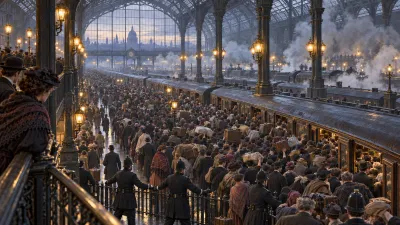
Before you read — think about:
- Six million people try to leave a city at once. What breaks first — roads, trains, police, food, or something else?
- In a crisis some people help strangers and some rob them. What decides which way a person goes?
- What is money worth when the shops are shut and the banks are closed? What replaces it?
- How can a writer make an enormous crowd feel like people rather than a number?
- Who is the most capable person you have seen in an emergency, and what made them so?
Watch for these while reading:
- The order in which organised society comes apart, and how long each part holds.
- Individual figures lifted out of the crowd — a blind man, an old soldier, a lost child, a man with a bag.
- The two women the brother travels with, and how differently Wells draws them.
- The cries repeated along the road, working almost like a chorus.
- Horses, carts, bicycles and feet: the sheer physics of moving that many bodies along one road.
Vocabulary to know:
liquefaction (noun) — the process of turning into liquid — used here for a society melting; coherency (noun) — the quality of holding together as one working whole; guttering (verb) — burning low and unsteadily, like a candle about to go out; volition (noun) — the power to choose and act for yourself; rout (noun) — a disorderly, headlong flight; host (noun) — an enormous multitude of people; galvanised (verb) — shocked suddenly into activity; paroxysm (noun) — a sudden violent fit of emotion; pugilistic (adjective) — relating to boxing; chivalry (noun) — a code of honourable, fair behaviour; prosecuting (verb) — carrying on with something determinedly; broached (verb) — raised a subject for the first time; designing (verb) — intending or planning; delusive (adjective) — misleading; creating a false impression; eddy (noun) — a small swirl that turns back against the main current; stokers (noun) — the men who shovel coal into a locomotive's furnace; stalwart (adjective) — strongly built and dependable; fruitless (adjective) — producing no result; notwithstanding (adverb) — in spite of that; even so; skirting (verb) — going along the edge of something rather than through it; fasting (adjective) — having eaten nothing; trudged (verb) — walked slowly and heavily; loiter (verb) — to hang about without moving on; congested (adjective) — blocked by too much traffic; hansom (noun) — a two-wheeled cab for hire, with the driver seated behind; induced (verb) — persuaded or led someone to do something; stile (noun) — a step or set of steps for climbing over a fence; pony-chaise (noun) — a small light carriage drawn by a pony; burly (adjective) — large and heavily built; unavoidable (adjective) — impossible to escape or prevent; provisions (noun) — supplies of food; wayfarers (noun) — people travelling on foot; jaded (adjective) — worn out and dulled by exhaustion; confluence (noun) — the place where two streams or roads flow together; sallow (adjective) — yellowish and unhealthy-looking in complexion; bowler (noun) — a hard round-topped felt hat; façade (noun) — the front face of a building; staccato (noun) — a series of short, sharp, separated sounds; perpetually (adverb) — continually, without any break; riotous (adjective) — wildly disorderly and violent; margin (noun) — the edge or border of something; gesticulating (verb) — making dramatic gestures with the hands; prostrate (adjective) — lying stretched out, face down; dray (noun) — a low heavy cart used for carrying barrels; vestry (noun) — the committee that ran a London parish's local services; unkempt (adjective) — untidy and uncared-for in appearance; refrain (noun) — a phrase repeated over and over, like the chorus of a song; reproaches (noun) — expressions of blame or complaint; privet (noun) — a dense shrub commonly used for garden hedges; sovereigns (noun) — gold coins each worth one pound; traces (noun) — the straps by which a horse pulls a carriage; coachman (noun) — the driver of a horse-drawn carriage; dubiously (adverb) — hesitantly and uncertainly; dilated (adjective) — opened wide; resolute (adjective) — firmly determined; weaklings (noun) — people without the strength to keep going.
Chapter 17: The "Thunder Child"
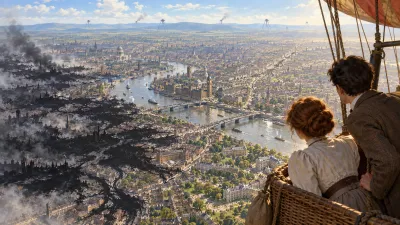
Before you read — think about:
- What could a warship of 1898 actually do against an enemy on land? What are its advantages, and its limits?
- Hundreds of thousands of people are short of food in the home counties. What happens to ordinary ideas about property?
- A moving crowd meets a bottleneck — a bridge, a gate, a quayside. What happens there, and what would prevent it?
- What does a coastline mean to people trying to escape? What does it promise, and what does it refuse?
- Wells liked to imagine a scene from far above it. What does a bird's-eye view show that someone on the ground cannot see?
Watch for these while reading:
- The aerial view Wells builds, and the image he uses for the spreading crowds.
- The catalogue of vessels off the Essex coast; the list is doing real work.
- The word the narrator chooses for what the invaders appear to be attempting, which is very precise.
- The Thunder Child herself: her class, her speed, her bearing, and the language used for her.
- Anything the brother notices in the air above the estuary, and how little Wells explains about it.
Vocabulary to know:
stippled (verb) — marked all over with small separate dots; hamstringing (verb) — crippling something by cutting what holds it together; demoralisation (noun) — the destruction of a people's courage and will to resist; ramifications (noun) — branches spreading out from a main body; gout (noun) — a splash or blob of liquid; leviathan (noun) — a vast sea creature; anything enormous; larboard (adjective) — the old word for the left-hand side of a ship, now called port; starboard (adverb) — on the right-hand side of a ship; ram (noun) — a warship built to sink others by driving into them; chaffering (verb) — haggling over a price; lightermen (noun) — men who work the flat barges that carry cargo on a river; boathooks (noun) — long poles with a hook, used to pull boats alongside; smacks (noun) — small single-masted fishing boats; colliers (noun) — ships that carry coal; merchantmen (noun) — trading ships; tramps (noun) — cargo steamers that take work wherever they can find it, with no fixed route; launches (noun) — small powered boats; estuary (noun) — the wide mouth of a river where it meets the sea; granaries (noun) — buildings where grain is stored; plunderers (noun) — people robbing empty houses; exorbitant (adjective) — far too expensive; gangway (noun) — the movable bridge by which passengers board a ship; bulwarks (noun) — the raised sides of a ship above the deck; upperworks (noun) — the parts of a ship above the waterline; ricocheted (verb) — bounced off a surface at an angle; matchwood (noun) — wood splintered into tiny pieces; ventilators (noun) — the funnel-shaped openings that draw air below a ship's decks; impetus (noun) — the force of something already in motion; involuntarily (adverb) — without meaning to; automatically; marbled (adjective) — streaked with swirling patterns, like marble; remnant (noun) — the small part that is left; parody (noun) — an imitation that is close enough to be unsettling; stunted (adjective) — prevented from growing to full size; mudflat (noun) — a stretch of muddy ground uncovered when the tide goes out; sickle-shaped (adjective) — curved like the blade of a sickle; pitching (verb) — plunging bow-first up and down in rough water; morrow (noun) — the next day; alternately (adverb) — taking turns, one after the other.
Chapter 18: Under Foot

Before you read — think about:
- What does an empty house tell you about the people who left it in a hurry?
- When does a plan become an obsession? How would you tell the difference from inside your own head?
- Two men are taking food from empty houses. How many days does it take before that stops feeling like theft?
- The second half of the book is called The Earth Under the Martians. What does a conqueror do once the fighting stops?
- What qualities keep people alive in a long emergency, as opposed to a short one?
Watch for these while reading:
- The exact quality the narrator says is needed now, when he sizes up his cousin at Leatherhead.
- Everything the narrator has taken from the artilleryman, and how he applies it.
- The catalogue of what is in the pantry, and why Wells troubles to list it.
- Activity by the invaders that has nothing to do with fighting.
- The difference between the curate's use of a day and the narrator's.
Vocabulary to know:
circumspection (noun) — careful, wary caution before acting; scullery (noun) — a small back room off a kitchen used for washing dishes; domicile (noun) — a house or dwelling; subsist (verb) — to stay alive on a limited supply; fortnight (noun) — two weeks; pall (noun) — a dark covering spread over everything, like a cloth over a coffin; foolhardy (adjective) — recklessly bold without regard for danger; manifest (adjective) — obvious; plain to see; aghast (adjective) — struck with sudden horror; remonstrance (noun) — a protest or objection made to someone; timorous (adjective) — nervous and easily frightened; inactivity (noun) — the state of doing nothing; reconciled (verb) — brought yourself to accept something unwelcome; radiating (verb) — spreading outward in all directions from a centre; carrier (noun) — a container for holding or transporting things; loomed (verb) — appeared suddenly and hugely; shrubbery (noun) — an area of a garden planted with bushes; plantations (noun) — areas of deliberately planted trees; hedgerows (noun) — lines of bushes forming field boundaries; semi-detached (adjective) — describing a house joined to one other house by a shared wall; hatchet (noun) — a small axe; house-breaking (noun) — breaking into houses; crockery (noun) — plates, cups and dishes; dresser (noun) — a kitchen sideboard with shelves for displaying plates; masonry (noun) — stone or brickwork; mould (noun) — loose earth or soil; range (noun) — a large cast-iron cooking stove built into a kitchen; supplements (noun) — extra picture sheets given away with a newspaper; haricot (adjective) — describing dried white beans used in cooking; burgundy (noun) — a red wine from the Burgundy region of France; copybooks (noun) — exercise books in which children practised handwriting; unaccountable (adjective) — impossible to explain; superheated (adjective) — heated far above boiling point; eclipsed (verb) — blocked from view; cut off from light; insistent (adjective) — demanding attention and refusing to be ignored; whimpering (verb) — making small frightened crying sounds.
Chapter 19: What We Saw from the Ruined House
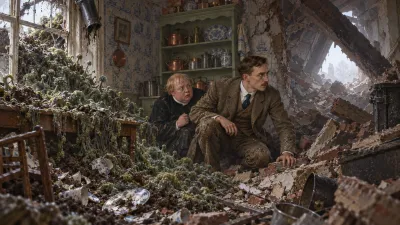
Before you read — think about:
- What would a trained scientific observer most want to record about a creature nobody had seen before?
- Wells was a biology student. What makes a description of an animal scientific rather than merely vivid, and can a piece of writing be both at once?
- How reliable can a description be when the observer is starving, frightened, and looking through a gap in a wall?
- Popular pictures of a thing often fix themselves in the public mind before accurate ones do. Why does that happen?
- What does a machine tell you about the people who built it?
Watch for these while reading:
- The difference between how the machines move and how the creatures that built them move.
- The narrator's complaints about the way artists and pamphlets have drawn all this.
- How the narrator handles the limits of his own evidence in this chapter — what he states plainly, what he offers as inference, and what he admits he cannot know.
- The red weed: where it first shows and how it behaves.
- One feature Wells says is entirely absent from Martian machinery, and what he makes of the absence.
Vocabulary to know:
integument (noun) — the outer covering of a body — skin, shell or hide; handling-machine (noun) — the five-legged spider-like machine the invaders use for building and assembling; actuated (verb) — made something move or work; dexterous (adjective) — skilful and quick with the hands; cerebral (adjective) — relating to the brain; pulverised (verb) — smashed into powder; nausea (noun) — a feeling of sickness and disgust; tympanic (adjective) — like a drum; relating to the eardrum; auditory (adjective) — relating to hearing; anatomist (noun) — a scientist who studies the structure of bodies; dissection (noun) — the cutting open of a body to study its structure; tactile (adjective) — relating to the sense of touch; pulmonary (adjective) — relating to the lungs; entrails (noun) — the internal digestive organs; pipette (noun) — a slender tube used to transfer small amounts of liquid; squeamish (adjective) — easily sickened or upset by unpleasant things; carnivorous (adjective) — meat-eating; heterogeneous (adjective) — made up of many different kinds of things; gastric (adjective) — relating to the stomach; bipeds (noun) — creatures that walk on two legs; silicious (adjective) — containing silica, the mineral that glass and sand are made of; musculature (noun) — the arrangement of muscles in a body; recuperate (verb) — to recover strength after effort; budded (verb) — grew as a small outgrowth from a parent body; polyp (noun) — a simple tube-shaped water animal that reproduces by budding; vertebrated (adjective) — having a backbone; superseded (verb) — took the place of something older; facetious (adjective) — treating a serious subject with unsuitable humour; cardinal (adjective) — most important; essential; diminution (noun) — a steady reduction in size; substratum (noun) — the underlying layer on which something rests; salient (adjective) — most noticeable or significant; morbidities (noun) — diseases and disorders; contagions (noun) — diseases passed from one living thing to another; consumption (noun) — the old name for tuberculosis, a wasting lung disease; luxuriance (noun) — rich, abundant growth; transitory (adjective) — lasting only a short while; carmine (adjective) — deep crimson-red; modulation (noun) — variation in the pitch or tone of a sound; intermediation (noun) — something acting as a go-between; preconceptions (noun) — opinions formed before you have the evidence; telepathic (adjective) — relating to communicating thought directly from mind to mind; decorum (noun) — correct and proper behaviour; locomotion (noun) — the act of moving from place to place; expedients (noun) — practical solutions adopted to get something done; pivot (noun) — a fixed point about which something turns; parallelism (noun) — a close similarity between two different things; vogue (noun) — widespread popularity; monotony (noun) — dull sameness; discriminating (adjective) — choosing carefully between things; forego (verb) — to do without something.
Chapter 20: The Days of Imprisonment

Before you read — think about:
- What is it like to be cut off from all news? How do people fill in what they cannot find out?
- What does confinement do to a person's sense of time?
- Why is watching something horrifying so hard to stop doing?
- When a person writes about their own conduct under pressure, do you expect them to flatter themselves or to be too hard on themselves?
- What would you actually attempt in order to get out of a cellar beside an enemy camp?
Watch for these while reading:
- How the two men behave about the peephole — the arrangement says more than the arguments do.
- The narrator's defence of his own conduct, and who he says is entitled to judge it.
- The manufacturing going on in the pit, and what it produces.
- The invaders' routine: how they rest, what sounds they make, what they carry about.
- Any noise reaching the ruins that is not made by the invaders.
Vocabulary to know:
vitiated (verb) — spoiled or destroyed the effectiveness of something; efficacious (adjective) — effective; capable of producing a result; importunities (noun) — persistent, wearing demands; incompatible (adjective) — unable to exist together without conflict; dispositions (noun) — natural temperaments or characters; accentuated (verb) — made something more noticeable or intense; monologue (noun) — a long speech by one person, with no reply expected; restraint (noun) — self-control; loathed (verb) — hated intensely; elemental (adjective) — reduced to the most basic, primitive level; charity (noun) — generous tolerance in judging others; brutality (noun) — cruel and violent behaviour; rigidity (noun) — an inability to bend or adapt; contrivances (noun) — cleverly designed devices; oscillated (verb) — swung steadily back and forth; receptacle (noun) — a container for holding something; imparted (verb) — gave or transmitted, such as motion or information; spatulate (adjective) — broad and flattened at the end, like a spatula; telescopic (adjective) — sliding out in sections to extend, like a telescope; untarnished (adjective) — not yet dulled or discoloured; ribbed (adjective) — having raised ridges along its length; abbreviated (adjective) — shortened; enigma (noun) — something completely mysterious; consequence (noun) — importance or social standing; studs (noun) — small fasteners used instead of buttons on a formal shirt; culminating (adjective) — forming the highest or worst point of a series; atrocity (noun) — an appallingly cruel act; vestiges (noun) — small remaining traces; forethought (noun) — thinking ahead and planning; irresistible (adjective) — impossible to resist; resignation (noun) — the giving up of a place or claim.
Chapter 21: The Death of the Curate
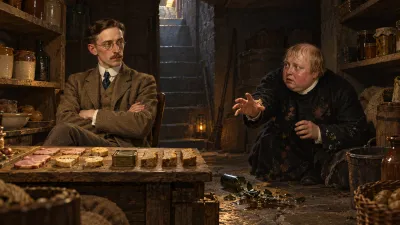
Before you read — think about:
- Food for two has to last an unknown number of days. Who should decide how it is divided, and by what right?
- Wells lets his narrator record things that do him no credit. Why would an author give a narrator that habit?
- What happens to people's sense of right and wrong when they are starving? Does it change, or only become harder to follow?
- How does a person keep hope going with no information at all? What do they use for it?
- What difference does it make when a narrator warns you in advance about something he did?
Watch for these while reading:
- The rationing arrangement the narrator sets out, and the terms he puts it in.
- What the curate actually says when he speaks aloud — the content, not only the volume.
- How much of the chapter the narrator can see, and how much he only hears.
- Where the narrator stops telling the story and starts explaining himself to you.
- The words he uses for the invaders' senses and abilities, and why they unsettle him.
Vocabulary to know:
copper (noun) — a large fixed boiler used for heating water and washing clothes; rations (noun) — fixed shares of food measured out to last a set time; discipline (noun) — a system of strict rules imposed to control behaviour; tussle (noun) — a rough struggle; undertones (noun) — low, hushed voices; cajoled (verb) — coaxed someone with flattery or persuasion; rudimentary (adjective) — the most basic and simple kind; babbling (noun) — rapid, meaningless talking; paradoxical (adjective) — seeming to contradict itself while still being true; moderate (verb) — to make less extreme; revert (verb) — to return to a previous subject or condition; withheld (verb) — kept back; refused to give; concession (noun) — something given up in order to settle a dispute; entreaties (noun) — desperate pleas; frothy (adjective) — full of empty, bubbling excitement with no substance; repentance (noun) — deep regret for having done wrong; folly (noun) — foolishness; a foolish course of action; witness (noun) — a public declaration of religious belief; chopper (noun) — a heavy short-bladed knife for cutting meat; butt (noun) — the blunt thick end of a tool or weapon; infer (verb) — to work something out from evidence; copiously (adverb) — abundantly; a great deal; intolerable (adjective) — impossible to bear; latch (noun) — a simple fastening for a door; catch (noun) — a fastening that holds a door shut; split-ring (noun) — a keyring made from a coiled loop of metal; cramped (adjective) — stiff and uncomfortable from being unable to move; craved (verb) — wanted desperately; oust (verb) — to force someone out of a place or position; insane (adjective) — having lost the ability to reason.
Chapter 22: The Stillness

Before you read — think about:
- After days underground, what would you notice first on stepping outside?
- Would you trust silence? What would it mean, and how long would you wait before believing it?
- What does prolonged hunger do to the way a person thinks? What goes first?
- How do people keep track of time with no clock, no daylight and nothing to do?
- What is the difference between being alone and being the only one?
Watch for these while reading:
- The narrator's day-by-day reckoning, and what his record-keeping shows about his state of mind.
- Every animal in the chapter, and what each of them is doing there.
- The state of the pit, and what is and is not left in it.
- The change in the colour and quality of the light reaching the scullery.
- How plainly Wells writes the closing lines, and how much weight he asks a simple sentence to carry.
Vocabulary to know:
parched (adjective) — extremely dry from lack of water; ebbed (verb) — drained away gradually, like a falling tide; despondent (adjective) — having lost all hope; tainted (adjective) — spoiled or contaminated; emboldened (verb) — made braver; inconclusive (adjective) — leading to no firm conclusion; disjointedly (adverb) — in a disconnected, rambling way; phantasms (noun) — frightening images seen in dreams or the imagination; sumptuous (adjective) — lavish and expensive; fronds (noun) — long divided leaves, like those of a fern; snuffing (noun) — sniffing noisily, as an animal does; induce (verb) — to persuade or lead someone to do something; interspersed (verb) — scattered here and there among other things; straggling (adjective) — spread out untidily in an irregular line; practicable (adjective) — able to be done or used; sheerly (adverb) — in a vertical drop, straight down; summit (noun) — the highest point; refuse (noun) — rubbish; what is left over and thrown away; solitary (adjective) — single; standing alone.
Chapter 23: The Work of Fifteen Days

Before you read — think about:
- What is the difference between a ruined place and a changed one? Which is stranger to walk through?
- What happens to a landscape when nobody is tending it? How quickly do things change?
- Where would you look for food in an empty suburb? Put your search in order.
- The narrator has compared people to rabbits and ants all through the book. What might it feel like to be on the receiving end of that comparison?
- If you believed you might be the last person alive, what would you do on the first day?
Watch for these while reading:
- The animal the narrator picks for himself this time, and how the comparison is phrased.
- Where the red weed grows thickest, and where it does not grow at all.
- The point at which the landscape stops seeming alien and becomes simply wrecked.
- Every scrap of food he finds, and what the list says about his condition.
- The Thames valley as a piece of geography — Sheen, Roehampton, Putney, the river itself.
Vocabulary to know:
dethronement (noun) — the removal of a ruler from power; noisome (adjective) — foul-smelling and unwholesome; navvies (noun) — labourers who dig canals, railways and foundations; inkling (noun) — a first faint hint or suspicion of something; coveted (verb) — wanted something badly that belonged to someone else; gladiolus (noun) — a tall garden flower grown from a bulb; immature (adjective) — not yet fully grown; whet (verb) — to sharpen or stimulate, especially an appetite; slake (verb) — to satisfy a thirst; exuberance (noun) — vigorous, overflowing growth; fecundity (noun) — the ability to produce offspring or seed in great quantity; unparalleled (adjective) — having no equal; succumbed (verb) — gave way and was overcome; cankering (adjective) — causing rot and decay; bacteria (noun) — microscopic living organisms, some of which cause disease; bleached (adjective) — drained of colour; impeded (verb) — got in the way of; hindered; spate (noun) — a sudden flood of water; devastation (noun) — widespread destruction; cyclone (noun) — a violent circular windstorm; trimly (adverb) — neatly and tidily; ransacked (verb) — searched roughly and stripped of anything valuable; circuitously (adverb) — by a long, roundabout route; singularly (adverb) — remarkably; in an unusual degree.
Chapter 24: The Man on Putney Hill

Before you read — think about:
- How should a person judge something they did under extreme pressure? Is intention all that matters?
- If civilisation were genuinely finished, what would be worth saving, and in what order?
- If a society had to be rebuilt from almost nothing, what would you want it organised around, and who would decide?
- The book has already shown panic, faith and despair as answers to catastrophe. What other answer might a determined person arrive at?
- What does a person need besides food and shelter in order to keep going?
Watch for these while reading:
- The private trial the narrator holds over himself, and the standard he judges by.
- The argument that humanity has been beaten, and how the narrator receives it.
- Everything proposed for the future, and the order in which it is proposed.
- The artilleryman's vocabulary for the world he describes — the words he borrows and the scale he reaches for.
- How the two men pass the day, hour by hour.
Vocabulary to know:
countervailing (adjective) — acting with equal force in the opposite direction; reconnoitred (verb) — made a preliminary survey of an area to gather information; cloaca (noun) — a main sewer; grandiose (adjective) — impressively large in conception, and usually unrealistic; funk (noun) — cowardly fear (old slang); precautions (noun) — steps taken in advance to avoid danger; lackadaisical (adjective) — lacking energy and purpose; feebly affected; parleyed (verb) — talked terms with an opponent instead of fighting; kinetic (adjective) — full of movement and energy; loath (adjective) — unwilling; culvert (noun) — a covered drain or channel carrying water under a road; cutlass (noun) — a short curved sword; drab (noun) — a dull light brown colour; remorse (noun) — deep regret for something you have done; wrath (noun) — intense anger; receptivity (noun) — a passive state of merely taking things in without thinking; static (adjective) — unchanging; not developing; extremity (noun) — a condition of extreme need or danger; languid (adjective) — slow and lacking energy; whither (adverb) — to what place (an old word for 'where to'); thicket (noun) — a dense growth of bushes and small trees; gorse (noun) — a spiny evergreen shrub with yellow flowers; broom (noun) — a shrub with long green stems and bright yellow flowers; vitality (noun) — the quality of being full of life and energy; assented (verb) — agreed; systematic (adjective) — done according to a fixed, organised plan; foolery (noun) — foolish behaviour; ornamental (adjective) — decorative rather than useful; skedaddle (verb) — to hurry off (informal); sombre (adjective) — dark and gloomy in mood; gratification (noun) — satisfaction or pleasure; pious (adjective) — showily religious; psalms (noun) — sacred songs from the Book of Psalms; persecution (noun) — cruel and sustained mistreatment; meditation (noun) — deep, silent thought; formulated (verb) — expressed an idea clearly and precisely; degenerate (verb) — to decline into a lower or worse condition; cumbersome (adjective) — awkward and burdensome; mischievous (adjective) — causing harm or trouble; disloyalty (noun) — failure to be faithful to a group or cause; vermin (noun) — small animals regarded as pests; smithereens (noun) — tiny fragments; susceptible (adjective) — easily influenced or persuaded; apprehension (noun) — anxious dread of what may happen; lair (noun) — a wild animal's hidden resting place; burrow (noun) — a hole dug by an animal for shelter; manholes (noun) — covered openings giving access to a sewer; propagation (noun) — the spreading and reproducing of a plant or species; laburnums (noun) — small trees hung with chains of yellow flowers; hydrangeas (noun) — shrubs bearing large rounded clusters of flowers; divine (verb) — to work out or guess something hidden; pursuant (adjective) — in accordance with something already decided; euchre (noun) — a card game for two or more players; pasteboard (noun) — stiff card — here, playing cards; degradation (noun) — reduction to a lower, more shameful condition; regenerator (noun) — someone who sets out to renew or rebuild something; shrouded (adjective) — covered and hidden, as if by a cloth; fluorescent (adjective) — giving off a cold glow of light; irradiation (noun) — a shining out of light; dormant (adjective) — inactive; asleep for a time.
Chapter 25: Dead London

Before you read — think about:
- What would the largest city in the world be like completely empty? What would you notice first, and what would you hear?
- Why would anyone deliberately walk toward danger rather than away from it? List the honest reasons.
- The narrator has already been at his lowest. What could break a person after hunger and burial have not?
- What sounds would you expect in a completely empty city, and which absences would be the most noticeable?
- What do the possessions people abandoned in a hurry tell you about the hour they left?
Watch for these while reading:
- The sound the narrator hears in the western suburbs, and what he says it does to the city.
- Small evidence of the last hours — a broken window, an untouched watch, a bottle left standing.
- His route through real streets: Fulham, South Kensington, Baker Street, Regent's Park. He is walking a map you can follow.
- What he intends when he climbs Primrose Hill.
- The vocabulary Wells reaches for to describe emptiness, when there is nothing to report.
Vocabulary to know:
redoubt (noun) — a small enclosed fort or defended earthwork; putrefactive (adjective) — causing dead matter to rot; temerity (noun) — reckless boldness; imperceptibly (adverb) — so gradually as to be almost unnoticeable; alternation (noun) — a regular switching back and forth between two things; solitude (noun) — the state of being completely alone; marvelling (verb) — filled with wonder; metropolis (noun) — a great capital city; condemned (adjective) — sentenced to destruction; singed (verb) — burned lightly around the edges; gratings (noun) — metal grilles set into a pavement over a cellar; horsehair (adjective) — stuffed with hair from a horse's mane or tail, as Victorian furniture was; routed (verb) — searched something out and dug it up; magnum (noun) — a wine bottle twice the ordinary size; mongrels (noun) — dogs of mixed breed; reasserted (verb) — made itself felt again; spongy (adjective) — soft and full of holes like a sponge; stationary (adjective) — not moving; spectrally (adverb) — like a ghost; pitchy (adjective) — as black as pitch or tar; unendurable (adjective) — impossible to bear; irrevocably (adverb) — in a way that cannot be undone or reversed; birthright (noun) — something a person is entitled to by being born; incomprehensible (adjective) — impossible to understand; tortuous (adjective) — full of twists and curves; enhaloed (verb) — surrounded as though by a halo; facet (noun) — one flat surface of a many-sided object; splintered (adjective) — broken into sharp fragments; jagged (adjective) — with rough, uneven, pointed edges; reef (noun) — a ridge built up over ages by countless small creatures; stayed (verb) — held back; stopped; restorers (noun) — people who repair and rebuild what has been damaged; trowels (noun) — small flat tools used for spreading mortar; superhuman (adjective) — beyond anything a human could produce.
Chapter 26: Wreckage

Before you read — think about:
- How does news of an ending travel in 1898, and how fast?
- What would a country need first in order to restart after weeks of paralysis — food, trains, news, or money? Put them in order.
- What does a city look like in the first week after a catastrophe is over? How would you recognise the survivors?
- How do people who have come through the same catastrophe recognise one another afterwards?
- What do strangers owe someone who arrives at their door with nothing?
Watch for these while reading:
- How the rest of the world responds, and how much of that response the narrator saw for himself.
- The physical marks on the survivors, and the expressions he reads on their faces.
- The unfinished sentence on his own writing table, and what it was about.
- How little Wells spends on scenes another writer would have stretched out.
- The kindness of strangers, and how matter-of-factly it is reported.
Vocabulary to know:
doggerel (noun) — crude, badly made verse; wantonness (noun) — deliberate, needless cruelty for its own sake; provocation (noun) — an action that causes an angry response; compositor (noun) — a printer who sets the type for a page; illuminations (noun) — displays of lights put up in celebration; deliverance (noun) — rescue from danger; lapse (noun) — a period during which the mind fails or memory is lost; pilgrimage (noun) — a journey made for a deeply personal reason; melancholy (adjective) — deeply and quietly sad; abroad (adverb) — out of doors and about in public; shaggy (adjective) — long, rough and untrimmed; constables (noun) — police officers; buttresses (noun) — stone supports built against a wall or bridge; transfixed (verb) — pierced through and held in place; resume (verb) — to begin again after a break; relaying (noun) — the work of laying railway track again; festoons (noun) — hanging chains or garlands; livid (adjective) — of a harsh, unnatural colour; sullen (adjective) — dull and gloomy; warped (adjective) — twisted out of shape; nursery (noun) — ground where young plants are raised for sale; selenite (noun) — a clear crystal form of gypsum; prophecy (noun) — a prediction about the future; cherished (verb) — held on to something dear for a long time; ruffled (adjective) — disarranged; pushed out of place.
Chapter 27: The Epilogue

Before you read — think about:
- What is left for a narrator to say once the events of a story are done? What is an epilogue for?
- What would scientists in 1898 most want to learn from wreckage left behind by something not made on Earth?
- Would you expect this narrator, of all people, to close hopefully or fearfully? Give reasons for both.
- The book opened with an argument about humanity's place in the universe. What would count as honestly closing that argument?
- What does coming through something like this do to a person years afterward?
Watch for these while reading:
- Which questions the narrator marks as still unanswered, and how carefully he separates knowledge from guesswork.
- The astronomical observations about Venus, and how tentatively they are offered.
- The benefits the narrator credits to what has happened, and the tone in which he lists them.
- How the closing pages move between the public future and one man's private life.
- The ordinary sights that still unsettle him, and the very last image of the book.
Vocabulary to know:
commonweal (noun) — the shared good of a whole community; sidereal (adjective) — relating to the stars; conjunction (noun) — the position of a planet when it is behind the sun as seen from Earth; province (noun) — a person's own field of knowledge; speculative (adjective) — based on reasoning rather than firm evidence; physiology (noun) — the study of how living bodies function; perpetrated (verb) — carried out something wrong or criminal; disinclined (verb) — made unwilling; constituent (noun) — one of the parts that make up a whole; forthcoming (adjective) — available when wanted; specimen (noun) — an example of something preserved for study; sustained (adjective) — kept up continuously over time; sinuous (adjective) — winding; full of curves; unillumined (adjective) — not lit up; alignment (noun) — an arrangement in a straight line; subsequently (adverb) — afterwards; abiding (adjective) — lasting; enduring; decadence (noun) — decline caused by comfort and complacency; relaxation (noun) — a loosening or easing off; sphere (noun) — a globe or ball — here, a planet; toils (noun) — a net or snare that catches something; reprieve (noun) — a temporary delay of a punishment; ordained (verb) — decided or decreed in advance; conjured (verb) — called up in the imagination; brooding (adjective) — heavy with unspoken threat; mockery (noun) — a poor imitation that makes the real thing look absurd; gibber (verb) — to chatter rapidly and meaninglessly; exaggerated (verb) — made to seem greater than it is.
About the Author
Herbert George Wells (1866-1946) grew up poor in Bromley, Kent, the son of a shopkeeper and a house servant, and escaped a future as a draper's apprentice by winning a scholarship to study biology in London under Thomas Henry Huxley, the great defender of Darwin. That training shaped everything he wrote: Wells thought about human beings as one species among many, recently arrived and not guaranteed a future. In a remarkable burst between 1895 and 1898 he produced "The Time Machine," "The Island of Doctor Moreau," "The Invisible Man," and "The War of the Worlds" — the books he called scientific romances, and which largely founded modern science fiction. He went on to write dozens of novels, histories and political works, campaigning all his life for education, social reform, and a world organised more sensibly than the one he saw around him.
Wells wrote in the 1890s, when Britain governed roughly a quarter of the planet and a Londoner could reasonably believe his civilisation was the most advanced that had ever existed. He set his story not in some far-off country but in the real, named, ordinary places around his own home — Woking, Horsell Common, Chertsey, the railway line into Waterloo — the streets his first readers commuted through every day. Two other currents fed the book. Astronomers had recently reported straight-line markings on Mars, which the public eagerly read as canals dug by a dying civilisation, so Martians were a live topic rather than an invention. And Britain had spent decades producing popular "invasion scare" stories about foreign fleets landing on English beaches. Wells took that anxious, patriotic genre and pointed it back at his own readers.