

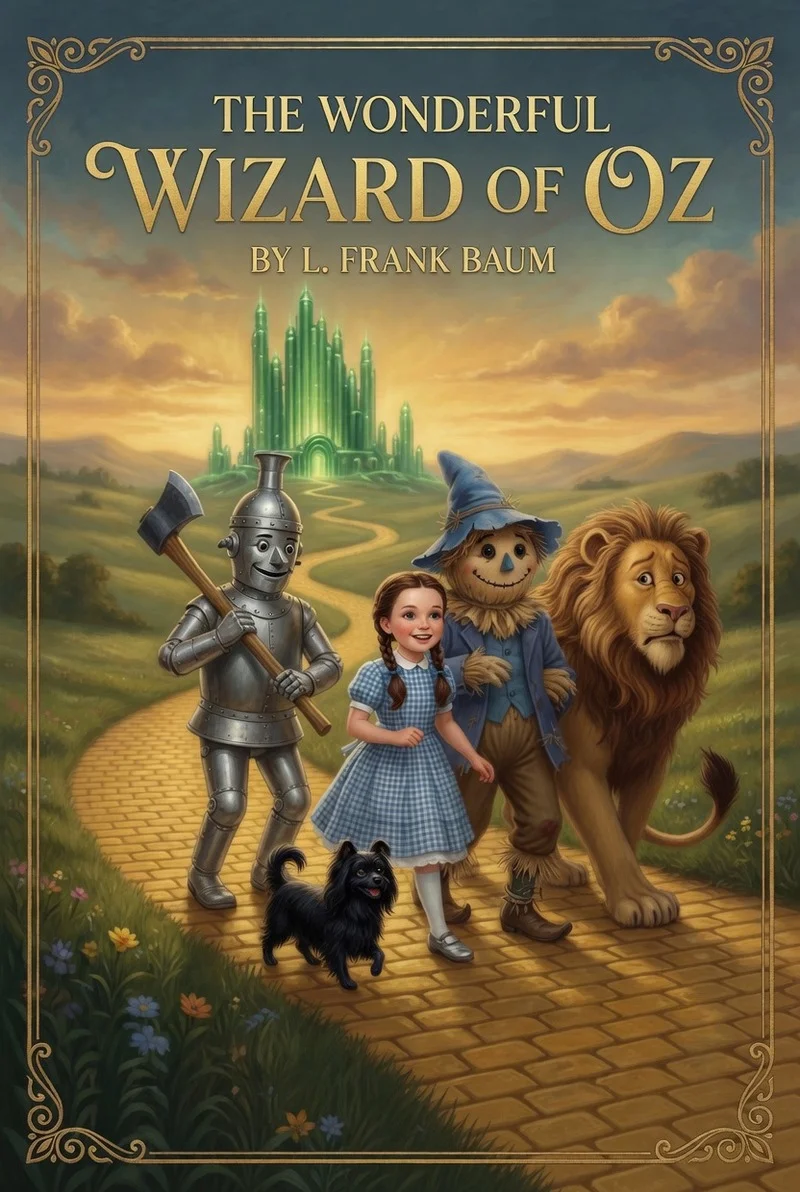
About This Book
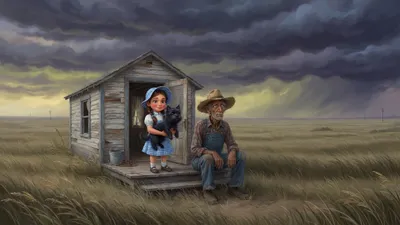
Dorothy is a young girl who lives on a small, gray Kansas farm with Aunt Em, Uncle Henry, and her little dog Toto. The prairie is quiet and hard, and even the house seems worn by wind and sun — until a great cyclone begins to form on the horizon.
Fourth graders get a clear, colorful adventure they can follow chapter by chapter, with characters who speak plainly about home, fear, kindness, and what they wish for. The sentences are sturdy rather than babyish, the scenes are easy to picture, and the book gives plenty to talk about without needing essay-level literary terms. It is also a chance to enjoy an American fairy tale that has its own look: silver shoes, a yellow brick road, and countries dressed in blue, yellow, green, and red.
Meet the Characters

More about Dorothy
Dorothy is a young girl who lives on a small, gray Kansas farm with her Aunt Em, her Uncle Henry, and her little dog. She is cheerful, honest, and quick to care for others. She loves her home dearly even though the prairie around it is plain and quiet.

More about Toto
Toto is Dorothy's small black dog and her constant companion on the farm. He is playful, lively, and never far from Dorothy's side. His cheerful barking is one of the few happy sounds on the quiet gray prairie.

More about Aunt Em
Aunt Em is the hardworking woman who raised Dorothy on a lonely Kansas farm. Years of prairie wind and endless chores have worn the color out of her, and she is not given to hugs or idle talk. She loves Dorothy in a quiet, worried way and keeps the little house running through drought and dust.

More about Uncle Henry
Uncle Henry works the grey Kansas prairie from dawn to dark and says very little. He is kind in a slow, silent way and treats Dorothy as one more creature on the farm who needs looking after. When the sky turns ugly he is the first to watch the horizon.

More about The Scarecrow
The Scarecrow is a cheerful figure made of straw who was set up in a Munchkin cornfield to frighten away crows. He is gentle, curious, and eager to see the world beyond his pole. He worries that he is not clever, yet he is thoughtful and kind.

More about The Tin Woodman
The Tin Woodman is a woodcutter whose whole body is made of tin, found standing still in the forest. He is gentle, caring, and easily moved by the troubles of others, and he takes great care never to harm any living thing. He longs to feel love and hopes the great Wizard can help him.

More about The Cowardly Lion
The Cowardly Lion is a huge lion who lives in the forests of Oz and roars to seem fierce, even though he is frightened inside. He is honest about his fears and has a warm, loyal heart underneath his booming voice. He hopes the great Wizard can give him real courage.

More about The Good Witch of the North
The Good Witch of the North is a small, kind old woman who rules the northern part of Oz and is a friend to the Munchkins. She is cheerful, plain-spoken, and fond of giving useful gifts rather than long speeches. She is the first person of Oz Dorothy meets after the cyclone.

More about Glinda
Glinda is the Good Witch of the South, known in Oz as a powerful witch who rules the Quadling Country. She is famous among her people for wisdom and kindness. Travelers hear her name as a ruler who is both beautiful and good.

More about The Wicked Witch of the West
The Wicked Witch of the West rules the yellow Winkie Country and is feared throughout Oz. She is greedy, suspicious, and determined to keep her power. People speak of her as a danger to anyone who travels west.

More about The Wizard of Oz
The Wizard of Oz is the great and terrible ruler of the Emerald City, known throughout the land for wonders no one has seen clearly. People speak of him with awe and hope that he can grant any wish. Dorothy and her friends travel the yellow brick road to ask him for help.

More about Boq
Boq is a well-to-do Munchkin who lives near the place where Dorothy first arrives in Oz. He is hospitable, talkative, and proud of his blue-clad country. He is among the first Munchkins to treat Dorothy as an honored guest.

More about The Queen of the Field Mice
The Queen of the Field Mice rules a vast nation of tiny grey mice who live in the meadows of Oz. She is brave, grateful, and very sure of her own dignity despite her size. She speaks with the manners of a real queen.

More about The King of the Winged Monkeys
The King of the Winged Monkeys leads a tribe of flying monkeys who live in the forests of Oz. He is proud, old, and bound by an ancient charm to serve whoever owns a certain golden cap. He speaks with dignity about that bargain.

More about The Guardian of the Gate
The Guardian of the Gate is the soldier who opens and locks the great gate of the Emerald City. He is careful, polite, and very particular about the rules of the city. No one enters Oz's capital without first meeting him and putting on the green spectacles.
Pre-Reading Discussion Questions
- What makes a place feel like home to you, even if it is not fancy?
- Have you ever watched a big storm build in the sky? What did you notice first?
- If you could visit a land that looked nothing like your own, what would you hope to see?
- Can a person feel scared and still do a brave thing? How?
- Who would you want beside you on a long trip, and what would each friend be good at?
- When someone promises they can help you, how do you decide whether to trust them?
Themes & Big Ideas to Track
- Notice how the book uses color and weather to show the difference between Kansas and Oz.
- Watch how characters talk about home, and what they think home is made of.
- Pay attention to what each traveler believes he or she is missing.
- Look at how friends take turns helping when the road gets hard.
- Notice the difference between being loud and being brave, or between looking wise and thinking well.
- Think about how strangers are welcomed, feared, or used in each new country.
Chapter-by-Chapter Study Guide
Chapter 1: The Cyclone
Before you read — think about:
- What details can make a place feel worn out and lonely even when nothing exciting is happening?
- Why might a pet matter so much to a child who lives far from other houses?
- How do grown-ups you know show worry without saying much?
- How does a writer make ordinary farm work feel important on the first pages of a book?
- What can you already tell about a family from the way a house is described?
Watch for these while reading:
- The color gray on the land, the house, and the people
- How Aunt Em and Uncle Henry look, work, and speak
- Toto, and why Dorothy loves him
- Sounds and signs of weather on the prairie
- How Dorothy behaves when she is frightened
Vocabulary to know:
prairie (noun) — a wide, mostly flat grassland with few trees; midst (noun) — the middle of something; lumber (noun) — wood cut into boards for building; garret (noun) — a small room or attic at the very top of a house; cellar (noun) — a room dug under the ground, used here as a storm shelter; cyclone (noun) — a powerful spinning windstorm strong enough to lift a house; whirlwinds (noun) — spinning columns of wind that twist as they move; plowed (verb) — turned over the soil to get it ready for planting; blistered (verb) — made the surface bubble and peel from heat; gaunt (adjective) — very thin and worn-looking; sober (adjective) — serious and without any brightness or joy; orphan (noun) — a child whose parents have died; startled (verb) — surprised suddenly, as if given a small shock; stern (adjective) — very serious and strict in look or manner; solemn (adjective) — very serious and quiet; anxiously (adverb) — in a worried, uneasy way; wail (noun) — a long, sad crying sound; ripples (noun) — small waves that move across a surface; shriek (noun) — a loud, sharp scream; footing (noun) — a steady, balanced position of the feet; whirled (verb) — spun around quickly; pressure (noun) — a steady pushing force; howled (verb) — made a long, loud crying sound; resolved (verb) — made up one's mind to do something; swaying (verb) — swinging slowly from side to side.
Chapter 2: The Council with the Munchkins
Before you read — think about:
- How would a world full of bright colors feel after a long time in a gray place?
- What questions would you ask first if you woke up in a country you had never heard of?
- Why do people in stories sometimes mix up 'powerful' with 'wicked'?
- What would make you trust a stranger who said they wanted to help you?
- Why might someone far from home want a clear road more than a feast?
Watch for these while reading:
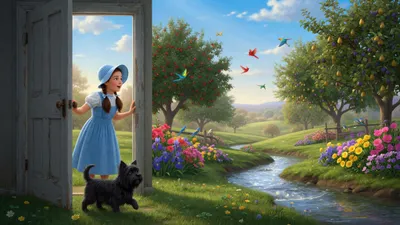
- The first things Dorothy sees when she opens the door
- The Munchkins' size, clothes, and hats
- The little old woman in white, and how she speaks to Dorothy
- The names of the lands around Oz and who lives in them
- Dorothy's wish to get home, and how the others answer her
Vocabulary to know:
dismally (adverb) — in a sad and gloomy way; amazement (noun) — great surprise and wonder; marvelous (adjective) — wonderful and almost hard to believe; greensward (noun) — a stretch of smooth green grass; stately (adjective) — tall, grand, and impressive; luscious (adjective) — rich, juicy, and delicious; gorgeous (adjective) — strikingly beautiful and brightly colored; plumage (noun) — a bird's feathers; murmuring (verb) — making a soft, low, flowing sound; pleats (noun) — folded strips of cloth sewn into a garment; glistened (verb) — shone with small, bright flashes of light; stiffly (adverb) — in a stiff, not-quite-easy way; noble (adjective) — worthy of honor, as if of high rank; sorceress (noun) — a woman believed to have magic power; bondage (noun) — the state of being forced to work as a slave; hesitation (noun) — a pause because you are unsure; evidently (adverb) — clearly; as can be seen; dismay (noun) — a sudden feeling of shock and worry; shod (adjective) — wearing shoes; Munchkins (noun) — the short people who live in the eastern land of Oz; messenger (noun) — a person sent to carry news; civilized (adjective) — living in a modern country with cities and schools, as the Witch uses the word; wizard (noun) — a man with great magic, here the ruler of Oz; magicians (noun) — people who work magic; Quadlings (noun) — the people who live in the southern country of Oz; Winkies (noun) — the people who live in the western country of Oz; desert (noun) — a huge dry waste of land that no one can cross; grieve (verb) — to feel deep sadness; charm (noun) — a magic power connected to an object; paved (verb) — covered with a hard surface for walking; pleaded (verb) — asked in a begging, earnest way; injure (verb) — to hurt or harm someone; straightway (adverb) — at once; without delay.
Chapter 3: How Dorothy Saved the Scarecrow
Before you read — think about:
- What would you take with you on a long walk through a country you did not know?
- Why might people treat a visitor as someone special before they really know her?
- How can a good meal and a kind host change a tired traveler's mood?
- What makes a stranger worth talking to instead of walking past?
- What would make you stop on a long walk to talk to someone you had never met?
Watch for these while reading:
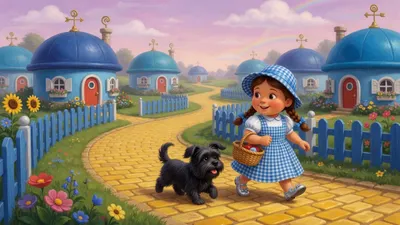
- Dorothy's clothes, shoes, and basket as she leaves the house
- The color blue along the Munchkin road
- Boq's gathering, and what the Munchkins believe about Dorothy
- The scarecrow in the cornfield, and how he is put together
- Toto's first feelings about the stuffed man
Vocabulary to know:
gingham (noun) — a cotton cloth with a checked pattern; frock (noun) — a girl's or woman's dress; sunbonnet (noun) — a bonnet with a wide brim to shade the face from the sun; soberly (adverb) — in a quiet, serious way; briskly (adverb) — quickly and with energy; tinkling (verb) — making light, ringing sounds; whisked (verb) — carried off suddenly and quickly; dainty (adjective) — delicately pretty and neat; abundance (noun) — a large amount; more than enough; dwellings (noun) — houses or places where people live; dome (noun) — a rounded roof shaped like half a ball; fiddlers (noun) — people who play the fiddle, a kind of violin; celebrate (verb) — to mark a happy event with a party; hearty (adjective) — large, satisfying, and cheerful; settee (noun) — a small sofa or long seat for more than one person; ordinary (adjective) — plain and not magical or special; soundly (adverb) — deeply and without waking; gravely (adverb) — in a serious, thoughtful way; bade (verb) — said, as in said goodbye; scarecrow (noun) — a figure stuffed with straw and set up to frighten birds from a field; perched (verb) — sat or was placed up high; stalks (noun) — the tall stems of plants, here the corn; represent (verb) — to stand for or look like something; earnestly (adverb) — in a serious, sincere way; queer (adjective) — strange or unusual; husky (adjective) — dry and rough-sounding; tedious (adjective) — long, dull, and tiring; obliged (adjective) — thankful and in someone's debt for a favor; puzzled (adjective) — confused and unsure what to think; brains (noun) — the mind used for thinking, which the Scarecrow believes he lacks; confidentially (adverb) — in a private, secret-sharing way; treads (verb) — steps or walks on; suspected (verb) — thought something might be true, without being sure.
Chapter 4: The Road Through the Forest
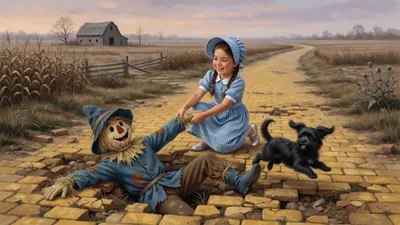
Before you read — think about:
- Why might someone love a plain home more than a prettier place?
- What is it like to hear how a friend first came to be?
- How does a road change as you leave farms and towns behind?
- Why might a person who cannot get tired still be a good companion at night?
- When have you had to keep walking even after it grew dark?
Watch for these while reading:
- How the yellow-brick road looks and feels as they walk
- What the Scarecrow can and cannot do at mealtime
- The Scarecrow's account of how he was made
- The change in the land as farms give way to trees
- Who stays awake, and who sleeps, when night comes
Vocabulary to know:
stumbled (verb) — tripped and almost fell; uneven (adjective) — not smooth or level; mishap (noun) — a small accident that is more clumsy than dangerous; dismal (adjective) — gloomy, dull, and cheerless; lonesome (adjective) — empty and lonely; dreary (adjective) — dull, gray, and without cheer; flesh (noun) — the living body of a person, not straw or tin; fortunate (adjective) — lucky; reproachfully (adverb) — in a way that shows you feel blamed or let down; glimpse (noun) — a quick first look; curiosity (noun) — a strong wish to look and learn; fastened (verb) — attached firmly; deserted (verb) — left alone and abandoned; clumsy (adjective) — awkward and not well made; comforted (verb) — cheered up; made to feel less sad; stake (noun) — a tall stick set in the ground; fool (noun) — a person thought to have no sense; untilled (adjective) — not plowed or farmed; required (verb) — needed; cottage (noun) — a small simple house; patiently (adverb) — in a calm way, without complaining about the wait.
Chapter 5: The Rescue of the Tin Woodman
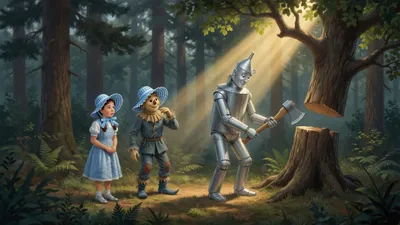
Before you read — think about:
- What makes a night in the woods feel different once morning comes?
- Why is it kind to stop and listen when you hear a sad sound?
- How do you judge whether a new companion will be a help on a journey?
- Why might two friends disagree about what is most worth wishing for?
- What worries a traveler more: the road ahead, or an empty basket?
Watch for these while reading:
- The sound that startles Dorothy near the spring
- The tin man beside the tree, and how he looks and speaks
- The woodman's long story of his axe and the East Witch
- What each traveler says he will ask of Oz
- How much bread is left in Dorothy's basket
Vocabulary to know:
inconvenient (adjective) — causing extra trouble or bother; scarcely (adverb) — hardly; almost not at all; groan (noun) — a low sound of pain or sadness; timidly (adverb) — in a shy, slightly frightened way; uplifted (adjective) — held up high; motionless (adjective) — not moving at all; joints (noun) — the places where parts of a body or machine bend; rusted (verb) — became stiff and stuck because of rust; oil-can (noun) — a can that holds oil for loosening rusty joints; satisfaction (noun) — a pleased, contented feeling; release (noun) — being set free from being stuck; comrade (noun) — a companion who travels and works with you; shouldered (verb) — set something on the shoulder to carry it; heartily (adverb) — in a warm, eager way; passage (noun) — an opening you can walk through; cheerfully (adverb) — in a bright, good-humored way; heart (noun) — the inner feeling that lets a person love, which the Tin Woodman believes he has lost; wood-chopper (noun) — a person whose work is cutting down trees; thereupon (adverb) — right after that; as a result; enchanted (verb) — put a magic spell on; misfortune (noun) — bad luck; a painful accident; tinsmith (noun) — a craftsperson who makes things out of tin; angered (verb) — made angry; daunted (verb) — made too afraid to go on; replaced (verb) — put a new part in place of an old one; maiden (noun) — a young woman; splitting (verb) — cutting or breaking into two parts; alas (interjection) — a sad word meaning 'unfortunately'; rainstorm (noun) — a heavy fall of rain; undergo (verb) — to live through something hard.
Chapter 6: The Cowardly Lion
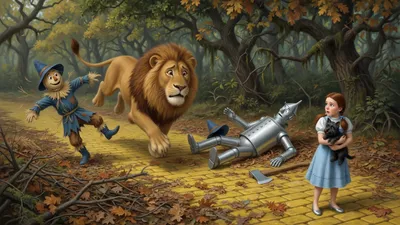
Before you read — think about:
- What is the difference between looking fierce and feeling brave?
- How can a loud voice hide a worried heart?
- When have you changed your mind about someone after hearing their side of the story?
- What does it mean to be a good companion on a scary road?
- Why might a person who has just joined a group still feel unhappy?
Watch for these while reading:
- The growl among the trees, and how Toto stays close
- How Dorothy speaks when Toto is in danger
- What the Lion says about roaring and running
- What each traveler hopes Oz will give
- How the Tin Woodman treats even the smallest creatures
Vocabulary to know:
bounded (verb) — jumped forward with a big leap; spinning (verb) — turning over and over; impression (noun) — a mark or effect left by a blow; heedless (adjective) — not stopping to think about danger; retorted (verb) — answered back quickly and sharply; coward (noun) — someone who feels too afraid to be brave; astonished (verb) — greatly surprised; blunted (verb) — made less sharp; shiver (noun) — a sudden trembling feeling; remarkably (adverb) — unusually; more than you would expect; mystery (noun) — something that cannot be explained; sorrow (noun) — deep sadness; courage (noun) — bravery; the feeling that lets you face danger; unbearable (adjective) — too hard to live with; strides (noun) — long steps; approve (verb) — to like or accept someone; mar (verb) — to spoil or damage; regret (noun) — a sad wishing that you had not done something; hinges (noun) — the joints that let a lid or jaw swing open; relieve (verb) — to free someone from pain or trouble; seized (verb) — grabbed quickly; thereafter (adverb) — from that time on; toiling (verb) — working or moving with great effort; cruel (adjective) — willing to hurt others.
Chapter 7: The Journey to the Great Oz
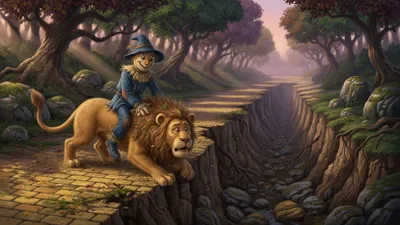
Before you read — think about:
- What makes a long journey through the woods feel longer?
- How do friends keep one another going when the path is hard?
- Why is it useful to have different strengths in a group?
- What would you miss first if you ran out of food on the road?
- How do you stay hopeful when you cannot yet see the place you are walking toward?
Watch for these while reading:
- How the Scarecrow keeps away from the fire
- The ditches that cut across the yellow-brick road
- The Lion's jumps, and who rides on his back
- Strange sounds deeper in the forest, and the Lion's name for them
- The river at the edge of the trees, and the start of a raft
Vocabulary to know:
covering (noun) — something that shelters you from above; splendid (adjective) — excellent and impressive; peculiar (adjective) — strange or unusual; awkward (adjective) — clumsy and not smooth; padded (adjective) — stuffed and softly filled out; enabled (verb) — made it possible; snug (adjective) — warm, tight, and comfortable; eventful (adjective) — full of important happenings; jagged (adjective) — having sharp, uneven points; despairingly (adverb) — in a way that shows you have almost given up hope; faintest (adjective) — the smallest or weakest possible; shaggy (adjective) — covered with long, rough hair; gulf (noun) — a deep, wide gap in the ground; dented (verb) — bent inward by a hard blow; crouched (verb) — bent down low, ready to spring; panted (verb) — breathed hard and fast; gloomy (adjective) — dark and cheerless; discomfort (noun) — an uneasy, unpleasant feeling; Kalidahs (noun) — fierce beasts of Oz with bodies like bears and heads like tigers; monstrous (adjective) — huge and frightening, like a monster; dreadful (adjective) — terrible and frightening; first-rate (adjective) — excellent; of the best kind; tremble (verb) — to shake from fear; fierce (adjective) — wild, angry, and ready to attack; snarling (adjective) — growling with bared teeth; brutes (noun) — rough, fierce animals; industrious (adjective) — hard-working and steady; untiring (adjective) — able to keep working without getting tired; raft (noun) — a flat floating platform made of logs.
Chapter 8: The Deadly Poppy Field

Before you read — think about:
- How do travelers decide when to rest and when to keep moving?
- How do friends share the work when a crossing starts to go wrong?
- When has a stranger offered help, and what made you trust them?
- How do you keep your spirits up after you have been swept off your path?
- What does it mean to be a good comrade when someone else is in trouble?
Watch for these while reading:
- The raft on the river, and the pull of the water
- The long poles used to push the raft
- The Stork at the water's edge
- The change from mixed flowers to scarlet poppies
- How the Scarecrow and the Tin Woodman try to help the others
Vocabulary to know:
discouragements (noun) — troubles that make you want to give up; beckon (verb) — to call someone forward as if waving them on; current (noun) — the strong flow of a river; downstream (adverb) — in the direction the river is flowing; slaves (noun) — people forced to work for someone against their will; clinging (verb) — holding on tightly; fortunately (adverb) — luckily; apron (noun) — a cloth worn over a dress to keep it clean; make-believe (verb) — to pretend; wistfully (adverb) — in a sad, longing way; eagerly (adverb) — in a keen, hopeful way; grabbed (verb) — seized suddenly with claws or hands; gay (adjective) — brightly happy and cheerful; kindness (noun) — a kind act done for someone else; carpeted (verb) — covered completely, as a carpet covers a floor; clusters (noun) — groups of things growing close together; scarlet (adjective) — bright red; poppies (noun) — bright flowers whose scent, in this story, can put living creatures to sleep; dazzled (verb) — almost blinded by brightness; spicy (adjective) — having a strong, sharp smell; scent (noun) — a smell, especially of flowers; frail (adjective) — delicate and easily hurt; meadow (noun) — a field of grass and flowers; odor (noun) — a strong smell; deadly (adjective) — able to kill if you stay too long; aroused (verb) — woke or stirred someone into action; mistress (noun) — the girl or woman a pet belongs to; poison (noun) — something harmful to breathe or swallow; breeze (noun) — a light, fresh wind.
Chapter 9: The Queen of the Field Mice
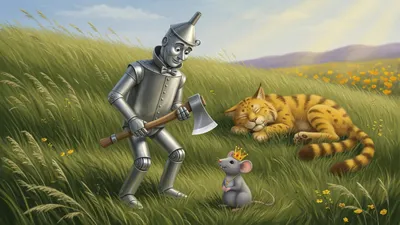
Before you read — think about:
- Why might someone help a stranger even if they expect nothing back?
- How do you feel when a person talks as if you are too small to matter?
- What makes a good leader of a large group?
- How do you show respect to someone much smaller than you?
- Why do some stories let animals talk and give orders like people?
Watch for these while reading:
- The Tin Woodman's habit of helping anyone who seems in trouble
- How the gray mouse answers when she is treated as unimportant
- How Toto behaves when he first sees the mouse
- The Scarecrow's effort to think of a useful idea
- The way a very small ruler speaks to her own people
Vocabulary to know:
Wildcat (noun) — a fierce wild animal of the cat family; glowed (verb) — shone with a bright, fiery light; indignantly (adverb) — in an angry way because of being treated as unimportant; Majesty (noun) — a polite title used when speaking to a queen or king; deed (noun) — an action, especially a brave or kind one; shrill (adjective) — high, sharp, and piercing in sound; chorus (noun) — many voices speaking or shouting the same words at once; scampered (verb) — ran quickly with light, hurried steps; clump (noun) — a thick bunch of plants growing close together; repay (verb) — to give something back in return for a kindness; attended (verb) — stayed near someone in order to serve or help; truck (noun) — a low wooden cart on wheels used to carry a heavy load; limbs (noun) — the large branches of a tree; harnessed (verb) — fastened with straps or strings so as to pull a load; dignified (adjective) — calm, serious, and worthy of respect; introduce (verb) — to present one person to another by name; Permit (verb) — to allow; curtsy (noun) — a polite bow made by bending the knees; hurriedly (adverb) — in a rushed, hurried way; assistance (noun) — help given to someone in need; lest (conjunction) — for fear that; so that something will not happen; unharnessed (verb) — unfastened from the straps or strings used for pulling; companion (noun) — a friend who travels or stays with you; hereafter (adverb) — from this time on; poisonous (adjective) — able to harm or make someone fall sick or sleep.
Chapter 10: The Guardian of the Gate
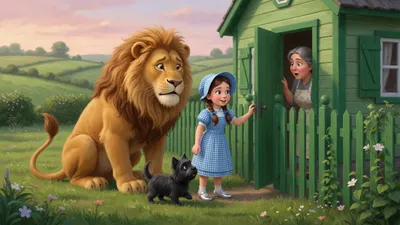
Before you read — think about:
- What have you already heard about the Great Oz, and what do you picture?
- Why might country people hesitate to welcome travelers they have never met?
- What does it feel like to leave a dark forest and walk on a smooth road again?
- How do you decide whether a large animal traveling with someone is safe?
- What makes a city feel different from the countryside around it?
Watch for these while reading:
- The color of fences, houses, and clothes along the road
- How ordinary people react when they see the Lion
- What is served at supper, and who eats nothing at all
- The Guardian of the Gates and the way he does his job
- The wall and the gate at the end of the yellow brick road
Vocabulary to know:
fragrance (noun) — a strong smell, often from flowers; generously (adverb) — in a kind, giving way; rejoiced (verb) — felt and showed great joy; peaked (adjective) — coming to a point at the top; boldly (adverb) — in a brave, confident way; tame (adjective) — gentle and not wild; safe to be near; peep (noun) — a quick, small look; presence (noun) — the state of being in the same place as someone important; Throne (noun) — the special chair of a ruler; fairy (noun) — a magical being, often pictured as small and lovely; brownie (noun) — a small, helpful magical creature from old stories; collection (noun) — a group of things of the same kind gathered together; sorrowfully (adverb) — in a sad, grieving way; porridge (noun) — a hot breakfast food made by cooking grain in water or milk; scrambled (adjective) — eggs stirred while cooking until they are fluffy; guarded (verb) — watched over a place to keep it safe; disturbed (verb) — bothered or interrupted while resting; surrounded (verb) — had something all the way around it; studded (verb) — decorated with many small jewels or raised bits set into the surface; glittered (verb) — sparkled with many tiny flashes of light; brilliancy (noun) — a very bright, dazzling shine; silvery (adjective) — clear and bright, like the sound or color of silver; arched (adjective) — curved overhead like a bow; tint (noun) — a light shade of a color; perplexity (noun) — a puzzled, mixed-up state of mind; idle (adjective) — done for no real purpose; not serious; errand (noun) — a trip taken to do a job or deliver a message; Guardian (noun) — a person whose job is to watch and protect a gate or place; spectacles (noun) — eyeglasses worn over the eyes; glory (noun) — great beauty and brightness that can overwhelm the eyes; portal (noun) — a large, grand doorway or gate; greenish (adjective) — somewhat green in color; reflections (noun) — careful thoughts; favorite (adjective) — liked most of all; farmhouse (noun) — the main house on a farm; thoughtfully (adverb) — in a careful, thinking way; demand (verb) — to ask for something firmly, as if it must be given.
Chapter 11: The Wonderful City of Oz
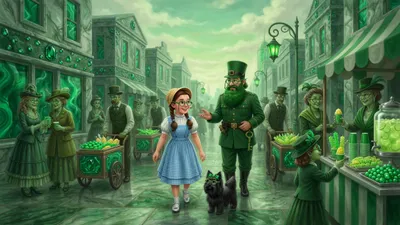
Before you read — think about:
- What would you miss most about home if you were far away for a long time?
- Why do people often put on their best clothes to meet someone important?
- How can waiting in one place feel harder than walking all day?
- What does it mean to sit with a friend who is disappointed?
- How do friends decide whether to stay together when a plan gets harder?
Watch for these while reading:
- The streets, shops, and palace rooms, and the color that fills them
- The soldier at the palace door and the girl who leads guests to their rooms
- How the Scarecrow, the Tin Woodman, and the Lion spend a night indoors
- The polite words people use when they speak in the Throne Room
- How the four friends share news when they are together again
Vocabulary to know:
marble (noun) — a hard, smooth stone used for fine buildings and floors; pavement (noun) — a hard walking surface made of fitted stone blocks; panes (noun) — the sheets of glass in a window; assorted (adjective) — of mixed kinds put together; lemonade (noun) — a sweet drink made from lemons; contented (adjective) — quietly happy and satisfied; prosperous (adjective) — doing well and having plenty; carts (noun) — small wagons pushed by hand to carry goods; soldier (noun) — a person who serves as a guard or fighter; uniform (noun) — matching clothes worn for a job, such as a guard's outfit; screen (noun) — a covered panel that hides the person sitting behind it; grant (verb) — to give or allow what is asked; audience (noun) — a private meeting with a ruler; desire (verb) — to want something very much; admit (verb) — to let someone come in; whistle (noun) — a small pipe blown to make a sharp call; silk (noun) — a soft, shiny cloth; velvet (noun) — a thick, fuzzy cloth that feels smooth; counterpane (noun) — a bedspread laid over the top of a bed; fountain (noun) — a spout that shoots water or perfume into the air; perfume (noun) — a sweet-smelling liquid; carved (adjective) — cut into a decorative shape; basin (noun) — a wide, shallow bowl that holds water; wardrobe (noun) — a tall closet for hanging clothes; satin (noun) — a glossy, smooth cloth; lodged (verb) — given a room to stay in; politeness (noun) — good manners shown to a guest; stupidly (adverb) — in a blank, unmoving way, without knowing what else to do; habit (noun) — something a person does from old custom, without thinking; purred (verb) — made a soft rumbling sound of comfort, like a cat; brocaded (adjective) — woven with a raised, fancy pattern; costumes (noun) — fine outfits worn at court; signal (noun) — a sound or sign that tells you it is time to act; enormous (adjective) — extremely large; Meek (adjective) — gentle and not proud or fierce; tremendously (adverb) — to a very great degree; gauze (noun) — a thin, light, see-through cloth; dominions (noun) — the lands a ruler controls; bestow (verb) — to give as a gift or honor; rhinoceros (noun) — a huge thick-skinned animal with a horn on its nose; woolly (adjective) — covered with thick, fluffy hair; monster (noun) — a huge, frightening creature; gruffly (adverb) — in a rough, low, unfriendly voice; compel (verb) — to force someone to do what you want; bidding (noun) — what someone orders you to do; intense (adjective) — very strong, as of heat; singed (verb) — burned slightly on the ends or edges; grindstone (noun) — a spinning stone wheel used to sharpen a blade; pop-corn (noun) — corn kernels heated until they puff open; fetch (verb) — to go and bring someone; sparkle (verb) — to shine with many little flashes.
Chapter 12: The Search for the Wicked Witch
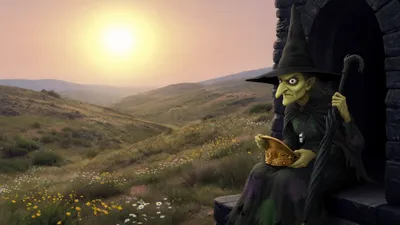
Before you read — think about:
- How do you keep going on a trip when there is no path to follow?
- Why might workers obey a ruler they are afraid of?
- What is the difference between being brave and being unkind?
- What does it feel like to work hard in a place you cannot leave?
- How can a friend split a hard job so each person does what they do best?
Watch for these while reading:
- How the western country looks after the Emerald City is left behind
- The Wicked Witch of the West, and the details of her appearance
- The way each friend steps forward when trouble comes
- The western castle, and how Baum describes its rooms and yard
- The silver shoes, and how carefully Dorothy treats them
Vocabulary to know:
daisies (noun) — small flowers with white petals and yellow centers; buttercups (noun) — small bright-yellow wildflowers; telescope (noun) — a tube that makes far-off things look close; wolves (noun) — wild animals related to dogs, with sharp teeth; weapon (noun) — a tool used to fight, such as an axe; rage (noun) — a burst of fierce anger; Forthwith (adverb) — at once; without waiting; buzzing (noun) — a low humming sound made by many flying insects; swarm (noun) — a large moving crowd of insects; sting (verb) — to prick with a sharp point that hurts; scatter (verb) — to spread bits of something loosely over a place; gnashed (verb) — ground the teeth together in anger; spears (noun) — long poles with sharp points used as weapons; marched (verb) — walked together in a steady, ordered way; strap (noun) — a strip of leather used to hit or to fasten; cunning (adjective) — clever in a sneaky, tricky way; diamonds (noun) — hard, clear jewels that sparkle; rubies (noun) — deep-red jewels; exhausted (adjective) — used up completely; rumbling (adjective) — making a deep rolling sound; chattering (noun) — quick, noisy talking; immense (adjective) — huge; very large; battered (adjective) — beaten out of shape by hard blows; bundle (noun) — things tied together in a pack; coils (noun) — loops of rope wound around and around; struggle (verb) — to fight and twist in order to get free; grinning (verb) — smiling widely, often in a scary way; motioning (verb) — giving a sign with the hand or body; harshly (adverb) — in a sharp, unkind voice; severely (adverb) — in a strict, stern way; courtyard (noun) — an open space enclosed by the walls of a castle; chariot (noun) — a cart pulled by an animal, used for riding; invisible (adjective) — not able to be seen; snatched (verb) — grabbed quickly; skinny (adjective) — very thin; shrink (verb) — to grow smaller; shapeless (adjective) — having no clear form; umbrella (noun) — a folding canopy on a stick, here used as a walking stick and a threat; longing (noun) — a strong wish to have something; tempted (verb) — felt pulled toward doing something; imprisoned (adjective) — locked up and not free to leave; arts (noun) — skills of magic; dread (noun) — deep fear; mass (noun) — a shapeless lump of melted stuff; bucket (noun) — a pail for carrying water; melted (verb) — turned from a solid shape into a puddle; dashed (verb) — threw liquid suddenly and hard; trick (noun) — a sneaky plan meant to fool someone; doorstep (noun) — the stone or step just outside a door; threatened (verb) — said or showed that harm would come if someone did not obey.
Chapter 13: The Rescue
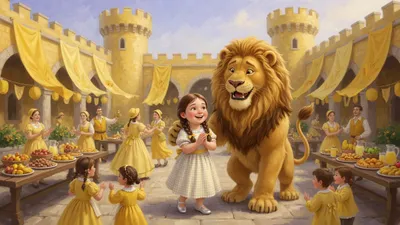
Before you read — think about:
- How do people celebrate when a hard time is finally over?
- Why might someone who was treated badly still be willing to help a new friend?
- What makes a goodbye gift feel well chosen?
- Why is it hard to rest in a comfortable place when you still miss home?
- How do you choose between staying where you are liked and keeping a promise somewhere else?
Watch for these while reading:
- How the yellow Winkies behave now that they are free
- The condition of the Tin Woodman and the Scarecrow when their friends reach them
- Who does the slow, careful work of putting things right
- The gifts offered before the travelers leave
- What Dorothy chooses to take from the castle
Vocabulary to know:
rejoicing (noun) — great happiness shown with cheers and celebration; cruelty (noun) — mean, hurtful treatment; holiday (noun) — a special day of rest and celebration; feasting (noun) — eating a rich, happy meal together; plight (noun) — a sad, difficult situation; solder (verb) — to join pieces of metal by melting a filler metal into the crack; hammering (verb) — pounding with a hammer to shape metal; pounding (verb) — hitting hard again and again; patches (noun) — pieces used to cover holes or broken spots; vain (adjective) — too proud of looks; easily upset by a flaw; goldsmith (noun) — a craftsperson who makes things from gold; burnished (adjective) — polished until it shines; behold (verb) — look; see what has happened; reunited (verb) — brought back together after being apart; determined (adjective) — firmly decided; not willing to change course; collar (noun) — a band worn around the neck; bracelet (noun) — a band of jewelry worn around the wrist; inlaid (adjective) — decorated by setting one material into the surface of another; precious (adjective) — very valuable, as jewels are; shedding (verb) — letting tears fall; straighten (verb) — to bend something back into its proper shape; cheers (noun) — shouts of good luck and praise.
Chapter 14: The Winged Monkeys
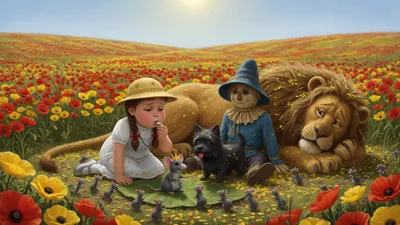
Before you read — think about:
- What do you do when you are sure you started the right way, but nothing looks familiar?
- Why is it useful to remember a friend's offer of help later on?
- How do you feel about following a rule you did not make yourself?
- What makes a leader worth listening to?
- How do you decide whom to trust when you are lost?
Watch for these while reading:
- How the travelers try to choose a direction with no road to follow
- The little whistle Dorothy has carried around her neck
- The Golden Cap, including anything written inside it
- The King of the Winged Monkeys and the manner of his speech
- How the travelers talk while they wait for help
Vocabulary to know:
pathway (noun) — a narrow track to walk on; grumble (verb) — to complain in a low, unhappy voice; whimper (noun) — a weak, whining sound of worry; tramping (verb) — walking heavily for a long way; pattering (noun) — the light, quick sound of many small feet; mischief (noun) — playful trouble that can still cause harm; plague (verb) — to bother and tease again and again; lining (noun) — the inner layer of a cap or garment; flapping (noun) — the beating sound of wings; careless (adjective) — not thinking about the trouble you may cause; handsome (adjective) — good-looking in a grand way; manly (adjective) — having the strength and dignity of a grown man; manhood (noun) — the time of being a grown man; hastened (verb) — hurried to get something done; wedding (noun) — the ceremony in which two people marry; grandfather (noun) — the father of someone's parent; drown (verb) — to die by sinking under water; condition (noun) — a rule that must be kept for an agreement to stand; kingdom (noun) — the land a princess or king rules; whosoever (pronoun) — anyone at all who; bride (noun) — a woman on her wedding day, or just after; enslave (verb) — to force people into slavery; rapid (adjective) — very fast; flight (noun) — a trip through the air; spared (verb) — let someone go without the full punishment; ruined (verb) — spoiled so badly it cannot be used as before; command (noun) — an order that must be obeyed; costume (noun) — a special outfit of fine clothes.
Chapter 15: The Discovery of Oz, the Terrible
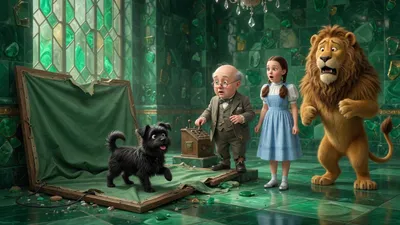
Before you read — think about:
- How do you feel when you have finished a hard job and then have to wait for what you were promised?
- What helps you stay patient when a meeting keeps being put off?
- What is the difference between being famous and being truly able to help?
- How should you treat someone who has disappointed you?
- What would you say to a friend who is scared of getting into trouble?
Watch for these while reading:
- How the people of the Emerald City greet the travelers this time
- How many days pass before Oz will see them, and how the friends feel about that wait
- The Throne Room when all four go in together
- What each friend expected to see, based on an earlier visit
- How Oz speaks, and what the travelers notice about the Throne Room
Vocabulary to know:
humbug (noun) — a fake; someone who pretends to have powers he does not have; tiresome (adjective) — boring and wearing after a long wait; vexed (adjective) — annoyed and impatient; hardships (noun) — hard, painful troubles; slavery (noun) — the state of being forced to work without freedom; sleepless (adjective) — without sleep; Promptly (adverb) — right on time; without delay; stillness (noun) — a complete quiet with no movement; mortals (noun) — ordinary human beings; converse (verb) — to talk with someone; alarm (noun) — sudden fear; bald (adjective) — having little or no hair on the head; overheard (verb) — heard by someone who was not meant to hear; bewilderment (noun) — a confused, puzzled feeling; chamber (noun) — a small room; thicknesses (noun) — layers stacked one on another; ventriloquist (noun) — a performer who can throw his voice so it seems to come from somewhere else; deceive (verb) — to make someone believe what is not true; mask (noun) — a covering worn over the face to hide who you are; slats (noun) — thin strips used to hold a shape out from the inside; sewn (verb) — joined with needle and thread; cotton (noun) — a soft fluffy material that can burn when oiled; subjects (noun) — the people who live under a ruler; imitate (verb) — to copy a sound or action; balloonist (noun) — a person who goes up in a balloon, often to draw a circus crowd; circus (noun) — a traveling show of acts and animals; gradually (adverb) — little by little; slowly; abounding (verb) — having a great plenty of something; metals (noun) — hard shiny materials such as gold and silver; confidence (noun) — trust in yourself; Experience (noun) — what you learn by living through things; knowledge (noun) — what a person knows and understands; opinion (noun) — what someone thinks; a personal view; guests (noun) — people welcomed to stay and be cared for; forgive (verb) — to stop blaming someone for a wrong; gracious (adjective) — used in a cry of surprise, as in 'Good gracious!'; receive (verb) — to welcome someone and see them; wire (noun) — a thin metal line used to hang something; thread (noun) — a thin string pulled to make something move; skins (noun) — animal hides sewn together to look like a beast.
Chapter 16: The Magic Art of the Great Humbug
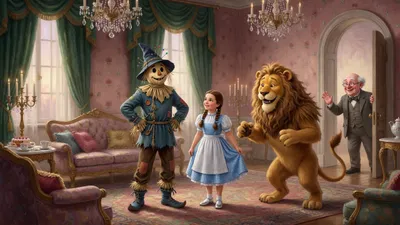
Before you read — think about:
- How do you show a friend you are happy for their good news?
- What is the difference between feeling wise and being wise?
- Why do some people want a keepsake or a token after a big change?
- How should you treat a person who is trying his best but is not what he claimed to be?
- What makes a visit to a helper feel official or important?
Watch for these while reading:
- How the Scarecrow talks about himself before he goes to Oz
- The Tin Woodman's questions about the gift he asked for
- How the Lion behaves in the Throne Room this time compared with his last visit
- How each friend talks about the gift he asked for
- Oz's manner while he works in the Throne Room
Vocabulary to know:
Congratulate (verb) — to tell someone you are glad for their good luck; uneasily (adverb) — in a slightly nervous, not-quite-calm way; unfastened (verb) — opened the fastenings and took apart; bran (noun) — the coarse outer part of grain, used here as fake 'brains'; needles (noun) — thin, sharp bits of metal, mixed here with pins; thoroughly (adverb) — completely; all the way through; mixture (noun) — two or more things stirred together; fulfillment (noun) — the coming true of a long-held wish; bulged (verb) — stuck out in a rounded swell; shears (noun) — large, strong scissors; sawdust (noun) — fine powder left when wood is cut; announced (verb) — said in a clear, official way; contents (noun) — what is inside a bottle or dish; swallowed (verb) — taken down the throat; advise (verb) — to tell someone what they ought to do; imagination (noun) — the power to picture things that are not really there; bran-new (adjective) — the Wizard's joke for 'brand-new,' because the brains are made of bran; proof (noun) — a sign that something is true; sharp (adjective) — clever; also literally pointed, as pins and needles are.
Chapter 17: How the Balloon Was Launched
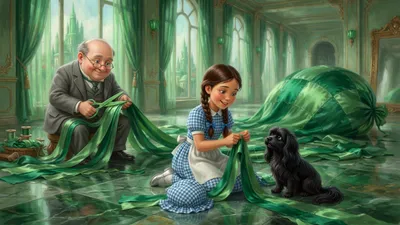
Before you read — think about:
- Why might waiting for news feel harder than doing a job yourself?
- How do you decide whether to trust a plan you have not seen yet?
- Why do people sometimes keep a project secret until it is ready to show?
- How do you say goodbye when you are not sure you will see someone again?
- What is the difference between being busy and being truly content?
Watch for these while reading:
- How Dorothy's mood compares with her three friends' moods after Oz's gifts
- The materials Oz chooses and the shades of green he likes
- The story Oz tells the people of the Emerald City about his trip
- What Oz says to the Scarecrow in front of the crowd
- How Toto behaves in the palace square among the crowd
Vocabulary to know:
rattling (verb) — making a series of quick knocking sounds; army (noun) — a large group of soldiers; notion (noun) — an idea or bit of knowledge; coated (verb) — covered with a thin layer of something; glue (noun) — a sticky liquid used to seal or hold things together; airtight (adjective) — sealed so that no air can get in or out; float (verb) — to stay up in the air instead of falling; strips (noun) — long, narrow pieces of cloth; fancy (noun) — a liking or special wish for something; swelled (verb) — grew bigger and puffed out; tugging (verb) — pulling hard; weight (noun) — how heavy something is; spread (verb) — traveled quickly from person to person; throughout (preposition) — in every part of; all through; gazed (verb) — looked steadily for a long time; chopped (verb) — cut into pieces with an axe; upward (adverb) — toward the sky; lovingly (adverb) — with warm affection; inquired (verb) — asked a question; screamed (verb) — cried out in a loud, high voice.
Chapter 18: Away to the South
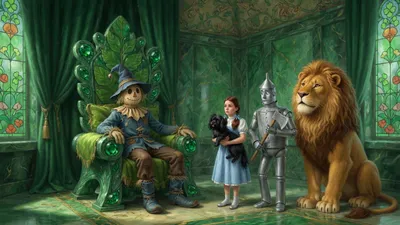
Before you read — think about:
- What does it mean to be content with what you already have?
- Why might a person still long for home even in a beautiful place?
- How do friends show they care when someone is disappointed?
- When is it wise to ask an older or more experienced person for advice?
- What makes a helper truly helpful, not just nearby?
Watch for these while reading:
- How each friend talks about the gift Oz already gave him
- Dorothy's reasons for not wanting to stay in the Emerald City
- The Golden Cap and the rules the Monkey King repeats
- The soldier with the green whiskers, and how he speaks about the South
- The reason each companion gives for traveling with Dorothy
Vocabulary to know:
passing (noun) — the going away or ending of something hoped for; ungrateful (adjective) — not thankful for a kindness; mourn (verb) — to feel and show deep sadness for a loss; towel (noun) — a cloth used for drying; oiled (verb) — put oil on so the parts will not stick; ruler (noun) — the person who is in charge of a city or country; stuffed (adjective) — filled with stuffing, such as straw; respectfully (adverb) — in a polite way that shows honor; unlucky (adjective) — having bad luck; lot (noun) — a person's situation or share in life; modestly (adverb) — in a humble way, without bragging; bowing (verb) — bending the body forward as a sign of respect; disappointment (noun) — the sad feeling when something hoped for does not happen; wasted (verb) — used up with no good result; purpose (noun) — a useful result or aim; horribly (adverb) — in a way that looks alarming; burst (verb) — to break open suddenly; advice (noun) — an idea about what someone should do; summoned (verb) — called to come; race (noun) — a group of beings of the same kind; protect (verb) — to keep someone safe from harm; service (noun) — helpful work done for someone; due (adjective) — owed to someone; caused by.
Chapter 19: Attacked by the Fighting Trees
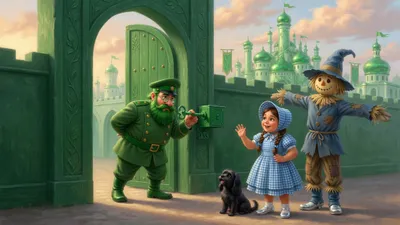
Before you read — think about:
- How do you say thank you when you leave a place that treated you well?
- Why might open country feel different after days spent in a busy city?
- What helps a group stay on course on a long walk?
- How can friends take turns going first when a path looks uncertain?
- Why do stories sometimes give a forest a personality of its own?
Watch for these while reading:
- The farewell at the city gate, and how the Guardian speaks to the Scarecrow
- The green spectacles, and what the Guardian does with them
- The Lion's mood once he is in open country again
- How Baum describes the trees at the edge of the wood
- The Tin Woodman's axe, and when he chooses to use it
Vocabulary to know:
farewell (noun) — a goodbye; good-natured (adjective) — friendly and kind; spirits (noun) — a person's mood or feelings; chatted (verb) — talked in a friendly, easy way; courageous (adjective) — brave; towers (noun) — tall, narrow parts of a city or palace; steeples (noun) — tall pointed roofs on towers; spires (noun) — sharp, pointed tops of towers; dose (noun) — an amount of medicine taken at one time; extend (verb) — to stretch out over a long distance; wide-spreading (adjective) — reaching far out in all directions; twined (verb) — wound and wrapped around; flung (verb) — threw hard and suddenly; headlong (adverb) — head-first and out of control; dizzy (adjective) — feeling as if things are spinning; tossed (verb) — threw roughly through the air; roughly (adverb) — in a harsh, not gentle way; injury (noun) — harm or a hurt to the body; policemen (noun) — guards whose job is to keep strangers out; china (noun) — a hard, white, breakable material used for dishes; surface (noun) — the outer face of something.
Chapter 20: The Dainty China Country
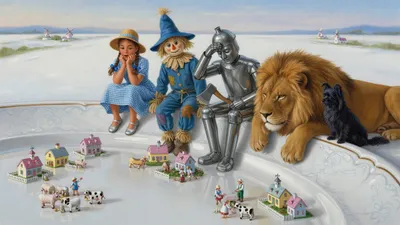
Before you read — think about:
- How should visitors behave in a country that is not their own?
- What can a person learn by listening instead of grabbing?
- Why might someone refuse a compliment that sounds like a gift?
- What does it mean to treat someone else's home with care?
- How do size and scale change the way a place feels to a traveler?
Watch for these while reading:
- The size of the houses, animals, and people compared with Dorothy
- The china milkmaid, the china cow, and the china clown
- How the china Princess speaks about her country
- How each traveler tries to move without doing harm
- The conversation between Dorothy and the china Princess
Vocabulary to know:
flattened (adjective) — pressed down flat; unwise (adjective) — not a smart choice; platter (noun) — a large, flat serving dish; scattered (verb) — spread out here and there; barns (noun) — farm buildings for animals and crops; milkmaid (noun) — a girl or woman who milks cows; shepherdesses (noun) — women who watch over sheep; bodices (noun) — the tight upper parts of dresses; shepherds (noun) — people who watch over sheep; breeches (noun) — short trousers that reach to the knee; ermine (noun) — a soft white fur used on royal robes; doublets (noun) — close-fitting jackets once worn by men; clowns (noun) — funny performers who make people laugh; ruffled (adjective) — trimmed with gathered, wavy folds of cloth; clatter (noun) — a loud rattling, banging noise; nick (noun) — a small chip or cut; mender (noun) — a person who fixes broken things; sulkily (adverb) — in a quietly grumpy, hurt way; prim (adjective) — very stiff, proper, and formal; saucily (adverb) — in a cheeky, teasing way; considerably (adverb) — by a large amount; mantel (noun) — the shelf above a fireplace; cabinets (noun) — cases with shelves for showing off pretty things; brittle (adjective) — hard but easily broken; scramble (verb) — to climb quickly using hands and feet; smashed (verb) — broke into many pieces.
Chapter 21: The Lion Becomes the King of Beasts

Before you read — think about:
- What kind of place feels like home to you, and why?
- How can a person's new confidence change the way others treat them?
- What responsibilities come with being called a leader or a king?
- What is the difference between looking fierce and being brave?
- Why might a promise to return later matter as much as a victory today?
Watch for these while reading:
- The bogs, tall grass, and old trees, and how each traveler feels about them
- The Lion's words about the forest compared with the Scarecrow's
- The gathering of many kinds of animals in the clearing
- The way the biggest tiger speaks to the Lion
- How the Lion talks now compared with his voice in the first forest
Vocabulary to know:
disagreeable (adjective) — unpleasant; bogs (noun) — areas of soft, wet, muddy ground; marshes (noun) — low, wet, soggy lands; rank (adjective) — growing thick and wild; muddy (adjective) — full of wet, sticky dirt; underbrush (noun) — low bushes and plants growing under trees; moss (noun) — a soft green plant that grows on trees and stones; well-trodden (adjective) — worn smooth by much walking; assemblage (noun) — a large gathering of beings; enemy (noun) — a dangerous foe that means harm; crawls (verb) — moves slowly on many legs; yonder (adverb) — over there; forefoot (noun) — one of an animal's front feet; disgust (noun) — a strong feeling of dislike; foe (noun) — an enemy; coarse (adjective) — rough and thick; pudgy (adjective) — short and fat; slender (adjective) — thin and narrow; wasp (noun) — a stinging insect with a very thin waist; hint (noun) — a small clue that helps you figure something out; armed (adjective) — fitted with something that can fight; wiggling (verb) — moving with quick twisting motions.
Chapter 22: The Country of the Quadlings
Before you read — think about:
- Why do different countries in a story sometimes have their own colors?
- How do you ask for help without being rude?
- What makes a land look well cared for?
- Why might a castle have guards at the gate?
- How does it feel to be close to the end of a long trip?
Watch for these while reading:
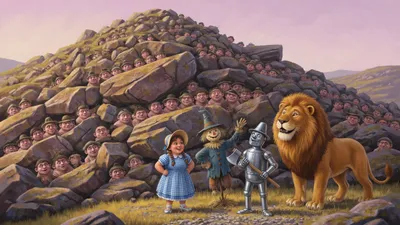
- The steep rocky hill and the voice that speaks from it
- The Hammer-Heads' bodies, and the way Baum describes them
- The Golden Cap, and the Monkey King's reminder about its charm
- The color of the Quadling houses, fences, and clothes
- The girl soldiers who stand before Glinda's gate
Vocabulary to know:
gloom (noun) — deep shade and darkness; nevertheless (adverb) — in spite of that; even so; supported (verb) — held up; helpless (adjective) — unable to do anything to stop someone; lightning (noun) — the sudden flash of light in a storm; here, a way of saying very fast; tumbling (verb) — rolling and falling over and over; boisterous (adjective) — loud, rowdy, and cheerful; armless (adjective) — having no arms; Hammer-Heads (noun) — the armless people of Oz who attack by shooting their flat heads out on long necks; hillside (noun) — the sloping side of a hill; echoed (verb) — sounded again as it bounced back; cannon (noun) — a large gun that fires a heavy ball; bruised (adjective) — sore from being hit; withstand (verb) — to stand up against without being beaten; uttered (verb) — said aloud; vexation (noun) — annoyance and frustration; twinkling (noun) — a very short instant; ripening (verb) — growing ready to be picked and eaten; chubby (adjective) — pleasantly plump and round; afresh (adverb) — again, from a new start; braid (noun) — a woven strip used as decoration on clothes; trimmed (verb) — decorated along the edges; admitted (verb) — allowed to come in.
Chapter 23: Glinda the Good Witch Grants Dorothy's Wish
Before you read — think about:
- How do you get ready to meet someone important?
- Why is it hard to say goodbye to friends who have traveled with you?
- What does a good ruler owe the people who trust them?
- Why might a person still choose home after seeing many wonders?
- What does the word home mean once you have been far away?
Watch for these while reading:
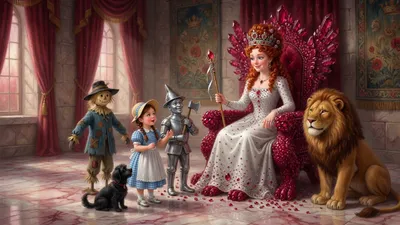
- Glinda's looks, her throne, and the way she greets Dorothy
- The story Dorothy tells, especially why she wants Kansas
- The Golden Cap Dorothy still carries, and what Glinda says about it
- The Silver Shoes Dorothy has worn since her first day in Oz
- What each of the three friends hopes to do next
Vocabulary to know:
combed (verb) — smoothed and tidied hair with a comb; polished (verb) — rubbed until shiny; presentable (adjective) — neat and tidy enough to be seen; ringlets (noun) — long curls of hair; flowing (adjective) — hanging loosely and gracefully; mourning (noun) — dark clothing worn to show sadness for someone lost; afford (verb) — to have enough money for something; upturned (adjective) — turned or tilted upward; bless (verb) — to wish good things upon someone; deprive (verb) — to take something needed away from someone; unusual (adjective) — not ordinary; special; brighter (adjective) — smarter or more clever; grand (adjective) — large and impressive; evermore (adverb) — forever; desired (verb) — wanted most of all; curious (adjective) — strange and interesting; wink (noun) — a tiny instant, as fast as blinking an eye; sorrowful (adjective) — full of sadness; parting (noun) — a goodbye; the act of leaving one another; instantly (adverb) — at once; right away; barnyard (noun) — the fenced area around a barn; furiously (adverb) — with great energy and noise; stocking-feet (noun) — feet wearing socks but no shoes.
Chapter 24: Home Again
Before you read — think about:
- How do you feel when you see a familiar person after a long time away?
- Why might a plain place still look wonderful when you return?
- What is the first thing you would say if you suddenly found yourself home?
- How do families show love without using many words?
- Why does a very short last chapter sometimes feel just right?
Watch for these while reading:
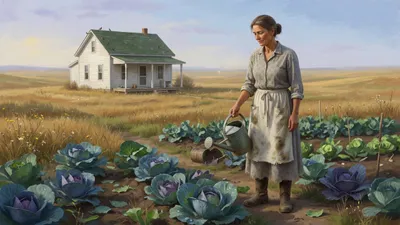
- The Kansas prairie and the new farmhouse Uncle Henry has been building
- What Aunt Em is doing when she first looks up
- Aunt Em's first words and the way she holds Dorothy
- How Dorothy answers the question about where she came from
- The last sentence of the book, and how it sounds after all the color of Oz
Vocabulary to know:
water (verb) — to pour water on plants to help them grow; cabbages (noun) — round, leafy green vegetables; darling (noun) — a dearly loved person; folding (verb) — wrapping or gathering someone in.
About the Author
L. Frank Baum was an American writer born in 1856. He loved inventing stories for children and wanted a homegrown fairy tale that felt friendly and modern rather than copied from old European collections. The Wonderful Wizard of Oz, published in 1900, made him famous, and he went on to write many more books set in the same imaginary land.
In 1900, most fairy tales American children knew had come from Europe. Baum set part of his story on the real Kansas prairie — a place of drought, cyclones, and hard farm work — before opening a door into a made-up country. The first edition was known for its bright pictures, and the book quickly became one of the best-loved children's stories written in the United States.