


About This Book
Treasure Island begins at a small, shabby inn on a windy stretch of the English coast, where a boy named Jim Hawkins helps his parents serve travellers. Then a scarred old seaman with a heavy sea-chest takes a room, pays in gold, and asks Jim to keep watch for a sailor with one leg. The first pages leave one question hanging — what is the captain so afraid of?
Treasure Island is the book later adventure stories keep borrowing from: the sea-song, the map, the talk of pieces of eight. It still matters because Stevenson writes excitement as a problem of attention — who is listening, who sounds trustworthy, and how much a young narrator can see from where he stands. Middle-school readers get a fast, spoken voice and a chance to watch how a writer hides and reveals information one page at a time.
Meet the Characters

More about Jim Hawkins
Jim Hawkins helps his mother and father run the Admiral Benbow, a small seaside inn on a lonely stretch of the English coast. He is curious, observant, and quick on his feet, and he spends a lot of time listening to sailors' talk and imagining the wider world. He tells this story himself, looking back on it.

More about Long John Silver
Long John Silver keeps a busy dockside tavern in Bristol and is known along the waterfront as a cheerful, capable seaman who lost a leg in the king's service. Sailors like him, and he seems to like everyone in return. He is hired as cook for a voyage and is easy company on land and at sea.

More about Dr. Livesey
Dr. Livesey is the doctor for the village near the Admiral Benbow, and he also serves as a local magistrate, which means he helps enforce the law. He is calm, precise, and fearless, and he treats everyone he meets — rich or poor — exactly the same way. Jim admires him from the moment they meet.

More about Squire Trelawney
Squire Trelawney is a rich landowner near Jim's home, generous and warm-hearted, with a booming voice and enormous enthusiasm for any new plan. He has travelled widely and loves telling people about it. He is the sort of man who decides quickly and spends freely once an idea has hold of him.

More about Captain Smollett
Captain Smollett is the professional seaman hired to sail the ship. He is blunt, exacting, and completely honest about his opinions, even when nobody wants to hear them. He cares about two things above all: a well-run ship and the safety of the people on it.

More about Ben Gunn
Ben Gunn is an English sailor who has been living far from other people for a very long time, with only the wind and the wild goats for company. Loneliness has made him talk in strange, hurried bursts, jumping from one idea to the next. He longs, more than almost anything, for the small ordinary comforts of home.

More about Billy Bones
The household calls him the captain. He arrives on foot with a sea-chest, pays in gold, and settles in as if he means to stay forever. He sings, drinks rum, watches the cove with a brass telescope, and pays Jim a few silver pennies to keep an eye on the road.

More about Blind Pew
Pew presents himself as a poor blind man tapping along the road, asking the way in a soft sing-song. He is hunched and slow to look at, and he asks to be led by the hand. The people who know him treat his arrival as something more than a beggar's call.

More about Black Dog
Black Dog turns up at the Admiral Benbow asking for his mate Bill. He is not quite sailorly and not quite a landsman, and he smiles in a way that does not put anyone at ease. He wears a cutlass, though he does not look much like a fighter.

More about Israel Hands
Israel Hands is a careful, wily, old, experienced seaman who can be trusted at a pinch with almost anything aboard. He is a close companion of the cook and speaks like a man who has spent his life in ships. On deck he is all professional competence; his eyes, when they wander, are harder to read.

More about Captain Flint
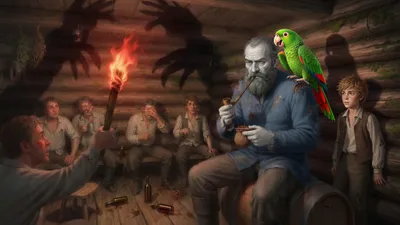
Silver keeps a talking parrot in a cage in the galley and calls her Captain Flint after a famous buccaneer. She screams scraps of seaman's talk and the words 'Pieces of eight' until a handkerchief goes over the cage. Silver feeds her sugar and speaks to her as if she were another old shipmate.
Pre-Reading Discussion Questions
- What pictures come to mind when you hear the word "pirate," and where do you think those pictures came from?
- What is it like to live in a house that is also a business, with strangers coming through the door?
- How do you form an opinion of an adult who is loud, frightening, and also a paying guest in your home?
- The story is told by one person looking back on events from his youth. What are the advantages of that kind of narrator, and what might a reader miss?
- Why might a writer start an adventure in a quiet place instead of in the middle of the action?
- What does the word "treasure" mean to you, apart from gold?
Themes & Big Ideas to Track
- How Stevenson uses an inn, a road, and a few rooms before he ever shows a ship.
- The difference between what people say in company and what they keep to themselves.
- How a first-person narrator decides what to tell you now and what to hold back.
- The sound of the book: songs, oaths, and the way talk changes from parlour to forecastle.
- What "looking like a sailor" is made of — clothes, scars, speech — and how far looks can be trusted.
- How fear, money, and manners pull on the same people at once.
Chapter-by-Chapter Study Guide
Chapter 1: The Old Sea-dog at the Admiral Benbow
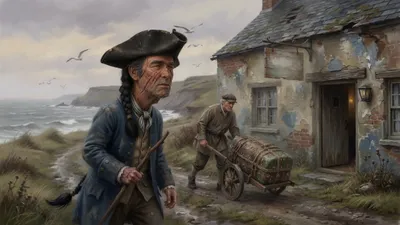
Before you read — think about:
- What draws travellers to stop at an inn on a lonely road, and what would it mean for a family if their living depended entirely on strangers?
- The narrator says he is setting this account down years later because other people asked him to. What does a story gain, and what might it lose, when it is remembered rather than reported on the spot?
- How do you form an opinion of a guest who pays well and explains almost nothing?
- What can the way a person takes up space in a room tell you about them?
- How did news and visitors travel along a country coast road in the eighteenth century?
Watch for these while reading:
- The Admiral Benbow itself — its cove, its road, and the sort of custom a small coastal inn usually gets.
- The old seaman's appearance, his songs, and the way he takes charge of a room he does not own.
- Jim's voice as narrator: a grown man telling a story he lived through as a boy, and how often he reminds you of the difference.
- Sailors' language — the ship's words, oaths and turns of phrase Stevenson puts in the seaman's mouth.
- Dr. Livesey's bearing and speech, and how they compare with the guest's.
Vocabulary to know:
particulars (noun) — the exact details and small facts of a story or event; bearings (noun) — the compass directions that tell exactly where a place lies; plodding (verb) — walking slowly and heavily, as if tired; tarry (adjective) — sticky and black with tar, the way sailors' ropes and pigtails often were; livid (adjective) — a pale, greyish-white colour, like an old bruise or scar; capstan (noun) — a barrel-shaped machine on a ship's deck that sailors push around with bars to haul in heavy ropes; handspike (noun) — a stout wooden bar used as a lever on board a ship; connoisseur (noun) — an expert who judges the quality of something carefully; cove (noun) — a small sheltered bay in the coastline; berth (noun) — a place to stay or sleep, especially on board a ship; skipper (noun) — the captain in charge of a ship; seafaring (adjective) — having to do with travelling or working on the sea; diabolical (adjective) — evil in a devilish, nightmarish way; abominable (adjective) — horrible and hateful; tyrannized (verb) — bullied and ruled over harshly; coltish (adjective) — awkward and clumsy, like a young horse; bleared (adjective) — dull and blurry, especially of eyes; villainous (adjective) — wicked; belonging to a criminal; assizes (noun) — a court that travelled from town to town to try serious crimes; magistrate (noun) — a local official with the power to judge and punish lawbreakers; incivility (noun) — rudeness; bad manners; effectual (adjective) — certain to produce the result you intend; rebuff (noun) — a sharp, blunt refusal; sabre (noun) — a heavy sword with a curved blade; parlour (noun) — the sitting room of an inn or house where guests gather.
Chapter 2: Black Dog Appears and Disappears

Before you read — think about:
- What is it like to run a household when someone in it is seriously ill?
- Why might a sick household still have to keep serving customers?
- Why might two people who know each other well still choose their words carefully?
- What can you tell from a person's hands, and what can you not tell?
- How does a doctor talk to a patient who does not want to be a patient?
Watch for these while reading:
- The visitor's appearance and the way he makes himself at home in the parlour.
- Sailors' speech — the slang, the oaths, and the words only seafaring men would use.
- Dr. Livesey's professional manner set beside the seaman's.
- The old seaman's body — scars, colour, hands — and what Stevenson lets you infer from them.
- How Jim's narration marks the difference between what he saw and what he only guessed.
Vocabulary to know:
gales (noun) — very strong winds; small storms; hoar-frost (noun) — a white coating of frozen dew that makes everything look grey and furry; cutlass (noun) — a short, broad sword with a curved blade, favoured by sailors; indignation (noun) — angry offence at something that seems unfair; tallowy (adjective) — pale and greasy-looking, like candle fat; leer (noun) — an unpleasant sideways smile that suggests bad intentions; mutilated (adjective) — badly damaged, with a part missing; fawning (adjective) — acting falsely friendly in order to get something; sneering (adjective) — showing scorn or contempt; hilt (noun) — the handle of a sword or knife; sheath (noun) — the case a blade slides into; shipmate (noun) — a sailor who serves on the same ship as you; fugitive (noun) — someone running away; notch (noun) — a cut or nick chopped into a surface; scuffle (noun) — a short, rough, confused fight; sinewy (adjective) — lean and stringy with muscle; gallows (noun) — the wooden frame used to hang criminals; prophetic (adjective) — predicting what will happen later; lancet (noun) — a small sharp blade doctors once used to open a vein on purpose; buccaneer (noun) — a pirate, especially one who robbed ships in the Caribbean.
Chapter 3: The Black Spot

Before you read — think about:
- Why might a sick person argue with a doctor's advice even when he believes the doctor is right?
- How do people talk about someone who is no longer in the room?
- The chapter is called "The Black Spot." Judging by the phrase alone, what sort of thing would you guess that name is given to?
- What is it like to be the only young person in a house of worried adults?
- How does fog change what you can know about a road you walk every day?
Watch for these while reading:
- The captain's talk when he has been drinking — the names, ships and places he lets fall.
- A visitor on the foggy road: voice, stick, and how he finds his way.
- Stevenson's use of dates and clock time in this chapter, and how precisely he places events.
- The way Jim and his mother divide the work of the inn between them.
- The captain's rum, and how his condition tracks with it from day to day.
Vocabulary to know:
noggin (noun) — a small cupful of strong drink; swab (noun) — a sailor's insult for a useless or contemptible person; hulk (noun) — the worn-out body of an old ship, no longer able to sail; lee (noun) — the side away from the wind; a lee shore is the coast a ship is being blown onto; dram (noun) — a small measure of strong drink; guinea (noun) — an old British gold coin worth slightly more than a pound; lubber (noun) — a clumsy person who does not know the sea; a sailor's insult; reef (noun) — a folded-in section of sail; shaking one out means putting on more speed; summons (noun) — an official order commanding someone to appear; peach (verb) — to inform on someone; to give away a secret to the authorities; swoon-like (adjective) — resembling a faint; deep and helpless; confidences (noun) — secrets shared privately with someone you trust; clambered (verb) — climbed awkwardly, using hands as well as feet; flighty (adjective) — unsteady and unpredictable, changing without warning; tattered (adjective) — torn and hanging in rags; deformed (adjective) — misshapen; not the normal shape; vise (noun) — a tool with jaws that clamp something tight; cowed (verb) — frightened into obedience; nimbleness (noun) — quick, light, skilful movement; apoplexy (noun) — an old word for a sudden stroke that kills or paralyses.
Chapter 4: The Sea-chest

Before you read — think about:
- What does a person's luggage tell you about the life they have led?
- When money is short, how do you decide what you are owed and what you are not?
- How do neighbours usually behave when someone asks for help after dark?
- What is the difference between being careful and being slow?
- How does weather — fog, tide, moon — change what people are willing to do at night?
Watch for these while reading:
- The contents of the sea-chest — Stevenson lists every object, and each one is a clue about its owner's history.
- The hamlet and its people: how far away help is, and how willing it is to come.
- Jim's mother's insistence on exact accounts, and what that says about the sort of woman she is.
- Tide, moon and fog — how Stevenson uses weather and light to control what can be seen and heard.
- Coins from a dozen countries in one bag, and what a mixed hoard implies about how it was gathered.
Vocabulary to know:
booty (noun) — goods taken by force; stolen treasure; detestable (adjective) — deserving to be hated; hamlet (noun) — a very small village; hearken (verb) — to listen carefully; smugglers (noun) — people who move goods secretly to avoid paying taxes on them; lugger (noun) — a small sailing ship with slanting sails, easy to handle close to shore; cowardice (noun) — lack of courage; infectious (adjective) — spreading easily from one person to another; foolhardiness (noun) — boldness that ignores obvious danger; grate (noun) — the metal frame in a fireplace that holds the burning coals; thimble (noun) — a small metal cap worn on a finger when sewing; gully (noun) — a large sailor's knife; repugnance (noun) — a strong feeling of disgust or unwillingness; miscellany (noun) — a jumbled mixture of unrelated things; quadrant (noun) — an old instrument for measuring the height of the sun or stars to find a ship's position; trinkets (noun) — small ornaments of little real value; dues (noun) — the money someone is rightfully owed; farthing (noun) — an old British coin worth a quarter of a penny — the smallest amount imaginable; score (noun) — the running bill a customer owes at an inn; doubloons (noun) — old Spanish gold coins; obstinately (adverb) — stubbornly refusing to change your mind; dispersing (verb) — spreading out and thinning away; dell (noun) — a small hollow valley.
Chapter 5: The Last of the Blind Man

Before you read — think about:
- How does a group of people who do not trust one another still manage to act together?
- What can you learn from a place by listening rather than looking?
- When help has been sent for, what should the people waiting do in the meantime?
- What holds a group of frightened people together, and what makes that hold fail?
- What kind of help can a lonely coast actually call on?
Watch for these while reading:
- Voices on the road, and who is giving orders to whom.
- The geography of the hamlet — the road, the bridge, the cove and the hill above it.
- How Stevenson uses sound — footsteps, a whistle, a cry — when sight is limited.
- The way a crowd's mood can turn in a few minutes.
- The talk among the men on the road, and what their slang suggests about where they have served.
Vocabulary to know:
formidable (adjective) — frightening because of strength or power; shirking (verb) — avoiding work or duty; aloft (adverb) — up above; on an upper level, as in a ship's rigging; overhauled (verb) — searched through thoroughly; glim (noun) — sailors' slang for a light or candle; reiterated (verb) — repeated something again for emphasis; skulk (noun) — a person who hangs back and avoids danger; irresolute (adjective) — unable to decide; hesitating; lumber (noun) — stored odds and ends; useless clutter; pluck (noun) — courage; nerve; weevil (noun) — a small beetle that infests stored grain and ship's biscuit; squalling (verb) — shouting or crying harshly and loudly; miscreant (noun) — a wicked person; a villain; wrest (verb) — to pull something away by force; frenzy (noun) — a state of wild, uncontrolled excitement; groping (verb) — feeling about blindly with the hands; spurned (verb) — struck or kicked aside; revenue (noun) — government money collected as taxes; revenue officers hunted smugglers; dingle (noun) — a deep narrow hollow between hills; deplore (verb) — to regret something deeply; dispatch (verb) — to send someone off quickly on an errand; cutter (noun) — a fast single-masted government ship used to chase smugglers.
Chapter 6: The Captain's Papers
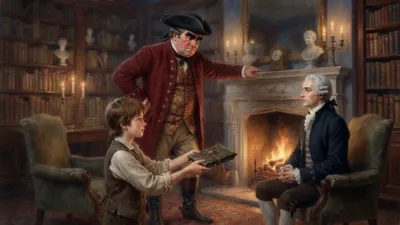
Before you read — think about:
- Why might a person carry a sealed packet for hours without opening it?
- What kinds of records would a working seaman keep, and why would he keep any at all?
- How do people of different ranks speak to one another in an eighteenth-century country house, and what can you tell from that?
- When two grown men disagree in front of a boy, what is the boy in a position to notice?
- What makes a country house feel far from an inn on a lonely road — and what does that distance do to a boy who has just arrived?
Watch for these while reading:
- Squire Trelawney's speech and manner set against Dr. Livesey's — Stevenson builds both men almost entirely out of how they talk.
- The inside of the squire's house, and what its comfort says about the distance in station between him and Jim.
- How the papers are described: handwriting, columns, marks, and what a landsman can and cannot read in them.
- The account-book and its columns — the bookkeeping habits of a seafaring man.
- Dr. Livesey's caution, and the exact terms he asks for.
Vocabulary to know:
stirrup (noun) — the metal loop hanging from a saddle that a rider's foot rests in; matted (adjective) — covered with woven floor matting; bluff (adjective) — blunt and hearty in manner; condescending (adjective) — acting kindly toward someone you consider beneath you; atrocious (adjective) — shockingly wicked or cruel; trump (noun) — old slang for an excellent, reliable person; prodigiously (adverb) — enormously; to an amazing degree; top-sails (noun) — the sails set above the lowest sails on a mast — the first part of a ship seen over the horizon; confoundedly (adverb) — annoyingly; extremely (a mild old-fashioned complaint); exclamatory (adjective) — given to shouting and dramatic outbursts; carcasses (noun) — bodies — used insultingly here; unintelligible (adjective) — impossible to understand; latitude (noun) — the measurement of how far north or south of the equator a place lies; longitude (noun) — the measurement of how far east or west of a fixed line a place lies; ambiguity (noun) — something that could be understood in more than one way; plundered (verb) — robbed by force, especially in war or piracy; thrifty (adjective) — careful with money; soundings (noun) — measurements of how deep the water is; anchorage (noun) — a place where a ship can safely drop anchor; cache (noun) — a hidden store of supplies or valuables; hummock (noun) — a small rounded hill; fathoms (noun) — units of depth or distance at sea, each six feet; crag (noun) — a steep rugged rock.
Chapter 7: I Go to Bristol

Before you read — think about:
- What is it like to wait weeks for a letter from someone you trust, and then to have to take every word of it as news?
- Jim spends weeks imagining a place before he sees it. How might that change what he notices once he arrives?
- What is it like to wait at someone else's house while the people in charge of you are miles away?
- Jim is leaving his mother alone at the inn. What does he owe her, and what does he owe himself?
- Why are people sometimes more excited about a journey than about whatever waits at the end of it?
Watch for these while reading:
- The squire's letter — its length, its exclamations, and how much of a talker it shows him to be.
- How a crew was put together in an eighteenth-century port — the inns, the quays, and the talk of wages and berths.
- The old sailors on the quay and the way they speak — Stevenson's ear for seafaring dialect.
- Jim's daydreams of the island, and how far they run ahead of anything he has been told.
- The arrangements made for the inn and for Jim's mother before he goes.
Vocabulary to know:
gamekeeper (noun) — a servant who looks after the birds and animals on a big estate; anticipations (noun) — eager expectations of what is coming; brooded (verb) — thought about something long and deeply, over and over; prospects (noun) — wide views over a landscape; schooner (noun) — a fast sailing ship with two or more masts, rigged fore and aft; prejudiced (adjective) — holding an unfair opinion formed before knowing the facts; calumnies (noun) — false statements made to damage someone's reputation; odious (adjective) — hateful; deserving disgust; hobbled (verb) — walked awkwardly and with difficulty; pension (noun) — regular money paid to someone who can no longer work, especially after military service; indomitable (adjective) — impossible to defeat or discourage; frigate (noun) — a fast medium-sized warship; fresh-water (adjective) — inexperienced at sea; used by sailors as an insult; tarpaulins (noun) — old sailors — named for the tarred canvas coats they wore; consort (noun) — a second ship sailing in company with the first; boatswain (noun) — the officer in charge of a ship's rigging, ropes, and crew work; roving (noun) — wandering; travelling with no fixed home; lament (verb) — to complain sorrowfully; apprentice (noun) — a young person learning a trade by working for someone; heath (noun) — open, uncultivated land covered with rough low shrubs; superintend (verb) — to oversee work and make sure it is done properly; quays (noun) — stone landing places where ships tie up to load and unload; figureheads (noun) — carved wooden figures fixed to the bows of ships; swaggering (adjective) — walking with a bold, rolling, showy step.
Chapter 8: At the Sign of the Spy-glass
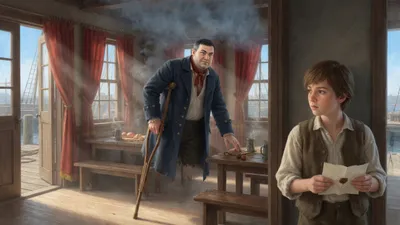
Before you read — think about:
- How do you get to know a person you have only heard about in a letter?
- How do people who work around ships talk and dress differently from people who live inland?
- What does it take to keep a tavern in a sailors' quarter busy from morning to night?
- How do you find your way through a city you have never seen? What do you go by?
- Jim is a long way from home among adults he has only just met. What does a person that age have to work out alone in that position?
Watch for these while reading:
- The Spy-glass tavern and the trade it does — Stevenson's picture of a sailors' quarter in a working port.
- Long John Silver's manner: his courtesy, his jokes, and his way of using a customer's name.
- How Silver moves on his crutch, and how much Stevenson chooses to make of it.
- The talk of the seamen in the room, and the distance between how they speak and how the gentlemen speak.
- How Jim describes a new face in detail, and which features he chooses to linger on.
Vocabulary to know:
dexterity (noun) — skill and quickness in using the body; relinquishing (verb) — letting go of something you were holding; pursuit (noun) — the act of chasing someone; mahogany-faced (adjective) — with skin darkened reddish-brown by years of sun and weather; sheepishly (adverb) — in an embarrassed, guilty way; quid (noun) — a lump of chewing tobacco kept in the cheek; dead-eye (noun) — a round wooden block used in a ship's rigging — here an insult meaning a blockhead; keel-hauling (noun) — a brutal old sea punishment in which a sailor was dragged under the ship's hull; confidential (adjective) — spoken privately, as to someone you trust; stumping (verb) — walking heavily on a wooden leg or crutch; narrowly (adverb) — closely and carefully; bail (noun) — money promised as a guarantee — to 'go bail' for someone is to vouch for them completely; confounded (adjective) — wretched; annoying (a mild old-fashioned curse); deadlights (noun) — the heavy shutters over a ship's windows — sailors' slang for eyes; mariner (noun) — a sailor, especially a skilled and qualified one; sea-calf (noun) — a seal — used here as cheerful self-mockery for a clumsy old sailor; mirth (noun) — laughter and merriment; discharging (verb) — unloading cargo from a ship; anecdote (noun) — a short entertaining story about something that happened; nautical (adjective) — to do with ships, sailors, and the sea; crutch (noun) — a support tucked under the arm to help someone walk.
Chapter 9: Powder and Arms
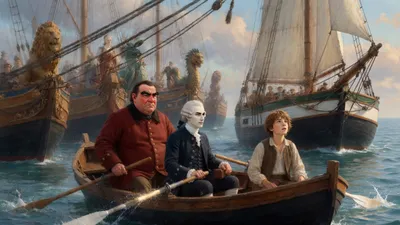
Before you read — think about:
- What does it mean to take orders from somebody you have not yet learned to respect?
- Why would it matter where weapons and gunpowder are stored on a ship, and who can reach them?
- What is the difference between someone who is rude and someone who is right? Can a person be both at once?
- Why do people so often dislike the one person willing to tell them an uncomfortable truth?
- When you are new somewhere, how do you work out who actually makes the decisions?
Watch for these while reading:
- Captain Smollett's way of speaking — blunt, precise, and nothing like the squire's.
- The layout of a schooner: cabin, berths, forecastle, powder magazine, and who sleeps where.
- The squire's temper when he is contradicted, and how Dr. Livesey manages him.
- The professional vocabulary of the sea, and how much of it Stevenson expects you to pick up from context.
- Silver's usefulness aboard, and the many small ways he makes himself agreeable.
Vocabulary to know:
keel (noun) — the long beam running along the bottom of a ship, from bow to stern; squint (noun) — a condition in which the eyes do not look in exactly the same direction; shipshape (adjective) — neat, tidy, and in proper working order; seaworthy (adjective) — in good enough condition to sail safely; cruise (noun) — a voyage, especially one without a fixed commercial route; ticklish (adjective) — risky and delicate; easily going wrong; blabbing (verb) — carelessly telling secrets; protestations (noun) — loud insistent declarations that something is true; garrison (noun) — a defended position held by armed men; mutiny (noun) — a rebellion by sailors or soldiers against their officers; precautions (noun) — steps taken in advance to prevent trouble; intolerable (adjective) — impossible to put up with; humbug (noun) — a fraud; someone who pretends to be more than he is; astern (adverb) — at or toward the back of a ship; galley (noun) — the kitchen on board a ship; forecastle (noun) — the forward part of a ship where the ordinary sailors live; companion (noun) — on a ship, the raised covering over the stairway leading below deck; hammocks (noun) — hanging canvas beds slung between two points; forelock (noun) — the lock of hair over the forehead — touching it was a sailor's sign of respect; swivel (noun) — a small cannon mounted so that it can turn to aim in any direction; amidships (adverb) — in the middle part of a ship.
Chapter 10: The Voyage
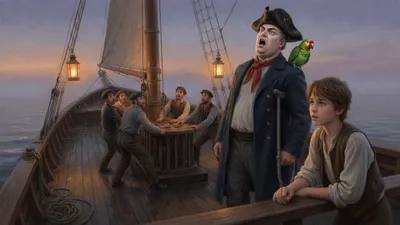
Before you read — think about:
- A long sea voyage shuts the same people up together for weeks with no way to leave. What sorts of problems build up slowly rather than all at once?
- How does the mood of a group change over a long trip? What starts to matter that did not matter at the beginning?
- A crew is treated very generously — extra rum, extra treats, few rebukes. Why might a strict captain object to that?
- A long voyage has a daily rhythm of watches, meals and weather. What would make that rhythm feel settled, and what would unsettle it?
- What is it like to be the youngest person in a group of adults? What do people let you do, and what do they not let you do?
Watch for these while reading:
- The routine of a working ship — watches, weather, sail-handling, meals — and how Stevenson conveys it without stopping to lecture.
- The crew's sea-songs, and the lines that keep coming back.
- Silver's galley, his parrot, and the audience he gathers around him.
- The weather the ship meets, and how Stevenson lets you feel a long passage without counting every day.
- Captain Smollett's opinion of the way the crew is being handled, and how the gentlemen receive it.
Vocabulary to know:
stowed (verb) — packed away tidily in the right place; stave (noun) — a verse of a song; bunk (noun) — a narrow bed built into the wall of a ship's cabin; irons (noun) — metal shackles used to imprison someone aboard ship; coxswain (noun) — the sailor who steers a ship's boat and commands its crew; wily (adjective) — clever in a sly, calculating way; confidant (noun) — someone trusted with another person's secrets; lanyard (noun) — a short cord used to secure or carry something aboard ship; bulkhead (noun) — an upright wall dividing a ship into compartments; burnished (adjective) — polished until shining; yarn (noun) — a long story, especially one told by a sailor; viceroy (noun) — a ruler who governs a colony on behalf of a king; chaplain (noun) — a clergyman attached to a ship, regiment, or household; despised (verb) — looked down on with contempt; grog (noun) — rum watered down, served to sailors as a ration; duff (noun) — a boiled pudding served as a treat aboard ship; broached (verb) — opened up, as a barrel is opened to get at what is inside; waist (noun) — the middle part of a ship's upper deck; treachery (noun) — betrayal of someone who trusts you; trades (noun) — the steady winds that blow toward the equator, used by sailing ships to cross oceans; bowsprit (noun) — the long spar sticking forward from a ship's bow; helm (noun) — the wheel or tiller by which a ship is steered; luff (noun) — the forward edge of a sail, watched to keep the ship sailing well.
Chapter 11: What I Heard in the Apple Barrel

Before you read — think about:
- The chapter is called "What I Heard in the Apple Barrel." What kinds of things can a hidden listener learn that a face-to-face talker cannot?
- What details of a conversation can you catch if you can hear voices but cannot see faces?
- What does it tell you about someone if he saves his money while everyone around him spends theirs?
- What does it cost a listener to stay perfectly still? What would give them away?
- If you come to know something you were not meant to know, what do you owe the people it concerns?
Watch for these while reading:
- The names of the men who speak, and how each of them talks to the others.
- The names of old pirates that come up in conversation, and the reputations attached to them.
- The flattery Silver uses on a younger man, and where earlier in the book you have met that manner.
- The sounds around the barrel besides voices — the sea, the ship, the men moving on deck.
- How Stevenson keeps you inside the barrel with Jim — what the narration can and cannot see from there.
Vocabulary to know:
quartermaster (noun) — aboard a pirate ship, a senior officer second only to the captain; broadside (noun) — the firing of all the guns along one side of a ship at once; surgeon (noun) — a doctor who performs operations; christened (verb) — formally named; hatches (noun) — the openings in a ship's deck; 'under hatches' means below deck, and in sailors' talk, dead and buried; flattery (noun) — praise that is not sincere, given to win someone over; rogue (noun) — a dishonest, untrustworthy person; derisively (adverb) — in a mocking, scornful way; cable (noun) — the heavy rope or chain attached to a ship's anchor; afloat (adjective) — at sea; sailing; corruption (noun) — the process of turning someone honest into someone dishonest; bumboat (noun) — a small boat that peddles goods to ships lying at anchor; hazed (verb) — driven hard with unnecessary work as a punishment; navigate (verb) — to work out and steer a ship's course across open sea; miscalculations (noun) — errors in working something out; windward (noun) — the direction the wind comes from — the advantageous side to be on; maroons (noun) — people deliberately abandoned on a deserted island; athwart (adverb) — across; crosswise — to lay a ship athwart is to move in for the attack; sea-lawyers (noun) — sailors who argue and quibble; here, awkward survivors who might testify; pannikin (noun) — a small metal drinking cup; bilge (noun) — the foul water in the bottom of a ship — used to mean nonsense or rubbish; prizes (noun) — ships captured at sea, and the goods taken from them.
Chapter 12: Council of War

Before you read — think about:
- When two groups on the same ship want different things, what does a captain have to decide first?
- Why might a captain want to know whether anyone aboard has been to a place before?
- When a ship first raises a new coast, what does a crew actually have to do before anyone can go ashore?
- How do you decide whether to act on something straight away or wait for a better chance?
- How do adults usually react when a young person brings them serious news? What would make them believe it?
Watch for these while reading:
- The first sight of the island from the deck, and the words Jim chooses for it.
- How a ship's company is mustered and addressed, and the set forms a captain uses.
- Silver's public voice in front of the gentlemen, set beside the voice Jim heard from the barrel.
- The arithmetic of the ship's company — who is counted on which side, and on what evidence.
- The squire’s manner toward Captain Smollett, set beside the way he spoke of him at Bristol.
Vocabulary to know:
congregated (verb) — gathered together in a crowd; conical (adjective) — shaped like a cone; islet (noun) — a very small island; chart (noun) — a map made for sailors, showing coasts, depths, and dangers; careen (verb) — to lay a ship over on her side to clean or repair the hull; avowed (verb) — admitted or declared openly; duplicity (noun) — deliberate double-dealing; saying one thing while intending another; trader (noun) — a merchant ship that carries goods for sale; current (noun) — water moving steadily in one direction; quarter-deck (noun) — the raised deck at the back of a ship, where the officers walk; durst (verb) — an old form of 'dared'; pretence (noun) — an excuse or false reason invented to cover a real one; countenance (noun) — the face and its expression; agitated (adjective) — disturbed and unable to stay calm; open-handed (adjective) — generous with money; subsided (verb) — died down; became quieter; plotting (verb) — secretly planning something harmful; yard-arm (noun) — the outer end of a spar across a mast — where the navy hanged offenders.
Chapter 13: How My Shore Adventure Began

Before you read — think about:
- A crew has arrived where it was going. What might change in how people behave, and why?
- A captain whose orders are obeyed slowly and sullenly is in an awkward position. What choices are left to him?
- How can a place look beautiful from a distance and feel unpleasant as soon as you are standing in it?
- What are the risks of being the person everybody talks freely in front of?
- What is the difference between a decision and an impulse? How can you tell them apart afterwards?
Watch for these while reading:
- Jim's first close description of the island — its colours, its trees, its smell, its hills.
- The anchorage and the two islets, and how carefully Stevenson maps the geography for you.
- Dr. Livesey's professional opinion of the air and the marsh.
- The mood of the crew once the anchor is down, and how it differs from the mood at sea.
- How the boats are handled and manned — a small piece of shipboard routine doing a lot of work in the story.
Vocabulary to know:
becalmed (adjective) — unable to move because there is no wind; vegetation (noun) — the plants growing in a place; spires (noun) — tall pointed shapes rising to a narrow top; configuration (noun) — the shape and arrangement of something; pedestal (noun) — the base a statue stands on; scuppers (noun) — the openings along a ship's deck that let water drain overboard; rudder (noun) — the flat piece at the stern that steers a ship; giddily (adverb) — dizzily; making the head spin; qualm (noun) — a sudden feeling of sickness or unease; melancholy (adjective) — sad and gloomy; warped (verb) — moved a ship by hauling on ropes rather than by sail; haven (noun) — a sheltered harbour; sweltering (adjective) — uncomfortably hot; conned (verb) — directed the steering of a ship; ebb (noun) — the outgoing tide; amphitheatre (noun) — a round arena with rising seats — used here for hills standing in a ring; land-locked (adjective) — enclosed on all sides by land; stagnant (adjective) — still and unmoving, and therefore stale; sodden (adjective) — soaked through with water; grudgingly (adverb) — unwillingly and resentfully; discontent (noun) — unhappiness with the way things are; gigs (noun) — light, narrow ship's boats; rebellious (adjective) — refusing to obey those in charge; disaffected (adjective) — no longer loyal or content; ringleaders (noun) — the people who lead others into trouble; stockade (noun) — a defensive fence of upright wooden posts; thicket (noun) — a dense clump of bushes and small trees.
Chapter 14: The First Blow

Before you read — think about:
- You are alone in unfamiliar country. What are the first things you ought to work out?
- How does the look of a place change when you stop walking through it and start keeping still?
- How does fear change what a person is able to notice and to remember afterwards?
- What do you do when you are somewhere you were told not to go?
- What do you notice first in wild country — plants, birds, heat, footing — and what do you tend to miss?
Watch for these while reading:
- The marsh country Jim crosses — its plants, its creatures, its footing and its heat.
- Jim's mood as an explorer with nobody to answer to, and how it colours what he describes.
- Silver's voice heard at a distance, and the way he talks to a man he wants something from.
- How Stevenson stages an overheard conversation: sight-lines, sound, and what the hidden listener cannot make out.
- The noises of the marsh itself, and how Stevenson uses them to break up the dialogue.
Vocabulary to know:
marshy (adjective) — soft, wet, and boggy; bulrushes (noun) — tall reeds that grow in wet ground; outlandish (adjective) — strange and unfamiliar; foreign-looking; undulating (adjective) — gently rising and falling in waves; contorted (adjective) — twisted out of shape; uninhabited (adjective) — with nobody living there; brutes (noun) — animals; brambles (noun) — prickly trailing bushes; boughs (noun) — the main branches of a tree; thatch (noun) — a roof covering of packed straw or reeds; knolls (noun) — small rounded hills; fen (noun) — low marshy ground; desperadoes (noun) — reckless, dangerous criminals; ambush (noun) — a hidden position from which to watch or attack; aperture (noun) — a small opening or gap; hoarse (adjective) — rough and harsh in the throat; taut (adjective) — stretched tight; gymnast (noun) — someone trained to move the body with strength and control; uncouth (adjective) — awkward and crude-looking; missile (noun) — an object thrown as a weapon; defenceless (adjective) — unable to protect oneself; sward (noun) — a stretch of short grass; pinnacle (noun) — a tall pointed peak; modulated (adjective) — varied in pitch or tone, as a coded signal is; extricate (verb) — to free yourself from a difficult position; languor (noun) — heavy stillness; drowsy lack of movement.
Chapter 15: The Man of the Island

Before you read — think about:
- Trapped between a known danger behind you and an unknown one ahead, which would you move toward, and why?
- The chapter is called "The Man of the Island." Judging by the title alone, what sort of person would you expect to meet, and what would you not want to assume?
- What makes a stranger seem trustworthy at a first meeting? What signs do you actually go on?
- Why might a stranger's story be worth listening to even when parts of it sound unlikely?
- When you are lost, whose advice is worth taking? What would you go on?
Watch for these while reading:
- The interior of the island — its live-oaks, pines, sand and rock, and how different it is from the marsh below.
- The speech of a man long out of practice at talking: its rhythm, its repetitions, its odd formality.
- The stories told about Captain Flint, and the effect his name has on the people who use it.
- How Jim's fear and his curiosity take turns, and which one is in charge from paragraph to paragraph.
- How Stevenson lets a new character introduce himself — what he says first, and what he leaves for later.
Vocabulary to know:
dislodged (verb) — knocked loose from its place; apparition (noun) — a startling figure that appears suddenly, like a ghost; lurking (adjective) — hiding and waiting, ready to appear; nondescript (noun) — something that cannot be identified or classified; retrace (verb) — to go back the way you came; contend (verb) — to compete or struggle against; adversary (noun) — an opponent or enemy; flitted (verb) — moved lightly and quickly from place to place; resolutely (adverb) — with firm determination; supplication (noun) — the act of begging humbly for something; raggedness (noun) — the state of being dressed in torn, worn-out clothes; incongruous (adjective) — oddly out of place together; mismatched; accoutrement (noun) — clothing and equipment; desolate (adjective) — empty, bare, and lonely; slyness (noun) — cunning secretiveness; pious (adjective) — deeply religious; catechism (noun) — a set of religious questions and answers learned by heart; Providence (noun) — God's care and guidance over what happens; solitude (noun) — the state of being completely alone; lowering (adjective) — dark and threatening, like a gathering storm; ally (noun) — someone who joins your side; predicament (noun) — a difficult situation with no easy way out; livery (noun) — the uniform worn by a household servant; shrewdness (noun) — sharp practical judgement; musket (noun) — an old long-barrelled gun fired from the shoulder; mastheaded (adjective) — sent to the top — here, driven up to the highest ground; volley (noun) — a burst of shots fired together; goatskins (noun) — clothing made from the hides of goats.
Chapter 16: Narrative Continued by the Doctor: How the Ship Was Abandoned

Before you read — think about:
- The story now passes to a different narrator. What can a reader gain from hearing events in somebody else's voice?
- In a place with no law and no help within reach, what does a small group need most in order to feel secure?
- What supplies would matter most if you had to leave a ship in a hurry, and in what order would you take them?
- How do people behave when they are doing a rushed job under the eyes of people they do not trust?
- Is it braver to speak up in front of a group, or to keep quiet and wait? What does each cost?
Watch for these while reading:
- The change of narrator: how the first paragraph tells you whose voice this is, and how his style differs from Jim's.
- Dr. Livesey's habits of mind — a physician's eye for air, water, health and risk.
- The piece of ground the party chooses ashore, and what about it they take the trouble to describe.
- What a small party judges worth carrying ashore, and in what order they take it.
- The men left aboard the schooner, and how they behave with nobody to give them orders.
Vocabulary to know:
mutineers (noun) — sailors who have rebelled against their officers; stench (noun) — a strong, disgusting smell; dysentery (noun) — a serious illness of the bowels, often caused by dirty water; jolly-boat (noun) — a small working boat carried by a ship; primed (adjective) — loaded and made ready to fire; log-house (noun) — a building made of whole tree trunks laid together; loopholed (adjective) — pierced with narrow slits to shoot through; musketry (noun) — gunfire from muskets; paling (noun) — a fence of pointed stakes; besiegers (noun) — attackers surrounding a defended place; partridges (noun) — plump game birds, easy targets for a shooter; regiment (noun) — a large organised body of soldiers; ammunition (noun) — the bullets, shot, and powder used in guns; dilly-dally (verb) — to waste time hesitating; gallery (noun) — a narrow passage running through part of a ship; kegs (noun) — small barrels; cask (noun) — a large barrel for liquids; consultation (noun) — a discussion to decide what to do; faint-hearted (adjective) — easily frightened; lacking courage; palisade (noun) — a strong fence of tall stakes built for defence; bestowed (verb) — put away in the right place; stored; sculled (verb) — rowed a boat with a single oar worked over the stern; painter (noun) — the rope at the bow of a small boat, used to tie her up; stays (noun) — the ropes supporting a mast; a ship caught 'in stays' is stuck head to wind and going nowhere.
Chapter 17: Narrative Continued by the Doctor: The Jolly-boat's Last Trip
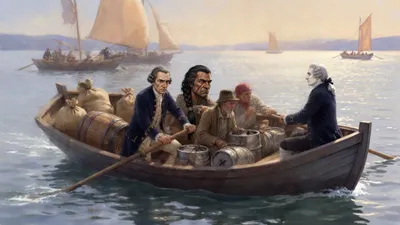
Before you read — think about:
- Who should be in charge when the person giving the orders is not the person who knows most about the job?
- How does a current change what steering a boat actually requires?
- A ship carries a cannon. Who aboard would know how to use one, and how would you find that out?
- When you cannot avoid being shot at, what can you still control?
- How do people behave differently when they are being watched by an enemy?
Watch for these while reading:
- The seamanship in this chapter — trim, freeboard, current and course, reported by a landsman who has only just learned it.
- How the party treat Abraham Gray, and what their manner toward him says about them.
- The nine-pounder aboard the Hispaniola, and the practical problem of working a heavy gun from a ship at anchor.
- Squire Trelawney as a marksman, and how that squares with everything else you know of him.
- The doctor's dry, orderly way of reporting alarming things.
Vocabulary to know:
gallipot (noun) — a tiny pot used by apothecaries — used here as a joke about the boat's size; gunwale (noun) — the upper edge of a boat's side; trim (verb) — to shift weight so a boat sits level in the water; basin (noun) — a wide, almost enclosed stretch of sheltered water; straits (noun) — a narrow channel of water joining two larger areas; swamping (verb) — filling a boat with water until she sinks; leeward (noun) — the direction the wind or current is pushing you toward; slacken (verb) — to become weaker or slower; bombardment (noun) — a sustained attack with heavy guns; round-shot (noun) — solid iron cannonballs; gunner (noun) — the crewman trained to aim and fire a ship's cannon; steerage (noun) — enough forward movement for the rudder to grip the water; muzzle (noun) — the open front end of a gun barrel; rammer (noun) — the long rod used to push powder and shot down a cannon barrel; slewed (verb) — swung something round on a pivot; reparation (noun) — making up for harm already done; assailants (noun) — attackers; disclosed (verb) — uncovered; brought into view; drenched (adjective) — soaked completely; bandoleer (noun) — a shoulder belt for carrying a gun or ammunition; valet (noun) — a manservant who looks after his employer's clothes.
Chapter 18: Narrative Continued by the Doctor: End of the First Day's Fighting

Before you read — think about:
- A party has to cross open ground to reach shelter. What decides who wins that kind of race?
- Why might a small group fly a flag over a hidden position, even though it shows the enemy exactly where they are?
- What keeps people going when things have gone badly? What do you need from the people around you?
- What is the difference between courage and stubbornness? Can a single decision be both?
- If your food would last ten days, how would that shape the way you planned?
Watch for these while reading:
- How the party arm themselves on the move, and what weapons they actually have between them.
- The stockade as a defensive position: the fence, the slope, the trees, and where the cover lies.
- The log-book and what a captain thinks worth recording in it.
- Captain Smollett's tone while he is under fire, and the sort of remarks he makes.
- The gun-fire from the ship, and how accurate a nine-pounder proves at that range.
Vocabulary to know:
footfalls (noun) — the sound of footsteps; breasted (verb) — pushed forward through something with the chest; enclosure (noun) — an area fenced in on all sides; molestation (noun) — interference or attack; hoisted (verb) — lifted with effort; acquiescence (noun) — quiet agreement, without protest; doggedly (adverb) — stubbornly and steadily, without giving up; serviceable (adjective) — useful; able to do the job required; apologetically (adverb) — as if sorry for causing trouble; colours (noun) — a flag flown to show which side you belong to; log-book (noun) — the official daily record of a ship's voyage; felled (adjective) — cut down; reverently (adverb) — with deep respect; divinity (noun) — religious teaching about God; allowance (noun) — an amount set aside to cover something; rations (noun) — fixed daily amounts of food shared out when supplies are short; cannonade (noun) — continuous firing of cannon; ricochet (noun) — a shot that bounces off a hard surface and keeps travelling; horse-play (noun) — rough, noisy fooling about; magazine (noun) — a store of gunpowder and weapons; landsmen (noun) — men with no training as sailors; Trojan (noun) — someone who works or endures with great courage.
Chapter 19: Narrative Resumed by Jim Hawkins: The Garrison in the Stockade

Before you read — think about:
- The narration returns to Jim. What does he know now that the people in the stockade do not?
- How do you catch up with people who have been through a fight you missed? What do you ask first?
- What makes a defended position comfortable to hold, and what makes it miserable?
- If your food would run out before help could reach you, what would your plan have to be?
- How do you keep a small, frightened group working instead of giving way?
Watch for these while reading:
- How Jim and the garrison compare notes: what each side already knows, and what has to be explained.
- Life inside the log-house — sand underfoot, smoke, cold draughts, and where the water comes from.
- How Captain Smollett organises a garrison: watches, duties and jobs handed out by name.
- The stores that survived, and the arithmetic the party do over them.
- Dr. Livesey's reasoning about the marsh, the climate and time — what a physician sees that a soldier might not.
Vocabulary to know:
headpiece (noun) — brains; cleverness; genteel (adjective) — polished and gentlemanly in manner; mainstay (noun) — the chief support that holds everything else up; detour (noun) — a longer way round; spit (noun) — a narrow strip of land running out into water; skirted (verb) — went round the edge of something; unsquared (adjective) — not trimmed into flat sides; left rough; hearth (noun) — the floor of a fireplace; grove (noun) — a group of trees growing together; streamlet (noun) — a very small stream; flourished (verb) — grew thickly and strongly; admixture (noun) — a mixture of something added in; chink (noun) — a narrow crack or gap; eddied (verb) — swirled round in circles; stark (adjective) — stiff and rigid; sentry (noun) — a person posted to keep watch; watches (noun) — the shifts a crew is divided into so that someone is always on duty; snuff (noun) — powdered tobacco taken by sniffing; nutritious (adjective) — full of goodness that the body needs; surrender (noun) — giving yourself up to an enemy; remedies (noun) — medicines and treatments; tracts (noun) — wide stretches of land; truce (noun) — an agreed pause in fighting.
Chapter 20: Silver's Embassy

Before you read — think about:
- Under a flag of truce both sides agree not to shoot. Why would enemies ever trust such an arrangement?
- What would each side want out of a meeting like that, and what would each want to hide?
- Where does authority come from — rank, ability, or the willingness of other people to go along with it?
- Under a flag of truce, who usually speaks first, and why might that matter?
- How do you talk to somebody you cannot trust but cannot avoid?
Watch for these while reading:
- The white flag and the etiquette around it — how eighteenth-century enemies were expected to behave under a truce.
- The morning weather and the vapour standing over the marsh, and what the doctor said earlier about that air.
- Silver's forms of address — the 'sirs' and 'mates', and the way he mixes courtesy with menace.
- How Captain Smollett places himself and his men before a word is spoken.
- Two very different registers of speech in one conversation, and who is steering it at each turn.
Vocabulary to know:
placidly (adverb) — calmly and without any sign of worry; marrow (noun) — the soft tissue inside the bones — 'a chill to the marrow' means cold right through; vapour (noun) — mist hanging in the air; morass (noun) — an area of soft, wet, boggy ground; feverish (adjective) — likely to cause fever; unhealthy; treacherous (adjective) — betraying trust; dangerously dishonest; lieutenant (noun) — a second-in-command; desertion (noun) — abandoning your post or your side; terms (noun) — the conditions of an agreement; cavalier (adjective) — offhand and dismissive; surmounting (verb) — getting over the top of something; bidden (verb) — told or invited to do something; riddle (noun) — something puzzling that needs solving; inkling (noun) — a slight hint or first suspicion; husky (adjective) — rough and unfriendly in tone; particle (noun) — the smallest possible amount; avast (interjection) — a sailor's command meaning stop at once; nettled (adjective) — irritated and stung by a remark; affy-davy (noun) — a sailor's version of 'affidavit' — a solemn sworn promise; sovereign (noun) — a king or queen; imprecations (noun) — curses called down on someone; puncheon (noun) — a very large barrel; promotion (noun) — being raised to a higher rank.
Chapter 21: The Attack
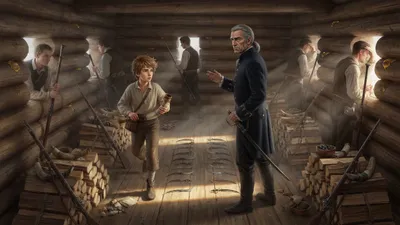
Before you read — think about:
- The defenders know roughly when an attack is coming. How should they spend that hour?
- Which counts for more in a fight: numbers, or shelter and preparation?
- Why is waiting for an attack often harder than fighting one?
- What happens to a careful plan in the first few seconds of real fighting?
- How should a small group measure whether they have come off best?
Watch for these while reading:
- How Captain Smollett readies a garrison: posts, loading, orders, and the reason he gives for each.
- The log-house at close quarters — loopholes, doorway, roof, and the ground outside each wall.
- How Stevenson handles the pace of a fight: short sentences, smoke, noise and confusion.
- The weapons of the period, and how long each of them takes to reload.
- Jim's narration under pressure — what he notices, and what he admits he failed to notice.
Vocabulary to know:
quarters (noun) — the positions each person takes up when a ship prepares to fight; slunk (verb) — moved away quietly in shame; drub (verb) — to beat thoroughly; embers (noun) — the glowing remains of a fire; girdle (noun) — a belt — here, a ring of something surrounding a place; resin (noun) — the sticky sap that oozes from pine trees; doldrums (noun) — a windless zone at sea where sailing ships could be stuck for days; musketeers (noun) — men armed with muskets; betrayed (verb) — gave away, without meaning to; hostilities (noun) — acts of war; fighting; stronghold (noun) — a strongly defended place; huzza (noun) — an old-fashioned shout of triumph or encouragement; boarders (noun) — attackers who climb aboard a ship or over a defence; marksmen (noun) — people skilled at shooting; senseless (adjective) — knocked unconscious; hurly-burly (noun) — noisy, confused commotion; mechanically (adverb) — automatically, without thinking; hanger (noun) — a short sword hung from the belt; impending (adjective) — about to happen at any second; trice (noun) — an instant; sallied (verb) — rushed out suddenly from a defended place; posture (noun) — position; the way things stand at a moment; unheeded (adjective) — not listened to; survivors (noun) — those left alive after a disaster or fight; agony (noun) — extreme pain or distress; discipline (noun) — trained obedience and self-control; computation (noun) — a count or calculation.
Chapter 22: How My Sea Adventure Began
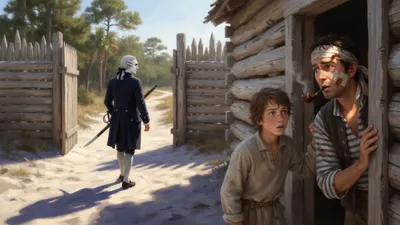
Before you read — think about:
- What is it like to be shut up somewhere with nothing to do and no news? What does that do to people?
- When is it right to keep your reasons to yourself, even from people who are depending on you?
- When does having a good reason stop excusing a bad method?
- What is the difference between a plan and an impulse dressed up as a plan?
- What is the difference between making yourself useful and getting in the way?
Watch for these while reading:
- The tally of the garrison afterwards — who can still stand a watch and who cannot.
- The heat of the afternoon and the stillness of the anchorage, and the use Stevenson makes of both.
- Jim's habit of telling you frankly, years later, what he thinks of his own conduct.
- Jim's reasons for leaving the stockade, as he gives them at the time and as he judges them later.
- The white rock and the spit, and how quietly Stevenson has been building the island's map in your head.
Vocabulary to know:
grievous (adjective) — very serious and painful; fractured (adjective) — cracked or broken, as a bone is; girt (verb) — fastened round the waist with a belt; thunder-struck (adjective) — utterly astonished; stifling (adjective) — so hot and airless it is hard to breathe; ablaze (adjective) — blazing with light or heat; escapade (noun) — a reckless adventure, usually against the rules; befall (verb) — to happen to someone, usually something bad; over-bold (adjective) — daring beyond what is wise; powder-horn (noun) — an animal horn used to carry gunpowder; ascertain (verb) — to find out for certain; warily (adverb) — cautiously, watching for danger; leaden (adjective) — dull grey, like lead; heavy and still; portrayed (verb) — shown as an exact picture; bulwarks (noun) — the raised sides of a ship above the deck; plumage (noun) — a bird's feathers; unearthly (adjective) — strange and unnatural, not like anything of this world; lop-sided (adjective) — heavier or higher on one side; badly balanced; thwart (noun) — a seat set across a small boat; propulsion (noun) — the means of driving something forward; coracle (noun) — a very small round boat made of hide stretched over a frame; portable (adjective) — light enough to be carried; truantry (noun) — the habit of slipping away from where you are supposed to be; adrift (adjective) — floating loose, with nothing holding it; repulse (noun) — the driving back of an attack; carousing (verb) — drinking and making noisy merriment; dwindled (verb) — grew steadily smaller and then vanished.
Chapter 23: The Ebb-tide Runs

Before you read — think about:
- A boat that spins instead of steering — how would that change what you could plan to do in it?
- How much of what people call courage is actually not having thought it through?
- How do people behave differently at night? Why does darkness change what feels possible?
- What do you owe the people you left behind when you go off on your own?
- At sea in the dark, what can a person actually control, and what must they simply endure?
Watch for these while reading:
- The coracle itself — how it is built, how it behaves, and why Stevenson spends so long describing it.
- Tide, wind and current in the anchorage, and how carefully Stevenson keeps track of them.
- The sounds carrying over water at night, and how much can be worked out from sound alone.
- The pirates' singing ashore, and Jim's reading of what it says about the state of the camp.
- The lit cabin window in the dark — Stevenson framing a picture inside a picture.
Vocabulary to know:
buoyant (adjective) — floating lightly and easily; seaway (noun) — rough open water with a running swell; cross-grained (adjective) — awkward and contrary; refusing to behave; leeway (noun) — the sideways drift a boat makes away from her intended course; manoeuvre (noun) — a planned movement or turn; fairway (noun) — the clear navigable channel through a harbour; loomed (verb) — appeared large and dim out of darkness or fog; spars (noun) — the poles that carry a ship's sails; hawser (noun) — a thick rope used to moor or tow a ship; sever (verb) — to cut right through; meditating (verb) — thinking something over carefully; droning (adjective) — dull and monotonous in sound; quaver (noun) — a shake or tremble in the voice; ditty (noun) — a short simple song; dolefully (adverb) — sorrowfully; mournfully; callous (adjective) — hardened; unfeeling about others' suffering; incessant (adjective) — never stopping; skiff (noun) — a small light boat; yawed (verb) — swung suddenly off course; phosphorescent (adjective) — glowing faintly with its own cold light; narrows (noun) — the narrowest part of a channel; breakers (noun) — waves collapsing into white water over shallows or rocks; billows (noun) — large rolling waves; stupor (noun) — a dazed state, half-conscious and unable to think; divined (verb) — guessed correctly without being told.
Chapter 24: The Cruise of the Coracle

Before you read — think about:
- You wake at sea in a tiny boat. What are your most urgent needs, and in what order?
- Why might a shore that looks close still be impossible to land on?
- How could a boat that cannot be steered still be used to get somewhere?
- How do you keep yourself going through something that is simply a matter of endurance?
- When you are hungry, thirsty and tired, how good are the decisions you make? What can you do about that?
Watch for these while reading:
- The southern coast of the island seen from sea level — cliffs, surf, and the way water behaves near rocks.
- The creatures on the rocks, and how Jim describes them before he has a name for them.
- How Jim works out the shape and behaviour of waves, and what he changes about his paddling as a result.
- The physical effects of thirst and sun across a long day.
- The Hispaniola's sail-handling watched from a distance, and what a seaman could read from it.
Vocabulary to know:
fringed (verb) — bordered along the edge; reverberations (noun) — echoing rumbles of sound; beetling (adjective) — jutting out overhead; overhanging; perils (noun) — serious dangers; cape (noun) — a headland reaching out into the sea; contrariety (noun) — opposition between two forces; subside (verb) — to sink down again; trough (noun) — the low hollow between two waves; disposition (noun) — the way weight or parts are arranged; baled (verb) — scooped water out of a boat; threaded (verb) — made a way through, as thread goes through cloth; toppling (adjective) — about to fall over; infallibly (adverb) — certainly; without any possibility of avoiding it; easting (noun) — distance gained toward the east; promontory (noun) — a high point of land jutting into the sea; caking (verb) — drying into a hard crust; jibs (noun) — triangular sails set forward of the mast; aback (adverb) — with the wind pressing on the wrong side of the sails, stopping the ship; shivering (verb) — flapping and shaking, of sails with no wind in them; tack (noun) — the course a sailing ship holds relative to the wind; intermittent (adjective) — stopping and starting; batten (verb) — to fasten down securely, especially a hatch; tiller (noun) — the bar used to swing a ship's rudder; blocks (noun) — the pulleys that ropes run through on a ship; redoubling (verb) — increasing greatly; trying twice as hard.
Chapter 25: I Strike the Jolly Roger

Before you read — think about:
- You have reached the thing you were chasing. What should your first concern be once you are aboard?
- What would tell you at a glance that a ship had been in the hands of people who did not care for her?
- Does somebody on the wrong side stop deserving decent treatment? Where would you draw the line?
- What do flags on a ship tell other ships, and who decides which one flies?
- What is the difference between being brave and being pleased with yourself? Can one turn into the other?
Watch for these while reading:
- The state of the deck and the cabin, and what a neglected ship looks like to someone who has seen her kept properly.
- The Jolly Roger, and what a flag is actually for at sea.
- The order in which Jim attends to himself, the ship, and the man aboard her.
- How much of Jim's vocabulary is borrowed from the grown seamen he has been listening to for months.
- Israel Hands's manner and speech — a coxswain's professional competence alongside everything else about him.
Vocabulary to know:
inboard (adverb) — swinging inward, toward the middle of a ship; boom (noun) — the long spar along the bottom edge of a sail; sheet (noun) — the rope that controls the angle of a sail; sidling (verb) — moving sideways in a shifty, uneven way; ghastly (adjective) — horrifying to look at; canting (verb) — tilting over to one side; frayed (adjective) — worn until the threads are coming apart; writhed (verb) — twisted the body in pain; ironically (adverb) — saying the opposite of what is meant, for effect; lockfast (adjective) — kept locked; gilt (noun) — a thin decoration of gold; gutted (verb) — torn out; emptied of its contents; umber (noun) — a dark brown earth colour; foraging (verb) — searching about for food or supplies; gill (noun) — a small liquid measure, about a quarter of a pint; infernal (adjective) — wretched; devilish (an old-fashioned insult); lashed (verb) — tied firmly with rope; elated (adjective) — thrilled and delighted; smitten (verb) — struck hard, as by guilt; haggard (adjective) — worn out and hollow-looking from pain or exhaustion; craftily (adverb) — with sly cunning; sparsely (adverb) — thinly scattered.
Chapter 26: Israel Hands

Before you read — think about:
- How would you behave toward somebody whose help you needed but whom you meant to see punished?
- What small signs give away a person who is lying about something ordinary?
- If you suspected a plan against you but could not prove it, what would you do differently?
- How do you keep your head when you are frightened and cannot afford to show it?
- What does it mean to grow up quickly? Can you tell while it is happening?
Watch for these while reading:
- The practical business of sailing a schooner shorthanded, and how much of it Jim has to be told out loud.
- Hands's questions, and the subjects he keeps steering back to.
- The geography of North Inlet as it is described from the deck — shore, trees, current and shoal.
- Where Jim puts his weapons, and how closely he keeps track of them.
- The double-sidedness of the conversation: courtesy on the surface, arithmetic underneath.
Vocabulary to know:
pretext (noun) — a false reason given to hide the real one; deception (noun) — a trick meant to mislead someone; scuttled (verb) — hurried with short quick steps; dirk (noun) — a short straight dagger; discoloured (adjective) — stained; changed from its proper colour; stranded (adjective) — run aground on a shore; junk (noun) — a thick lump or chunk; navigation (noun) — the skill of directing a ship's course; shoal (adjective) — shallow; subaltern (noun) — a junior officer who carries out another's orders; pilot (noun) — someone who guides a ship through difficult waters; estuary (noun) — the wide mouth of a river where it meets the sea; dilapidation (noun) — the state of falling to pieces through neglect; starboard (noun) — the right-hand side of a ship, facing forward; larboard (noun) — an old word for the left-hand side of a ship; craning (verb) — stretching the neck to see better; disquietude (noun) — a sudden feeling of unease; feints (noun) — pretended movements meant to mislead an opponent; capsized (verb) — knocked over; overturned; shrouds (noun) — the ropes running from a mast to the ship's sides, used as a ladder; cross-trees (noun) — the small platform of timbers high up a mast; ensign (noun) — a national flag flown by a ship; grizzled (adjective) — grey-haired; perplexity (noun) — complete puzzlement; fouled (adjective) — tangled together, as ropes or anchors are; articles (noun) — the written agreement a crew signs before a voyage; younker (noun) — an old sailors' word for a youngster or ship's boy; volition (noun) — an act of your own will; deliberate choice.
Chapter 27: Pieces of Eight

Before you read — think about:
- If you were hurt and alone on a grounded ship, what would have to be done before you could leave her?
- How might someone feel after coming through something they had to fight for? Is relief the only feeling?
- What would you want to say to your friends at the end of a day like that — and what would you want them to say to you?
- Why is a fire at night a risky thing on an island where enemies are camped?
- How does a familiar path feel different when you walk it in the dark?
Watch for these while reading:
- The cross-trees and the rigging — where exactly Jim is, and how a ship is put together above the deck.
- The tilt of a ship aground, and the practical difficulties it makes for anybody moving about her.
- The list of tasks Jim sets himself, and the order he puts them in.
- The island at night: firelight, sound, and how little any of it can be interpreted from a distance.
- The phrase that gives this chapter its title, and where it has come up earlier in the book.
Vocabulary to know:
lather (noun) — a mass of froth or foam; quivering (noun) — a slight trembling movement; desisted (verb) — stopped trying; gall (verb) — to rub painfully; to chafe; ungainly (adjective) — awkward and clumsy in shape; comeliness (noun) — pleasing, healthy good looks; tragical (adjective) — full of disaster and death; tremulous (adjective) — shaking slightly; cordage (noun) — all the ropes of a ship taken together; doused (verb) — lowered a sail quickly; halyards (noun) — the ropes used to haul sails up a mast; glade (noun) — an open space among trees; mantle (noun) — a covering, like a cloak; beam-ends (noun) — the position of a ship lying right over on her side; clenching (adjective) — settling an argument for good; circumspectly (adverb) — cautiously, looking all around; radiance (noun) — a glow of light; chequered (adjective) — marked with patches of light and dark; steeped (verb) — soaked; bathed thoroughly; infamous (adjective) — shockingly bad; refrain (noun) — a phrase repeated over and over in a song; wearisome (adjective) — tiring because it never stops; recoiled (verb) — sprang back suddenly; smouldering (adjective) — burning slowly without flame.
Chapter 28: In the Enemy's Camp
Before you read — think about:
- How well do you actually know somebody you have only ever seen being pleasant?
- Does telling the truth get easier or harder when you are frightened?
- What is the difference between courage and defiance? Is being defiant always brave?
- How does a leader hold on to followers who are losing faith in him?
- When is telling an enemy the whole truth a stronger move than lying to him?
Watch for these while reading:
- The inside of the log-house as it is now, and what the state of a place says about who has been living in it.
- The parrot, and the history Silver attaches to it.
- The pirates' speech among themselves — grumbling, sea-slang, and the way they conduct an argument.
- Silver's two voices in one room: how he speaks to Jim, and how he speaks to his crew.
- Jim's account of his own conduct — how he explains himself, and how much he chooses to say.
Vocabulary to know:
apprehensions (noun) — fears about what may happen; tenfold (adverb) — ten times over; enormously; swollen (adjective) — puffed up and enlarged; preening (verb) — smoothing and cleaning its feathers, as a bird does; broadcloth (noun) — fine, closely woven woollen cloth; daubed (adjective) — smeared roughly with something; briers (noun) — prickly bushes; composure (noun) — calmness and self-control; despair (noun) — complete loss of hope; incensed (adjective) — extremely angry; truculently (adverb) — aggressively; in a threatening way; gracious (adjective) — polite and pleasant, especially from a position of power; dog-watch (noun) — one of two short evening watches aboard ship; kelson (noun) — the timber running along the inside of a ship's keel — the very bottom of her; treaty (noun) — a formal agreement between two sides; bygones (noun) — things that happened in the past; scamp (noun) — a rascal; a worthless fellow; ungrateful (adjective) — showing no thanks for kindness received; hawse (noun) — the part of a ship's bow where the anchor cables run out; unruly (adjective) — disorderly; hard to control; furtively (adverb) — secretly, trying not to be noticed; dissatisfied (adjective) — unhappy with how things are being run; marlin-spike (noun) — a pointed iron tool used for working rope; staunch (adjective) — loyal and dependable; cannikin (noun) — a small metal cup; caulker (noun) — sailors' slang for a stiff drink; unaffected (adjective) — genuine; not put on.
Chapter 29: The Black Spot Again
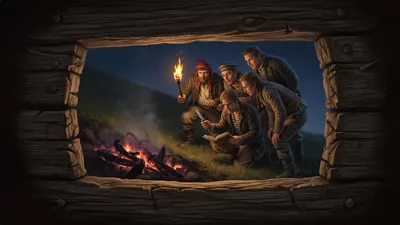
Before you read — think about:
- When a crew votes its own leader out of command, what do they have to get right for the change to stick?
- Jim saw a black spot used once before, years ago at the Admiral Benbow. What did it mean then, and who brought it?
- How does a person defend himself against several accusations at once?
- Why do people keep to rules and rituals even in a group that has broken every other rule?
- Is a leader who is feared the same thing as a leader who is followed?
Watch for these while reading:
- The forms of pirate custom — doing things 'ship-shape' and 'accordin' to rules', even among mutineers.
- George Merry and the other named hands, and how each behaves in front of a group he is trying to sway.
- Silver's technique as a debater: which charges he takes first, and what he does with each.
- Pirate superstition — oaths, luck, and the handling of things these men think sacred.
- Jim's feelings about Silver through this chapter, and how honestly he reports them.
Vocabulary to know:
emissary (noun) — someone sent to deliver a message; duskily (adverb) — dimly; with a dark, fading glow; conspirators (noun) — people secretly plotting together; deputation (noun) — a small group sent to speak for a larger one; deposed (verb) — removed from a position of power; contemptuously (adverb) — with scorn; grievances (noun) — complaints about being treated unfairly; bungling (noun) — clumsy mismanagement; gibbet (noun) — a post where the bodies of executed criminals were displayed as a warning; ague (noun) — a fever with fits of shivering; vehemence (noun) — forceful, passionate energy; ruination (noun) — the state of being ruined; total destruction; hostage (noun) — a prisoner held to force the other side to make terms; inexplicable (adjective) — impossible to explain; sentinel (noun) — a guard posted to keep watch; vengeance (noun) — punishment inflicted in return for a wrong; perilous (adjective) — extremely dangerous; environed (verb) — surrounded; slain (verb) — killed; hornpipe (noun) — a lively sailors' dance; insolence (noun) — rude, disrespectful boldness; meddling (adjective) — interfering in what is not your business; belay (verb) — a sailor's order meaning stop that; ballad (noun) — a song that tells a story.
Chapter 30: On Parole

Before you read — think about:
- A doctor has to treat everybody, including enemies. In what way might that keep him safe, and in what way might it put him in danger?
- How would you speak to people who might kill you, if you wanted them to go on listening?
- Should a promise made to an enemy be kept? What would change your answer?
- Can you respect somebody whose side you are against? What would earn that respect?
- What does it cost to be the person who has to stay calm when everybody around them is not?
Watch for these while reading:
- Eighteenth-century medicine as Dr. Livesey practises it, and how the sick men receive it.
- The word 'parole', and what it meant between enemies in this period.
- The doctor's dry jokes, and who in the room takes them well.
- Silver's conduct while somebody else is running the conversation.
- How much two people can say to each other with a third standing close enough to hear.
Vocabulary to know:
insubordinate (adjective) — disobedient to those in charge; supercargo (noun) — the officer in charge of a ship's cargo, who has an easy time of it; home-thrust (noun) — a remark that hits its target painfully; arrant (adjective) — complete; utter (used of something bad); pestiferous (adjective) — carrying disease; slough (noun) — a patch of soft, waterlogged ground; malaria (noun) — a fever caught in marshy places, carried by mosquitoes; rudiments (noun) — the first basic principles of a subject; dosed (verb) — gave medicine to; prescriptions (noun) — medicines ordered by a doctor; spluttering (verb) — spitting and coughing over something unpleasant; pledge (noun) — a solemn promise; accomplices (noun) — partners in a crime; preponderance (noun) — a clear advantage in weight or influence; dolts (noun) — stupid people; gammon (verb) — to deceive someone with smooth talk; disarray (noun) — disorder and confusion; volubility (noun) — a flood of fluent talk; squalls (noun) — sudden violent gusts of wind — here, sudden trouble; musingly (adverb) — thoughtfully, as if talking to oneself; perjury (noun) — lying under oath in a court of law; concession (noun) — something given up or granted in a negotiation; halloo (verb) — to shout loudly to attract attention; forfeit (adjective) — lost as a penalty; given up as the price of something; wolf-trap (noun) — a trap set for a dangerous animal — used here for a deadly situation.
Chapter 31: The Treasure-hunt: Flint's Pointer
Before you read — think about:
- Silver needs Jim alive. How safe does that actually make him?
- What can you learn about people from the way they handle food, tools and supplies?
- A chart gives directions but not an exact spot. What else would you need to turn directions into a place?
- How does a person's reputation outlast them? Why do stories about somebody grow rather than fade?
- What would make a leader keep his followers bunched together rather than let them spread out?
Watch for these while reading:
- The pirates' housekeeping — their food, their fire and their stores — and what Jim makes of it.
- How Jim is brought along on the march, and the comparison he uses for himself.
- The written directions on the chart, and the practical business of following bearings over rough ground.
- The island's inland country: the plateau, the pines, the nutmeg and azalea thickets, the heat.
- The name of Flint, and the different ways different men say it.
Vocabulary to know:
glint (noun) — a tiny flash or gleam; prolonged (adjective) — drawn out over a long time; recklessness (noun) — careless disregard for danger or consequences; feasible (adjective) — able to be done; traitor (noun) — someone who betrays the side he belongs to; cession (noun) — the handing over of something to another person; burthened (adjective) — loaded down (an old spelling of 'burdened'); subsist (verb) — to survive on very little; straggled (verb) — moved along in a loose, untidy line; plateau (noun) — a broad area of high, level ground; adjoining (verb) — joining onto; next to; eminence (noun) — a piece of rising ground; prematurely (adverb) — too soon; earlier than is wise; cleft (noun) — a deep split or narrow valley; miry (adjective) — boggy and muddy; aroma (noun) — a strong pleasant smell; nutmeg (noun) — a tropical tree whose seed is used as a spice; tethered (adjective) — tied by a rope; creeper (noun) — a plant that grows along the ground or up other plants; enveloped (verb) — wrapped completely around; numbskull (noun) — a stupid head; a blockhead; doit (noun) — a coin of tiny value; bated (adjective) — held back; hushed; gabbling (verb) — chattering rapidly and meaninglessly.
Chapter 32: The Treasure-hunt: The Voice Among the Trees

Before you read — think about:
- A frightened group is walking toward something it badly wants. Which feeling usually wins?
- What kinds of argument work on people who are superstitious?
- What is the difference between being brave and simply having nothing left to lose?
- Why would a leader risk mocking the very thing his followers are afraid of?
- What happens to people's judgement when they are within sight of something they have wanted for years?
Watch for these while reading:
- How each of the named pirates behaves differently under the same fright.
- Silver's arguments against the men's fears, and whether they hold together when you examine them.
- The old songs and sayings of Flint's crew, and how much of their world is carried inside them.
- The high ground of the island — its view, its trees, its air — as the party climbs.
- What Jim reads in Silver's face, and how much he trusts his own reading.
Vocabulary to know:
ascent (noun) — a climb upward; precipices (noun) — sheer cliff faces; enchantment (noun) — magic; a spell; grovelled (verb) — threw himself face down on the ground; ashen (adjective) — grey-white with fear; skylarking (verb) — playing about; fooling around; wailed (verb) — cried out in a long mournful voice; unconquered (adjective) — not beaten; still holding out; irreverence (noun) — disrespect toward something others treat as sacred; severally (adverb) — separately; each on his own; superstitious (adjective) — believing in luck, omens, and spirits; azalea (noun) — a flowering shrub; underwood (noun) — the small trees and bushes growing beneath tall trees; extravagance (noun) — wild spending; murderous (adjective) — intending to kill; wretchedness (noun) — deep misery; ungodly (adjective) — wicked; without any respect for right and wrong; excavation (noun) — a hole that has been dug out; strewn (adjective) — scattered about; branded (adjective) — burned on with a hot iron as a mark; rifled (verb) — searched through and robbed; probation (noun) — proof.
Chapter 33: The Fall of a Chieftain

Before you read — think about:
- What holds a group of dangerous men together, and what sort of thing could dissolve it?
- How does a person decide which side to be on when both sides are dangerous to him?
- Does getting what you wanted usually feel the way you expected it to? Why, or why not?
- How much do you owe somebody who has kept you safe for reasons of their own?
- When two people have each been using the other, what is left between them at the end?
Watch for these while reading:
- Where Silver places himself and Jim as the party comes up to the tall tree.
- The great trees on the plateau, and the practical difficulty of matching a chart's words to real ground.
- The account given of how matters stood at the stockade during the days Jim was away.
- How the men's mood shifts in a few pages, and what Stevenson uses to move it.
- Stevenson's pacing here: how much story he packs into a few pages, and what he passes over.
Vocabulary to know:
overturn (noun) — a complete reversal of fortune; forbear (verb) — to hold back from doing something; revolted (adjective) — disgusted; cub (noun) — a young animal — used as an insult for a boy; teetotum (noun) — a small spinning top; verge (noun) — the very edge of a state or condition; wriggling (verb) — twisting about awkwardly; haft (noun) — the handle of a tool or weapon; wormed (verb) — got something out of someone by patient questioning; diagonal (noun) — a slanting line across something; demolished (verb) — smashed to pieces; fatigue (noun) — extreme tiredness; cordial (adjective) — warm and friendly; imposter (noun) — someone who pretends to be what he is not; prosecute (verb) — to bring someone to trial; mill-stones (noun) — huge grinding stones — a byword for a crushing weight; dereliction (noun) — a serious failure to do one's duty; quadrilaterals (noun) — four-sided shapes; amassing (noun) — the gathering together of a great quantity; delicacies (noun) — special, choice foods; bland (adjective) — smoothly pleasant in manner; obsequious (adjective) — overly eager to serve and please.
Chapter 34: And Last

Before you read — think about:
- A fortune in coin has to be got aboard a ship. What makes that a bigger job than it sounds?
- After a long stretch of danger, what is the first ordinary job that has to be done?
- How do people spend a sudden fortune? Does character predict it?
- What does a person owe to somebody who once protected them but did great harm to others?
- After an adventure like this one, what would you want to happen to you next?
Watch for these while reading:
- The coins themselves — the countries and reigns they come from, and what Jim makes of handling them.
- The labour of moving and shipping a fortune, and who does which part of it.
- How Stevenson winds up a long book: which threads he ties off, and how briefly.
- The closing account given of each character, and how much space Stevenson allows to each.
- The last paragraph, and the note the whole book is left on.
Vocabulary to know:
transportation (noun) — the carrying of something from one place to another; onslaught (noun) — a fierce sudden attack; minted (adjective) — made into coins; hoard (noun) — a hidden store of money or valuables; diversity (noun) — great variety; coinage (noun) — the coins of a country, taken together; moidores (noun) — old Portuguese gold coins; sequins (noun) — old Venetian and Turkish gold coins; slights (noun) — small insults; unwearying (adjective) — never tiring; ingratiate (verb) — to work at making people like you; gruffly (adverb) — in a rough, short-tempered voice; humane (adjective) — showing kindness and mercy; raving (adjective) — talking wildly because of fever or madness; quoth (verb) — an old word meaning 'said'; necessaries (noun) — the basic supplies a person needs; inexpressible (adjective) — too great to put into words; baffling (adjective) — shifting and unhelpful, of winds; sojourn (noun) — a temporary stay in a place; contortions (noun) — awkward twistings of the body; connived (verb) — secretly helped something wrong to happen; smit (verb) — struck (an old form of 'smitten'); butt (noun) — a person others make fun of; man-of-war (noun) — a naval warship.
About the Author
Robert Louis Stevenson was born in Edinburgh, Scotland, in 1850, into a family of famous lighthouse engineers who expected him to follow them into the profession. Poor health kept him indoors for much of his childhood, and he spent those hours reading and inventing stories. He trained as a lawyer, then abandoned law for writing, and travelled constantly in search of a climate his lungs could tolerate. He began Treasure Island in 1881 on a rainy holiday, after drawing a map of an imaginary island to entertain his young stepson; the story grew out of the map rather than the other way around. It appeared first as a magazine serial and then as a book in 1883, and it made him famous. He went on to write Kidnapped, The Strange Case of Dr. Jekyll and Mr. Hyde, and a much-loved book of poems for children, before settling in Samoa in the South Pacific, where he died in 1894 at the age of forty-four.
The novel is set in the middle of the eighteenth century, a generation or two after the era historians call the golden age of piracy had already ended. Britain was a seafaring nation whose wealth moved on wooden ships, and an ordinary sailor's life was dangerous, badly paid, and harshly disciplined. Stevenson wrote in the 1880s, at the height of the Victorian appetite for adventure stories aimed at young readers, in the language of his own century — so a few words and attitudes belong to 1883 rather than to today, and are worth pausing over.