

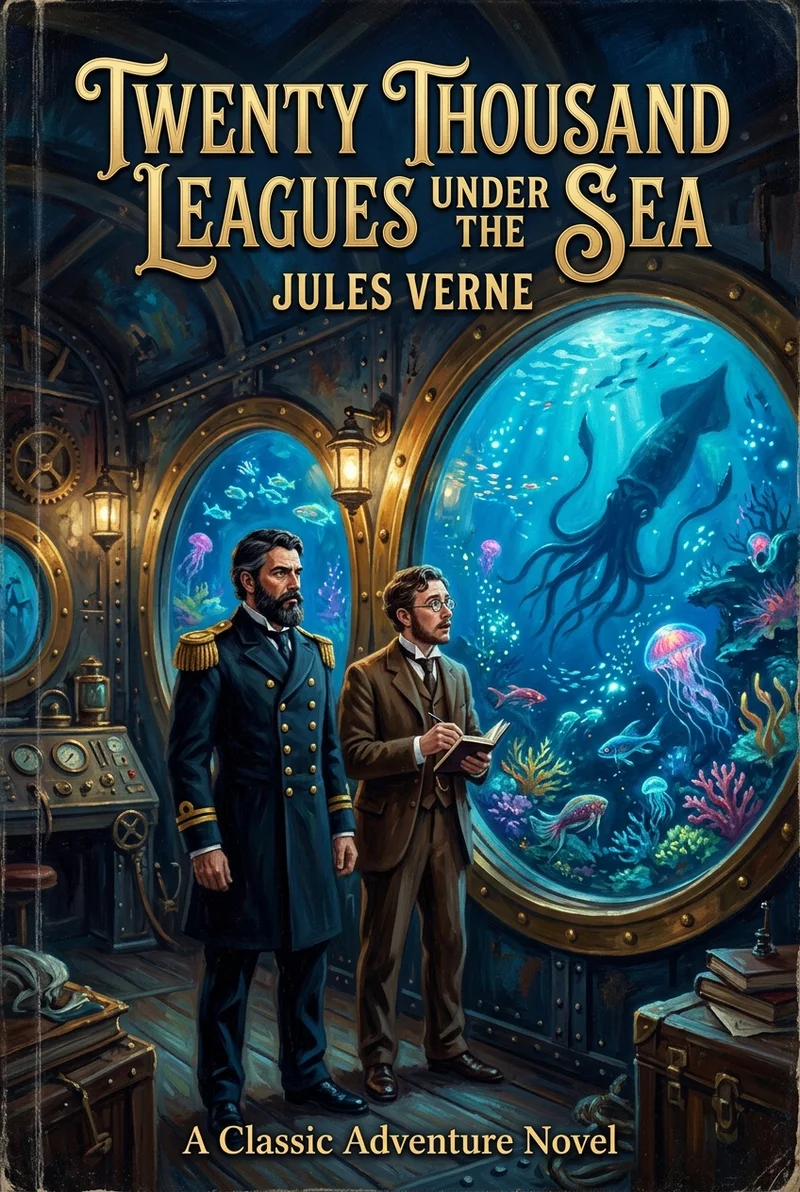
About This Book
In the spring of 1866, ships all over the world begin reporting the same impossible thing: an enormous glowing shape moving through the ocean faster than any vessel afloat. Some captains call it a giant narwhal, others a floating reef, and a few insist it is a machine. When the creature tears a hole in a steamship's hull, the newspapers demand action, and the United States government fits out a fast frigate to hunt the thing down and clear the sea lanes once and for all. Aboard that frigate are three men who will spend the rest of the novel together: Pierre Aronnax, a French professor of natural history who is invited along as the world's leading expert on deep-sea life; Conseil, his unshakably calm servant, who classifies every creature he meets and never complains; and Ned Land, a Canadian harpooner with a temper as famous as his aim. For months they search empty water. Then, one night in the Pacific, they find what they are looking for — and discover that it is not an animal at all. What follows is one of the most famous voyages in all of literature. Verne takes his readers through coral forests and sunken cities, across the floor of the Pacific, into the polar ice, and down into depths no human being of his century had ever seen. At the center of it all stands the vessel's commander, a man who calls himself Captain Nemo — a brilliant scientist and engineer who has turned his back on every nation on earth and will not say why.
This is the book that taught the world to imagine the ocean floor, and it still works because Verne makes the science as thrilling as the adventure. Readers who like survival stories, mysteries, or science fiction will find all three here, along with a question that gets harder the longer you think about it: is the professor a guest on the Nautilus, or a prisoner? Middle school readers also meet a genuinely complicated character in Captain Nemo, a man who is generous and cruel, admirable and frightening, sometimes on the same page — the kind of character that makes a class argument worth having. And because Verne wrote in 1870 about submarines, electric power, and scuba diving gear that would not exist for decades, the novel is a rare chance to watch an author guess at the future and get an astonishing amount of it right.
Meet the Characters

More about Professor Pierre Aronnax
Pierre Aronnax is a professor at the Museum of Natural History in Paris and the author of a respected book about life in the deep sea. As the story opens he is returning from a scientific expedition when the world's newspapers fill with reports of a mysterious sea monster, and his opinion is suddenly in demand. He is curious, patient, and a little vain about his learning, and he would rather understand a thing than fight it.

More about Conseil
Conseil has followed Professor Aronnax on ten years of scientific journeys and would follow him anywhere else without complaint. He is unshakably calm, tireless, and endlessly good-natured, with a passion for sorting every living thing he meets into its proper scientific class and order. Oddly for a man whose name means "advice" in French, he never offers any — he simply does what is needed.

More about Ned Land
Ned Land comes from a family of Quebec fishermen and is famous across the whaling fleets as the quickest and surest harpooner alive. He is grave, blunt, and slow to talk, but quick to anger when he is contradicted, and he trusts what his own eyes and hands tell him far more than any professor's theory. He speaks French as well as English, which draws him to Professor Aronnax almost against his will.

More about Captain Nemo
Captain Nemo commands a vessel unlike any other in the world, built and supplied entirely by his own genius and resources. He is a scientist, engineer, musician, and collector of astonishing learning, and he speaks with the absolute authority of a man used to being obeyed. Cold and courteous by turns, he has cut every tie to the nations of the land, and he guards the reasons why very closely.
Pre-Reading Discussion Questions
- In 1866 the deep ocean was almost completely unexplored. What do you think people in that century imagined was down there, and how might that shape the way sailors in this book react to something strange in the water?
- When several trustworthy people report seeing something impossible, how should the rest of us decide what to believe? What kind of evidence would convince you?
- The novel's title promises a journey of twenty thousand leagues under the sea. What do you expect a story set almost entirely underwater will need in order to stay exciting?
- Is a person who takes you aboard, feeds you, and treats you well, but will never let you leave, your host or your captor? Does the kindness change anything?
- Think of an invention that gave one person or group enormous power over everyone else. What responsibilities, if any, come with holding a technology no one else has?
- Can someone who has been badly wronged ever be justified in taking revenge on their own? Where would you draw the line?
Themes & Big Ideas to Track
- Freedom and captivity: watch how each of the three castaways defines being free, and notice that they never quite agree with one another.
- The scientist's dilemma: Aronnax is offered the discovery of a lifetime at the price of his liberty, and he must keep deciding whether the trade is worth it.
- Knowledge as power: the Nautilus exists because one man understood things nobody else did, so track what he chooses to do with that advantage.
- The sea as both wonder and threat: Verne's ocean is beautiful, generous, and completely indifferent to whether human beings survive it.
- The cost of cutting yourself off: notice what Captain Nemo has gained by leaving humanity behind, and what it appears to have cost him.
- Revenge and its limits: pay attention to the moments when the captain's grief and anger begin to steer the voyage.
Chapter-by-Chapter Study Guide
Chapter 1: A Shifting Reef
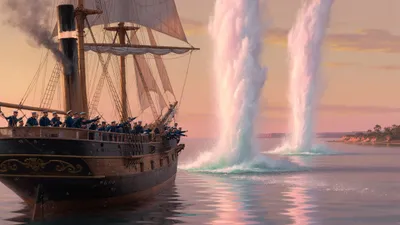
Before you read — think about:
- Many people know the 1954 Disney movie of this famous underwater adventure. What people, objects, and settings do you already picture in the ocean — and how will you notice what THIS chapter actually shows, on the surface, in newspapers and on charts?
- What is the difference between a rumour, a report, and a proof?
- In 1866 a strange sighting at sea could take weeks to reach a newspaper, and many charts still had blank water. How do news and maps reach you now?
- At what point should a government spend public money on a story sailors keep repeating?
- A reef is a fixed thing on a chart, which is what makes charts useful. What would it mean for navigation if something that size could move?
Watch for these while reading:
- Verne's habit of stacking dates, ship names, tonnages, and coordinates on top of one another, and what all that paperwork does to a tall tale
- The disagreements among the witnesses about length, speed, and shape, and how each of them arrived at their figures
- The different vocabulary used for the thing in the water — object, animal, phenomenon, reef — and who prefers which word
- The narrator's voice: he is writing after the fact, and he addresses you directly about how much you already know
- Which ships, places, and names actually appear in this chapter, compared with any 1954 Disney underwater movie you already know
Vocabulary to know:
phenomenon (noun) — a remarkable event or fact that people notice and try to explain; maritime (adjective) — having to do with the sea, ships, and sailing; phosphorescent (adjective) — giving off a soft glow of light without burning; apparition (noun) — something strange that appears suddenly, as if it were a ghost or vision; cetacean (noun) — a sea mammal such as a whale, dolphin, or porpoise; locomotion (noun) — the power of moving from place to place; velocity (noun) — speed, especially the speed of something moving in a straight line; nautical (adjective) — relating to ships, sailors, and navigation at sea; kraken (noun) — a monstrous sea creature of old Norwegian legend, said to drag ships under; abyss (noun) — a bottomless depth, especially the deepest part of the ocean; credulous (adjective) — too ready to believe something without proof; savant (noun) — a learned person, a scholar or scientist; controversy (noun) — a long public argument in which people take strong opposite sides; satirical (adjective) — using humor and mockery to attack an idea or a person; delirious (adjective) — confused and seeing things that are not there, as if in a fever; keel (noun) — the long beam running along the bottom of a ship that forms its backbone; eddy (noun) — a small whirlpool of swirling water; scrupulous (adjective) — extremely careful and exact about every detail; imminent (adjective) — about to happen at any moment; impunity (noun) — freedom from harm or punishment; influx (noun) — a flowing in, especially of water; prodigious (adjective) — enormous, far beyond the ordinary; retrograde (adjective) — moving backward; inexplicable (adjective) — impossible to explain or account for; formidable (adjective) — causing fear or respect because of size, strength, or power; peremptorily (adverb) — in a way that leaves no room for argument or refusal; intermittent (adjective) — stopping and starting again at intervals rather than steadily; geyser (noun) — a natural spring that shoots hot water and steam into the air.
Chapter 2: Pro and Con
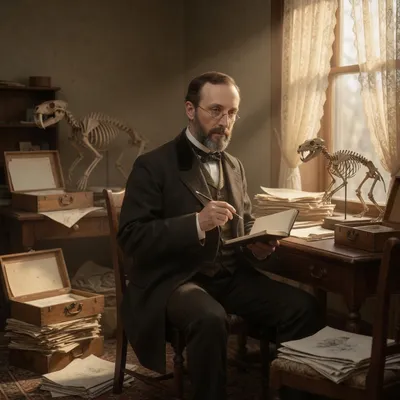
Before you read — think about:
- Many people know the 1954 Disney movie of this underwater adventure. What experts, papers, and public arguments do you already picture — and how will you notice the debate actually on THIS page?
- When everyone wants you to pick a side, what is the cost of saying you are not sure yet?
- In the 1860s a scientist answered the public in a magazine article that took weeks to print and mail. How does an expert share an opinion with the world now?
- Scientists are trained to say 'not yet proved.' Why is that answer so unsatisfying to everybody else?
- The title 'Pro and Con' names a way of thinking. Where in your own life do you argue both sides before you decide?
Watch for these while reading:
- How the narrator introduces himself — the work he mentions, the tone he takes about it, and what he leaves out
- The order in which he takes up each possible explanation, and the reasoning he uses on each
- The exact wording of his published article, especially the room he leaves himself at the end of it
- Verne's use of real institutions and real publications to make an invented debate feel documented
- Which people, papers, and places actually appear in this chapter, compared with any 1954 Disney version of this story you already know
Vocabulary to know:
hypothesis (noun) — a proposed explanation offered as a starting point for testing; shoal (noun) — a shallow place in the sea, often a bank of sand; colossal (adjective) — gigantic, far larger than anything of its kind; plausible (adjective) — seeming reasonable and likely to be true; ingenuity (noun) — cleverness at inventing and building things; veracity (noun) — truthfulness; the quality of being honest; quarto (noun) — a large book size made by folding printed sheets into four leaves; categorically (adverb) — in a clear and absolute way, leaving no doubt; conjecture (verb) — to guess at something without enough evidence to be certain; narwhal (noun) — an Arctic whale whose male has a single long spiral tusk; halberd (noun) — a long-handled weapon with an axe blade and a spike; tusk (noun) — a very long pointed tooth that sticks out of an animal's mouth; gimlet (noun) — a small hand tool with a screw point for boring holes; naturalist (noun) — a scientist who studies plants, animals, and the natural world; partisan (noun) — a strong and loyal supporter of one side in a dispute; terrestrial (adjective) — living on land rather than in the sea; mercantile (adjective) — having to do with trade and merchants; unanimous (adjective) — in complete agreement, with no one disagreeing; arsenal (noun) — a place where weapons and military supplies are stored and made; capricious (adjective) — changing suddenly and unpredictably, on a whim; strata (noun) — layers, here the layers of water at different depths of the sea; sounding (noun) — a measurement of the depth of water, taken with a weighted line; jester (noun) — someone who makes jokes, especially at another's expense.
Chapter 3: I Form My Resolution

Before you read — think about:
- Many people know the 1954 Disney movie of this hunt. What people and ships do you already picture leaving harbour — and how will you notice who actually walks onto THIS page?
- In the 1860s a government invitation arrived as a paper letter at a hotel, and you answered by going there in person. How do job offers and invitations reach you now?
- A first-person narrator tells you his own mind in the same breath as a ship's fittings. What does that mix of inner life and machinery do for a reader?
- Why do people keep an assistant with them for years?
- The title is 'I Form My Resolution.' What is the difference between forming a resolution and simply agreeing?
Watch for these while reading:
- Conseil, introduced here: his manner of addressing his master, and the kind of talk he offers
- The letter itself — who it is from, and the tone it takes
- The Abraham Lincoln — her engines, her speed, her fittings, and the care Verne takes over them
- Commander Farragut and the mood aboard on the day of sailing
- Which people, ships, and harbour scenes actually appear in this chapter, compared with any 1954 Disney departure you already picture
Vocabulary to know:
vocation (noun) — the work a person feels called to do with their life; purge (verb) — to clear something away completely, to rid a place of it; repose (noun) — rest and quiet; antipodes (noun) — places on the exact opposite side of the world; phlegmatic (adjective) — calm and hard to excite, no matter what happens; zealous (adjective) — eager and enthusiastic in doing one's duty; portmanteau (noun) — a large travelling case or trunk that opens into two halves; ceremonious (adjective) — very formal and polite, sometimes annoyingly so; impassive (adjective) — showing no feeling or reaction; hazardous (adjective) — full of danger and risk; menagerie (noun) — a collection of live wild animals kept for study or display; evasively (adverb) — in a way that avoids answering directly; quay (noun) — a landing place built along the water where ships tie up; resplendent (adjective) — shining brilliantly, dazzling to look at; buoy (noun) — a floating marker anchored in place to guide ships; schooner (noun) — a sailing ship with two or more masts, rigged fore and aft; mooring (noun) — a rope or cable that holds a ship fast to a pier; scepticism (noun) — doubt about whether something is true; frigate (noun) — a fast warship, smaller than a ship of the line; whelk (noun) — a sea snail with a thick spiral shell.
Chapter 4: Ned Land
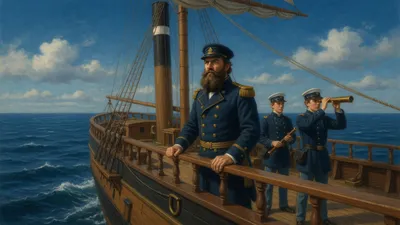
Before you read — think about:
- Many people know the 1954 Disney movie of this adventure, and a harpooner who is often the movie's loudest sailor. What people and jobs do you already picture aboard a hunt — and how will you notice the Ned Land actually on THIS page?
- In the 1860s a naval lookout used his eyes, a spyglass, and a shout from the mast. How does a ship or a plane spot something at sea now?
- Adventure novels sometimes stop to explain the science. Does that add to the excitement or interrupt it?
- What is the difference between skill with tools and skill with arguments?
- This chapter is named for one person. What do you expect a chapter titled with a name to show you first?
Watch for these while reading:
- Ned Land — his build, his silence, his accent, and the way the narrator describes his skill
- The difference between what Ned offers as evidence and what Aronnax offers
- How the lookout watches are organised, and the daily talk on deck
- The narrator's occasional slip into a later time, as a man writing all this down long afterwards
- Which people, jobs, and shipboard habits actually appear in this chapter, compared with any 1954 Disney crew you already know
Vocabulary to know:
leviathan (noun) — an enormous sea monster of legend or scripture; desolate (verb) — to lay waste to a place and leave it ruined and empty; berth (noun) — a sleeping place or assigned station aboard a ship; rigging (noun) — the system of ropes and chains that supports a ship's masts and sails; forecastle (noun) — the raised deck at the front of a ship; blunderbuss (noun) — a short gun with a wide muzzle, here adapted to fire barbed harpoons; barbed (adjective) — having a backward-facing point that makes a weapon hard to pull out; breech (noun) — the back part of a gun barrel, where the charge is loaded; conical (adjective) — shaped like a cone, pointed at one end; projectile (noun) — an object fired from a gun; apparatus (noun) — the equipment needed for a particular job; harpooner (noun) — a sailor whose job is to throw the barbed spear that catches whales; audacity (noun) — bold daring, a willingness to take great risks; cachalot (noun) — a sperm whale; taciturn (adjective) — saying very little; not talkative by nature; recital (noun) — the telling of a story aloud from beginning to end; conviction (noun) — a firm belief that something is true; leeward (adjective) — on the side away from the wind; antediluvian (adjective) — belonging to the ancient world before recorded history; extremely old; chimera (noun) — an imaginary creature or a wild fancy that cannot really exist; vertebrate (noun) — an animal that has a backbone; incalculable (adjective) — too great to be measured or counted; equilibrium (noun) — a state of balance between opposing forces; hydraulic (adjective) — worked by the pressure of a liquid; obstinate (adjective) — stubbornly refusing to change one's mind.
Chapter 5: At a Venture
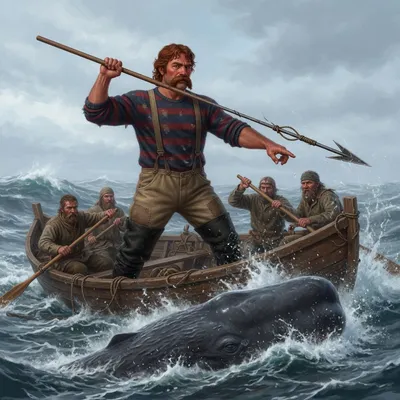
Before you read — think about:
- Many people know the 1954 Disney movie of this hunt at sea. What oceans, ships, and daily work do you already picture — and how will you notice the voyage actually on THIS page?
- Sailors in the 1860s spent months at sea with no letters from home and no way to send a message from mid-ocean. How is that different from a long trip you take now?
- Verne published his novels a few chapters at a time in a magazine. How might writing to that rhythm shape the way a long voyage gets told?
- 'At a venture' means acting on chance rather than on a plan. When is that a reasonable way to look for something?
- Verne gives exact dates, latitudes, and longitudes page after page. What does that kind of precision do for a reader?
Watch for these while reading:
- The route itself — Cape Horn, the Straits, the Pacific crossing — and the way Verne keeps the ship's log for you
- Ned Land's eyesight and his manner on lookout, and how he differs from the men in the rigging
- The bargain Commander Farragut strikes with his crew, and the words he chooses to strike it in
- The talk on deck — the wagers, the nicknames for the thing, and how the men fill a long watch
- Which oceans, ports, and shipboard jobs actually appear in this chapter, compared with any 1954 Disney hunt you already know
Vocabulary to know:
dexterity (noun) — great skill and quickness, especially with the hands; tortuous (adjective) — full of twists and turns; nyctalope (noun) — a creature or person able to see in the dark; taffrail (noun) — the rail around the stern of a ship; wake (noun) — the trail of disturbed water a ship leaves behind it; ratlines (noun) — the small ropes tied across a ship's rigging to make a ladder; starboard (adjective) — on the right-hand side of a ship, looking forward; execration (noun) — a curse or shout of loathing; auspices (noun) — signs promising success; favorable circumstances; meridian (noun) — a line of longitude running from pole to pole; scour (verb) — to search a place thoroughly and rapidly; palpitate (verb) — to beat rapidly, as a heart does under strain; misconception (noun) — a mistaken idea about what something is; furrow (verb) — to cut a long groove through something, as a ship cuts through water; deviation (noun) — a turn away from a planned course; veer (verb) — to change direction suddenly; tack (noun) — the course a ship takes in relation to the wind; detractor (noun) — someone who criticizes and belittles a plan or a person; resolute (adjective) — firmly determined and not to be moved; discontent (noun) — unhappiness with the way things are, often expressed openly; mutiny (noun) — an open rebellion by a crew against their officers; defiance (noun) — open resistance or a bold challenge; apathy (noun) — a complete lack of interest or response; undulate (verb) — to move in smooth waves.
Chapter 6: At Full Steam
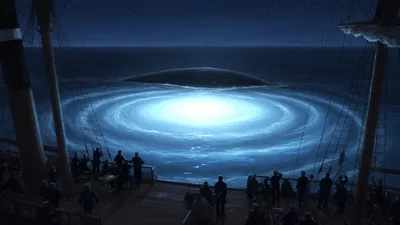
Before you read — think about:
- Many people know the 1954 Disney movie of this adventure, where a chase is often short and loud. What lights, speeds, and ships do you already picture — and how will you notice the night actually on THIS page?
- Ships of the 1860s were changing from sail to steam, and a vessel in mid-ocean still could not send a telegram. How does a ship at sea send and receive news now?
- How can a writer make a chase feel long without making it dull?
- What is the difference between hunting something and measuring it?
- Sound at night can tell you as much as sight. What night sounds do you already know how to read?
Watch for these while reading:
- The behaviour of the light in the water — how it moves, how it dims, how it travels
- The speeds Verne records for both the frigate and the thing, measured over and over through the night
- The tactics Farragut chooses hour by hour, and the reason he gives for each of them
- Where Ned Land stations himself during the night
- Which lights, sounds, and people actually appear in this night chase, compared with any 1954 Disney chase you already know
Vocabulary to know:
momentum (noun) — the force that keeps a moving object going after the power is cut; fathom (noun) — a unit for measuring the depth of water, equal to six feet; irradiation (noun) — a spreading out of light in all directions; luminous (adjective) — giving off light; glowing; agglomeration (noun) — a clustered mass of many small things heaped together; gradation (noun) — a gradual change from one degree to the next; elongated (adjective) — stretched out and longer than it is wide; stupefaction (noun) — a state of being so astonished that one cannot move or speak; envelop (verb) — to wrap something up completely on all sides; emanation (noun) — something that flows or streams out from a source; abate (verb) — to grow less; to die down; manoeuvre (noun) — a planned and skillful movement of a ship or vehicle; imprudently (adverb) — in a way that is unwise and takes needless risks; gymnotus (noun) — an electric eel; glow-worm (noun) — a small creature that gives off a soft greenish light; windward (adjective) — on the side from which the wind is blowing; engulf (verb) — to swallow up completely; cylinder (noun) — the tube-shaped chamber in an engine where steam or gas drives a piston; manometer (noun) — an instrument for measuring the pressure of steam or gas; spy-glass (noun) — a small handheld telescope; caudal (adjective) — relating to an animal's tail; appendage (noun) — a part that sticks out from the main body of an animal; funnel (noun) — a ship's smokestack; propel (verb) — to drive something forward; disdain (verb) — to treat something as beneath one's notice; indefatigably (adverb) — tirelessly, without ever giving up; insensible (adjective) — unable to feel something; adversary (noun) — an opponent in a fight or contest; bowsprit (noun) — the long spar sticking forward from a ship's bow; brandish (verb) — to wave a weapon about in a bold or threatening way; sonorous (adjective) — deep, loud, and ringing; waterspout (noun) — a tall column of water thrown into the air; bulwark (noun) — the raised side of a ship above the deck.
Chapter 7: An Unknown Species of Whale
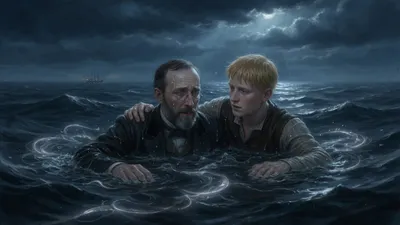
Before you read — think about:
- Many people know the 1954 Disney movie of this adventure. What do you already picture when a ship and something huge meet at sea — and how will you notice the people, the water, and the dark actually on THIS page?
- In the 1860s a ship at night used oil lamps, shouting, and a lookout's ears. How do people on the water see and call to each other after dark now?
- Verne wrote for readers who had never been to sea. How does an author make a completely unfamiliar place feel real?
- A first-person narrator can only report what he himself notices. What does a story gain from that limit, and what does it lose?
- The chapter title calls the thing 'an unknown species of whale.' How much weight should a reader put on a chapter title?
Watch for these while reading:
- Aronnax's first minutes in the water — what he does to stay afloat, and how he keeps his bearings in the dark
- The physical sensations he records: cold, weight, buoyancy, the taste of the sea, what he can and cannot hear
- The way Verne uses shouts and voices in the dark, when nothing at all can be seen
- The hours counted off through the night, and how Aronnax keeps track of them
- Which people, sounds, and stretches of water actually appear in this chapter, compared with any 1954 Disney night-at-sea you already know
Vocabulary to know:
encumber (verb) — to weigh down and make movement difficult; paralyse (verb) — to make something unable to move; suffocate (verb) — to be unable to breathe; beacon (noun) — a light used as a signal or guide; imperturbable (adjective) — impossible to upset or alarm; self-possessed (adjective) — calm and in full control of oneself under pressure; husband (verb) — to use something sparingly so that it lasts longer; practicable (adjective) — able to be done in practice, not just in theory; dispel (verb) — to drive away or scatter; quicksilver (noun) — an old name for mercury, a shining silver liquid metal; cramp (noun) — a sudden painful tightening of a muscle; devolve (verb) — to pass to someone else as a duty or burden; discernible (adjective) — just barely able to be seen or made out; articulate (verb) — to speak words clearly; convulsively (adverb) — with sudden uncontrollable jerking movements; carapace (noun) — the hard shell covering the back of an animal such as a turtle; amphibious (adjective) — able to live both in water and on land; riveted (adjective) — fastened together with metal bolts hammered flat; impenetrable (adjective) — impossible to get through or into; hemisphere (noun) — one half of the globe; aperture (noun) — an opening or gap; fugitive (adjective) — fleeting; lasting only a moment before it is gone; lull (noun) — a brief pause in noise or activity; inhospitable (adjective) — unwelcoming; refusing to receive guests kindly; waning (adjective) — growing smaller or fading away.
Chapter 8: Mobilis in Mobili
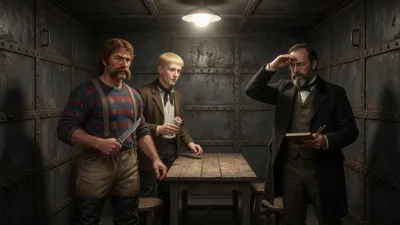
Before you read — think about:
- Many people know the 1954 Disney movie of this adventure, and a grand iron interior. What rooms, objects, and people do you already picture inside a mysterious vessel — and how will you notice what is actually on THIS page?
- In 1870, indoor electric light was still a wonder; most rooms were lit by oil lamps or gas. How do you light a room now, and what would have surprised you about a brightly lit iron cabin then?
- What can the objects in a room tell you about the people who use it?
- Why do mottos and Latin phrases get engraved on everyday objects?
- The Latin title means roughly 'moving within the moving element.' What sort of thing could that describe, and what sort of person would take it as a motto?
Watch for these while reading:
- The cell itself — its dimensions, its furnishings, and the things a room normally has that this one does not
- The source of the light in the cabin, and how startling that would have been to a reader in 1870
- Every detail of the tall stranger's face, bearing, and manner
- The dinner service — the metal it is made of, and the letter and motto engraved on every piece
- Which rooms, objects, and people actually appear in this first look inside, compared with any 1954 Disney vessel you already know
Vocabulary to know:
abduction (noun) — the act of carrying someone off by force; indignation (noun) — anger at being treated unfairly; compromise (verb) — to put someone in danger by acting rashly; steward (noun) — a crew member who serves meals and looks after passengers; hermetically (adverb) — sealed so completely that no air or water can pass; minutely (adverb) — in great detail, examining every small part; robust (adjective) — strong and sturdily built; vivacity (noun) — liveliness of manner; disciple (noun) — a student and follower of a particular teacher or school of thought; prevailing (adjective) — strongest and most noticeable; assurance (noun) — complete confidence in oneself; lofty (adjective) — high; here, a high and broad forehead; taper (adjective) — growing gradually narrower toward the end; temperament (noun) — a person's natural character and way of reacting; faculty (noun) — a natural power or ability; opaque (adjective) — impossible to see through; countenance (noun) — a person's face, especially as it shows feeling; dialect (noun) — a particular form of a language spoken by one group of people; accentuation (noun) — the way syllables are stressed in speech; incomprehensible (adjective) — impossible to understand; intelligible (adjective) — able to be understood; nonplussed (adjective) — so puzzled that one has no idea what to do next; impetuous (adjective) — acting quickly and without thinking; irascible (adjective) — easily made angry; rancorous (adjective) — bitter and resentful; facsimile (noun) — an exact copy of something.
Chapter 9: Ned Land's Tempers
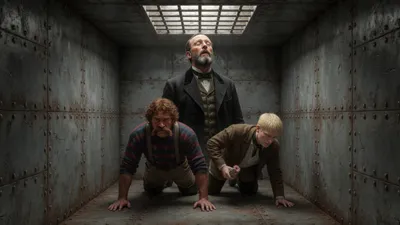
Before you read — think about:
- Many people know the 1954 Disney movie of this adventure, where prisoners often joke their way through a waiting scene. What tempers and locked rooms do you already picture — and how will you notice the three men actually on THIS page?
- Ships in the 1860s told time with bells and a chronometer, not with a phone in a pocket. How do you tell the time now if every clock and screen went dark?
- The title is 'Ned Land's Tempers.' What does a temper show that a speech might hide?
- Hunger and uncertainty work on people differently. Which one do you think is harder to sit with, and why?
- Under pressure some people go quiet and others get loud. Which are you, and what does each response cost a group?
Watch for these while reading:
- The cell as Aronnax examines it — what has changed, and what has not
- The air, the sounds, and the motion: what can be noticed without a window
- Ned Land's manner as the hours pass, and how Aronnax reads it
- How each of the three men talks about being shut in
- Which moods, objects, and people actually appear in this waiting chapter, compared with any 1954 Disney captivity scene you already know
Vocabulary to know:
rouse (verb) — to wake up or stir from sleep; oppress (verb) — to weigh down heavily and make breathing or moving hard; respiration (noun) — the act of breathing; carbonic (adjective) — containing carbon; here describing the gas breathed out by people; caustic (adjective) — able to burn or eat away by chemical action; saline (adjective) — containing salt; invigorating (adjective) — giving strength and energy; iodine (noun) — a chemical element found in seaweed, giving sea air its distinctive smell; saturate (verb) — to fill something completely; conduit (noun) — a pipe or channel that carries something from one place to another; ventilator (noun) — an opening or device that lets fresh air into a closed space; impoverished (adjective) — made poor or used up; drained of what it needs; conform (verb) — to follow the rules or customs of a place; contradict (verb) — to say the opposite of what someone else has said; craving (noun) — a powerful hunger or desire; notwithstanding (preposition) — in spite of; dread (verb) — to fear that something bad is about to happen; unclasp (verb) — to pry or loosen a grip.
Chapter 10: The Man of the Seas
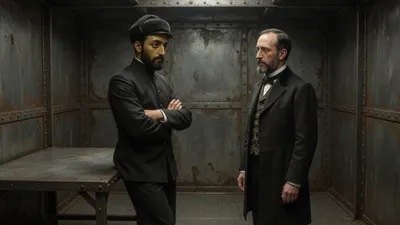
Before you read — think about:
- Many people know the 1954 Disney captain of this story — a man at a pipe organ in a grand salon. What kind of commander, rooms, and terms do you already picture — and how will you notice the man actually on THIS page?
- In the 1860s a private library at sea was a room of bound paper books, and music meant a live instrument, not a recording. How do people carry books and music with them now?
- How does an author introduce a character who has to carry the rest of a book?
- What is the difference between a collection and a home?
- 'The Man of the Seas' is a large title to give anybody. What would a person have to be for it to fit?
Watch for these while reading:
- The terms the commander lays out for the three men, in his own words
- The name he gives himself and the name he gives his vessel
- The library, the paintings, and the music: what a man who has left the world chose to bring with him, and what is missing from the collection
- The contrast between the public rooms of the vessel and the room where the commander himself sleeps
- Which rooms, objects, and people actually appear in this first meeting, compared with any 1954 Disney captain and salon you already picture
Vocabulary to know:
totter (verb) — to walk unsteadily, as if about to fall; resentment (noun) — bitter anger at being treated badly; assent (noun) — agreement or acceptance; fluency (noun) — the ability to speak a language smoothly and easily; recrimination (noun) — an accusation made in reply to an accusation; restrained (adjective) — held back and kept under control; cannonade (verb) — to fire cannon at something repeatedly; contrivance (noun) — a cleverly designed device or machine; savage (noun) — a person acting without the rules or mercy of civilized life; allude (verb) — to refer to something indirectly; kindle (verb) — to light up suddenly, as a fire catches; cuirass (noun) — a plate of armour protecting the chest, or the armour plating of a warship; spur (noun) — a sharp ram fixed to the bow of a vessel; conscience (noun) — the inner sense of right and wrong that judges one's own actions; answerable (adjective) — required to explain or justify one's actions to someone; reconcile (verb) — to make two things fit together that seem opposed; impose (verb) — to force a rule or condition on someone; unforeseen (adjective) — not expected or predicted; consign (verb) — to send someone somewhere and leave them there; passive (adjective) — accepting what happens without resisting; obedience (noun) — the act of doing what one is told; acquit (verb) — to declare someone free of blame; renounce (verb) — to give something up formally and for good; yoke (noun) — a heavy wooden collar for oxen; anything that weighs a person down; unendurable (adjective) — impossible to bear; clemency (noun) — mercy shown by someone who has the power to punish; sublime (adjective) — so grand and beautiful that it inspires awe; contemplation (noun) — long, thoughtful looking at or thinking about something; repast (noun) — a meal; sideboard (noun) — a long low cabinet for dishes in a dining room; ebony (noun) — a very hard, nearly black wood; inlaid (adjective) — decorated with pieces of another material set into the surface; inestimable (adjective) — too valuable to be measured; exquisite (adjective) — extremely beautiful and finely made; aliment (noun) — food; nourishment; wholesome (adjective) — good for one's health; quarry (verb) — to hunt down and take game; graze (verb) — to feed on growing plants, as cattle do; cultivate (verb) — to tend and grow crops; connoisseur (noun) — an expert judge of something, especially in the arts or in taste; embodiment (noun) — the physical form that an idea or quality takes; reservoir (noun) — a large store or supply of something; tranquillity (noun) — deep calm and peacefulness; despot (noun) — a ruler with absolute power who uses it cruelly; quench (verb) — to put out or extinguish completely; divan (noun) — a long low couch without a back; pamphlet (noun) — a short unbound printed booklet; astounded (adjective) — completely amazed; solitude (noun) — the state of being completely alone; proscribed (adjective) — forbidden and shut out; medley (noun) — a jumbled mixture of different things; brazier (noun) — a metal pan for holding burning coals; arabesque (noun) — a flowing decorative pattern of curves and leaves; drapery (noun) — cloth hung in loose folds for decoration; tapestry (noun) — heavy woven cloth with pictures or patterns, hung on a wall; pedestal (noun) — a base on which a statue stands; reverie (noun) — a state of being lost in one's own thoughts; zoophyte (noun) — an old term for a sea animal that looks like a plant, such as a coral; mollusc (noun) — a soft-bodied animal usually protected by a shell, such as a snail or clam; calcareous (adjective) — made of or containing chalky lime.
Chapter 11: All by Electricity
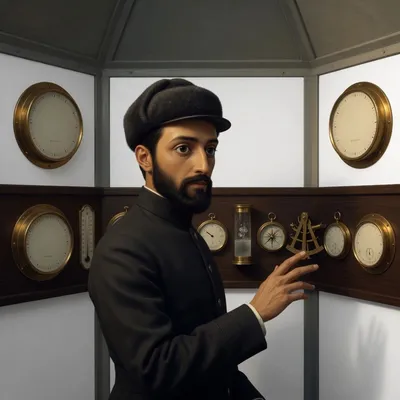
Before you read — think about:
- Many people know the 1954 Disney Nautilus as a Victorian showpiece full of gadgets. What machines and rooms do you already picture — and how will you notice the electricity actually described on THIS page?
- In 1868 electricity was mostly a laboratory curiosity; homes used gaslight or oil, and there were no wall sockets. What in your house runs on electricity now that Verne's first readers had to do by hand or by flame?
- What is the difference between understanding a machine and trusting it?
- Why do people still wear a watch even when a clock is on every wall?
- Aronnax is a prisoner who is also being given a private tour by an expert. Which of those two situations would occupy you more?
Watch for these while reading:
- The instruments Aronnax names one by one, and the difference between the ones he recognises and the ones he cannot place
- Where the electricity comes from, and the chain of steps Nemo describes to produce it
- The small boat carried inside the hull, and the arrangement that allows it to be used
- The room-by-room layout, and the measurement Verne supplies for every compartment
- Which instruments, rooms, and power sources actually appear in this chapter, compared with any 1954 Disney Nautilus you already know
Vocabulary to know:
thermometer (noun) — an instrument that measures temperature; barometer (noun) — an instrument that measures air pressure and helps predict weather; hygrometer (noun) — an instrument that measures how much moisture is in the air; sextant (noun) — an instrument for measuring the angle of the sun or stars to find latitude; chronometer (noun) — an extremely accurate clock used to calculate longitude at sea; dynamic (adjective) — having to do with force and motion; restraint (noun) — something that holds a force back and limits it; chloride (noun) — a chemical compound containing chlorine, such as ordinary salt; sodium (noun) — a soft silvery metal, half of common table salt; sulphate (noun) — a chemical salt formed from sulphuric acid; carbonate (noun) — a chemical salt formed from carbonic acid, such as chalk; factitious (adjective) — artificial; made by people rather than occurring naturally; anterior (adjective) — situated toward the front; partition (noun) — a wall dividing one space from another; insubmersible (adjective) — unable to be sunk; cavity (noun) — a hollow space made to hold something; telegraph (verb) — to send a signal along a wire; avidity (noun) — great eagerness, especially for food; evaporation (noun) — the process of turning a liquid into vapour; platina (noun) — an old word for platinum, a metal that withstands great heat; locomotive (adjective) — having to do with movement from place to place; lever (noun) — a bar that turns on a fixed point to move a load; cog-wheel (noun) — a toothed wheel that meshes with another to transmit motion; axle (noun) — the rod on which a wheel or propeller turns; requisite (adjective) — required; necessary for a purpose; medium (noun) — the substance something moves through, such as air or water; saloon (noun) — a large public room aboard a ship; hoist (verb) — to raise something up, especially with ropes.
Chapter 12: Some Figures
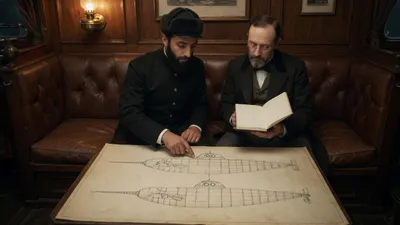
Before you read — think about:
- Many people know the 1954 Disney movie of this vessel. What secret-ship stories do you already picture — and how will you notice the numbers, parts, and places actually on THIS page?
- In the 1860s a ship's hull was riveted iron or wood, and plans were paper drawings copied by hand. How are large machines designed and built now?
- What advantages come with understanding every single part of the thing your life depends on?
- The chapter is called 'Some Figures.' Why might an adventure novel stop for a page of arithmetic, and what does the author gain by it?
- Why does it help a reader to be given exact measurements instead of only the word 'huge'?
Watch for these while reading:
- The double hull, and the reason Nemo gives for building the vessel that way
- The distinction he insists on between statics and dynamics — sinking by weight against steering by motion
- The reservoirs, the pumps, and the side planes, and the order in which Nemo introduces each of them
- The list of countries and firms that supplied the parts, and the trouble taken over each order
- Which measurements, parts, and countries actually appear in these figures, compared with any 1954 Disney version of how the vessel was made
Vocabulary to know:
elevation (noun) — a drawing showing the side view of a structure; breadth (noun) — width from side to side; immersed (adjective) — completely covered by water; displace (verb) — to push aside a volume of water equal to the part of a hull under the surface; bulk (noun) — the total size or volume of something; cellular (adjective) — made up of many small connected compartments; cohere (verb) — to hold together as one piece; spontaneously (adverb) — of its own accord, without outside help; envelope (noun) — an outer covering or layer; ballast (noun) — heavy material or water carried to steady or sink a vessel; bulkhead (noun) — an upright wall dividing a ship into watertight sections; thrust (noun) — a strong pushing force; statics (noun) — the study of forces acting on objects at rest; incompressible (adjective) — unable to be squeezed into a smaller space; supplementary (adjective) — extra; added to complete something; subsidiary (adjective) — serving as a backup or secondary help; infallible (adjective) — never failing; certain to work; rudder (noun) — the flat blade at a ship's stern used to steer left or right; tackle (noun) — an arrangement of ropes and pulleys used to work something; flotation (noun) — the ability to float; here, the point at which a hull balances in water; inclination (noun) — the angle at which something slopes; glazed (adjective) — fitted with glass; reflector (noun) — a device that throws light forward in a beam; forge (verb) — to shape metal by heating and hammering it; immensely (adverb) — enormously; to a very great degree.
Chapter 13: The Black River
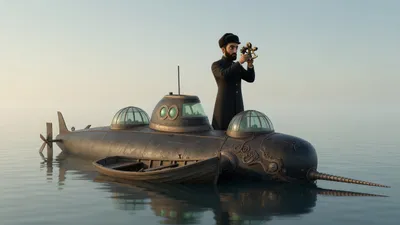
Before you read — think about:
- Many people know the 1954 Disney movie of this adventure already diving through wonders. What underwater scenery do you already picture — and how will you notice the sea, the fish, and the people actually on THIS page?
- In 1868 sailors measured their position with a sextant and a chronometer, and nobody in mid-ocean could check a map on a phone. How do people find their place on the earth now?
- The sea has 'rivers' running inside it — currents that keep a fixed path. How can a current inside water stay separate from the water around it?
- What do you already know about how living things are grouped and named? Why would scientists bother with Latin names at all?
- A warm current travels thousands of miles from where it began. What might it carry along with it?
Watch for these while reading:
- Aronnax's first sight of the Nautilus from outside, standing on her platform in daylight
- The crew at work: how they move, whether they speak, and how much Aronnax can gather about them
- Nemo taking the sun's altitude, and the steadiness with which he holds the instrument
- Ned Land's practical questions, and the ones Aronnax has no answer for
- Which fish, tools, and people actually appear on this platform, compared with any 1954 Disney dive you already know
Vocabulary to know:
spherical (adjective) — shaped like a ball; quintillion (noun) — an enormous number, a billion times a billion in the older French counting; epoch (noun) — a long period of time in the earth's history; igneous (adjective) — produced by fire or great heat; aqueous (adjective) — having to do with water; deluge (noun) — a great flood; wrest (verb) — to take something away by force; bearings (noun) — a ship's exact position, worked out by instruments; clamber (verb) — to climb using hands and feet; platform (noun) — the flat upper deck of the Nautilus, just above the waterline; excrescence (noun) — a lump or bulge sticking out from a surface; lenticular (adjective) — shaped like a lens, thicker in the middle; planisphere (noun) — a flat map showing the whole round earth; perpendicular (adjective) — straight up and down; at a right angle; indigenous (adjective) — growing or living naturally in a particular place; indigo (noun) — a deep blue-violet colour; camphor (noun) — a strong-smelling white substance obtained from a laurel tree of eastern Asia; petrified (adjective) — so astonished that one cannot move; masterpiece (noun) — a work of the very highest skill; oblong (adjective) — longer than it is wide; rectangular; frail (adjective) — easily broken; fragile; suspension (noun) — the state of being held floating within a liquid; obscurity (noun) — darkness; the state of being dim; aquatic (adjective) — living or growing in water; lamprey (noun) — a long eel-like fish with a round sucking mouth; interjection (noun) — a short exclamation of surprise or delight; ecstasy (noun) — a state of overwhelming delight; savour (noun) — the taste or flavour of food; zostera (noun) — eelgrass, a sea plant used here to stuff a mattress.
Chapter 14: A Note of Invitation
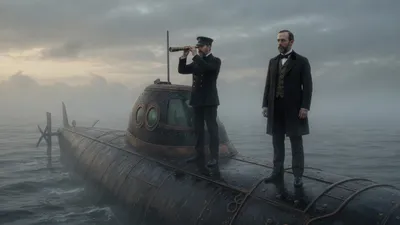
Before you read — think about:
- Many people know the 1954 Disney movie of underwater hunting. What gear and ocean trips do you already picture — and how will you notice the note, the rooms, and the tools actually on THIS page?
- In 1868 a diver was tied to the surface by an air hose and a signal rope. How do divers breathe and talk now, and what would cutting that hose have meant then?
- Can an invitation from the person holding you really be refused? What makes an invitation an invitation?
- How does a writer keep a journal-inside-the-novel from feeling like homework?
- What makes a written invitation feel different from someone simply telling you to come?
Watch for these while reading:
- The sentence the second officer repeats every morning, word for word, and Aronnax's attempts to make sense of it
- How Aronnax comes to be keeping the journal that becomes this book, and the material he writes it on
- The three pieces of equipment explained in detail — the air reservoir, the lamp, the gun — and the problem each one solves
- The word 'forest' as Ned Land understands it, set beside the word 'forest' as Aronnax understands it
- Which tools, rooms, and people actually appear around this invitation, compared with any 1954 Disney underwater hunt you already know
Vocabulary to know:
revel (verb) — to take great delight in something; herbal (noun) — a book or album of preserved plant specimens; hydrophyte (noun) — a plant that grows in water; algae (noun) — simple water plants such as seaweeds; desertion (noun) — the state of being left alone and abandoned; singularity (noun) — the quality of being strange or one of a kind; compensation (noun) — something given to make up for a loss; exactitude (noun) — carefulness about being precisely correct; billow (noun) — a large rolling wave; pinnace (noun) — a small boat carried by a larger vessel; radiant (adjective) — shining brightly; betoken (verb) — to be a sign of something coming; aversion (noun) — a strong dislike of something; manifest (adjective) — obvious; plain to see; mute (adjective) — silent; not speaking; fermented (adjective) — changed by a natural chemical process, as in making wine or beer; folly (noun) — foolishness; impervious (adjective) — not letting anything pass through; regulator (noun) — a device that controls the flow or pressure of something; physiological (adjective) — having to do with how the body works; brace (noun) — a strap that holds something in place; knapsack (noun) — a bag carried on the back; bellows (noun) — a device that pushes air along by squeezing; tension (noun) — the pressure at which a gas is held; saltpetre (noun) — potassium nitrate, one of the three ingredients of gunpowder; sulphur (noun) — a yellow chemical element used in gunpowder and matches; charcoal (noun) — black carbon left after wood is burned slowly; pellet (noun) — a small rounded piece of metal; thunderbolt (noun) — a flash of lightning striking down; reservation (noun) — a doubt that holds a person back from full agreement.
Chapter 15: A Walk on the Bottom of the Sea
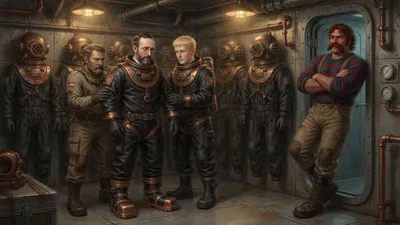
Before you read — think about:
- Many people know the 1954 Disney movie's walks on the seafloor, often short and dramatic. What people, suits, and ocean floors do you already picture — and how will you notice the walk actually on THIS page?
- In 1868 nobody had published a first-person walk on the real ocean floor; the heavy diving suits of the day were still tied to a ship above. How can you see the seafloor now without getting wet?
- What do you imagine it would feel like to walk across the sea floor in a heavy suit and a metal helmet?
- Sunlight changes as it passes down through water. Which colours would go first, and what would that do to everything a diver sees?
- No reader in 1868 had ever seen a walk on the ocean floor described. What would they most have wanted to be told about it?
Watch for these while reading:
- The airlock — the exact sequence of steps that gets a person out of a ship without letting the sea in
- The weight of the equipment on deck set against the weight of it once the divers are down
- How far Aronnax can see, and the way the colours change as the party descends
- The changing floor underfoot — sand, then ooze, then a plain of weed — and Verne's patience in cataloguing every shell and plant on it
- Which colours, plants, and pieces of gear actually appear on this walk, compared with any 1954 Disney seafloor you already know
Vocabulary to know:
wardrobe (noun) — a room or cupboard where clothing is kept; repugnance (noun) — strong dislike or disgust; supple (adjective) — flexible and easy to bend; waistcoat (noun) — a sleeveless garment covering the upper body; leaden (adjective) — made of lead; extremely heavy; consummate (adjective) — perfect of its kind; showing the highest skill; breastplate (noun) — a piece of armour worn over the chest; vogue (noun) — the fashion of a particular time; valve (noun) — a device that opens and closes to control the flow of gas or liquid; groove (noun) — a long narrow channel cut into a surface; stranded (adjective) — run aground; resting on the bottom; ironical (adjective) — said in a mocking way that means the opposite; contiguous (adjective) — next to and touching something else; invade (verb) — to flow in and take over a space; impotent (adjective) — powerless; unable to do what is needed; dissipate (verb) — to scatter and drive away; ultramarine (noun) — a deep vivid blue; impalpable (adjective) — too fine to be felt; oblique (adjective) — slanting rather than straight; refraction (noun) — the bending of light as it passes from one substance into another; prism (noun) — a piece of glass that splits light into its separate colours; kaleidoscope (noun) — a constantly changing pattern of bright colours; palette (noun) — the full range of colours a painter uses; declaim (verb) — to speak aloud in a grand or dramatic way; expedient (adjective) — sensible and useful in the circumstances; festoon (noun) — a hanging chain or garland that dips in a curve; naiad (noun) — a water nymph in Greek mythology; veritable (adjective) — genuine; deserving to be called by that name; inexhaustible (adjective) — so plentiful it can never be used up; medusa (noun) — a jellyfish; ooze (noun) — soft slimy mud on the sea floor; luxuriant (adjective) — growing thickly and abundantly; sward (noun) — an expanse of short thick growth, like a lawn; verdure (noun) — green growing plants; foliage (noun) — the leaves of a plant; parterre (noun) — a formal flower bed laid out in a pattern; ratio (noun) — the relationship between two amounts; loom (verb) — to appear dimly as a large shape.
Chapter 16: A Submarine Forest

Before you read — think about:
- Many people know the 1954 Disney movie of underwater woods used as set-dressing. What plants and paths under the sea do you already picture — and how will you notice the forest actually on THIS page?
- In the 1860s a 'forest' meant trees on land, and the only pictures of deep-sea plants were drawings from scraps hauled up in nets. How do people look at a coral reef or a kelp forest now?
- The title is 'A Submarine Forest.' What do you expect to be like a forest, and what do you expect to be unlike one?
- How can a writer catalogue plants for a page and still keep you walking with the characters?
- Why might two walkers in the same place keep different kinds of silence?
Watch for these while reading:
- How these plants stand and spread, and the reason Verne gives
- Aronnax admitting that he cannot always tell the animals from the plants
- Nemo as a hunter — his manner, and how he carries the gun
- The route the party takes — the depths, the distances, and the hours Aronnax records along the way
- Which plants, creatures, and path-markers actually appear in this forest, compared with any 1954 Disney underwater woods you already know
Vocabulary to know:
domain (noun) — an area that someone owns or rules; pioneer (noun) — the first person to settle or open up a new region; hatchet (noun) — a small axe used with one hand; copse (noun) — a small group of trees or bushes growing close together; arcade (noun) — a covered passage formed by a row of arches; filament (noun) — a very fine thread; rigid (adjective) — stiff and unbending; flora (noun) — all the plants of a particular place; fauna (noun) — all the animals of a particular place; genera (noun) — groups of related living things, one step above species; propagate (verb) — to reproduce and spread; carmine (noun) — a deep crimson red; devoid (adjective) — completely without something; anomaly (noun) — something that does not follow the usual rule; temperate (adjective) — having a mild climate, neither tropical nor polar; arbour (noun) — a shady shelter formed by growing plants; insurmountable (adjective) — impossible to overcome; slumber (noun) — sleep; crustacean (noun) — a hard-shelled animal such as a crab, lobster, or shrimp; writhe (verb) — to twist and squirm; declivity (noun) — a downward slope; grope (verb) — to feel one's way blindly; sustenance (noun) — food and nourishment; imposing (adjective) — grand and impressive in size; grotto (noun) — a small cave; trample (verb) — to tread heavily on something; lesion (noun) — an injury to the body; spectral (adjective) — ghostly; quadruped (noun) — a four-footed animal; lustre (noun) — a soft shine or gloss; extinct (adjective) — no longer existing anywhere; inversely (adverb) — the other way round; reversed; fleecy (adjective) — soft and white like wool; discern (verb) — to make something out with difficulty; dexterous (adjective) — skilful, especially with the hands; albatross (noun) — a very large seabird with long narrow wings; deficient (adjective) — lacking enough of something; voracious (adjective) — extremely greedy for food; muzzle (noun) — the projecting nose and jaws of an animal; vestry (noun) — a small side room used for changing clothes.
Chapter 17: Four Thousand Leagues Under the Pacific
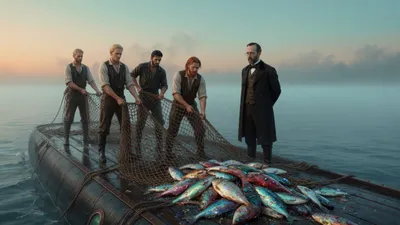
Before you read — think about:
- Many people know the 1954 Disney movie of this voyage. What long ocean crossings do you already picture — and how will you notice the weeks, the windows, and the talk actually on THIS page?
- In the 1860s, measuring ocean depth meant dropping a lead line from a ship and waiting; there was no sonar and no satellite map of the seafloor. How do people measure or picture the deep ocean now?
- Weeks of routine pass in a few pages here. How does a writer keep a long, uneventful stretch of a journey interesting?
- How does a writer keep a list of fish from becoming only a list?
- The title names a distance, not an event. What does a title like that promise a reader?
Watch for these while reading:
- What Aronnax can and cannot work out about the crew — their nationalities, their language, their discipline
- Nemo's talk about life beneath the sea, and where he stops
- The dates and positions Verne records to mark the ship's track across the Pacific
- The way Verne alternates catalogue and incident, and how long he lets a list run before something interrupts it
- Which crew habits, sea-creatures, and dates actually appear in this crossing, compared with any 1954 Disney Pacific you already know
Vocabulary to know:
abstractedly (adverb) — in a way that shows the mind is somewhere else; astronomical (adjective) — having to do with the sun, stars, and planets; hundredweight (noun) — an old unit of weight, about a hundred pounds; mesh (noun) — one of the open spaces in a net; haul (noun) — the amount of fish caught at one time; pickled (adjective) — preserved in salt or vinegar; preamble (noun) — an opening remark leading up to what follows; diurnal (adjective) — happening each day; caloric (noun) — an old term for heat considered as a substance; animalcule (noun) — a microscopic animal; spasm (noun) — a sudden involuntary movement; artery (noun) — a large tube carrying blood away from the heart; circulation (noun) — movement round and round a system, returning to the start; mean (adjective) — average; sparing (adjective) — giving very little of something; azure (adjective) — bright sky blue; destitute (adjective) — completely lacking something; gill (noun) — the organ a fish breathes with; bonito (noun) — a fish related to the tuna, prized for eating; immovable (adjective) — perfectly still; not moving at all; tattered (adjective) — torn into ragged strips; shroud (noun) — one of the ropes that support a ship's mast; heel (verb) — to lean over to one side; decompose (verb) — to break down and decay; distorted (adjective) — twisted out of natural shape; helm (noun) — the wheel or tiller by which a ship is steered; stern (noun) — the back end of a ship; infant (noun) — a baby or very young child.
Chapter 18: Vanikoro
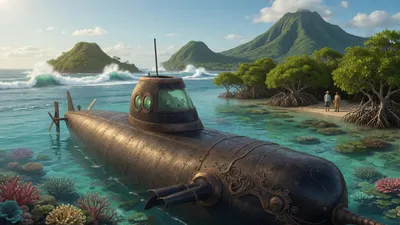
Before you read — think about:
- Many people know the 1954 Disney movie of this underwater adventure. What islands, wrecks, and relics do you already picture — and how will you notice the place and the history actually on THIS page?
- In the 1780s through the 1860s a lost expedition could stay missing for decades; news moved by other ships and by word of mouth. How would a missing plane or ship be searched for now?
- In 1785 a French expedition sailed round the world and vanished. How would a government of that century go about searching for a lost fleet?
- Why does it matter so much to families, and to whole countries, to know exactly where and how someone was lost?
- Why might a novelist retell a real historical search that readers in 1870 already knew from school?
Watch for these while reading:
- The tone Nemo takes when he asks Aronnax to recite a history they both already know
- The chain of searchers — d'Entrecasteaux, Dillon, Dumont d'Urville — and the evidence each of them had to work from
- The kinds of relics a coral reef preserves and the kinds it destroys
- Nemo's interest in men lost at sea, and the places in the conversation where it keeps surfacing
- Which islands, relics, and names actually appear in this chapter, compared with any 1954 Disney wreck or ruin you already know
Vocabulary to know:
celebrated (adjective) — famous; widely talked about; circumference (noun) — the distance around the outside of something; breaker (noun) — a wave that breaks into foam over a rock or reef; mangrove (noun) — a tropical tree that grows in salt water on stilt-like roots; circumnavigation (noun) — a voyage all the way around the world; corvette (noun) — a small fast warship; sloop (noun) — a small single-masted sailing vessel; merchantman (noun) — a ship used for trade rather than war; debris (noun) — scattered broken pieces left after something is destroyed; disastrous (adjective) — causing great harm or loss; shrewd (adjective) — sharp-witted and good at judging situations; hilt (noun) — the handle of a sword; relic (noun) — an object that survives from an earlier time; utensil (noun) — a tool or implement; foundry (noun) — a workshop where metal is melted and cast; inscription (noun) — words carved or stamped into a surface; perplexed (adjective) — puzzled and unsure what to think; deserter (noun) — someone who has abandoned their ship or army; interpreter (noun) — a person who translates speech between languages; trifle (noun) — something of little value or importance; denial (noun) — a statement that something is not true; ambiguous (adjective) — unclear; able to be understood in more than one way; castaway (noun) — a survivor of a shipwreck, stranded far from home; appease (verb) — to calm someone by giving them something; reprisal (noun) — an act of revenge for something done earlier; concretion (noun) — a hard mass formed by material sticking together; capstan (noun) — an upright winch used on ships to haul ropes and anchors; myriad (noun) — a very great number; corrode (verb) — to eat away slowly by chemical action; annotate (verb) — to add notes to a document; avenge (verb) — to take revenge on behalf of someone who was wronged; tomb (noun) — a grave or burial place.
Chapter 19: Torres Straits
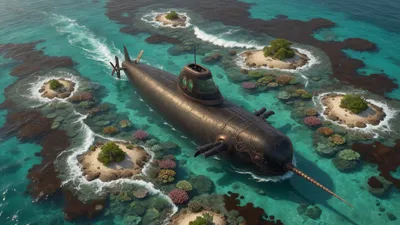
Before you read — think about:
- Many people know the 1954 Disney movie of this voyage. What coral seas and ship-handling do you already picture — and how will you notice the charts, the names, and the passage actually on THIS page?
- In the 1860s a pilot in the Torres Strait used paper charts, a lead line, and lookouts in the rigging — no GPS, no depth-sounder screen. How does a ship pick its way through reefs now?
- The Torres Strait lies between Australia and New Guinea. What do you know about that part of the world, and who was living there in the 1860s?
- Verne packs his chapters with real place names and real coordinates. What does that do to a story that is otherwise impossible?
- The chapter is named for a notoriously difficult passage of water. Why do sailors give names to stretches of open sea at all?
Watch for these while reading:
- Conseil's answer when he is asked what a happy new year would even mean for the three of them
- How Nemo handles his vessel in confined water — the speed he keeps and how much sea room he allows himself
- The date Nemo names, and the reasoning by which he arrives at it
- The navigation itself — Verne's use of real charts, real reefs, and the names of real explorers
- Which reefs, instruments, and people actually appear in this passage, compared with any 1954 Disney coral-sea you already know
Vocabulary to know:
progression (noun) — a steady advance from one stage to the next; redoubtable (adjective) — to be feared; formidable; transverse (adjective) — lying across something; tunny (noun) — a tuna; impregnated (adjective) — soaked through with a substance; mucilage (noun) — a thick sticky substance produced by some plants; transude (verb) — to ooze out through pores; pore (noun) — a tiny opening in a surface; obstruct (verb) — to block a way; islet (noun) — a very small island; betwixt (preposition) — an old-fashioned word for between; detestable (adjective) — thoroughly unpleasant; hateful; swerve (verb) — to change direction suddenly; screw-pine (noun) — a tropical tree with a crown of stiff spiral leaves; recede (verb) — to move back or fall away; ebb (noun) — the falling tide; aground (adverb) — stuck on the bottom in shallow water; middling (adjective) — average; neither large nor small; satellite (noun) — a body that orbits a planet, here the moon; indebted (adjective) — owing gratitude for a favour; coralline (adjective) — made of or resembling coral; indestructible (adjective) — impossible to destroy; circumspectly (adverb) — cautiously, with careful attention to risk; cutlet (noun) — a small cut of meat, usually from the ribs; amiability (noun) — friendly good nature; perilous (adjective) — very dangerous; glutton (noun) — someone who eats greedily; extremity (noun) — a last resort in a desperate situation.
Chapter 20: A Few Days on Land

Before you read — think about:
- Many people know the 1954 Disney movie of tropical shore days in this story. What islands, trees, and hunts do you already picture — and how will you notice the plants, animals, and three men actually on THIS page?
- In the 1860s a European sailor's fresh food on a tropical island meant whatever he could shoot or pick; there was no grocery store and no canned-fruit aisle. How does your family get fruit and meat now?
- How much could three people really learn about an island in a few days ashore?
- What fruits and trees grow in the tropics that would have been unfamiliar to a European reader in 1868?
- After months of eating food drawn from the sea, what would you want most?
Watch for these while reading:
- Ned Land on solid ground — his manner, his pace, his talk
- The running joke between Ned and Conseil, and how straight Conseil manages to keep his face
- The behaviour of the birds and animals, and what Aronnax concludes from how wary they are
- Verne's long catalogue of fruits, trees, and birds, and the way he works a recipe into an adventure novel
- Which fruits, birds, and island-things actually appear on this shore day, compared with any 1954 Disney island from this story
Vocabulary to know:
musket (noun) — an old long-barrelled gun; a musket-shot is the distance one could fire; garland (noun) — a rope of flowers or leaves hung in a loop; bindweed (noun) — a climbing plant that twists itself around others; profusion (noun) — a very large and generous quantity; vault (noun) — an arched roof, or anything shaped like one; leguminous (adjective) — belonging to the pea and bean family of plants; reconnoitre (verb) — to explore an area in order to learn about it; sombre (adjective) — dark and gloomy; bread-fruit (noun) — a large tropical fruit that can be roasted and eaten like bread; maturity (noun) — the state of being fully ripe or grown; fibrous (adjective) — made of tough thread-like strands; pulp (noun) — the soft fleshy inside of a fruit; gelatinous (adjective) — thick and jelly-like; kernel (noun) — the seed or stone at the centre of a fruit; crumb (noun) — the soft inner part of a loaf of bread; artichoke (noun) — a green vegetable made of tightly overlapping leaves; relish (noun) — great enjoyment of food; yam (noun) — a large starchy root vegetable; ford (verb) — to cross a stream by wading; torrent (noun) — a fast-rushing stream; kingfisher (noun) — a small brightly coloured bird that dives for fish; biped (noun) — a creature that walks on two legs; pheasant (noun) — a large game bird prized for eating; cockatoo (noun) — a crested parrot of Australia and New Guinea; meditate (verb) — to think deeply about something; disposition (noun) — the way parts are arranged; aerial (adjective) — happening in the air; snare (noun) — a trap made of a loop of cord; viscous (adjective) — thick and sticky; birdlime (noun) — a sticky substance smeared on branches to catch birds; ammunition (noun) — the bullets or shot fired from a weapon; traverse (verb) — to travel across; pluck (verb) — to pull the feathers off a bird; skewer (noun) — a long pin used to hold food over a fire; nutmeg (noun) — a hard aromatic seed used as a spice; sago (noun) — a starch obtained from the pith of certain palms; inoffensive (adjective) — harmless; triumphal (adjective) — expressing victory; quail (noun) — a small plump game bird; intemperance (noun) — a lack of self-control, especially with drink; downy (adjective) — covered with soft fine feathers; marsupial (noun) — a mammal, such as a kangaroo, that carries its young in a pouch; estimable (adjective) — worthy of respect; of good quality; depopulate (verb) — to empty a place of its inhabitants.
Chapter 21: Captain Nemo's Thunderbolt
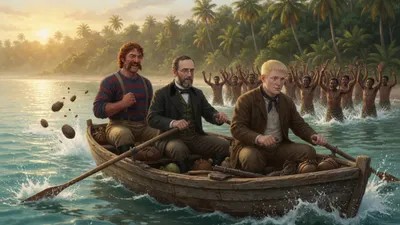
Before you read — think about:
- Many people know the 1954 Disney movie of a loud fight around this vessel. What weapons, crowds, and ship-parts do you already picture — and how will you notice the warning, the talk, and the 'thunderbolt' actually on THIS page?
- In the 1860s, news from a remote Pacific island might take months to reach a European newspaper — if it ever did. How would news from a far-off shore reach you now?
- European travel writing of the 1800s used the word 'savage' constantly. What work was that word doing, and for whom?
- The title is 'Captain Nemo's Thunderbolt.' What kinds of thunderbolt could a chapter at sea even mean?
- A person with a private source of power and no law above him could build almost any weapon. What restrains anyone in that position?
Watch for these while reading:
- What Nemo is occupied with, and how he answers visitors
- Nemo's reply to Aronnax's use of the word 'savages', and the argument underneath the reply
- The conversation about Dumont d'Urville, and the feeling Nemo lets show during it
- The exact hour and minute Nemo names for the tide, and his confidence in his own arithmetic
- Which weapons, island people, and ship-parts actually appear in this chapter, compared with any 1954 Disney fight on the Nautilus you already picture
Vocabulary to know:
aerolite (noun) — a stony meteorite that falls from the sky; savoury (adjective) — salty or spicy rather than sweet; tasty; sling (noun) — a strap used to hurl a stone with great force; hostile (adjective) — unfriendly and threatening; gesticulate (verb) — to make sweeping movements with the arms while speaking; chord (noun) — several musical notes sounded together; botanise (verb) — to collect and study plants; vicinity (noun) — nearness; the surrounding area; ironically (adverb) — in a way that says one thing and means another; melody (noun) — a tune; indistinctly (adverb) — unclearly; not sharply; zodiacal (adjective) — belonging to the band of constellations the sun appears to travel through; zenith (noun) — the point in the sky directly overhead; mischance (noun) — bad luck; an unfortunate accident; summit (noun) — the highest point of a hill or mountain; athletic (adjective) — strong and well built; tinge (noun) — a slight shade of colour; lobe (noun) — the soft lower part of the ear; distend (verb) — to stretch or swell outward; crescent (noun) — a curved shape like a new moon; notch (verb) — to cut a V-shaped nick into an edge; parry (verb) — to ward off a blow rather than strike first; adroit (adjective) — clever and skilful; viand (noun) — an item of food, especially a choice one; limpid (adjective) — perfectly clear; unceasingly (adverb) — without stopping; deformity (noun) — an abnormal shape or form; spiral (noun) — a curve that winds around a centre; amulet (noun) — a charm worn to protect against harm; poise (verb) — to hold something balanced and ready to throw; scoundrel (noun) — a rascal; a dishonourable person; paddler (noun) — someone who propels a canoe with a paddle; familiarise (verb) — to get used to something; blustering (adjective) — loud and noisy; reverberation (noun) — a rolling echo; algebraical (adjective) — relating to algebra, the mathematics of unknown quantities; hatch (noun) — an opening in a ship's deck, with a cover; stave (verb) — to smash a hole in something; hinder (verb) — to get in the way of; to prevent; apropos (adverb) — with regard to; on the subject of; navigator (noun) — someone who plans and directs a ship's course; hydrographical (adjective) — having to do with mapping seas and coastlines; incessantly (adverb) — without a pause; repository (noun) — a place where things are stored and kept safe; curtly (adverb) — briefly and rather rudely; feign (verb) — to pretend; sarcastically (adverb) — in a mocking, cutting way; deafening (adjective) — extremely loud; vociferation (noun) — loud shouting; contortion (noun) — a violent twisting of the body; assailant (noun) — someone who attacks; exasperated (adjective) — extremely annoyed and frustrated; majestically (adverb) — grandly and with dignity; conductor (noun) — a material that carries electricity.
Chapter 22: Ægri Somnia
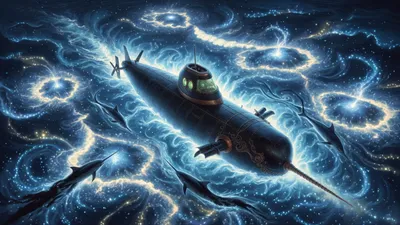
Before you read — think about:
- Many people know the 1954 Disney movie of this adventure. What do you already picture filling a stretch of underwater travel — and how will you notice the experiments, the light, and the moods actually on THIS page?
- In the 1860s, sea temperature and depth were measured with thermometers and sounding lines hauled by hand, then written in a paper log. How do scientists record the ocean now?
- Why do people keep a journal of ordinary days, even when nothing seems to happen?
- The Latin title names a sick man's dreams. What kind of chapter do you expect from a title like that?
- Why do some chapters of an adventure novel spend pages on weather and water instead of action?
Watch for these while reading:
- The temperature and pressure experiments, and the numbers attached to them
- The night the sea itself gives off light, and the explanation Aronnax offers for it
- The second officer's daily phrase, and any variation in it
- Nemo's face and bearing at the times when he is observing rather than explaining
- Which experiments, lights, and faces actually appear in this chapter, compared with any 1954 Disney version of a quiet spell aboard
Vocabulary to know:
profane (adjective) — not sacred; here, an outsider's hand that has no right to touch; thunderstricken (adjective) — struck down as if by lightning; unbounded (adjective) — without limits; becalmed (adjective) — stopped and motionless for want of any driving force; thermometrical (adjective) — relating to the measurement of temperature; obliquely (adverb) — at a slanting angle; infusoria (noun) — microscopic organisms found in water; globule (noun) — a tiny round drop; disport (verb) — to play or frolic; salamander (noun) — in old legend, a creature able to live in fire; porpoise (noun) — a small blunt-nosed relative of the dolphin; prophetic (adjective) — foretelling what is to come; herald (noun) — a messenger who announces something coming; rivulet (noun) — a small stream; ardent (adjective) — burning; intensely hot; ignition (noun) — the state of being set alight; horary (adjective) — relating to the hour; used in measuring time by the sun; forebode (verb) — to be a warning sign of something bad; repress (verb) — to hold back a feeling; steadfastly (adverb) — firmly and without wavering; agitation (noun) — a state of nervous disturbance; jut (verb) — to stick out; transfigured (adjective) — completely changed in appearance; sullenly (adverb) — with silent, resentful anger; pervade (verb) — to spread through every part of something; unwittingly (adverb) — without meaning to; subside (verb) — to become calm again; imperious (adjective) — commanding; expecting to be obeyed at once; altercation (noun) — a noisy argument; remonstrate (verb) — to protest strongly; cogitation (noun) — deep thinking; soporific (adjective) — causing sleep; morbid (adjective) — unhealthy; diseased; hallucination (noun) — seeing something that is not really there; bereft (adjective) — deprived of something; robbed of it.
Chapter 23: The Coral Kingdom
Before you read — think about:
- Many people know the 1954 Disney movie of this book, which stays on chases and sea-monsters. What places under the sea do you already picture — and how will you notice what is actually on THIS page?
- What did people in the 1860s know about coral reefs, and how is that different from a nature video you might watch now?
- How can a writer describe a place that is both alive and like stone without turning it into a lecture?
- Coral looks like stone but is built by living animals over centuries. What makes something 'alive' if it looks like rock?
- 'The Coral Kingdom' is a grand name for a place in the sea. What do you expect a kingdom of coral to look like?
Watch for these while reading:
- The cabin and the saloon — who is in each, and how each room is described
- Nemo's appearance and manner when he next comes into the saloon
- How Nemo answers, or does not answer, ordinary questions
- The coral itself — what Verne says it is, how it grows, and how long it takes to build anything
- Which underwater places, objects, and people actually appear on THIS page, compared with any 1954 Disney sea-caves or monster-fights you already know
Vocabulary to know:
reinstate (verb) — to put someone or something back in its former place; habitual (adjective) — done regularly as a matter of habit; sorrowful (adjective) — full of sadness; prescribe (verb) — to advise a treatment for an illness; swathe (verb) — to wrap in bandages or cloth; shatter (verb) — to break violently into pieces; contusion (noun) — a bruise; an injury without a break in the skin; spasmodic (adjective) — coming in sudden irregular jerks; ensue (verb) — to follow as a result; signify (verb) — to matter; to be of importance; glisten (verb) — to shine with reflected light; pallor (noun) — unusual paleness of the face; premature (adjective) — happening earlier than it should; psalm (noun) — a sacred song or hymn; cylindrical (adjective) — shaped like a tube; petal (noun) — one of the coloured parts of a flower; inextricable (adjective) — so tangled it cannot be separated; thicket (noun) — a dense group of bushes or small trees; joist (noun) — a long horizontal beam supporting a structure; gallery (noun) — a long narrow passage; pendant (noun) — an ornament that hangs down; brushwood (noun) — small broken branches and low undergrowth; glade (noun) — an open clearing in a forest; encrusted (adjective) — covered with a hard coating; pickaxe (noun) — a heavy tool with a pointed head for breaking ground; flint (noun) — a very hard stone that strikes sparks; linen (noun) — cloth woven from flax; mound (noun) — a small raised heap of earth; adieu (noun) — a farewell; procession (noun) — a line of people moving together in a ceremony; binnacle (noun) — the stand that holds a ship's compass; suppress (verb) — to hold something down or keep it from showing.
Chapter 24: The Indian Ocean
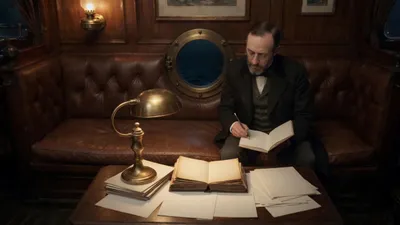
Before you read — think about:
- Many people know the 1954 Disney film of this book, with its pipe-organ Nemo and a handful of big set-pieces. What people, objects, and settings do you already picture from that movie — and how will you notice what is actually on THIS page?
- In the 1860s a chart of the Indian Ocean still had blank stretches, and a steamship crossed it by sun-sights and luck. Today a phone can drop a pin in the middle of that same water. How does that change what 'being at sea' even means?
- How does a writer keep a long stretch of travel interesting when no single event is promised in the title?
- What would you miss most on a voyage with no post, no news, and no way to send word home?
- This chapter is named for an ocean rather than for an event. What does a title like that make you expect as a reader?
Watch for these while reading:
- Which people, objects, and settings actually appear on this page compared with the 1954 Disney film you already know.
- Aronnax's current theory about Nemo, and the evidence he lines up for it.
- The dates, latitudes, and place-names Verne stacks in the opening pages.
- How Aronnax fills his days aboard, and the feelings he claims he does and does not have.
- Conseil's questions about the look of the water, and the kind of answer Aronnax likes to give.
Vocabulary to know:
implacable (adjective) — impossible to soften or satisfy; contempt (noun) — a feeling that someone or something is worthless; indifference (noun) — a complete lack of interest or concern; deception (noun) — a disappointment or betrayal; shun (verb) — to deliberately avoid; retaliation (noun) — the act of striking back for a wrong; involuntary (adjective) — done without meaning to; graphite (noun) — a soft black form of carbon; imperceptible (adjective) — too small to be noticed; giddy (adjective) — dizzy; monotonous (adjective) — dull because always the same; compile (verb) — to gather material together into a written work; memoir (noun) — a written account of one's own experiences; ennui (noun) — boredom; a weary lack of interest; sea-mew (noun) — a seagull; discordant (adjective) — harsh and unpleasant in sound; braying (noun) — the loud harsh cry of a donkey; chalky (adjective) — made of or like chalk; quadrangle (noun) — a four-sided figure; tubercle (noun) — a small rounded lump on a body; dromedary (noun) — a one-humped camel; longitudinal (adjective) — running lengthwise; ovoid (adjective) — egg-shaped; dart (noun) — a small pointed missile or spine; pectoral (adjective) — on or near the chest; rugged (adjective) — rough and uneven; tubular (adjective) — shaped like a tube; dorsal (adjective) — on the back; protuberance (noun) — a bulge sticking out from a surface; repugnant (adjective) — causing disgust; parasite (noun) — a living thing that lives on or in another; invariably (adverb) — always; without exception; rebound (verb) — to bounce back; fleeting (adjective) — lasting a very short time; argonaut (noun) — a small octopus-like mollusc that floats in a papery shell; furl (verb) — to roll up a sail; skiff (noun) — a small light boat; adhere (verb) — to stick fast to something; squadron (noun) — a group of ships operating together; sidereal (adjective) — relating to the stars; wavelet (noun) — a small wave; compute (verb) — to work out by calculation; glimmering (noun) — a faint unsteady light; undertaker (noun) — someone whose work is burying the dead; forbidding (adjective) — grim and unwelcoming.
Chapter 25: A Novel Proposal of Captain Nemo's
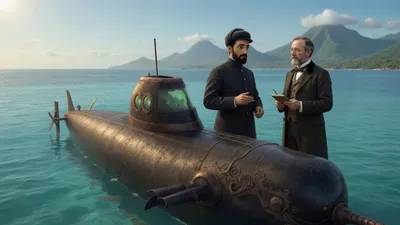
Before you read — think about:
- The 1954 Disney film is about two hours long; this novel has forty-six chapters. What kinds of scenes do movies usually keep, and how will you notice what THIS page spends its time on?
- In the 1860s, Ceylon — now Sri Lanka — was a name most European readers knew from newspapers, school maps, and shop windows full of tea and gems. Today you can open a photo of its coast in a second. How does that change the way a far-off island feels?
- What do you already know about how a pearl forms, and why people have wanted them?
- Verne often titles a chapter with a plan rather than an event. What does that do to your expectations as you begin reading?
- A 'novel proposal' means a new and unusual one. Which kinds of offer are hardest to refuse, and why?
Watch for these while reading:
- A count of who is actually in this chapter versus who you remember from the 1954 Disney film.
- Where the Nautilus is when land comes in sight, and the name Nemo gives that land.
- The invitation Nemo makes, and the tone he uses to make it.
- The lecture on pearls: how they form, what they fetch, and the figures Verne enjoys quoting.
- How Ned, Conseil, and Aronnax each answer when they are asked to come along.
Vocabulary to know:
exportation (noun) — the sending of goods abroad for sale; perspiration (noun) — sweat; noose (noun) — a loop of rope that tightens when pulled; affront (verb) — to confront boldly; ill-timed (adjective) — happening at the wrong moment; composed (adjective) — calm and untroubled; ottoman (noun) — a low padded seat without a back; solidify (verb) — to become solid; brilliancy (noun) — brightness; sparkle; mother-of-pearl (noun) — the smooth shining layer lining some shells; phosphate (noun) — a chemical salt of phosphorus; gelatine (noun) — a clear substance obtained from animal tissue; secretion (noun) — a substance produced and released by a living body; testacea (noun) — an old term for shellfish with hard shells; nacreous (adjective) — made of mother-of-pearl; globular (adjective) — shaped like a ball; concentric (adjective) — having a shared centre, like rings inside rings; casket (noun) — a small box for jewels; pincers (noun) — a gripping tool with two hinged arms; diapered (adjective) — patterned with a fine repeating design; paragon (noun) — a perfect example of its kind; opal (noun) — a milky gemstone that shows shifting colours; embroidery (noun) — decorative needlework; calling (noun) — a trade or profession; precaution (noun) — a step taken in advance to prevent harm; chopper (noun) — a heavy blade used for cutting.
Chapter 26: A Pearl of Ten Millions
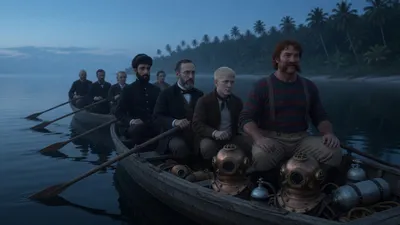
Before you read — think about:
- In the 1954 Disney film, underwater scenes are a spectacle with music and huge sets. What do you already picture when someone says 'underwater adventure' — and how will you notice the details Verne actually puts on THIS page?
- In the 1860s a fortune in pearls might sit in a shop window or a royal crown, and news of a fishery took months to travel. Today a rare gem is photographed, insured, and listed online. How does that change what a number like 'ten million' even means?
- What makes an object valuable — how rare it is, how hard it is to reach, or simply what people agree it is worth?
- How does a writer describe a place you could not have visited yourself in 1870?
- A person can be generous to guests and harsh toward the wider world at the same time. How would you make sense of someone like that?
Watch for these while reading:
- Which tools, clothes, and sea-floor details actually appear here versus the diving gear you picture from the 1954 Disney film.
- The pearl bank itself: depth, light, and the living things Verne bothers to name.
- Nemo's manner in the water compared with his manner aboard his own ship.
- Any other divers at work, and the gear they actually use.
- How Nemo talks about other human beings, if he talks about them at all.
Vocabulary to know:
disembark (verb) — to get out of a boat onto land or the sea floor; tiller (noun) — the handle used to turn a boat's rudder; oarsman (noun) — someone who rows a boat; samphire (noun) — a fleshy plant that grows in salty coastal places; ransack (verb) — to search through roughly and take everything of value; inopportunely (adverb) — at a bad moment; dagger (noun) — a short stabbing knife; covey (noun) — a small flock of game birds; snipe (noun) — a long-billed marsh bird; bog (noun) — soft wet marshy ground; livid (adjective) — having a dull greyish-blue colour; conger (noun) — a large sea eel; scythe (noun) — a long curved blade for cutting grass; causeway (noun) — a raised road or path across low ground; boulder (noun) — a large rounded rock; fracture (noun) — a crack or split in rock; annelid (noun) — a segmented worm; warp (noun) — the threads running lengthwise in woven cloth; crypt (noun) — an underground chamber; pillar (noun) — an upright column supporting a structure; goblet (noun) — a large drinking cup; demolish (verb) — here, to eat up entirely; membrane (noun) — a thin soft layer of tissue; plait (noun) — a fold or pleat; mantle (noun) — the fold of tissue that lines a mollusc's shell; crouch (verb) — to bend low and keep still; disquieting (adjective) — causing worry; glean (verb) — to gather what is left over, especially before or after a harvest; byssus (noun) — the tough threads a mollusc uses to anchor itself; undaunted (adjective) — not discouraged by danger; haggard (adjective) — wild and worn-looking; shears (noun) — a large cutting tool with two blades; disentangle (verb) — to free something that is caught up; friction (noun) — rubbing; immersion (noun) — the state of being under water; munificent (adjective) — extremely generous; inert (adjective) — lifeless and unmoving; unparalleled (adjective) — having no equal; devotion (noun) — deep loyal care for someone; oppressed (adjective) — held down and treated unjustly by those in power; ghastly (adjective) — horrible; deathly pale.
Chapter 27: The Red Sea
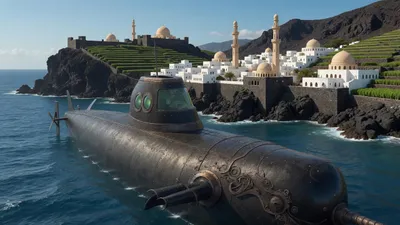
Before you read — think about:
- Many people remember the 1954 Disney Nautilus as a particular shape and colour. What does that movie-ship look like in your head, and how will you notice the seas and shores THIS page actually names?
- In 1868 the Suez Canal was just being finished; before that, cargo from India to Europe went the long way around Africa, and the news of a ship's arrival took weeks. Today a container ship uses the canal in hours, and you can track it on a screen. How does a shortcut like that change the world?
- Seas take their names from colours, from people, and from old stories. Where do you think the name 'Red Sea' came from?
- Verne keeps mixing real ports and real dates into a made-up voyage. What does that mix do for a reader?
- What is it like to be a passenger who never chooses the route?
Watch for these while reading:
- Settings on this page — coasts, towns, and stretches of water — that do not match the 1954 Disney voyage you already know.
- Ned Land's questions about where they are, and how Aronnax answers them.
- Nemo's talk about the Red Sea's history, and any living person he bothers to praise.
- The wildlife Verne catalogues as they go.
- Aronnax's own feelings about whether he wants the voyage to end.
Vocabulary to know:
labyrinth (noun) — a confusing network of passages; archipelago (noun) — a group or chain of islands; egress (noun) — a way out; isthmus (noun) — a narrow neck of land joining two larger areas; sluice (noun) — a gate that controls the flow of water in a canal; surfeited (adjective) — having had far too much of something; emphasis (noun) — special weight given to certain words; dome (noun) — a rounded roof; mosque (noun) — a Muslim place of worship; minaret (noun) — the slender tower of a mosque; verdant (adjective) — green with growing plants; promontory (noun) — a high point of land jutting into the sea; fortification (noun) — a defensive wall or fort; octagon (noun) — an eight-sided figure; magazine (noun) — a storehouse for goods; caprice (noun) — a sudden unexplained change of mind; girdle (noun) — a belt; anything that encircles; interlacing (noun) — a pattern of things woven across each other; ulterior (adjective) — further off; kept hidden for now; gracious (adjective) — kind and courteous; invulnerable (adjective) — impossible to harm; portray (verb) — to describe or represent; strewn (adjective) — scattered over an area; era (noun) — a long distinct period of history; rigged (adjective) — fitted out with masts, sails, and ropes; resin (noun) — a sticky substance from trees, used to seal wood; propitiatory (adjective) — meant to win the favour of a god; wreath (noun) — a ring of flowers or leaves worn or hung as an honour; gilt (adjective) — covered with a thin layer of gold; chronicler (noun) — someone who writes a record of historical events; fanciful (adjective) — imaginative rather than factual; appellation (noun) — a name given to something; attribute (verb) — to give something as the cause; microscopic (adjective) — far too small to see without a microscope; estuary (noun) — the wide mouth of a river where it meets the sea; miraculous (adjective) — brought about by a miracle; excavation (noun) — a careful digging up of buried remains; archaeologist (noun) — someone who studies the past by digging up its remains; utility (noun) — usefulness; trireme (noun) — an ancient warship rowed by three banks of oars; abreast (adverb) — side by side; revolt (verb) — to rise up against a ruler; junction (noun) — a place where two things are joined; rebuff (noun) — a blunt refusal or rejection; illustrious (adjective) — famous and greatly admired; jetty (noun) — a structure built out into the water to protect a harbour; subterranean (adjective) — underground; quicksand (noun) — loose wet sand that swallows anything heavy; identical (adjective) — exactly the same.
Chapter 28: The Arabian Tunnel
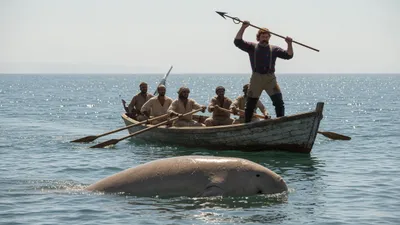
Before you read — think about:
- The 1954 Disney film never has time for every crossing in this book. When a chapter is named for a place you do not remember from the movie, how will you notice what is actually on THIS page?
- Today ships use the Suez Canal as a routine shortcut between the Indian Ocean and the Mediterranean. In the 1860s that canal was brand-new, and most cargo still went the long way. How did people move goods between those two seas then, and how do they do it now?
- Verne builds this chapter on a piece of geography that does not exist. How much invention will you accept in a story that otherwise sticks to real maps?
- What are the risks of being the only person who knows that a particular route exists?
- How do you keep your bearings in a place you cannot see, when you have to trust someone else's steering?
Watch for these while reading:
- Which people are actually on this page, and which 1954 Disney faces or extra animals never appear.
- Who takes the helm, and the instruments Aronnax watches while they go.
- The look of the passage: walls, light, and the motion of the water.
- Ned Land's manner before they submerge, and what he is given to do.
- The clock. How long Verne says anything takes, set against how long the chapter makes it feel.
Vocabulary to know:
counting-house (noun) — a building where a merchant's accounts and trade are handled; draught (noun) — the depth of water a ship needs to float; Bedouin (noun) — a member of the nomadic desert peoples of Arabia and North Africa; covetousness (noun) — a strong desire to have something; dugong (noun) — a large plant-eating sea mammal of tropical coasts; manatee (noun) — a related sea mammal, sometimes called a sea cow; lateral (adjective) — on or at the side; diverging (adjective) — spreading apart from a common point; rowlock (noun) — the fitting on a boat's side that holds an oar; coxswain (noun) — the crewman who steers a boat and directs its rowers; expletive (noun) — a sharp exclamation, often an angry one; relaxation (noun) — a letting up or easing off; perverse (adjective) — stubbornly wrong-headed; vengeance (noun) — punishment inflicted in return for a wrong; repent (verb) — to be sorry for what one has done; outlandish (adjective) — strange and foreign-sounding; nostril (noun) — one of the two openings of the nose; belabour (verb) — to beat repeatedly; gunwale (noun) — the upper edge of a boat's side; roebuck (noun) — a male roe deer; larder (noun) — a store of food; tow (verb) — to pull something along behind; socket (noun) — a hollow that something fits into; scuttle (noun) — a small opening or window in a ship's side; substructure (noun) — a supporting structure underneath; fissure (noun) — a narrow crack; precipitate (verb) — to hurl or rush something violently forward; chafe (verb) — to rub against something.
Chapter 29: The Grecian Archipelago
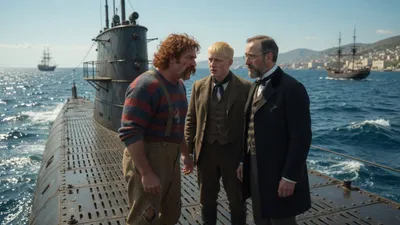
Before you read — think about:
- Movie versions of this story often put Ned Land in the foreground as a hero. What do you already picture about him from the 1954 Disney film — and how will you notice the Ned on THIS page?
- In the 1860s a letter from the Greek islands to Paris took weeks; a newspaper might print the news a month late. Today a photo from those same islands arrives in a second. How does that change what 'far away' means?
- What makes a place feel like home — the land itself, the people, the language, or something else?
- The Greek islands have been a crossroads for thousands of years. Why do storytellers keep sending characters through a real archipelago instead of an invented one?
- How does a writer put a hard conversation on the page without telling you who is right?
Watch for these while reading:
- Which people and objects actually appear here versus the 1954 Disney version you already know.
- The tone of Ned Land's conversation with Aronnax, and the way Aronnax answers him.
- Whatever can be seen through the saloon windows in this chapter.
- Nemo's manner when he is with his guests and when he is not.
- The temperature in the saloon, and any reading on a dial Verne bothers to give you.
Vocabulary to know:
jovial (adjective) — cheerful and good-humoured; impassable (adjective) — impossible to cross; shackle (verb) — to restrain someone as if with chains; destiny (noun) — the force that decides what will happen to someone; rotten (adjective) — thoroughly unsound; foundation (noun) — the base on which something rests; hitch (noun) — a small problem that stops progress; distrust (verb) — to have no confidence in someone; frequented (adjective) — visited by many people or ships; plough (verb) — to force a way through, as a ship through water; recite (verb) — to say aloud from memory; abode (noun) — a dwelling place; insurrection (noun) — an armed rising against a government; preoccupied (adjective) — absorbed in one's own thoughts; leathern (adjective) — made of leather; purse (noun) — a small bag for carrying money; cypher (noun) — an initial or monogram; device (noun) — an emblem or motto belonging to a person or family; ingot (noun) — a block of cast metal; methodically (adverb) — in a careful orderly way; pulley (noun) — a wheel used with a rope to lift heavy loads; pitching (noun) — the rocking of a ship from bow to stern; correspondent (noun) — someone with whom one exchanges letters or business; idiosyncrasy (noun) — an odd personal peculiarity; intolerable (adjective) — impossible to put up with; sulphurous (adjective) — containing or smelling of sulphur; eruption (noun) — a violent bursting out of lava, steam, or gas; Plutonian (adjective) — relating to the fiery forces beneath the earth; vitreous (adjective) — glassy; felspar (noun) — a common rock-forming mineral, now usually spelled feldspar; insupportable (adjective) — unbearable; extinguish (verb) — to put out a light or fire; broil (verb) — to cook with fierce direct heat; basin (noun) — a deep hollow area of sea floor.
Chapter 30: The Mediterranean in Forty-Eight Hours
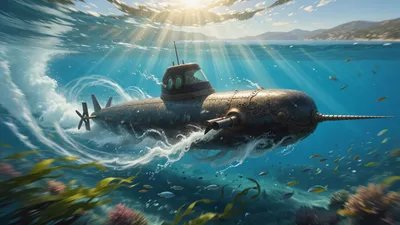
Before you read — think about:
- The 1954 Disney film has to skip a lot of geography. What do you already picture as 'the voyage,' and how will you notice the actual sea THIS page is moving through?
- In the 1860s a steamship might take a week or more to work from one end of the Mediterranean to the other. Today a flight covers the same water in a few hours. How does speed change what a traveler actually sees?
- The chapter title tells you in advance how long the crossing takes. Why might an author want you to know that before you start reading?
- What is it like to miss things because you are going too fast?
- How can a writer list many places in a few pages without the list going dead?
Watch for these while reading:
- Seas, wrecks, and windows on this page that do not match the 1954 Disney voyage you remember.
- How much Nemo is seen during the crossing, and Aronnax's reading of that.
- The floor of the Mediterranean as Verne describes it.
- Conseil's questions, and the answers he gets.
- The comparison Aronnax reaches for to describe how much a passenger can take in at that speed.
Vocabulary to know:
aloe (noun) — a fleshy-leaved plant of hot dry places; cactus (noun) — a spiny plant that stores water in its thick stem; embalm (verb) — to fill with sweet scent; myrtle (noun) — an evergreen shrub with fragrant white flowers; rude (adjective) — rough and unpolished; dispute (verb) — to fight over possession of something; superficial (adjective) — of the surface; distasteful (adjective) — unpleasant; disagreeable; gait (noun) — a manner of moving; cramped (adjective) — confined in too small a space; barrier (noun) — something that blocks the way; geological (adjective) — relating to the structure and history of the earth; detriment (noun) — harm or damage; uninhabitable (adjective) — impossible to live in; corpse (noun) — a dead body; counter-current (noun) — a current flowing the opposite way to the main one; surplus (noun) — the amount left over beyond what is needed.
Chapter 31: Vigo Bay
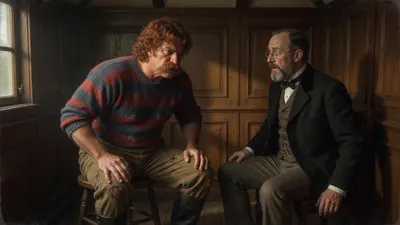
Before you read — think about:
- Some people know this book only from the 1954 Disney film, which picks a few famous stops. If THIS page names a bay you do not remember from the movie, how will you watch what Verne actually does with it?
- In the 1860s, news of an old sea fight lived in history books and in the talk of sailors. Today you can look up a bay on a map app in seconds and read the same fight on a screen. How does that change the way a place's past stays alive?
- Why do particular patches of water get remembered for centuries?
- Verne loves dates, ship names, and cargo lists. What does a pile of historical facts do to a scene?
- How does a writer make a list of old cargo interesting to read?
Watch for these while reading:
- Which people, objects, and settings actually appear here compared with the 1954 Disney film you already know.
- Ned Land's manner in this chapter.
- How Aronnax spends the hours of this chapter, and what he goes back to look at.
- Nemo's timing: where he is, and the questions he asks.
- Vigo Bay as Verne recounts it — the sea fight of 1702, carried on his usual freight of dates and names.
Vocabulary to know:
mariner (noun) — a sailor; gale (noun) — a very strong wind; billowy (adjective) — full of great rolling waves; reproach (verb) — to blame someone, or oneself; compressed (adjective) — pressed tightly together; refuge (noun) — a place of safety; uneasiness (noun) — a troubled, anxious feeling; wrench (noun) — a tool for turning bolts; procure (verb) — to obtain something, often with effort; retract (verb) — to take back something one has said or promised; ingratitude (noun) — failure to be thankful for kindness received; oath (noun) — a solemn promise; exile (noun) — long banishment from home; ajar (adjective) — slightly open; monklike (adjective) — plain and severe, like a monk's cell; insufficient (adjective) — not enough; amiable (adjective) — friendly and pleasant; interlocutor (noun) — the person one is talking with; potentate (noun) — a ruler with great power; treaty (noun) — a formal agreement between states; alliance (noun) — a union formed for a common purpose; prematurely (adverb) — earlier than is proper; archduke (noun) — a prince of the Austrian royal family; coalition (noun) — a group of states acting together; galleon (noun) — a large Spanish sailing ship used to carry treasure; convoy (noun) — a group of ships travelling together under escort; rashness (noun) — reckless haste; injunction (noun) — a firm order; rivalry (noun) — competition between people wanting the same thing; privilege (noun) — a special right granted to some and not others; merchandise (noun) — goods for sale; deprive (verb) — to take something away from someone; sequestered (adjective) — held apart and kept from use; inferior (adjective) — smaller or weaker; piastre (noun) — an old Spanish silver coin; booty (noun) — valuable goods taken as spoil; heir (noun) — someone who inherits property; allurement (noun) — something that tempts and attracts; bounty (noun) — a reward or payment; shareholder (noun) — someone who owns part of a company; barren (adjective) — producing nothing of value; console (verb) — to comfort someone in distress.
Chapter 32: A Vanished Continent
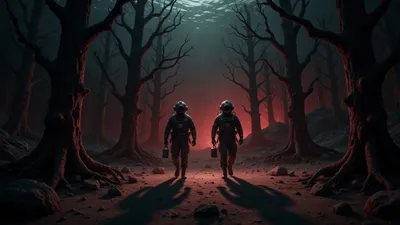
Before you read — think about:
- The 1954 Disney film is famous for its look — organ, iron, and big windows. What interiors do you already picture, and how will you notice whatever setting THIS page actually gives you?
- In the 1860s the Atlantic floor was almost unmapped; sailors filled the blanks with stories. Today sonar and satellites have drawn most of that floor. How does a real map change legends about lost lands?
- Plato wrote of a great civilisation that sank beneath the Atlantic. Do you think there is any truth in stories like that, and what would count as proof?
- How would you tell a natural rock formation from something built by human hands, after thousands of years under water?
- Verne likes to let a narrator guess wrong several times before he is sure. What does that do for a reader?
Watch for these while reading:
- Rooms, lights, and sea-floor scenery on this page versus the 1954 Disney interiors you already know.
- Who is invited on this walk, and who is not.
- The light in the water — its colour, its strength, and where it seems to fall.
- The stonework — materials, proportions, and any styles Aronnax names.
- Nemo's manner among the ruins.
Vocabulary to know:
pattering (noun) — a light tapping sound; sap (noun) — the liquid that carries food through a plant; grovel (verb) — to crawl low along the ground; stride (verb) — to step across with long steps; avalanche (noun) — a mass of snow or rock sliding down a mountain; crevice (noun) — a narrow opening in rock; monumental (adjective) — massive and impressive, like a monument; scarp (noun) — a steep cliff face; gravitation (noun) — the force pulling objects toward the earth; tolerate (verb) — to allow or permit; rent (adjective) — torn open; unfathomable (adjective) — too deep to be measured; curdle (verb) — to thicken and turn sour; used of blood, to freeze with fear; antenna (noun) — a feeler on the head of an insect or crustacean; titanic (adjective) — enormous; poulp (noun) — an octopus or squid; interweave (verb) — to twist together; conflagration (noun) — a great fire; genie (noun) — a spirit of great power in eastern legend; stature (noun) — a person's height and build; dreary (adjective) — bleak and gloomy; maze (noun) — a confusing network of paths; cromlech (noun) — a prehistoric arrangement of standing stones; cataclysm (noun) — a violent upheaval that destroys; fain (adverb) — gladly; willingly; fulguration (noun) — a flash of brilliant light; scoria (noun) — rough cinder-like fragments thrown out by a volcano; crater (noun) — the mouth of a volcano; incandescence (noun) — glowing white heat; diffusion (noun) — the spreading of one substance through another; aqueduct (noun) — a channel or bridge built to carry water; acropolis (noun) — the fortified high point of an ancient Greek city; abut (verb) — to border on; to touch at one end; basalt (noun) — a dark volcanic rock; testimony (noun) — evidence given in support of a claim; wage (verb) — to carry on a war; mossy (adjective) — covered with soft green growth; grandeur (noun) — impressive greatness.
Chapter 33: The Submarine Coal-Mines

Before you read — think about:
- People who know the 1954 Disney film often remember Nemo as a man with a hidden home. What do you already picture — and how will you notice what THIS page actually shows you of how he lives and works?
- In the 1860s factories and ships ran on coal. Today most ships burn oil or gas, and a lot of electricity comes from other sources. How does a change in fuel change what a voyage even needs?
- How can a writer make an industrial process — mining, refining, making things — read like an adventure?
- What would you notice first if you were taken to a workplace you had never seen and were not allowed to wander?
- Nineteenth-century industry ran on coal. What do you already know about how it was mined and what it was used for?
Watch for these while reading:
- Which people and workplaces actually appear here versus any secret base you picture from the 1954 Disney film.
- The shape of the space the Nautilus is lying in, and how Aronnax works out where he is.
- Nemo's chain of explanation running from coal to the power the ship uses.
- Ned Land's manner once land is near.
- The living things the three men come across ashore.
Vocabulary to know:
conglomerate (noun) — rock made of pebbles cemented together; designedly (adverb) — on purpose; orifice (noun) — an opening or mouth; vaulted (adjective) — arched like the roof of a great hall; commodious (adjective) — roomy and convenient; lagoon (noun) — a stretch of salt water enclosed by land; wherewithal (noun) — the means needed to do something; combustible (noun) — a substance that burns as fuel; mineralised (adjective) — turned into mineral over long ages; pumice (noun) — a light frothy volcanic rock; enamel (noun) — a hard glossy coating; mica (noun) — a mineral that splits into shining flakes; circuitous (adjective) — roundabout rather than direct; quartz (noun) — a hard glassy mineral; trachyte (noun) — a rough volcanic rock; colonnade (noun) — a row of columns supporting a roof; bituminous (adjective) — containing tar-like material; euphorbia (noun) — a plant family whose stems ooze a milky juice; heliotrope (noun) — a fragrant plant whose name means turning to the sun; chrysanthemum (noun) — a garden flower with many narrow petals; droop (verb) — to hang down limply; dragon-tree (noun) — a stout tree of the Canary Islands with a thick trunk; hive (noun) — a home for a colony of bees; incredulity (noun) — unwillingness to believe; esteemed (adjective) — highly valued; haversack (noun) — a bag carried over the shoulder; succulent (adjective) — juicy and delicious; crest (noun) — the top ridge of a slope; kestrel (noun) — a small hovering falcon; bustard (noun) — a large ground-dwelling bird with long legs; scamper (verb) — to run quickly with short steps; fruitless (adjective) — producing no result; gape (verb) — to open wide; remnant (noun) — a small remaining piece; umbelliferous (adjective) — belonging to the plant family whose flowers spread like an umbrella; limpet (noun) — a shellfish that clings tightly to rocks.
Chapter 34: The Sargasso Sea
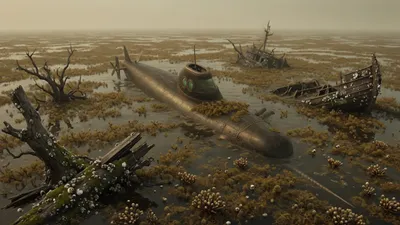
Before you read — think about:
- The 1954 Disney film cannot linger on a stretch of empty ocean. What do you already expect a 'sea chapter' to look like from that movie — and how will you notice what Verne actually puts on THIS page?
- In the 1860s the Sargasso Sea was a mystery on sailors' charts, a place of weed and still water. Today you can see that same weed — and the plastic caught in it — from satellite photos. How does a picture from space change a sea story?
- How can a writer make a still, weedy sea interesting to read?
- Why do some parts of the ocean feel empty even when they are not?
- What would you miss most if you had no mail and no news for months?
Watch for these while reading:
- Which objects and stretches of water actually appear here compared with the 1954 Disney ocean you already know.
- The weed itself, and how Verne explains why it gathers in one place.
- The thoughts Aronnax keeps to himself in this chapter.
- Any sign that Nemo has been reading Aronnax's own published work.
- The instruments during any change of depth — the manometer, the readings, the figures Verne quotes.
Vocabulary to know:
kelp (noun) — a large brown seaweed; herbaceous (adjective) — made up of soft green plants rather than wood; entangle (verb) — to catch and twist up in something; barnacle (noun) — a small shellfish that fastens itself to hulls and rocks; halcyon (noun) — here, a delicate pink sea creature; actinia (noun) — a sea anemone; signalise (verb) — to mark out as notable; void (adjective) — empty of something; cunning (noun) — clever trickery; persuasion (noun) — the act of convincing someone by argument; tacit (adjective) — understood without being spoken; exact (verb) — to demand and obtain by force; marginal (adjective) — written in the margin of a page; melancholy (adjective) — deeply sad; diagonal (noun) — a slanting line or path; quiver (verb) — to shake with a fine rapid tremble; groan (verb) — to make a low straining sound; receptacle (noun) — a container or hollow that holds something; objective (noun) — the lens of a camera or microscope; uniformity (noun) — sameness throughout; negative (noun) — a photographic plate with light and dark reversed; subdue (verb) — to hold something down or reduce its force; expend (verb) — to use up.
Chapter 35: Cachalots and Whales
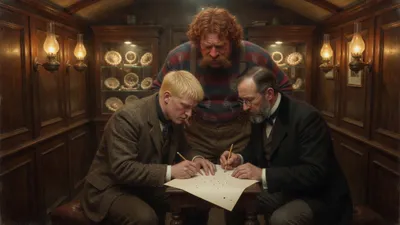
Before you read — think about:
- The 1954 Disney Ned Land is a harpooner in a Hollywood adventure. What do you already picture about hunting at sea from that movie — and how will you notice the animals and the people on THIS page?
- In the 1860s whale hunting was a major industry, and whale oil lit lamps in ordinary houses. Today most countries protect whales, and people pay to watch them. What changed?
- The title names two kinds of whale. What do you already know about how the largest sea animals feed and travel?
- Conseil's way of being a friend is to explain things. What does that kind of friendship look like in real life?
- How does a writer describe a large animal so that you can see it without a picture?
Watch for these while reading:
- Which animals and weapons actually appear here versus any hunting scene you remember from the 1954 Disney film.
- Nemo's remarks about the two kinds of whale, and how those remarks differ.
- Ned Land's manner while he watches, and any verdict he offers afterward.
- Conseil's conversation with Aronnax, including any sums he tries to work.
- The look of the animals as Verne describes them, close to and far from the ship.
Vocabulary to know:
temerity (noun) — reckless boldness; suppressed (adjective) — held down and hidden; surmise (noun) — a guess based on incomplete evidence; quotient (noun) — the result of a division; tavern (noun) — an inn where food and drink are served; autumnal (adjective) — belonging to autumn; blow-hole (noun) — the opening on a whale's head through which it breathes; localise (verb) — to confine to one area; aggravate (verb) — to irritate or provoke; encamp (verb) — to make a camp; whalebone (noun) — the flexible plates in a whale's mouth used to strain food; macrocephalous (adjective) — having an unusually large head; spermaceti (noun) — a valuable waxy oil found in the head of a sperm whale; cartilage (noun) — tough flexible tissue in the body; tadpole (noun) — the young of a frog, all head and tail; culpable (adjective) — deserving blame; annihilate (verb) — to destroy completely; barbarous (adjective) — cruel and uncivilised; inconsiderate (adjective) — thoughtless about the effects on others; greed (noun) — excessive desire for more than one needs; disperse (verb) — to scatter in different directions; exterminate (verb) — to wipe out entirely; mischievous (adjective) — causing harm or trouble; ferocious (adjective) — savagely fierce; carnage (noun) — great slaughter; massacre (noun) — a killing of many at once; mutilated (adjective) — badly damaged or torn; butchery (noun) — brutal slaughter; anatomically (adverb) — with regard to the structure of the body; cervical (adjective) — relating to the neck; vertebra (noun) — one of the bones of the spine; congener (noun) — an animal of the same kind or group; riddled (adjective) — full of holes; ill-will (noun) — hostility; bad feeling toward someone.
Chapter 36: The Iceberg
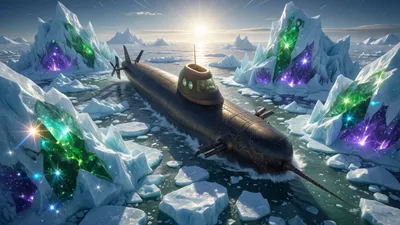
Before you read — think about:
- Many people know the 1954 Disney film of this book. What pictures of ice and ships do you already have — and how will you notice what is actually on THIS page?
- In the 1860s a captain in ice had no radar and no satellite picture of the ice edge. Today icebreakers and daily maps from space show where the ice is. How does that change a polar voyage?
- About how much of an iceberg sits below the waterline, and why would that figure matter to a navigator?
- The 1860s were the last decades of real blank space on the map. Why do people go to enormous trouble to reach somewhere nobody has been?
- How does a writer make cold feel like a place, not just a temperature?
Watch for these while reading:
- Ice, light, and ship-handling on this page that do not match any polar picture you brought from the 1954 Disney film.
- The whalers' name for the white glare along the horizon, and what it warns a captain of.
- The navigation south — the dates, latitudes, and ice conditions Verne records day by day.
- Nemo's account of what sealers did to the islands of the far south.
- Nemo's manner when he next comes into the saloon.
Vocabulary to know:
equinoctial (adjective) — relating to the equinox, when day and night are equal; amethyst (noun) — a violet-coloured crystal; facet (noun) — one flat cut surface of a crystal or gem; perpetual (adjective) — never stopping; circumpolar (adjective) — surrounding one of the earth's poles; animation (noun) — liveliness; the presence of active life; detonation (noun) — a loud explosive noise; diorama (noun) — a scene that changes as it is lit and viewed; brittle (adjective) — hard but easily broken; wedge (noun) — a tapering block driven in to split something; impulsion (noun) — the force of a driving push; impetus (noun) — the force of something already moving; gorge (noun) — a narrow passage between steep sides; soldered (adjective) — joined together as if fused with metal; interminable (adjective) — seemingly endless; hew (verb) — to cut with heavy blows; petrel (noun) — a long-winged seabird of the open ocean; puffin (noun) — a small seabird with a large brightly coloured bill; stationary (adjective) — not moving; disengage (verb) — to free oneself from something that holds one fast; affirm (verb) — to state firmly as true; bristle (verb) — to stand out thickly like stiff hairs; maniac (noun) — a person who behaves wildly and without reason; providential (adjective) — arranged by a fortunate design of nature; density (noun) — how heavy something is for its size; deviate (verb) — to turn aside from a course; sojourn (verb) — to stay for a time; groping (noun) — feeling one's way blindly; besiege (verb) — to surround and press in on; slacken (verb) — to slow down; inverse (adjective) — reversed; the opposite way round; profile (noun) — an outline seen from the side; audacious (adjective) — extremely bold.
Chapter 37: The South Pole
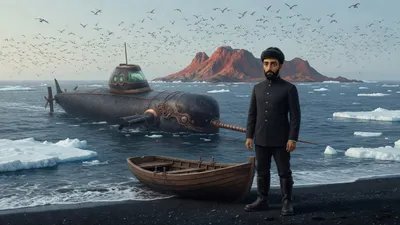
Before you read — think about:
- The 1954 Disney film has a clear three-act shape; this chapter is named for a pole. What do you already picture as 'the bottom of the world,' and how will you notice what is actually on THIS page?
- In the 1860s nobody had stood at the South Pole. Today research stations sit there year-round, and you can see the ice on a map app. What does it mean that a 'first' can become ordinary?
- How does a writer make a place with no landmarks feel like a destination?
- What would you want to do if you stood somewhere almost nobody else had ever stood?
- What is the difference between being the first to reach a place and being the first to prove you reached it?
Watch for these while reading:
- Which people, animals, and objects actually appear on the ice compared with any polar picture you already have, including from the 1954 Disney film.
- Who steps onto the land first, and the reason given for it.
- How the birds and the seals behave toward the visitors.
- The obstacles to taking an observation, and Nemo's manner while he waits on the weather.
- Any flag that is shown, and the words, if any, spoken over the ice.
Vocabulary to know:
strand (noun) — a shore or beach; acclivity (noun) — an upward slope; emit (verb) — to give off; expansive (adjective) — tending to spread out with force; lichen (noun) — a crusty growth of fungus and alga on rocks; rudimentary (adjective) — very simple and undeveloped; diatom (noun) — a microscopic alga with a glassy shell; bladder (noun) — a small air-filled sac that keeps seaweed afloat; meagre (adjective) — small in quantity; poor; sea-butterfly (noun) — a tiny swimming sea snail with wing-like flaps; starfish (noun) — a star-shaped sea animal with five or more arms; agile (adjective) — quick and light in movement; clamour (noun) — loud continuous noise; familiarly (adverb) — in a friendly, unafraid way; wick (noun) — the cord in a candle or lamp that carries the flame; vexed (adjective) — annoyed and frustrated; orb (noun) — a sphere; here, the sun; tempest (noun) — a violent storm; flake (noun) — a flat floating piece of ice; unreflecting (adjective) — acting without thinking things through; humpback (noun) — a large whale with very long flippers; fin-back (noun) — a long slender whale with a prominent back fin; whirlwind (noun) — a spinning column of air; invoke (verb) — to call on a higher power for help; observatory (noun) — a place chosen for making astronomical observations; ascent (noun) — a climb upward; agility (noun) — quickness and ease of movement; porphyry (noun) — a hard rock containing large crystals; sheaf (noun) — a bundle of things gathered together; chaotic (adjective) — in complete disorder; equinox (noun) — either of the two days a year when day and night are equal everywhere; coincide (verb) — to happen at exactly the same moment; unfurl (verb) — to unroll and spread out; banner (noun) — a flag; quartered (adjective) — placed in one quarter of a flag or shield; bunting (noun) — the light cloth from which flags are made; lap (verb) — to wash gently against.
Chapter 38: Accident or Incident?
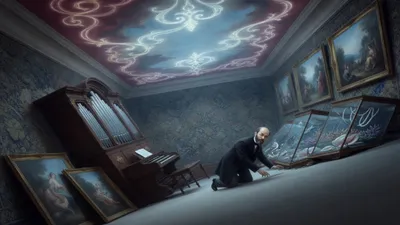
Before you read — think about:
- Movie adventures often signal trouble with music and a look on an actor's face. The 1954 Disney film can show you a ship among ice in one shot. What pictures of ice and ships do you already have — and how will you notice what is actually on THIS page?
- In the 1860s a ship among polar ice had no radio and no beacon. Today an emergency signal can call for help from almost anywhere. How does that change what 'trouble at sea' means?
- The chapter's title is a question with two words for a setback. What is the difference between those two words, and who gets to decide which one applies?
- Why does the word someone picks for a setback matter?
- How do you stay useful when you are not the person who knows what to do?
Watch for these while reading:
- Which rooms, instruments, and pieces of ice actually appear here versus the 1954 Disney Nautilus you already know.
- The saloon when Aronnax first comes in — who is there, and how the room is described.
- Nemo lecturing on ice — how it forms, how it drifts, and how much of it rides out of sight.
- The compass and the manometer: the figures Verne gives, and the order he gives them in.
- The two title-words, if anyone aboard uses them, and which word each speaker prefers.
Vocabulary to know:
constellation (noun) — a named group of stars; morse (noun) — an old word for a walrus; emigrate (verb) — to leave one region and settle in another; undermine (verb) — to wear away the base of something; reiterated (adjective) — repeated again and again; irresistible (adjective) — impossible to withstand; ascending (adjective) — moving upward; philosophical (adjective) — concerned with general truths about life; voltaic (adjective) — produced by an electric battery; ridge (noun) — a long narrow raised edge; sapphire (noun) — a deep blue gemstone; emerald (noun) — a bright green gemstone; capriciously (adverb) — in an irregular, unpredictable way; dazzle (verb) — to blind briefly with too much light; superb (adjective) — magnificent; devour (verb) — to consume greedily; here, to overwhelm; mechanically (adverb) — without thinking about it; detain (verb) — to keep someone from leaving; hindrance (noun) — something that delays or obstructs; outlet (noun) — a way out; glassy (adjective) — smooth and clear like glass.
Chapter 39: Want of Air
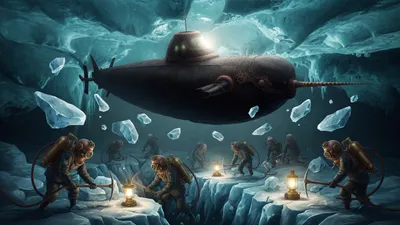
Before you read — think about:
- The title names air. Many people who know the 1954 Disney film remember excitement, not waiting. What do you already picture as 'danger aboard the Nautilus' from that movie — and how will you notice what THIS page actually dwells on?
- In the 1860s nobody had lived for days in a sealed metal room under water. Today submarines have air scrubbers and can stay down for months. What problems did engineers have to solve to make that possible?
- How can a writer make you feel a danger you cannot see?
- What is the longest you have had to wait while you could not fix the problem yourself?
- Why does running short of air frighten people more than other shortages do?
Watch for these while reading:
- Which people and instruments actually appear here compared with any crisis scene you remember from the 1954 Disney film.
- The way Nemo lays the situation out, like a lecturer at a blackboard.
- Ned Land's manner in this chapter.
- The arithmetic Verne puts on the page — hours, figures, and readings on a dial.
- The thoughts Aronnax keeps to himself, if he keeps any.
Vocabulary to know:
deliverance (noun) — rescue from danger; ambient (adjective) — surrounding on all sides; superintend (verb) — to oversee work; trench (noun) — a long narrow cut in the ground; detach (verb) — to break something away from a mass; vivifying (adjective) — life-giving; enfeebled (adjective) — weakened; lapse (noun) — the passing of a period of time; slushy (adjective) — half-melted and watery; solidification (noun) — the process of turning solid; tendency (noun) — an inclination to behave a certain way; counteract (verb) — to work against and cancel out; apprehension (noun) — fearful expectation; vitiated (adjective) — spoiled; made impure; deleterious (adjective) — harmful to health; dissolve (verb) — to break a substance down within a liquid; pile (noun) — an early form of electric battery; jar (noun) — a wide-mouthed container; resume (verb) — to begin again after a pause; despair (noun) — complete loss of hope; ferocity (noun) — extreme cruelty; cement (noun) — a substance that hardens and binds things together; hollow (noun) — a hole or empty space; dizziness (noun) — a spinning, unsteady feeling in the head; rattling (noun) — a harsh sound in the throat when breathing is failing; forsake (verb) — to abandon; lighten (verb) — to make something less heavy; perforate (verb) — to pierce with holes; overcharge (noun) — an excessive load; agony (noun) — extreme suffering; succumb (verb) — to give way and die; impel (verb) — to drive forward with force; particle (noun) — a tiny amount; abundance (noun) — a very large quantity.
Chapter 40: From Cape Horn to the Amazon
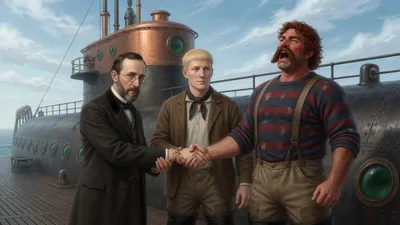
Before you read — think about:
- The 1954 Disney film compresses the voyage into a few stops. THIS page is named for a long stretch of coast. What do you already picture from the movie's voyage — and how will you notice the actual route on THIS page?
- In the 1860s a ship spent weeks going from Cape Horn toward the Amazon. Today the same stretch is a long flight. What does a traveler lose, and gain, by going that much faster?
- Coming through a hard stretch beside someone changes a friendship. In what ways, do you think?
- What could a naturalist learn about a coast he races past and can never set foot on?
- This chapter covers thousands of miles of coastline. What holds a travelogue together when there is no single event in it?
Watch for these while reading:
- Coasts, animals, and conversations on this page that do not match the 1954 Disney voyage you already know.
- The first words on the platform, and who speaks them.
- Which ocean the Nautilus turns into.
- Conseil's manner toward the sea life they meet.
- The coasts Verne names one after another, and how close the Nautilus comes to each of them.
Vocabulary to know:
indulge (verb) — to allow oneself something enjoyable; restrain (verb) — to hold back; gratitude (noun) — thankfulness for a kindness received; obligation (noun) — a debt of duty owed to someone; tenacity (noun) — the quality of holding firmly without breaking; fertile (adjective) — rich in growth; pantry (noun) — a room where food is stored; embouchure (noun) — the mouth of a river where it opens into the sea; bifurcate (verb) — to divide into two branches; depression (noun) — a sunken hollow in a surface; broadside (noun) — a long flat surface along a ship's side; translucid (adjective) — letting light through; almost transparent; cartilaginous (adjective) — having a skeleton of gristle rather than bone; snout (noun) — the projecting nose and jaws of an animal; jagged (adjective) — with rough sharp points; prolongation (noun) — an extended part; horny (adjective) — made of hard material like horn; topaz (noun) — a golden-yellow gemstone; ruby (noun) — a deep red gemstone; glossy (adjective) — smooth and shining; bilobed (adjective) — divided into two rounded parts; sirenian (adjective) — belonging to the order of sea cows; herd (verb) — to gather in a group; provident (adjective) — providing carefully for the future; putrefied (adjective) — rotted and foul; plague (noun) — a widespread deadly disease; infest (verb) — to overrun in unpleasant numbers; infection (noun) — the spread of disease; torrid (adjective) — very hot; contract (verb) — to draw together and tighten.
Chapter 41: The Poulps
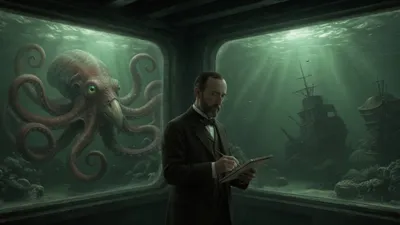
Before you read — think about:
- Many people remember a giant sea creature from the 1954 Disney film. What do you already picture from that set-piece — and how will you notice what is actually on THIS page?
- In the 1860s, stories of huge sea animals lived in sailors' talk and in a few disputed reports. Today you can watch a giant squid on a nature documentary filmed in the deep. How does a camera change a monster story?
- Sailors have told stories of giant squid for centuries. What kind of evidence would settle whether they are real?
- Verne gives whole pages to classifying whatever his characters see. Does the cataloguing slow the story down, or is it part of the appeal?
- Why do sea monsters keep their hold on the imagination even after science has described them?
Watch for these while reading:
- Which creatures, tools, and people actually appear in this fight-or-sighting compared with the 1954 Disney set-piece you already know.
- Stories Aronnax recalls about large sea animals, and how much of each is a matter of record.
- Conseil identifying an animal through a window by working through a series of questions.
- The vocabulary Verne reaches for — poulp, squid, cuttlefish, kraken — and where each of those words comes from.
- Nemo's manner toward the animals, and toward his own men.
Vocabulary to know:
despatch-boat (noun) — a fast vessel used to carry messages; indisputable (adjective) — impossible to argue against; slip-knot (noun) — a knot that tightens as it is pulled; rejoin (verb) — to reply; cephalopod (noun) — a mollusc whose arms grow straight from its head, such as a squid or octopus; crossways (adverb) — at an angle across something; beak (noun) — a hard horny mouthpart; horned (adjective) — made of tough material like horn; air-hole (noun) — here, one of the suction cups along a tentacle; sucker (noun) — a cup-shaped organ for gripping; freak (noun) — a strange departure from the usual; spindle (noun) — a rod tapering at both ends; irritation (noun) — a state of being provoked; vitality (noun) — life force; energy; vigour (noun) — strength and energy; renewal (noun) — the growing back of something lost; gnash (verb) — to grind the teeth together; dull (adjective) — low in spirits; vermin (noun) — creatures regarded as pests; unscrew (verb) — to loosen by turning; wriggle (verb) — to twist and squirm; lash (verb) — to strike out violently; stifle (verb) — to smother; to prevent from breathing; heart-rending (adjective) — causing deep grief; flank (noun) — the side of something; musk (noun) — a strong penetrating smell; suction (noun) — the force of sucking that holds things fast; staring (adjective) — fixed in an unblinking gaze.
Chapter 42: The Gulf Stream
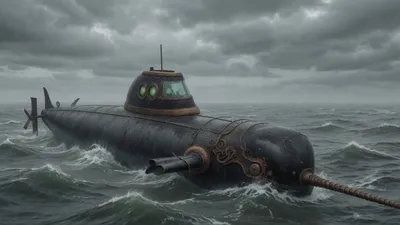
Before you read — think about:
- After a famous movie set-piece, a film often cuts to the next thrill. This book keeps going in chapters. What do you already expect to happen 'after the monster' from the 1954 Disney film — and how will you notice what THIS page actually attends to?
- In the 1860s sailors knew the Gulf Stream from logs, bottle papers, and the colour of the water. Today a weather app shows the current and the storms that ride it. How does that change a captain's job?
- The chapter is named for a current. What kind of weather is that stretch of the Atlantic known for?
- How can a writer describe wind and water without being able to show you a picture?
- What makes a current in the ocean different from a river, and why would sailors care?
Watch for these while reading:
- Which rooms, currents, and weather actually appear here versus whatever the 1954 Disney film does after its big sea-creature scene.
- How the ship herself behaves in the days that follow, and what Aronnax reads into the course she keeps.
- Any conversation between the three guests about speaking to the captain.
- The Gulf Stream itself — its course, its colour, and its temperature.
- The capes, coasts, and harbours Verne names along the Gulf Stream, and how far off the Nautilus stays.
Vocabulary to know:
bruised (adjective) — injured by a blow without breaking the skin; conventional (adjective) — agreed on by custom rather than natural; recoil (verb) — to draw back in fear or disgust; insoluble (adjective) — impossible to solve; irresolute (adjective) — unable to decide; random (noun) — without plan or direction; supervision (noun) — the act of watching over and directing; ply (verb) — to travel a route regularly; thwart (verb) — to prevent someone from doing what they intend; engender (verb) — to give rise to; cyclone (noun) — a violent circular storm; hurricane (noun) — an extremely violent tropical storm; nostalgia (noun) — a painful longing for home; fret (verb) — to worry and chafe restlessly; surly (adjective) — bad-tempered and unfriendly; home-sickness (noun) — misery caused by being far from home; diversion (noun) — something that takes the mind off troubles; bequeath (verb) — to leave something to those who come after; obscure (adjective) — unknown to the world; consideration (noun) — thoughtful regard for another person; slavery (noun) — the condition of being owned and held against one's will; cirrhous (adjective) — wispy and high, describing thin streaky cloud; cumulus (noun) — a heaped, piled-up cloud; strife (noun) — violent conflict; squall (noun) — a sudden violent burst of wind and rain; saturated (adjective) — soaked through; propagation (noun) — the movement of a wave through a medium; gloom (noun) — darkness; envy (verb) — to wish one had what another has.
Chapter 43: From Latitude 47° 24' to Longitude 17° 28'
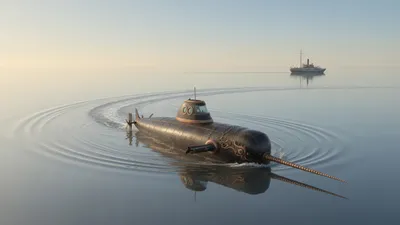
Before you read — think about:
- The 1954 Disney film does not give you coordinates and a history lecture. What do you already picture as the 'late part' of this story from that movie — and how will you notice what is actually on THIS page?
- In the 1860s a place at sea was a pair of numbers in a logbook. Today those same numbers drop a pin on a phone map. What does a coordinate mean to you compared with a name?
- The chapter title is nothing but a pair of coordinates. What does it mean to give a place a number instead of a name?
- What might home waters mean to a man who has renounced his own country — or to passengers who still have one?
- How does a writer handle a character who will not explain himself?
Watch for these while reading:
- Which people, wrecks, and numbered places actually appear here compared with the late-voyage pictures you have from the 1954 Disney film.
- Nemo's mood as the numbers on the chart change, and the guesses Aronnax makes about it.
- Whatever lies on the sea floor in this chapter, and the condition it is in.
- Any date Nemo names, and how it sits against the date Aronnax is living through.
- The difference between the way Aronnax talks about history and the way Nemo talks about it.
Vocabulary to know:
proximity (noun) — nearness; gloomy (adjective) — dark in mood; deeply sad; remorse (noun) — deep regret for something one has done; presentiment (noun) — a feeling that something is about to happen; betray (verb) — to reveal something that was meant to stay hidden; flutter (verb) — to flap lightly in the wind; altitude (noun) — the height of the sun above the horizon; motionless (adjective) — completely still; vertical (adjective) — straight up and down; immensity (noun) — vastness; coating (noun) — a layer covering a surface; lime (noun) — a chalky mineral deposited from water; launch (verb) — to put a newly built ship into the water; entrust (verb) — to place something in someone's care; corn (noun) — grain of any kind; disabled (adjective) — put out of action; surrender (verb) — to give oneself up to an enemy; colours (noun) — a ship's national flag; heroically (adverb) — with great courage; avenger (noun) — one who takes revenge on behalf of another; republic (noun) — a state ruled by the people rather than a monarch; mutter (verb) — to speak in a low, half-heard voice.
Chapter 44: A Hecatomb
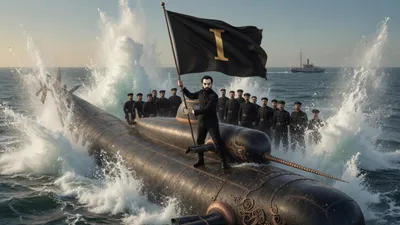
Before you read — think about:
- Many people know a sea-fight ending from the 1954 Disney film. What do you already picture from that movie's last act — and how will you notice what is actually on THIS page?
- In the 1860s a warship was wood or iron, and news of a fight at sea took weeks to reach shore. Today hulls are steel, and a video can be on a phone the same day. How does that change what a battle even is?
- A hecatomb is a great slaughter offered up in a temple. What extra meaning does a word like that carry before you even start reading?
- Being a guest with no say in where you go is a strange position. How would months of it change the way you saw your host?
- Verne sometimes borrows a heavy word from religion or ancient history for a chapter title. What does that choice do to your expectations?
Watch for these while reading:
- Which ships, flags, and people actually appear here versus the last-act pictures you have from the 1954 Disney film.
- Flags, signals, and the way people use them at sea in this chapter.
- Nemo's bearing, and how much of what he is doing he chooses to explain.
- Ned Land's manner on the platform.
- The words Verne chooses for a fight at sea — ordinary naval language, or something heavier.
Vocabulary to know:
hecatomb (noun) — a great slaughter of many victims at once; vow (verb) — to promise solemnly; pitiless (adjective) — showing no mercy; ricochet (verb) — to bounce off a surface at an angle; dilemma (noun) — a situation offering only bad choices; pupil (noun) — the dark opening at the centre of the eye; wring (verb) — to twist and squeeze hard; accursed (adjective) — hateful; under a curse; animate (verb) — to fill with feeling or purpose; mediate (verb) — to try to settle a quarrel between two sides; cherish (verb) — to hold dear; venerate (verb) — to regard with deep respect; oppressor (noun) — one who rules others cruelly and unjustly; accomplice (noun) — someone who helps another commit a wrong; fascinate (verb) — to hold spellbound; brooding (adjective) — darkly and silently gathering; uttermost (noun) — the greatest possible degree; foremast (noun) — the mast nearest the bow of a ship; filter (verb) — to pass through slowly; stupor (noun) — a state in which the mind stops working; accelerate (verb) — to increase speed; sailcloth (noun) — the heavy fabric used for sails; scraping (noun) — a harsh sound of metal dragging; netting (noun) — a barrier of knotted rope along a ship's side; ant-heap (noun) — an anthill; a swarming crowd; anguish (noun) — extreme mental suffering; laden (adjective) — loaded; topmast (noun) — the second section of a mast, above the lower mast; spar (noun) — a stout pole supporting a sail; mainmast (noun) — the principal mast of a ship; archangel (noun) — an angel of the highest rank.
Chapter 45: The Last Words of Captain Nemo
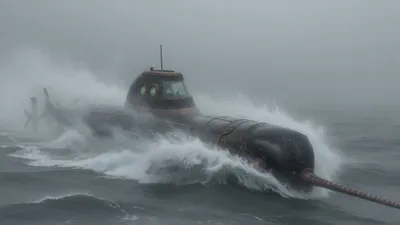
Before you read — think about:
- Many people remember Nemo at a pipe organ from the 1954 Disney film. What do you already picture from that — and how will you notice the Nemo, the rooms, and the sounds actually on THIS page?
- In the 1860s, from under the sea you could send no letter and no telegram. Today people send a last message from almost anywhere. How does that change what 'last words' even mean?
- The chapter is titled 'The Last Words of Captain Nemo'. What kind of thing do people say last, and how much does it reveal about them?
- The sea in this novel is beautiful, useful, and completely indifferent to human beings. How should people feel about a force like that?
- What draws a person to solitude, and what does a long stretch of it cost them?
Watch for these while reading:
- Which rooms, instruments, and sounds actually appear here compared with the pipe-organ Nemo you know from the 1954 Disney film.
- Aronnax's feelings toward Nemo, stated as plainly as he knows how.
- How often the captain and his crew are seen, and where they keep themselves.
- Ned Land's manner, and how close Conseil keeps to him.
- Any music heard in the ship, and any words that come through a closed door.
Vocabulary to know:
nightmare (noun) — a terrifying dream; foundered (adjective) — sunk; overwhelmed; fabulous (adjective) — belonging to fable; legendary; cataract (noun) — a great waterfall; adventurous (adjective) — full of risk and daring; catastrophe (noun) — a sudden disaster; unhealthy (adjective) — not good for one's health; fit (noun) — a sudden violent attack of illness or emotion; bolt (noun) — a metal pin that fastens two things together; murmur (verb) — to speak very softly; maelstrom (noun) — a powerful whirlpool; pent-up (adjective) — held back under pressure; whirlpool (noun) — water spinning violently in a circle; navel (noun) — the centre point of something; thither (adverb) — to that place; voluntarily (adverb) — by one's own choice; involuntarily (adverb) — without meaning to; giddiness (noun) — dizziness; whirling (noun) — rapid spinning; bark (noun) — a small boat; uproar (noun) — a loud confused noise; roaring (noun) — a deep prolonged noise; echo (noun) — a sound thrown back from a surface; sacrifice (verb) — to give up or destroy; veiled (adjective) — covered and hidden from view.
Chapter 46: Conclusion
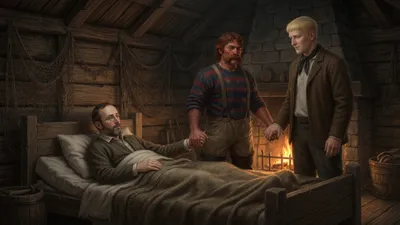
Before you read — think about:
- Many people know how the 1954 Disney film ends. What do you already picture from that ending — and how will you notice what is actually on THIS page?
- In the 1860s Aronnax would publish a book and wait months for reviews. Today someone might post the whole story in a day. How does that change what it means to tell what happened?
- Do you prefer an ending that answers a story's questions or one that leaves them open? Give your reasons.
- How much of an extraordinary experience can anybody ever prove to other people?
- The chapter is simply called 'Conclusion'. How long should the last chapter of a long novel be, and what is its job?
Watch for these while reading:
- Which people, places, and unanswered questions actually appear here versus the 1954 Disney ending you already know.
- How much Aronnax admits he cannot account for.
- The claim he makes about the accuracy of his own record.
- The questions he sets down about Nemo and about the Nautilus.
- The quotation Verne closes the novel on, and the writer he borrows it from.
Vocabulary to know:
hut (noun) — a small simple dwelling; embrace (verb) — to hold someone in one's arms; heartily (adverb) — warmly and sincerely; revise (verb) — to go over and correct a piece of writing; omit (verb) — to leave out; exaggerate (verb) — to make something sound greater than it is; faithful (adjective) — accurate and true to the facts; narrative (noun) — an account of connected events; incredible (adjective) — hard or impossible to believe; inaccessible (adjective) — impossible to reach; progress (noun) — the advance of knowledge and invention; manuscript (noun) — a handwritten document; adopted (adjective) — chosen as one's own rather than inherited; exceeding (adjective) — extremely great.
About the Author
Jules Verne (1828-1905) was a French novelist who was supposed to become a lawyer like his father and became a writer instead. Working with the publisher Pierre-Jules Hetzel, he produced a long series of novels called the Voyages Extraordinaires, meant to carry readers into every corner of the known — and not-yet-known — world; among them are Journey to the Center of the Earth, From the Earth to the Moon, and Around the World in Eighty Days. Verne was not a scientist, but he was a tireless researcher who filled notebooks with facts from journals, encyclopedias, and expedition reports, then built his stories on top of them, which is why his adventures feel so oddly plausible. He is one of the most translated authors who has ever lived, and he is often called a founder of science fiction.
Verne wrote this novel between 1869 and 1870, a moment when the deep ocean was as unknown as outer space. The first successful transatlantic telegraph cable had only just been laid, the Suez Canal opened in 1869, and the great scientific expeditions that would map the sea floor were still ahead. Working submarines existed but were small, dangerous, and hand-cranked; electricity was a laboratory marvel rather than a source of power for daily life. The 1860s were also a decade of empire and rebellion — Verne wrote against a background of European colonial rule and the uprisings against it, which shapes Captain Nemo's fury at the nations of the surface world more than a first reading may suggest. Note as well that most English editions of this book descend from an 1873 translation that shortened and altered Verne's French, so different editions can vary noticeably.