

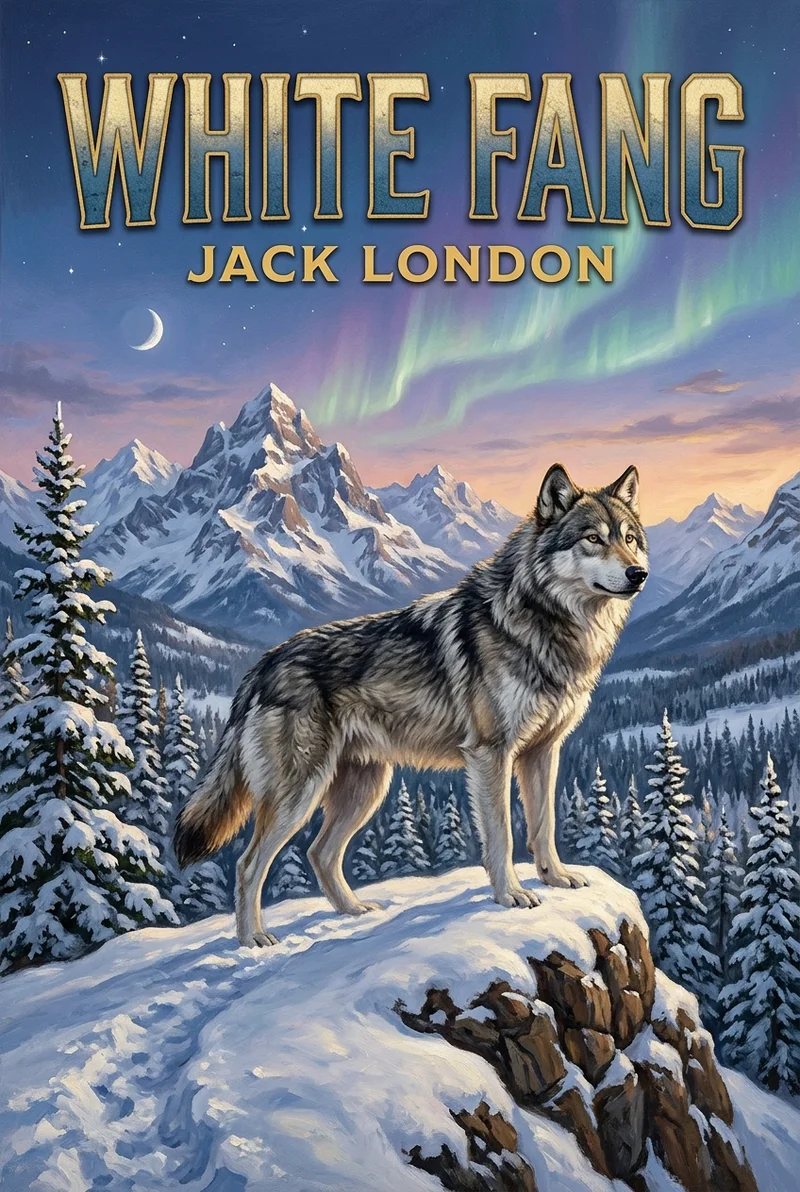
About This Book
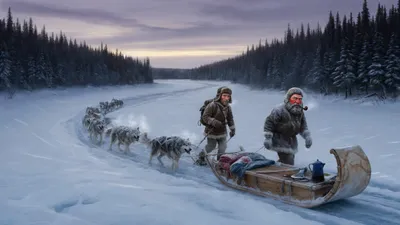
In the dead of a Yukon winter, two men named Bill and Henry haul a sled along a frozen river toward a distant fort. The country around them is empty, silent, and colder than anything they can joke away. Something is following them through the dark. Night after night they listen, count their dogs, and try to keep a fire between themselves and whatever is out there.
Most books ask you to imagine being another person; this one asks you to imagine not being a person at all. That makes White Fang unusually good practice in the skill every reader needs — building a mind that is not your own out of nothing but evidence on the page. London is also arguing in public: he wants to know whether a creature is made by what it is born as or by what happens to it, and he puts the evidence where you can weigh it. Along the way the story is genuinely gripping — hunger, blizzards, and rivalries that a reader feels in the stomach rather than just follows on the page.
Meet the Characters

More about White Fang
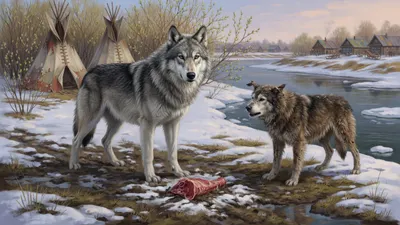
White Fang is a grey cub in a hidden den, the only cub of his litter who takes after his grey father. He is curious and stubborn, drawn toward the bright wall of light at the mouth of the cave. The wild is the only world he knows yet, and it teaches its lessons with teeth.

More about Kiche
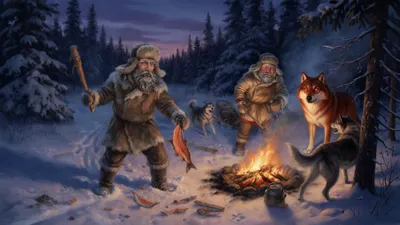
Kiche is a lean she-wolf with a strange reddish coat who runs at the head of a wolf pack through a starving Yukon winter. She is patient, clever, and fiercely protective of whatever she claims as hers. The pack follows her lead more often than it follows any of the males.

More about One Eye
One Eye is a battle-worn old wolf who has outlived more hungry winters than anyone else in his pack. He is wary, unhurried, and enormously experienced, hunting by cunning rather than by speed. He is neither the biggest wolf on the trail nor the fastest, but he may well be the smartest.

More about Bill
Bill is a trail-hand on a long winter haul toward Fort McGurry, walking behind the sled while his partner breaks trail. He talks more than he has to, notices small wrong numbers, and does not like leaving a question unanswered. Under the frost on his face he is a man who would rather name a danger than joke it away.

More about Henry
Henry is Bill's partner on the same frozen haul, the one who breaks trail on snowshoes and tends the fire and the coffee-pot. He is slower to admit that something is wrong, and quicker to make a dry joke when the silence gets heavy. He does the practical work of camp as if naming a fear might make it real.

More about Grey Beaver
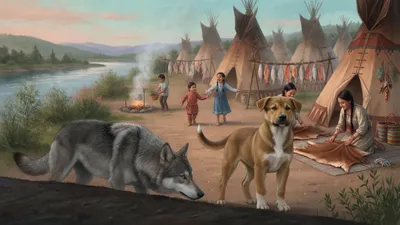
Grey Beaver is a respected hunter and trader who leads his people's camp along the Mackenzie River. He is stern, quiet, and thoroughly practical, expecting steady obedience from everyone and everything in his household. To him an animal is property — useful, valuable, and never a friend.

More about Mit-sah
Mit-sah is Grey Beaver's son, still young enough to be learning a man's work and already serious about it. He resembles his father in the way he watches and waits before he speaks. In camp he is a boy among dogs and sleds, not yet the head of a household.

More about Lip-lip
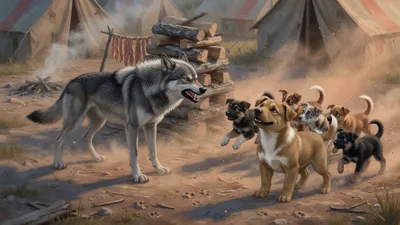
Lip-lip is a camp puppy, bigger and older than the grey cub who arrives beside Kiche. He already knows the other young dogs of the village, and he treats a newcomer as something to be driven off. He is bold when no grown person is watching, and careful when one is.

More about Beauty Smith
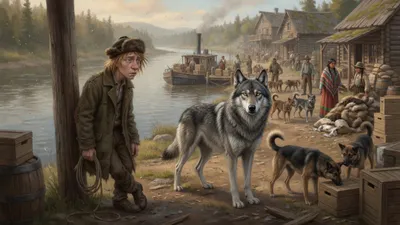
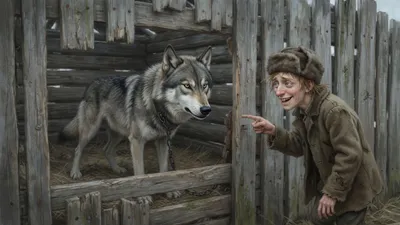
Beauty Smith is a camp cook and odd-job man who drifts from settlement to settlement around the goldrush town of Dawson, taking whatever work he can get. He is nervous and flattering around men stronger than himself, and a great deal braver around anything smaller. Watch how differently he behaves when no one important is looking.

More about Weedon Scott
Weedon Scott is a mining engineer from California, working a claim in the Klondike a long way from the comfortable life he grew up in. He is even-tempered, observant, and unusually patient, with firm opinions about how animals ought to be handled. Among the rough crowd of the goldfields, he stands out for refusing to settle anything with a club.

More about Matt
Matt is a working dog-musher who knows sled-dogs the way a carpenter knows wood. He talks in a dry Northern drawl, shrugs more than he lectures, and trusts what a dog's body tells him over what a theory says. He is practical, stubborn once he has made up his mind, and not easily frightened by a snarl.

More about Collie
Collie is the ranch sheep-dog of a family place in the Santa Clara Valley, bright-eyed and sure of her job. She is quick, sharp-muzzled, and not in the habit of sharing a gate with a stranger. To her a wolf-looking animal is something to be kept off the lawn.

More about Judge Scott
Judge Scott is an older gentleman of the Santa Clara Valley, the head of a large, comfortable household called Sierra Vista. He reads the newspaper on a wide porch and speaks in the measured way of a man used to giving verdicts. He is undemonstrative, sure of his opinions, and not easily talked out of them.
Pre-Reading Discussion Questions
- When a story is told from an animal's point of view, what can the author show you that a human narrator could not — and what does the author lose?
- Think of an animal you know well. How much of its behavior do you think comes from what it was born as, and how much from how it has been treated?
- The novel treats a frozen wilderness almost as a character with its own will. What other stories, films, or games have you encountered where the setting itself acts like an opponent?
- In a place where food is scarce and help is far away, which rules that govern your daily life would stop mattering — and which new ones would take their place?
- What does it take for you to trust someone — or some animal — you have just met? What would make you decide not to?
- How do you know when a writer is describing a place and when the place is being asked to do the work of a character?
Themes & Big Ideas to Track
- How often the book credits a character's behavior to birth, and how often to treatment, and whether those two explanations ever disagree.
- The way London writes the frozen country as if it had wishes, moods, and a kind of laughter.
- How groups in this book — packs, sled teams, camps, households — sort themselves into ranks, and what life looks like at the bottom of one.
- What hunger, cold, and silence do to judgment, speech, and the stories people tell themselves.
- The difference between a rule someone can state and a rule a creature simply lives.
- How London uses sound, scent, and the circle of firelight when there is almost nothing to see.
Chapter-by-Chapter Study Guide
Chapter 1: The Trail of the Meat
Before you read — think about:
- Some stories open by describing a place at length before a single character speaks. What can a landscape tell you about a story that an introduction to a character cannot?
- Travelling hundreds of miles through country with no roads, no towns, and no help means carrying everything you need. What would you rank as essential, and what would you leave behind?
- Extreme cold changes what counts as a small problem. Which ordinary inconveniences do you think become dangerous at sixty degrees below zero?
- In the far North, dogs were working animals rather than pets. How might depending on an animal for your survival change the way you think about it?
- How do people keep their spirits up on a long, hard job, and when does that stop working?
Watch for these while reading:
- The way London writes about the Wild itself — wishes, moods, even a kind of laughter, as though the country had opinions.
- The sled and what is lashed most securely to it.
- Sound: how much of the chapter is built out of what can be heard rather than what can be seen.
- How the two men speak: sentence length, jokes, silences, and the difference between the two voices.
- The dogs at feeding time and around the fire — what they do that the men cannot do for themselves.
Vocabulary to know:
ominous (adjective) — giving the feeling that something bad is about to happen; desolation (noun) — a place that is empty, bare, and without life; mirthless (adjective) — having no real joy or humor in it; defiant (adjective) — boldly refusing to give in; rimed (adjective) — coated with a crust of frost; traces (noun) — the leather straps that connect a sled dog to the sled it pulls; oblong (adjective) — much longer than it is wide; shaped like a stretched rectangle; indomitable (adjective) — impossible to defeat or discourage; discernible (adjective) — able to be seen or made out; spectral (adjective) — ghostly; belonging to the world of the dead; puny (adjective) — small and weak, especially next to something enormous; colossal (adjective) — enormous in size or scale; tangible (adjective) — real and solid enough to be touched; evinced (verb) — showed clearly through behavior; bedlam (noun) — wild, noisy confusion; cartridges (noun) — the metal cases holding the powder and bullet that a rifle fires; moccasins (noun) — soft leather shoes of the kind worn for travel in the North; epitaph (noun) — the words spoken or written about someone after they have died; scant (adjective) — barely enough; meager; wrath (noun) — fierce anger.
Chapter 2: The She-Wolf
Before you read — think about:
- What do you already know about wolves, and where did that idea come from?
- How do working dogs behave when something they cannot see is nearby?
- Why might a writer give one animal a colour that does not match the rest of its kind?
- What is it like to travel the same trail for days with the same partner and the same load?
- How do you decide whether a clever-looking plan is actually going to hold?
Watch for these while reading:
- London's colour vocabulary. He is unusually specific about the colour of animals in this chapter.
- The way the two men's talk drifts apart: who shortens his sentences, who keeps up the jokes.
- The arithmetic the men keep doing out loud: cartridges, matches, miles, days.
- How the she-wolf of the title is described when she is seen in daylight.
- Anything a follower does around fire, food, or a camp that looks learned rather than wild.
Vocabulary to know:
pall (noun) — a dark covering that blots out light, like a heavy cloth spread over something; crestfallen (adjective) — suddenly disappointed and discouraged; stout (adjective) — thick, strong, and sturdy; intonation (noun) — the rise and fall of a voice, which can change what words really mean; thong (noun) — a narrow strip of leather used to tie something; gnaw (verb) — to chew at something steadily until it gives way; decoy (noun) — someone or something used to lure a victim into a trap; stealthy (adjective) — moving quietly and carefully so as not to be noticed; sidelong (adjective) — moving or looking to the side rather than straight on; mistrust (noun) — a lack of trust; suspicion; gaunt (adjective) — extremely thin, usually from hunger or hardship; gait (noun) — a particular way of walking or running; scrutiny (noun) — a long, close, careful examination; merciless (adjective) — showing no pity at all; solitude (noun) — a state of being completely alone, or a place with nobody in it; plodded (verb) — walked slowly and heavily; slinking (adjective) — moving low and quietly, as though trying not to be seen; hue (noun) — a shade or tint of color; marauders (noun) — raiders who roam about looking for something to seize; admonished (verb) — warned or advised firmly.
Chapter 3: The Hunger Cry
Before you read — think about:
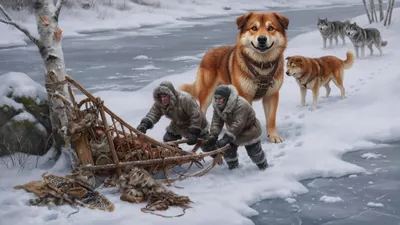
- Fire is warmth, light, and protection all at once. What does keeping a fire burning actually cost the person tending it?
- After several days without real sleep, which of your abilities do you think would fail first, and would you notice it happening?
- The title mentions a cry of hunger. Is a starving predator more dangerous than a well-fed one, or less? Argue both sides.
- What supplies would you want with you if you were travelling through wilderness in winter?
- What is the difference between being physically tired and being mentally tired, and how would you know which one you were?
Watch for these while reading:
- How much of this chapter reaches a character through his ears rather than his eyes.
- Every use found for fire, and how ideas about it change as the hours go on.
- The sky, the light, and the length of the day. London keeps one eye on the weather.
- A passage where the narration slows right down to look at ordinary human hands and teeth.
- The difference between what a person says out loud and what the narrator says is actually happening.
Vocabulary to know:
auspiciously (adverb) — in a way that seems to promise good luck ahead; forebodings (noun) — uneasy feelings that something bad is coming; facetious (adjective) — joking, especially about something that is not really funny; sidling (verb) — moving sideways, quietly, hoping not to be noticed; ingratiating (adjective) — designed to win someone's trust or liking; menacing (adjective) — threatening; suggesting harm is coming; haggard (adjective) — looking worn out and hollow from exhaustion or worry; saplings (noun) — young, slender trees; scaffold (noun) — a raised platform built out of poles; sepulchre (noun) — a tomb or burial place; ravenous (adjective) — extremely hungry; sustenance (noun) — food that keeps a living thing alive; carnivorous (adjective) — meat-eating; malignity (noun) — intense ill will; a look or feeling of deep hostility; precarious (adjective) — unsteady and likely to be lost at any moment; efficacy (noun) — the power to produce the result you want; benumbed (adjective) — made dull and unfeeling; besieged (verb) — surrounded and cut off, as an army surrounds a fort; smouldering (adjective) — burning slowly without flame; haunches (noun) — the hindquarters — the hips and back legs of an animal; petulantly (adverb) — in a cross, childishly impatient way; resilience (noun) — the ability to spring back after being pressed down.
Chapter 4: The Battle of the Fangs
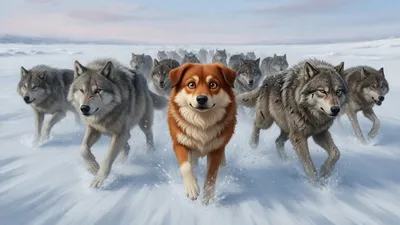
Before you read — think about:
- The story now follows wolves instead of men. What does a writer have to do differently to hold a reader's attention on characters who cannot speak?
- In an animal group that hunts together, what jobs need doing, and how might a group with no language settle who does which?
- Groups under pressure sometimes pull together and sometimes come apart. From teams, classes, or families you know, what makes the difference?
- Hunger is one of the few experiences a reader genuinely shares with a wolf. How would you describe real hunger to someone who had never felt it?
- Before you read, what do you think you already know about how wolves live, and where did that idea come from?
Watch for these while reading:
- Running order as a language: who runs where, who gets snapped at for moving up.
- The old one-eyed wolf's methods. He is not the strongest animal on the page, so notice what he uses instead of strength.
- London's habit of describing the pack as one moving body before he separates out any individual in it.
- Every mention of scent. Smell is doing the work that dialogue would do in a scene between people.
- The she-wolf's response to signs of human beings, and how it compares with the way the other wolves respond.
Vocabulary to know:
loath (adjective) — unwilling; strongly reluctant to do something; abashed (adjective) — embarrassed and made to feel foolish; grizzled (adjective) — streaked with grey, usually from age; rivalry (noun) — fierce competition between two who want the same thing; vigour (noun) — physical strength and energy; mane (noun) — the long, stiff hair along the neck and shoulders; flanks (noun) — the sides of an animal's body between the ribs and the hips; famine (noun) — a long stretch when there is almost no food to be found; remnant (noun) — the small part of something that is left after the rest is gone; dwindled (verb) — steadily grew smaller and fewer; smote (verb) — struck hard (an old past-tense form of 'smite'); vanquished (adjective) — completely defeated; guttural (adjective) — made low and rough in the throat; plaintive (adjective) — sounding sad and complaining; myriad (adjective) — countless; too many to number; quarry (noun) — the animal being hunted; onslaught (noun) — a sudden violent attack; indignation (noun) — anger at being treated unfairly; impending (adjective) — about to happen at any second; quandary (noun) — a difficult situation with no obvious way out; devour (verb) — to eat something up hungrily and completely; wallowing (adjective) — floundering heavily through something soft, like deep snow.
Chapter 5: The Lair
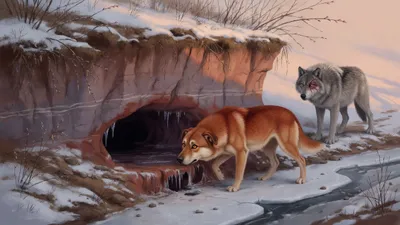
Before you read — think about:
- What makes a place feel safe? Think of somewhere you have felt genuinely secure, and try to list the features that did it.
- One Eye has survived a long time in hard country. What kinds of caution would experience teach a predator that instinct alone would not?
- Which animals do you think of as dangerous and which as harmless? What is that judgement actually based on?
- Patience can be practised like any other skill. What is the longest you have ever waited for something, and what got you through it?
- In your own household, who does what, and how was that settled? By rule, by habit, or by who is best at it?
Watch for these while reading:
- Exactly what the she-wolf inspects before she will accept a place. London lists the features she is checking for.
- Signs that the season is turning: the snow underfoot, running water, birds, insects.
- How One Eye behaves around a track larger than his own.
- A long standoff in which almost nothing moves. Notice how London keeps it tense with no action at all.
- What One Eye does with meat that he does not eat himself.
Vocabulary to know:
apprehensive (adjective) — uneasy and expecting something bad; lope (noun) — an easy, long-striding run an animal can keep up for miles; imperative (adjective) — absolutely urgent; impossible to put off any longer; solicitous (adjective) — showing anxious care and concern for someone; fissure (noun) — a long narrow crack in rock or earth; lair (noun) — the hidden den where a wild animal rests and raises its young; instinct (noun) — knowledge and behavior an animal is born with rather than taught — in this book, the memory of an entire species; progeny (noun) — the young that a creature produces; offspring; quills (noun) — the long, sharp, needle-like spines of a porcupine; ptarmigan (noun) — a plump northern bird of the grouse family that turns white in winter; covert (noun) — a patch of thick low growth that hides an animal; impregnable (adjective) — impossible to break into or get past; talons (noun) — sharp, curved claws; unscathed (adjective) — completely unhurt; frenzy (noun) — wild, uncontrolled activity; perturbation (noun) — a state of being upset or thrown off balance; inert (adjective) — completely motionless and seemingly lifeless; rankling (adjective) — causing a soreness that keeps on hurting; leeward (noun) — the downwind side, where your scent will not carry to what you are watching; vista (noun) — a long open view down a stretch of ground.
Chapter 6: The Grey Cub
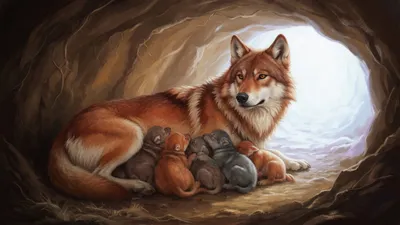
Before you read — think about:
- What could a newborn animal possibly know before its eyes have even opened? Try to list what it could learn from warmth, touch, and smell alone.
- If your entire world were one small dark room, how would you decide what counted as normal and what counted as strange?
- A plant grows toward light without deciding to. Is there any real difference between being pulled toward something and choosing it?
- How does any young creature come to understand that a thing can hurt?
- Most of this book is told from inside the head of an animal with no words. What kinds of thought can a writer show that way, and what has to be left out?
Watch for these while reading:
- The one wall of the cub's world that behaves differently from the other walls, and everything he works out about it.
- The difference between what the cub does automatically and what he does because he has been taught. London marks the difference explicitly.
- How the she-wolf teaches, and which tools she actually has to teach with.
- The details London chooses in order to set this cub apart from the rest of the litter.
- London's plain, unsentimental reporting voice for the hard facts of wild life. He states them and moves straight on.
Vocabulary to know:
inherited (verb) — received from a parent by being born with it; litter (noun) — all the young born to an animal at the same time; romp (verb) — to play in a rough, tumbling, energetic way; rasping (adjective) — rough and grating in sound; confines (noun) — the outer limits or boundaries of a space; oppressed (verb) — weighed down; made to feel trapped or crushed; irresistible (adjective) — impossible to hold out against; yearned (verb) — longed for something deeply; rebuke (noun) — a sharp correction for doing something wrong; recoiled (verb) — jerked back suddenly; predestined (adjective) — decided in advance, before it ever happens; obstruction (noun) — something solid that blocks the way; peculiarity (noun) — an odd feature that belongs to one particular thing; insistent (adjective) — refusing to give up or be put off; venture (verb) — to go somewhere dangerous despite the risk; individuality (noun) — the particular qualities that make one creature a separate self; caressing (adjective) — gently stroking and soothing; fount (noun) — a source from which something flows steadily.
Chapter 7: The Wall of the World

Before you read — think about:
- Where does fear come from? Can a creature be afraid of something it has never once encountered?
- Rules keep the young safe. How does anyone decide a rule still applies once they are stronger than they were?
- Think of a skill you had to learn by getting it wrong first. What did the failure teach you that getting it right would not have?
- Some things can only be learned by watching someone else do them. What have you picked up that way?
- The cub has lived his whole life inside one cave. Which everyday thing do you think would be hardest for a first-time observer to make sense of?
Watch for these while reading:
- How each new thing gets sorted: alive or not alive, safe or dangerous, and what the cub does with something that will not fit either box.
- The cub's nose. London keeps returning to it, and it is doing real work in this chapter.
- The difference between fear of a thing at a distance and fear of a thing that has hold of you.
- London's vocabulary for movement, and how he writes a body that is not yet under its owner's control.
- The cub building a working model of the world out of a very small number of examples. Watch him revise it.
Vocabulary to know:
ancestry (noun) — the long line of relatives a creature is descended from; heritage (noun) — something handed down from earlier generations that you are born already carrying; legacy (noun) — something left to you by those who came before; wolverine (noun) — a powerful, stocky northern animal of the weasel family, famous for its boldness; concealment (noun) — the act of hiding yourself; immobility (noun) — total inability or refusal to move; vehemence (noun) — great force of feeling behind an action; permeable (adjective) — able to be passed straight through; bewildering (adjective) — so confusing that you cannot tell what is happening; solidity (noun) — the quality of being firm and solid; hostile (adjective) — unfriendly and ready to do harm; intimidating (adjective) — meant to frighten someone into backing off; equilibrium (noun) — steady balance; mishap (noun) — a small accident; foray (noun) — a short trip out into unfamiliar or risky territory; elated (adjective) — thrilled and full of triumph; winced (verb) — flinched from sudden pain; draught (noun) — a current of moving air; weasel (noun) — a small, slender, extremely fierce hunter of the northern woods; vindictive (adjective) — determined to get revenge; catastrophe (noun) — a complete disaster; routed (verb) — completely driven off and defeated.
Chapter 8: The Law of Meat

Before you read — think about:
- After a frightening first attempt at something, what makes a person, or an animal, go out and try it again?
- How does a young hunter improve if it keeps failing? What can failure teach that success cannot?
- When you were small, which grown-up seemed to you the most powerful person alive? What was that impression built on?
- Try writing, in one short sentence, a rule that explains how every living thing in a wilderness stands in relation to every other.
- Can an animal be happy? What would you accept as evidence either way?
Watch for these while reading:
- How the cub moves. London describes his gait more than once, and the descriptions are not the same.
- Which creatures he now goes for on sight, and where each of those grudges came from.
- The law this chapter states in plain terms, and everything London says the cub is NOT doing while he obeys it.
- The narrator's tone whenever he explains the cub's thinking, and how often he tells you what the cub does not know.
- The closing lines. London makes a claim about the cub's state of mind that a reader may well want to argue with.
Vocabulary to know:
expedient (adjective) — sensible and useful for getting what you want; prowling (adjective) — moving quietly about in search of something to kill; exertion (noun) — visible physical effort; burrows (noun) — tunnels that animals dig to live in; conspicuously (adverb) — in a way that is impossible to miss; impunity (noun) — freedom from punishment or payback; valiantly (adverb) — bravely; ignominiously (adverb) — in a humiliating way; prowess (noun) — proven skill and strength; timidity (noun) — shyness and readiness to be frightened; formidable (adjective) — impressively strong and rather frightening; voracious (adjective) — greedily and endlessly hungry; multitude (noun) — a very large number of things; craft (noun) — skill at achieving something by cleverness rather than force; fearlessness (noun) — the state of not being afraid; despoiled (verb) — robbed and stripped of what it held; wrenched (verb) — twisted violently loose; ardours (noun) — bursts of fierce energy and eagerness.
Chapter 9: The Makers of Fire
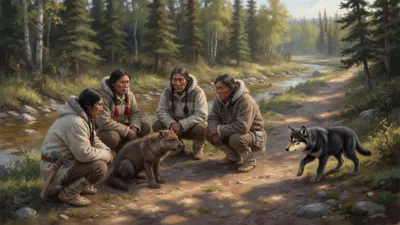
Before you read — think about:
- Can you be afraid of something you have never seen, because everyone who came before you was afraid of it? What would that feel like from the inside?
- What actually separates human beings from every other animal in a wilderness? Try to name specific abilities rather than saying 'intelligence'.
- Have you ever watched an expert do something so fast or so skilfully that you could not follow how it was done? What did that feel like?
- Which stays with you longer: something someone did to you, or something someone said about you? Why do you think that is?
- Fire is the one thing in this book that only human beings can make. What would you say is the single most useful thing people have ever invented?
Watch for these while reading:
- The two instincts that pull in opposite directions when a human hand comes toward the cub.
- The specific human abilities London lists to explain why the man-animals seem superior. Not one of them is strength.
- How the cub is named, who does the naming, and what the name is built on.
- Laughter: who laughs, at what, and what London says laughter does to an animal.
- The line London draws between a hurt to the body and a hurt to the spirit.
Vocabulary to know:
awe (noun) — a mix of wonder and fear felt before something overwhelmingly powerful; mastery (noun) — complete control and command over something; paralysis (noun) — a complete inability to move; submission (noun) — the act of giving in and accepting someone else's power over you; clout (noun) — a heavy open-handed blow; spectacle (noun) — a striking sight; authority (noun) — the right to give orders and expect to be obeyed; appalled (adjective) — shocked and dismayed; token (noun) — a small early sign of something much bigger to come; tepees (noun) — cone-shaped dwellings built from poles and covered with skins or cloth; warily (adverb) — cautiously, keeping watch for danger; precaution (noun) — care taken in advance to avoid harm; ostentatious (adjective) — showy; done to be noticed; belligerent (adjective) — eager for a fight; forlorn (adjective) — lonely and miserable; pitiable (adjective) — deserving pity; perplexed (adjective) — puzzled and unable to work something out; bondage (noun) — the state of being tied up and unable to go free; cached (verb) — stored away in a hidden or protected place; hubbub (noun) — a loud, confused mixture of noise; ungainly (adjective) — awkward and clumsy-looking; astounded (adjective) — completely amazed.
Chapter 10: The Bondage
Before you read — think about:
- What is the difference between believing in something you cannot see and believing in something standing in front of you holding a club?
- Giving up your freedom always costs something. What could a creature get in return that would make the trade look reasonable from the inside?
- In a camp full of strangers, how would you work out who to approach and who to keep well away from?
- How does anyone learn the difference between a rule that is genuinely enforced and a rule that is merely announced?
- What does it feel like to be the newcomer in a group that already has its own habits?
Watch for these while reading:
- London's argument about why a wolf's gods are harder to doubt than a human being's gods.
- The precise inventory of what White Fang does when a man walks past him, calls, threatens, or commands.
- What camp life takes away from him, and the surprising list of things London says it gives him.
- The one offence the chapter identifies as unforgivable in a camp dog.
- Grey Beaver's manner: how he handles a dog, how seldom he speaks, and how little of him London lets you see from the inside.
Vocabulary to know:
contempt (noun) — the feeling that something is beneath your respect; allegiance (noun) — loyalty and obedience owed to a ruler or master; privilege (noun) — a special right that belongs to certain people; tolerate (verb) — to put up with something without approving of it; dominant (adjective) — strongest and most in control; bane (noun) — the source of someone's misery or ruin; persecution (noun) — steady, deliberate cruelty directed at one victim; torment (noun) — long-lasting suffering; morose (adjective) — gloomy, silent, and bad-tempered; genial (adjective) — cheerful and friendly; forage (verb) — to hunt about for food wherever it can be found; crafty (adjective) — clever at getting what you want by sly means; vengeance (noun) — punishment inflicted in return for an injury; nape (noun) — the back of the neck; surly (adjective) — gruff, unfriendly, and short-tempered; endearing (verb) — making itself loved without seeming to try; familiarity (noun) — close knowledge of something from being around it a long time; maul (verb) — to handle roughly enough to injure; outclassed (adjective) — beaten by an opponent operating on a completely higher level; implacable (adjective) — impossible to satisfy, calm down, or turn aside; consternation (noun) — sudden alarm and dismay; plight (noun) — a difficult and unhappy situation.
Chapter 11: The Outcast
Before you read — think about:
- Once a group has decided that someone is trouble, what happens to the way it reads everything that person does afterward?
- Have you ever been outnumbered, in an argument, a game, or a group decision? What did you do differently because of it?
- A reputation can be a burden or a weapon. When is being feared genuinely useful, and what does it cost?
- Think about what you actually learn from playing games with other people, beyond the game itself.
- What do you actually learn from a bully, besides how to dislike one?
Watch for these while reading:
- The combat lessons White Fang draws from being set on by a group, and how his fighting changes because of them.
- How one animal on its own can alter the habits of a whole pack. Notice whose freedom of movement shrinks.
- The explanation the camp settles on for White Fang's behaviour, and what nobody in the camp bothers to look into.
- London's extremely precise physical description of a snarl. Count the separate body parts involved in it.
- Lip-lip, and the way London describes a bully's methods without ever using the word.
Vocabulary to know:
reputation (noun) — what people generally believe about someone; outcast (noun) — someone driven out of a group and kept out; enmity (noun) — deep, settled hostility; combat (noun) — fighting; foe (noun) — an enemy; vulnerable (adjective) — open to being hurt; unprotected; vicious (adjective) — deliberately cruel and violent; assailant (noun) — someone who attacks you; mutual (adjective) — shared by two or more; working in both directions; stratagems (noun) — clever schemes and tricks; predatory (adjective) — living by hunting and killing; lithe (adjective) — supple and easily bent; flexible and quick; sinew (noun) — the tough cord that fastens muscle to bone; savageness (noun) — wild fierceness; resolutely (adverb) — firmly, without wavering; lacerated (adjective) — torn and cut open; faculties (noun) — natural abilities and powers; waylaying (verb) — ambushing someone from hiding along their route.
Chapter 12: The Trail of the Gods
Before you read — think about:
- This chapter's title names a trail. What makes a trail different from just walking in a direction, and why might following one be harder than it looks?
- Silence can be more frightening than noise. Why might that be?
- Sound and silence work differently in a forest than they do in a village. What would you expect to hear, and not hear, if you had grown up in one and then stood in the other?
- In a story told from an animal's point of view, what might 'gods' mean that it would not mean in a story about people?
- Expectations are built out of past experience. How reliable a guide is that once you are standing in a situation you have never met before?
Watch for these while reading:
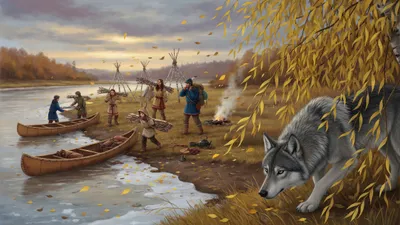
- Grey Beaver's camp as White Fang last saw it: who is doing what, and how a whole village on the move actually looks.
- Hunger, cold, and fatigue written as physical facts — what they do to a body, not what they are called.
- How London writes night as opposed to day in this chapter — what the dark takes away, and what it leaves.
- The other living things White Fang encounters, and whether they treat him as hunter, prey, or something else.
- Loneliness written as a physical experience, something felt in the body rather than thought about.
Vocabulary to know:
liberty (noun) — freedom to go and do as you please; dismantled (verb) — taken apart piece by piece; slink (verb) — to move off quietly, hoping not to be seen; perilous (adjective) — dangerous; inedible (adjective) — not able to be eaten; companionship (noun) — the comfort of having others nearby; fatigue (noun) — deep physical tiredness; endurance (noun) — the power to keep going under hardship; precipitous (adjective) — extremely steep; bluffs (noun) — high, steep banks or cliffs above a river; forded (verb) — waded across a river at a shallow place; traversed (verb) — travelled across; tallow (noun) — hard animal fat, used as food or for making candles; gregarious (adjective) — naturally needing the company of others; abjectness (noun) — a state of complete, miserable humbleness; surrendered (verb) — gave himself up completely; voluntarily (adverb) — by one's own free choice; bleak (adjective) — bare, cold, and cheerless; mournful (adjective) — full of grief; afflicted (verb) — struck with something painful.
Chapter 13: The Covenant
Before you read — think about:
- Have you been on a team where people did not get along? What did the person in charge do about it, and what would you have done?
- Sled dogs were worth more than almost anything else a person owned in the North. How does knowing something is valuable change the way people treat it?
- December on the Mackenzie means weeks of travel in cold and darkness. What would be the hardest part of a journey like that for you?
- Every working relationship is an exchange. If an animal gives a person its labour and its obedience, what should it get back?
- Can you serve someone faithfully without loving them? What would that kind of loyalty be built on instead?
Watch for these while reading:
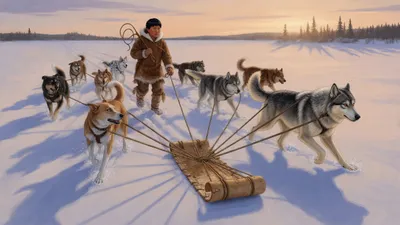
- The design of the sled team. London explains it in detail, and every feature of it is solving a problem.
- How the other dogs in the team behave toward White Fang, and how he behaves toward them, once they are all in harness.
- A rule from earlier in the book that gets amended here, and the exception White Fang works out for himself.
- The one thing London says Grey Beaver never does, and what he says follows from that.
- The closing paragraphs, where the terms of the bargain between dog and man are set out plainly. Note what is not on the list.
Vocabulary to know:
harnessed (verb) — strapped into the gear that lets an animal pull a load; toboggan (noun) — a flat sled with no runners, whose whole surface rides on the snow; taut (adjective) — pulled tight with no slack; lash (noun) — the long flexible striking part of a whip; jealousy (noun) — resentment at the advantages someone else is given; discipline (noun) — trained obedience to a set of rules; faithfulness (noun) — steady, reliable loyalty; thrashed (verb) — beaten soundly; isolation (noun) — the state of being kept apart from everyone else; tyrant (noun) — a ruler who governs entirely by force and cruelty; transgression (noun) — the breaking of a law or rule; unpardonable (adjective) — impossible to forgive; cornered (adjective) — trapped with no way out; covenant (noun) — a solemn, binding agreement between two sides; kin (noun) — one's relatives and one's own kind; maltreated (verb) — treated badly and roughly; gorged (adjective) — stuffed completely full of food; indirection (noun) — the use of roundabout methods instead of direct ones; dignity (noun) — the quality of deserving respect; unremitting (adjective) — never letting up for a moment.
Chapter 14: The Famine
Before you read — think about:
- Rank inside a group is never written down anywhere. How do you think the members of a group keep track of who outranks whom?
- Have you ever backed down from something and afterwards wished you had not, or held your ground and wished you had not? What decided it at the time?
- Dogs and wolves take in most of their information through their noses. Try describing a place you know well using only its smells.
- London keeps comparing a young creature's nature to clay. What does that comparison suggest, and what does it leave out?
- When food runs short for everyone, which rules break down first and which ones hold?
Watch for these while reading:
- A dispute over a bone, broken down move by move. London treats it rather like a chess problem.
- How the other dogs conduct themselves around White Fang, and the one thing they seem to want from him above all.
- London's account of what a year of growth does to a wolf: size, coat, gait, voice.
- One thing London says White Fang cannot get past, however strong he becomes.
- What men, dogs, and wild animals all do alike once there is no meat left in the country. London draws no line between them.
Vocabulary to know:
yearling (noun) — an animal that is one year old; stature (noun) — height and overall build; compact (adjective) — solidly and densely built, with nothing wasted; rangy (adjective) — long-limbed and lean; temerity (noun) — reckless boldness; valour (noun) — courage in the face of danger; glowering (verb) — staring in a dark, threatening way; unmolested (adjective) — left alone and undisturbed; redoubtable (adjective) — formidable enough that others think twice; heredity (noun) — the qualities passed down from a creature's parents; moulded (verb) — shaped, the way soft clay is pressed into a form; perished (verb) — died; shambles (noun) — a scene of slaughter and disorder; adept (adjective) — highly skilled at something; scorn (verb) — to refuse something as beneath you; scrawny (adjective) — painfully thin and bony; refuge (noun) — a place of shelter and safety; eked (verb) — barely managed to make something last; compulsion (noun) — being made to do something by force; alien (adjective) — completely foreign; unlike anything familiar.
Chapter 15: The Enemy of His Kind
Before you read — think about:
- What happens inside a creature that is required, every single day, to do the opposite of what its nature pushes it toward?
- Why might animals that fight constantly among themselves unite instantly against one particular outsider?
- What makes a fighter genuinely dangerous: strength, speed, or something harder to see?
- Have you ever been the new person somewhere? What did you misjudge in your first week?
- Can an animal be blamed for what it has become? If not, who or what would you hold responsible?
Watch for these while reading:
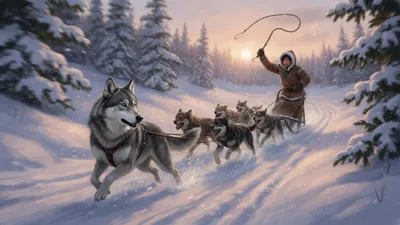
- The work White Fang is put to, and who decides what it will be.
- London's explanation of why the other dogs hate White Fang in particular. His answer reaches back thousands of years.
- The very precise account of what makes him effective in a fight. Very little of it is about strength.
- A different kind of man arriving at Fort Yukon, and what White Fang notices about these newcomers.
- The closing paragraph, which names the two things that would have had to be different for him to have become a different animal.
Vocabulary to know:
fraternise (verb) — to associate with others on friendly terms; horde (noun) — a large, disorderly crowd; malice (noun) — the settled desire to do harm; tenacity (noun) — the quality of gripping and refusing to let go; vendetta (noun) — a long-running feud carried on through revenge; havoc (noun) — widespread destruction; prolonged (adjective) — stretched out over time; steamer (noun) — a boat driven by a steam engine; floundered (verb) — struggled about clumsily; dexterity (noun) — skillful quickness; aloof (adjective) — keeping distant and uninvolved; primeval (adjective) — belonging to the earliest ages of the world; feud (noun) — a long-standing quarrel between two sides; disdained (verb) — rejected as beneath oneself; marred (verb) — damaged and spoiled; watershed (noun) — the high ground that separates two river systems; bales (noun) — large, tightly packed bundles of goods; potent (adjective) — powerful in its effect; diversion (noun) — an amusement; something done to pass the time; disreputable (adjective) — having a thoroughly bad reputation.
Chapter 16: The Mad God
Before you read — think about:
- How do animals decide whether a stranger is safe? What might they be reading that a person standing beside them would miss?
- Someone who is bullied by everyone above them often takes it out on whoever is below. Why does that pattern repeat so reliably?
- The Klondike filled up with strangers almost overnight in 1898. What do you think that does to a place, and to the people already living there?
- Gold-rush towns turned ordinary goods into luxuries and made prices behave strangely. What does that kind of scarcity do to people's sense of what anything is worth?
- London describes some characters' faces in enormous detail. What should a careful reader do with a description that invites you to judge a person by their appearance?
Watch for these while reading:
- How White Fang responds to one particular man before that man has done anything to him at all, and how London explains the response.
- The new man's introduction: the length of it, and London's insistence on explaining where a man like this comes from.
- Dealings with Grey Beaver. What is offered, how often the visitor comes back, and what Grey Beaver says about it.
- The word London chooses for the quality that keeps White Fang attached to Grey Beaver. It is not love, and the book is careful about the difference.
- Every kind of restraint that appears in the chapter: leather, wood, chain, and what each of them is worth.
Vocabulary to know:
covetous (adjective) — greedily wanting something that belongs to somebody else; meagre (adjective) — thin, scanty, and lacking in substance; lavish (adjective) — generous to the point of excess; snivelling (adjective) — whining and weepy in a cowardly way; sparse (adjective) — thinly scattered; not thick or full; monstrosity (noun) — something oddly and badly formed; drudgery (noun) — dull, hard, thankless work; despise (verb) — to look down on with strong dislike; abandon (noun) — complete freedom from care or restraint; fidelity (noun) — faithfulness; sticking by someone no matter what; stolidly (adverb) — showing no feeling whatsoever; vitality (noun) — the raw force of life in a living body; whim (noun) — a sudden passing wish with no reason behind it; parsimony (noun) — extreme stinginess in giving anything out; apex (noun) — the highest point or tip of something; gurgling (adjective) — making the bubbling sound of liquid pouring; stimulant (noun) — a substance that excites the body and mind; timber (noun) — heavy cut wood used for building; bankrupt (adjective) — having lost all one's money; veritable (adjective) — genuine; truly deserving the name.
Chapter 17: The Reign of Hate
Before you read — think about:
- What happens to a person or an animal that is given no fair way to answer a daily attack?
- Why would people pay money to watch animals fight? What does that tell you about the audience rather than about the animals?
- Can a reputation change the thing it describes? If everyone treats you as dangerous, what follows?
- The book keeps comparing character to clay. Who is doing the pressing in a situation like this, and what shape are they after?
- What is the difference between a spirit that is broken and one that is only bent?
Watch for these while reading:
- The particular weakness that is used against White Fang again and again, and who worked out that it was there.
- The list of what he comes to hate. Notice how far past one man it extends.
- London's word for the quality that carries White Fang through this stretch of the book.
- One thing that cannot be taken away from him no matter how he is handled.
- The crowd at the pen: who is in it, what they have come for, and how London writes their noise.
Vocabulary to know:
tutelage (noun) — instruction and guardianship under a teacher; torments (noun) — deliberate cruelties inflicted for someone's amusement; derisively (adverb) — in a mocking way; confined (verb) — shut in and prevented from leaving; mastiff (noun) — a very large, heavy, powerfully built breed of dog; ponderous (adjective) — heavy and slow-moving; victor (noun) — the winner of a contest; confinement (noun) — being shut up in a small space and kept there; plasticity (noun) — the ability to be shaped and reshaped, like soft clay; antagonists (noun) — opponents in a contest or fight; pit (verb) — to set one fighter against another; mainspring (noun) — the main driving force behind something; superfluous (adjective) — more than is needed; evading (verb) — slipping away from something that is trying to catch you; incited (verb) — deliberately stirred up and provoked; exhibited (verb) — put on display for people to look at; intervals (noun) — gaps of time between events; secured (verb) — obtained and got hold of.
Chapter 18: The Clinging Death
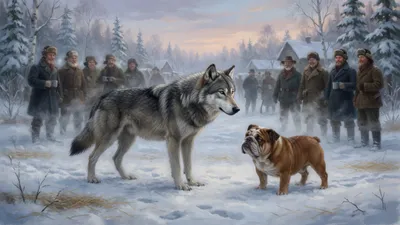
Before you read — think about:
- A fight in a story can read as thrilling or as sickening depending entirely on how it is written. What makes the difference?
- The Klondike drew gamblers, saloon-keepers, and fortune-hunters as well as miners. What kind of person do you think a gold rush attracts?
- A crowd is a character too. What do crowds do that the individuals inside them would never do alone?
- Have you ever been in a group that was enjoying something you did not enjoy at all? What did you do?
- What do you think people owe the animals in their care? Where does that obligation start, and where does it stop?
Watch for these while reading:
- The bulldog's method, and how long it takes White Fang to work out what he is up against.
- What London tells you about White Fang's thinking during the fight, and how it differs from every fight before it.
- The crowd: who is in it, what it shouts, and where London chooses to stand while he narrates.
- Two men who arrive from outside the crowd. Notice which word one of them keeps repeating.
- London's fight choreography. He narrates footing, breathing, and position far more than he narrates blows.
Vocabulary to know:
squat (adjective) — short, thick, and low to the ground; waddled (verb) — walked with a rocking, side-to-side motion; partisan (adjective) — strongly taking one side over the other; demeanour (noun) — the outward manner and bearing of a creature; grim (adjective) — stern, joyless, and unshakable; somersault (noun) — a complete head-over-heels roll of the body; clinging (adjective) — holding on and refusing to let go; gyrations (noun) — wild whirling movements; inexorable (adjective) — impossible to stop, slow down, or talk out of it; jugular (noun) — the great vein of the throat; jubilant (adjective) — triumphantly joyful; wager (noun) — a bet; spectators (noun) — the people watching an event; holster (noun) — a case worn on the body for carrying a pistol; muzzle (noun) — the open front end of a gun barrel; drawled (verb) — spoke slowly, stretching out the words; peremptory (adjective) — spoken as an order that allows no argument; ineffectual (adjective) — producing no result at all; forfeited (verb) — lost a right because of your own conduct; armour (noun) — protective covering; impetus (noun) — the push that gets something moving; catlike (adjective) — moving with the balance and agility of a cat.
Chapter 19: The Indomitable
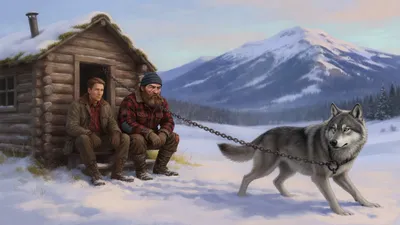
Before you read — think about:
- How do you decide whether to trust a dog you have never met? What do you actually look at?
- Why might a person find it hard to accept help? Try to think of reasons that have nothing to do with pride.
- Whose fault is it when an animal that has been trained to fight behaves like a fighter?
- Fear and anger can look much the same from the outside. Have you ever mistaken one for the other?
- Two people can watch the same behaviour and reach opposite conclusions about what should be done. What usually decides which of them is right?
Watch for these while reading:
- Physical evidence on White Fang's body that tells the two men about his past before he has done a single thing.
- Matt's way of talking. London gives him a dialect, and a great deal of practical knowledge is buried inside it.
- The argument between the two men, and how often they swap positions in it.
- The quality London keeps naming in White Fang through this chapter. It is not gentleness and it is not obedience.
- Every time a hand, a rope, or a rifle comes near him, and how precisely he reads each one.
Vocabulary to know:
sundry (adjective) — various; several different ones; imparted (verb) — passed on or delivered to someone; incredulously (adverb) — in a way that shows you cannot believe it; contrived (verb) — managed to do something difficult by care or cleverness; assailed (verb) — attacked; sheer (verb) — to swerve suddenly off to one side; reluctant (adjective) — unwilling; doing something only because you feel you must; untamable (adjective) — impossible to tame; vigilant (adjective) — keeping constant careful watch; treachery (noun) — betrayal by someone who seemed friendly; antipathy (noun) — a deep, settled dislike; insatiable (noun) — impossible to satisfy or fill up; coiled (adjective) — wound into loops and ready to spring; solemnly (adverb) — very seriously and without a trace of humour; pityingly (adverb) — with pity; mercy (noun) — kindness shown to someone entirely in your power.
Chapter 20: The Love-Master
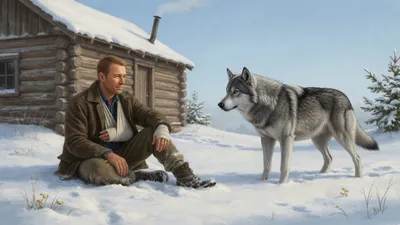
Before you read — think about:
- How would you go about earning the trust of an animal that has excellent reasons to expect a trap?
- Is it harder to change when you are young or once you are fully grown? What makes the difference?
- Can someone want two opposite things in the same instant? What does that feel like from the inside?
- How do you show a feeling when you have never been taught any way of expressing it?
- Can a wrong done by many people be repaid by one person? What would that even look like?
Watch for these while reading:
- Scott's exact procedure: where he sits, what he does with his hands, what he does with his voice, and how long he is willing to spend on each stage.
- One sound White Fang keeps making, and the way it changes without ever quite stopping.
- London's images for how hard a change like this is: clay, weaving, iron, a thumb. Notice which one he keeps coming back to.
- The distinction this chapter draws between liking someone and loving them.
- Time. London is careful to tell you how many days and weeks each thing takes, so keep an eye on the clock he is running.
Vocabulary to know:
sling (noun) — a cloth loop that holds up an injured arm; unison (noun) — perfect agreement in timing or sound; belied (verb) — contradicted; gave a false picture of; scanned (verb) — looked over searchingly; steadfastly (adverb) — firmly, without giving way; trifled (verb) — treated as unimportant; played with; conflicting (adjective) — pulling in opposite directions at the same time; indecision (noun) — the inability to choose between two courses; retaliate (verb) — to strike back in return; dual (adjective) — double; of two opposite kinds at once; restrained (verb) — held back from moving or acting freely; fealty (noun) — the loyalty a follower owes to a lord; primordial (adjective) — belonging to the very beginning of the world; croon (noun) — a low, soft, humming sound of contentment; maturity (noun) — full adult development; rigidity (noun) — stiffness; the inability to bend; radiant (adjective) — giving out light and warmth; demonstrative (adjective) — openly showing what you feel; conscience (noun) — the inner sense of what is right and wrong; adamantine (adjective) — unbreakably hard; gratified (verb) — satisfied a need or desire; prod (noun) — a sharp poke that urges you into action.
Chapter 21: The Long Trail
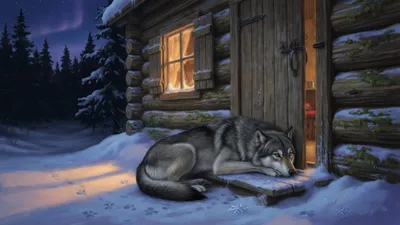
Before you read — think about:
- How do people — and animals — pick up that a household's routine is about to change, even when nobody has said so?
- Leaving a place for good means deciding what comes with you and what stays behind. How would you choose?
- What is hard about saying a temporary goodbye, and how is that different from a goodbye that is meant to be forever?
- How do you say goodbye to someone who has no idea what a goodbye is?
- How do you work out what an animal wants? Give an example from an animal you have known.
Watch for these while reading:
- The reasons Scott gives for his plan. Every one of them is sensible, so notice who he is really arguing with.
- Matt's technique in the conversation. He agrees with everything and still gets the better of it.
- A sound that comes back from much earlier in the book, and the two places in White Fang's life where he has made it.
- Everything White Fang does to make himself understood, none of which involves a word.
- The gold-rush world going on in the background: steamers, gang-planks, mail, and how quickly the North empties out again.
Vocabulary to know:
calamity (noun) — a disaster; haunted (verb) — hung about a place constantly and restlessly; audible (adjective) — loud enough to be heard; questing (adjective) — searching; concurred (verb) — agreed; allayed (verb) — calmed and put to rest; debated (verb) — argued back and forth over something; placid (adjective) — calm and undisturbed; vexed (verb) — disturbed and unsettled; dogged (verb) — followed persistently and closely; tarpaulin (noun) — a sheet of waterproofed canvas; hoarse (adjective) — rough and harsh in sound; quavering (adjective) — trembling and unsteady; gang-plank (noun) — the movable walkway between a ship and the shore; fervent (adjective) — intensely earnest; resentfully (adverb) — with bitterness at being treated unfairly; bandana (noun) — a large coloured handkerchief worn round the neck; scurrying (verb) — hurrying along with short, quick steps.
Chapter 22: The Southland
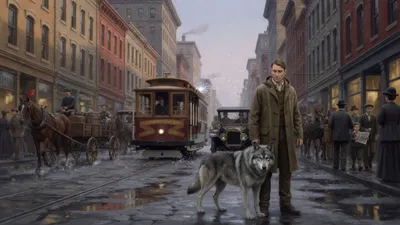
Before you read — think about:
- What would a city look like to an animal that has never seen anything bigger than a log cabin? Which parts would be frightening, and why?
- A gesture can mean opposite things in different places. Do you know one that means something different somewhere else?
- A guard animal has to work out for itself who counts as a threat. What information would it use?
- Think about arriving somewhere as an outsider: a new school, a new team, a new neighbourhood. What did you notice first?
- Are there things you would not do even if the other person did them to you first? Where does that line come from?
Watch for these while reading:
- How White Fang measures power in this new country, and what convinces him about the men who live in it.
- An ordinary human gesture that he reads completely wrong, and how long it takes him to stop reacting to it.
- The two dogs at the new house, and the quite different reasons each of them has for coming at him.
- One instinct that puts him at a disadvantage, and whether he can find a way around it without breaking it.
- London's Southland vocabulary: heat, colour, crowding, machinery, set against the Northland words he has used for twenty chapters.
Vocabulary to know:
clanging (adjective) — making a loud ringing sound of struck metal; awed (adjective) — filled with wonder and fear at the same time; valises (noun) — small cases for carrying clothes when travelling; brawny (adjective) — muscular and powerfully built; inferno (noun) — a place of noise, chaos, and torment; transformation (noun) — a complete change from one thing into another; sullenly (adverb) — in a silently resentful way; tawny (adjective) — a warm golden-brown colour; hereditary (adjective) — handed down through the generations; hysterically (adverb) — in a wild, uncontrolled way; alighting (verb) — stepping down out of a carriage; malignancy (noun) — an appearance of intense ill will; unceremoniously (adverb) — roughly and without any politeness; justifiable (adjective) — able to be defended as right; dwelling (noun) — a building where people live; interlacing (adjective) — crossing over and through one another; upland (adjective) — of the higher ground away from the valley; abruptness (noun) — suddenness.
Chapter 23: The God's Domain
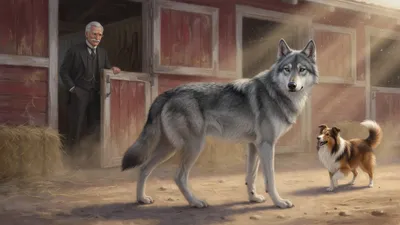
Before you read — think about:
- How would an animal work out who matters in a large household when nobody can explain it?
- In the North, anything that was not a dog was fair game. What has to change once nearly every animal around you belongs to somebody?
- Think about the different ways the adults you know show that they are unhappy with you. Which one lands hardest, and why?
- How do you learn a rule that nobody can state to you, and that you only find out about by breaking it?
- Rules at home and rules at school are often different, and you are expected to switch between them. How do you keep track?
Watch for these while reading:
- The method White Fang uses to rank the members of the household. It is built entirely on observation.
- The forms of correction used at Sierra Vista, and how they compare with the ones he knew in the North.
- Judge Scott, and the running argument he keeps having with his son about the dog.
- The law White Fang has to construct about which animals may be hunted and which may not, and how many exceptions it needs.
- Situations in which he is attacked and not permitted to answer. Watch how London writes restraint.
Vocabulary to know:
adaptable (adjective) — able to adjust to new conditions; sanctioned (verb) — officially approved and permitted; premises (noun) — a house together with its grounds; seclusion (noun) — the state of being kept apart from others; persistence (noun) — the refusal to give up or let something rest; denizens (noun) — the inhabitants of a particular place; tyranny (noun) — cruel and unjust use of power over someone weaker; cuff (noun) — a light slap with an open hand; domain (noun) — the whole territory that a ruler controls; censure (noun) — strong expressed disapproval; invincible (adjective) — impossible to defeat; fowl (noun) — a bird kept for its meat or eggs; grooms (noun) — servants who look after horses; chastisement (noun) — punishment; taboo (noun) — a rule absolutely forbidding something; amity (noun) — friendly relations; lofty (adjective) — grandly superior in manner; equity (noun) — fairness; pledged (verb) — solemnly promised; molest (verb) — to bother, harass, or attack; neutrality (noun) — a state of taking neither side; stately (adjective) — dignified, unhurried, and impressive.
Chapter 24: The Call of Kind
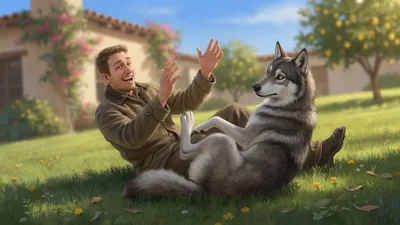
Before you read — think about:
- Can you be completely at home somewhere and still be unlike everyone in it? What would that look like day to day?
- If you had never been taught any way of showing affection, what would you invent?
- What is the difference between being teased by someone you love and being mocked by someone you don't?
- Charades, gestures, drawings, pointing: how do people manage without a shared language? Have you ever had to?
- How would you tell a genuine change of heart from a temporary one?
Watch for these while reading:
- New ways of expressing himself that White Fang picks up here, and which people he is willing to use them on.
- The Sierra Vista household, and the place White Fang is given in it.
- Collie, and the way she conducts herself around him.
- London's argument that a grown animal can still be reshaped, and the limits he puts on that claim.
- Play and romping: what London says they do for a creature, and what he thinks their absence costs.
Vocabulary to know:
flourished (verb) — grew strongly and healthily; aversion (noun) — a strong, settled dislike; persistently (adverb) — continually and stubbornly; pest (noun) — a constant, wearing nuisance; dumfounded (verb) — struck completely speechless with astonishment; bantering (adjective) — teasing in a good-humoured way; nonplussed (adjective) — so puzzled you cannot decide how to react; quizzical (adjective) — mildly amused and questioning; feigned (verb) — pretended; jauntily (adverb) — with brisk, cheerful confidence; thoroughbred (noun) — a horse of pure and carefully kept bloodlines; dismounting (noun) — the act of getting down off a horse; reared (verb) — rose up on the hind legs; spurs (noun) — spiked metal wheels on a rider's heels, used to urge a horse forward; frail (adjective) — delicate and easily broken or torn; utterance (noun) — the act of speaking something out loud; disported (verb) — frolicked and played about; chummed (verb) — became close, friendly companions.
Chapter 25: The Sleeping Wolf
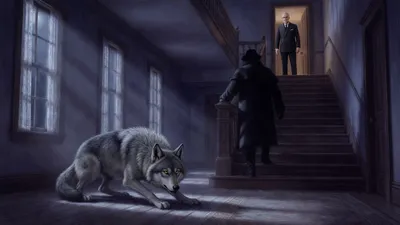
Before you read — think about:
- How would you rather be judged: by what you have done, or by what was done to you? Are those two things separable?
- London has spent the whole book writing through a wolf's nose, ears, and skin. What can that kind of narration notice that a human narrator would miss?
- Who do you go to when you need an answer you can rely on, and how did they earn that from you?
- Do you think animals dream? What would you guess a dog dreams about?
- What kind of ending does a long adventure story owe its reader, and what kind would feel like a cheat?
Watch for these while reading:
- A new character described in almost exactly the terms the book has used about White Fang. The parallel is deliberate, so hold the two side by side.
- London's naturalism showing plainly here: heredity, environment, and which of the two he gives the last word to.
- A parade of memories from every stage of the book, and anything from the Southland that has worked its way in among them.
- The Santa Clara Valley in summer. London's Southland descriptions are at their fullest in this chapter.
- The final scene: where White Fang is, who is around him, and the note London chooses to end on.
Vocabulary to know:
convict (noun) — a person serving a sentence in prison; incorrigible (adjective) — impossible to correct or reform; warden (noun) — the official in charge of a prison; slum (noun) — a poor, crowded, run-down district of a city; bloodhounds (noun) — dogs bred to follow a human scent over long distances; proclaimed (verb) — announced publicly and loudly; conspiracy (noun) — a secret agreement among several people to do something wrong; perjured (adjective) — deliberately false, though sworn to be true; guiltless (adjective) — innocent; keystone (noun) — the central stone at the top of an arch that holds the whole thing up; sibilant (adjective) — hissing; abyss (noun) — a bottomless depth; verdict (noun) — a decision or judgment delivered by someone with authority; optimistic (adjective) — expecting the best possible outcome; pageant (noun) — a long parade of scenes or images; tottering (adjective) — unsteady and about to fall; pudgy (adjective) — short, plump, and rounded; jowl (noun) — the lower cheek and jaw; clamber (verb) — to climb awkwardly, using hands and feet; drowsing (verb) — dozing lightly.
About the Author
Jack London (1876-1916) grew up poor in and around Oakland, California, and got most of his education from the public library rather than a classroom. Before he was twenty-one he had worked in a cannery, sailed the Pacific on a sealing ship, ridden freight trains across the country as a tramp, and spent thirty days in jail for vagrancy. In 1897, at twenty-one, he joined the rush of prospectors heading for the Klondike goldfields and spent a brutal winter on the Yukon River. He came home with no gold, a serious case of scurvy, and a head full of material that would make him one of the most widely read authors in the world. The Call of the Wild made him famous in 1903; White Fang followed in 1906. He wrote more than fifty books in under two decades and died in 1916 at the age of forty.
The Klondike Gold Rush began in 1896, when gold was found near the Yukon River, and by 1898 roughly one hundred thousand people had set out for the goldfields. Fewer than half of them made it. There were no roads, no railways, and no engines that could be trusted in that cold, which meant that everything and everyone moved by dog team — a fact that turned working dogs into some of the most valuable property in the North. London is also writing inside a literary movement called naturalism, which held that living things are shaped by heredity and environment much the way rocks are shaped by weather. One part of that historical setting needs naming honestly: London's portrayal of the Indigenous people of the Yukon reflects the prejudices common among white writers of his era, and modern readers should read those passages critically rather than as accurate description of the peoples who had lived in that country for thousands of years before any prospector arrived.