

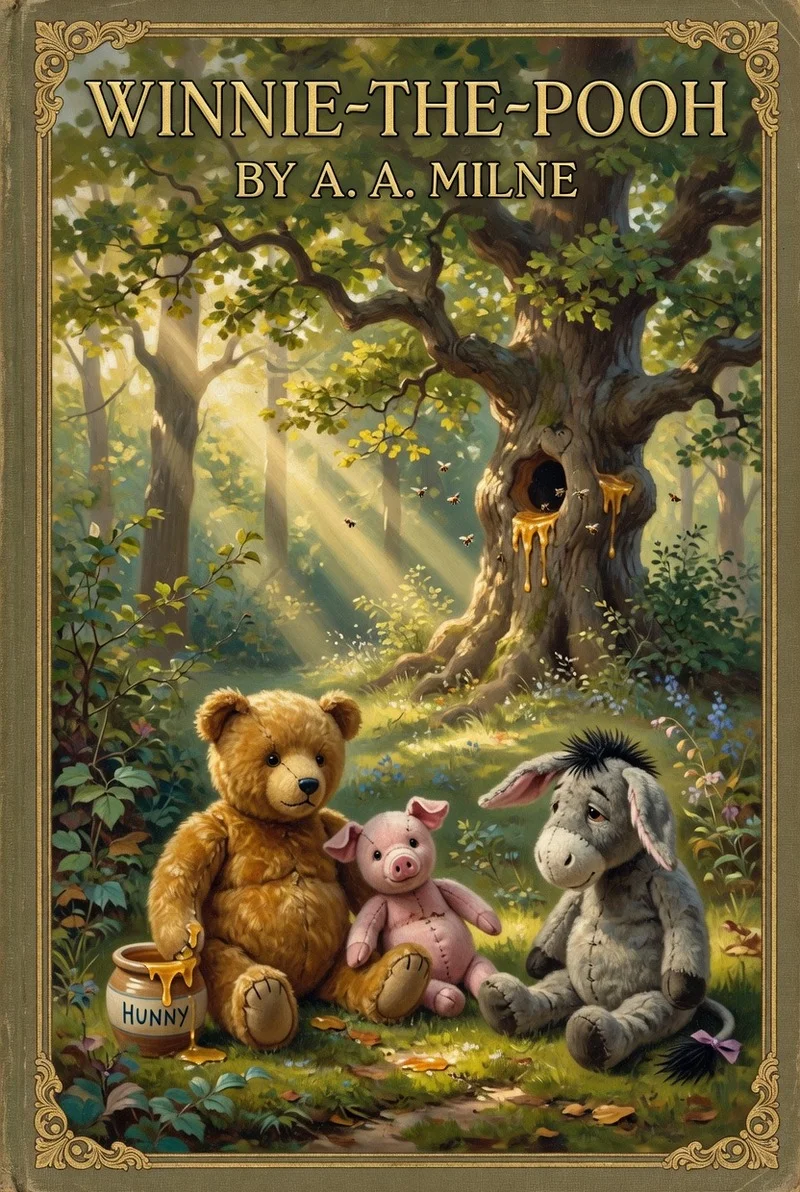
About This Book
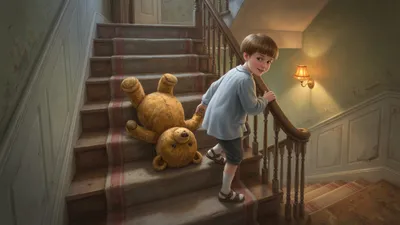
A boy named Christopher Robin has a stuffed bear called Winnie-the-Pooh, and he asks for a story about that bear. In the forest of these stories, Pooh lives under a tree, thinks slowly, hums little songs, and is never far from the idea of honey. The book begins by introducing you to Pooh — bumping downstairs on the back of his head — and then the forest opens.
These stories come in short sittings and are funny without being mean, which makes them a good fit for third grade. Each friend has a clear way of talking, so you can hear a gloomy voice, a busy voice, or a tiny worried voice even before you see the name. The book also plays with words: long ones, misspelled ones, and silly made-up ones. It is a fine book for noticing how people sound when they are trying to help, trying to look clever, or just hoping for a snack.
Meet the Characters

More about Winnie-the-Pooh
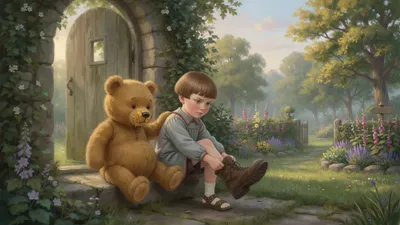
Winnie-the-Pooh, often just called Pooh, is a gentle and cheerful teddy bear who lives in the Hundred Acre Wood. He loves honey more than almost anything and likes to make up little hums and songs. Though he calls himself a Bear of Very Little Brain, he is kind, loyal, and always ready to help a friend.

More about Christopher Robin
Christopher Robin is a kind and thoughtful little boy who loves his stuffed animals and treats them as real friends. He is the one the animals turn to whenever there is a problem, because he is calm, clever, and brave. He lives near the Hundred Acre Wood and spends his days playing there with Pooh and the others.

More about Piglet
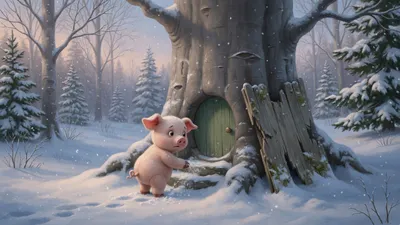
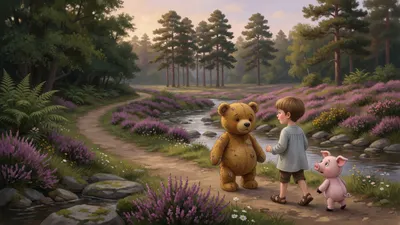
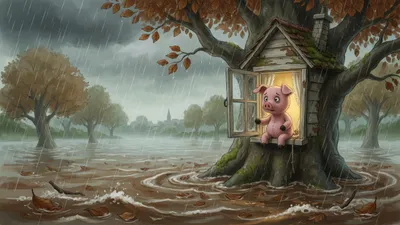
Piglet is Pooh's closest friend, a tiny animal who lives in a beech tree in the middle of the forest. He is often nervous and easily frightened, but he cares deeply about his friends and tries hard to be brave for them. Small as he is, Piglet has a big and gentle heart.

More about Eeyore
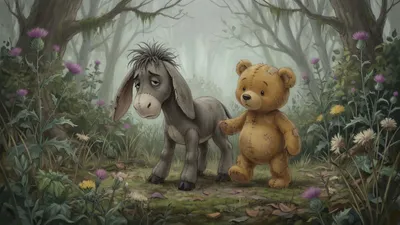
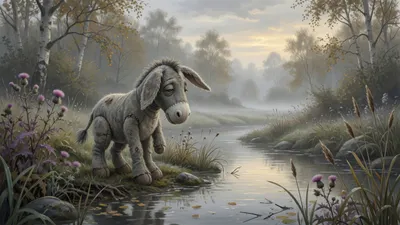
Eeyore is a grey donkey who lives in a boggy, thistly corner of the forest all by himself. He usually expects things to go wrong and speaks in a slow, gloomy way, but he still likes it when his friends remember him. Underneath his sad outlook, he is fond of the others and grateful for their kindness.

More about Owl
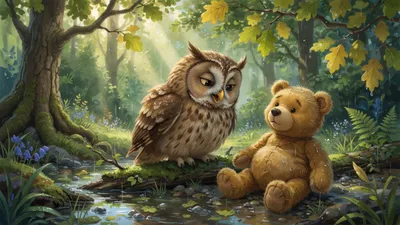
Owl lives in a grand tree-home in the forest and is believed by the others to be the cleverest animal around. He enjoys using long words and telling long stories, even if he sometimes gets things a little muddled. The animals go to Owl whenever they need advice or something written down.

More about Rabbit
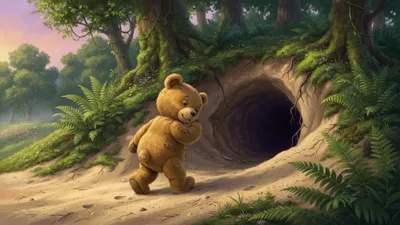
Rabbit is a practical and busy animal who lives in a cozy burrow with many doors and many friends-and-relations. He likes to organize plans, give directions, and keep things in order. Though he can be a little bossy, Rabbit means well and is a dependable member of the Hundred Acre Wood.

More about Kanga
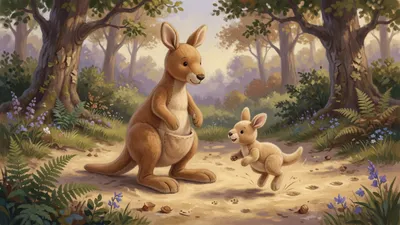
Kanga is a kangaroo who comes to live in the Forest with her baby Roo. She is practical, affectionate, and very sure about baths and strengthening medicine. The others are not quite sure about her at first because she is new.

More about Baby Roo
Roo is Kanga's baby, small, happy, and always wanting to jump. He is not afraid of much. Piglet finds him interesting and a little alarming.
Pre-Reading Discussion Questions
- If one of your toys could talk, what would it care about most, and why?
- What makes a made-up place feel real when you play in it?
- How can two friends enjoy being together even if they do not like the same things?
- Why might someone use a song, a joke, or a long word when they are thinking out loud?
- When a person says they are 'not very clever,' what else might still be true about them?
- Have you ever wanted a story about someone you already love, instead of a brand-new hero? Why?
Themes & Big Ideas to Track
- Notice how each animal has a different way of talking.
- Notice when Pooh thinks with a song instead of a careful plan.
- Notice how Christopher Robin speaks to the animals when they are mixed up or stuck.
- Notice the made-up words, and the long words that get in the way.
- Notice small helpful acts between friends, even when they look ordinary.
- Notice when the story steps out of the forest and talks to the boy who owns the bear.
Chapter-by-Chapter Study Guide
Chapter 1: In Which We Are Introduced to Winnie-the-Pooh and Some Bees, and the Stories Begin
Before you read — think about:
- Do you have a stuffed toy that feels like a real friend? What is its name?
- Why might a child ask for a story about himself instead of a story about a king or a dragon?
- What makes a nickname feel like it belongs to someone, even if it sounds a little strange?
- How do you like to hear a story — sitting still by a fire, or moving around while you listen?
- When a grown-up and a child make up a story together, what can each of them add?
Watch for these while reading:
- The storyteller's voice, and the little talks he has with Christopher Robin before the forest tale starts.
- The names Pooh is given on these first pages, including the one painted over his door.
- The small songs Pooh makes up while he is busy.
- Capital letters on ordinary words, as if they were Important Titles.
- How Pooh lines up his thoughts, one small reason after another.
Vocabulary to know:
introduced (verb) — brought forward so that people can meet you and learn your name; anyhow (adverb) — anyway; used when you decide to go on with the story; sweetly (adverb) — in a kind, gentle, polite way; explanation (noun) — the words that tell why something is so; Sanders (noun) — the name painted in gold letters over Pooh's door, so he is said to live under it; growly (adjective) — low and rumbling, like a bear's voice; oak-tree (noun) — a large, strong tree with a thick trunk; buzzing-noise (noun) — a humming, bee-like sound that Pooh hears high in the tree; Complaining (adjective) — grumbling; used here for a song Pooh sings when he is tired of climbing; bounced (verb) — sprang or jumped down and hit something; head-over-heels (adverb) — turning right over in the air, tumbling; crashed (verb) — fell hard and noisily into something; admitted (verb) — owned up that something was true; slithered (verb) — slid down fast in a slippery way; gorse-bush (noun) — a wild, prickly shrub with sharp thorns; gracefully (adverb) — in a smooth, pretty way — here used in a funny way for a fall; crawled (verb) — moved along slowly on hands and knees, or very low down; prickles (noun) — sharp little thorns that stick in your skin; awed (adjective) — full of wonder and a little shy, as if something amazing has happened; balloon (noun) — a stretchy bag filled with air that can float up into the sky; whisper (noun) — a very quiet way of speaking, almost under your breath; muddy (adjective) — covered in wet, sticky dirt; floated (verb) — rose and hung in the air without falling; cloud (noun) — a puff in the sky; here, the disguise Pooh hopes the bees will believe; anxiously (adverb) — in a worried, hopeful way, wanting the answer to be yes; suspicious (adjective) — feeling that something is not right and should not be trusted; umbrella (noun) — a folding cover you hold over your head in rain; deception (noun) — a trick meant to make someone believe what is not true; practising (verb) — carrying out; here, working a trick on the bees; fond (adjective) — loving; caring about someone very much; discovered (verb) — found out; noticed something new; definitely (adverb) — for sure; with no doubt; practical (adjective) — sensible and useful; thinking about what will really work; proud (adjective) — pleased with yourself, as Pooh's pretend-cloud is in his song; decision (noun) — a choice you make after thinking; spoil (verb) — to ruin or damage something; aimed (verb) — pointed carefully before shooting; stiff (adjective) — hard to bend; stuck straight; settled (verb) — landed softly and stayed there; trailing (verb) — dragging along behind you.
Chapter 2: In Which Pooh Goes Visiting and Gets Into a Tight Place
Before you read — think about:
- What are good manners when you knock at a friend's door?
- Why might someone hum a little tune while walking along?
- How do you decide when it is time to leave a friend's house?
- What makes a visit feel friendly to both the guest and the host?
- When a job needs more than one person, who do you ask to help?
Watch for these while reading:
- The hum Pooh makes up that morning, and the way he says it over and over.
- Rabbit's voice from inside the hole, and how it changes.
- The polite phrases Pooh and Rabbit trade at the table.
- How Rabbit talks when he is being careful and tidy.
- Christopher Robin's way of speaking when he is called.
Vocabulary to know:
stoutness (noun) — the round, heavy shape of a body; here, the exercises Pooh does because he is a plump bear; hum (noun) — a little made-up tune Pooh sings to himself as he walks; glass (noun) — a looking-glass; a mirror; gaily (adverb) — in a cheerful, light-hearted way; sandy (adjective) — made of sand; here, the bank where Rabbit's hole is; company (noun) — friends to visit, talk with, and (Pooh hopes) share food with; scuffling (adjective) — a quick, scrabbling noise of someone moving in a hurry; bother (interjection) — a mild word Pooh says when something is annoying or will not go his way; mouthful (noun) — a small amount of food; here, a snack Rabbit offers; condensed (adjective) — made thick and sweet, as canned milk cooked down with sugar; greedy (adjective) — wanting more food than is polite or needed; sticky (adjective) — covered in something gluey, like honey; politely (adverb) — in a well-mannered, courteous way; larder (noun) — a small cupboard or room where food is kept; directly (adverb) — very soon; in a moment; carelessly (adverb) — in an offhand way, as if the thing did not matter much; sternly (adverb) — in a firm, serious, scolding way; whiskers (noun) — the long stiff hairs on a rabbit's face; hopeful (adjective) — feeling that things may turn out well; gloomily (adverb) — in a sad, heavy, downhearted way; convenient (adjective) — handy and useful for what you need right now; towel-horse (noun) — a rack for hanging towels; here, Rabbit uses Pooh's back legs as one; sustaining (adjective) — giving comfort and strength; here, a book that would cheer a stuck bear; wedged (adjective) — stuck tight in a narrow space; tightness (noun) — the state of being squeezed with no room to move; washing (noun) — laundry; clothes and towels that have been washed; slenderer (adjective) — thinner; less round than before; relations (noun) — family members; here, Rabbit's many friends-and-relations who help pull; cork (noun) — the stopper in a bottle; here, the pop Pooh makes when he comes free.
Chapter 3: In Which Pooh and Piglet Go Hunting and Nearly Catch a Woozle
Before you read — think about:
- What is winter like in a wood? What would you notice first if you stepped outside?
- Why do people put names or signs in front of houses?
- How do you act when you want a friend to think you are not scared?
- When is it useful to have a friend along, and when might you rather go home?
- What makes a winter walk with a friend feel cozy, and what might make it feel a little scary?
Watch for these while reading:
- Piglet's house in the beech-tree, and the old broken board beside it.
- The snow around Piglet's front door.
- How Piglet talks when he wants to sound brave.
- The way Pooh studies the ground as he walks.
- Christopher Robin's place up in the trees, and how he speaks to Pooh.
Vocabulary to know:
grand (adjective) — very fine and important-looking; here, funny, because Piglet's house is a tree; beech-tree (noun) — a tall forest tree with smooth gray bark; Piglet lives inside one; board (noun) — a flat piece of wood; here, a broken sign by Piglet's house; Trespassers (noun) — people who go onto land without permission; Piglet treats the broken sign as his grandfather's name; hunting (verb) — going after something you want to find; here, following tracks in the snow; tracking (verb) — following the marks an animal has left on the ground; mysteriously (adverb) — in a secret, important-sounding way; paw-marks (noun) — footprints left by paws in the snow; excitement (noun) — a thrilled, eager feeling; Woozle (noun) — an imaginary animal Pooh and Piglet believe they are following; puzzled (adjective) — confused; not sure what something means; proceeding (verb) — going along; moving forward; Hostile (adjective) — unfriendly and maybe dangerous; delighted (adjective) — very pleased and happy to agree; spinney (noun) — a small clump of trees; a little wood; larch (noun) — a kind of tree with needles; here, the trees in the little spinney; stiffness (noun) — the tight, hard feeling in muscles after a long walk; Wizzle (noun) — another imaginary animal Pooh invents when the tracks look different; Intent (noun) — what someone means to do; here, unfriendly plans; accidentally (adverb) — by chance, not on purpose; elsewhere (adverb) — in some other place, not here; muddled (adjective) — mixed up and hard to sort out; plainly (adverb) — clearly; easy to see; particular (adjective) — special and exact; here, a job Piglet claims can only be done at one time; whistle (noun) — a high sound made with the lips or a whistle; here, Christopher Robin calling from a tree; trotted (verb) — went off quickly with short, light steps; fitted (verb) — placed something so that it matched exactly; Foolish (adjective) — silly; having made a mistake; Deluded (adjective) — fooled into believing something that is not true; soothingly (adverb) — in a gentle way meant to calm someone; Luncheon (noun) — lunch; the midday meal.
Chapter 4: In Which Eeyore Loses a Tail and Pooh Finds One
Before you read — think about:
- How do you greet a friend who sounds a bit sad?
- What does it mean, in your mind, to be a real friend?
- What does a spring morning feel like outdoors — the light, the air, the plants?
- How can a long walk change the way you feel?
- What is the difference between saying you will help and actually helping?
Watch for these while reading:
- Eeyore's slow, gloomy way of talking.
- The spring morning walk: copse, gorse, heather, and streams.
- Owl's house, and the two notices on the door.
- The long words Owl enjoys using.
- The knocker and the bell-pull, and how they are described.
Vocabulary to know:
thistly (adjective) — full of thistles; prickly and weedy; Wherefore (adverb) — an old, extra-serious way of saying 'why'; Inasmuch (adverb) — an old-fashioned word that starts a very formal 'because'; Eeyore uses it when he is thinking heavy thoughts; stumping (verb) — walking with heavy, solid steps; gazing (verb) — looking for a long time, often sadly; Accounts (verb) — explains; gives a reason for something; solemnly (adverb) — in a very serious, important way; copse (noun) — a small group of trees growing together; firs (noun) — evergreen trees that keep their needles all year; dowdy (adjective) — plain and a little shabby next to something new and pretty; heather (noun) — a low, purple-flowered plant that grows on open slopes; sandstone (noun) — rock made of packed sand, forming steep banks; residence (noun) — a grand word for a house where someone lives; charm (noun) — a pleasing, pretty quality that makes a place feel special; knocker (noun) — a metal piece on a door that you rap to ask to come in; bell-pull (noun) — a rope or handle you pull to ring a doorbell; notice (noun) — a written sign that tells people what to do; spell (verb) — to write the letters of a word in the right order; delicate (adjective) — tricky and easy to get wrong; here, words Owl cannot spell; measles (noun) — a childhood illness; here, just a hard word Owl cannot spell; bell-rope (noun) — the rope you pull to ring a bell; here, the thing hanging by Owl's door; require (verb) — to need; to ask for as if it is important; Moping (verb) — hanging about in a sad, droopy way; customary (adjective) — the usual, proper way of doing something; procedure (noun) — the set of steps you are supposed to follow; Crustimoney (noun) — Pooh's muddled hearing of Owl's word 'customary'; Proseedcake (noun) — Pooh's muddled hearing of Owl's word 'procedure'; Reward (noun) — a prize offered to anyone who finds something that is lost; wistfully (adverb) — in a longing, slightly sad way, wishing for something; parlour (noun) — a sitting room in a house; whatnot (noun) — this and that; whatever else there might be; handsome (adjective) — fine-looking; pleasing to look at; attached (adjective) — joined on; also, fond of — Pooh uses both meanings at once; unhooked (verb) — took something down from a hook; nailed (verb) — fastened with a nail; frisked (verb) — skipped and danced about in a happy way; sustain (verb) — to keep someone going, often with food.
Chapter 5: In Which Piglet Meets a Heffalump
Before you read — think about:
- How do friends share a walk home after they have been talking together?
- Why do people keep food in a special cupboard or on a high shelf?
- What helps you fall asleep when your mind is still busy?
- How do you tell a friend about something that frightened you?
- When someone tells you they have seen a creature you have never met, what do you picture, and why?
Watch for these while reading:
- The way Pooh and Piglet take turns talking as they walk.
- Capital-letter ideas like a Cunning Trap or a Very Deep Pit.
- The letters Pooh writes on his jar.
- Piglet's night-time thoughts, and the questions he asks himself.
- The way Christopher Robin speaks to Piglet and to Pooh, and whether those two voices sound the same.
Vocabulary to know:
Heffalump (noun) — an imaginary creature the friends talk about as if it were real; nobody quite knows what one looks like; lumping (verb) — moving along in a heavy, clumsy way — Christopher Robin's joke-word for how a Heffalump walks; edged (verb) — ran along the side or border of something; stream (noun) — a small river; here, they cross it on stepping stones; Cunning (adjective) — clever in a tricky way; here, the kind of trap Pooh wants; Trap (noun) — something set up to catch a creature by surprise; Pit (noun) — a deep hole dug in the ground; helpful (adjective) — useful; giving the kind of answer someone was hoping for; half-way (adverb) — in the middle of doing something; part of the way down; acorns (noun) — the nuts that grow on oak trees; Piglet thinks a Heffalump might like them; Haycorns (noun) — Piglet and Pooh's funny way of saying 'acorns'; start (noun) — a sudden little jump, as when you wake in surprise; thoughtful (adjective) — quiet and thinking hard; Hunny (noun) — Pooh's own spelling of 'honey,' painted on his jar; cover (noun) — a lid or paper top that closes a jar; uncle (noun) — the brother of a parent; Pooh remembers advice from his; cheese (noun) — a food Pooh worries might be hiding under the honey; colour (noun) — the British spelling of color; the look of the honey in the jar; certain (adjective) — sure; with no doubt left; jar (noun) — a pot with a wide mouth, here used to hold honey; string (noun) — thin cord; Pooh wants some to lead Heffalumps home; preparations (noun) — the things you do to get ready; steal (verb) — to slip away quietly; here, the night slowly leaving before dawn; sinking (adjective) — a heavy, dropping feeling in the tummy; for Pooh, it means he is hungry; wander (verb) — to walk back and forth with no clear plan; murmur (noun) — a quiet, repeating little song or mutter; label (noun) — a written tag that tells what is inside; goloptious (adjective) — Pooh's made-up word meaning wonderfully delicious; miserably (adverb) — in an unhappy, pitiful way; jaws (noun) — the mouth and teeth; here, a Heffalump licking its mouth after honey; lonely (adjective) — sad from being alone; here, how the pine trees look before sunrise; half-light (noun) — the dim light just before sunrise; mysterious (adjective) — hard to see or understand; strange; polish (verb) — to rub until ready and shining; here, Pooh's tongue getting his mouth ready for honey; bravely (adverb) — in a courageous way, even if you still feel scared; jiggeting (verb) — a made-up word for a thought bouncing about in your brain and refusing to sit still; Fierce (adjective) — wild and dangerous; difference (noun) — the way one thing is not the same as another; headache (noun) — a pain in the head; also an excuse Piglet considers so he will not have to go; wasting (verb) — using up time on nothing useful; peep (verb) — to look quickly and secretly; cautiously (adverb) — in a very careful, watchful way; crept (verb) — moved slowly and quietly so as not to be heard; honey-jar (noun) — the pot of honey, here stuck on Pooh's head; roaring (adjective) — loud like a roar; Sadness (noun) — a deep unhappy feeling; Despair (noun) — the feeling that nothing will turn out well; Horrible (adjective) — very frightening and awful; scampered (verb) — ran away with quick, light, frightened steps; enormous (adjective) — huge; very, very big; ashamed (adjective) — feeling sorry and embarrassed about a mistake.
Chapter 6: In Which Eeyore Has a Birthday and Gets Two Presents
Before you read — think about:
- How do you pick a present for a friend whose tastes are different from yours?
- Why might a gloomy friend still be hard to cheer on a day that sounds happy?
- When you cannot think of what to say, do you talk, sing, or go quiet? Why?
- Why do writers give some ordinary words Capital Letters in the middle of a sentence?
- If you made a card to go with a gift, what would you want it to say?
Watch for these while reading:
- Eeyore's way of greeting a "good morning," and how often he doubts it.
- Pooh's habit of humming a song when a thought is too hard.
- The capital letters Milne puts on plain words to make them sound Important.
- Owl's manner when he has a pencil and a long word to spell.
- Piglet's hopes about how a gift will be received.
Vocabulary to know:
pathetic (adjective) — pitiful and sad-looking; gaiety (noun) — cheerful fun and high spirits; bon-hommy (noun) — Eeyore's muddled word for being friendly and good-humored; riddle (noun) — a puzzling question that is hard to figure out; song-and-dance (noun) — lively singing and dancing; a show of cheer; miserable (adjective) — very unhappy; present (noun) — a gift given to someone; uncheered (adjective) — not made happy; still feeling low; useful (adjective) — helpful because you can put it to work; wobbly (adjective) — unsteady; here, spelling that puts letters in the wrong places; earnestly (adverb) — in a serious, sincere way; burst (verb) — to break open suddenly with a pop; damp (adjective) — a little wet; favourite (adjective) — liked most of all; snuffling (verb) — breathing noisily because you are sad or stuffed up; sorrowfully (adverb) — in a sad, sorry way; impressed (adjective) — feeling admiration because something seems grand; icing (noun) — the sweet coating spread on top of a cake; bracken (noun) — tall ferns growing wild in the woods; mulberry (noun) — a tree; here part of a nursery-rhyme circling game; crackling (adjective) — making short, sharp snapping sounds; trickled (verb) — flowed slowly in a thin stream; balancing (verb) — keeping steady so as not to fall; coloured (adjective) — having a bright color; unlucky (adjective) — having bad luck; difficulty (noun) — trouble; something hard to do; naturally (adverb) — of course; as you would expect; condition (noun) — the state someone is in; proper (adjective) — real and fitting; the right kind; returns (noun) — in "many happy returns," good wishes for more happy birthdays; spelling (noun) — the way letters are put in order to make a word; washed (verb) — cleaned with water; creep (verb) — to spread slowly through you, like a feeling; ringing (noun) — the sound of a bell at a door; actually (adverb) — in fact; really; splashed (verb) — moved through water so that it flew up; hurried (verb) — went as fast as you could; writing (noun) — letters and words written down; stare (verb) — to look at someone for a long time; placed (verb) — put something down carefully; Cottleston (noun) — the made-up name of a pie in a song Pooh sings; French (adjective) — from France; here, a language Eeyore claims a word comes from; downwards (adverb) — toward the ground; face down; gathering (verb) — collecting or picking things up.
Chapter 7: In Which Kanga and Baby Roo Come to the Forest, and Piglet Has a Bath
Before you read — think about:
- What helps you feel brave when you are the smallest person in a group?
- Why do some friends like to take charge and write things down?
- What makes a silly poem fun to listen to even if it does not make much sense?
- What is it like to bounce or hop when you are still very small?
- Why might someone new in a neighborhood seem unusual at first?
Watch for these while reading:
- Rabbit's busy, organizing voice, and how he talks to Pooh and Piglet.
- Piglet's size compared with everyone else in the room.
- Rabbit's habit of writing things down with a pencil.
- Pooh's poetry, and how long a Bear of Very Little Brain can keep a rhyme going.
- Kanga's calm, motherly way of speaking.
Vocabulary to know:
fiercer (adjective) — more dangerous and wild than usual; deprived (verb) — having something important taken away; pluck (noun) — courage; bravery; affectionate (adjective) — loving and gentle; disposition (noun) — a person's usual mood or nature; capture (verb) — to catch and take hold of someone; regarded (verb) — thought of or looked on as; adventure (noun) — an exciting, slightly risky happening; impossible (adjective) — not able to be done; fidgeting (verb) — moving restlessly because you are nervous; huskily (adverb) — in a rough, quiet voice; splendid (adjective) — excellent; very fine; poetry (noun) — poems; writing that uses rhythm and rhyme; hoar-frost (noun) — the white icy coating that forms on trees in cold weather; twinkles (verb) — shines with little quick flashes of light; starling (noun) — a common dark bird that often gathers in flocks; blackbird (noun) — a bird with black feathers and a yellow beak; mouse-hole (noun) — a small hole in the ground where a mouse lives; buttoned (verb) — fastened shut with a button; terrifying (adjective) — very frightening; indignant (adjective) — angry because something feels unfair; shudder (noun) — a sudden shake of the body from dislike or cold; lathery (adjective) — covered in soapy foam; flannel (noun) — a soft cloth used for washing; scrubbing (verb) — rubbing hard to clean; spluttered (verb) — spoke in bursts, often while coughing or spitting; medicine (noun) — a dose given to make someone healthier and stronger; imitating (verb) — copying someone's voice or looks; nephew (noun) — the son of your brother or sister; wriggled (verb) — twisted and turned to get free; spleak (verb) — Piglet's mixed-up way of saying speak; painly (adverb) — Piglet's mixed-up way of saying plainly; purpose (noun) — a plan you mean to carry out; on purpose means you meant to; comfortable (adjective) — cozy and at ease; disappointed (adjective) — sad because something you hoped for did not happen; eagerly (adverb) — with excited interest; frowning (verb) — drawing the brows together in a puzzled or serious look; handkerchief (noun) — a small cloth for wiping a nose or face; usual (adjective) — ordinary; the way things normally happen; strange (adjective) — unfamiliar; not like what you know; stolen (verb) — taken away without permission; promise (verb) — to give your word that you will do something; practise (verb) — to do something again and again to get better at it; therefore (adverb) — for that reason; as a result; remarks (noun) — comments or spoken thoughts; winter (noun) — the cold season of the year; nudge (noun) — a small push, often to hurry someone; winked (verb) — closed one eye quickly as a signal; squeaked (verb) — spoke or cried in a tiny high voice; jerkily (adverb) — in sudden, uneven little jumps.
Chapter 8: In Which Christopher Robin Leads an Expotition to the North Pole
Before you read — think about:
- Why do people put on special boots before a long walk outdoors?
- What food would you pack if you were going out all day with friends?
- Why does a line of walkers sometimes pass "hush" from the front to the back?
- How do you rest beside a stream without spoiling the quiet for everyone else?
- Why might the last person in a long walking line feel extra tired?
Watch for these while reading:
- The Big Boots Christopher Robin puts on outside his door.
- Pooh's way of repeating a big word he has just heard.
- Where Eeyore walks in the long line, and who tags along behind him.
- The rocky stream and its steep banks.
- Owl's habit of explaining long words to the others.
Vocabulary to know:
Expotition (noun) — Pooh's way of saying expedition; a long group trip; Expedition (noun) — a journey taken by a group to find something; Provisions (noun) — food packed for a trip; Ambush (noun) — a surprise jump-out from hiding; friends-and-relations (noun) — Rabbit's many small family members who tag along; marmalade (noun) — a sweet jelly made from oranges, spread on food; honeycomb (noun) — the waxy cells bees fill with honey; spruced (verb) — tidied yourself up to look ready; thaws (verb) — melts after being frozen; dandelion (noun) — a yellow wildflower whose seeds blow away as a puff; unsettling (adjective) — making you feel uneasy and not settled; oblige (verb) — to do something to be helpful, even if you did not want to; Confused (adjective) — mixed up and not in order; melancholy (adjective) — sad in a quiet, lingering way; Consideration (noun) — careful thought for other people's feelings; Anecdote (noun) — a short story told about something that happened; Rhododendron (noun) — a large flowering bush; one of Owl's long showing-off words; Immersion (noun) — being dunked or dropped into water; Temporary (adjective) — lasting only a short time; superior (adjective) — acting as if you know more than others; private (adjective) — meant for only one person to hear; Dangerous (adjective) — not safe; able to cause harm; whispered (verb) — spoke in a very quiet voice; Numbed (verb) — made a body part lose feeling, often from cold; revive (verb) — to bring yourself back to feeling better; modestly (adverb) — without bragging; in a humble way; thistle (noun) — a prickly plant Eeyore likes to eat; munching (verb) — chewing in a steady, noisy way; imagination (noun) — the power to picture things in your mind; Belongs (verb) — feels like it is really yours again; hastily (adverb) — in a hurry; buried (verb) — hid by pushing down into the ground; Beetle (noun) — a small insect with a hard shell; here, a tiny follower named Alexander; ever-afterwards (adverb) — from that time on, for the rest of his days; waterfall (noun) — a place where a stream drops down over rocks; drifted (verb) — floated along with the moving water; scolded (verb) — spoke sharply to someone for doing something unsafe; tumbled (verb) — fell or rolled in a rushing way; Boots (noun) — tall, sturdy shoes; here a sign that an adventure is coming; stroking (verb) — gently running a paw along whiskers or fur; suggested (verb) — offered an idea; helpfully (adverb) — in a way meant to be of use; rushing (verb) — hurrying toward something; rescue (noun) — the act of saving someone from danger; peacefully (adverb) — in a calm, quiet way; perfectly (adverb) — completely; in every way; Behind-the-ears (adjective) — the modern idea of washing even the hidden spots; nonsense (noun) — silly talk that you do not take seriously; Pole (noun) — a long stick; here the North Pole they set out to find; message (noun) — words written for someone to read later.
Chapter 9: In Which Piglet Is Entirely Surrounded by Water
Before you read — think about:
- How do you pass the time if you have to stay inside for a long stretch?
- Why does a worry feel smaller when a friend is with you?
- What makes a stretch of rainy days feel exciting to one person and lonely to another?
- Why might Owl use the longest words he knows even for simple weather?
- How do you show someone you are glad to see them after time apart?
Watch for these while reading:
- Piglet looking out of his window, and what he tells himself about the other animals.
- Owl's long, important-sounding weather words.
- Pooh sitting on a branch of his tree, high above the water.
- Christopher Robin's umbrella standing ready by the door.
- The honorary letters and titles people attach to Pooh's name.
Vocabulary to know:
Missage (noun) — Pooh's way of saying message; a note that needs to be read; Surrounded (verb) — having something all the way around you; Escape (noun) — a way of getting out of danger; atmospheric (adjective) — having to do with the weather and the air; unfavourable (adjective) — not helpful; going against you; unprecedented (adjective) — never seen this high or this much before; favourable (adjective) — looking better; turning your way; dorsal (adjective) — along the back; Owl's word for back muscles; muscles (noun) — the parts of the body that pull and lift; triumphantly (adverb) — in a proud, winning way; vigorously (adverb) — with strong energy; astride (adverb) — sitting with one leg on each side; corked (verb) — closed with a cork so nothing can get in or out; plunged (verb) — jumped or dived suddenly into water; bobbed (verb) — floated up and down on the water; sprawled (verb) — spread out over a wide space; Burrowing (verb) — digging a tunnel underground to get away; Comforter (noun) — someone who cheers a sad friend; Discoverer (noun) — someone who finds a new place or thing; Tail-finder (noun) — Pooh's honorary title for finding Eeyore's tail; south-westerly (adjective) — toward the southwest; revolving (verb) — turning around and around; imprisonment (noun) — being stuck inside and unable to leave; squawk (noun) — a loud, harsh bird cry; waded (verb) — walked through water that is not too deep; wobbled (verb) — rocked unsteadily from side to side; flood (noun) — water that has risen and covered the land; island (noun) — a piece of land with water all around it; dangling (verb) — hanging loosely and swinging; desert (adjective) — empty of people; a desert island is one you are stranded on; flood-level (noun) — how high the flood water has risen; indoors (adverb) — inside a house; inhabit (verb) — to live in a place; paddling (verb) — moving a boat by kicking or using the feet like oars; prospects (noun) — the chances of how things will turn out; rapidly (adverb) — very quickly; Readers (noun) — people who can read writing; ripple (noun) — a small wave on the water; seized (verb) — grabbed hold of suddenly; Serious (adjective) — important and not a joke; share (verb) — to have an experience together with someone; forthwith (adverb) — at once; right away; Learnt (verb) — gained knowledge, especially from books; nosed (verb) — pushed your nose around to explore.
Chapter 10: In Which Christopher Robin Gives Pooh a Party, and We Say Good-bye
Before you read — think about:
- How do you feel while you wait for a party to begin?
- What makes a picnic table in the woods feel like a real party?
- How do you know when it is time to be quiet at a meal?
- How do you walk home with a friend after a big afternoon?
- Why might a book close with the storyteller talking to the child who owns the toys?
Watch for these while reading:
- Owl flying from house to house with the news.
- Eeyore's way of talking about a party he has just been told of.
- Roo's manners at a grown-up table, and how Kanga answers him.
- The long wooden table and who sits along each side.
- The narrator's voice at the very end, talking with Christopher Robin in the nursery.
Vocabulary to know:
Invitation (noun) — a request asking someone to come to a party; india-rubber (noun) — an eraser for rubbing out pencil marks; hiccups (noun) — sudden little catches in the breath after eating or drinking; dolefully (adverb) — in a sad, drooping way; reproachfully (adverb) — in a scolding way that shows you are disappointed; oddments (noun) — leftover bits and extra small guests; sulkily (adverb) — in a moody, slightly offended way; tinkling (verb) — making light, ringing water sounds; cuckoo (noun) — a woodland bird known for its two-note call; wood-pigeons (noun) — plump wild pigeons that live among trees; scent (noun) — a pleasant smell, here of May blossom; Over-rated (adjective) — praised more than it deserves; what-not (noun) — and other bits of that sort; odds and ends; Social (adjective) — having to do with visiting and being among friends; impressive (adjective) — meant to look important and grand; including (verb) — counting someone in as part of the group; apply (verb) — to be meant for; to count as true about someone; beneath (preposition) — too low or silly for someone who feels important; fussy (adjective) — flustered and particular; growled (verb) — said in a low, rumbly bear voice; invented (verb) — made up or created for the first time; wetting (noun) — getting soaked in water; hearty (adjective) — loud, warm, and full of energy; wisdom (noun) — good sense and understanding; riches (noun) — wealth; lots of valuable things; ruler (noun) — a straight stick for drawing lines and measuring; inches (noun) — small units of length marked on a ruler; pleasure (noun) — a feeling of being glad and enjoying yourself; silent (adjective) — not making any sound; Thank-you (noun) — Pooh's hyphenated way of saying thanks; banged (verb) — hit something hard so it made a noise; interrupted (verb) — stopped someone in the middle of speaking; golden (adjective) — the warm yellow light of late evening.
About the Author
A. A. Milne (Alan Alexander Milne) was an English writer born in 1882. He wrote plays, essays, and poems before he became famous for his children's books. He made up Winnie-the-Pooh after watching his young son, Christopher Robin, play with stuffed animals. Families still know Milne best for those forest stories, even though he also wrote for grown-ups.
Winnie-the-Pooh was first published in England in 1926, when many children's books were written to be read aloud at bedtime. The original pictures by E. H. Shepard showed the characters as stuffed toys and a real little boy, not as cartoon figures. A real bear named Winnie at the London Zoo, together with Christopher Robin's own teddy, helped give the stories their names. For a hundred years, families have kept coming back to Shepard's drawings and Milne's quiet humor.